
Quick Answer
Use a handover clause for figma assets that links release to a verified payment condition, identifies the exact deliverables, and states whether the deal uses assignment or a limited license. Then close in a controlled order: approval-ready package, invoice, payment verification, and documented transfer to the correct recipient account. This keeps payment, scope, and rights aligned at project close.
The Three-Phase Guide to Drafting a Handover Clause for Figma Assets#
Designers drafting a handover clause for Figma assets need one controlled sequence: define rights and release triggers, package the approved files, then transfer only when the payment condition is verified. This keeps payment, delivery, and IP aligned at close.
According to the Figma transfer workflow, transfer mechanics are operational steps, not legal terms. Your contract still has to define timing, rights, and release conditions in plain language.
Use this 2026 guide alongside your IP ownership primer, your client brand handoff process, and your Freelance Contract Generator so the clause and delivery workflow stay consistent.
Both sides may be acting in good faith, but if the trigger, rights model, or delivery method is loose, the closing step becomes an avoidable dispute. A practical protocol keeps the project out of that gray area. It gives you a repeatable way to answer four questions before the final release:
- What exact deliverables count as the final package?
- What rights attach to those deliverables?
- What event unlocks release?
- What record will show what was approved, invoiced, and transferred?
When those answers are settled early, the final release becomes an administrative step instead of a negotiation.
Guide Step 1: Drafting the Figma assets handover clause#
Start by defining the release trigger, the final package, and the rights model before scope is finalized. Most handover disputes are drafting failures, not design failures.
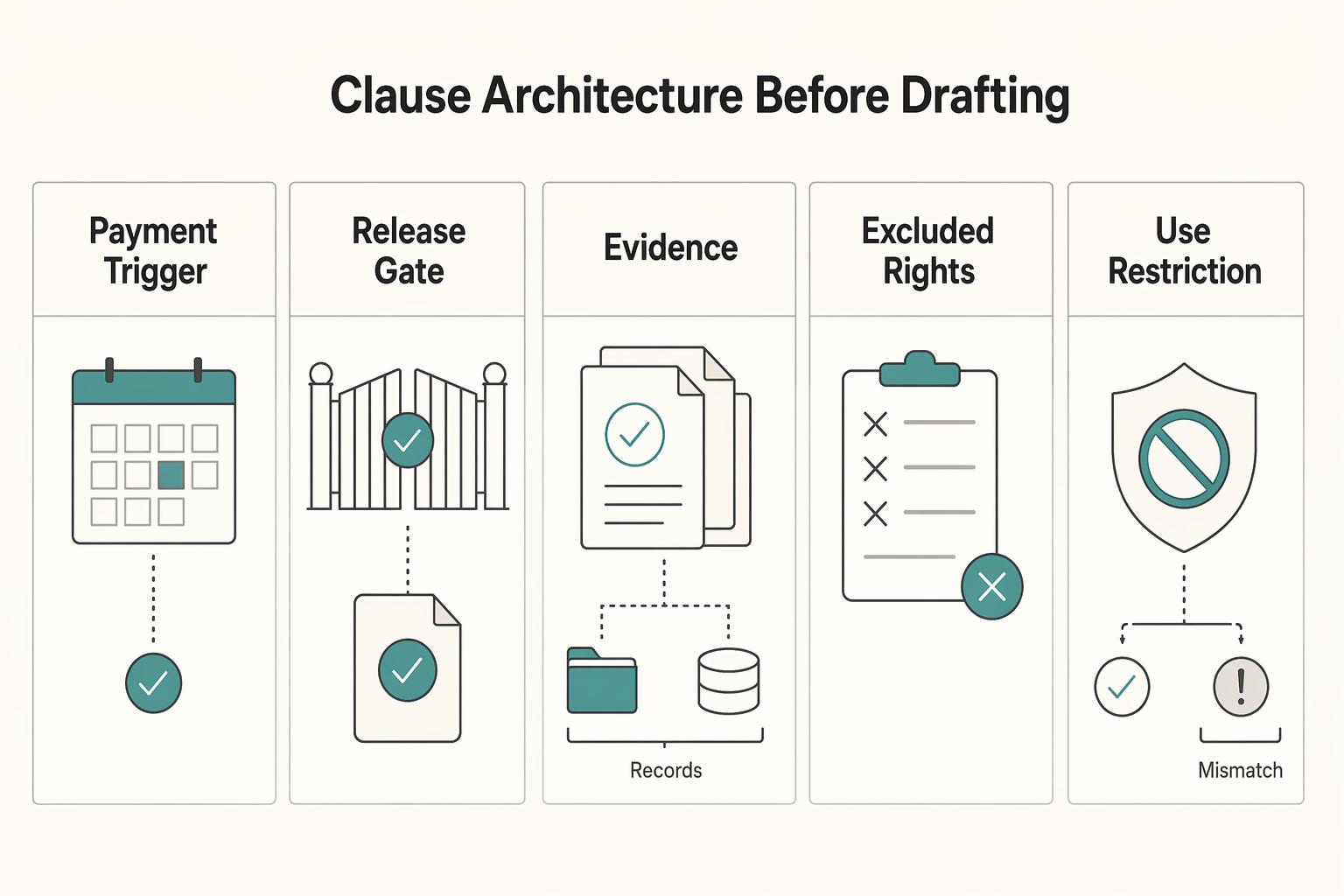
Clause architecture before drafting#
According to U.S. Copyright Office guidance, ownership and permissions should be explicit. In practical drafting, that means your clause states exactly what transfers, when it transfers, and what stays excluded.
| Checkpoint | What to specify | Operational marker |
|---|---|---|
| Payment trigger | The exact event that unlocks release | Example schedule: 50% upfront, 30% milestone, 20% before final transfer |
| Acceptance condition | How final approval is confirmed | Set a written acceptance window such as 48 hours after delivery review |
| Transfer condition | What is transferred, how, and to whom | Record destination account and transfer timestamp (UTC) |
| Excluded rights | What is not included | List reusable components and system assets retained by designer |
| AI-use restriction (if desired) | State it clearly and confirm wording with counsel | Define approved and prohibited usage in one clause block |
Treat the terms below as project labels your lawyer can adapt to governing law:
- Conditional handover: release happens only after the contract's stated payment condition is met.
- Assignment model: the agreement transfers the specified rights in the specified final deliverables.
- Limited license model: the agreement grants specific usage rights while reserving other rights.
- Third-party asset responsibility: the agreement states which outside assets are included and who handles permissions.
| Contract decision | Assignment model | Limited license model |
|---|---|---|
| What is covered | Identify the exact final deliverables being transferred | Identify the exact deliverables and allowed uses |
| Your reusable materials | State any carve-outs you retain | State that underlying materials remain with you |
| Client use rights | Define modification and sharing rights | Define modification and sharing limits |
| Choose this when | Client needs full control over the final output | You need reuse control or scope-limited use |
In this phase, specificity matters. "Final designs" is usually too loose if the project has working files, iterations, deprecated concepts, reusable systems, or third-party materials mixed into the same workspace. A stronger approach is to treat the final deliverable as an identified package rather than a vague body of work. That means the file, page set, or approved package you expect to release is named and described clearly enough that both sides can recognize it later without debate.
The same applies to timing. Do not rely on a general understanding that handover happens "at the end." In practice, the end of a project can mean final review, approval, invoice issue, payment due, payment verified, or transfer completed. If the written trigger does not identify which of those events matters, the closing sequence can stall. The goal is not to create friction. It is to make the final step clear enough that neither side has to improvise.
Rights need the same level of care. If the client needs broad rights in the approved final output, that should be reflected in the selected model and in the described deliverables. If you need to keep underlying materials, systems, or other reusable pieces out of the transfer, the carve-out or retained rights language should be visible from the start rather than raised after the work is done. Many end-of-project conflicts are not really about payment. They are about different assumptions over what the client believed "handover" included.
Before you sign, run these checkpoints to remove ambiguity and keep your clause aligned with your project delivery checklist and invoice plan:
- Payment trigger: specify the exact event that unlocks release.
- Acceptance condition: specify how final approval is confirmed.
- Transfer condition: specify what is transferred, how, and to whom.
- Excluded rights: list what is not included.
- AI-use restriction (if desired): state it clearly and confirm wording with counsel.
The payment trigger keeps you from having to argue later about whether a project was "basically paid." If release is conditional, the agreement should make clear what counts as satisfying that condition. That way, when the final moment arrives, you are verifying against the written trigger rather than against assumptions, pressure, or friendly promises.
The acceptance condition matters because approval is often treated casually during a project and formally at the end. If the client says a version is approved in one place but later continues to comment elsewhere, a vague record can leave room for argument over what was actually accepted. A defined approval path helps you separate normal review chatter from the final approval that turns a working file into an approval-ready deliverable.
The transfer condition keeps delivery mechanics from drifting. If ownership transfer, admin transfer, or clean-copy delivery is contemplated, that should not be left for the last day. You want the receiving party, transfer path, and release object to be clear before the handover is due. Otherwise, the closing step can stall on account confusion rather than substance.
The excluded rights line is where you avoid accidental over-transfer. If something is not part of the deal, it should not be buried in your assumptions. This is especially important when a client has seen process files, alternate concepts, or supporting materials during the project and may naturally assume all of that comes with the final package.
The AI-use restriction, if you want one, should be explicit instead of implied. This is not the place for shorthand or informal expectations. If it matters to the deal, put it in writing and have counsel check it.
Once the written trigger and rights model are set, the next step is making sure the thing you release matches that agreement exactly. A strong contract helps, but it will not save a messy handover package that blurs final, draft, and excluded work.
Guide Step 2: Packaging Figma assets for handover#
Build one approval-ready final package and archive the rest. A clean handover package does two jobs at once: it helps the client use the final work, and it gives you a defensible record of what was actually approved and delivered. In practice, that means reducing noise before release, not adding more of it.
Packaging controls before release#
| Checklist item | What to lock before release | Quantified control |
|---|---|---|
| Final package setup | One dated, approval-ready final package | Timestamp the release candidate in UTC and lock the file list |
| Naming hygiene | Consistent names for final versus non-final items | Use one naming standard with version numbers and date suffixes |
| Annotation boundaries | Guidance for implementation, not open-ended scope discussion | Cap unresolved comments and move deferred work to a backlog item |
| Archive retention | Keep a dated pre-cleanup archive and the approval trail, including messages, approvals, invoice, and any promised third-party notes | Store approval and invoice records for at least one full delivery cycle |
A common mistake at this stage is to treat the client's access needs as a reason to leave the entire working environment untouched. That often creates the opposite of clarity. If drafts, deprecated pages, rough notes, exploration branches, and approved designs all sit side by side without clear boundaries, the client may not know what is current. Your implementation guidance can get diluted by outdated commentary, and your own record of "what was delivered" becomes harder to prove later.
Prepare one clear final set with naming that distinguishes current, deprecated, and reference items. Keep annotations focused on approved behavior and edge cases. If something is outside scope, label it as excluded or deferred rather than leaving it open to interpretation later.
"Current" should mean the client can rely on it. "Deprecated" should mean it is no longer the operative version. "Reference" should mean it is there for context, not as an approved deliverable. However you express that in your naming system, the point is the same: a third party should be able to open the package and understand which materials are final without needing you on a call to explain the history.
That is why annotation boundaries matter. Notes can be useful, but only if they support the approved design instead of reopening unresolved work. Handover notes are not the place to continue scope debate, float optional future enhancements, or leave loose comments that sound like commitments.
Focus annotations on approved behavior, edge cases, and boundaries of approved work. According to W3C accessibility guidance, implementation notes should be explicit enough for reliable execution; if a state or screen is intentionally excluded, label it as excluded or deferred.
Before release, lock the package against this checklist:
- Final package setup: one dated, approval-ready final package.
- Naming hygiene: consistent names for final versus non-final items.
- Annotation boundaries: guidance for implementation, not open-ended scope discussion.
- Archive retention: keep a dated pre-cleanup archive and the approval trail, including messages, approvals, invoice, and any promised third-party notes.
The first item, final package setup, is about freezing the release object. The package you transfer should be the same package the client approved, not a moving target that keeps being tidied after approval. Dating the package gives you a fixed point in the record. If anything changes after that, it is easier to identify whether the change belonged to the approved deliverable or to a later revision.
Naming hygiene is more important than it looks. When stakeholders reopen a project weeks or months later, they rarely remember the entire review history. Clear naming helps them locate the approved materials quickly, and it helps you avoid accidental transfer of work that was explored but never accepted. If you have alternate concepts or replaced components, move them out of the final path or mark them so plainly that they cannot be mistaken for current deliverables.
Annotation boundaries protect both sides. The client gets implementation-oriented guidance that reflects the approved state. You avoid creating fresh ambiguity by leaving open questions inside the final file. If there were unresolved requests that fell outside the current scope, the cleanest treatment is not to leave them as scattered comments. It is to label them as excluded or deferred so the boundary between approved work and future work stays visible.
Archive retention is your insurance against a blurry memory. Keep a dated pre-cleanup archive before you simplify the final package. Also keep the approval trail, invoice record, transfer confirmations, and any third-party asset notes you said you would provide. That archive does not have to be glamorous. It just has to be organized enough that, if someone later questions what was approved, paid for, or handed over, you can reconstruct the sequence without guesswork.
This is also the point where many small failure modes can be prevented cheaply. If your final design set includes reference work, make sure it is clearly segregated. If exploratory pages are still in the same path as approved screens, move or relabel them before release. If implementation notes refer to an old version, update or remove them. If a screen was discussed but not approved, do not let it sit in the final set unlabeled. None of that is glamorous work, but it is exactly what makes the eventual handover defensible.
With the package locked, the last step is operational discipline. This is where you make sure release happens only after the agreed condition is actually met.
Guide Step 3: Releasing Figma assets under the handover clause#
Run release in a fixed order: final invoice, approval-ready package, payment verification, then transfer. Treat release as a gated sequence, not a courtesy step. Do not proceed until you verify the contract's payment condition is satisfied.
Release gate verification#
| Step | What it marks | Control metric |
|---|---|---|
| Final invoice | The financial close | Invoice includes agreed amount (for example £2,000, £5,000, or £10,000) |
| Approval-ready package | The deliverable close | Approved file list locked with dated export |
| Payment verification | Confirms the release condition | Payment event verified against contract trigger |
| Transfer | Completes the handover | Transfer confirmation logged with recipient and timestamp |
That order matters because it keeps each step tied to a clear project state. The invoice marks the financial close. The approval-ready package marks the deliverable close. Verification confirms the release condition. Transfer completes the handover. If you skip around that sequence, you make it easier for the project to drift into informal promises and partial release.
In practice, the biggest risk here is treating the handover as a favor instead of a controlled release event. The project may feel finished, the relationship may be friendly, and the client may be eager to move fast. None of that changes the need to verify the underlying condition before you transfer a file or change ownership. Once control moves, your leverage and your documentary clarity both weaken.
Use a documented transfer method that fits both the contract and the actual delivery path:
| Transfer method | Use when | Control check before release |
|---|---|---|
| Platform-native ownership or admin transfer | Your contract and current platform process both support this path | Confirm destination account, permissions outcome, and written confirmation |
| Clean-copy delivery | Your contract calls for delivery of a defined final package copy | Confirm recipient account or contact, file identity, and written confirmation |
The right method depends on what your agreement promises and on what the platform supports in practice. Verify the current sharing and export behavior in Figma, then map it to your contract language so operational behavior and legal wording stay aligned.
If you are using platform-native ownership or admin transfer, confirm exactly where the file is going and what the permissions result will be after the transfer. "They'll have access" is not enough. Before you click anything, verify the destination account, confirm that the outcome matches the agreed release model, and make sure the written record identifies the receiving party. If there are several people on the client side, it is worth confirming who the actual receiving account is rather than assuming the most visible stakeholder is the right endpoint.
If you are using clean-copy delivery, treat the delivered copy as the defined final package, not just whatever happens to be easiest to send. Confirm the file identity, confirm the recipient contact or account, and confirm in writing that this is the transferred final package contemplated by the agreement. The more clearly the copy matches the approved package, the easier it is later to show what was delivered and when.
Before transfer, reconfirm the recipient contact, account email, file name, and transfer date in writing. That final check is small, but it prevents a common failure mode: releasing the right work through the wrong channel or to the wrong account.
This is one of those low-effort checks that pays off disproportionately. The project may have multiple email threads, several stakeholders, and more than one version of the final file. Without a last written confirmation, it is easy to send the correct deliverable to a stale contact, transfer admin rights to the wrong account, or create a record that is too messy to rely on later. A brief written reconfirmation aligns the operational details with the contract and your package record.
It also helps to think of the transfer step as something you complete and then document immediately, not something you plan to document later. Once the transfer is done, capture the confirmation while the details are fresh and while everyone involved can still verify them easily. That turns the release from a memory into a record.
FAQ for designers drafting a handover clause for Figma assets#
Once the contract, package, and release gate are under control, most remaining questions are about rights, access, and records. Use this with your rights ownership guide, your contract baseline, and your invoice workflow.
Should you use assignment or license?#
Use assignment when the deal requires full control of clearly identified final deliverables. Use a limited license when you need reuse rights or scope-limited client use. Decide this before pricing and scope are finalized.
The practical reason to decide early is that the rights model affects what you package, what you carve out, and what the client expects to receive at the end. If you leave that decision until handover, you can end up negotiating rights when the file is already approved and the relationship is most exposed to friction.
What if a client asks for edit-level access before payment is verified?#
You can allow review access without triggering final transfer. Keep the release gate tied to the signed payment condition and mirror the same trigger in your project close checklist.
The important distinction is between access for review and the final release contemplated by the contract. If you blur those two, you weaken your own control over the handover sequence. Keep the conversation calm and procedural: the project can be reviewed, but the actual transfer still follows the agreed trigger.
What belongs in your handover record?#
Keep the approved final package, invoice record, approval confirmation, transfer confirmation, and documented exclusions. Keep third-party asset notes if they were part of the agreement. This gives you one clear record if scope or rights are disputed later.
What makes this useful is not volume but coherence. You want one set of materials that shows the sequence of the close: what the client approved, what you invoiced, what rights model applied, and what was transferred in the end. If the record is split across stray comments and unorganized exports, it becomes much harder to rely on.
When should legal counsel review your clause?#
Get review before reusing the clause across jurisdictions, promising broad rights transfer, or adding AI-use restrictions. Those are common places where generic wording fails. Counsel review matters even more when deal terms are cross-border or high-value.
The earlier that review happens, the easier it is to align your pricing, scope, and release process with the actual legal language you plan to rely on. Waiting until the project is already at the finish line often leaves you choosing between poor operational wording or a delayed handover.
Final guidance: Keep the sequence simple. Define the trigger, define the package, verify the gate, then release. Most handover failures come from ambiguity, not intent. A disciplined three-phase protocol keeps the transaction controlled and the record clean.
If you remember nothing else, remember the order. Do not let the rights model stay implied. Do not let the final package remain mixed with drafts and references. Do not let transfer happen before the agreed payment condition is verified. And do not assume the right file sent to the wrong account is close enough. A bulletproof handover is usually not about doing more; it is about making each step clear enough that nothing important is left to inference.
If you want a deeper dive, read Work for Hire vs. Assignment of Rights: A Freelancer's Guide to Owning Your IP and compare it with your international contract baseline.
Before finalizing clause language, draft a clean baseline in the Freelance Contract Generator, build your payment events in the Free Invoice Generator, and keep your close-out checklist in Tools.
If you want this handover workflow to run with clearer payment-status visibility across clients, talk with Gruv and map your live clause language to your production workflow.
Frequently Asked Questions
Should release happen before payment is verified?
When the agreement uses conditional release, final transfer should occur only after the agreed payment condition is verified and documented.
What belongs in a Figma handover package?
A strong package includes the approved file set, implementation-ready annotations, transfer confirmation, and archived approval and invoice records.
Is assignment always better than a limited license?
No. Assignment can suit full-control client needs, while limited licenses may better fit scope-limited usage and designer reuse protections.
Can review access be separate from ownership transfer?
Yes. Teams often separate review visibility from final ownership transfer to keep payment and rights triggers controlled.
When should legal counsel review handover wording?
Counsel should review clauses before cross-border reuse, broad rights transfer commitments, or AI-use restrictions.
Try a related tool
Researched and edited by the Gruv editorial team. Gruv builds cross-border billing, payouts, and finance-operations software for global businesses.
Sources
Includes 4 external sources outside the trusted-domain allowlist.
- copyright.gov/help/faq/faq-general.htmltrusted
- legislation.gov.uk/ukpga/1988/48/contentstrusted
- aiga.org/resources/business-freelancersexternal
- help.figma.com/hc/en-us/articles/360040451373-Transfer-file...external
- help.figma.com/hc/en-us/articles/360039823894-Share-and-exp...external
- w3.org/WAI/standards-guidelines/wcagexternal
Educational content only. Not legal, tax, or financial advice.
Related Posts

Work for Hire vs Assignment of Rights for Freelancers
A freelance agreement is not just about price and scope. It decides who controls the rights in the work. If the ownership language is loose, rights can move earlier than you expect, cutting down your control once the work is delivered or used.

Germany Freelance Visa Application Path for Freiberufler and Gewerbe
Choose your track before you collect documents. That first decision determines what your file needs to prove and which label should appear everywhere: `Freiberufler` for liberal-profession services, or `Selbständiger/Gewerbetreibender` for business and trade activity.
How to Create a Brand Style Guide for a Client
If you work alone, your guide does not need to be a full brand book. It should work as a control document. Standardize the few choices that keep coming up so your proposals, reports, invoices, decks, and delegated work look and sound like they come from the same business.