
Quick Answer
UX researchers should define IP ownership and research data rights explicitly in the contract before signing. Inventory pre-existing materials, project-created deliverables, and sensitive research data, then match them to clear assignment, license, data ownership, and confidentiality clauses. Keep governing law, jurisdiction, termination, payment, and acceptance terms consistent across the MSA, SOW, NDA, and any other deal documents.
Start Here With What You Need to Protect#
This is a contract-first checklist for ip rights for ux researcher, not a general IP explainer. In client research work, the core question is simple: what you are transferring, what you are keeping, and where the contract says so clearly.
An NDA and security controls do not decide ownership. Treat ownership as contract language that allocates rights to deliverables, pre-existing materials, and use permissions.
You only get that protection when the agreement is explicit, before broad "all work product" language gets locked in.
What you should leave this section with#
Use this guide to build three tools for live deals:
- A clause sequence that separates pre-existing IP, project-created outputs, and client use rights.
- Negotiation fallbacks for common pushes toward broad transfer language.
- Signature-stage checks to confirm the signed documents match what you intended to sell.
If terms are split across an MSA, SOW, and NDA, read them together. Clear ownership in one document and vague wording in another can create dispute risk before work starts.
The first decision rule#
Start with assets, not abstract law. Split what you already own, what you will create for this client, and what research data needs handling rules alongside ownership terms.
Then run a direct language check. Find the exact clauses covering licensing, assignment, and other IPR terms in the client contract and any subcontracting agreement. Clear IPR language there is a concrete checkpoint. If that language is missing, buried, or inconsistent, pause before signature.
Why cross-border changes the risk#
Cross-border work raises the risk because IP rules are jurisdiction-specific. Local law governs trademark, copyright, and other IP rights in each jurisdiction, and U.S. patent rights do not automatically apply outside the United States.
Given those jurisdiction differences, treat Governing Law and Jurisdiction as early negotiation items, not end-stage cleanup. For cross-border engagements, run due diligence on foreign partners and check that forum, ownership terms, and subcontractor terms point in the same direction. Many small companies struggle to protect IPR abroad.
Scope of this guide#
This guide is for freelancers, consultants, and small studios in client service engagements, including cross-border projects.
It is not legal advice for your specific contract, and government toolkits are informational, not a substitute for counsel. Use it as a practical test: who owns what, what the client can use, what stays yours, and whether your signed documents actually say that.
Inventory Every Research Asset Before You Talk Terms#
A vague asset list can make otherwise decent ownership language hard to apply. Inventory assets before you draft clauses so ownership and use language maps to real artifacts instead of catchall wording.
Treat this as a practical drafting checklist, not a statement of default legal ownership rules.
Use three buckets and list items concretely across your SOW, MSA, and any Data Ownership Clause:
| Bucket | What to list concretely | Drafting question to answer |
|---|---|---|
| Background IP you already own | templates, discussion guides, analysis formats, screener structures, prompts, internal scripts, repositories, prior frameworks | Is this excluded from transfer and made available only by permission? |
| Project-created deliverables | synthesis decks, reports, highlight reels, journey maps, coded findings, presentation files | What client rights are being granted for these items? |
| Sensitive UX Research Data | raw recordings, transcripts, notes, participant lists, consent records, exports, tagged repositories | Who can access, store, use, return, or delete this data under the contract terms? |
Name assets at the level they actually exist in your workflow. Specific labels like "session recordings," "verbatim transcripts," and "final findings deck" are easier to align to contract language than broad labels like "research materials."
Use a one page intake sheet#
Keep this simple. A one-page intake sheet can be enough to make drafting practical and consistent. For each asset, capture:
- Asset name
- Bucket
- Created before project or during project
- Intended client right
- Handling note for confidentiality or retention
Before you send contract language, confirm every named deliverable appears on the sheet and every sensitive data item has a handling note.
Mark intent for Copyright and confidentiality treatment#
At this stage, mark drafting intent, not legal conclusions. Tag items intended for client use under Copyright permissions, and tag restricted reusable methods for separate confidential handling in the agreement.
What usually gets missed#
What usually gets missed are the support assets around the polished deliverable: notes, transcripts, repositories, taxonomies, tagging structures, and scripts used to process findings. When review gets stuck, use the asset list to walk category by category and confirm the intended treatment in the contract language.
For a step-by-step walkthrough, see Copyright Considerations for Freelance Photographers in the Age of AI.
Pick the Ownership Structure That Matches the Engagement#
Choose the structure by intent, not by label. Define what the client needs to use, what you need to keep reusing, and write the clause to match that split.
| Structure | Use it when the parties intend to... | Define explicitly in the clause | Red flag to catch |
|---|---|---|---|
Work for Hire | express a client-ownership intent for clearly named outputs, subject to governing law | exactly which deliverables are covered and what is excluded | broad phrases like "all work product" that can pull in pre-existing methods and tools |
Assignment of Rights | express a transfer intent for specific assets, subject to governing law | the exact assets being assigned, not catchalls | undefined scope that can sweep in notes, transcripts, or reusable structures |
License Grant | express permission-based use terms while ownership treatment is set by contract and governing law | scope, modification rights, redistribution, exclusivity, and reuse limits | vague permission language that invites later disputes |
If your value includes reusable methods, templates, screeners, prompts, taxonomies, or internal scripts, consider listing those as background IP and excluding them from blanket transfer wording.
Keep ownership language tied to named assets#
Map the clause line by line to your inventory: background IP, project-created deliverables, and sensitive research data. If a term says "all materials created in connection with the services," but your list includes pre-existing assets, fix that mismatch before signature.
If transfer is required, define timing explicitly#
If transfer is part of the deal, state when it is intended to take effect, and keep that same trigger consistent across the MSA, SOW, acceptance language, and invoice terms.
Treat this as a drafting objective, not a universal legal result. IP regimes and categories can vary by country, so the same transfer-timing language may not be interpreted the same way under every Governing Law.
Be explicit in cross-border deals#
Cross-border deals need extra specificity. IP is non-physical property based on ideas. IP rights are exclusive, time-limited rights, and IPR categories such as copyright, trademarks, utility patents, and design patents vary across countries. Review ownership language against the chosen governing law instead of assuming standard wording will work the same way everywhere.
Also draft for a moving legal environment. A May 2025 U.S. Copyright Office pre-publication report discusses pending U.S. fair-use lawsuits and ongoing global legal changes around copyrighted-works use, and policy debate continues over how licensing obligations may affect technology progress. If client reuse may include training, product, or knowledge systems, state those permissions and limits directly rather than relying on implied rights.
Related: The legal difference between 'licensing' your IP and 'assigning' your IP.
Build the Minimum Clause Set Every UX Research Contract Needs#
The cleanest contracts separate ownership, permission, and data handling instead of burying everything inside phrases like "all materials." A practical baseline is a four-clause pack plus tight definitions.
For U.S.-linked deals, keep ownership and permission separate in your drafting. Title 17 treats Copyright Ownership and Transfer as a distinct topic, and Section 201 sits under that heading. In practice, that means transfer terms and usage rights should be written as separate decisions.
Start with named assets, not labels#
Before you add clause language, attach an asset schedule to the SOW or an exhibit. Keep three buckets clear: pre-existing frameworks and templates, project deliverables, and research data. This follows a practical IP governance idea: identify assets first, then apply ownership and licensing terms to those named items.
The compact clause pack#
| Clause | Purpose | Starter text |
|---|---|---|
| Data Ownership Clause | define what research data is and who controls use and handling | For this agreement, Research Data means the raw and derived data collected or generated during the services, including recordings, transcripts, notes, coded responses, and research files specifically created for the project. The parties will use, store, disclose, return, delete, or retain Research Data only as stated in this agreement and the SOW. |
| IP Assignment Clause | transfer ownership only when transfer is the chosen structure, and only for named outputs | Consultant assigns to Client all right, title, and interest in the Deliverables expressly identified in the SOW as Assigned Deliverables, effective upon full payment of the applicable invoice, excluding all Background IP and Excluded Materials. |
| License Grant | grant use rights without automatic full transfer | Consultant retains ownership of all Deliverables and Background IP except as expressly assigned. Consultant grants Client a non-exclusive, worldwide license to use the Deliverables for Client's internal business purposes as stated in the SOW. Any right to modify, redistribute, sublicense, commercialize, or use outside that scope must be expressly stated. |
| Confidentiality Clause | restrict unauthorized use or disclosure without treating confidentiality as ownership | Each party will protect the other party's Confidential Information from unauthorized use or disclosure and will use it only to perform or receive the services under this agreement. Confidential Information includes nonpublic research materials, participant information, project records, methods marked or identified as confidential, and any Research Data designated as confidential. |
Exclusions and acceptance language that keep this operationally clear#
Make exclusions explicit: "Background IP and Excluded Materials include Consultant's pre-existing frameworks, templates, prompts, taxonomies, interview guides, screeners, scripts, analysis methods, repositories, know-how, and improvements to the foregoing, unless the SOW specifically identifies an item as an Assigned Deliverable."
Then define delivery and acceptance so the agreement clearly states when ownership is intended to attach to named outputs: "Deliverables means only the items listed in the SOW under Deliverables," plus objective acceptance criteria such as format, delivery location, approver, and review window.
Final negotiation checkpoint#
| Clause | Risk prevented | Negotiation sensitivity | Concede first |
|---|---|---|---|
| Data Ownership Clause | Disputes over data use, retention, and unauthorized handling | High when sensitive data is involved | Operational handling detail before core use rights |
| IP Assignment Clause | Transfer of undefined assets or transfer before intended trigger | Very high | Narrow assigned asset list before changing transfer trigger |
| License Grant | Implied rights to modify, redistribute, or commercialize | Medium to high | Expand internal-use scope before redistribution or commercial reuse |
| Confidentiality Clause | Unauthorized disclosure or misuse of nonpublic research materials | Medium | Clarify categories and carve-outs while keeping project-use limits |
Final check before signature: every asset should sit in a defined bucket, and every client right, including internal use, commercial reuse, modification, and redistribution, should be stated directly rather than implied. Treat this as drafting guidance, not legal advice, and have qualified counsel confirm final language for your jurisdiction.
Pair Legal Clauses With Practical Confidentiality Controls#
Use confidentiality as an enforcement layer, not an ownership shortcut. An NDA or Confidentiality Clause can support misuse and disclosure enforcement, but it should not be treated as the sole mechanism for deciding who owns deliverables, background methods, or UX Research Data.
If a client says the NDA already "covers ownership," treat that as incomplete. Keep ownership, license, and data terms explicit, then use confidentiality to support enforcement.
Use controls that match the data lifecycle#
For sensitive research data, define controls across the full handling lifecycle: storage, processing, transmission, and access.
| Control | What to define | Extra note |
|---|---|---|
| Access limits | State who can access recordings, transcripts, notes, and coded files, and for what purpose. | If subcontractors or client-side observers are allowed, name role classes instead of relying on "authorized personnel." |
| Encryption at rest and in transit | Require protected storage and transfer. | only promise what the actual tools and transfer methods can support |
| Retention windows | set them by data type where possible, especially for recordings and participant-linked files | If longer retention is required, document that exception clearly. |
| Deletion confirmation | require written confirmation when data is deleted or returned at retention end or termination | If deletion or return is required |
Set these controls as a risk and access tradeoff, not a template exercise. Stronger controls can reduce likely threats, but they can also affect review speed and collaboration, and implementation depends on local conditions, skills, and resources.
Define confidential information by category#
Define confidential information by category so the clause is workable. For research work, that can include nonpublic project records, study materials, participant information, and raw or derived research files.
Add any needed carve-outs, then align definitions across the MSA, SOW, and NDA so "Confidential Information" is used consistently.
Add breach handling that preserves evidence#
If confidentiality is meant to help protect potential Trade Secret value, include breach workflow details, not just "prompt notice."
Set three expectations: notice in the agreed timeframe, preservation of relevant evidence, and reasonable remediation steps. Evidence preservation should cover materials like access logs, transfer records, emails, screenshots, or repository history so you can connect observed conduct to the legal claim if a dispute follows.
Lock Cross-Border Rules Early With Governing Law Jurisdiction and Dispute Resolution#
If your client is in another country, align on Governing Law, Jurisdiction, and Dispute Resolution early in contract comments. Legal clarity can take months, and late fixes can trigger painful, expensive course corrections, sometimes during funding, acquisition, or customer-audit checkpoints. Unclear dispute language can still create friction even when ownership terms look clear.
Use a simple selection test#
Pick one clear, internally consistent route both sides can actually use. Compare options with the same four checks: speed, cost, enforceability, and language burden.
| Forum option | Speed question | Cost question | Enforceability question | Language question |
|---|---|---|---|---|
| Courts in your country | Can this forum move at a pace both sides can accept? | What counsel and process costs are likely for each side? | Is the forum clause stated clearly and consistently across documents? | Can both sides handle contract and dispute materials in the working language? |
| Courts in the client's country | Can you realistically pursue the claim there if needed? | What additional local process costs could you absorb? | Are forum terms precise enough to avoid a side dispute first? | What translation or bilingual drafting burden should you expect? |
| Arbitration | Is the process defined clearly enough to start without procedural fights? | Are filing, arbitrator, and counsel costs understood upfront? | Is arbitration scope clear, including any court carve-outs? | Is the language of proceedings set clearly in the clause? |
The point is not that one forum is always better. What matters is choosing a route that is clear enough to use if the deal goes bad. Arbitration and litigation are both established dispute paths, including across the USA and beyond.
Keep the dispute stack consistent#
A common avoidable problem is conflicting language across the deal set. Before you sign, run one consistency pass across the MSA, SOW, NDA, and procurement terms for governing law, jurisdiction, venue, court, arbitration, and dispute resolution, then resolve conflicts into one workable path.
If the parties are in different countries, keep the mechanics simple. Avoid mixed or contradictory forum language unless there is a clear reason and legal review.
Do not treat statute names as universal defaults#
References to domestic statutes can be jurisdiction-specific and are not automatic cross-border defaults. If a statute appears in draft language, confirm it matches the governing law actually chosen rather than copied text from a domestic template.
Negotiate Red Flags Without Blowing Up the Deal#
You can protect yourself without stalling the deal if you make scope language concrete early. Most client contract terms are negotiable, and unclear terms can lead to unpaid work, ownership disputes, and avoidable liability.
Flag ambiguity first, then fix it in the SOW#
Start with the Creative Services Agreement, the SOW, and any procurement terms. The usual red flags are vague deliverables and undefined revision boundaries.
Use this quick checkpoint before you negotiate anything else:
- Define the exact services and outputs in the SOW.
- Set revision limits clearly.
- Align wording across all live documents so expectations stay consistent.
If revision limits are missing, scope creep can turn a scoped engagement into unpaid overwork, including major rework beyond the original scope.
Use phased concessions to keep momentum#
To avoid deadlock, negotiate in layers instead of conceding everything at once:
- Confirm exactly what is in scope now.
- Clarify what counts as a revision versus new work.
- Agree that out-of-scope requests require an updated scope and fee.
This is a negotiation approach, not a legal default. Keep the discussion tied to business outcomes and defined scope.
If procurement pushes broad language, use if-then guardrails#
If procurement insists on broad or unclear wording, counter with clear operating conditions:
- A precise definition of deliverables.
- Explicit revision limits.
- A process to document and price added work before it starts.
If the draft is still unclear, ask for tighter definitions so both sides are clear on what is included and what requires a scope update.
Keep pushback short and commercial#
- "Let's list the exact services and outputs in the SOW."
- "Let's set a clear revision limit so we avoid open-ended rework."
- "If new requests come up, we can add them with updated scope and pricing."
- "Let's align the agreement and attachments so expectations stay clear."
That kind of response keeps the deal moving while protecting scope and reducing misaligned expectations.
Handle Termination So Rights and Deliverables Stay Clear#
Termination terms do a lot of cleanup work when a project stops early. If exit terms are vague, teams can end up with operational downtime or lock-in, with disputes over deliverable status, payment, and post-termination use rights.
Start with the documents that control exit outcomes#
Review the full contract set before you negotiate details. The Master Services Agreement (MSA) usually carries term, termination, and confidentiality terms, while the Statement of Work (SOW) defines scope, deliverables, acceptance criteria, and fees. If those documents use different definitions, termination will expose the mismatch.
Write the exit logic in this order#
| Exit item | What to state |
|---|---|
| Termination trigger, cure, and payment | Define what can trigger termination, whether a cure period applies, and how payment and in-progress work are handled. |
| Post-termination use under the License Grant | State exactly what the client may continue using after termination, and tie that right to clearly named deliverables. Keep excluded background IP and licensed third-party components outside any exclusive transfer language. |
| Confidential materials under the NDA and Confidentiality Clause | Clarify the confidentiality obligations that continue after termination and align any handling requirements with the contract language. |
Make partial completion explicit in Assignment of Rights#
Do not rely on implication. State exactly when assignment applies and which deliverables it covers, using the contract's payment and acceptance terms. If the engagement uses licensed third-party or pre-existing components, call that out directly so those licensed elements are not treated as exclusive transfers.
Allocate Risk With Limitation of Liability and Indemnification#
Risk terms work best when they stay as narrow as the work you actually control. Lock scope first in the SOW, then align liability and indemnity to that defined scope.
Start with the real control point#
For this section, the main control is the Scope of Work (SOW), not liability wording alone. Define the exact services, timelines for project phases, and included revision limits. Those checkpoints reduce the scope-creep pattern where extra work gets requested beyond the original agreement.
Keep limitation language tied to defined work#
As a drafting approach, keep Limitation of Liability language tied to named deliverables and agreed services. If deliverables include third-party or embedded rights, keep that carve-out explicit so the contract does not imply a full transfer you cannot give.
Control downstream use and responsibility#
If the client wants sublicensing, require prior written consent where appropriate and make downstream responsibility explicit. Sample IP clauses use this approach: onward access is permissioned, and compliance responsibility is clearly assigned.
Scope indemnity to controllable risk, not assumptions#
Indemnification should track work you can actually manage under the agreed scope. Default indemnity triggers, carve-outs, or standard liability-cap formulas are not established, so treat those as points to define explicitly rather than assumed defaults.
Trade breadth for precision#
If a client asks for broader indemnification, define the covered scope and related obligations with precision. In practice, that means tighter scope definitions and clear revision limits before extra fees apply.
Run Sanity Checks Before Signature#
Do a final read as an enforcement check, not a style pass. The question is whether the full Contract Documents work together, not whether the signature page is ready.
- Read IP and payment terms as one bundle.
Review ownership language, license grant language, and payment terms side by side. Fix any mismatch before signature, especially where IP protection and practical use rights point in different directions.
- Confirm every referenced document and exhibit exists and aligns.
If the deal includes exhibits, proposal materials, or a notice to proceed, review those with the signed terms. Hidden risk starts when terms drift across documents or when obligations are implied by references you did not fully validate.
- Flag implied obligations and undefined terms.
Check for language that could require work even when it is not specifically called out, and tighten unclear cross-references before you sign.
- Verify execution and timing triggers.
Check when the contract becomes effective, including signature sequence and any required approval path. Then confirm term, renewal, and payment structure are internally consistent, including any stated base term, extension periods, or compensation cap such as 200,000.
- Pressure-test cross-document consistency.
Make sure defined terms and obligations are used consistently across the main agreement and exhibits. If key terms are unclear or shifting, the draft is not signature-ready.
Before you send redlines, create a first-pass agreement with the freelance contract generator.
Keep an Evidence Pack During Delivery#
Do not wait for a dispute to start building the record. Keep an evidence pack as you deliver so you can show what was agreed, what was approved, and how sensitive material was handled.
- Keep one audit file for the executed deal.
A practical file can include the signed NDA, final signed agreement, last redline before signature, approval emails, and delivery acceptance records. Check that the License Grant, Assignment of Rights, and acceptance language match the version actually executed.
- Track handling of
UX Research Dataand confidential artifacts.
If you handle sensitive files, keep a usable log of where they were stored, who had access, what was shared, and what was restricted. Weak IP protection can lead to unauthorized use or replication, and a clear handling history can help you respond.
- Snapshot ownership clauses by version, not just filename.
Keep dated copies of the exact License Grant, Assignment of Rights, and Data Ownership Clause text as terms change. This reduces confusion when one side cites a draft and the other cites the signed terms.
- Store records in a structure you can retrieve quickly for
Dispute Resolution.
Organize by client, matter, and document type: executed terms, negotiations, approvals, deliveries, and data-handling logs. If deliverables include computer-generated output, keep the related instruction trail with the file set, since ownership can be less clear under traditional authorship tests.
Treat acceptance evidence as part of the deliverable itself. In practice, disputes may focus on what was paid for, approved, and delivered under the signed terms.
Related reading: A Biotech Consultant's Guide to IP Protection in Contracts.
Use This Clause Checklist to Stay Protected and Still Close Fast#
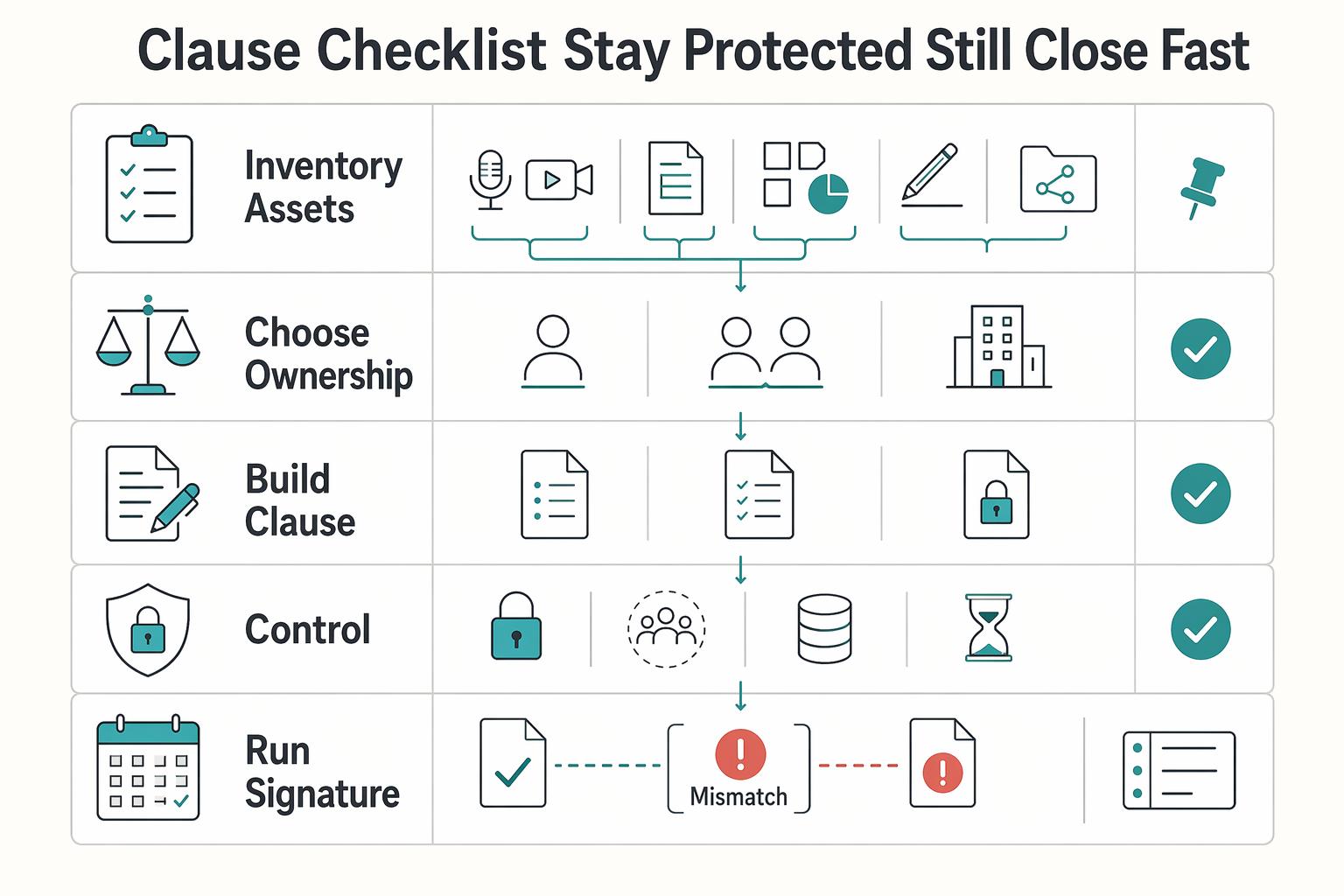
Fast deals tend to move better when your clause logic is settled before signature pressure starts. One practical sequence is to map the assets, choose the ownership model, build matching clauses, add practical controls, then run a final signature check.
- Inventory assets before discussing ownership
List what is pre-existing, what will be created in this engagement, and what sensitive research data you expect to handle. Include concrete items like recordings, transcripts, notes, synthesis outputs, scripts, repositories, and reusable methods or templates. Checkpoint: if the SOW says "all work product" but your real asset list is more specific, the draft is likely too vague. Flag what you treat as a Trade Secret at this stage.
- Choose the ownership model for this deal
Decide whether the client needs ownership, a license to use deliverables, or a mixed structure. If your methods or templates are reusable, keep them out of blanket transfer language unless transfer is intentional. A known drafting risk is accepting broad transfer wording first and trying to narrow it later.
- Build a clause set that matches the decision
Align ownership, licensing, confidentiality, and termination language so they do not conflict. Make sure the client's use rights are explicit and practical. Then verify that key definitions stay consistent across your agreement documents.
- Add controls that support the contract language
If you are protecting confidential research materials or reusable know-how, pair the clause text with real handling practices. Set access limits, retention expectations, and end-of-project return or deletion steps when required. Keep clean records of signed terms, final redlines, approvals, and acceptance to support what was granted and what stayed confidential.
- Run a signature check before sending draft one
Use a dedicated IP clause checklist instead of memory, and avoid cut-and-paste IP language. Read once only for contradictions: ownership versus license, termination versus ongoing use, and payment timing versus transfer timing. Under time pressure, review the highest-risk terms first: broad transfer language, silence on research data handling, and conflicting definitions.
For deeper mechanics on ownership structures, read Work for Hire vs. Assignment of Rights: A Freelancer's Guide to Owning Your IP. If you need the broader consultant view, the companion guide on protecting your intellectual property as a strategic consultant is the right next read.
Next step: adapt this checklist to your next SOW and review each high-risk clause before you send the first draft.
If you want contract terms and cross-border money movement to stay aligned from signature to payout, book a practical review with Gruv.
Frequently Asked Questions
Who owns UX research data in freelance projects by default?
Do not assume there is one universal default owner. Set ownership, use rights, and post-delivery handling clearly in the contract or governing policy. If the agreement is unclear, fix it during requirements and contracting.
Is an NDA enough to protect my research IP?
No. An NDA helps with confidentiality, but it does not decide ownership or usage rights on its own. Pair it with explicit license, assignment, and data ownership terms in the core agreement.
What should I always keep as my background IP?
There is no universal must-keep list. Define your pre-existing materials and reusable know-how in writing, then state what is excluded from transfer. Keep that language consistent in the signed agreement and SOW.
When should I offer a License Grant instead of Assignment of Rights?
There is no one-size-fits-all rule. Choose a license, an assignment, or another defined right based on what is agreed in writing. Make that decision during requirements and contracting, because data-rights issues are harder to fix after kickoff.
How do I set Governing Law and Jurisdiction for cross-border clients?
There is no universally best combination for every cross-border UX contract. Set governing law and jurisdiction early, and keep the language consistent across your agreement documents. If terms conflict across documents, resolve that before signing.
What should happen to IP rights if a project ends early under Termination?
Your contract should state what rights survive, what transfers, if anything, and under what conditions. It should also say how confidential and personal data is handled at the end of the project. Where GDPR applies, align retention and deletion terms with the principle that personal data should not be kept longer than necessary.
Researched and edited by the Gruv editorial team. Gruv builds cross-border billing, payouts, and finance-operations software for global businesses.
Sources
- acquisition.gov/sites/default/files/manual/PSC%20Manual%20Ap...trusted
- admindatahandbook.mit.edu/book/v1.1/security.htmltrusted
- business.defense.gov/Portals/57/MARC%20Presentation.pdftrusted
- caloes.ca.gov/wp-content/uploads/PSC/Documents/Agreement-A...trusted
- copyright.gov/ai/Copyright-and-Artificial-Intelligence-Par...trusted
- courts.ca.gov/sites/default/files/courts/default/2024-10/s...trusted
- cppa.ca.gov/regulations/pdf/comments_51_75.pdftrusted
- docs.lib.purdue.edu/cgi/viewcontent.cgitrusted
Educational content only. Not legal, tax, or financial advice.
Related Posts

Work for Hire vs Assignment of Rights for Freelancers
A freelance agreement is not just about price and scope. It decides who controls the rights in the work. If the ownership language is loose, rights can move earlier than you expect, cutting down your control once the work is delivered or used.

How to Protect Your Intellectual Property as a Strategic Consultant
**Build a repeatable IP system that defines ownership scope, sets confidentiality rules, and makes governing law and dispute forum explicit before work starts.** As the CEO of a business-of-one, your IP is not "nice to have." It is core operating value. You are not trying to lawyer up every project. You are setting safe defaults so deals move fast and preventable disputes stay contained.

The Freelance Payment Penalty: A Modeled Audit of Platform Fees, FX Spreads, and Payout Delays
The money rarely disappears through a single, easy-to-spot fee. The real loss is stacked. A marketplace takes its commission, a processor adds a charge for international cards, a bank or payment company converts the currency at a spread, a platform holds the funds before release, and a wire sheds a little to intermediaries on the way in. Each layer looks defensible on its own, but the worker feels the combined result as a smaller deposit and a later payday.