
Quick Answer
Start with a three-phase plan: set strategy, execute the legal transaction, and run post-closing compliance. For a U.S. buyer, that means getting a Codice Fiscale and banking path in place before offers, using proposta d'acquisto, compromesso, and rogito as written control gates, and then maintaining annual U.S.-Italy reporting checks, including foreign-account filings where relevant. If financing is uncertain, compare mortgage friction against available liquidity options before committing to your closing timeline.
Buying Italian real estate as a U.S. citizen is less about the dream property than the process. Bureaucratic friction, hidden liabilities, and compliance mistakes can turn a good purchase into a long, expensive distraction.
This is not a travel guide. It is a practical playbook for buying Italian real estate with the same discipline you would bring to any serious investment. The work breaks into three phases: set the strategy, execute the transaction, and manage the property and its cross-border obligations after closing. If you approach it that way, you can keep the process controlled and avoid the mistakes that usually come from rushing.
Phase 1: The Strategic Foundation#
Most of the real risk is set before you tour properties. Decide four things first: your purpose, whether you can complete the purchase under reciprocity rules, your Codice Fiscale and banking path, and how you will hold title.
Decide your use case before you pick a location#
If you mix personal use, rental income, and residency into one plan too early, you can create avoidable legal, tax, and execution problems.
| Primary intent | Primary obligations to map first | Main risk if mis-scoped | Who to engage first |
|---|---|---|---|
| Personal use | Confirm notarial path and reciprocity assessment; set up tax ID and payment rails | You negotiate before confirming legal path and account readiness | Notaio |
| Rental income | Italian administration plus U.S. worldwide-income reporting, including rental reporting | Cashflow model misses reporting and admin load | Commercialista |
| Residency | Separate visa strategy from property purchase | You assume ownership grants residency rights | Immigration adviser/lawyer, then notaio |
If residency is your goal, run immigration as its own track. Italy's elective residency visa is for people planning to move permanently, does not allow work, and processing may take up to 90 days.
Set up identity and banking before deal pressure starts#
Your first operational document is the Codice Fiscale. It is a 16-character alphanumeric code used to identify foreign citizens in dealings with Italian public authorities and administrations. A non-resident can obtain it through Italian consular authorities, at the Italian Revenue Agency, or by delegating a representative in Italy. Some consular channels limit requests to cases tied to online necessity or where delegation is not possible, so confirm the route early.
For banking, do not assume there is one standard non-resident checklist. What is consistent is customer due diligence. The bank must identify and verify you using reliable, independent information before establishing the relationship. Ask the bank in writing for its current non-resident onboarding steps, timeline, and any in-person requirements.
Once the account is open, add U.S. reporting to your process immediately. Track aggregate foreign-account value against the $10,000 FBAR threshold for FinCEN Form 114. That filing is due April 15 with an automatic extension to October 15.
Choose ownership structure before negotiating price#
For many buyers, direct ownership is the cleaner starting point. Holding through an entity can make sense, but for a U.S. person it can add reporting work and compliance complexity.
| Ownership path | U.S. tax/reporting path | Reporting burden | Operating overhead | Exit implications for a U.S. person |
|---|---|---|---|---|
| Direct individual ownership | Directly held foreign real estate is not itself reported on Form 8938; rental income or loss is reported on Schedule E; worldwide income still applies | Lower than entity structures in many cases | Typically simpler annual administration | Notarial guidance cites a 26% substitute tax for residential capital gains in covered cases |
| Foreign entity ownership | Interest in the entity can be reportable on Form 8938; may also involve Form 5471 or Form 8865 depending on structure | Higher in many cases, with additional annual filings | Usually higher professional and compliance cost | Exit planning can require entity-level tax and reporting analysis, not just property-sale economics |
Build your adviser team in sequence#
The order matters. Each adviser solves a different problem, and bringing them in too late can mean paying to fix a rushed decision.
| Adviser | Engage when | Key note |
|---|---|---|
Notaio | Early | Required for purchase and sale; buyer chooses the notary; performs legality checks including case-by-case reciprocity assessment |
Commercialista | Rental use, entity ownership, or residency planning is in scope | Consider bringing one in when those issues are in scope |
| Technical surveyor | Before you are economically locked in, if you want independent checks | Independent condition and documentation checks |
| Independent legal counsel | Terms are customized, timing pressure is high, or language and contract risk are material | The notary is neutral, not your advocate |
When you vet any adviser, ask for three things up front: written scope, fee schedule, and the initial document list. That gives you an early read on how they execute before money is at risk.
Related: How to Invest in Real Estate as a Digital Nomad.
Phase 2: Transactional Execution with Full Control#
With the foundation set, treat the transaction as three hard gates: offerta (proposta d'acquisto) -> compromesso -> rogito notarile. You stay in control by moving forward only when each stage is complete in writing.
Italy's purchase flow is formal and regulated: written offer and acceptance, preliminary act (compromesso), then final deed before the notary (atto/rogito notarile). Use that sequence as your discipline, not as a reason to rush.
Gate 1: proposta d'acquisto (offer)#
Your offer is your first written commitment, so treat it like a controlled document, not a placeholder. The offer is written in Italian and English, and a typical offer-stage deposit is shown as about EUR 10,000 to 20,000. Before you sign, check the following:
| Offer check | What to confirm |
|---|---|
| Intermediary chain | Confirm the intermediary chain and verify agent registration details; Chamber of Commerce registration has been required since 1989 |
| Language versions | Confirm both language versions match on property identity, price, deposit, and timing |
| Unresolved fields | Mark unresolved fields explicitly so nothing is assumed |
| Document tracker | Add a document tracker (received / pending / not applicable) so gaps are visible before acceptance |
| Buyer eligibility | Confirm early whether any buyer-eligibility or reciprocity limits apply to your case |
Gate 2: compromesso (preliminary act)#
The compromesso is the commitment gate. Sign only when your team has assigned each verification area, agreed on what counts as enough evidence for your file, and defined the stop points.
| Verification area | What you need before signing |
|---|---|
| Buyer eligibility and reciprocity limits (if applicable) | Assign responsibility in writing, define the evidence standard, and define the stop or walk-away trigger |
| Contract terms and conditions for your file | Assign responsibility in writing, define the evidence standard, and define the stop or walk-away trigger |
| Financial terms (price, deposit, payment steps) | Assign responsibility in writing, define the evidence standard, and define the stop or walk-away trigger |
| Closing deliverables and post-signing recording checks | Assign responsibility in writing, define the evidence standard, and define the stop or walk-away trigger |
If any item is still open, either pause or document clearly that you are accepting that risk in price and terms.
Gate 3: rogito notarile (final deed)#
By the time you reach rogito notarile, the hard work should already be done. This is where the deed is signed, the balance is paid, and keys are handed over. After that, the deed is recorded in the Public or Land Registry.
Use a closing-cost control sheet with verified inputs. Exact percentages and fee levels are file-specific and should be confirmed in writing.
| Cost category | Typical basis | Who quotes it | When payable | Verification source |
|---|---|---|---|---|
| Purchase price balance | Contract price minus deposits | Deal documents and closing parties | Per closing schedule | Draft deed/payment schedule |
| Transfer/registration taxes | Basis depends on the file and should be verified; may reference Valore Catastale in some cases | Written quote for your file | Per closing schedule | Written estimate |
| Notary fees/disbursements | File-specific fee quote | Notary | Per fee quote | Written fee quote |
| Agency commission | Agency terms for your file | Agency | Per agency terms | Agency terms/invoice |
| Bank/payment costs | Transfer and payment charges for your file | Bank | As incurred | Bank quote/transfer terms |
Before closing, use this execution sequence:
- Lock one written funds map covering every amount and payee.
- Align the draft deed, payment schedule, and closing deliverables in one final check.
- Review deed terms before signing; if needed, arrange translated review in advance.
- After signing, confirm key handover and confirm delivery of registry recording proof.
If you keep these gates strict, the closing stays routine. If you blur them, unresolved issues pile up at the worst point in the process.
We covered this in detail in Can I Use My US LLC to Buy Property in Spain?.
Phase 3: The Ongoing Cross-Border Compliance Engine#
After closing, the job changes. You are not buying property anymore. You are running a cross-border asset. A reliable approach is a fixed cadence: monthly bookkeeping, quarterly checks, and one year-end package that both your U.S. and Italian advisers can use without rebuilding the file.
| Cadence | What you track | Output you should have |
|---|---|---|
| Monthly | Italian bank activity, rent received, property expenses, agent/utility payments | Reconciled ledger and labeled backup docs |
| Quarterly | Foreign-account reporting exposure, upcoming municipal tax steps, document completeness with your commercialista | Updated filing checklist and owner-by-owner task list |
| Year-end | Full-year rent/expense totals, tax payments, filing support files | One clean package for U.S. and Italian tax prep |
Your U.S. reporting triggers#
The property itself does not automatically trigger every form, but the accounts around it often do. The core rule is simple: you remain in U.S. tax scope on worldwide income, including Italian rental income and sale gains. Separate from that, foreign-account reporting may apply even if the account itself did not generate taxable income.
| Filing item | Trigger condition | What is reportable | Filing owner | Key note |
|---|---|---|---|---|
| FBAR, FinCEN Form 114 | Aggregate foreign financial accounts exceed $10,000 at any time during the year | Foreign financial accounts, including an Italian account used for purchase, rent, or property payments | You, typically with U.S. preparer support | Separate from IRS return; due April 15 with automatic extension to October 15 |
| Form 8938 | Thresholds vary based on filing status and residency | Specified foreign financial assets | You, with your U.S. income tax return | Does not replace FBAR |
| U.S. income tax return (Form 1116 as applicable) | You had rental income, foreign tax paid, or taxable gain | Worldwide income and any foreign tax credit claim | You | Directly held foreign real estate is not itself a Form 8938 asset; related financial accounts may still be reportable |
Rental income and sale gains: cross-border workflow#
For rental income and sale gains, use the same sequence each time. Consistency matters more here than cleverness.
- Determine and calculate income or gain for Italian tax handling.
- Report that same income or gain on your U.S. return because U.S. taxation still applies to citizens.
- Apply treaty and credit coordination through Form 1116 based on foreign income taxes actually paid.
- For sale scenarios, confirm treatment before signing. Where available, one option is requesting a notary-applied substitute tax election at deed execution.
Keep one evidence file that can support both countries' filings. Include purchase and sale deeds, notary statements, lease contracts, rent ledger, invoices, bank statements, IMU and TARI records, and proof of foreign taxes paid.
IMU and TARI execution#
Run IMU and TARI like operating tasks, not calendar reminders. IMU is paid in two installments, 16 giugno and 16 dicembre, through permitted channels such as F24 or a postal current account slip. TARI applies to possession or detention of premises capable of producing waste, and payment timing is set at municipal level. Use this checklist with your commercialista:
| Task | Action | Output |
|---|---|---|
| Validate inputs | Confirm Comune, cadastral data, ownership share, possession period, and property-use details relevant to TARI | Validated inputs in writing |
| Assign ownership | Assign an owner for IMU calculation, municipal rate or tariff verification, and payment submission | Owner assigned for each step |
| Archive payment proof | Keep the filed form, bank debit confirmation, municipal notice, and calculation worksheet on payment day | Proof of payment archive |
| Hand off summary | Provide a reconciled tax summary to your U.S. preparer | Reconciled tax summary for your U.S. preparer |
Failure prevention#
The common failures here are operational: a missed FBAR after account opening, vague payment labels, or rent flows that never get reconciled. The fix is not more theory. It is one annual compliance review tied directly to property cashflow.
Before filings, run this check:
- Reconcile every bank inflow and outflow to rent, tax, or property-expense categories.
- Confirm core documents can be retrieved quickly from a single archive.
- Match net property cashflow against what is being reported for Italian tax, U.S. tax, and foreign-account filings.
- If any view does not reconcile, stop and correct it before filing.
For a step-by-step walkthrough, see A Guide to Opening a Brokerage Account in Europe as a US Citizen.
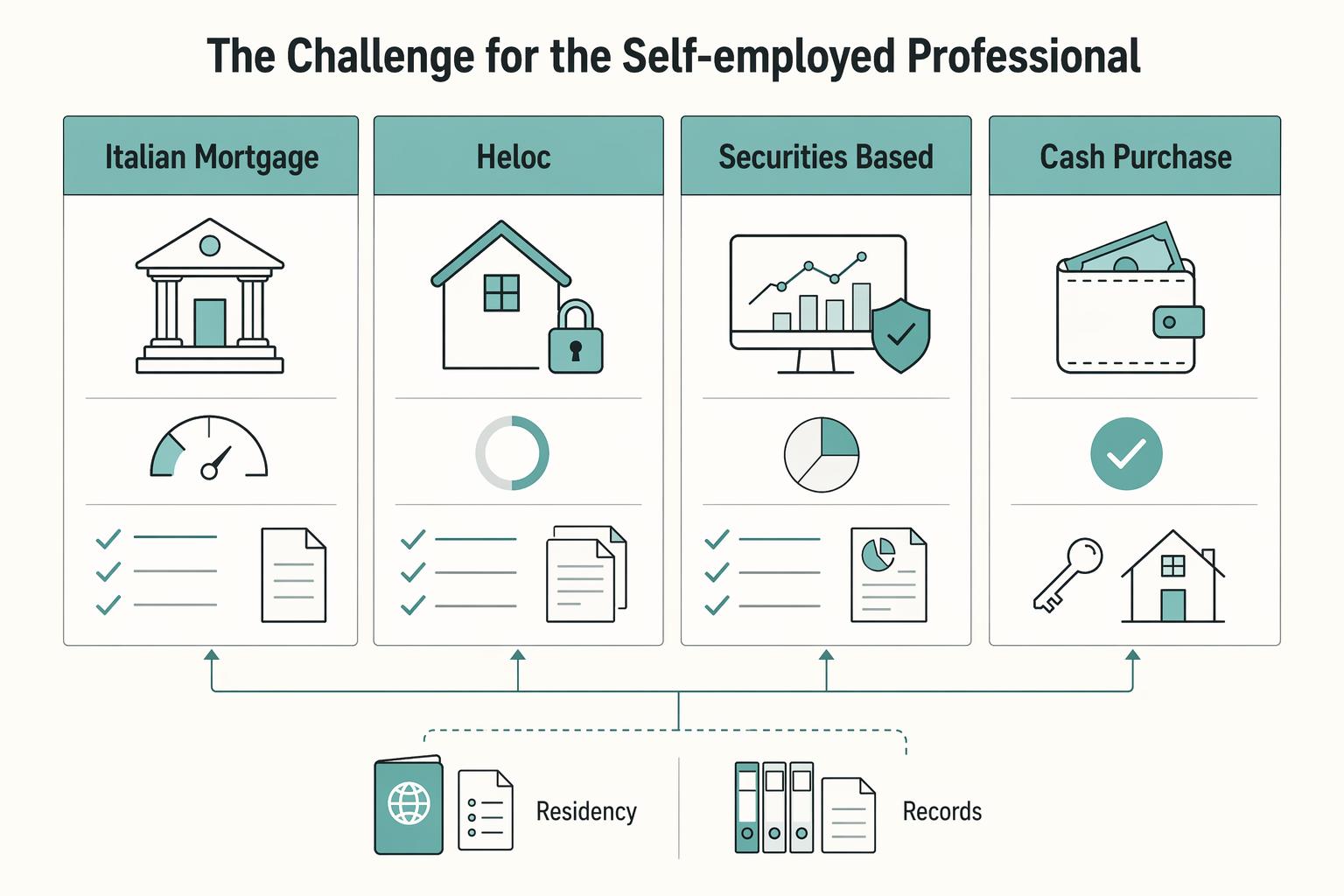
A Note on Financing: The Challenge for the Self-Employed Professional#
If you are self-employed, financing may be the hardest part of the plan. In practice, you may end up weighing Italian mortgage underwriting against liquidity you already control.
Do not anchor on old rate assumptions. One cited guide shows average Italian mortgage levels around 1.4% at the end of 2021, 3.6% in January 2023, and roughly 3% in March 2025. Those averages combine fixed and variable loans. Your actual offer still depends on loan type, term, and borrower profile, so treat market averages as context, not as your likely terms.
Before you spend time on a lender application, use this planning checklist (not a definitive lender requirement list) to decide whether an Italian mortgage file is worth pursuing:
- Income stability: prepare a clear record of earnings consistency and volatility.
- Business continuity: show that your business is active and operating normally.
- Cash reserves: document your ability to absorb closing and ownership shocks.
- Credit quality: organize current credit and debt-position evidence.
- Source-of-funds traceability: map purchase funds to verifiable account history.
| Financing path | Approval friction | Speed to close | Currency exposure | Repayment risk | Operational complexity |
|---|---|---|---|---|---|
| Italian mortgage | Depends on lender eligibility criteria and borrower profile | Includes multiple lender steps before closing | Depends on loan currency relative to your income/cashflow currency | Depends on fixed vs variable structure and final terms | Varies with documentation and process requirements |
| HELOC | Confirm with your lender | Confirm with the relevant authority | Depends on borrowing currency relative to the property currency | Confirm with your lender | Lender- and structure-specific |
| Securities-based lending | Confirm with your lender | Confirm with the relevant authority | Depends on loan/collateral currency mix relative to the property currency | Confirm with your lender | Lender- and structure-specific |
| Cash purchase | No mortgage underwriting path to evaluate in this section | Confirm with the relevant authority | Direct exposure to property-currency value movements | No loan repayment terms if fully cash-funded | Still requires legal, tax, and transfer planning |
Choose the path that fits your timeline, risk tolerance, and administrative capacity. If you use a HELOC or securities-based line, treat terms, timelines, and risk triggers as lender-specific until you have them in writing. If you pursue an Italian mortgage, move forward only after you receive the lender's current criteria and process steps in writing, and confirm you can meet them without last-minute gaps. Alongside financing, plan for legal requirements, tax implications, and exit strategy.
You might also find this useful: A Guide to Getting a Golden Visa in Spain.
Before you choose how to fund deposit and closing transfers, run a quick scenario in the Payment Fee Comparison tool to review potential fee and FX tradeoffs.
Conclusion: Keep the deal, advisers, cashflow, and compliance aligned#
The most useful way to think about this purchase is as an operating asset, not a one-time event. Your job is to keep four things aligned: the deal process, adviser roles, cashflow, and cross-border compliance.
Keep the core roles clear. Your Codice Fiscale is the identifier used in dealings with Italian public and private entities, including core purchase steps. Your notaio handles the public-deed side of the transaction and can also handle payment flow in a power-of-attorney structure. Your commercialista should be verifiable in the relevant Albo.
On the U.S. side, foreign-account reporting can trigger FBAR when aggregate foreign account balances exceed $10,000 at any point in the year. Form 8938 may apply under separate thresholds, but it does not replace FBAR.
Use this closeout sequence:
- Phase 1: Confirm purpose, ownership structure, and banking setup. Obtain your Codice Fiscale early. Decide whether you need treaty-aware tax planning before signing, and do not assume ownership alone grants residency or citizenship.
- Phase 2: Keep a complete deal file: offer, preliminary contract, final deed, transfer proofs, adviser communications, and any survey or title documentation. Re-check names, account details, and adviser responsibilities before closing.
- Phase 3: Run an annual review for FBAR, Form 8938 where relevant, local filings, and income treatment. If you hold through an entity, review whether the entity interest changes your Form 8938 analysis.
The operating rule is simple: keep a clean document trail, review the structure every year, and escalate early to qualified advisers when the facts change.
If you want a deeper dive, read Should Your Freelance Business Accept Credit Cards?.
If you want your client cashflow to stay operational while managing an overseas property, review Gruv Payouts for disbursements and status visibility where supported.
Frequently Asked Questions
Do U.S. buyers need an Italian bank account before making an offer?
Treat banking as part of the control plan, not a late admin step. The practical sequence in this article is to secure your Codice Fiscale, ask the bank for its live non-resident requirements in writing, and understand the payment path before deal pressure starts. If the account path is still unclear, do not let an offer outrun your operating setup.
Should I buy Italian property directly or through a U.S. LLC?
For many buyers, direct ownership is the cleaner starting point. A U.S. or foreign entity can make sense in some cases, but it can also add Form 8938, Form 5471, or Form 8865 analysis depending on the structure. Decide that before negotiating price so tax and reporting complexity does not appear after the file is already moving.
Does buying property in Italy give me residency rights?
No. Property ownership and immigration status are separate tracks. If residency is part of the goal, run it as its own planning stream with the right adviser instead of assuming a purchase automatically creates residence rights.
What records should I keep after closing?
Keep one operating file that includes the final deed, transfer proofs, bank statements, lease or rent records where relevant, IMU and TARI support, and the year-end package used by your U.S. and Italian advisers. The value is not just storage. It is being able to reconcile cashflow, tax support, and ownership evidence without rebuilding the file each year.
How often should I review FBAR, Form 8938, and local tax obligations?
Run the operational review at least yearly, with monthly bookkeeping and quarterly checks feeding it. According to the IRS comparison of Form 8938 and FBAR requirements, one filing does not replace the other, so review both whenever foreign accounts or ownership facts change. Pair that review with your Italian tax calendar so the U.S. and local obligations stay tied to the same records.
Try a related tool
Researched and edited by the Gruv editorial team. Gruv builds cross-border billing, payouts, and finance-operations software for global businesses.
Sources
- congress.gov/106/cdoc/tdoc11/CDOC-106tdoc11.pdftrusted
- ecfr.gov/current/title-15/subtitle-B/chapter-VII/subc...trusted
- fam.state.gov/fam/09FAM/09FAM040203.htmltrusted
- financialresearch.gov/annual-reports/files/OFR-AR-2023_web.pdftrusted
- irs.gov/businesses/small-businesses-self-employed/re...trusted
- irs.gov/individuals/international-taxpayers/us-citiz...trusted
- state.gov/wp-content/uploads/2019/02/09-1216-Italy-Tax...trusted
Educational content only. Not legal, tax, or financial advice.
Related Posts
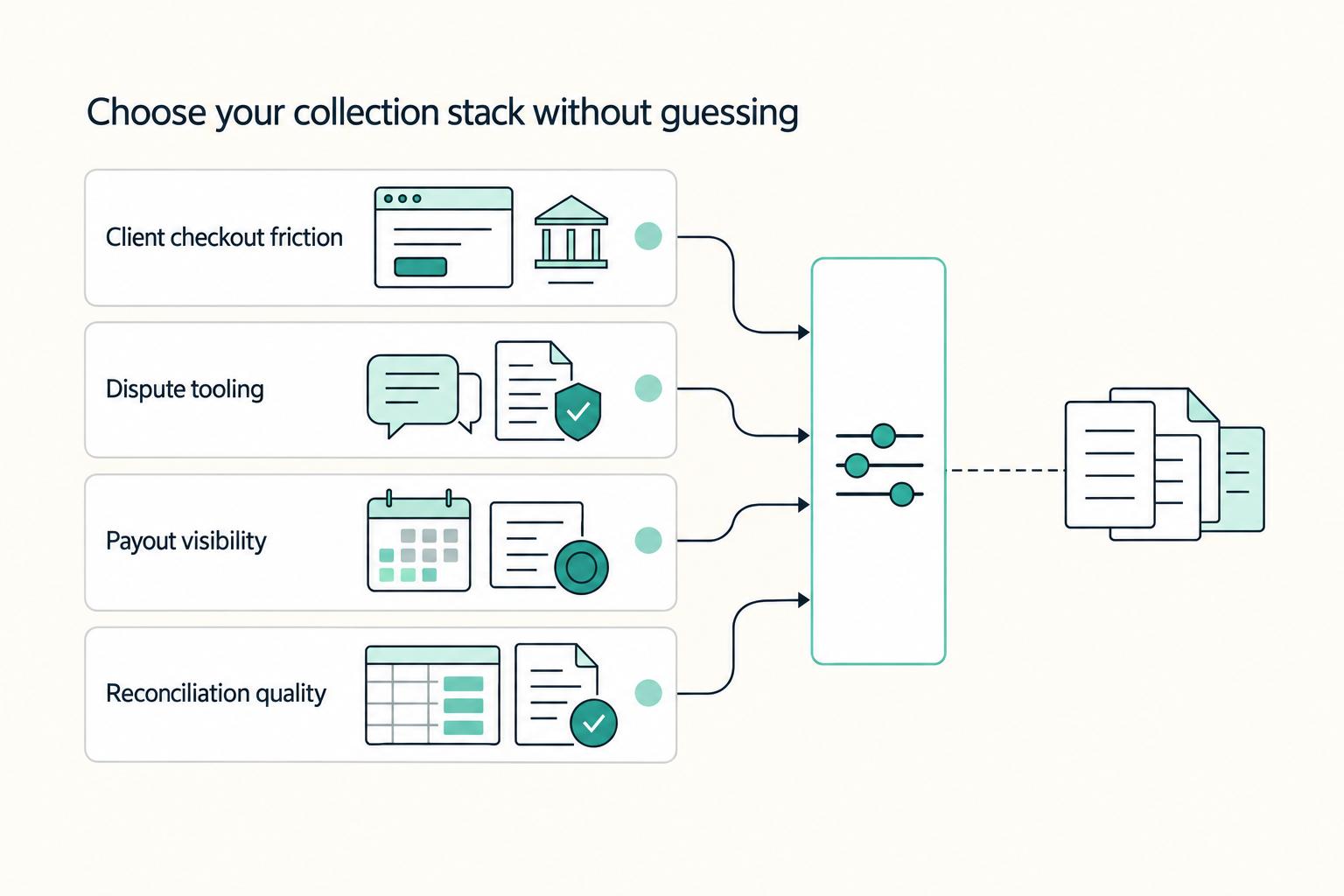
Should Your Freelance Business Accept Credit Cards?
Offer card payments, but stay in control of how money reaches you. The goal is not a smoother checkout screen. It is predictable cash you can use to run the business.
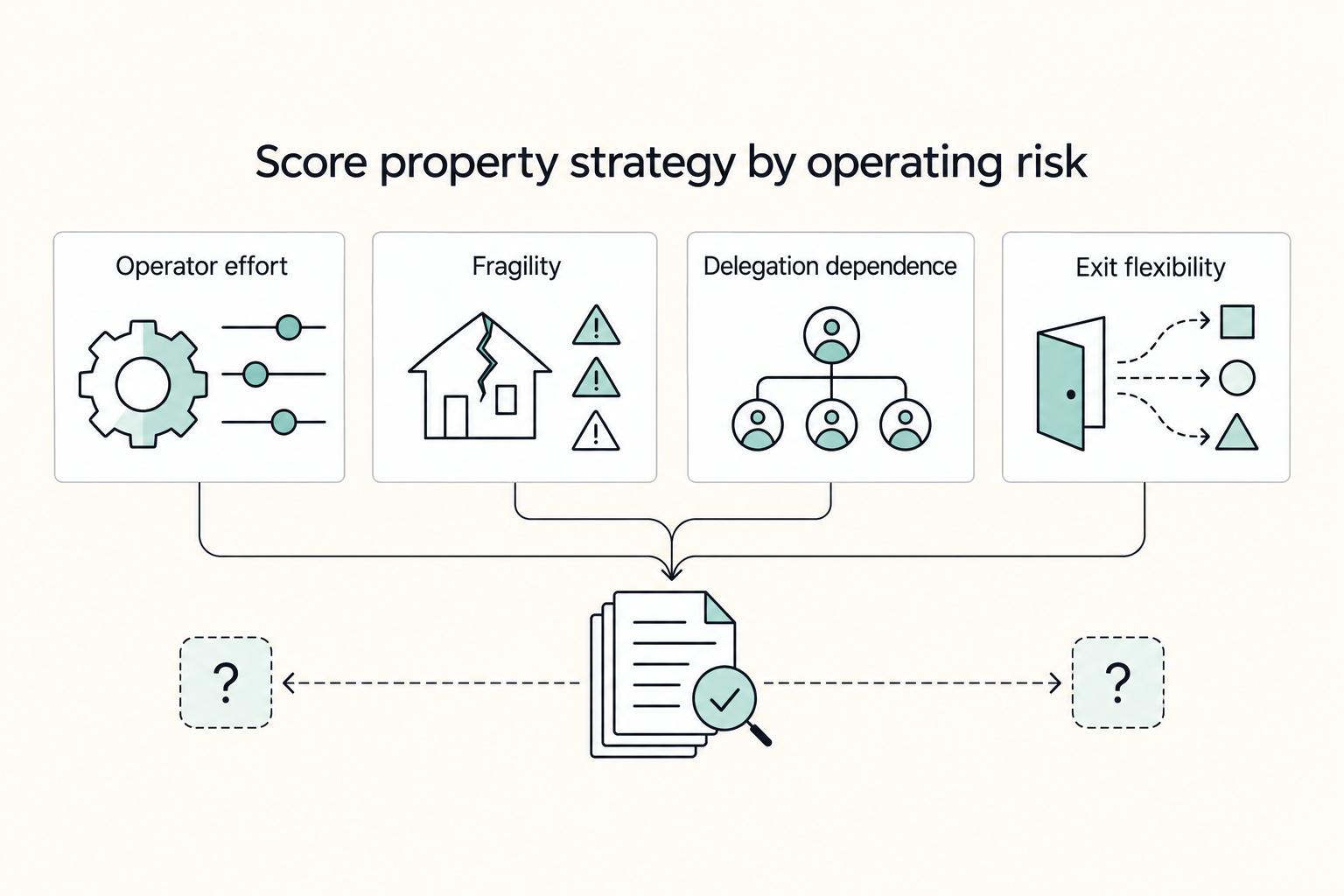
How to Invest in Real Estate as a Digital Nomad
**Run anything with money and moving parts like an operations system (cash, docs, delegation, and controls), not a "passive income" vibe.** Real life stress-tests weak spots. You change time zones, a client pays late, and something breaks at the worst moment. As the CEO of a business-of-one, your job is to build a setup that keeps working when you are not available on demand.
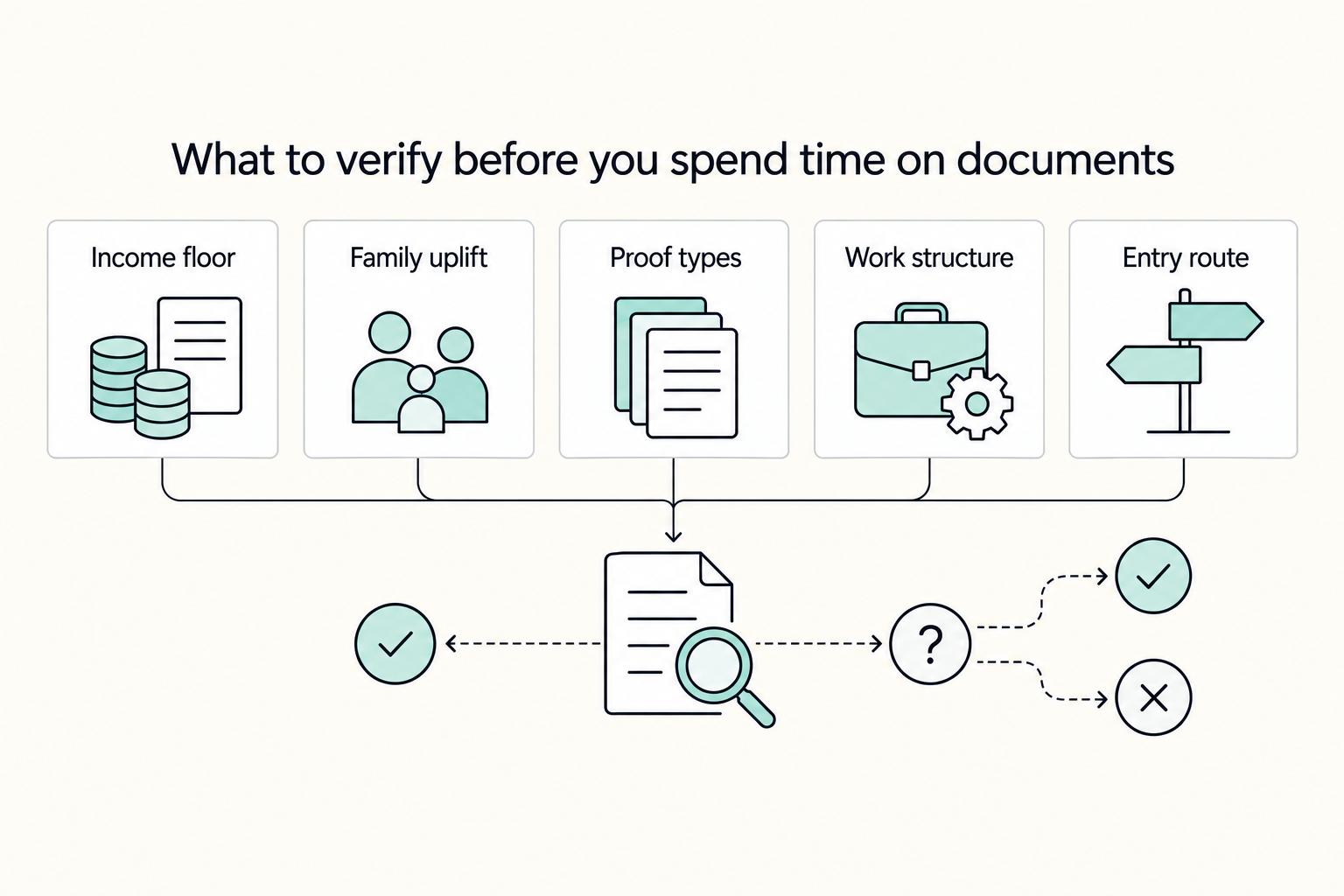
Choosing the Right Residency Path After Spain’s Golden Visa Closure
Start from a conservative planning position. If your move depended on a Golden Visa path, do not build your timeline around assumptions. Confirm current eligibility and process details through official channels before you commit. In practice, the decision is simpler than it feels: choose a residency route based on how you earn, what work you plan to do after arrival, and how you want to live.