
Quick Answer
Confirm the US-person, foreign-account and aggregate-over-$10,000 filing test. Calculate each account’s maximum in USD, enter filer information in Part I, then use Part II for separate ownership, III for joint ownership, IV for authority without financial interest or V for eligible consolidated reporting. Sign and submit electronically, separately from your tax return, and retain acknowledgment and records.
First decide whether FinCEN Form 114 applies#
FBAR reports certain foreign financial accounts to FinCEN, separately from your federal income-tax return. A US person generally must file if they have a financial interest in, or signature or other authority over, foreign financial accounts whose aggregate value exceeded $10,000 at any time during the calendar year. Once the threshold is met, report the relevant accounts, including those individually below $10,000.
The IRS FBAR guidance covers US citizens, residents and relevant domestic entities. A domestic LLC’s disregarded income-tax status does not by itself remove its FBAR obligation. Identify the individual and entity filers separately rather than treating the business’s accounts as automatically covered by the owner’s return.
Account location matters: an account at a US bank’s foreign branch can be foreign, while one at a foreign bank’s US branch is generally not. Interest, profit or taxable income is not the filing test. Screen the actual account and your ownership or authority against the definitions and exceptions in the FinCEN line-item instructions.
Step 1: Classify the account and filing relationship#
Financial interest includes ownership of record or legal title and specified indirect interests, such as certain greater-than-50-percent entity interests. Signature authority is an individual’s ability, alone or with another person, to control account assets by direct communication with the institution. It does not mean merely being able to view a statement. A director or employee may have a reportable authority-only account without owning its funds.
| Your relationship | Usual form section | Information to gather |
|---|---|---|
| Financial interest in a separately owned account | Part II | Account and institution details, maximum value |
| Financial interest in a jointly owned account | Part III | Same account details plus other joint-owner count and principal joint owner |
| Signature/other authority with no financial interest | Part IV | Account details and owner identity, plus your title/authority role |
| Eligible entity filing a consolidated FBAR | Part V | Covered account details and each account-owning entity’s identity |
Check exclusions before entering accounts: the instructions include specified IRA/retirement-plan accounts and other exceptions. Some signature-authority roles also have exceptions or special extensions. They are not a blanket exemption for every employee. Use the applicable exception and current FinCEN relief notice for your role and year.
For the spouse exception, all accounts the non-filing spouse is required to report must be jointly owned with the filing spouse; the filing spouse must include those accounts on a timely signed FBAR; and both must complete and sign Form 114a. A separate reportable account or authority-only obligation can defeat that exception for the would-be non-filing spouse. Filing a joint income-tax return does not establish FBAR eligibility for this exception.
An eligible US entity owning directly or indirectly more than 50 percent of another entity required to file can use the consolidated-report provisions. Confirm the covered entities and accounts before omitting their separate filings. This is a FinCEN reporting rule, not a consequence of producing consolidated financial statements.
Step 2: Calculate and document each maximum value#
Use a reasonable approximation of each account’s greatest value during the reported calendar year. Periodic statements can support it if they fairly reflect the maximum. A year-end balance alone can miss a higher balance earlier in the year. Closed accounts and accounts held for only part of the year still need review.
FinCEN’s maximum-value instructions require separate account valuations. Convert a non-USD account’s maximum using the applicable Treasury year-end rate; if no Treasury rate is available, use a verifiable alternative and record the source. Report whole US dollars rounded upward. If the resulting maximum is negative, enter zero in Item 15.
Keep the exchange-rate direction explicit. In this illustrative calculation, suppose an EUR account’s maximum is EUR 8,000 and the hypothetical year-end rate is 0.90 EUR per USD. Divide 8,000 by 0.90 to obtain $8,888.89, then report $8,889. This is a made-up rate for the arithmetic, not a Treasury rate for a particular year. Use the published rate for the year you are reporting.
| Example account | Ownership and section | Maximum USD amount to report |
|---|---|---|
| EUR account with illustrative conversion above | Separately owned; Part II | $8,889 |
| USD-denominated account at a foreign institution | Jointly owned with spouse; Part III | $2,500 full account value, not $1,250 |
| Combined maxima for these reportable accounts | Threshold assessment | $11,389; exceeds $10,000, so report both |
Joint owners generally report the entire account value, not their percentage share. A transfer between foreign accounts can also make their individual maxima occur on different dates; follow FinCEN’s aggregate-of-maxima instructions rather than netting out transfers as though only the year-end cash mattered.
Item 15a is an account-level “amount unknown” box when that account’s value cannot be determined. FinCEN also gives a filing instruction for people with fewer than 25 accounts who cannot determine whether aggregate maxima exceeded $10,000: complete the appropriate account sections and use the prescribed amount-unknown handling. That is not permission to assume no filing obligation, label a known value unknown, or replace the account inventory with one unknown aggregate.
For 25 or more accounts, Item 14 has special reporting provisions. They can reduce the account details entered on the report, while detailed records remain required and must be provided on request. Count the financial-interest and authority-only groups correctly and use their respective instructions; do not apply the fewer-than-25 walkthrough unchanged.
Step 3: Choose the electronic filing route#
Use the official BSA E-Filing FBAR page. Individuals reporting personally or jointly owned accounts can file without registering. The current page offers a PDF route that requires Adobe Reader and permits saving/reusing the form, and an online HTML route intended for a one-time submission when you are ready to file. Choose the route appropriate to your filing role; entity and professional third-party filings use the registered BSA E-Filing process.
The PDF form is an electronic filing document, not a paper return to print and mail. If you cannot e-file, request an exemption from FinCEN’s Resource Center; use a paper form only if that request is approved. Do not mail a printed electronic Form 114 or the obsolete TD F 90-22.1.
If another person files for you, complete Form 114a as applicable and retain the authorization. Do not upload it as part of the FBAR. A preparer’s registered account and the taxpayer’s filing obligation are different records; authorization should identify the filer whose accounts are reported.
Step 4: Complete Part I, the filer details#
- Item 1: enter the calendar year being reported, not the year you are submitting. For a correction, select Amended and supply the prior report’s BSA Identifier as instructed.
- Item 2: select the filer type. Individuals include people filing only signature authority. A consolidated filing selects its designated type; an LLC or other unlisted type follows the fiduciary/other instructions, including disregarded-entity labeling where applicable.
- Items 3–4: provide the filer’s US TIN and type. If no US TIN applies, use the specified foreign-identification fields rather than inventing a number.
- Items 5–13: enter the individual date of birth where applicable, filer name and mailing address using the form’s formats. An organization name goes in the organization/last-name field, with individual-only name fields left blank.
- Item 14: answer the 25-or-more account questions and enter counts where required. Keep supporting details even if the form’s special provisions let you omit some account rows.
For a 2025 FBAR submitted during 2026, Item 1 remains 2025. Confirm that the TIN, legal name and filer type belong to that filer. The owner’s income-tax W-9 treatment does not automatically dictate the separate LLC’s FBAR identity.
Step 5: Enter the accounts in Parts II–V#
For ordinary account-by-account reporting, Items 15–23 identify the account and institution. Enter the maximum USD value or the permitted amount-unknown selection; choose Bank, Securities or Other for account type, describing Other when needed; then enter the financial institution’s name, account number or designation, and its mailing address and country. Do not substitute your home address for the institution’s address.
| Section | Additional fields beyond account information | Common mistake to avoid |
|---|---|---|
| Part II: separately owned | Ordinary Items 15–23 account/institution fields | Putting joint or authority-only accounts in this section |
| Part III: jointly owned | Item 24 counts other joint owners, excluding the filer; Items 25–33 identify the principal joint owner and address as instructed | Dividing the account value or counting yourself as another joint owner |
| Part IV: authority without financial interest | Items 34–42 identify the account owner; Item 43 states your title giving authority | Entering yourself as the economic owner solely because you can sign |
| Part V: consolidated report | Owner organization name, identifying number/type and address, in addition to the applicable account information | Assuming every affiliated company qualifies or is covered automatically |
If your spouse has an interest in the joint account, the spouse is the principal joint owner for Part III. Supply the available identifying details and use the instructions for unknown information, rather than manufacturing a TIN. Report the full account maximum even when only half the funds are economically yours.
Part IV has special detail rules for 25-or-more authority-only accounts and for the stated case of an individual residing outside the US who is an officer or employee of an employer physically outside the US and has authority over that employer’s foreign account. Those rules change the fields completed, not the need to establish which filing obligation or exception applies.
As an example, an employee authorized to instruct a foreign bank on an employer’s account may report it in Part IV, subject to the applicable exceptions. The employer is the account owner; the employee’s title explains the authority. The account is not moved to Part II merely because the employee also has a personal account at that bank.
Step 6: Review, sign and preserve acknowledgment#
- Compare every reportable account against your inventory, section choice, maximum-value support, institution and owner details. Check additions and closed accounts, not just last year’s rows.
- Complete the signature/date and applicable filer-title fields. Complete third-party preparer information when relevant and retain Form 114a authorization.
- Use the chosen electronic route’s validation and submission steps. Save the submitted report, tracking details and acknowledgment, including the BSA Identifier.
- Check submission status if acknowledgment is missing or an error is reported. Correct rejected information through the appropriate process instead of assuming a draft or upload screen proves an accepted filing.
For an amendment, complete a new report in full and mark it amended, rather than reporting only the changed account. Use the prior BSA Identifier; the line-item instructions specify the placeholder to use if it is unknown. Retain the original and corrected reports so the change is explainable.
Meet the deadline and keep the required records#
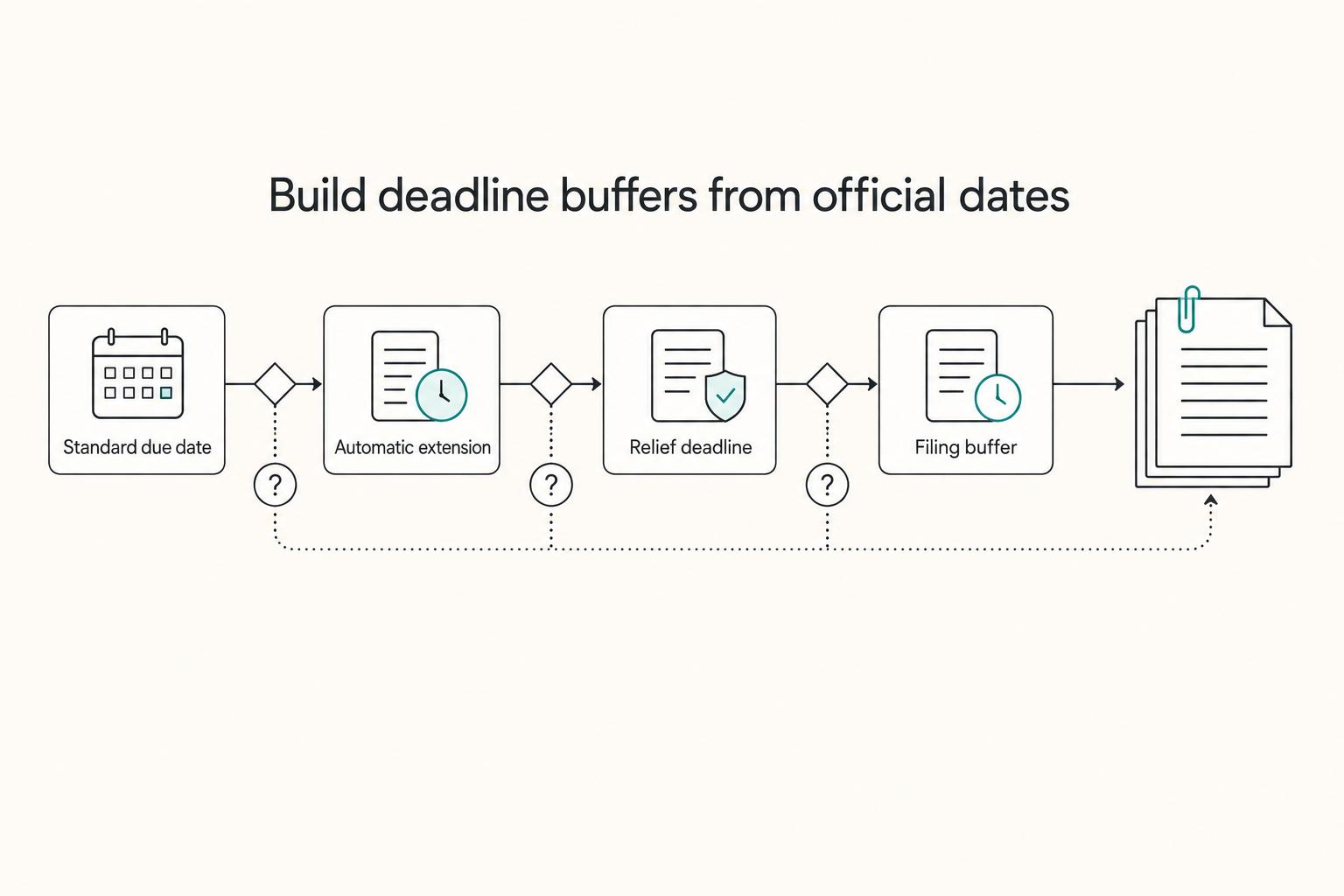
The normal FBAR due date is April 15 after the reported calendar year, with an automatic extension to October 15; no separate extension request is needed. Thus the ordinary 2025 FBAR is due April 15, 2026, with the automatic extension to October 15, 2026. Disaster relief and specified authority-only extensions apply only to their defined groups and years. Verify the relevant official notice before relying on a later date.
Keep the account name, number/designation, foreign institution name/address, account type and maximum annual value, together with the supporting records. FinCEN’s line-item instructions require five years from April 15 following the report year, or the actual filing date if later. Save the filed form, rate calculation and acknowledgment alongside that information. For an employee reporting only authority over an employer account, the employer retains the account records under the stated recordkeeping exception.
If you discover a late or omitted report, identify the affected years and obtain a correction/compliance plan suited to the facts. The IRS distinguishes ordinary late filings from specific compliance procedures and ongoing examinations; an explanation alone is not a universal penalty waiver. Use the applicable late-filing reason and procedure instead of submitting unrelated amendments as if they cover every past omission.
Form 8938 is a separate IRS reporting decision and filing route. It may cover a different asset set and uses its own thresholds. Filing it with an income-tax return does not replace an otherwise required FBAR, and filing an FBAR does not replace Form 8938.
Finish with a report you can trace#
A useful FBAR worksheet leads directly to the correct filer, account section and maximum-value entry. Complete the electronic report from that worksheet, check acknowledgment and keep the records by reporting year. That leaves next year’s filing as an update to known accounts and classifications instead of a new search for missing information.
Frequently Asked Questions
Can an individual file FBAR without a BSA E-Filing account?
Yes. FinCEN’s individual filing page permits individuals reporting personally or jointly owned accounts to file without registration and offers PDF and online HTML routes. Entity and professional third-party filings use the registered process; choose the route suited to your filing role.
Which form section holds a jointly owned account?
Part III. Enter the full account maximum, the count of other joint owners excluding yourself, and the required principal joint-owner information. Do not halve the value. The spouse exception requires all its conditions, including timely signed reporting and completed Form 114a.
Does “amount unknown” mean I can skip the threshold decision?
No. Item 15a concerns account value, and FinCEN gives prescribed filing instructions for qualifying fewer-than-25-account cases when aggregate maxima cannot be determined. Keep the account inventory and available evidence; uncertainty is not a no-filing conclusion.
How long should I retain FBAR records?
Keep the required account identifying information and maximum-value records for five years under the applicable instructions. FinCEN’s line-item instructions use April 15 following the report year or the filing date if later. Retain the submitted form, calculation support and acknowledgment as well.
Researched and edited by the Gruv editorial team. Gruv builds cross-border billing, payouts, and finance-operations software for global businesses.
Sources
Educational content only. Not legal, tax, or financial advice.
Related Posts

The Freelance Payment Penalty: A Modeled Audit of Platform Fees, FX Spreads, and Payout Delays
The money rarely disappears through a single, easy-to-spot fee. The real loss is stacked. A marketplace takes its commission, a processor adds a charge for international cards, a bank or payment company converts the currency at a spread, a platform holds the funds before release, and a wire sheds a little to intermediaries on the way in. Each layer looks defensible on its own, but the worker feels the combined result as a smaller deposit and a later payday.

How to Respond to a Subpoena for Business Records
Move fast, but do not produce records on instinct. If you need to **respond to a subpoena for business records**, your immediate job is to control deadlines, preserve records, and make any later production defensible.

A US Expat's Guide to Investing in UCITS ETFs to Avoid PFIC Issues
The real problem is a two-system conflict. U.S. tax treatment can punish the wrong fund choice, while local product-access constraints can block the funds you want to buy in the first place. For **us expat ucits etfs**, the practical question is not "Which product is best?" It is "What can I access, report, and keep doing every year without guessing?" Use this four-part filter before any trade: