
Quick Answer
Start by confirming Form 2555 applies, then attach it to Form 1040 or Form 1040-SR and use the matching IRS form year and instructions before entering numbers. For how to fill out form 2555, establish tax home first, choose either bona fide residence or the 330-full-day physical presence route, and complete only the relevant parts. Reconcile final exclusion figures to your return, and stop to resolve conflicts if travel dates, qualification windows, or earned-income timing do not line up.
Start Here and Avoid Guesswork#
If you need a practical answer to how to fill out Form 2555, start with a conservative, supportable approach. Use the correct form year, keep your return consistent, and avoid errors you will have to unwind later.
First, confirm that Form 2555 fits your situation. Form 2555 is used, if you qualify, to figure the foreign earned income exclusion and the foreign housing exclusion or deduction. It is attached to Form 1040 or Form 1040-SR, and it is marked for U.S. citizens and resident aliens only.
This guide is for globally mobile freelancers and consultants filing an individual U.S. return on Form 1040 or Form 1040-SR. If you are treating Form 2555 as a standalone filing, stop and fix that first.
Next, pull the current IRS form and the matching instructions before filling in any line. The form directs you to www.irs.gov/Form2555 for instructions and latest information. The IRS also says not to file draft forms or rely on draft instructions or publications, and notes that developments can change guidance after publication.
Do a quick control check before you start:
- Confirm the form year matches your filing year.
- Open the matching instructions for that same year.
- Verify neither document is marked draft.
Year details can change. For example, the 2025 instructions list a maximum exclusion amount of $130,000.
Treat this guide as a decision path, not a substitute for the IRS instructions. The goal is to make clear, documentable choices and keep the same story across your return. Before you move on, save the current Form 2555 and its instructions in your tax folder with the filing year in the filename so you can keep versions straight.
Related: Opening a Bank Account in Europe as a Non-Resident.
Confirm You Should File Form 2555 at All#
Make the go-or-no-go call first. If you do not have foreign earned income, stop and do not attach Form 2555 to Form 1040 or Form 1040-SR.
Start with the income itself. For Form 2555, foreign earned income means pay for personal services you performed, such as wages, salaries, or professional fees. It does not cover every type of income connected to another country.
A simple check is to review each income item and ask whether it came from your own services. If you cannot tie a payment to services you rendered, do not assume it belongs on Form 2555. Also, income earned abroad as an employee of the U.S. Government does not qualify for the exclusion or housing deduction.
Run the Tax Home Test before anything else. Your tax home must be in a foreign country, or countries, throughout the qualifying period. If this fails, the rest of the Form 2555 analysis will not save the filing position.
Review your records to confirm they support the same tax-home conclusion. If your documentation conflicts, resolve that before moving forward.
Only after tax home is established should you test qualification. You must meet either the Bona Fide Residence Test or the Physical Presence Test.
- Bona fide residence test: an uninterrupted period of bona fide residence that includes an entire tax year.
- Physical presence test: 330 full days in a foreign country, or countries, during any 12 consecutive months.
If your facts are mixed or incomplete, take the conservative path and do not guess. Form 2555 asks for specific information, and missing required details can cause a claimed exclusion or deduction to be disallowed.
For related context, see How to Fill Out Form W-8BEN for a Foreign Freelancer.
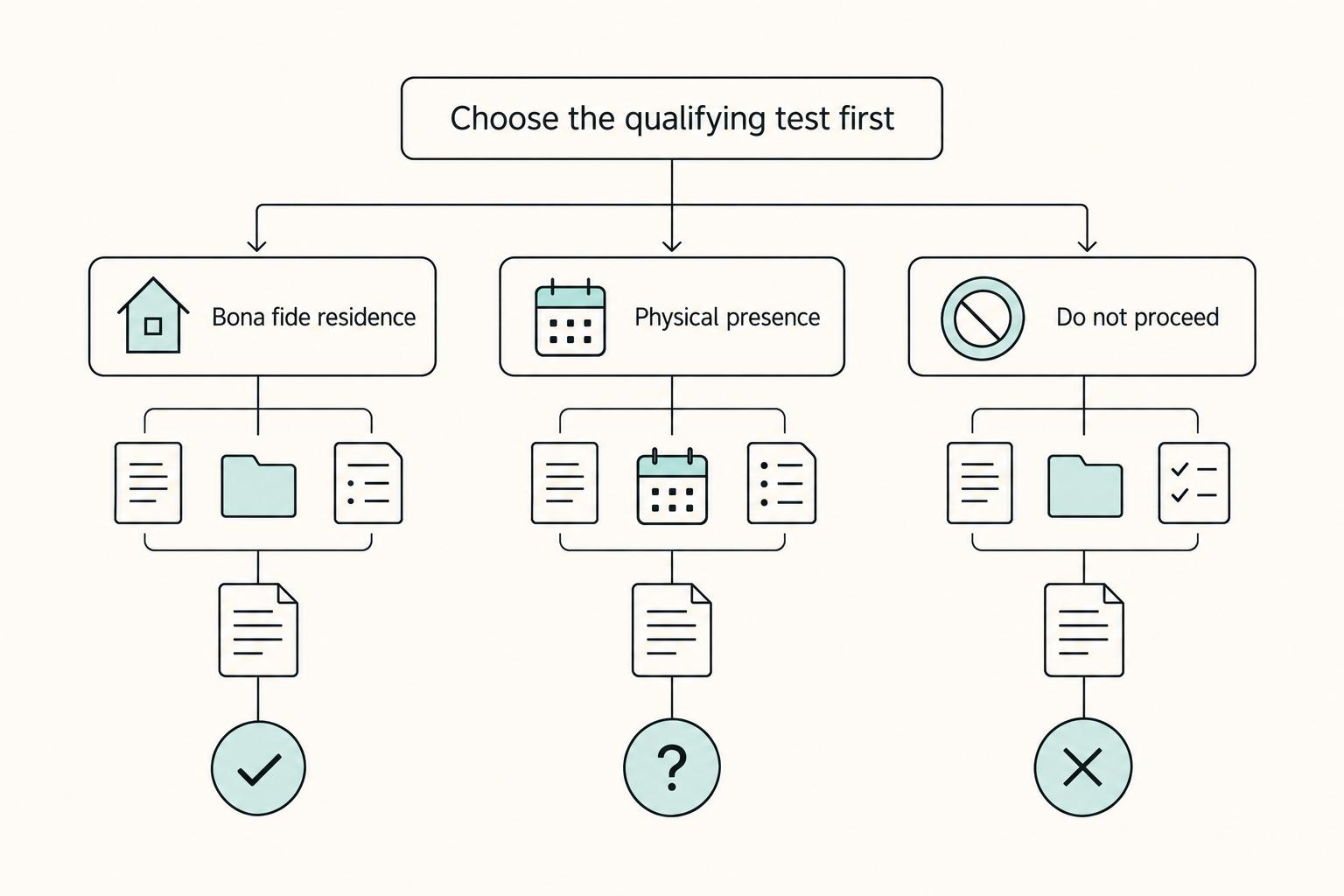
Choose Your Qualifying Test Before You Touch the Form#
Choose the test you can prove cleanly, not the one that just looks better at first glance. If your travel is fragmented, use the path with clearer evidence and fewer judgment calls, as long as it stays consistent with your foreign tax home facts.
Compare both tests before you enter anything on Form 2555.
| Path | Trigger | Evidence to have ready | Common failure mode | Best-fit freelancer scenario |
|---|---|---|---|---|
| Bona Fide Residence Test | You were a bona fide resident of a foreign country or countries for an uninterrupted period that includes an entire tax year. For calendar-year taxpayers, that means January 1 through December 31. | Records that support continuous residence and the visa or entry-status details the IRS asks for. | Assuming one year abroad automatically qualifies you. Bona fide residence is determined by the facts of your situation. | You had a stable foreign base and your records support one consistent residency story across a full tax year. |
| Physical Presence Test | You were in a foreign country or countries for 330 full days in any 12 consecutive months. A full day is 24 consecutive hours from midnight to midnight. | A defined 12-month window and exact arrival and departure dates that reconcile with your travel schedule on the form. | Loose window selection, day-count errors, counting partial days, or assuming the day count alone fixes weak tax-home facts. | You move frequently, but your travel records are complete and easy to verify. |
| Do not proceed | Your residency facts are ambiguous or your two test narratives conflict with your foreign tax home facts. | A written timeline of where you lived, worked, and what document supports each period. | Filing anyway with unresolved contradictions. | You changed countries midyear, split time heavily, or cannot clearly explain foreign tax home continuity. Escalate before filing. |
Use one decision rule. If your travel pattern is fragmented, prioritize the test with cleaner proof. For mobile taxpayers, the physical presence route is often easier to support because it turns on time abroad, but it only helps when your day-count records are reliable.
Once you pick a path, match your evidence standard to it and test it against tax-home consistency. For the Bona Fide Residence Test, your records must support residence across a continuous period that includes a full tax year, not just presence abroad. For the Physical Presence Test, your records must support the exact 12-month window and the 330 full-day count without guesswork.
Finish with one tax-home consistency check. Under either path, your tax home must be in a foreign country throughout the qualifying period. If your residency and tax-home story still do not reconcile, pause and resolve it before you attach Form 2555 to your return.
This pairs well with our guide on How to Fill Out Form W-8BEN-E for a Foreign Company.
Build Your Evidence Pack Before You Start Filling Lines#
Do not start with the form. Start with the file that supports it. Form 2555 asks for specific dates, addresses, tax-home details, and U.S.-presence entries, and it warns that missing requested information can lead to disallowed exclusions or deductions.
Build one packet that maps directly to the fields on the form. Collect these in one folder or working file:
- Travel log with exact arrival and departure dates, especially if you are using the Physical Presence Test and need to support 330 full days in a 12-month period
- Foreign address history, including country
- Tax home timeline, including each tax home and the date it was established
- Income records that tie foreign earned income to your return
- Employer name and address details in the U.S. and abroad, when applicable
- Housing cost records if you plan to claim the foreign housing exclusion or deduction, computed in Parts VI, VIII, and IX
- Prior Form 2555 record, since the form asks for the last year you filed Form 2555 or Form 2555-EZ
You should be able to point to a source document for every date, address, and income figure you plan to enter.
Keep related compliance records in the same review. This helps you catch silo errors.
If you have foreign financial accounts, keep FBAR records alongside your filing documents, even though FinCEN Form 114 is filed separately from the IRS return. Add Form 8938 tracking notes too, because Form 8938 does not replace FBAR, and some filers need one, the other, or both. Your address history, account story, and country timeline should align across your return, FBAR notes, and Form 8938 tracking.
If any income is self-employment income, prepare Schedule SE support now. The foreign earned income exclusion does not remove the need to compute self-employment tax. IRS instructions state SE tax applies at $400 or more in net earnings, and businesses abroad must include all self-employment income when figuring net earnings.
Gather the records used to compute net earnings, including income and expenses, before you finalize Form 2555.
Before you fill in the form, run one reconciliation check. Match your evidence pack against what you will enter on Form 2555 and attach to Form 1040 or 1040-SR. Dates and locations should reconcile across your travel log, foreign address history, tax-home timeline, and any U.S.-presence entries.
If the same date, country, or address appears in multiple places, it should tell the same story each time. If it does not, fix the timeline first, then file.
You might also find this useful: How to Fill Out Form 1116 (Foreign Tax Credit).
Decide What You Are Actually Claiming#
Decide your claim set before you enter numbers. The FEIE election is voluntary, and you should claim only what you can support.
| Item | Rule in the article |
|---|---|
| Foreign Tax Credit | You cannot claim FTC for taxes on income you exclude, and the IRS warns one or both elections may be treated as revoked in this overlap situation. |
| Earned Income Credit | Not allowed if you claim either exclusion or the housing deduction. |
| Additional Child Tax Credit | Not allowed if you claim either exclusion or the housing deduction. |
| IRA deduction | Special rules apply if you claim either exclusion. |
Separate the three possible claims in writing first:
- FEIE
- Foreign housing exclusion
- Foreign housing deduction
They are related, but they are not the same thing. For 2025, the FEIE ceiling in the Form 2555 instructions is $130,000, and you cannot exclude or deduct more than your foreign earned income for the year. If you are self-employed, note that you may be eligible for the foreign housing deduction instead of the housing exclusion.
Verification point: write one sentence that states exactly which of the three you are claiming.
Check overlap rules before you finalize the return.
- Foreign Tax Credit: you cannot claim FTC for taxes on income you exclude, and the IRS warns one or both elections may be treated as revoked in this overlap situation.
- Earned Income Credit: not allowed if you claim either exclusion or the housing deduction.
- Additional Child Tax Credit: not allowed if you claim either exclusion or the housing deduction.
- IRA deduction: special rules apply if you claim either exclusion.
Claim only what you can document cleanly. If your housing calculation is not fully supportable, pause that part until you can substantiate it. Your housing amounts should reconcile to your documented dates and location details. If they do not, pause and fix that first.
Map the Form Parts So You Complete Only What Applies#
Before you touch the line items, decide which parts of the form actually apply. Complete only the areas tied to the claim set you already chose, and leave the rest alone unless the current Specific Instructions tell you otherwise.
Use a conservative map so you do not over-complete the form.
| Form area | Complete / skip gate | Evidence pack input | Common error to avoid |
|---|---|---|---|
| Qualification test area | Complete only the qualification path you can substantiate. | Travel timeline, passport stamps, day-count records | Counting days that are not full 24-hour midnight-to-midnight days, or treating fewer than 330 full days as enough for the physical presence test |
| Foreign earned income area | Complete if you are claiming FEIE | Income records used for foreign earned income | Treating this as optional because income will be excluded. Excluded income is still reported on the return. |
| Housing area | Complete only if you are claiming housing exclusion or housing deduction | Housing expense records | Opening housing sections just because you paid rent abroad |
| Final limitation and calculation area | Complete after earlier amounts are settled | Outputs from earlier form areas and current-year instructions | Finalizing exclusion math before upstream amounts are finished |
Verification point: if your map is unclear for any area, pause and reconcile it against the current Form 2555 Specific Instructions before you continue.
Use one hard gate for housing. If you are not claiming the foreign housing exclusion or foreign housing deduction, leave housing entries out of your calculation flow.
If you are claiming housing, figure housing first. The housing amount is figured before FEIE because it reduces income available for exclusion, and qualified housing expenses are limited. The general housing limit is 30% of the FEIE maximum: $39,000 (2025) and $39,870 (2026).
If your facts changed, for example if you added a housing claim or your work setup changed, rebuild the map from scratch instead of reusing an older pattern.
Complete Parts I Through III Without Residency Contradictions#
Parts I through III set the story for the rest of the form. Complete Part I first, then either Part II or Part III, and fix any date or residency conflicts before you move on.
Treat Part I as the anchor. Keep the personal details consistent with the return you are filing, since Form 2555 is attached to Form 1040 or 1040-SR and is not filed by itself. If a field does not apply, enter N/A.
Be exact on tax-home entries. Part I asks for your tax home location or locations during the tax year and the date or dates established. Those entries should match the qualification path you complete later and stay consistent with your main return.
Choose one qualification path and complete only that part. Form 2555 says to complete either Part II or Part III.
Use Part II for the Bona Fide Residence Test. This path requires an uninterrupted period that includes an entire tax year, and the identity and residency-period details in Part II are commonly missed. Also apply the built-in disqualifier: if line 13a is "Yes" and 13b is "No," you do not qualify as a bona fide resident.
Use Part III for the Physical Presence Test. This path requires 330 full days during any 12 consecutive months. Part III asks for the beginning and ending dates of that 12-month period, plus arrival and departure dates in the travel schedule.
Run a contradiction check before continuing. Your tax-home details and your selected qualification test should tell one consistent story.
- If Part I tax-home dates conflict with your claimed qualifying period, correct the dates before moving on.
- If Part II does not reflect a period that includes an entire tax year, recheck your test choice and entries.
- If Part III dates and travel schedule do not support 330 full days in a 12-month period, rebuild the timeline.
- If both Part II and Part III were started, keep only the path you are actually claiming.
Missing requested information can cause the exclusion or deduction to be disallowed.
Do a mini QA pass against Form 1040 before moving to the income sections. Confirm identifying details match the return. Confirm tax-home country and dates are consistent with the rest of your filing timeline.
Related reading: How to Fill Out Schedule SE (Self-Employment Tax).
Complete Parts IV Through IX and Reconcile With the Return#
Once Parts I through III line up, finish the rest of the form in calculation order: income first, housing if claimed next, then the final exclusion results.
Start by assigning foreign earned income to the year it was earned, not just when it was paid. The FEIE applies only if you are a qualifying individual with foreign earned income, and you still file a U.S. return reporting that income.
For freelancers, your service period, invoice records, and books should point to the same tax year. If they do not, build a simple ledger showing client, service period, amount, and tax year earned before entering totals.
Then run the cap check. For tax year 2025, the maximum FEIE is the lesser of foreign earned income or $130,000 per qualifying person. For 2026, it is $132,900 per person. If you qualify for only part of the year, adjust the maximum by qualifying days rather than using the full-year cap.
If you claim the foreign housing exclusion, compute it before finalizing FEIE. That order is required, and it matters because FEIE is limited to foreign earned income minus any foreign housing exclusion you claim.
For 2025, the stated housing amount limitation is $39,000. For 2026, it is $39,870. The general housing-expense limitation is 30% of the maximum FEIE, before any location or day adjustments in the year's instructions.
If your housing result appears to increase income available for FEIE, pause and recalculate. That can point to an order or assumption problem.
If you are self-employed, run a separate consistency check before finalizing Form 2555 outputs. Use the same business income story across your books, Form 2555, and the rest of the return.
A failure pattern to watch for is mixed timing and mixed location: work performed across different places and payments received in different periods. If the exclusion result seems to absorb all business income without a clear trail, stop and split income by service period and location first. Also keep status consistent. If Part I reflects self-employment, the rest of the return should not reflect an employee fact pattern.
Before you treat the form as complete, reconcile the final Form 2555 outputs to Form 1040 or Form 1040-SR. Claiming FEIE still requires filing a U.S. return that reports the income.
Use this checkpoint:
- Taxpayer identity and tax year match between Form 2555 and the return.
- The income base on the return matches the income base used in your exclusion calculations.
- The final exclusion or housing result carried over is consistent with your qualification period and records.
Use the current-year IRS instructions when carrying results to Form 1040 or Form 1040-SR.
If the numbers look wrong, stop before filing. At this stage, unresolved conflicts are filing blockers.
Common blockers:
- Full-year FEIE cap used even though qualification covered only part of the year.
- Physical Presence Test claimed without support for
330 full daysin any12 consecutive monthsperiod. - Day counts that ignore the full-day rule, meaning
24 consecutive hoursfrom midnight to midnight. - Income included even though it was earned during time in a country in violation of U.S. law.
Recheck the qualification period, earned-versus-received timing, and housing-before-FEIE order. If the conflict remains, do not file until the assumptions are resolved.
If you want a deeper dive, read 183-Day Rule Explained: Stop the Tax Myths Before They Cost You.
Run a Pre-Submit QA Pass Before Filing#
Treat this as a real filing gate. If eligibility, dates, attachments, credit interactions, and calculations do not tell one consistent story, do not file yet.
Use this pre-submit checklist and clear it line by line:
- Eligibility test consistency
Confirm you meet the tax home test and either the bona fide residence test or the physical presence test.
- Date consistency
If you are using physical presence, confirm the exact 12-month qualifying period and all arrival and departure dates match your records.
- Attachment completeness
Confirm Form 2555 is attached to Form 1040 or Form 1040-X. Do not file Form 2555 by itself.
- Calculation traceability
Make sure every final number ties back to your working records and worksheets.
Run interaction checks before you submit, because they directly affect what you can claim.
If income is excluded under Form 2555, you cannot claim a Foreign Tax Credit on taxes tied to that excluded income. If you claim the exclusions or housing deduction, you cannot claim the Earned Income Credit. If you file Form 2555, you cannot claim the Additional Child Tax Credit.
Assemble the filing packet you will retain after filing:
- Final return copy with attached Form 2555
- Qualification-period support records
- Income and housing support used in calculations
- A short worksheet showing how you reached the final exclusion result
- FBAR (FinCEN Form 114) review notes
- Form 8938 review notes or filed copy, if applicable
Keep this distinction clear: FBAR is filed with FinCEN, not the IRS, and Form 8938 does not replace FBAR. You must determine whether to file Form 8938, FinCEN Form 114, or both. If aggregate foreign account value exceeded $10,000 at any time during the calendar year, treat that as an FBAR filing checkpoint and confirm whether FinCEN Form 114 is required.
Make a final go or no-go call with a conservative rule. If one critical fact is uncertain, delay filing and resolve it first.
Critical facts include eligibility, qualifying-period dates, travel-date support, and whether foreign taxes relate to excluded income. Filing with unresolved facts is the risk to avoid.
Need the full breakdown? Read Bona Fide Establishment Test FEIE for Form 2555 Decisions.
Before you file, sanity-check your travel days and residency timeline in the Tax Residency Tracker so your qualifying-test logic and dates stay aligned.
Recover Cleanly If You Filed Too Early or Filed It Wrong#
If your filed Form 1040 used the wrong Form 2555 position, fix the underlying analysis first, then determine whether an amended return is needed. The Form 2555 instructions include an amended-return path.
Classify the error before changing calculations. Put it in one bucket:
- You did not qualify when you filed, often because of a missed physical presence threshold.
- You qualified for only part of the year, so the exclusion needed a qualifying-day adjustment.
- You used the wrong income year, because income is applied to the year it was earned, not when received.
If you are using physical presence, re-count against the actual rule: 330 full days in 12 consecutive months, where a full day is 24 consecutive hours from midnight to midnight.
Rebuild your evidence set before recalculating. Pull travel logs, passport records, flight records, address history, and income records by earned date.
Recheck edge conditions while you do this. Days in a foreign country while violating U.S. law do not count for physical presence, and IRS annual Revenue Procedures may list countries and dates with time-requirement waivers.
Recalculate from scratch. The foreign earned income exclusion applies only if you are a qualifying individual with foreign earned income. Partial-year qualification requires a qualifying-day adjustment to the maximum exclusion.
Use a fresh worksheet and tie each corrected figure back to your records so the revision trail is clear.
Amend only after the corrected position is complete. If an amended return is required, prepare it using your rebuilt Form 2555 numbers and support.
Keep each revision and support document organized so dates, versions, and calculations are easier to reconcile.
Know the Red Flags That Mean Talk to a Pro#
Get a professional review before filing when your Form 2555 position depends on judgment calls instead of clean, reconcilable facts. The main red flags are an unclear Tax Home Test, a borderline Physical Presence Test count, mixed timing across work and payment, or records that conflict.
Stress-test your qualification logic first. If you are using the Physical Presence Test and your count is close, do not rely on rough math. The standard is 330 full days in 12 consecutive months, and a full day is 24 consecutive hours from midnight to midnight. Days can be nonconsecutive, which helps fragmented travel schedules, but it also raises the risk of counting errors.
Borderline files should be reviewed because missing the day count fails the test even if the shortfall came from illness, family issues, vacation, or employer orders. Days spent in a country while in violation of U.S. law do not count, and income from services performed during that period does not qualify as foreign earned income. If you think a waiver applies due to war, civil unrest, or similar conditions, confirm it against the IRS annual Revenue Procedure country and date list before claiming it.
A second red flag is an unclear Tax Home Test. IRS materials note that intent is relevant to tax-home analysis. If your address history, work pattern, and travel records point in different directions, escalate.
Verification point: keep one date log that reconciles passport stamps, flight records, address history, and the exact 12-month window you used.
Escalate when income timing is not clean. FEIE treatment depends on when work was performed, while cash-basis reporting still requires income to be reported in the year received. That combination is a common failure point.
Ask for review if you worked in one year and were paid in another, or if your timeline and records do not reconcile cleanly. Also escalate if you are combining FEIE with housing exclusion, since housing is figured first and reduces income available for FEIE.
Treat related filings as a complexity trigger. If the same fact pattern also touches FBAR or foreign tax credit/deduction decisions, review helps keep facts consistent across filings.
For FBAR, do not rely on memory for due dates or relief. Use FinCEN's FBAR page as the current checkpoint for filing and relief notices.
Use the five-minute write-up test, then hand off a tight packet. This is not IRS guidance; it is a practical threshold. If you cannot explain your filing logic in writing in five minutes, pause and escalate before submitting.
Your handoff packet should include:
- Draft Form 2555 showing the qualifying test selected
- Your U.S. return draft and any amendment draft, if applicable
- One-page timeline with countries, entry and exit dates, addresses, and your chosen 12-month window, if using physical presence
- Travel records, including passport records, flight records, and your travel log or calendar
- Income schedule by service date and payment date, with work-location country
- Notes on possible FBAR filing issues and any foreign tax credit/deduction positions
This lets a reviewer validate your logic quickly instead of rebuilding the case from scratch.
Use This Copy Paste Closeout Checklist#
Use this as a final stop-or-go check before filing. If one critical fact is unclear, pause and resolve it before you submit.
- Confirm one qualifying path.
If you use the Physical Presence Test, verify your tax home was in a foreign country for the days you count. Then confirm 330 full days in 12 consecutive months, and count only full 24-hour midnight-to-midnight days.
- Complete only the Form 2555 entries that match your facts.
Keep one consistent filing story. If you use the Bona Fide Residence Test, remember that living abroad for one year alone does not automatically establish bona fide residence, and for calendar-year filers an entire tax year is January 1 through December 31.
- Reconcile Form 2555 amounts to your U.S. return before signing.
The excluded income still needs to be reported on your return. If you also claim a foreign housing exclusion or deduction, compute housing first because it limits FEIE, and apply income to the year it was earned. Then confirm your exclusion amount stays within the annual cap, for example $130,000 for 2025 and $132,900 for 2026 per qualifying person.
- Check interaction items before treating the return as finished.
Review any Foreign Tax Credit position as a separate interaction point. If your return also includes other credits or deductions, review those separately instead of assuming Form 2555 resolves everything.
- Archive the support records you would need to defend the filing.
Keep the records that support your dates, day count, income timing, and any housing amounts used in the calculation.
- Do not guess on critical uncertainties.
If your day count, tax-home timeline, or income-year assignment is uncertain, stop and fix that fact first. The closeout rule is simple: if your evidence and entries do not cleanly reconcile, the file is not ready.
If you want to keep this process operational after filing season, bookmark Gruv's practical Tools for recurring compliance workflows.
Frequently Asked Questions
Do I file Form 2555 by itself or attach it to Form 1040 or Form 1040-SR?
Attach it to your return, not as a stand-alone filing. Form 2555 says to attach it to Form 1040 or Form 1040-SR, and IRS guidance also says not to submit Form 2555 by itself. If you amend, attach Form 2555 to Form 1040-X.
How do I decide between the Bona Fide Residence Test and the Physical Presence Test?
Start with the tax home test, because your tax home must be in a foreign country throughout your qualifying period under either path. Then choose the test you can prove cleanly. Bona fide residence is the residence-status path, while physical presence requires at least 330 full days in a 12-month period. If you are a calendar-year filer using bona fide residence, the entire tax year runs January 1 through December 31.
Do I need to complete all nine parts of Form 2555?
No. Complete the parts that apply to your facts and election. IRS specifically says to complete Part VI for foreign housing exclusion or deduction and Part VII for the foreign earned income exclusion.
Can I amend later with Form 1040-X if I qualify after I already filed?
Possibly, but not automatically in every case. IRS includes "a return amending a timely filed return" as a path for making the election. Rebuild your timeline and eligibility before filing Form 1040-X with Form 2555 attached.
What documents should I collect before starting Form 2555?
Collect records that let you prove your qualifying path and reconcile your dates. IRS specifically calls for visa type and residence-period details for bona fide residence, and for the 12-month qualifying period plus arrival and departure dates for physical presence. Keep your timeline consistent so your filing position is easier to validate.
Can I claim Foreign Earned Income Exclusion and Foreign Housing Exclusion or Foreign Housing Deduction together?
Yes, if you meet the requirements and complete the appropriate parts of Form 2555. IRS states you can choose FEIE and the foreign housing exclusion, and it separately states housing benefits may be claimed in addition to FEIE. Claim only amounts you can support with clear records.
How does Form 2555 interact with Foreign Tax Credit and Schedule SE?
You cannot claim a foreign tax credit on income you exclude. IRS is explicit that taxes tied to excluded income are not creditable for FTC purposes. Also, FEIE does not automatically remove self-employment tax exposure, so review Schedule SE separately.
Try a related tool
Researched and edited by the Gruv editorial team. Gruv builds cross-border billing, payouts, and finance-operations software for global businesses.
Sources
Educational content only. Not legal, tax, or financial advice.
Related Posts

183-Day Rule Tax Myths That Trigger Residency Filing Mistakes
If you are a mobile freelancer or consultant, start here: the "183 day rule tax" idea is not a single universal test. It is a shortcut phrase people use for different residency rules that do not ask the same question. If you mix federal and non-federal residency logic, you can create filing risk even when your travel calendar looks clean.

Opening a Bank Account in Europe as a Non-Resident
If euros arrive on time, reconcile cleanly, and remain usable without constant support tickets, you have solved the real problem. The search phrase "open european bank account non resident" usually means one thing in practice: protect cashflow. Start there, not with prestige features.

The Freelance Payment Penalty: A Modeled Audit of Platform Fees, FX Spreads, and Payout Delays
The money rarely disappears through a single, easy-to-spot fee. The real loss is stacked. A marketplace takes its commission, a processor adds a charge for international cards, a bank or payment company converts the currency at a spread, a platform holds the funds before release, and a wire sheds a little to intermediaries on the way in. Each layer looks defensible on its own, but the worker feels the combined result as a smaller deposit and a later payday.