
Quick Answer
Start with one concrete objective, then build a verified shortlist and compare options on a single decision table. For writing residencies for authors, the article recommends checking format, eligibility, full cost, and deadline status on each host site before tailoring materials. It uses examples like A.I.R. Studio Paducah and Studio Faire Residency to show why category labels alone are not enough. Final advice is practical: submit only after a pre-send risk pass that confirms files, links, and timing details.
Start here with the outcome you want from a residency#
Decide what success looks like before you open a single listing. If you skip that step, a residency turns into inspiration browsing. That is how you end up chasing attractive programs that do not actually help you finish the work in front of you.
Start with one primary outcome, not five. Common outcomes include finishing a draft, unblocking a research problem, rebuilding writing momentum, or resetting a schedule that has been chewed up by client work, teaching, family demands, or travel. Those goals sound close, but they lead you to different kinds of programs. A quiet solo stay may help you draft chapters quickly. A more social artist residency may be better if you need outside energy and structure.
A useful checkpoint is to write your outcome as a sentence you could drop into an application. State what you plan to work on, what will be different by the end, and what conditions you need to get there. Specificity matters. Writers have reported being selected because they were clear about their goals and needs, and that tracks with how these applications are judged. Your application is not a formality. In some programs, the writing sample can account for 40% of the score, and in others as much as 80%.
Treat this as an operating decision, not a daydream. If your goal is draft completion, your criteria might be uninterrupted writing hours, private workspace, and a stay long enough to settle in. If your goal is momentum, you may care more about structure, deadlines, and whether the environment makes it easy to write every day. If your goal is research, you need to test whether the location, archives, or field access actually match the project instead of assuming the setting will somehow help.
Two failure modes show up early. The first is browsing based on mood: beautiful photos, famous names, or the vague idea that any retreat time will help. The second is starting applications before you know what evidence you can support. Since the same packet can lead to very different outcomes across programs, you should not assume one generic set of materials will do the job everywhere. If a listing asks for a writing sample, project statement, and even two letters of recommendation, you need to know why that program belongs on your list before you spend the effort.
So the first move is simple: define the result, name your constraints, and use that as a filter. By the end of this guide, you should have three practical outputs: a shortlist you would genuinely attend, a comparison method you can trust, and an application checklist you can execute this month.
This pairs well with our guide on The best 'writing apps' for authors (Scrivener).
What a writing residency is and is not#
A writing residency is a program designed to give you dedicated time and space to work, but it is not one single format. Treat it as a category, not a promise of one standard experience.
In practice, residencies can support writers and other artists, and that can change the rhythm and expectations of daily work. Some are more self-directed, others more communal, and formats vary by program. Duration varies too, even though some programs in the wider field use two- to four-week windows.
A residency is also not automatically the same thing as an author retreat. Many programs use formal application processes, and some are more selective than others. Cost is not uniform either, so check each listing directly for whether it is fully funded, partly subsidized, or fee-based.
Use names like A.I.R. Studio Paducah and Studio Faire Residency as reminders that the category is broad, not as shortcuts. Before you invest time in applying, confirm on the official page who the program is for, how long it runs, how the work setup is structured, and what you are expected to pay or provide.
If useful, see A Guide to Writing Case Studies for a B2B SaaS Audience.
Set your objective before you shortlist programs#
Set one primary objective before you compare programs, because the right choice for one goal can be wrong for another. Keep it singular, then treat everything else as a bonus.
Choose the outcome that makes the stay a win#
Pick one:
| Objective | What it means |
|---|---|
| Draft completion | clear progress on pages, chapters, or a manuscript section |
| Revision sprint | focused time to rework existing material |
| Research immersion | location or access is central to the work |
| Recovery and rest | the goal is sustainable output later, not maximum output now |
Pick the objective that matches how you actually work, not what looks most prestigious.
Turn your objective into hard constraints#
Before you browse, write down:
- your minimum uninterrupted writing block
- your maximum acceptable travel burden
- the residency length that fits your objective
Then screen every listing against those constraints first.
Use the program's own language as a check. Jerwood Arvon describes a self-directed development opportunity for 12 writers working on a full-length project with the aim of completion, in a self-guided 18-month programme running from early 2026 to mid-2027. It also sets clear eligibility boundaries: applicants must be 18+ and based in the UK.
Kenyon Review describes its residential workshops as generative, focused on giving writers time and space to produce new work, with listed tuition of $2,545. It also states that Applications for Summer 2026 have closed, which is the kind of status detail that should affect your shortlist immediately.
If a program page does not clearly support your one main objective, move on.
You might also find this useful: How to Write a Book to Establish Your Freelance Expertise.
Build a credible longlist from four source types#
Build your longlist from mixed source types, then trust only what the official program page confirms. That keeps discovery broad without letting stale or mislabeled entries into your shortlist.
| Source type | Guidance |
|---|---|
| discipline-organized current-calls page | like BOMB Magazine and Fellowships & Residencies (including WRITING) |
| mixed opportunity hubs that combine formats | like Penguin's list of awards, retreats, mentorships, and training opportunities |
| roundup posts | for breadth, knowing some are only "very roughly" organized |
| official program page | the final authority before an entry stays on your sheet |
Use all four in parallel, but let the official program page decide whether an entry stays.
Verify the format before you keep the entry#
Not every writer opportunity is a residency, even when it appears in the same discovery flow. If an official page is framed around "eligibility + submissions," read it end to end before you classify it.
Use Aspen as a model check: the page clearly presents the Aspen Words Literary Prize as "a $35,000 annual award." Valuable opportunity, but not a residency slot.
Use source tags and kill weak entries fast#
A credible longlist is easy to audit. Keep these fields beside every entry:
- discovery source used
- official program URL
- format confirmed: residency, retreat, prize, mentorship, or other
- current deadline or status
- exact eligibility page or section
If a roundup looks dated (for example, old deadlines) or the official page is vague, missing, or contradictory, remove the entry.
Need the full breakdown? Read Build a Character Profile for a Novel That Survives Revision.
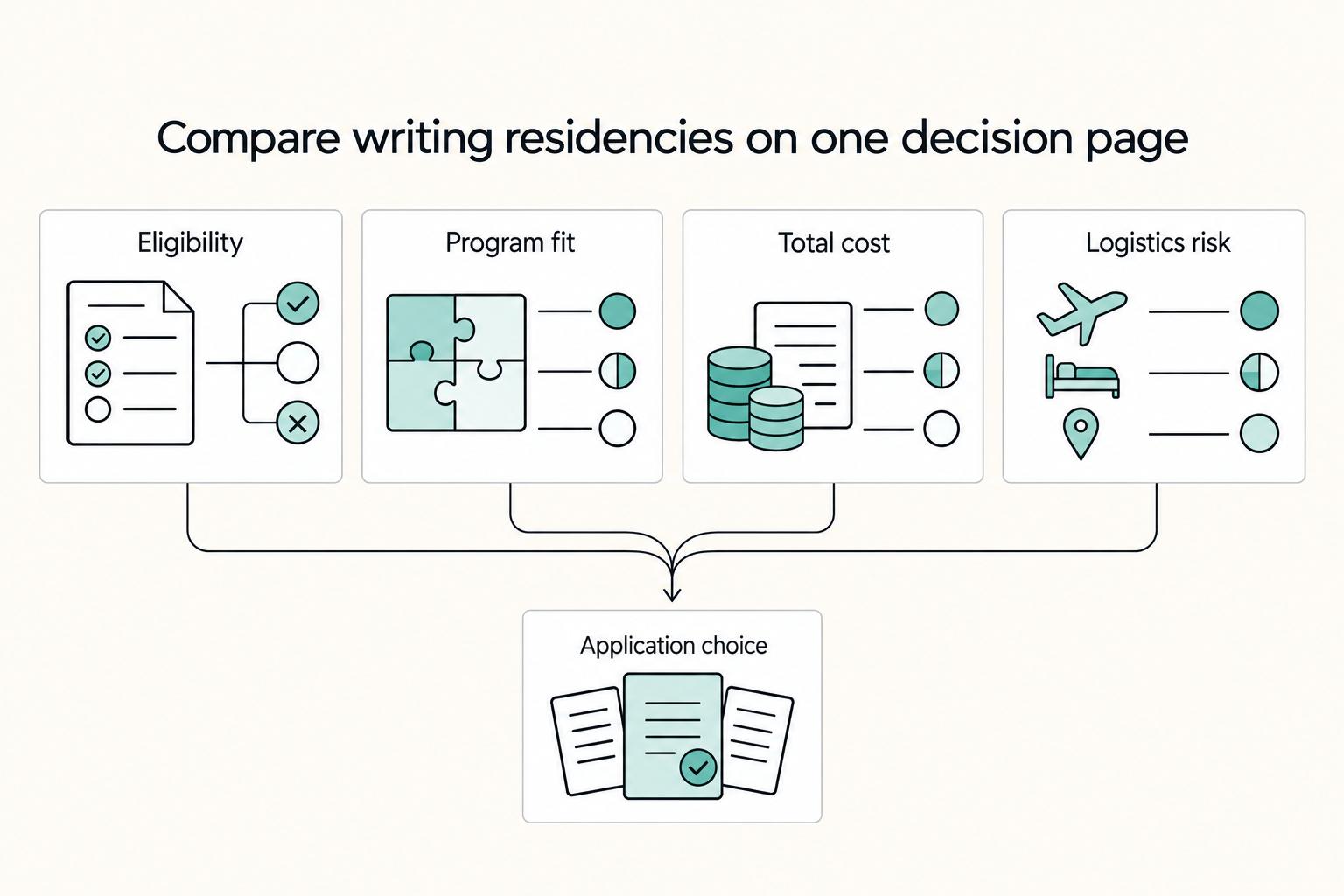
Compare programs with a decision table before you apply#
Once your longlist is verified, make the decision on one page. A compact comparison table makes tradeoffs visible fast, and if two options are close, choose the one with clearer eligibility language and lower logistics risk, not stronger marketing copy.
Build the table from official-page language#
Use exact wording from each official program page, not what you remember from roundups. Keep only the fields you need to decide: program type, duration, deadline model, eligibility, total expected cost, workspace setup, required materials, and verification status.
For cost, do not label anything as "free" until you check the full page. Residency models vary: some are free, some pay participants, and some charge room and board. Application fees are common, with one guide citing a typical range of $25 to $50, and some programs may waive fees if you ask and explain your situation.
| Program | Program type | Duration | Deadline model | Eligibility | Total expected cost | Workspace setup | Required materials | Verification status |
|---|---|---|---|---|---|---|---|---|
| Rockvale Writers' Colony | Copy exact label from official page | Enter exact stated length | Fixed date, rolling, or other | Paste exact applicant criteria | App fee, travel, room/board if any | Private, shared, or unclear | Sample, project statement, bio, references, other | Set after official-page review |
| Vermont Studio Center | Copy exact label from official page | Enter exact stated length | Fixed date, rolling, or other | Paste exact applicant criteria | App fee, travel, room/board if any | Private, shared, or unclear | Sample, project statement, bio, references, other | Set after official-page review |
| Bellagio Center Residency Program | Copy exact label from official page | Enter exact stated length | Fixed date, rolling, or other | Paste exact applicant criteria | App fee, travel, room/board if any | Private, shared, or unclear | Sample, project statement, bio, references, other | Set after official-page review |
| Berlin Prize Fellowships | Copy exact label from official page | Enter exact stated length | Fixed date, rolling, or other | Paste exact applicant criteria | App fee, travel, room/board if any | Private, shared, or unclear | Sample, project statement, bio, references, other | Set after official-page review |
Set verification status with discipline:
- confirmed: clearly stated on the official program page
- unconfirmed: found only on third-party pages, or official language is too vague
- outdated: conflicting or stale dates, fees, or instructions
Compare risk, not just attractiveness#
Your best-looking option may not be your best operational bet. Prioritize programs with clear eligibility, complete requirements, and a cost picture you can defend before you invest application time.
Some competitive residencies are reported at 10 to 20 percent acceptance, which is useful for sequencing but not a universal benchmark. Use that as planning input rather than a guarantee: pair one stretch application with one clearer, lower-friction option so your month does not depend on a single long shot.
Before you apply, date-stamp each row, save the official URL, and note exactly what supports each claim. If eligibility is vague or materials are buried, flag it now and move carefully.
If you want a deeper dive, read Digital Nomad Health Insurance: A Comparison of Top Providers.
Run cost, eligibility, and logistics checks before submission#
Before you submit, confirm three things: your real total cost, clear eligibility, and an active, correctly timed application window.
| Area | What to confirm | Details from the article |
|---|---|---|
| Cost | your real total cost | application fee; participation/program fee; travel; lodging; meals; local transport |
| Eligibility | clear eligibility and required materials | nationality, career stage, discipline, or age; artist statement, portfolio, statement of intent, plus program-specific items |
| Status and timing | an active, correctly timed application window | record deadline date and timezone exactly; for example, midnight EST vs 11:59 PM local time |
Price the full application, not just the headline fee#
A listing can be fee-free and still expensive overall. Break costs into:
- application fee
- participation/program fee
- travel
- lodging
- meals
- local transport
Treat each line as a number or an explicit "unknown." One checklist source reports many application fees in the $0-$50 range, with some higher. If cost is a blocker, ask about a fee waiver early so you have time to get a response.
Check eligibility from the official guidelines page#
Read the full call, not a summary page. Eligibility can be limited by factors like nationality, career stage, discipline, or age, and broad labels can hide exclusions.
Use program names like A-Frame Residency or Anderson Center Jerome Early Career Artist Residency Program as prompts to verify exact criteria on the official page. If you cannot state in one sentence why you are clearly eligible, pause and confirm before spending more time.
Also verify required materials early. Missing materials is a common rejection reason, and many applications ask for an artist statement, portfolio, and statement of intent, plus program-specific items.
Verify status, deadline timezone, and final details#
Do not treat unclear or older listings as active until the official program page confirms it. If status language is vague, contact the program directly before you invest application effort.
Record deadline date and timezone exactly. Cutoffs can differ (for example, midnight EST vs 11:59 PM local time), and that difference can decide whether your submission is accepted.
If anything is ambiguous, send a short email with one concrete question and save the reply with the program URL and date.
For a step-by-step walkthrough, see A guide to 'Amazon Ads' for authors.
Prepare one reusable application evidence pack#
Build one reusable application pack, then tailor only what each call actually asks for. The goal is consistency so you can hit "send" before deadline pressure creates avoidable mistakes.
Use this as a reusable base for residency applications:
- project statement
- writing sample set
- short and medium bio variants
- references list with current contact details
- residency-specific cover note
Treat this as your working packet, not a universal requirement. Program pages control the final upload list, so mark each requested item as ready, needs tailoring, or missing before you submit.
Keep two project statement versions#
Keep two versions and choose based on the call.
- Outcome-focused: use when the call emphasizes what you will produce and why the residency period matters now.
- Process-focused: use when the call emphasizes time, experimentation, or sustained practice.
For selective programs such as Edward F. Albee Foundation Residencies, use this as a framing choice only, not an assumption about exact requirements.
Track submissions like records, not memory#
Use a simple tracker with: program name, official deadline, timezone, required uploads, version submitted, submission date, and confirmation receipt. Deadline roundups can help you scan what is coming first, but your own tracker is what prevents missed details.
Keep a basic document history (v1, v2, submitted) and save confirmation emails or portal receipts with the submitted files. If a call asks for materials you cannot provide at quality this cycle, defer it instead of submitting a weak packet.
Related reading: How to Structure an LLC for a Freelance Writing Business.
Avoid the failure modes that waste time and money#
The biggest waste is usually avoidable: applying at volume before you confirm fit, recency, and access. Use discovery lists to find options, then filter hard before you invest in tailoring.
Filter before volume#
A broad list can create activity without progress. If your goal needs sustained writing time, a listing described as "a two-week-long stint for comedy writers" may be a mismatch, even if the program sounds attractive.
Before you keep any listing, check it against your own constraints (for example: duration, work setting, and likely total spend). If it misses your core needs, drop it early.
Do not confuse a fresh list with a current opportunity#
A roundup can look recent while the underlying opportunity is old, changed, or closed. Treat the official program page as the source of truth every time.
A useful reminder: one Congress tracker shows "Latest Action" on 11/20/2014 while the status is still "Introduced." The latest visible entry is not the same as current availability. Apply that same logic to residency lists. If you see an age warning like "more than 1 year old," verify before acting.
Also check access limits before you trust details. Some posts are marked "Paid" (for example, a Substack post dated May 15, 2025), and some are labeled "Member-only story." If you cannot view full terms, do not assume you have complete eligibility or submission requirements.
Run a 72 hour red-flag pass#
About 72 hours before submitting, pause writing edits and do a final risk check against the official page and your evidence pack:
- confirm the call is still active and the URL works
- copy the eligibility line exactly as written into your tracker
- open every attachment from the exported submission files
- click every link in your bio, site, and writing samples
- verify references, file names, and upload formats match the call
Prestige can hide practical problems. If timeline, working setup, or total cost is still unclear, treat that as a red flag until clarified.
Make your decision and take the next step this week#
Make one clear decision rule this week and act on it. If a three-program sequence with a primary and backup helps you move, use it as a workflow, not a universal formula.
Do not turn "top three" or "primary plus backup" into a rule. Do not assume it is the one correct method for every applicant. One source is a personal Substack post (Feb 19, 2025) sharing "the shortest free residencies I could find," which is useful for discovery but not for confirming current fees, eligibility, deadlines, or program status.
Before each submission, verify details on the official program page and in the exact files you will upload:
- Confirm the call is live.
- Confirm eligibility language matches your situation.
- Confirm file requirements and limits in your final exports.
- Save submission confirmation so you can track what was actually sent.
After each submission, log what worked and update your materials before the next deadline window. Ignore advice built for medical-residency personal statements, since that is a different admissions context.
Related: The Best Ways to Diversify Your Income as a Freelancer.
Frequently Asked Questions
What is a writing residency for authors?
A writing residency is a retreat format that gives creative writers dedicated time and space for a specific project. Beyond that baseline, formats can vary by program, so use each residency's own description to judge the structure and fit.
How do I choose between a writing residency and an author retreat?
Choose based on the work you need to complete right now. Compare each program's stated structure and expectations, then pick the option that best matches your project goals.
Are fee-free writing residencies actually free in practice?
Not necessarily. A program may charge no application fee, and many listings note that many residencies do not, but "no application fee" only describes the application step. Check each program's full terms before you apply.
Where can I find legitimate writing residency listings quickly?
Start with reputable residency listing hubs to build a shortlist. Then verify every serious option on the official program page before you spend time tailoring materials.
What should I verify before applying to any residency?
Confirm the eligibility and required materials on the official program page, and follow those requirements exactly. If a program requires extras such as recommendation letters, include them exactly as requested.
How should I compare rolling admissions with fixed deadlines?
Do not assume a fixed rule for rolling versus fixed deadlines applies. Use the current program page for each residency, and prioritize submitting only when your writing sample and project statement are strong and specific.
What are the most common application mistakes first-time applicants make?
A common mistake is treating the statement like a vague dream instead of a concrete work plan: be specific about what you plan to do. The writing sample is often the core document, with some residencies weighting it at 40% to 80% of the score, though not universally. Another frequent miss is ignoring exact program instructions, including required letters when requested.
Try a related tool
Researched and edited by the Gruv editorial team. Gruv builds cross-border billing, payouts, and finance-operations software for global businesses.
Sources
- arts.gov/sites/default/files/FY27-GAP-Literary-Arts-I...trusted
- buffalo.edu/grad/beyond/professional-development/write.htmltrusted
- congress.gov/bill/113th-congress/senate-bill/2954/texttrusted
- era.nih.gov/docs/commons_userguide.pdftrusted
- files.eric.ed.gov/fulltext/ED301529.pdftrusted
- grants.nih.gov/grants/rppr/rppr_instruction_guide.pdftrusted
- pmc.ncbi.nlm.nih.gov/articles/PMC5289455trusted
- poetry.arizona.edu/blog/give-me-time-and-space-how-land-writing...trusted
Educational content only. Not legal, tax, or financial advice.
Related Posts

Digital Nomad Health Insurance Comparison for Long-Stay Moves
Use focused time now to avoid expensive mistakes later. Start with a practical `digital nomad health insurance comparison`, then map your route in [Gruv's visa planner](/tools/visa-for-digital-nomads) so we anchor policy checks to your real plan before pricing pages pull you off course.
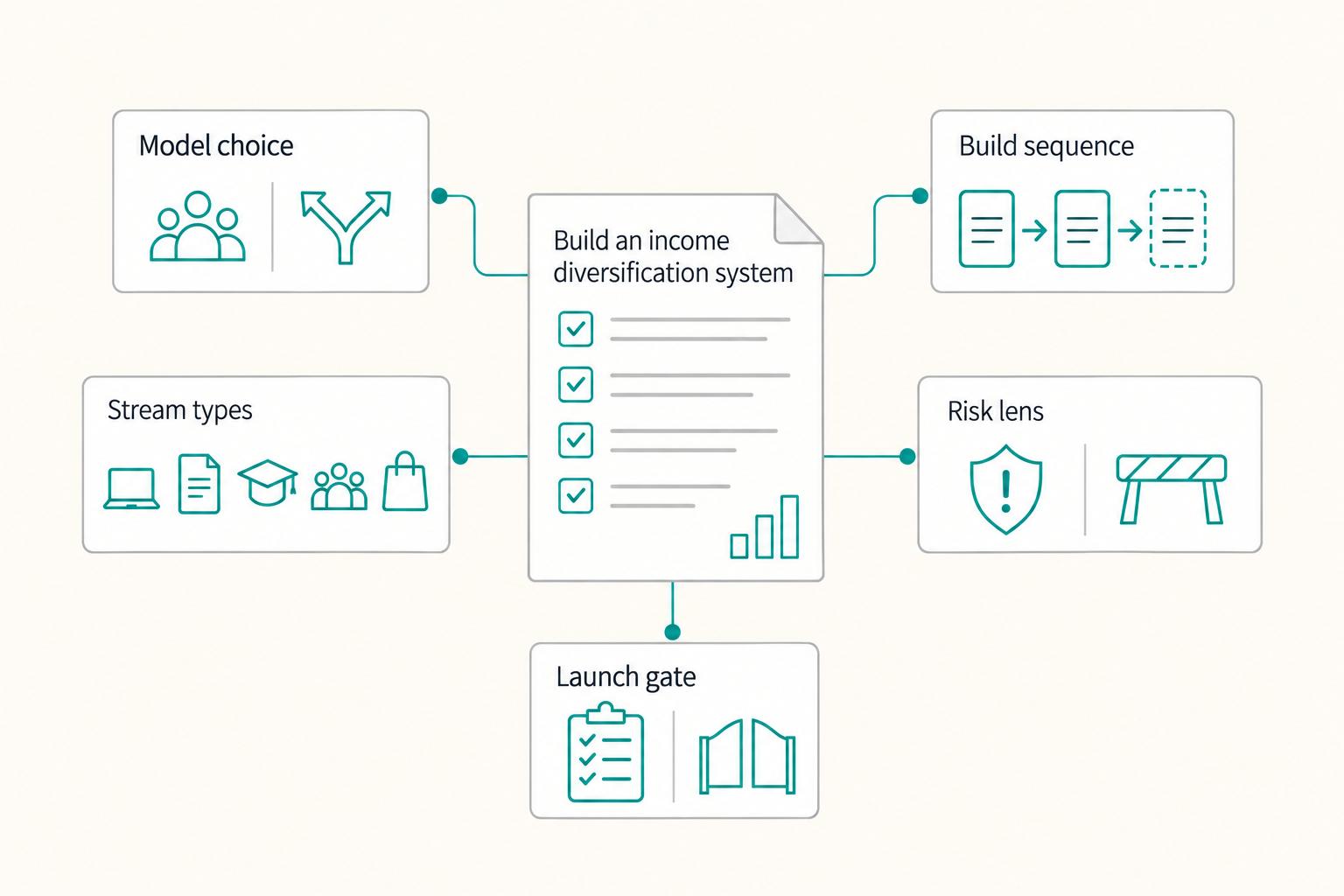
The Best Ways to Diversify Your Freelance Income: A Risk-First Framework
Most freelancers add new revenue lines reactively: a course after a slow month, an affiliate link because someone else said it works, a consulting offer because one client asked for it once. The result is usually the same: more moving parts, unclear priorities, and no real protection when one major client or platform wobbles.

How to Write a Book as a Freelancer Without Scope Drift
The book needs a defined job and a defined boundary before you draft. In this cycle, give it one job: either support your client book services, or strengthen your own authority book so your niche, offer, and sales conversations become clearer.