
Quick Answer
Start by treating case studies for B2B SaaS as decision documents, not promo stories. Choose one objective, map each metric to a source system and owner, and draft only from claims you can retrace. Use a clear Challenge-Solution-Results structure, then add certainty labels such as verified, directional, or self-reported. If attribution is disputed or approvals are incomplete, narrow the claim or hold the release.
Why this guide exists for independent B2B SaaS operators#
If you work independently, you do not need another gallery of polished examples. You need a way to produce B2B SaaS case studies that help a buyer trust the result, help a client feel fairly represented, and hold up in review when someone asks, "Where did this number come from?"
That need is sharper in B2B SaaS because the ground moves fast. Technology changes, market demand shifts, and growth depends on both strategy and execution. In that environment, a case study is not just a nice proof asset. It can show a real problem, a real intervention, and measurable outcomes in one place. Done well, it builds trust and can influence buying decisions because it gives prospective customers proof, not just positioning copy.
The challenge is that polished examples often emphasize outcomes more than the process details operators need. A glossy page can help with tone and structure, but it may leave open questions about metric definitions, timeframe, customer approval, or what was excluded because it could not be supported. That missing layer is where independent consultants, fractional marketers, and small SaaS teams can run into trouble.
A credible SaaS case study is often a decision document in a marketing format. Before you write a line, you should know four things: the business problem, what changed, which outcome matters most, and what evidence supports that outcome. If any one of those is fuzzy, the draft can go vague or overreach. Both hurt trust. A common failure mode is leading with a dramatic result from mixed sources or unclear attribution, then finding out during review that the baseline is disputed.
That is why this guide is built around repeatability, not inspiration. The goal is to give you a method you can reuse across clients and accounts, with checkpoints that force clarity early. One rule carries through the rest of the article: if you cannot trace a claim back to a source artifact or a named owner, do not make it the headline. Reframe it, narrow it, or leave it out.
The promise is simple: you should be able to publish a persuasive B2B SaaS case study that is specific enough to support buying decisions and careful enough to protect trust. That gives you a piece of content you can reuse across sales, SEO, and content marketing without changing the facts.
Define the case study standard before you write#
Set the standard first: for B2B SaaS, a case study should help a buyer make a decision, not just provide social proof. Keep enough context to show what changed, how it changed, what outcomes were observed, and where the limits are.
| Part | What to specify |
|---|---|
| Challenge | What problem existed, in whose words, and in what business context? |
| Solution | What was actually implemented, changed, or removed? |
| Results | What outcomes were observed, over what period, and from which source? |
A customer story can be lighter and more promotional. A case study should carry decision value. If it feels overpolished and skips operational detail, skeptical buyers are more likely to discount it.
Use the Challenge-Solution-Results framework as your base, and make each part specific enough to answer the questions in the table.
Hold a strict credibility bar: no claim without a source artifact, and no metric without stated scope. Scope can be as simple as channel, segment, team, or reporting period.
If you cannot verify a claim, downgrade it to directional insight or remove it. That is what separates a usable case study from a glossy customer story. Related: Best Lead Generation Tools for B2B SaaS Operators.
Pick the right customer story and metric spine#
Choose the story with the clearest verifiable outcome, then write. The strongest draft starts with one primary objective and a metric spine you can defend.
Use one objective per draft: lead generation, conversion efficiency, or pipeline quality. When you mix all three, the story usually gets blurry, especially across SEO, paid media, and demand generation. Prioritize audience relevance over internal preference.
If data is split across Google Ads, LinkedIn, and Facebook, do not headline ROI. Lead with funnel movement you can verify from a named source, with clear scope and ownership.
Before you commit, run a quick publishability check:
- Who owns the number?
- Where does it live?
- Will the customer approve it?
Customer participation and approval are often the real bottleneck, not writing quality. If those answers are vague, pick a different story.
| Candidate story | Primary objective | Data access | Outcome clarity | Stakeholder availability | Time to publish |
|---|---|---|---|---|---|
| SEO content program | Lead generation | Can you access search, form, and CRM data? | Is there a clear before/after period? | Will marketing and customer approve? | Fast, medium, or slow |
| Paid media campaign | Conversion efficiency | Are ad platform and landing page numbers aligned? | Can you show movement beyond clicks? | Is a channel owner available? | Fast, medium, or slow |
| Demand generation motion | Pipeline quality | Can CRM stages and definitions be verified? | Is lead quality defined in plain terms? | Can sales confirm the story? | Fast, medium, or slow |
Use this table early, before interviews are booked. You are screening for publishable evidence, not just interesting wins.
Detailed interviews still matter. Specific stories and real numbers make drafting easier, but a strong interview subject is not always a strong case study candidate. Pick the story with accessible data, a clean narrative arc, and fast stakeholder follow-up.
Use examples like Powered By Search and HIVE Strategy for pattern ideas, not as proof standards for your claims. Your standard is simple: choose the story whose core outcome you can verify, explain, and get approved clearly.
Assemble an evidence pack before drafting#
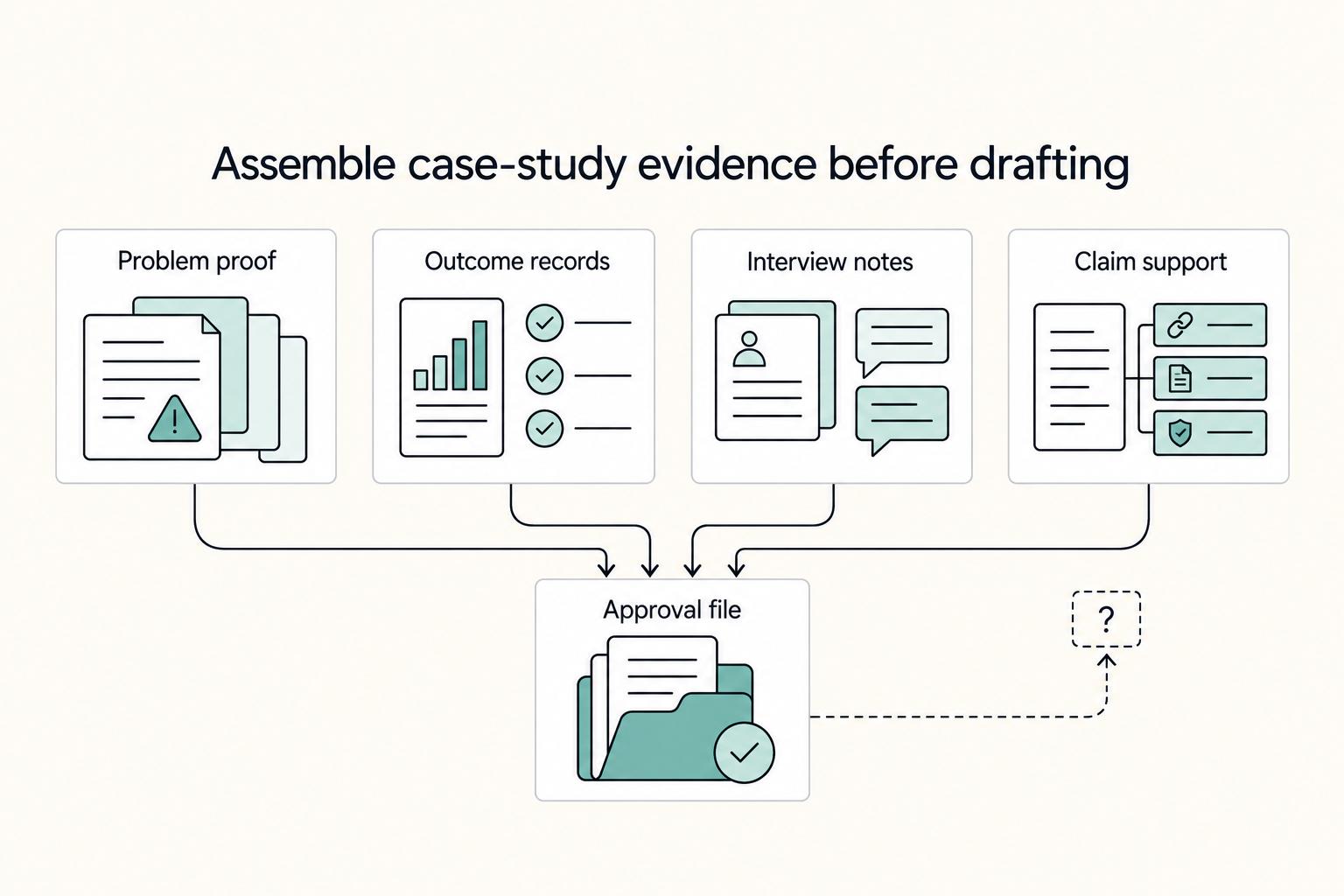
Assemble the evidence pack before you draft, because trust depends on claims you can retrace and defend. For a case study, that means showing how a real problem was solved with narrative plus verifiable numbers, not relying on memory.
What to gather#
Keep it simple but complete enough for review:
| Evidence item | Details |
|---|---|
| Campaign exports | From the platforms you reference |
| CRM snapshots | For the stages or outcomes you mention |
| Attribution notes | Explaining how touchpoints were counted |
| Interview notes or transcript | Customer and account-team interview notes or transcript |
| Approval owner | For metrics, naming, and quote usage |
| Redaction notes | Anything that cannot be published as-is |
Freeze this evidence at a point in time so the draft and source data do not drift during review.
Track metric confidence, not just the metric#
Use an internal verification table so each number has ownership and context.
| Metric | Source system | Calculation owner | Timeframe label | Confidence level |
|---|---|---|---|---|
| [Metric name] | [Platform/CRM/report] | [Role/name] | Before/after window or period | High / Medium / Low |
Keep confidence labels blunt:
- High: source and calculation logic are stable and approved.
- Medium: usable, but depends on a known assumption.
- Low: not strong enough to headline without clear caveats.
If a claim is self-reported and has no audit trail, treat it as context, not core proof.
Flag failure modes and compliance language early#
Call out failure modes before drafting: attribution mismatch, missing baseline, overlap between SEO and paid media touchpoints, and unsupported self-reported outcomes. If channel-level causality is not defensible, anchor the story to the outcome you can verify with owned records.
For regulated or geography-sensitive topics, add plain scope language early so the draft does not overclaim. Phrases like "coverage varies by market and program" or "results depend on geography and account setup" keep the section accurate.
Draft the narrative without hype using Challenge-Solution-Results#
Use Challenge-Solution-Results, but make process change the center of the story, not just the result line. The most credible case studies show how the team moved from problem to outcome with concrete implementation steps a buyer can evaluate.
A practical sequence is: Situation, Trigger, Barrier, Solution, Results. It prevents the common jump from "we needed more pipeline" to "pipeline improved" without showing what changed in between.
Put process changes in the middle#
Name the operating problem in the challenge, not only the business goal. "Lead volume was inconsistent" is vague. "Paid traffic was landing on a generic demo page, and sales flagged low-fit form fills" gives readers something specific to assess.
In the solution, replace broad verbs like "optimized" with actions supported by your evidence pack: revised landing pages, narrowed targeting, rewritten onboarding emails, cleaned CRM stages, or updated marketing-sales handoff rules. Concrete actions make the result feel plausible, not promotional.
Use a simple check: each paragraph should map to an artifact you already froze. Challenges should map to interviews, CRM views, or attribution notes. Results should map to the export and timeframe label.
Keep the tone close to a buyer memo#
Use Gong, Zylo, or Databox-style pages as tone references, not templates to copy. If your draft spends more words praising the brand than explaining the business problem and implementation changes, it has drifted into promotion.
That matters because overly product-focused writing is a known failure pattern in B2B content. Clarity, education, and trust are more persuasive than hype.
Scannable should not mean shallow#
Scannable structure helps when it stays evidence-led: a measurable headline, a concise snapshot box, and tight paragraphs. But keep the operational detail that explains why the outcome was possible.
If you cannot clearly describe process change, narrow the claim instead of forcing cause and effect. It is better to publish a smaller, defensible result than a bigger, weakly supported one.
Validate outcomes and disclose unknowns like a professional#
Before you publish results, label each outcome by certainty: verified, directional, or self-reported. If attribution is disputed, publish the most conservative defensible metric and document the dispute internally before approval.
A practical standard:
| Outcome type | What to publish | What to note internally |
|---|---|---|
| Verified | Metric tied to a source artifact, timeframe, and calculation owner | Where it was pulled from and who owns the math |
| Directional | Signal-level result with clear uncertainty language | Which assumptions or blended logic affect confidence |
| Self-reported | Explicitly marked as client-reported and not independently audited | Why independent verification was not possible |
Label certainty in the draft, not after approval#
Put certainty labels next to the metric in the draft so reviewers do not treat every number as equally strong. Simple labels are enough, such as "Verified in CRM for stated period" or "Self-reported by client, not independently audited."
Before approval, check every published result for:
- source system
- timeframe label
- calculation owner
If any one is missing, downgrade or remove the claim.
Treat attribution disputes as a warning, not a footnote#
Attribution can include missing and unknowable data, so avoid presenting disputed models as precise. When systems or stakeholders disagree, publish only the conservative metric you can defend and keep the dispute in internal notes.
If attribution for a pipeline claim is contested, lead with movement you can verify instead of a hard causal claim.
Disclose unknowns before they become trust problems#
If results are self-reported, say that plainly and avoid overclaiming causality. Use this red-flag checklist, especially for forum and roundup-style material:
- freshness unknown
- methodology unclear
- survivorship bias risk
If any flag appears, narrow the claim and add context.
Match format length to channel and buying stage#
Choose format by buyer stage and channel, not by habit. Use short proof for sales follow-up and outbound when the reader needs to validate one claim quickly. Use a full case study for SEO and content marketing, where buyers compare options across channels and need enough detail to judge whether outcomes are credible.
Keep one core narrative, then adapt packaging, not facts. Your master version should hold the canonical challenge, implementation sequence, verified outcomes, timeframe labels, and any "self-reported" language. Before publishing a sales page, blog version, or PDF, confirm the baseline, date range, and confidence label still match the source.
| Use case | Length | Emphasis | Watch for |
|---|---|---|---|
| Sales enablement page | Short | One problem, one relevant result, one implementation detail | Cutting context so much that the result looks unearned |
| Blog case study | Full | Searchable context, implementation depth, verified outcomes, clear limits | Turning it into promotion and losing decision value |
| Downloadable PDF | Medium to full | Clean narrative, visuals, approval-safe phrasing, easy sharing | Version drift and stale metrics |
If implementation complexity is high, do not force a sub-500-word version just because competitors publish thin summaries. For multi-step rollouts and risk-sensitive buyers, over-compression often removes the steps that make the outcome believable. A short asset can still work if it points readers to the fuller source.
For a step-by-step walkthrough, see The Best CRMs for a B2B SaaS Sales Team.
Run a pre-publish compliance and approval check#
Before you publish, run a strict go or no-go check: if approvals, permissions, or claim substantiation are incomplete, hold the release.
In B2B SaaS, this is a trust and deal-readiness gate, not just an editorial step. Buyers often assess governance and proof of ROI alongside product fit, and procurement can become a real checkpoint. Enterprise prospects may also ask for a SOC2 report before moving forward, and one source states that over 70% of B2B SaaS deals require it before contract signature.
Confirm approvals and substantiation before release#
Use a final yes-or-no pass:
| Check | What to confirm | If unclear |
|---|---|---|
| Customer naming, logo use, and quote permissions | Confirmed for this exact version | Pause publication |
| Anonymization | Redactions and generalizations clearly defined | Pause publication |
| Outcome claims | Map to the evidence pack, including baseline, date range, and calculation owner | Pause publication |
| Superlative words | Removed or softened when the evidence does not clearly support them | Pause publication |
If any answer is uncertain, pause publication. The final polish is not stronger wording; it is cleaner proof that can stand up in buyer and procurement review. Related reading: How to Build a 'Glocal' Marketing Strategy for Your SaaS Product.
Turn this into your next published case study#
Publish one defensible story first, not a backlog. Pick the account with verifiable outcomes, a responsive customer contact, and a clear approval path so the draft can actually ship.
Use this operating sequence:
- Choose one candidate account and one primary outcome you can measure.
- Build the evidence pack before drafting, and keep only claims you can verify from source artifacts.
- Draft a clear Challenge-Solution-Result narrative with concrete implementation detail.
- Label self-reported outcomes as self-reported and lower claim strength where needed.
- Get final sign-off from the people who own the data, the customer relationship, and publication.
Treat interview quality as a gate, not a polish step. If the interview is vague, pause and rerun it, because strong interviews produce the language and detail that make outcomes believable.
After the first publish, reuse the same evidence check, narrative order, and approval flow as your standard. That repeatable structure makes each new case study faster, cleaner, and easier to defend, while still letting you adapt format by use case.
Keep your library fresh by updating stories over time instead of relying on one flagship piece. For drafting help, use How to Write a Compelling Case Study, connect it to your wider plan with A Guide to Content Marketing for B2B SaaS, and talk to Gruv if you need to confirm coverage for your market or program.
Frequently Asked Questions
What makes a B2B SaaS case study credible?
Credibility comes from real customer language, concrete details, and clear limits. A strong piece ties outcome claims to evidence you can explain, instead of polishing the story until it reads like ad copy. Buyers often distrust overly polished SaaS case studies, so authenticity matters more than presentation sheen.
Which sections are mandatory in a B2B SaaS case study?
There is no universal mandatory template. A practical structure is customer context, the challenge, what changed, the result, and any important limitation. The Challenge-Solution-Result framework is a solid base only when it uses the customer's actual words, not generic marketing phrasing. If implementation was complex, include concrete process details so the result feels plausible.
How many metrics should I include before it becomes noisy?
There is no magic number, so choose the fewest metrics that explain the business outcome. Noise usually starts when you stack numbers that do not support the main decision. If attribution is unclear, use fewer conservative metrics and label the scope clearly.
How do I write a strong case study when outcomes are self-reported?
Say they are self-reported, then lower the claim strength instead of hiding the weakness. Pair the claimed outcome with concrete operational details from your interview transcript. Prep matters here: if the interview itself is 30 minutes, the prep should take longer so you can ask for specific stories, real numbers, and exact wording.
What is the difference between a promotional success story and a decision-grade case study?
A promotional story is built to create positive sentiment. A decision-grade piece helps a buyer judge fit, so it includes context, implementation detail, proof, and known limits. Real quotes and specific details usually do more for trust than a polished narrative with no friction or uncertainty.
How long should a B2B SaaS case study be for SEO versus sales enablement?
Do not assume there is a fixed length for SEO versus sales enablement content. For SEO and broader content marketing, give the story enough space to explain the problem, the change, and the evidence without rushing the reader. For sales follow-up, shorten it to the essentials and keep the same facts. If implementation is complex, keep the details that affect credibility.
What must be reviewed before publishing to avoid compliance and trust issues?
Do not assume there is a formal legal or compliance publication standard to follow. Before you publish, make sure customer participation and approvals are complete, and verify that quotes and result claims match your interview evidence. A common bottleneck is customer participation and approvals, so if any approval is still unclear, hold the release.
Try a related tool
Researched and edited by the Gruv editorial team. Gruv builds cross-border billing, payouts, and finance-operations software for global businesses.
Sources
Includes 5 external sources outside the trusted-domain allowlist.
- clame.nyu.edu/HomePages/E1FA4B/316850/b2b-saas_content_wri...trusted
- downloads.regulations.gov/USTR-2023-0009-0038/attachment_1.pdftrusted
- pmc.ncbi.nlm.nih.gov/articles/PMC12648044trusted
- a88lab.com/blog/how-to-write-a-winning-b2b-saas-case-studyexternal
- contensifyhq.com/blog/how-to-write-a-b2b-saas-case-studyexternal
- devsquad.com/blog/saas-case-studiesexternal
- hospitalitynet.org/opinion/4131412/leveraging-b2b-co-marketing-...external
- iteratorshq.com/blog/soc2-compliance-for-saas-why-enterprise...external
Educational content only. Not legal, tax, or financial advice.
Related Posts

Use Case Studies to Win Better-Fit Freelance Clients
The point of case studies is not to sound impressive. It is to help a buyer approve you faster by lowering the risk they feel when hiring an outside specialist. When your proof is vague, scattered, or hard to verify, clients often default to someone whose work feels easier to trust.
How to Write a Compelling Case Study
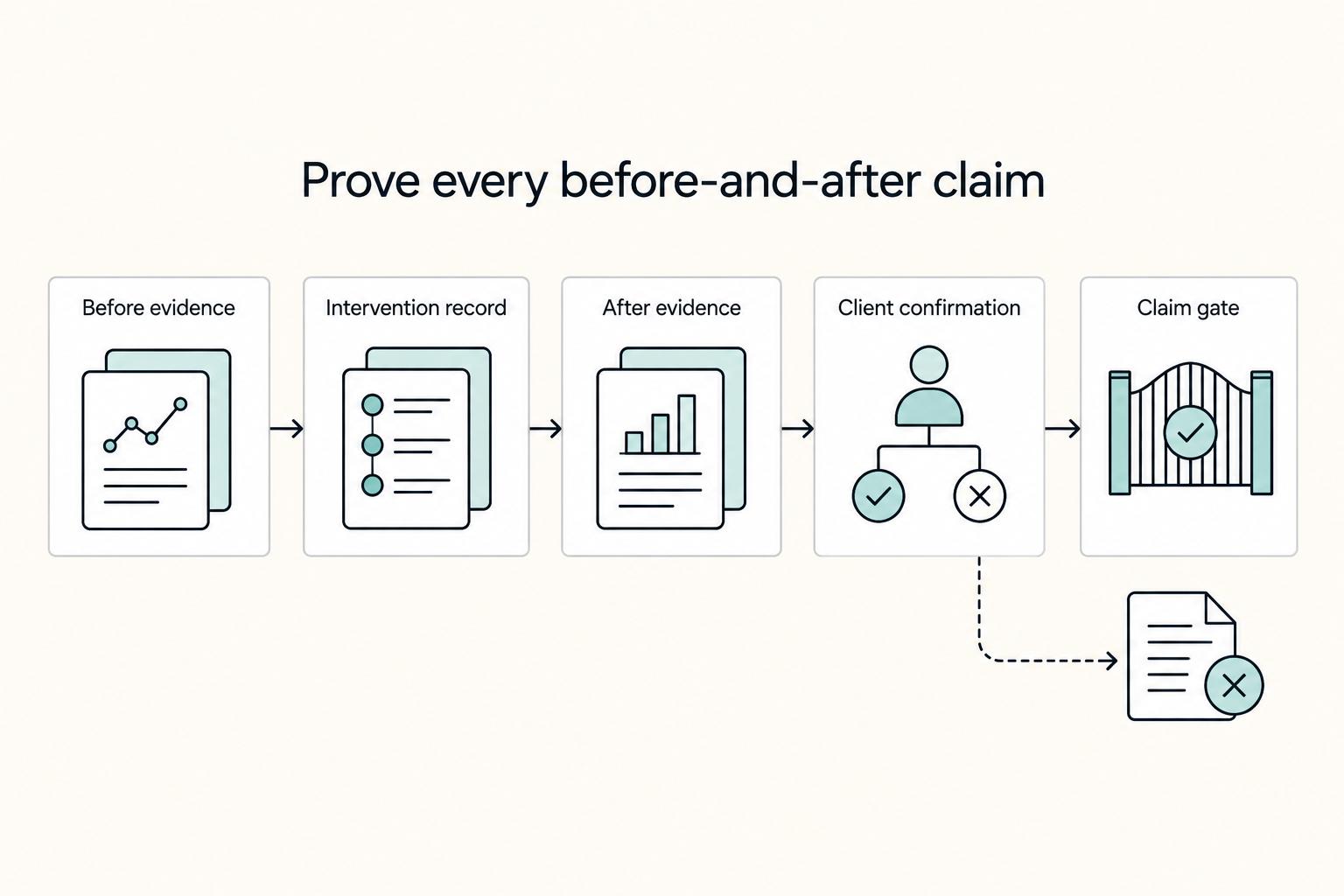
A case study should help a buyer make a decision, not just feel good about your work. Treat it as decision evidence: a detailed account of a business problem, the solution you delivered, and the results that followed. The strongest versions use client-centered proof, documented facts, and a clear [challenge-solution-results structure](https://libguides.usc.edu/writingguide/assignments/casestudy). They do not lead with praise, drift into product-centered copy, or make vague claims that sound like promotion.
Content Marketing for B2B SaaS That Holds Up Under Real Work
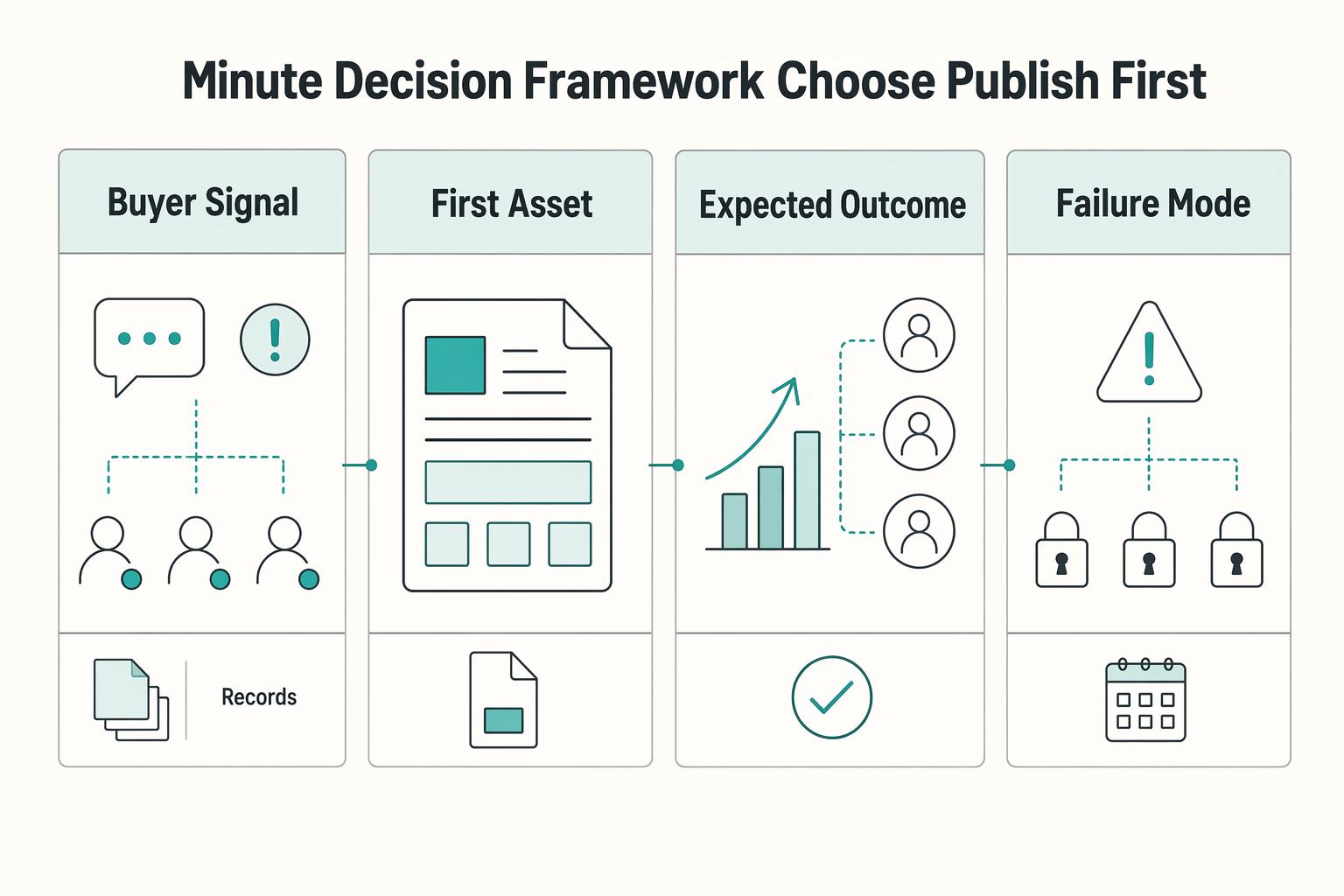
If your publishing is inconsistent, nobody clearly owns decisions, and each post dies after one channel, you do not have an ideas problem. You have an operating problem. For a solo operator or lean team, your content gets more reliable when you document a few non-negotiable rules and review points.