
Quick Answer
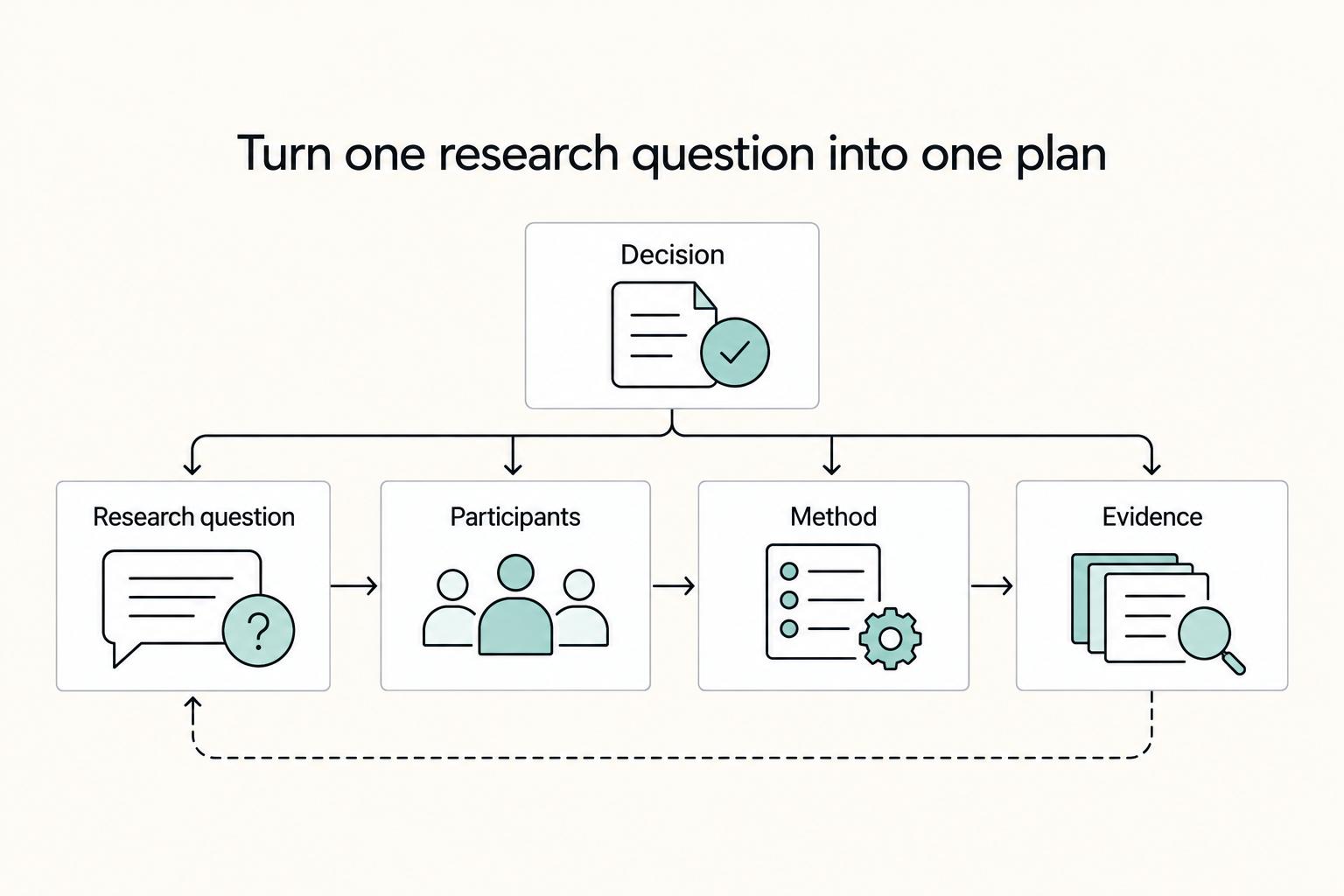
Start with a one-page user research plan tied to a single decision. Include objective, method, participant profile, logistics, risks, decision checkpoint, and output format, then assign one decision owner. Use if-then method rules, keep recruiting criteria mapped to objectives, and run four checkpoints: pre-brief signoff, in-field quality check, synthesis review, and decision readout.
Start With the Decision#
You do not need a polished research deck to work professionally. You need a decision-ready user research plan. It should make one thing obvious: what choice this work is meant to inform, who owns that choice, and what evidence will count when it is time to decide.
That sounds simple, but many research problems start before a single session runs. Teams begin with a broad goal, rush into recruiting, then discover halfway through that stakeholders are answering different questions. Maze describes running UX research without a plan as confusing and exhausting. That framing fits a common failure mode. The work itself is not always hard, but unclear intent can make every step heavier than it should be.
For an independent operator, the value of planning is not ceremony. It is control. A short plan keeps UX research, recruiting, and stakeholder alignment tied to the same decision instead of drifting into parallel efforts. Your first checkpoint is blunt and useful: can you write the product or business decision in one sentence before fieldwork starts? If not, you are probably planning activity, not evidence.
A practical plan can also protect your time. Maze points to achievable research goals as a way to avoid wasting time and resources, and that is the right standard here. If the scope cannot be explained clearly enough for a collaborator to repeat it back, it is probably not ready. If the question changes every time a stakeholder comments, freeze the decision first and refine the method second. That habit can reduce avoidable rework.
This guide is for people who need clean execution without enterprise overhead. You may be working solo, with a client, or alongside a product lead who wants answers quickly but has not thought through ownership, recruiting constraints, or how findings will be used. In those settings, the strongest move is usually not a bigger document. It is a tighter one with clear boundaries, a named decision owner, and enough evidence prep to keep the study from wobbling once it starts.
That approach is not niche or improvised. The UX Research Field Guide includes a dedicated module called Planning for UX Research, which is a useful reminder that planning is part of the craft, not admin wrapped around it. The sections that follow focus on drafting a practical plan, pressure-testing it with simple decision rules, and running with fewer surprises. If you do that well, the document becomes useful for the only reason it should exist at all: it helps you make a better call.
Define the document before you plan the work#
Define the document first: this is a user research plan, not a UX strategy. Keep it tied to one specific study so it can organize, document, and inform the decision in front of you; when plan and strategy are blended, scope and ownership usually get blurry.
Before discussing tools or recruiting, lock a small working core:
- research objectives
- research methodology
- decision owner
- timeline
- success signal
Treat that list as a practical minimum, not a universal template. Quick check: can the decision owner read those lines and restate, in plain language, what decision this research supports?
Use a hard edit rule: if a section does not change a product or business decision, remove it. That keeps the plan shorter, easier to execute, and aligned with dscout's point that a well-structured plan relieves many logistical headaches.
Align terminology early. If collaborators are split between product discovery and qualitative usability testing, your questions, participant tasks, and readout can drift. Write one line that names the work type so the method matches the decision.
Build the one-page plan you can actually run#
Once decision and scope are clear, keep the plan to one page and make it specific enough to execute. A one-page user research plan is usually enough when each line supports study quality or decision quality.
Keep the page fixed#
Use the same seven blocks each time: objective, method, participant profile, logistics, risks, decision checkpoint, and output format. This is not a universal standard, but it keeps the plan focused on the who, what, when, why, and how.
Keep each block tight. For the objective, write 3 to 5 research questions when possible, and avoid going beyond ten. For method, state what you will do, where, and for how long. For participant profile, define who you need in behavioral terms, not only demographics. For output format, specify exactly what the team will get: a slide readout, annotated clips, a memo, or a decision summary.
Treat the decision checkpoint as mandatory in practice. Name the decision owner and the decision they are expected to make after the readout. When ownership is unclear, findings are less likely to be implemented.
Match the method to the decision#
Choose methods by decision fit, not team preference.
| Method | Best fit | Weak fit | Operator note |
|---|---|---|---|
| Qualitative research | Understanding why behavior happens, finding pain points, exploring mental models | Estimating prevalence or comparing segments at scale | Use when the main risk is misunderstanding motives or context |
| Quantitative research | Measuring how many, how often, or how strongly | Explaining root causes on its own | Add when the decision needs directional magnitude |
| Stakeholder interviews | Aligning goals early and creating consensus around research goals | Replacing user evidence | Run at the outset so internal assumptions are explicit |
| Preference testing | Comparing two or more design options by asking which option people prefer | Diagnosing detailed interaction problems | Useful for option choice, but not a substitute for usability evidence |
| Qualitative usability testing | Identifying interface problems | Market sizing or broad attitude measurement | If this is your main method, quick guidance is 5 to 8 participants |
If you combine methods in one sprint, write one line naming which method carries final weight for the product decision. Without that line, teams often argue from whichever evidence is most visible instead of most relevant.
Treat artifacts and checkpoints as part of the plan#
The page is the front layer; each section should have a small evidence pack behind it. Include the interview guide, screener surveys, consent/privacy notes, incentive policy, and synthesis format.
| Checkpoint | Timing | What to do |
|---|---|---|
| Pre-brief signoff | Before recruiting starts | Review the page, guide, screener, and output format with the decision owner |
| In-field quality check | Early in fieldwork | Confirm recruits match the screener, consent is documented, and the guide is producing usable evidence |
| Synthesis review | Before the readout | Verify claims can be traced from notes to themes; cut or relabel anything that cannot |
| Decision readout | End of the readout | Restate the checkpoint question and document what was decided, what is still open, and what evidence is needed next |
Run checkpoints in order:
- Pre-brief signoff
Review the page, guide, screener, and output format with the decision owner before recruiting starts.
- In-field quality check
Early in fieldwork, confirm recruits match the screener, consent is documented, and the guide is producing usable evidence.
- Synthesis review
Before the readout, verify claims can be traced from notes to themes; cut or relabel anything that cannot.
- Decision readout
End with the decision call. Restate the checkpoint question, document what was decided, what is still open, and what evidence is needed next.
If recruiting is still moving, keep the plan tied to the live recruit criteria so the page and screener do not drift apart. For a step-by-step walkthrough, see How to Conduct Effective User Interviews.
Pick methods with if-then rules instead of preference#
Pick methods from the question type, not team preference. Start with your Research objectives, then choose the method that can answer them with reliable evidence in the time and resources you have.
| Question signal | Method choice | Note |
|---|---|---|
| Starts with "how," "what," or "why" | Lead with qualitative research | Use it to understand behavior and reasons |
| Starts with "how many" or "how much" | Include a quantitative method | Use it to measure magnitude |
| Alignment is still unclear | Run stakeholder interviews at the outset | Then move into user research |
| Time is tight | Prioritize one primary method | Add a supporting method only when it reduces a clear decision risk |
Use the question wording as your first filter:
- If the question starts with "how," "what," or "why," lead with qualitative research to understand behavior and reasons.
- If the question starts with "how many" or "how much," include a quantitative method to measure magnitude.
- If alignment is still unclear, run Stakeholder interviews at the outset, then move into user research.
- If time is tight, prioritize one primary method and only add a supporting method when it reduces a clear decision risk.
Before recruiting, name which method will carry the product decision. Without that, teams often stack methods that are each useful but not equally decision-critical.
A simple tradeoff view#
A compact comparison is usually enough:
| Method | Speed | Confidence it gives | Sample access need | Decision impact |
|---|---|---|---|---|
| Stakeholder interviews | Usually fast if internal calendars move | Good for aligning goals and surfacing assumptions | No external recruiting | Shapes scope early, but should not stand in for user evidence |
| Qualitative sessions | Moderate, depends on recruiting and scheduling | Strong for explaining behavior and causes | Small, well-matched participant set | Useful for product discovery and interaction decisions |
| Quantitative method | Often heavier because it needs a larger group | Strong for measuring pattern size or direction | Larger sample required | Useful when the call depends on "how much" rather than "why" |
When recruiting is the real constraint#
Treat weak participant access as a feasibility constraint, not a reason to quietly rewrite the study midstream. First check whether the original question is practical for your timeline and resources, then narrow scope: reduce audience breadth, cut secondary questions, or split into rounds.
Use one operator check: each screener criterion should map to one objective and one method. If it does not map, cut it. If access remains thin, update scope, screener, timeline, and decision checkpoint together so the study does not drift. Keep this tied to your user research plan. Related reading: The Best Keyword Research Tools for SEO Freelancers.
Set scope and logistics that survive real constraints#
To keep the work useful under pressure, lock scope, ownership, timeline, and logistics before recruiting starts. Your user research plan should cover objectives, methodology, timeline, and logistics, plus clear boundaries on what is in scope, out of scope, and based on assumptions.
Define those boundaries in plain terms: audience segment, decision window, key questions, and excluded questions. Then run a quick check against your materials: if a recruit criterion does not support an in-scope question, cut it; if a discussion-guide block answers an excluded question, remove it before sessions start.
Assign named owners for recruiting, moderation, synthesis, and stakeholder signoff, and set one final decision owner for tradeoffs and scope changes. Shared ownership can still work operationally, but one person should be accountable for final calls.
Keep execution order explicit in the live UX research plan:
- Planning doc freeze
- Recruit launch (with screening-to-scheduling buffer time)
- Session window
- Synthesis window
- Decision meeting tied to the original decision
Add contingencies before fieldwork begins. Pre-agree fallback actions for no-shows, low-quality recruits, and stakeholder changes, and route any mid-study change through the decision owner so alignment holds and scope creep stays controlled.
Treat Planning for UX Research as the stage for setting these rules, then keep the live plan as the working source of truth for day-to-day execution. If you want a related next step, read Affinity Mapping for User Research That Leads to Better Decisions.
Recruit participants without contaminating the study#
Recruit for real fit, not for people who know how to qualify. Participant quality problems can weaken conclusions, and self-reported screeners alone are easier to game.
Ask for proof of behavior#
Build Screener surveys around recent actions, context, and constraints. Ask what someone did, when they last did it, what process or tool they used, and what triggered the behavior. Those details are harder to fake than broad self-descriptions.
Keep this tied to the plan you already set: before recruiting starts, your live plan should define the research question, target audience, and recruitment strategy. Use that as a filter for every screener question. If a question does not confirm fit or reduce bias risk, remove it.
Before booking a full wave, review an early batch of screener responses for contradictions, vague behavior, or overly polished answers with little substance. For higher-stakes work, add stronger verification where possible, such as behavioral checks, cross-study response checks, fraud detection, and automated verification with human review.
Keep the incentive policy stable#
Set User research incentives before outreach starts and document them with the screener version and participant criteria. The goal is consistency in how you recruit and evaluate responses across the study.
Treat incentive policy as part of your working record, not just admin. Keep a clear log of what was offered, when, and to whom so decisions later are easier to defend.
Write red-line exclusions before responses arrive#
Define exclusions before the first response. Common red lines include:
- people with conflicts of interest, including direct ties to your company or client
- people with prior exposure that could bias reactions to the product, prototype, or topic
- people who match demographically but not behaviorally or contextually
If participants are scarce, run fewer sessions with tighter fit instead of broadening criteria until conclusions get weak.
Keep the recruiting brief synchronized with the live user research plan so decisions do not drift into email threads. For detailed sourcing and outreach tactics, see How to recruit participants for a 'User Research' study.
Handle ethics and regional rules before fieldwork starts#
Before fieldwork begins, lock ethics and privacy as a launch gate. Your user research plan should include a short block that states how data is handled, what consent says, how long details are kept, and who can access raw notes, recordings, and participant details.
Write this so someone outside the study can still answer: what are you collecting, why, who will see it, and when it will be deleted. Keep consent specific and informed. It should cover collection, storage and use, and sharing, and it should be freely given, specific, informed, and unambiguous.
Add checks before launch#
Treat this as pre-launch control, not admin cleanup. Before the first session, verify:
| Check | Verify |
|---|---|
| Consent language | The moderator script matches the written consent language |
| Access control | Access to raw notes and participant details is limited to people who genuinely need it |
| Retention window | The retention window is documented, owned, and realistic for the study |
Common failures are avoidable: recordings spreading too broadly "for context," or participant details being kept because no end point was defined. If your study informs a real decision, your evidence pack should be defensible, not just convenient.
Document regional assumptions explicitly#
If your Research methodology includes participants across countries, confirm consent and data-use expectations with local policy counsel or a data-protection adviser before launch. Cross-region processing can trigger different rules, including GDPR territorial scope, depending on whether the relevant criteria are met.
For market-facing SaaS work, write jurisdiction assumptions directly into the plan. If findings come from one region, state that clearly so downstream teams do not overgeneralize.
Related: How to Price a UI/UX Audit for a SaaS Company.
Catch failure modes before they waste a sprint#
Before fieldwork starts, pressure-test three points: decision-linked objectives, method fit, and evidence traceability. Missing any one of these usually burns time without improving a product decision.
A goal like "learn about users" is too broad to run a defensible study. Maze defines a UX research objective as the goal that gives the study direction, and User Interviews adds the key planning test: "What decision will this research enable?" If you cannot answer that clearly, rewrite the objective before recruiting or moderation begins.
Use this preflight check:
- Objective check: each objective maps to one product or business decision. If one objective tries to serve multiple unrelated decisions, narrow scope or split the work.
- Method check: pick the method for the question, not team habit. Use a quick qualitative-vs-quantitative check: do you need explanation and behavior detail, or a measurable pattern at scale?
- Evidence check: require each planned readout section to trace back to raw notes, clips, transcripts, or survey exports.
Method drift is common when teams repeat last sprint's format. NN/g frames methods as ways to answer different question types, and Maze similarly emphasizes selecting the technique that best fits your goals and insights. With multiple method options available, "we always do interviews" is not a rationale.
At synthesis, treat auditability as a release gate. A polished narrative is not enough; include the evidence trail and the logic from data to conclusion so another stakeholder can trace a headline finding back to source material.
| Source | Best use | Guardrail |
|---|---|---|
| NN/g | Pressure-test whether the method can answer the real question | Use for method fit, not as a canned recipe |
| Maze | Check objective clarity, method options, and report structure | Useful practical guidance, but still adapt to your context |
| User Interviews | Keep planning and scope decision-driven | If no decision is named, scope is still too soft |
| Reddit r/UXResearch | Surface practitioner pain points and edge cases | Use as a warning signal, not as authority |
A common failure pattern is a confident deck with themes but no links, no excerpts, and no clear handling of contradictory evidence. Build the evidence pack into the readout from the start, and weak claims are harder to pass through.
Conclusion#
A strong user research plan earns its keep by improving the decision, not by looking thorough. If it helps you organize the work, document the choices, and inform the call, it is doing the job. That lines up with NN/g's plain framing of research plans: "Organize, Document, Inform," which is a better standard than deck length or template polish.
That matters because the real cost in research is rarely the document itself. It is the avoidable confusion that follows when objectives are loose, ownership is fuzzy, or the method was picked out of habit. dscout makes the practical point well: some logistical headaches are inevitable, but many can be relieved with a well-structured, well-written plan. In practice, that difference can show up when recruiting starts on time, stakeholders know what decision is on the table, and findings can be checked against raw evidence without a long explanation.
If you want a reliable starting point, keep the first version small and make it survive contact with real work. Define the decision-linked objective, choose a method with an explicit tradeoff, name one owner, and set checkpoints you will actually use. A good verification pass before fieldwork is simple: can someone else read the plan and identify the objective, participant criteria, session window, and where notes or recordings will live? If they cannot, the plan is still carrying too much implied knowledge in your head.
The failure mode to watch is not that the document is too short. It is that the important risks are still hidden. Broad goals like "learn about users," a participant pool that drifted because recruiting got hard, or a polished summary with no source links are all signs that the work may be harder to trust than it looks. That is why evidence handling belongs in the plan itself: guide, screener, consent language, incentives, raw notes or clips, and the synthesis logic that turns observations into a recommendation.
You also do not need enterprise overhead to work credibly. dscout talks about 7 core components, but the more useful takeaway is that structure matters because it reduces avoidable mistakes, not because every study needs more sections. Start with a compact first version, run one full cycle, and then review what actually broke. If the weak point was recruiting, fix your screener. If the weak point was stakeholder alignment, tighten the decision owner and pre-brief. If the weak point was synthesis, improve the evidence pack before you add another method. That kind of iteration will do more for your practice than adding more slides ever will.
Frequently Asked Questions
What is the minimum content a user research plan must include to be credible?
There is no single required template. A practical minimum is a decision-linked objective, a method that fits that objective, a defined participant profile, a timeline, and one named owner. Maze is useful here because it ties question planning back to the overarching plan and objectives, so if your questions cannot be traced to a clear goal, the document is already weak. It also helps to note where core study artifacts (for example, notes or survey exports) will live so findings are traceable.
How is a user research plan different from a UX research strategy in day-to-day work?
This guide is plan-heavy: it focuses on planning and running research studies, including recruiting mechanics. In day-to-day work, a plan is typically the document for executing a specific study, while strategy is the longer-horizon direction across studies. If you are assigning recruiters, setting dates, writing the guide, or defining the readout format, you are working in the plan.
How do I choose between qualitative and quantitative methods for one product decision?
Start with the decision, then choose the method that can answer it. The UX Research Field Guide explicitly separates Qualitative vs. Quantitative Research, and Maze makes the same core point: the kind of questions you ask depends on your research goals. There is no single best method for every study. If you need explanation and behavioral detail, start with qualitative work; if you need to gauge how widespread a pattern is, add a quantitative method when it would materially change the decision.
How many participants do I need before findings are directionally useful?
There is no credible fixed number to treat as a universal rule. Treat usefulness as decision-specific: if new sessions are still changing the judgment, or if your strongest finding rests on one or two shaky cases, you are likely not ready. A good checkpoint is whether someone outside the study can trace the headline finding back to consistent source material without your narration.
What should I do if recruiting fails or the participant pool is too narrow?
Narrow the scope before broadening the audience. Keep your recruiting criteria intact, then reduce the question set, extend the field window, or pause the decision if needed. Planning and recruiting guidance points to practical levers like screener surveys and incentives, so use those deliberately before diluting who you recruit. For the mechanics, see How to recruit participants for a 'User Research' study.
How do I keep stakeholder interviews useful without letting stakeholder opinions bias user findings?
Use Stakeholder interviews early to collect assumptions, constraints, and decision context, then label that input clearly as stakeholder input. Do not mix those notes into user evidence or let stakeholder language become a finding unless user data supports it. A simple guardrail is a split readout: one section for business context, one section for user evidence, and no claim crossing that line without support.
Try a related tool
Researched and edited by the Gruv editorial team. Gruv builds cross-border billing, payouts, and finance-operations software for global businesses.
Sources
- dhs.gov/cx/learning-trainings/cx-learning/basics-of-...trusted
- fac.gov/assets/compliance/2023-Compliance-Supplement...trusted
- hr.berkeley.edu/sites/default/files/change_management_toolki...trusted
- irb.ucsf.edu/obtaining-and-documenting-informed-consenttrusted
- pmc.ncbi.nlm.nih.gov/articles/PMC9450319trusted
- pmc.ncbi.nlm.nih.gov/articles/PMC10805236trusted
- research-support.yale.edu/sites/default/files/2025-07/HRPP_Policy_and_...trusted
- user-research.education.gov.uk/guidance/planningtrusted
Educational content only. Not legal, tax, or financial advice.
Related Posts

Thailand's Long-Term Resident (LTR) Visa for Professionals
For a long stay in Thailand, the biggest avoidable risk is doing the right steps in the wrong order. Pick the LTR track first, build the evidence pack that matches it second, and verify live official checkpoints right before every submission or payment. That extra day of discipline usually saves far more time than it costs.

How to Price a UI/UX Audit for a SaaS Company
If you need to price UI/UX audit work for a SaaS client, the job is not finding a magic market number. It is turning uncertain scope into a quote you can defend, a Statement of Work (SOW) the client can approve, and payment terms that do not leave you carrying the risk.
How to Recruit for User Research Without Wasting Study Time
**Participant recruitment is often the bottleneck** for independent consultants and boutique firms. It is high-risk, time-consuming, and easy to underestimate until it starts consuming the hours you need for the research itself. It also brings compliance traps, scheduling friction, and the constant risk that poor-fit participants will compromise the project.