
Quick Answer
Remote professionals need wilderness first aid when they work or travel where EMS, definitive care, or transport may be delayed. It provides a practical framework for pre-trip risk assessment, layered communications, simple assessment under stress, and early evacuation decisions when local care or reliable support is limited.
Your business is built on freedom: the freedom to work from anywhere, serve clients globally, and set your own terms. That freedom also removes the layers that usually absorb disruption before it turns into a business crisis. Your office might be a villa in rural Spain, a research site in Costa Rica, or a temporary base in a developing nation. In any of those places, you are also the security lead, risk manager, and first responder.
In that setting, a medical incident is not just personal. It can stop work, break communication, and force decisions when local care, transport, or both are limited. The useful mindset here comes from wilderness medicine, not from a standard business continuity binder. This is not about preparing for a hike. It is about building a repeatable way to handle emergencies in places where help may be delayed and information may be incomplete.
This framework uses three roles: the CEO for strategic preparation, the Operator for systematic response, and the Commander for decisive leadership.
Most of your risk control happens before you leave#
Most of your risk control happens before you leave. If you are heading somewhere without immediate EMS response, or where definitive care and rapid transport are not readily available, start your pre-trip threat assessment 4 to 6 weeks before departure.
Run the same four checks before every move#
Start with the same four checks every time, then tailor your plan to the route. Do not rely on a one-size-fits-all kit. CDC guidance says travel health kits should be personalized, including for local care and evacuation access, so adjust your kit and decision points for each move.
| Check | What to verify | Notes |
|---|---|---|
| Local care access | Nearest clinic, nearest hospital, how you will get there, and whether payment is expected upfront | Travelers are usually responsible for medical expenses out of pocket in most destinations |
| Likely injury and illness patterns | The issues you are most likely to face on that route | Match medications, supplies, and records to that risk profile |
| Terrain and climate risks | Environmental constraints that can affect both injuries and communication reliability | Include conditions that can obstruct sky access for satellite messaging |
| Evacuation pathways | Incident-to-clinic and clinic-to-higher-care routes | Do not assume rapid transport; for higher-risk or limited-care destinations, the U.S. State Department strongly recommends medical evacuation insurance |
Those four checks force the right questions: where you can actually get care, what is most likely to go wrong, what terrain and climate will do to both injury patterns and communications, and how you get from incident to clinic to higher care.
Keep critical contacts in at least two formats: phone and a paper card in your kit. Include clinic, hospital, insurer assistance, local emergency number, and embassy or consulate details.
Choose communications by failure pattern, not brand#
A single device is not a communications plan. Build a layered setup around how tools fail: no cell signal, blocked sky view, dead battery, inactive plan, or a device you cannot reach.
| Tool | Best use scenario | Failure points | Power and logistics burden | Pair it with |
|---|---|---|---|---|
| Satellite messenger (for example, Garmin inReach) | Two-way updates, SOS, and ongoing coordination | Requires an active satellite subscription; depends on sky access | Charging + subscription management; Garmin plans are month-to-month with a 30-day commitment | Local SIM phone, power bank, paper contacts |
| 406 MHz PLB | Dedicated distress alert with minimal interaction | Distress signaling focus only; U.S.-coded beacons must be registered with NOAA | Lower ongoing messaging burden; U.S. registration required | Phone or satellite messenger for non-distress communication |
| iPhone Emergency SOS via satellite | Emergency messaging from eligible iPhone 14+ devices | Requires clear sky or horizon; can be delayed under foliage | Depends on phone battery and eligible hardware; Apple states two years of included service after activation on eligible models | Power bank and either local SIM or satellite messenger |
Before each trip, verify the boring parts: subscription status, beacon registration, and charging resilience. A layered plan only works if the device is active, registered, and powered when you need it.
Define your operational planning window#
Treat the "Business Golden Hour" as a planning window, not a fixed medical rule. The point is to decide how long your business can absorb a medical event before it also becomes an operations and continuity problem.
Use three estimates:
- Time to first competent care
- Time to extraction if local care is insufficient
- Time before missed obligations create business damage
For route-specific timing assumptions, use current local benchmarks only after verification. Then see whether your plan still holds if care or extraction slips.
Let that window drive both kit depth and coverage decisions. If meaningful care may take many hours and extraction is uncertain, prioritize communication redundancy and medevac planning. U.S. State Department guidance notes air ambulance evacuation to the U.S. can cost about $20,000 to $200,000.
Keep duty of care tight and practical#
Set the scope before you leave: yourself first, then partner, then client or team responsibilities. In U.S. employment contexts, OSHA's baseline is a practical reference point for recognized serious hazards, even though jurisdiction-specific law varies.
In practice, duty of care means choosing destinations with verified care and evacuation pathways, briefing companions or team members on the plan, carrying the right kit, contacts, and communication backups, and escalating to professional services when needed.
Escalation means using local emergency services, SOS features, insurer assistance lines, and embassy or consulate support to locate care. It does not mean improvising beyond your training because logistics are inconvenient.
The Operator's System: Imposing Order on Chaos#
Preparation only helps if your response stays simple under stress. When an incident starts, your job is to run one repeatable sequence, not invent a new response in real time.
Run PAS in the same order#
If you have PAS training, follow that order every time. Keep the exact sequence and treatment details anchored to your current training.
Start with scene safety before contact, then continue through your trained assessment and monitoring steps. Keep actions inside your scope, and keep brief notes on time, observed changes, and actions taken so handoff is cleaner if outside support takes over.
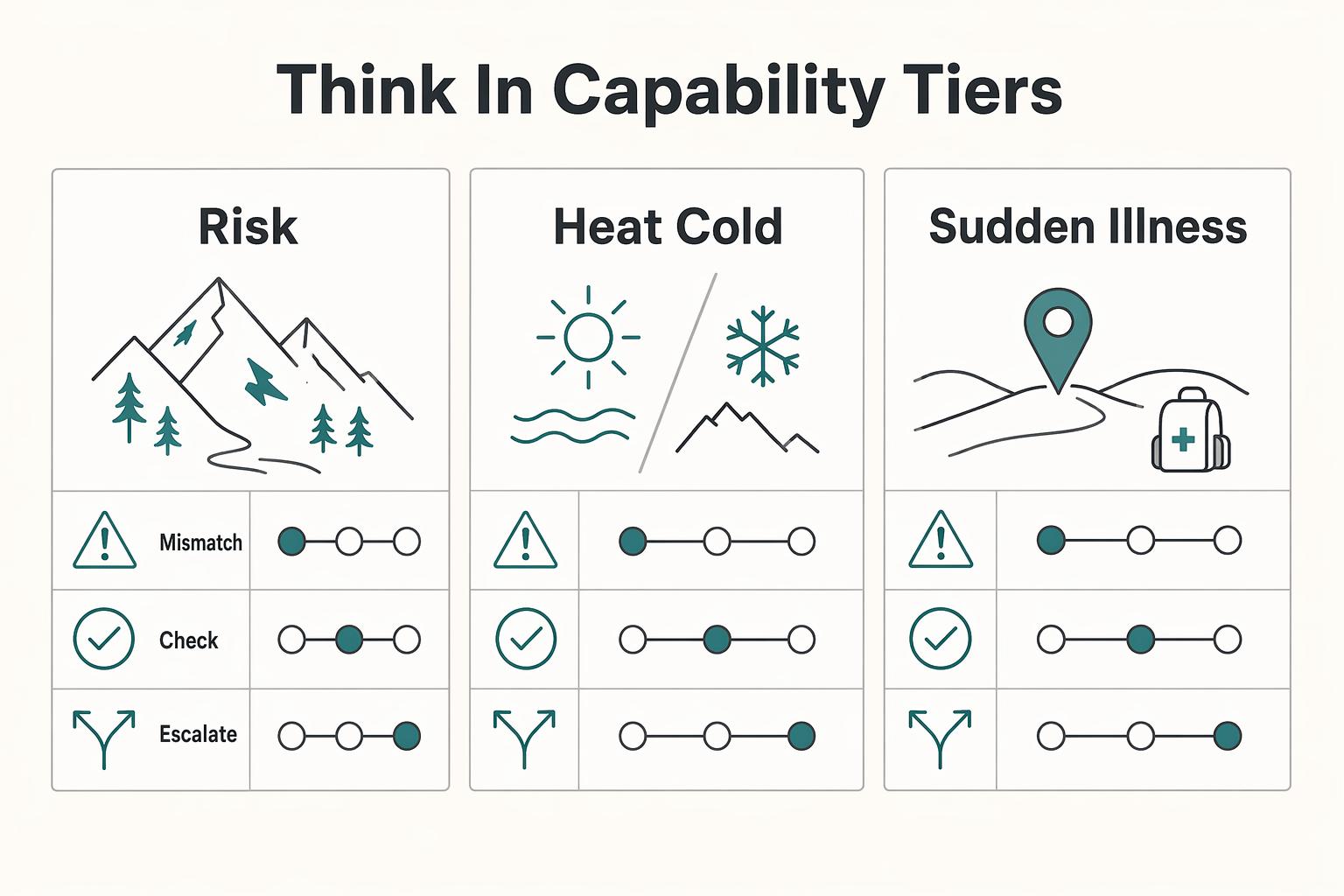
Think in capability tiers#
Judge your response by capability, not confidence. The question is not whether you feel calm. It is whether you can still assess, monitor, and act reliably with the people, gear, and time available.
- Immediate actions: make the area safer, start your assessment sequence, call for help early, and use accessible supplies.
- Stabilization phase: buy time, organize gear, keep reassessing, and prepare for waiting or transport.
- Escalation phase: move to external support when conditions worsen, monitoring is no longer reliable, safe movement is not possible, or local care access is uncertain.
Use your pre-trip contact plan so escalation is procedural, not improvised.
| Scenario (planning template) | Immediate actions to verify against your training | Kit items to stage | Handoff or escalation checkpoint |
|---|---|---|---|
| Bleeding or open-wound concern | Follow your trained sequence and only verified steps | Stage items from your prebuilt checklist | Escalate if you cannot stabilize within your training scope or risk increases |
| Fall with possible limb injury | Prevent further harm, check for higher-priority risks, limit unnecessary movement | Stage items from your prebuilt checklist | Escalate if safe movement or self-transport is not possible |
| Heat, cold, or exposure concern | Reduce environmental stress where feasible and reassess often | Stage items from your prebuilt checklist | Escalate if status does not stabilize or becomes harder to monitor reliably |
| Sudden illness in a remote stay | Run your assessment sequence, track timeline/symptoms, prepare comms | Stage items from your prebuilt checklist | Escalate when symptoms are concerning, progressing, or unclear with limited local care access |
Resource scarcity is the real operating condition#
In remote work, scarcity is often the default condition, not the exception. A rural home with weak infrastructure, a long transit segment with no reliable signal, or disrupted local services can each change what a workable response looks like.
| Setting | Constraint | Preparation |
|---|---|---|
| Rural housing | Weak infrastructure | Pre-pin care locations, confirm logistics, and keep backup lighting, charging, and directions ready |
| Transit corridors | No reliable signal | Carry offline navigation, visible ID, water, and a comms backup not dependent on cell coverage |
| Disrupted infrastructure | Interruptions to pharmacy access, cash access, or transport | Plan around likely interruptions to pharmacy access, cash access, or transport |
Use consistent language in handoffs. The same discipline shows up in the NWCG Glossary of Wildland Fire (PMS 205): approved terms and clear definitions, while not aiming to include every term used across all groups. Apply that discipline to your own updates: location, what happened, what changed, what you observed, what you did, and when you did it.
The Commander's Decision: Managing the Business Crisis#
Once your PAS loop is stable, stop drifting and make the decision that shapes everything else: self-evacuate, shelter in place, or request rescue. Make that call from verified signals, not hope. Evacuation decision-making is part of this training for a reason.
Choose the path that matches current conditions#
Your three options stay the same. The signals you use to choose among them do not. Condition, terrain, weather, fatigue, and communications can all shift quickly. In remote incidents, help can take hours or days. Even in contexts where EMS is expected in fewer than eight hours, you should still plan to manage the situation yourself while you wait.
| Option | Patient trajectory | Environmental risk | Team capability | Communications reliability | Operational impact on work commitments |
|---|---|---|---|---|---|
| Self-evacuate | Stable enough to move without clear worsening during prep and travel | Route is currently passable; staying put is equal or higher risk | You can move safely with available people and gear | You can send updates during movement or confirm destination | Work is disrupted, but access to care and infrastructure may improve |
| Shelter in place | Stable and monitorable; movement risk is higher than waiting right now | Current location is safer than the route out | Team can continue monitoring and basic support | Intermittent comms still allow check-ins | Deadlines may slip; send early stakeholder updates |
| Request rescue | Serious concern, worsening trend, unsafe or unrealistic self-evacuation, or uncertainty too high | Terrain, weather, exposure, or distance makes movement unsafe | Team cannot safely transport or sustain care alone | You still have an emergency signal path (for example a 406 MHz beacon) | Pause normal work and switch to continuity-only communications |
If condition is worsening and your ability to move or communicate is likely to degrade, escalate early. Do not wait until light, weather, or battery conditions reduce your options.
If you carry evacuation coverage, verify terms before travel. Evacuation insurance is a separate coverage type and varies by policy.
Protect operations while you wait#
Once the immediate response is under control, treat the situation as a continuity event as well as a medical one. Keep the response simple and protect the parts of your business you can still protect.
| Step | What to do |
|---|---|
| Secure devices and credentials | Lock devices, end unnecessary sessions, and keep access under control |
| Confirm essential records access | Ensure ID, insurance details, emergency contacts, itinerary, and critical work files are available from redundant storage |
| Assign communication roles | One person handles patient or help updates; one person handles stakeholder and family updates |
| Send one concise status update | Medical incident. Immediate care is underway. Some work may be delayed. Next update by [time and time zone], if communications allow. |
A simple status update can be as short as:
Medical incident. Immediate care is underway. Some work may be delayed. Next update by [time and time zone], if communications allow.
If calls fail, send text updates. If needed, use your hardware fallback; off-grid communication devices can provide an additional distress signaling path but do not guarantee rescue timing.
Coordinate with insurers, assistance providers, and responders#
Before you call for help, build one consistent information packet and reuse it for every handoff. That keeps updates aligned across responders, insurers, and anyone coordinating transport.
- Condition summary
- Nature of injury or problem
- Exact location
- Number of people involved
- Current movement or access constraints
- Next planned check-in time
Verify location details, access constraints, and whether you can still receive messages. Clear, consistent handoffs reduce delays and prevent avoidable confusion.
The ROI of Resilience: A Business Case for WFA#
Treat wilderness first aid as a risk-control expense if delayed help, uncertain transport, or self-managed evacuation decisions are a recurring part of how you travel and work. If not, it may stay optional for now. The point is not to collect a credential. It is to reduce the chance that a medical incident becomes an operational breakdown.
The ROI case depends on whether training changes decisions under pressure, especially the same three-way call from the previous section: self-evacuate, shelter in place, or request rescue.
| Cost lens | What to verify now | Why it matters |
|---|---|---|
| Course investment | Tuition, travel, lodging, and calendar time. Current range pending provider/source verification. | Predictable upfront spend. |
| Likely disruption cost | Your day rate, missed deliverables, backup contractor cost, and client penalty exposure. Current range pending operating-record/source verification. | This can materially change total cost. |
| Evacuation exposure | Coverage terms, exclusions, rescue language, deductible or copay, and network rules. Current exposure range pending policy/source verification. | Policy details can change out-of-pocket risk. |
| Business continuity upside | Faster triage, cleaner handoffs, better update discipline, fewer poor movement decisions. Quantify only from your own operations. | Can be meaningful business value, even when hard to price. |
Use a verification-first standard for your budget case. A 2024-2028 county workforce plan or Public Law 116-94 may be real documents, but they do not tell you what your training costs, evacuation exposure, or ROI look like. Build your numbers from current provider materials, your own operating economics, and your actual coverage documents.
Vet the course like any business-critical purchase#
Choose fit, not prestige. Ask for the current syllabus, scenario format, proof of completion, and recertification path in writing. Then compare providers against the same four criteria below.
- Curriculum quality: clear assessment flow, decision sequence, environmental risk handling, and evacuation communication.
- Scenario realism: reflects your travel pattern (solo or small team, weak signal, delayed transport, weather pressure).
- Recertification path: clear renewal process and practical refresh options.
- Role relevance: matches your real responsibility, not an aspirational identity.
WFA vs. WFR decision matrix#
| Your context | What to verify before choosing |
|---|---|
| Primary responsibility during incidents | Confirm which course is designed for your actual responsibility level. |
| Typical operating environment and transport constraints | Confirm the scenario coverage matches your real conditions. |
| External expectations (clients, partners, insurers, employers) | Verify any required or preferred training language directly in writing. |
| Current confidence and recency of training | Decide whether a refresher or deeper training is the better next step. |
What "sufficient for now" looks like#
A practical "sufficient for now" standard is that you can assess in order, monitor for change, make conservative movement decisions, and deliver a clear handoff summary in realistic practice. Reassess and consider upgrading when your responsibilities or operating context changes, then validate your next step with current provider materials.
Your Greatest Asset Isn't Your Laptop; It's Your Uptime#
A major continuity risk is operator readiness, not just hardware. If you are injured, unsupported, or unable to make clear decisions at a remote worksite, delivery, communication, and incident control can fail at the same time.
Use this framework to protect uptime. Your threat assessment should define likely failure points before departure. Run a clear assessment sequence under stress. Set evacuation decision points early, so you are not improvising once conditions worsen.
Business continuity lens#
| Continuity concern | Tech-focused response | Operator-focused response |
|---|---|---|
| Device outage | Backup device, power, cloud access | Current training, clear response sequence, basic incident plan |
| Communication gaps | Redundant connectivity options | Comms plan matched to route and available support options |
| Incident escalation | Account security and remote lock tools | Predefined evacuation triggers and notification process |
Verify before you rely#
Treat standards and policies as version-sensitive, not static. The OSHA Emergency Response Standard entry dated 02/05/2024 is shown as a Proposed Rule, and FederalRegister.gov notes its displayed version is not the official legal edition. Verify the linked printed official PDF before treating requirements as settled. Apply the same discipline to your own prep: scope risks, define constraints, and account for uncertainty before you travel.
Do this now#
- Confirm your training status and review your response plan before departure.
- Align your communications setup and incident checklist to the destination risks from your threat assessment.
- Document a one-page incident process: assessment, evacuation decision points, client notification, and work handoff if you go offline.
Before your next move, centralize your prep workflow so health, travel, and operations checks happen in one place: Explore Gruv tools.
Frequently Asked Questions
When do I actually need wilderness first aid?
You need this level of preparation when immediate EMS response is not available or when weather, communication limits, and limited equipment make standard first-aid assumptions unreliable. Do not rely on a single time cutoff alone. If you may need to assess, monitor, and manage someone before help arrives, it is a practical baseline.
What level of training fits my trip?
Match the course to the expected delay to care and the responsibility you may carry in the field. WFA fits situations where EMS can be expected in fewer than eight hours, WAFA adds more depth for remote areas, and WFR fits longer evacuation delays that may require extended care. Verify the current syllabus before booking.
What does the training actually cover?
Expect a decision framework, not just treatment steps. Core topics include the Patient Assessment System, injury evaluation, ongoing monitoring, and evacuation decisions. The goal is to help you make safer decisions when conditions are uncertain and support is delayed.
What should I pack?
Start with a pre-made kit, then customize it to your route, expected risks, and personal medical needs. Build around common minor illness or injury plus your ongoing conditions. The Ten Essentials are a baseline, not a complete list.
How do I decide whether to evacuate, and what should I do before departure?
Assess first, then decide based on patient status and your ability to continue care. If communication, weather, or equipment limits make monitoring and support less reliable, make the more conservative evacuation decision. Before departure, book a travel-health visit 4 to 6 weeks out, check destination guidance, and consider insurance that includes emergency evacuation for remote travel.
Researched and edited by the Gruv editorial team. Gruv builds cross-border billing, payouts, and finance-operations software for global businesses.
Sources
- cdc.gov/yellow-book/hcp/preparing-international-trav...trusted
- cisa.gov/sites/default/files/publications/ESS-CPS%20W...trusted
- congress.gov/116/plaws/publ94/PLAW-116publ94.htmtrusted
- epa.gov/system/files/documents/2025-01/guidelines-fo...trusted
- federalregister.gov/documents/2024/02/05/2023-28203/emergency-re...trusted
- hrsa.gov/sites/default/files/hrsa/advisory-committees...trusted
- nifc.gov/sites/default/files/redbook-files/RedBook_Fi...trusted
- nols.edu/courses/wm/wilderness-first-aid-wfatrusted
Educational content only. Not legal, tax, or financial advice.
Related Posts
Freelance Crypto Payments That Protect Cashflow and Reduce Disputes
Crypto payments make sense only when they improve how reliably you get paid after you plan conversion, compliance, and recordkeeping up front. They can reduce friction in some international setups where traditional platforms add fees, restrictions, or extra steps. They also move risk onto conversion timing, exchange-fee exposure, and documentation quality, so use a simple acceptance test before you agree:

How to Build a Travel First-Aid Kit
**Treat your travel first aid kit like a system for long stays, not a vacation pouch.** If you move city to city, you need repeatable coverage for everyday minor problems and a simple way to keep that coverage current. Build once, review it regularly, and stop re-deciding the basics before every move.
The Best Emergency Communication Devices for Off-Grid Travel
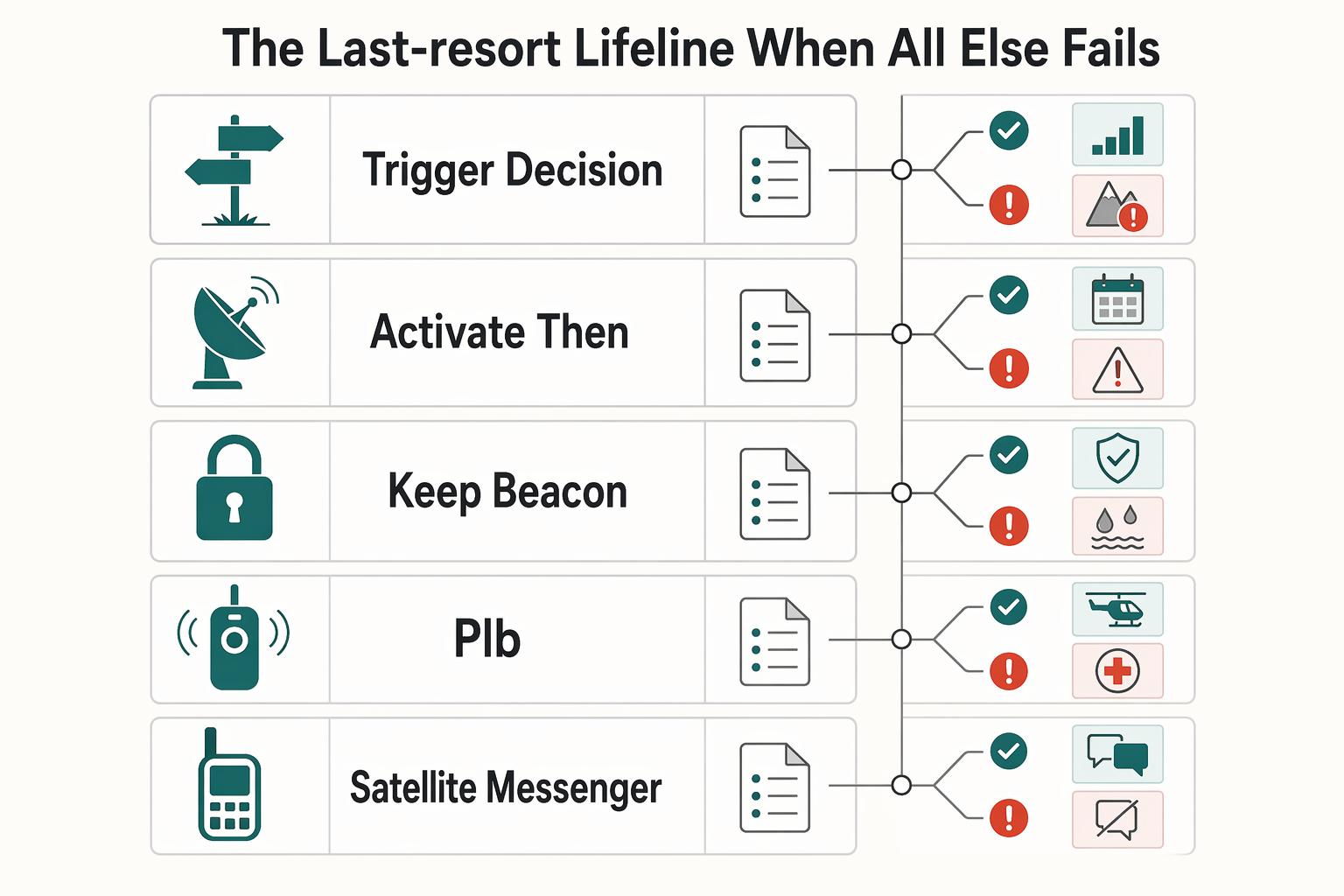
If you are trying to solve everyday communications, network outages, and life-threatening rescue with one device, you are setting yourself up for failure. A better model is simpler: give each layer one job, know when to switch to it, and judge it by the outcome it is supposed to produce.