
Quick Answer
Start by treating waste separation germany as a local operating routine: sort packaging, paper, organic waste, and residual waste into the correct streams, then verify edge cases before disposal. Use your Abfallkalender and district guidance as the decision source, not memory. Keep special items like glass, Pfand returns, batteries, and electronics outside daily household bins until you confirm the right drop-off route.
Why the sorting rules exist and where to confirm them locally#
Waste separation in Germany is a local household system, not a test of bin-color trivia. The rules are designed to assign cost and recover materials. Once you see that logic, the sorting rules stop feeling arbitrary and start reading like household operating instructions.
| Item | Meaning here | Use it for |
|---|---|---|
| Verursacherprinzip | Polluter pays; producers of packaging carry the financial responsibility for collection, sorting, and recycling | Do not treat packaging as ordinary trash just because you are done with it |
| Kreislaufwirtschaft | Circular economy; materials should stay in use as long as possible instead of being lost as mixed waste | Keep paper, organic waste, and packaging separated cleanly |
| Der Grüne Punkt | Useful background on packaging funding logic, not a universal sorting answer for every address | Treat it as context and verify actual collection rules with your municipality or district |
| Abfallkalender | Local waste pickup calendar, often delivered once a year and usually also found online through district channels | Confirm pickup timing and accepted categories there before you improvise |
Two ideas explain most of the system. Verursacherprinzip means polluter pays: producers of packaging carry the financial responsibility for collection, sorting, and recycling. For you, that changes one daily habit right away. You do not treat packaging as ordinary trash just because you are done with it. Packaging is its own category, and sorting it correctly helps keep that cost and recovery loop working.
Kreislaufwirtschaft means circular economy. Materials should stay in use as long as possible instead of being lost as mixed waste. In plain terms, paper, organic waste, and packaging are far more useful when separated cleanly than when thrown together. That is why households are expected to sort waste into separate bins and why only certain waste types belong in each one.
Older labels such as Der Grüne Punkt are useful background, but they are not a shortcut for current local practice. The label points to the packaging funding logic, not to a universal sorting answer for every address. If you see legacy references on packaging or in older guides, treat them as context and verify the actual collection rules with your municipality or district before relying on them.
That local check matters more than people expect. In many big cities, you will find four different bins in the backyard of almost every house, but that is a common setup, not a guarantee for every building or rural area. Your best checkpoint is the Abfallkalender, the local waste pickup calendar, which is often delivered once a year and can usually also be found through district channels online. If you are unsure, confirm pickup timing and accepted categories there before you improvise.
What this means for you this week#
This week, do three things early:
- Set up basic sorting space at home so you are not making bin decisions item by item at the communal containers.
- Check your building setup and your district's Abfallkalender or local authority page.
- Do not default to residual waste when you are uncertain, because mis-sorting creates extra re-sorting work, raises costs, and can create friction, including higher Nebenkosten or landlord warnings.
This is less about performance and more about smooth shared living. When you sort correctly, you make life easier for your household, your neighbors, and whoever manages the building. Next comes the day-to-day model many homes, especially in big cities, use: the four-bin system. If you are also sorting out other practical basics, see The Best Debit Cards for International Travel.
The Core System: Deconstructing Your Four Household Bins#
Use this default rule for almost every item: yellow for sales packaging, blue for clean paper/cardboard, brown for organic waste (no standard plastic liners), and Restmull for true residual waste only. If you sort by collection stream instead of raw material, daily decisions get much easier.
Sort by stream, not material#
For Gelber Sack / Gelbe Tonne, focus on function: it is for sales packaging, not every plastic or metal object. Packaging like yogurt cups, plastic wrap, milk or juice cartons, and tin cans goes in yellow. Non-packaging objects like a broken hanger, old toothbrush, or metal kitchen tool stay out, even if they are plastic or metal. If your municipality allows extra items, verify that local rule first.
For Blaue Tonne, keep it to clean, dry paper and cardboard. Flatten boxes so shared bins stay usable. The main failure point is contamination from moisture or food residue.
For Biotonne, execution matters more than theory: standard plastic bags are not allowed. If local guidance does not clearly allow your liner choice, do not use it.
Use Restmull as a last resort, not a convenience bin. Treat it as the stream for waste that truly does not fit the others. This helps avoid contamination, shared-bin friction, higher Nebenkosten, and landlord warnings.
| Bin | Purpose | Include | Keep out | Frequent mistake | When in doubt |
|---|---|---|---|---|---|
| Gelber Sack / Gelbe Tonne | Lightweight sales packaging | Yogurt cups, plastic wrap, milk or juice cartons, tin cans | Non-packaging plastic or metal objects, batteries, electronics | Sorting by material instead of packaging function | Ask: was this sold as packaging? If not, verify local rule first |
| Blaue Tonne | Paper and cardboard recovery | Paper, cardboard, flattened boxes | Wet or heavily soiled paper, beverage cartons | Throwing in dirty paper or unflattened boxes | If paper is contaminated, do not force it into blue |
| Biotonne | Organic waste stream | Organic kitchen waste | Standard plastic bags, non-organic household waste | Using ordinary plastic liners | If the liner is not explicitly allowed locally, skip it |
| Restmull | Residual waste only | Non-recyclable mixed residuals | Packaging, paper, organic waste, batteries, electronics | Using it as the default for uncertainty | Check local authority rules first, then use Restmull only for true residuals |
One verification habit prevents most errors: check your local waste authority app or district guidance before you guess, especially for yellow-bin exceptions. Also remember that some items are outside this four-bin flow: glass follows separate local collection rules and should never be deposited on Sundays, and batteries/electronics go to retail or municipal collection points.
Once this classification is clear, move to workflow: set up your home so the right bin is the easiest one to use daily. You might also find this useful: The Best Digital Nomad Cities for a Work-Life Balance.
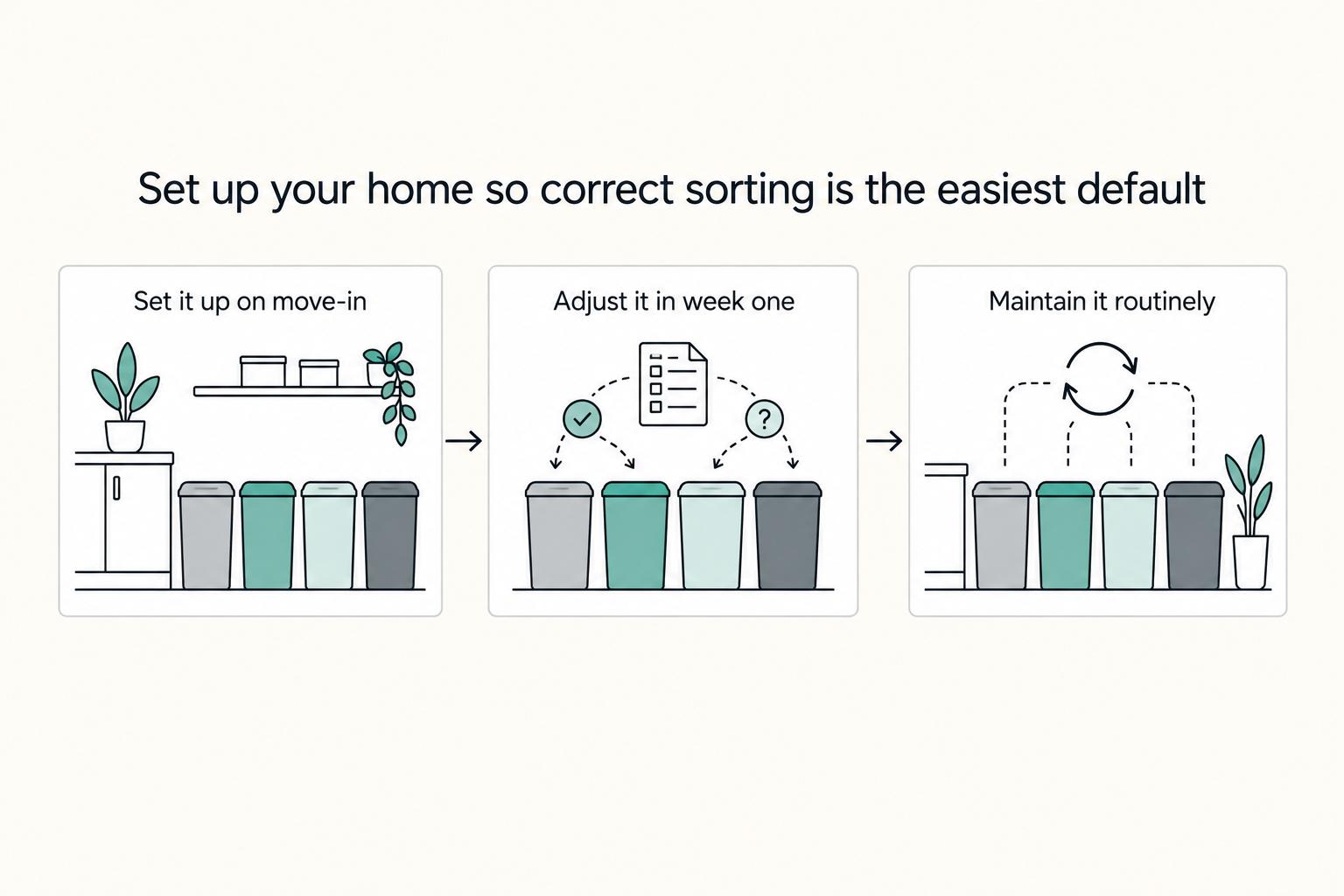
Set up your home so correct sorting is the easiest default#
Your setup should make correct sorting the easiest default. If you place the right containers in the right spots, most mistakes drop quickly without extra effort.
Set it up on move-in day#
Create a small multi-bin station where most waste appears, usually your kitchen. Use separate containers for paper, lightweight packaging (yellow stream), bio waste, and residual waste, then label each one so you, flatmates, and guests can sort fast without guessing.
| Element | Placement | Purpose |
|---|---|---|
| Multi-bin station for paper, lightweight packaging, bio waste, and residual waste | Where most waste appears, usually your kitchen | Makes correct sorting the easiest default |
| Labels on each container | On the home sorting containers | Lets you, flatmates, and guests sort fast without guessing |
| Two visible rules | From day one | Keep clear that the yellow stream is for lightweight packaging and standard plastic bags are not allowed in the brown (bio) stream |
| Separate outbox for batteries, electronics, glass, and Pfand containers | Near your exit | Keeps shared bins cleaner and makes special-item drop-offs easier to batch |
Keep two rules visible from day one: the yellow stream is for lightweight packaging, and standard plastic bags are not allowed in the brown (bio) stream. If you want liners for bio waste, verify local acceptance first.
Set up one separate outbox near your exit for items outside daily bin flow, including batteries, electronics, glass, and Pfand containers. This keeps shared bins cleaner and makes special-item drop-offs easier to batch.
Adjust it in week one#
Use your local waste authority app as your go-to source for pickup reminders and sorting rules. Confirm pickup cadence and exceptions there, especially for liner types and sorting exceptions.
After a few days, tune the setup based on friction:
- If packaging piles up, move or upsize that container.
- If paper gets damp or dirty, improve separation so it stays clean and dry.
- If special items collect in drawers, move them into the exit-side outbox.
Use this compact setup checklist:
- Place a multi-bin station at the main waste point.
- Label each container clearly.
- Keep paper clean and dry; flatten cardboard before shared-bin drop-off.
- Keep bio waste free of standard plastic bags.
- Put a special-items outbox near the door.
- Install the municipal app and set reminders.
- Mark municipality-dependent points and verify them locally before you rely on them.
| Common setup mistake | Better setup |
|---|---|
| One bin in a small apartment, "sort later" | Separate containers at point of use, even if compact |
| Unlabeled bins in a shared flat | Clear labels for consistent shared-bin etiquette |
| Cardboard dropped unflattened | Flatten boxes to protect shared-bin space |
| Batteries/electronics mixed into residual waste | Exit-side outbox for special-item routing |
| Missed collection days | Municipal app reminders and a simple routine check |
Maintain it routinely#
Keep it light: empty indoor bins before overflow, keep packaging reasonably clean and dry, and check your local app when an item is unclear. This helps prevent contamination that can lead to shared-bin issues, official landlord warnings, and higher Nebenkosten.
With this home workflow in place, you are ready for the next step: handling special-disposal streams outside the four household bins. For a separate admin task, see How to do Your 'Anmeldung' (Address Registration) in Germany. If relevant, you can also Browse Gruv tools.
Mastering Special Disposal: Beyond the Four Bins#
Your exit-side outbox is the control point for special items: separate first, verify the local channel second, then dispose deliberately.
Glass and Pfand#
Take glass to an Altglascontainer, not your household bins. Sort it before you leave home, then follow your municipality's container and timing rules instead of guessing.
Check the local disposal window before you go. When in doubt, wait and recheck, because visible mistakes around glass disposal can quickly upset neighbors.
For Pfand, keep deposit containers separate from ordinary recycling and return them through a Pfandautomat or another accepting retailer. Follow the return-point instructions on site, and do not assume every container is accepted everywhere.
If you need the current deposit value, verify it locally before you rely on it.
Hazardous waste and electronics#
If an item has batteries, electronics, or chemicals, keep it out of household trash. Use retailer take-back where available, or your municipal Recyclinghof/Wertstoffhof after checking local acceptance rules.
Keep items identifiable and sorted in your outbox so drop-off is faster and cleaner. For recyclable materials, avoid bagging them; bagged recyclables can jam sorting equipment. For plastic wraps or bags, check whether your supermarket has a dedicated collection bin.
| Item type | Drop-off channel | Common mistake | Best fallback |
|---|---|---|---|
| Glass | Altglascontainer | Guessing timing or local rules | Verify local rules, then go in the correct window |
| Pfand containers | Pfandautomat or accepting retailer | Mixing deposit items into regular recycling | Keep a separate Pfand bag in your outbox |
| Batteries | Retailer take-back or Recyclinghof/Wertstoffhof | Putting them in household trash | Hold in outbox until your next verified drop-off |
| Small electronics | Retailer take-back or Recyclinghof/Wertstoffhof | Treating cables/chargers as residual waste | Batch and drop off together after checking acceptance |
| Bulky items or textiles | Municipal bulky-pickup booking flow, Recyclinghof/Wertstoffhof, or approved textile route | Leaving items out without booking or verification | Book first or use the confirmed drop-off route |
Bulky waste and textiles#
For Sperrmull and other bulky items, do not leave items outside without confirmation. Use the municipal bulky-pickup booking flow or a Recyclinghof/Wertstoffhof, based on your local instructions.
For textiles, separate wearable from contaminated items before disposal. If condition or channel is unclear, verify local guidance first so one bad batch does not spoil the rest.
- Check your local app or website for glass rules, bulky booking, and Recyclinghof/Wertstoffhof acceptance
- Empty your outbox into four piles: glass, Pfand, hazardous/e-waste, bulky/textiles
- Keep Pfand separate from ordinary glass and packaging
- Use retailer take-back on regular shopping trips when available
- Keep booking confirmations until pickup or drop-off is complete
If you want a deeper dive, read Can Digital Nomads Claim the Home Office Deduction?.
Risk Mitigation: The Real Consequences of Non-Compliance#
Your main risk is usually a practical chain reaction, not an instant major penalty: a sorting mistake creates a visible bin problem, collection may be delayed, and the issue can spill into building communications and shared costs such as Nebenkosten.
This matters because small errors add up. German Environment Agency reporting shows that many recyclable materials still end up in the residual waste bin, and biowaste is the largest share there at about 39 percent. In urban areas, residual bins also tend to contain more recyclables than in rural or suburban areas, so shared-bin discipline is even more important in city buildings.
Where the risk actually shows up#
Enforcement is local and document-based. Your municipality sets collection rules, and your building sets day-to-day expectations through the Mietvertrag, Hausordnung, bin-room notices, and manager messages. Treat all of these as operating instructions.
If a shared bin is not collected, document it immediately: take a photo of the bin, any sticker or written notice, and the visible issue, then save the scheduled collection date from the municipal app or calendar.
| Failure type | Who is affected | Likely consequence | Your fastest corrective action |
|---|---|---|---|
| Wrong item in biowaste (for example, a standard plastic bag) | Everyone sharing that bin | Bin may be flagged or left unemptied | Remove obvious wrong items if safe, check the notice, and inform management for shared bins |
| Recyclables repeatedly put in residual waste | All tenants via shared waste volume | More residual-waste pressure and possible higher shared disposal costs via Nebenkosten | Tighten in-home sorting before the next billing cycle and keep packaging out of Restmull |
| Glass, bulky waste, or special items left in the wrong place | Neighbors, caretaker, building manager | Complaint, cleanup request, or delayed removal | Move items to the correct channel and keep booking/drop-off proof |
| Missed pickup rule or unverified disposal route | You first, then the building if waste accumulates | Overflow, complaints, or rebooking effort | Recheck municipal calendar/booking steps and document the fix |
What happens next when something goes wrong#
If a shared bin is contaminated, the usual pattern is: problem identified -> bin flagged or not emptied -> manual correction. The escalation step after that is local, so verify it with your municipality or building management.
| Situation | Usual next step | Local note |
|---|---|---|
| Shared bin is contaminated | Problem identified -> bin flagged or not emptied -> manual correction | Verify the local escalation step |
| You miss a pickup or use the wrong route | Rebooking or waiting for the next valid window after you verify local rules | Verify the local escalation step |
| There is a building complaint | Respond with date, photos, and what you corrected, then confirm whether your house rules require any additional step | Verify the local escalation step |
If you miss a pickup or use the wrong route, the next step is usually rebooking or waiting for the next valid window after you verify local rules.
If there is a building complaint, respond with facts: date, photos, and what you corrected, then confirm whether your house rules require any additional step.
- Check your Mietvertrag, Hausordnung, and municipal collection calendar before the next billing cycle
- Photograph refused bins, stickers, or pickup issues the same day
- Keep bulky-pickup confirmations and special-disposal receipts until the issue is closed
- For edge cases, hold the item aside and verify locally before using a shared bin
This pairs well with our guide on A Guide to Health Insurance for Freelancers in Germany.
Conclusion: From Compliant Resident to Integrated Professional#
Once you stop guessing and start verifying, the system becomes less of a cultural puzzle and more of a steady household habit. In practice, that can mean fewer sorting mistakes and less day-to-day friction in shared spaces.
The habits that matter are the ones you can repeat without much thought. Keep a workable sorting setup at home, not an aspirational one. Use clearly separated containers, keep a place for items you are unsure about, and add a small hold box for batteries, electronics, or other items that may require special disposal. Your main checkpoint is local, not generic. Recheck your city sanitation site or app, your Abfallkalender, and your Hausordnung or Mietvertrag when you move, when collection rules change, or when a building notice appears.
That routine is what turns compliance intention into consistent participation in the Kreislaufwirtschaft. You are not proving anything grand. You are showing that you can operate well inside a shared residential setup, correct errors quickly, and avoid the common failure mode of tossing uncertain items into a household bin just to get them out of sight. If a pickup is refused or a notice appears on a bin, photograph it the same day and verify the next step before re-sorting.
What you do next#
- Label your home sorting points and add one separate box for "verify later" items
- Save your municipality's waste page or app and check it against your building rules
- Keep a fallback route for special disposal so batteries, electronics, and other edge cases are handled outside your main household bins
- If something goes wrong, document the notice and fix it quickly instead of debating from memory
For another Germany-focused read, see A Guide to Christmas Markets in Germany.
Frequently Asked Questions
How do you dispose of electronics in Germany?
Set electronics aside and verify the local route before disposal. The sources here treat electrical appliances as a separate waste category, but they do not provide one universal disposal method. Check your district waste calendar online, or ask at the Rathaus if the route is unclear.
What happens if you do not separate waste correctly?
Correct it quickly. A common consequence is that sorting personnel at recycling facilities have to re-sort the waste. Recyclable packaging can also be lost if it ends up in residual waste.
Are the rules the same everywhere?
No. Treat waste separation in Germany as a local-rules task, not something you memorize once. Check your district pickup calendar online, use your local Abfallkalender, and confirm details with the Rathaus when needed. When in doubt, hold the item aside until you can verify it.
How does Pfand work?
You pay a deposit when you buy an eligible drink container, then return the empty container to a shop to get that amount back. If you need the current amount, verify it locally before you rely on a fixed figure from an older guide.
Try a related tool
Researched and edited by the Gruv editorial team. Gruv builds cross-border billing, payouts, and finance-operations software for global businesses.
Sources
- apps.ecology.wa.gov/publications/documents/2209058.pdftrusted
- cs.unc.edu/xcms/wpfiles/dissertations/brandenburg.pdftrusted
- docs.nrel.gov/docs/legosti/old/7978.pdftrusted
- ec.europa.eu/environment/pdf/waste/studies/euwastemanagem...trusted
- epa.gov/sites/default/files/2020-11/documents/benzen...trusted
- irs.gov/pub/irs-pdf/p4012a.pdftrusted
- nepis.epa.gov/Exe/ZyPURL.cgitrusted
- nepis.epa.gov/Exe/ZyPURL.cgitrusted
Educational content only. Not legal, tax, or financial advice.
Related Posts

Can Digital Nomads Claim the Home Office Deduction?
Claim the deduction only when your facts and records can carry it. With the home office deduction for digital nomads, the real decision is usually a three-way call: claim it, do not claim it, or pause and get help because your file is not ready.

The Best Debit Cards for International Travel
If reliable cash access is the priority, do not evaluate this like a perks list. Treat it like continuity planning. Give one card the everyday ATM job, fund a second card for disruptions, and decide that split before you leave.
Best Digital Nomad Cities for Work-Life Balance in 2026
Use this as a decision tool, not a travel ranking. If you are relocating for better balance, work in the safest order: legal stay viability first, monthly affordability second, and weekly pace third. Get that order wrong and you usually pay for it later.