
Quick Answer
Wise can suit a large transfer when the route, available funding method, fee, and estimated timing fit the payment. Check limits for your account type and address, prepare relevant documents, and allow for further verification. US-profile volume discounts start above 25,000 USD of completed qualifying cross-currency volume in a UTC calendar month; Personal and Business accounts count separately and lower fees apply only to higher-bracket amounts. Use the exact quote and tracker for execution planning.
How to evaluate Wise for large international transfers beyond the headline fee#
For high-value cross-border payments, the real decision is not just the headline fee. The bigger risk is cashflow disruption if timing slips after you start the transfer.
That is the lens for this guide. Here, "large" is an operational label: any transfer where a delay or mismatch creates real business risk.
Wise’s US pricing page describes a mid-market exchange rate and a separate upfront fee. Fees depend on the route and funding method. Its volume-discount rules apply lower fees only to amounts above the relevant monthly bracket: for US profiles, the first threshold is 25,000 USD. Only completed cross-currency transfers or conversions with supported pay-in currencies count, in a UTC calendar month. Personal and Business accounts accumulate separately, and the threshold currency follows your registered profile address.
Those signals are useful, but the pricing information here does not guarantee execution outcomes on every route. Keep this practical: confirm your funding path and account readiness before you lock external deadlines. Verify sender and recipient details before launch. Prepare your support documents and escalation path in advance if timing is critical.
This guide uses Wise’s current pricing and help pages, with USD funding limits separated by account type and registered address. Use your exact route’s live quote and transfer tracker for the available methods, fee, and arrival estimate. Preparation can reduce avoidable questions, but it cannot guarantee that a transfer will avoid further verification.
What a large transfer means in practice#
For Wise transfers, "large" is often about operational risk, not just amount. In practice, it includes payments where timing or detail mismatches could disrupt obligations or cashflow.
| Scenario | When it counts as large | Operational effect |
|---|---|---|
| Near-term cross-currency obligations | A timing slip would leave you short on upcoming payments | Could disrupt obligations or cashflow |
| Deadline-driven payments | Timing risk matters more than marginal fee savings | Could disrupt obligations or cashflow |
| Clustered operating transfers | Several routine transfers land together, even if no single transfer looks especially large | Can strain liquidity |
Wise’s published transfer pricing uses a mid-market exchange rate with a separate fee. Your baseline is the live quote for the exact send and receive currencies and funding method. Account or business-feature charges are separate from the transfer quote; do not assume one headline percentage covers every cost.
Separate operationally large from discount-eligible. For a US profile, the first volume-discount bracket starts above 25,000 USD in completed qualifying volume during a UTC calendar month. Only cross-currency transfers or conversions with a supported pay-in currency qualify; same-currency, uncompleted, and cancelled transfers do not count. Personal and Business accounts have separate totals. Lower rates apply to the portion in higher brackets, not retroactively to the entire month’s volume. In practice, the payment scenario is what makes a transfer sensitive:
- Near-term cross-currency obligations: large when a timing slip would leave you short on upcoming payments.
- Deadline-driven payments: large when timing risk matters more than marginal fee savings.
- Clustered operating transfers: large when several routine transfers land together and strain liquidity, even if no single transfer looks especially large.
That framing matters because it changes how you should evaluate the transfer. If the payment is operationally sensitive, your main job is not to chase the lowest quoted cost in the abstract. Your job is to confirm that the route, funding method, and account details line up well enough that you can execute when needed. A transfer that is affordable but not executable on your required timeline is not a good fit.
Decide when Wise is a fit for your transfer#
Evaluate Wise using the exact route, available funding methods, fee, and estimated timing. Before executing, check that you can fund the chosen method and allow for further review; a future discount should not carry a tight deadline.
Use a hard go or no-go gate#
Before you commit transfer timing to a client, seller, or vendor, confirm two things inside Wise:
- You have a live quote for your exact send currency, receive currency, and payment method.
- The funding method you plan to use is ready now.
Wise says you will see the fee and exchange-rate breakdown before confirmation. It also says fees depend on send currency, receive currency, and payment method. Use that live quote as your decision point, not a generic fee headline or an old screenshot.
Use these as execution checks. You can compare routes and obtain quotes while funding or details are still being arranged, but before confirming the transfer, align the route you priced with the method you will use. A later funding change can affect both cost and timing.
Score fit on three factors#
| Factor | Good fit | Red flag | What to verify now |
|---|---|---|---|
| Amount vs. discount status | You plan timing separately from the tiered fee | You count pending, same-currency, or another account’s volume | For a US profile, check completed eligible cross-currency volume above 25,000 USD in this account’s UTC calendar month; confirm the live tiered quote |
| Route specifics | You priced the exact route and payment method you will use | You are using a broad "from" fee as your estimate | Recheck the live quote for this transfer |
| Timing discipline | Your plan still works if pricing shifts slightly | Your timing only works if today's quote is unchanged | Confirm current route cost right before sending |
For a US profile, discount planning starts with completed qualifying cross-currency volume above 25,000 USD in the UTC calendar month, tracked separately for Personal and Business accounts. Wise automatically applies lower fees to amounts in higher brackets. Check the quote for the portion eligible on this transfer; the discount does not make the arrival estimate a guarantee.
A useful way to think about fit is this: if you had to execute the transfer today, with the funding rail you can actually use today, would it still work? If the answer is no, the issue is not pricing alone. It is readiness.
Complete pre-transfer checks before you lock timing#
Check limits, available funding methods, and the live quote before promising a send date. Agree a realistic lead-time buffer rather than treating these checks as proof that verification or bank processing cannot delay the payment.
Use pass/fail gates#
Work through these checks in order:
| Gate | What to verify | Why it matters |
|---|---|---|
| Relevant account and method limit | Check the exact route, account type, address, and funding method; for USD bank debit, use Limits and Connected bank account limits (USD) | A supported route can still exceed the funding cap |
| Funding method fits this transfer | Confirm feasibility for the exact rail you will use, not just the total amount | Changing the funding rail can change both feasibility and cost |
| No active limit block while arranging | Watch for in-app or desktop notice if you hit a limit during setup | Treat that as a stop signal |
| Live quote rechecked right before confirmation | Recheck the fee and exchange-rate breakdown for the send currency, receive currency, and funding method | The quote you were relying on may no longer be the one you will execute |
Check the funding method and limits together. If you change the rail, review the relevant cap, fee, and timing again; you do not need to repeat unrelated checks that remain valid. A transfer that fits a wire limit can exceed an ACH bank-debit limit at the same amount.
Start with the rail, not the amount headline#
Wise’s USD guide distinguishes account type and registered address. The examples below concern sending from USD for profiles in licensed US states, Guam, the Virgin Islands, or outside the US. Check your connected-bank-account limit in Wise; receiving USD and sending from a Wise balance use different route rules.
| USD funding path | Personal / Business limit for the specified profiles | Timing or availability check |
|---|---|---|
| External bank funding within the overall transfer cap | 1,000,000 USD per transfer for Personal or Business | Your bank and selected method can impose lower limits; this is not a universal balance-funded payout cap |
| ACH bank debit | Personal: 50,000 USD per 24 hours and 50,000–250,000 USD per 60 days; Business: 100,000 USD per 24 hours and 50,000–600,000 USD per 60 days | Check your actual connected-account limit; Wise says sending over 50,000 USD per 24 hours takes longer to process |
| Card, if offered and eligible | 2,000 USD per 24 hours; 8,000 USD per 7 days for Personal or Business | Card and business-funding restrictions apply; do not assume every credit/debit card is available |
Profiles in Nevada, American Samoa, or the Mariana Islands have different personal limits: 50,000 USD per 24 hours, 250,000 USD over a rolling 12 months, and ACH bank debit of 10,000 USD per 24 hours and 400,000 USD over 60 days. Those addresses cannot fund by debit or credit card. US-address profiles cannot fund a USD transfer by Swift. For other profiles, card funding still depends on the method being offered and the card meeting Wise’s requirements; Wise Business transfers require business funding, not a personal card or bank account. Choose a route that fits your account and your bank’s own limits.
Finish with a fresh quote, not an old assumption#
The final check is the live quote at execution time. Confirm the available method, amount, fee, exchange rate, and any displayed rate-guarantee deadline before sending the funding payment. An earlier estimate may no longer match the transfer you can execute. Recheck when the route, method, or timing changes.
That last recheck matters most when the transfer depends on a specific route or a specific funding method. The point is not that every small pricing move is material. The point is that a large transfer should go out based on the conditions you can see now, not on the conditions you remember from earlier planning.
For a step-by-step walkthrough, see A Guide to Using Wise for Payroll for International Contractors.
Before you lock a send date, run one last route-and-amount check with the payment fee comparison tool.
Prepare source-of-funds documents for a possible review#
Have relevant documents ready before you send, but do not assume Wise can approve the source of funds beforehand. Wise says it cannot check these documents before you set up a transfer. Submit them when requested and allow time for review.
Wise may need to verify your account and, depending on the amount, where the transfer funds came from. The document requirements depend on the source and whether you use a personal or business account. Prepare the relevant proof rather than treating a general folder as guaranteed approval.
Use a simple internal coherence check#
Use these internal checks to organize the records you already have and label any gaps. Submit the provider’s requested evidence; an internal coherence check does not replace its review:
- Name alignment: the same legal person or entity is clear across documents.
- Amount coverage: the records plausibly explain the transfer amount.
- Date sequence: the timeline from source to receipt to funding is easy to follow.
| Evidence component | What it should prove | Common mismatch risk | Fix before submission |
|---|---|---|---|
| Identity-linked record | Who owns the funds | Name format differs across files | Use documents that show the same legal identity clearly |
| Origin record | Where the money came from | Origin is implied, not explicit | Include the record that shows the underlying event or transaction |
| Account movement record | How funds reached the sending account | Timeline or amounts are hard to reconcile | Pair movement records with the origin record and align dates and amounts |
Arrange your pack in a clear review order: who you are, where the funds came from, and how they reached the account you are using to fund the transfer. If a reviewer has to infer that chain from loosely related files, review gets harder before it starts.
Ask whether another operator can follow the source and movement of funds from the available records. If something is unclear, label the gap and obtain the relevant supporting document. You can still compare fees or ask Wise what evidence is needed while the file is being prepared.
Avoid shortcuts that create compliance risk#
Use genuine documents for the correct person or business. Wise’s wire-funding guidance requires the funding account name to match the Wise account; a joint account may require proof that your name is on it. Business bank-account funding belongs on a Wise Business account. If a mismatch prevents funding, correct the account or method before paying.
Avoid unrelated files, but do not withhold relevant proof to keep a submission short. Wise recommends providing as many of the relevant listed documents as you can when asked. A bank statement is usually not sufficient on its own; include supporting origin records where required.
Keep internal handling clean#
Use redacted working copies for internal collaboration and keep untouched originals in secure storage. For formal submission, follow Wise’s requested fields and document format; do not redact information it needs to verify. If a requirement is unclear, ask for guidance rather than waiting until you can guess a complete submission.
It also helps to keep one internal folder per transfer or payment event rather than mixing unrelated files into a general archive. That makes it easier to respond if your provider requests additional information later, and it reduces the chance of uploading the wrong version under time pressure. The goal is a pack you can reuse and explain, not a one-off scramble assembled only after a review request appears.
Plan fees and discounts without guesswork#
Track completed qualifying monthly volume and price the exact route before sending. For US profiles, the first bracket is 25,000 USD, with lower fees only on amounts above the bracket. Qualifying cross-currency transfers or conversions can accumulate across a UTC calendar month, with separate totals for Personal and Business accounts. The monthly window resets on the first; use the actual quote to see this transfer’s tiered fee.
The threshold currency follows your registered profile address, not the currency balance you opened. Only completed cross-currency transfers or conversions with supported pay-in currencies count. Same-currency transfers and pending or cancelled items do not count. Wise’s detailed rules identify the eligible pay-in currencies and profile thresholds.
One large transfer vs several transfers in one month#
The threshold logic is the same, but the planning tradeoff changes:
- One qualifying large transfer: standard fees apply to the lower bracket and lower fees only to the portion above it.
- Several qualifying transfers: completed cross-currency volume in the same account accumulates within the UTC calendar month.
- In both cases: Personal and Business accounts count separately; pending, cancelled, and same-currency transfers do not qualify.
Fees depend on the send currency, receive currency, and funding method. Re-run the exact route quote instead of budgeting from a broad “from” percentage. A volume discount reduces eligible higher-bracket fees; it does not remove other route or method conditions.
A practical planning rule is to separate urgent transfers from optimization transfers. If a payment has a hard deadline, base the decision on the route cost and discount status you can confirm now. If a payment is flexible, you may have more room to time it within the same month. What you should not do is make an urgent transfer depend on a discount status that is not yet active or on a route estimate that has not been refreshed.
Threshold planning by profile region#
| Registered profile region | First monthly bracket in profile currency | Planning move |
|---|---|---|
| USA and other countries tracked in USD | 25,000 USD | Use completed qualifying cross-currency volume in the correct account |
| Europe tracked in EUR | 22,000 EUR | The profile address, not your currency balance, sets the base currency |
| UK tracked in GBP | 20,000 GBP | Lower fees apply only to the amounts above the relevant brackets |
| Australia tracked in AUD | 40,000 AUD | Personal and Business accumulate separately; UTC month resets on the first |
Use your registered profile address to select the threshold, then check completed qualifying cross-currency volume in the correct Personal or Business account. Time only non-urgent transfers for cost optimization; the discount window does not justify risking a payment deadline.
Keep a month-to-date view of completed eligible transfers and conversions. Pending items are excluded, and same-currency movements do not qualify. Check the live quote near a bracket or month boundary rather than estimating a discount from the total money moved through your accounts.
Related reading: Using Ramp for Corporate Card and Expense Management in a Remote US Agency.
Run the transfer in the right order to protect cashflow#
Separate planning from execution. You can compare pricing before details or funding are final. When ready to confirm and fund a transfer, use a consistent sequence and check the displayed instructions and deadlines.
Confirm the payment obligation is final#
Before execution, confirm the amount, recipient details, and due date. While these are being finalized, obtain indicative quotes and record which assumptions may change.
Confirm funding is ready#
Arrange the sending account, approvals, and funding amount. You can compare prices beforehand; at execution, check the quote for the method you can actually fund.
Use the pre-confirmation Wise screen as a hard checkpoint#
Wise shows the fee and exchange-rate breakdown before confirmation. Review it right then, and recheck the fee calculator if your route or payment method looks different from your plan.
Follow the funding instructions after confirmation#
After confirmation, follow the funding instructions and any displayed deadline. Prompt funding can reduce avoidable delay, but it does not bypass Wise’s checks or your bank’s processing time.
Track status until completion#
Treat the transfer as complete only when it reaches a final status and the recipient confirms receipt.
The sequence aligns final recipient details, approved funding, and the current quote before execution. Early comparison is still useful when assumptions are labelled. If a detail or funding method changes, revisit the affected quote and instructions; do not treat an earlier estimate as proof of current price or arrival timing.
If extra checks appear after you send#
If additional checks are requested, pause downstream commitments until the transfer reaches a final status. Keep payout timing conservative while the transfer is still in progress.
That is important internally as well as externally. Do not treat "initiated" as interchangeable with "settled," and do not trigger onward releases, supplier promises, or customer confirmations just because the transfer has been created. If the payment matters enough to monitor closely, it matters enough to wait for final status before you rely on it operationally.
Keep one execution log per transfer#
Keep one execution log per transfer, and track these checkpoints in one place:
- initiated time
- fee and exchange-rate details shown before confirmation
- status updates
- any requested documents
- document submission timestamps (if applicable)
- final recipient receipt confirmation
A simple log does two jobs at once. It helps you respond quickly if the transfer slows down, and it gives you evidence later if someone asks what happened, when it happened, and what you saw at the point of confirmation. Without that record, teams often end up reconstructing the timeline from memory, screenshots, and inbox fragments.
Build records you can reuse#
Keep the transfer record set together: payment obligation, recipient details used, pre-send pricing snapshot, payment proof, any submitted documents, and final completion proof. That gives you a clean audit trail and makes repeat transfers easier to run and reconcile.
Over time, those records also show you where friction actually occurs on your route. You may find that one step is consistently smooth while another creates most of the timing variability. That kind of route-specific learning is more useful than any generic assumption about how a large transfer should behave.
Related: How to Set Up a US LLC from the UK.
Handle delays and holds with explicit escalation triggers#
When a transfer slows down, one complete case summary is often more effective than sending multiple partial follow-ups.
Use the transfer tracker’s estimate for the actual payment. Wise explains three possible delay stages: funding has not reached Wise, Wise is processing or checking the transfer, or the recipient’s bank is processing the payout. Broad currency or country coverage cannot predict the timing of a large transfer.
Use a simple escalation ladder#
Recheck what you control first#
Confirm recipient details, amount, and funding status are correct and consistent with what you intended to send.
Complete open requests fully#
If Wise requests documents, answer the relevant request and keep submission timestamps. If you cannot provide a document or do not understand the request, contact support with that question and the records you have.
Ask for help when the next action or delay is unclear#
If the tracker estimate has passed, status is unclear, or a request cannot be completed, ask the appropriate team for help. A funding payment still with your bank may need a bank trace; a payout sent to the recipient may need their bank to investigate using the transfer confirmation. For Wise-side questions, include the transfer reference, current status, completed actions, and unresolved issue.
This is an internal workflow, not a Wise escalation SLA. You do not have to wait for every document to be complete before asking how to resolve a blocker. Wise says extra security checks cannot be sped up; support can clarify the requested action without guaranteeing an earlier release.
Escalate with one clean case file#
Make your escalation message read like a complete case note. Include:
| Case file item | Detail |
|---|---|
| Transfer reference | Include the transfer reference |
| Send and receive currencies | Include the send and receive currencies |
| Amount | Include the amount |
| Initiated time | Include the initiated time |
| Status detail | Include the current status and last visible status change |
| Requested documents | Include the requested documents |
| Submission record | Include submission timestamps and current document state |
| Funding proof | Include proof your funding payment was sent |
Send one coherent update with the available facts, completed actions, and open questions. Mark missing information explicitly. Ask for guidance promptly if a request blocks progress rather than waiting for a file that you cannot complete.
That same discipline helps internally. Decide who owns the case, keep the timeline in one place, and avoid having multiple people ask the same question in parallel without the full record. Fragmented escalation creates noise, while one well-built case file can make it easier to see whether the issue is still on your side or is now waiting on review.
Reduce repeat risk with client terms and payout policy#
The best time to absorb timing uncertainty is before money moves. Clear client terms and payout policy can protect trust and cashflow better than trying to explain a delay after the fact.
Set these points at the start of every engagement:
- agreed invoice currency
- a lead-time buffer before any deadline that depends on onward payment
- milestone timing so one transfer does not become a single point of failure
Agree lead time, buffers, and what happens if verification or bank processing changes the arrival estimate. For an onward payout funded by this transfer, release only when the funds have been received and are available.
Keep business and personal flows separate. Wise requires business bank-account funding to use a Wise Business account. As an internal reconciliation check, map each transfer to its payer, recipient, invoice or other obligation, business purpose, and funding source; use those records to explain the flow if questions arise.
That checkpoint is useful because it turns policy into something testable. If you cannot explain a transfer cleanly before sending it, it may be harder to explain after questions are raised. Clean separation of flows, clear invoice currency, and explicit payout conditions can make transfers easier to reconcile and easier to defend if timing or purpose is later reviewed.
Review outcomes monthly, by route and payment type rather than only when something breaks:
- time from client payment notice to recipient confirmation
- total fees and FX outcome versus expectation
- document requests, resubmissions, and mismatch reasons
If one route keeps creating documentation questions or timing surprises, update your terms or payout policy before the next cycle.
This review is where repeated small issues become useful information. If the same route regularly needs extra documentation explanation, tighten your file requirements earlier. If one type of payment repeatedly creates deadline stress, increase your internal buffer before you promise onward payout. Operational policy works best when it reflects what your transfers are actually doing, not what you hoped they would do.
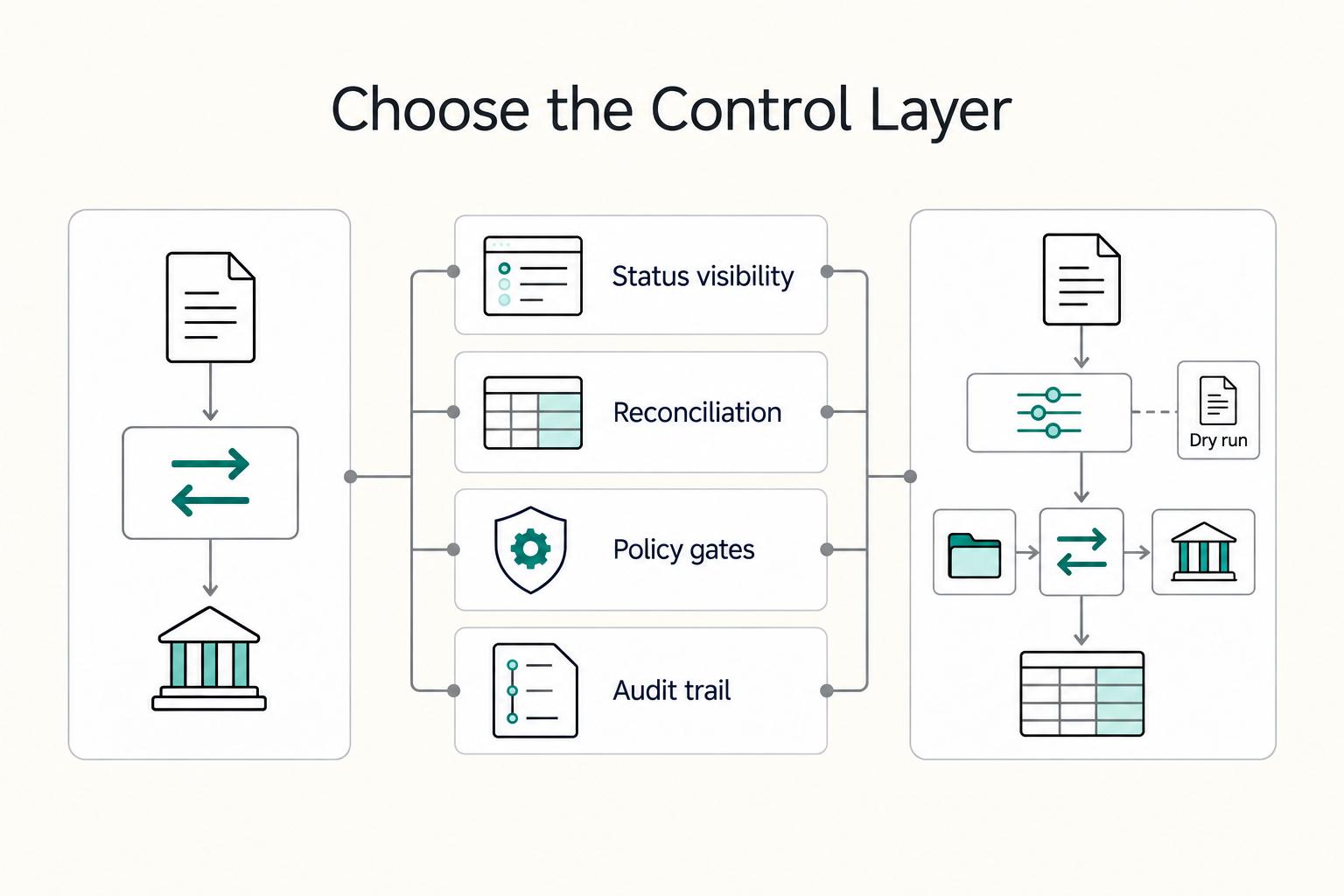
Choose between Wise only and a layered Gruv setup#
Choose the simplest setup that gives your operation the controls and records it needs. Compare the workflows below in your actual process; do not assume an extra tool changes Wise’s verification, funding limits, or bank delivery times.
| Operating attribute | In your current process, check this | In any layered setup, verify this before rollout |
|---|---|---|
| Status visibility | Can you see payment progress without chasing multiple channels? | Will status stay clear across collection, conversion, and payout steps? |
| Reconciliation depth | Can you tie each transfer to invoice, payer, recipient, amount, and confirmation in one usable record? | Can you export the fields your operator or accountant needs without manual stitching? |
| Policy gates | Are release and exception decisions explicit and repeatable? | Can approvals, limits, and exception handling be applied consistently for your use case? |
| Multi-step audit trail | If timing or amount is disputed, can you show a complete decision and payment path quickly? | Will the layered flow keep one traceable record instead of splitting history across tools? |
Use a practical if-then rule: if you need formal approval gates, tighter payout controls, and repeatable audit outputs, test those requirements explicitly in any candidate layered setup. If Gruv is on your shortlist, evaluate module fit where supported and confirm market or program coverage before committing to migration.
Before changing your stack, run one low-risk dry run and review the month-end file quality. If the layered flow reduces manual reconstruction and makes decisions easier to explain, proceed. If it adds mapping work, keep the leaner setup and tighten policy first.
The key comparison is not "more tools" versus "fewer tools." It is whether the setup you choose gives you enough control for the transfer pattern you actually run. If your current process already gives you clear status, clean records, and manageable exceptions, adding another layer may not help. If the pain point is approvals, payout release logic, or audit reconstruction, then the operational case for layering may be stronger.
Conclusion#
Large transfers benefit from an exact route check, relevant documents, realistic lead time, and clear records. Preparation reduces avoidable mistakes while leaving room for provider review and bank processing.
Compare the route and funding options first. Before execution, confirm recipient details, account and bank limits, approvals, the live quote, and the displayed funding instructions. After sending, track the stages, keep one record, and ask for guidance when status or an outstanding action is unclear.
Match the recipient details and routing number to the selected payout method. Wise’s USD guide gives different estimates for domestic ACH, domestic wire, and international Swift payouts; funding and conversion are additional stages. Use the actual transfer tracker and allow a buffer rather than assuming every bank route completes within three days.
Be careful with broad coverage claims. Different materials can describe reach differently. That is a good reminder to verify corridor coverage for your specific market and account setup before you make commitments.
Your next step is simple: run this checklist on your next high-value transfer and record the outcome. If volume or complexity is increasing, evaluate whether a layered setup with stronger controls and cleaner reconciliation is warranted.
If large transfers are becoming a repeat workflow, map whether a layered setup with collection, payout controls, and traceable records fits your operation in Gruv for freelancers.
Frequently Asked Questions
Is Wise good for large transfers if I care most about reliability, not just fee percentage?
Wise can be a fit when its available route, funding method, fee, and estimated timing suit the payment. Preparation can reduce avoidable questions, but it cannot guarantee delivery by a fixed deadline. Complete account checks when requested and have relevant funds-origin documents ready. Wise cannot review source-of-funds documents before you set up a transfer, so allow for review after setup. For an important payment, check the specific recipient, available funding method, account limits, and arrival estimate. Keep a buffer for verification and bank processing even if your initial documents and funding details look ready. Ask for help if a request is unclear rather than treating a prepared pack as pre-approval.
At what point do Wise volume discounts typically start, and what counts toward them?
For US profiles, the first bracket is 25,000 USD in completed eligible volume during a UTC calendar month. Only cross-currency transfers or conversions paid in supported currencies count; same-currency, pending, and cancelled transfers do not. Personal and Business accounts accumulate separately. Your registered profile address sets the threshold currency, and lower fees apply only to amounts in higher brackets. The monthly window resets on the first. Track completed eligible volume in the correct account and check the live quote for the transfer’s actual tiered fee. Other profile regions have different starting thresholds, including 20,000 GBP for the UK, 22,000 EUR for Europe, and 40,000 AUD for Australia.
Do multiple completed transfers in one month count the same as one large transfer?
Yes, qualifying completed cross-currency transfers or conversions accumulate within the same UTC calendar month, in the same Personal or Business account and using supported pay-in currencies. Wise applies standard fees to lower brackets and discounted fees to higher-bracket amounts whether that qualifying volume comes from one transfer or several. Bank funding limits and payment timing still need separate planning. That is why discount logic and execution logic should be kept separate. Multiple transfers may help with cumulative volume, but they can also introduce more timing points, more room for a rail limit issue, and more chances for the route cost you finally execute to differ from the one you planned.
What are the most common reasons a large transfer gets delayed?
Possible delays include funding still with your bank, verification or source-of-funds checks at Wise, recipient-bank processing, and incorrect account details. Wise’s current guidance says verification requested after a transfer is in progress is targeted within 5–14 working days for personal and business customers; that is not a guaranteed completion time. For joint-account wire funding, Wise may request proof that your name is on the bank account. In practice, many of these delays are connected. A limit issue can force a funding-method change, which can require a new quote. A document gap can pause a transfer that otherwise looked ready. A minor detail mismatch can create a review cycle that matters only because the deadline was already too tight. That is why pre-transfer checks matter more on large payments than on low-stakes ones.
Which documents are usually expected for source-of-funds verification?
Wise may request documents such as a property sale agreement, payslips, bank statements, or other evidence relevant to the source and account type. Statements are usually not enough alone. Its statement guidance requires the amount, origin references, and your name and account details; for salary or savings, it instead describes three months of statements showing regular payments with clear references. Prepare relevant records, then answer the actual request after transfer setup. If you need to prepare in advance, think in terms of proof chain rather than document type alone. The strongest pack is the one that makes ownership, origin, and movement easy to follow without explanation gaps. That is usually more useful than sending a larger bundle that still leaves the money path unclear.
How predictable are transfer speed and total cost across different currency routes?
Wise shows the transfer fee and exchange rate before confirmation, but the available method and price depend on the exact route. Use the current quote and any displayed funding or rate-guarantee deadline. Delivery is an estimate: bank funding, conversion, checks, and recipient processing can add time. For example, its USD guide separates ACH bank-debit funding from an ACH payout to a US recipient; they are different stages with different limits and timing. That means planning should treat cost and timing differently. Cost can often be checked right before confirmation. Timing has to be managed through readiness, routing choice, and buffer discipline. If the payment is critical, assume speed needs operational protection even when cost appears straightforward.
Try a related tool
Researched and edited by the Gruv editorial team. Gruv builds cross-border billing, payouts, and finance-operations software for global businesses.
Sources
Educational content only. Not legal, tax, or financial advice.
Related Posts

How LLC Owners Separate Business and Personal Finances
For an LLC, separating business and personal money is best treated as a weekly habit, not a one-time bank setup. It keeps records cleaner, cuts month-end cleanup, and creates clearer boundaries as the company grows.

How to Set Up a US LLC from the UK
A UK resident can generally own a US LLC without moving to the United States. The practical sequence is to resolve the UK and US tax treatment, choose a state and registered agent, file the formation document, record ownership, obtain an EIN, complete banking checks, and establish a filing calendar. **An LLC is a legal entity, not a promise of tax savings or a bank account.**

The Freelance Payment Penalty: A Modeled Audit of Platform Fees, FX Spreads, and Payout Delays
The money rarely disappears through a single, easy-to-spot fee. The real loss is stacked. A marketplace takes its commission, a processor adds a charge for international cards, a bank or payment company converts the currency at a spread, a platform holds the funds before release, and a wire sheds a little to intermediaries on the way in. Each layer looks defensible on its own, but the worker feels the combined result as a smaller deposit and a later payday.