
Quick Answer
Use a series llc for real estate only after a written decision memo confirms state treatment, lender requirements, and your ability to run separate records by series. Form the Master LLC first, finalize an operating agreement that authorizes internal series, and create each series with signed approvals before any deed or lease move. Then keep dedicated bank activity, series-level books, and matching legal names across contracts. If those controls will slip, standalone LLCs are usually the cleaner choice.
Liability shield conditions, state recognition limits, and three early checkpoints#
A Series LLC for real estate makes sense only if it helps you isolate property-level risk without creating operating confusion. The real question is whether you can maintain real separation in practice, and whether the states involved will treat the structure the way you expect.
At a basic level, a Series LLC is one LLC that can create multiple separate series under a single umbrella. The master LLC sits at the top, and each series can have different assets, liabilities, members, managers, duties, and rights. For real estate investing, that means separate properties or operations with different goals can sit inside one structure.
The main appeal is the inter-series liability shield, but that protection is not automatic. Two limits matter from the start: not all states recognize Series LLCs, and case law interpreting these statutes is still limited. If your plan touches more than one state, that uncertainty is part of the decision.
This guide stays practical. It focuses on decision checkpoints, setup order, and maintenance habits that make separation more credible. Early checkpoints include:
- Whether your state fit supports the structure.
- Whether your formation package includes parent-level Articles of Organization and an operating agreement that defines how the series is structured and operated.
- Whether you file the required formation documents with the correct Secretary of State.
Where the rules are unsettled, this guide says so directly and flags what to confirm with state-specific legal and tax counsel before you act. The sequence is straightforward: validate jurisdiction fit, form correctly, then operate with records and governance that can support the separation you are counting on.
Related: How to Invest in Real Estate as a Digital Nomad.
What a Series LLC means in plain English#
A Series LLC is one umbrella Limited Liability Company (LLC) with multiple internal compartments (series). The umbrella is the Master LLC, and each series can be treated separately for assets, liabilities, operations, and membership interests.
For real estate, the practical idea is simple. You place different properties in different series and keep each one tied to its own bank accounts and books and records. That can reduce entity sprawl compared with forming a separate standalone LLC for every property.
The tradeoff is operating discipline and legal uncertainty. This structure depends on the separation you maintain day to day, and liability protection questions are still a known risk. In routine records, separation should show up like this:
- each series uses its own name consistently
- each series has its own bank account activity
- each series keeps distinct books and records
That is the real plain-English test. If you want the liability logic, you need clean series-level operations that can demonstrate separation. Sloppy formalities can weaken the protection you think you have.
Where the liability shield can break in practice#
The liability shield is conditional, not automatic. With a Series LLC, separation is more defensible when your records, contracts, and governing documents consistently show each series operating as a distinct unit within the same LLC.
Weak separation usually shows up in routine records#
Problems usually build gradually, not all at once. When money trails, entity names, and books and records do not line up, it gets harder to show who did what. You may not be able to show which series owned an asset, incurred an obligation, or paid an expense.
Your day-to-day records should match your operating agreement. If the agreement explains how series are created and how assets and liabilities are allocated, your documentation should reflect that same structure.
Contract naming drift is a quiet failure point#
If a property is supposed to sit in one series, but leases, vendor contracts, invoices, or related bank activity use a different legal name, your separation story gets weaker.
One mismatch does not automatically collapse the structure. Repeated mismatches can create avoidable doubt. Use the same legal name across contracts, signature blocks, and account activity tied to each property.
Formalities and state fit are baseline checks#
Do not rely on separation until you confirm state fit, because not all states recognize Series LLCs. Keep your core formation and governance records current and organized, including state-filed formation documents and the operating agreement that defines your structure.
Add a recurring verification checkpoint#
A recurring internal review can be a practical control, not a legal guarantee. Keep it short and repeatable:
| Review area | What to verify | Where to look |
|---|---|---|
| Entity naming | Verify entity naming is consistent across active properties and related documents | Active properties and related documents |
| Contracts | Sample contracts to confirm the legal party and signature block are correct | Sample contracts |
| Transactions | Trace selected transactions from account activity to ledger to supporting documents for each series | Account activity, ledger, supporting documents |
If you find a mismatch, fix the root cause - whether that is a template, process, or account mapping issue, not just the one error.
Compare Series LLC against standalone LLCs before you file#
Choose based on how you actually operate, not just on filing convenience. A Series LLC can reduce front-end formation work, but it can add ongoing complexity and create legal or market friction.
A Series LLC can start with one state filing for the Master LLC, then create new series through the operating agreement or board resolution. That setup advantage matters only if each one is run as its own unit with separate books, records, and bank accounts.
| Structure | Setup burden | Ongoing admin | Cost pattern | Legal and market uncertainty |
|---|---|---|---|---|
| Series LLC | One master filing, then series created internally | Requires strict control discipline per series with separate books, records, and accounts | Potential formation savings; bookkeeping still has to be maintained per series; franchise-tax treatment is state-specific, and in some states such as Delaware one franchise tax may apply at the master level | Significant uncertainty due to recognition issues, financing friction, and unresolved legal questions |
| Standalone LLCs | More separate formations than a single master-series setup | Separate administration for each LLC | Less formation efficiency than a single master filing; bookkeeping remains entity by entity; state tax exposure is state-specific | Does not depend on internal-series treatment, but outcomes are still state-dependent |
| Holding company / parent-subsidiary | Alternative structure referenced for comparison | Varies by design and entity count | Varies by entity count and state-specific tax rules | Alternative path to compare before filing, with its own complexity |
Before you file, separate the cost discussion into three buckets:
- Formation effort: one master filing plus series creation versus multiple entity filings.
- Ongoing bookkeeping overhead: whether you can actually maintain clean separation for each property.
- Franchise-tax exposure: state by state, not universal.
If you expect frequent refinancing, outside investors, or multi-state operations, stress-test how lenders and other counterparties will treat a Series LLC in the states involved. If growth is steady in one legal environment and you can maintain strict controls, the structure may be worth the added complexity.
Use this decision rule: choose it only if you can consistently prove separation in records and operations, not just on paper. That comparison matters only if the states involved will respect what you are building.
Validate state fit before formation#
Validate state fit across every state that will touch your properties before you file. A valid formation state does not remove risk if an operating state treats series differently, may require different filings, or leaves key issues unsettled.
The reason is simple. Internal liability separation is conditional, not automatic, and state treatment is not uniform. Assume uncertainty is real until you verify the statute, filing expectations, and practical fit for your financing path.
Check formation state and operating states separately#
Start with your formation candidates. Then give equal weight to every state where properties will operate.
| Jurisdiction to review | Why it belongs on your list | What to verify before filing |
|---|---|---|
| Delaware | Often part of formation discussions; the structure is described as first introduced there in 1996 | Current statute treatment of series, Secretary of State filing expectations, and counsel's view of fit for your property states |
| Illinois | If it is a formation or operating candidate, it needs direct review | Statute treatment of internal separation and any filing or record expectations |
| Nevada | If it is on your shortlist, review it directly rather than assuming fit | Current statute language, filing expectations, and practical concerns from lenders |
| Texas | If it is a formation or operating candidate, it needs direct review | Statute treatment, filing expectations, and any financing-path friction |
| Every operating state | Operating-state treatment can matter even if you form elsewhere | Whether the structure is recognized or addressed, what filings may be triggered, and where uncertainty remains |
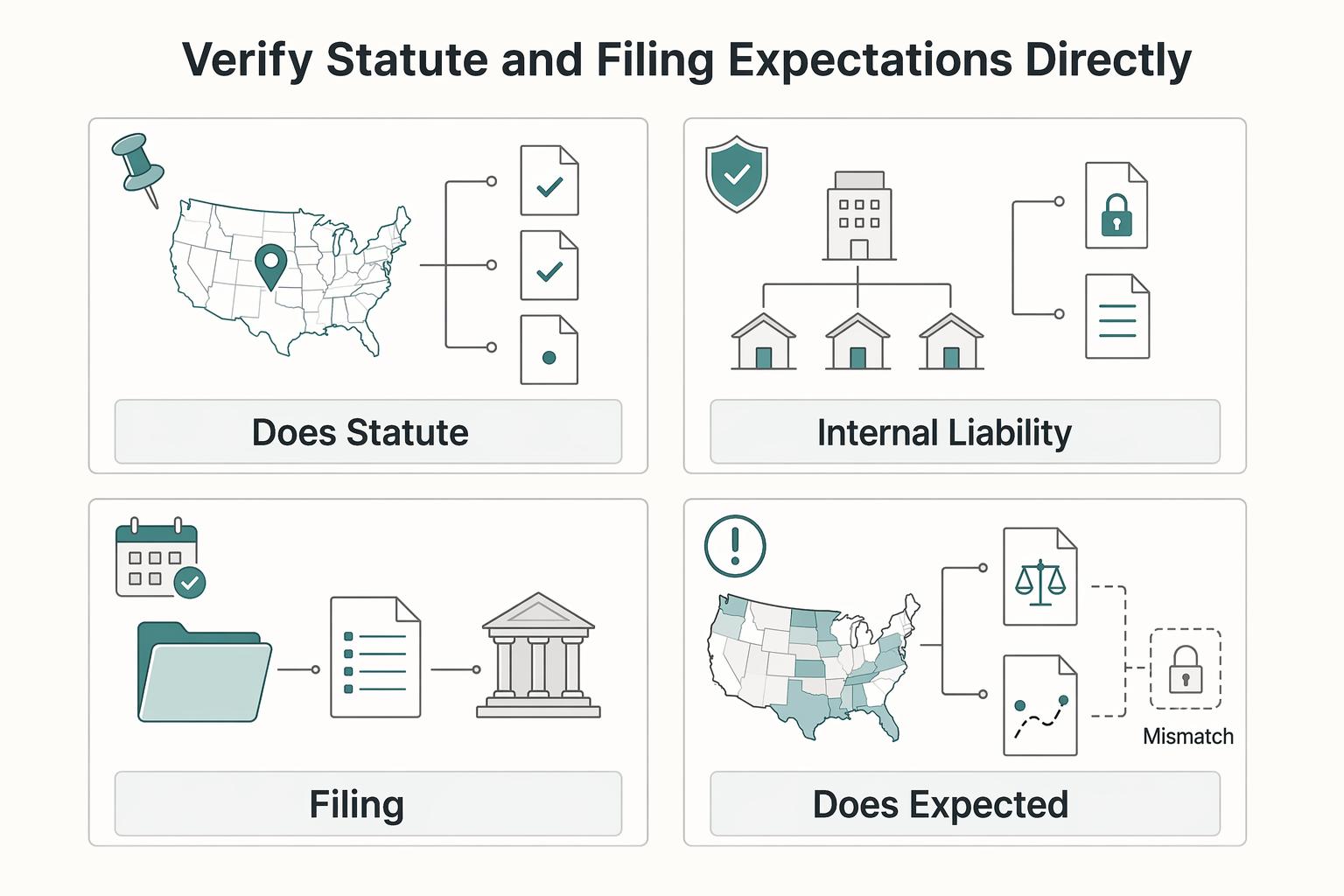
Verify statute and filing expectations directly#
Use each Secretary of State site as a starting point, then confirm the statute and have counsel interpret any gaps. Your checklist should answer:
- Does the statute address a Series LLC or separate series?
- Is internal liability separation conditioned on specific statutory requirements?
- What filing obligations appear at the master or series level?
- Does your expected financing path, including hard money or traditional lenders, create structure friction?
Treat uncertainty as a decision input. Do not treat unknowns as footnotes. State recognition varies, and legal questions remain, so cross-state recognition and litigation outcomes may still be unsettled even when formation is valid.
If your portfolio may become cross-border, add a separate legal and tax checkpoint before filing rather than assuming treatment outside the U.S. mirrors your formation state. You may also want to review How to Structure a US LLC for Investing in Foreign Real Estate.
Write a go/no-go memo before filing. Before you file, write a short memo that captures the states reviewed, statute conclusions, open filing questions, financing constraints, counsel input, and your final decision. That gives partners and advisers a clear record of why you chose this structure and which assumptions would change the decision later.
Once the jurisdiction fit is clear, the next risk is getting the setup and paper trail right from the start. For a step-by-step walkthrough, see A Guide to Opportunity Zones for Real Estate Investors.
Form the structure correctly the first time#
Get the paperwork complete before you move any property. In states that recognize Series LLCs, one practical sequence is to form the parent entity first, then create each series through signed governing documents before any deed, lease, or bank account is tied to it.
Form the Master LLC, then document authority for internal series#
In many setups, you file the Master LLC first, then finalize an operating agreement that clearly authorizes series and explains how each new one is approved and governed. State rules on registration, liability protections, and taxation vary, so confirm your jurisdiction before you lock the sequence. The agreement should also cover filings and books-and-records responsibilities, not just ownership percentages.
That level of detail makes your separation story more defensible later. One cited operating agreement artifact separates these functions explicitly. It uses headings such as 2.1 Formation; Continuation and Admission of Members, 4.3 Filings; Duty of Members to Cooperate, and 7.2 Maintenance of Books and Records. You do not need identical headings, but you do need equivalent substance.
A useful checkpoint is simple: you should be able to point to a signed page that authorizes creation and governance, not just describe the plan.
Document each series like it will be reviewed later. Treat each new one as a formal record event. Use a signed board resolution or other written approval document for each property bucket, and keep naming consistent across the approval, bank account, deed, insurance, and lease package.
Use a naming rule your team can follow every time: parent name, series identifier, and property reference. If you use a series schedule attached to the operating agreement, sign each schedule as part of that record trail.
Most breakdowns here are small inconsistencies, not dramatic errors. Mismatched naming across documents can create avoidable friction during diligence, refinancing, or claims.
Keep one evidence pack before any property transfer#
Assemble a controlled formation folder for the parent and for every series before assets move. At minimum, include:
| Item | Applies to | Article detail |
|---|---|---|
| Filed entity records | Master LLC | Filed entity records for the Master LLC |
| Operating agreement | Parent structure | Signed operating agreement |
| Series-creation approvals | Each series | Signed series-creation approvals, for example resolutions |
| Series schedules or property-assignment records | Each series | Signed series schedules or property-assignment records |
| State or assumed-name filings | Each series | Any required state or assumed-name filings for each series |
| Transfer documents and lender correspondence or approvals | Property transfer | Include where applicable |
Before transferring mortgaged property, confirm lender requirements to reduce due-on-sale clause risk. Formation documents alone do not remove that risk.
Then run a final legal review against the state statute you already vetted to confirm your filed parent, operating agreement, series documents, and state-specific filings align. If Texas applies, for example, review whether Form 503 is needed for each subsidiary series before transfer. If a property does not have a complete evidence pack, pause the transfer and fix the file first.
Good formation is only the start. The structure holds up only if each series is operated as a separate unit after the documents are signed.
For the systems side after setup, see The Best CRM for a Real Estate Agent.
Set up each internal series as its own operating unit#
Treat each series as its own operating unit from day one. The conservative approach is to keep cash handling, books and records, and contract naming separated by series, because Series LLCs still carry unresolved risk and unanswered questions and the legal market continues to evolve.
Separate cash by series#
Where practical, use a dedicated bank account for each series and map each account to the property or properties in that series. Then make traceability the rule: rent in, bills out, and owner funding should match the same series name used in the property file.
If operations force a temporary master-account workflow, log it as an exception and document how it was cleared and reclassified.
Keep books and records at series level#
Maintain series-level books and records, not just umbrella-level records. At minimum, keep a separate ledger and document set for each one covering income, expenses, contracts, insurance records, and owner funding or reimbursements tied to it.
| Operating area | Conservative setup | Monthly check |
|---|---|---|
| Bank activity | Account activity mapped to one series | Statement ties to ledger and property activity |
| Books and records | Separate ledger and files per series | No uncoded entries or unexplained inter-series transfers |
| Contracts | Lease and vendor templates use the exact approved series name | Signed documents match the property file |
| Insurance records | Policy and related documents filed by series | Named insured and property details still match |
Control entity naming before signature. Avoidable cleanup often starts with naming drift in templates. Pull the legal name from one approved series record so the header, notices section, and signature block all match.
Before signing, compare the series-creation record, property file, and signature block. If the names do not match, fix the document first.
Reconcile monthly and keep an exception log. Monthly reconciliation is an operating control, not a legal shortcut, but it can help you catch drift early. Close each series monthly. Reconcile bank activity, tie rent to leases, and record any cross-series or parent-level item in an exception log with the reason and backup.
If you have California exposure, keep records clean enough for Form 568 reporting and for cases where FTB 4197 may need to be filed with the tax return. The Form 568 instructions state they are not authoritative law, so accurate series-level records make adviser review and compliance decisions easier.
Plan for lenders, partners, and deal friction early#
Expect deal friction even with clean records. A Series LLC can slow financing or partner review because some lenders, title insurers, and servicing teams are less comfortable with unusual series naming than with standard LLC ownership.
That pushback is often about documentation and predictability. State recognition is not uniform, and rules vary even where these structures are recognized. Make the structure easy to understand before a closing is underway.
Build the diligence packet before anyone asks#
If you are bringing in JVs, outside capital, or a refinance, prepare a short packet up front so counterparties can evaluate the structure quickly:
- the Master LLC provision authorizing series
- the formation record or resolution for the specific series in the deal
- a property schedule mapping each property to its series
- a signer or control chart showing who can bind that series
- a one-page operating summary showing separation in practice, including banking, books and records, and contract naming
This can cut avoidable back-and-forth and show that separation is being operated, not just described.
Use one pre-close checkpoint on title changes. Before any deed transfer, refinance, or entity-change step, confirm transfer and due-on-sale implications before moving title.
If title may move into a series, verify that path before loan and title documents are finalized so naming mismatches do not surface late.
Decide borrower structure before documents are drafted. Set the borrowing entity early so you are not forcing a series setup into a deal flow that expects simpler documentation.
Financing is only one part of the picture. State-level rule differences can create problems if you carry one state's assumptions into another.
Handle taxes and filings without false confidence#
Treat tax and annual filing assumptions as state-specific until you verify them from current authority. With this structure, a common failure is importing one jurisdiction's rules into another and learning too late that reporting or annual maintenance works differently.
Verify from the actual authority, not summaries#
For franchise tax, annual reports, and separate reporting questions, start with the applicable state statute and current filing-agency or tax-department instructions. Do not treat blog summaries, old checklists, or IRS navigation aids as authority. IRS issue synopses are not authoritative interpretations, and procedures can change from year to year.
Use a written checkpoint for each state:
- confirm whether filing or tax steps apply to the Master LLC, each series, or both
- save the statute reference, agency page, and date checked
- if you see a rulemaking notice, confirm whether it is still only a Proposed Rule and whether the public comment period has ended before you change your process
Reassess complexity as your footprint grows. As you expand across jurisdictions, compliance coordination may change quickly. If each new acquisition keeps triggering fresh state-by-state uncertainty, reassess your filing approach before scaling further.
Keep a year-round compliance calendar tied to:
- filing owner by entity or series
- due dates and renewal windows
- review sign-offs after each filing
- recurring rule checks in states where requirements may be changing
When checking federal rule materials online, verify against the official legal edition.
Use a 90-day launch checklist and annual control checklist#
Use the first 90 days to build operating controls, not to assume there is one legally required Series LLC sequence. Series LLC-specific setup mandates are not established. Your goal is to make naming, records, and review steps consistent enough that you can verify what happened later.
| Period | Main focus | Examples from the section |
|---|---|---|
| First 30 days | Lock down reusable documents and labels, and pick one disclosure format for compliance materials | Use the same names and format in formation and internal records, disclosures and templates, signed agreements, bookkeeping and folders |
| Days 31 to 60 | Stand up the operating lanes you plan to review consistently | Build confirmation of the disclosure format selected, a document or version change log, ledger or chart-of-accounts mapping, and a controlled folder for signed contracts and review records |
| Days 61 to 90 | Run a mock audit before setup is treated as complete | Sample documents and reconciliations, and look for inconsistent naming or formatting, summaries used where rule text should govern, missing or outdated review records, and transfers or changes that cannot be reconciled clearly |
First 30 days#
Lock down reusable documents and labels, and pick one disclosure format for your compliance materials.
Use the same names and format everywhere, with no variants:
- formation and internal records
- disclosures and templates
- signed agreements
- bookkeeping and folders
For legal checkpoints, start with the current rule text, and its explanatory basis, as the controlling authority, not secondary summaries. Treat compliance guides as additional, non-exhaustive resources.
Days 31 to 60#
Stand up the operating lanes you plan to review consistently: records, change logs, and books-and-records controls.
Build a basic evidence set:
- confirmation of the disclosure format you selected
- a document/version change log
- ledger or chart-of-accounts mapping to your control checklist
- a controlled folder for signed contracts and review records
Days 61 to 90#
Run a mock audit before you treat setup as complete. Sample documents and reconciliations to confirm names, format, and record trails match your intended control process.
Look for practical control breaks:
- inconsistent naming or formatting in key documents
- summaries used where rule text should govern
- missing or outdated review records
- transfers or changes that cannot be reconciled clearly
Annual controls and red flags. Run an annual control review tied to your compliance calendar:
- review current rule text and any updates that affect your obligations
- confirm that, once selected, your disclosure format is still used consistently
- test whether records and supporting documents remain consistent and traceable
Keep a red-flag escalation list for immediate legal review when the rule text is unclear, requirements conflict, or control failures are high impact. These triggers are risk controls, not proof that the structure failed.
Before you operationalize the 90-day plan, map how funds and records will be traced so reconciliations stay clean. See Virtual Accounts overview.
The bottom line and your next move#
Choose a Series LLC only if a written go/no-go test passes on state fit, financing fit, and control discipline. If any one of those fails, or is still uncertain, use a simpler structure for now.
In states where this structure is available, a Series LLC can organize multiple properties under one parent LLC, but liability insulation remains conditional on careful formation and ongoing compliance. The entity label alone is not the protection. Execution is.
Run a real go or no-go test#
Before filing, write clear yes or no answers for:
- State fit
Have you checked how each relevant state treats this structure for where you form, own, and operate, and listed open questions for counsel?
- Financing fit
Does your planned deal path work with this structure based on confirmed requirements, not assumptions?
- Control discipline
Can you consistently maintain clear per-series records, accurate entity naming in contracts, and clean books for each series?
Judge the structure by how you operate it. Treat recordkeeping and compliance as core controls, not cleanup work. Weak records or inconsistent compliance can weaken the separation you are relying on. Keep recurring compliance tasks on a calendar and review entity naming, signature blocks, and account records regularly.
What to take to counsel before you file. Next step: complete the comparison table and state-validation checklist, then review both with counsel before filing or moving property. Bring:
- your draft entity structure and naming convention
- the properties you plan to place in each series
- your bank accounts map
- sample contract signature blocks
- your per-series recordkeeping process
- open financing or title questions already identified
Related reading: A Guide to Real Estate Investment Trusts (REITs). If you want a practical check on cross-border money movement controls before finalizing your setup, talk with Gruv.
Frequently Asked Questions
What is a Series LLC for real estate in plain English?
A Series LLC is a variation of a traditional LLC that lets one umbrella entity contain multiple series. Each one can operate with its own assets, liabilities, contracts, and business purpose. In real estate, that is meant to separate one property's risk from another without creating a brand-new standalone entity each time.
Is a Series LLC safer than using separate Standalone LLC entities for multiple rentals?
Not automatically. A Series LLC can reduce entity sprawl, but it adds recordkeeping and legal-interpretation complexity. If your priority is simpler administration and fewer moving parts, separate standalone LLCs may be a better fit.
Does one lawsuit against one property stay inside that internal series?
That is the intended design, and sources describe other series and the parent as generally shielded. But "generally" is not the same as guaranteed. The outcome depends in part on disciplined documentation and operations.
What statutory formalities matter most to preserve the liability shield?
Clean execution matters most: clear operating documents, documented series setup, and consistent records. Keep books and supporting documents organized so ownership, obligations, and activity match the intended series. Poor management or documentation can weaken the separation you are relying on.
Can I form in one state and operate properties in other states?
You can, but you should not assume every state treats the structure the same way. Only some states have statutes allowing and governing Series LLCs, and cross-state recognition issues can arise. If you operate across states, confirm treatment before relying on internal separation.
Why do some lenders push back on Series LLC structures?
There is no single rule. Lender acceptance and documentation expectations are not uniform, so confirm requirements early with each lender before relying on a series structure.
When should I avoid a Series LLC and choose separate entities instead?
Avoid it when your plan depends on simple administration and predictable legal treatment across states. If your strategy depends on cross-state certainty or you are unlikely to maintain strong record discipline, separate entities may be easier to operate. Choose the structure you can maintain cleanly and consistently.
Is there one setup checkpoint that matters more than people think?
Yes. Form the Series LLC before purchasing property you intend to place in it. One cited source says setup should ideally happen before acquisition. Doing it later can make ownership and documentation cleanup more complicated.
Try a related tool
Researched and edited by the Gruv editorial team. Gruv builds cross-border billing, payouts, and finance-operations software for global businesses.
Sources
- brownsvilletx.govtrusted
- dam.assets.ohio.gov/image/upload/med.ohio.gov/laws-and-regulatio...trusted
- dos.ny.gov/system/files/documents/2026/03/031126_0.pdftrusted
- fdic.gov/resources/resolutions/asset-sales/historical...trusted
- federalregister.gov/documents/2024/02/16/2024-02565/anti-money-l...trusted
- federalreserve.gov/publications/files/bhc-3900-3980.pdftrusted
- federalreserve.gov/aboutthefed/files/bstfinaccountingmanual.pdftrusted
- ftb.ca.gov/forms/2025/2025-568-booklet.htmltrusted
Educational content only. Not legal, tax, or financial advice.
Related Posts

Sole Proprietorship vs LLC for Global Freelancers in 2026
For most freelancers in 2026, the practical default is still simple: use the simplest structure you can run cleanly, then formalize when risk actually rises. If your work is still in validation mode and the downside is contained, a sole proprietorship is often the practical starting point. When contract exposure, delivery stakes, or dispute risk starts climbing, forming an LLC deserves earlier attention.
How to Invest in Real Estate as a Digital Nomad
**Run anything with money and moving parts like an operations system (cash, docs, delegation, and controls), not a "passive income" vibe.** Real life stress-tests weak spots. You change time zones, a client pays late, and something breaks at the worst moment. As the CEO of a business-of-one, your job is to build a setup that keeps working when you are not available on demand.

How to Structure a US LLC for Investing in Foreign Real Estate
If you are considering a **Limited Liability Company (LLC)** to buy property outside the United States, start with compliance, not convenience. A clean structure can support ownership separation and, in some cases, financing options. Weak setup decisions can also create tax exposure and expensive rework.