
Quick Answer
Use the uniform trust code as a drafting framework, not a guaranteed result. It helps by providing a model structure for trust law, but each state edits and applies it differently, and mandatory rules still limit what your document can change. Your practical path is to verify the enacted state text, align role design with that text, and confirm that administration facts match the governing law you selected.
How the Uniform Trust Code works as a state-by-state baseline#
The Uniform Trust Code is a model state trust statute. It gives you a practical baseline, not a single national rulebook. You are choosing among state-by-state variations, and the real question is whether the rules will be predictable when you draft the trust, administer it, and assess dispute risk. Many states use the code as a starting point, even though each state can and does revise the text.
In practice, think of the code as a hierarchy. First, your trust instrument usually controls. A UTC-style statute can say that directly. Pennsylvania, for example, provides that the trust instrument prevails over contrary statutory provisions except for listed mandatory rules. Nebraska states that its code governs trustee duties, powers, and beneficiary interests except as otherwise provided in the terms of the trust. That is the core drafting benefit. You can customize a great deal, but not everything.
What you can change and what you cannot#
Most rules are defaults. Under UTC § 105, the act is largely made up of rules that can be overridden in the trust document unless a mandatory rule says otherwise. That gives you room to tailor trustee powers, administrative mechanics, and beneficiary provisions to your actual goals instead of accepting generic statutory settings.
Mandatory rules are the hard edge. A trustee's duty to act in good faith is a standard example. So is the duty to keep qualified beneficiaries reasonably informed about administration. If your draft tries to waive one of those nonwaivable rules, the clause is the problem, not the statute. That is the first red flag to watch for when you review forms borrowed from another state.
| If you rely on... | Your practical risk |
|---|---|
| old common law assumptions | more uncertainty about what fills drafting gaps and how a court reads silence |
| a UTC based statute without checking state edits | false confidence, because enacted text may differ from the model act |
| a trust instrument drafted against local mandatory rules | clauses that fail when challenged |
One more caution. A UTC-based statute does not erase common law. Pennsylvania's trust statute says common law trust and equity principles still supplement the chapter unless modified. So even in a code state, you should expect courts to read the statute alongside older trust principles where the statute is silent.
How to verify the state you are actually using#
Do not stop at "this state adopted the UTC." That is the start of the review, not the end. Check the enacted state text, recent amendments, and any local comments with counsel. The Uniform Law Commission's trust code page has adoption tracking views such as Map, Bill List, Summary, and Enactment History. That helps you confirm whether you are looking at model text or live state law.
| Verification item | What to check |
|---|---|
| Enacted state text | Check the enacted state text, not just whether the state adopted the UTC. |
| Recent amendments | Review recent amendments before relying on a governing law clause. |
| Local comments | Check any local comments with counsel. |
| ULC tracking views | Use Map, Bill List, Summary, and Enactment History to confirm whether you are looking at model text or live state law. |
| Trust controls section | Pull the state's current trust controls section before you approve any governing law clause. |
| Mandatory rules section | Pull the state's mandatory rules section before you approve any governing law clause. |
A practical checkpoint is to pull the state's current trust controls section and mandatory rules section before you approve any governing law clause. In Pennsylvania, for example, mandatory rules still govern even in a governing law conflict setting. If you want the broader setup before getting into clause design, see A Guide to Setting Up a Trust for Asset Protection. If you want a quick next step, try the SOW generator.
Where control comes from when you draft trust provisions#
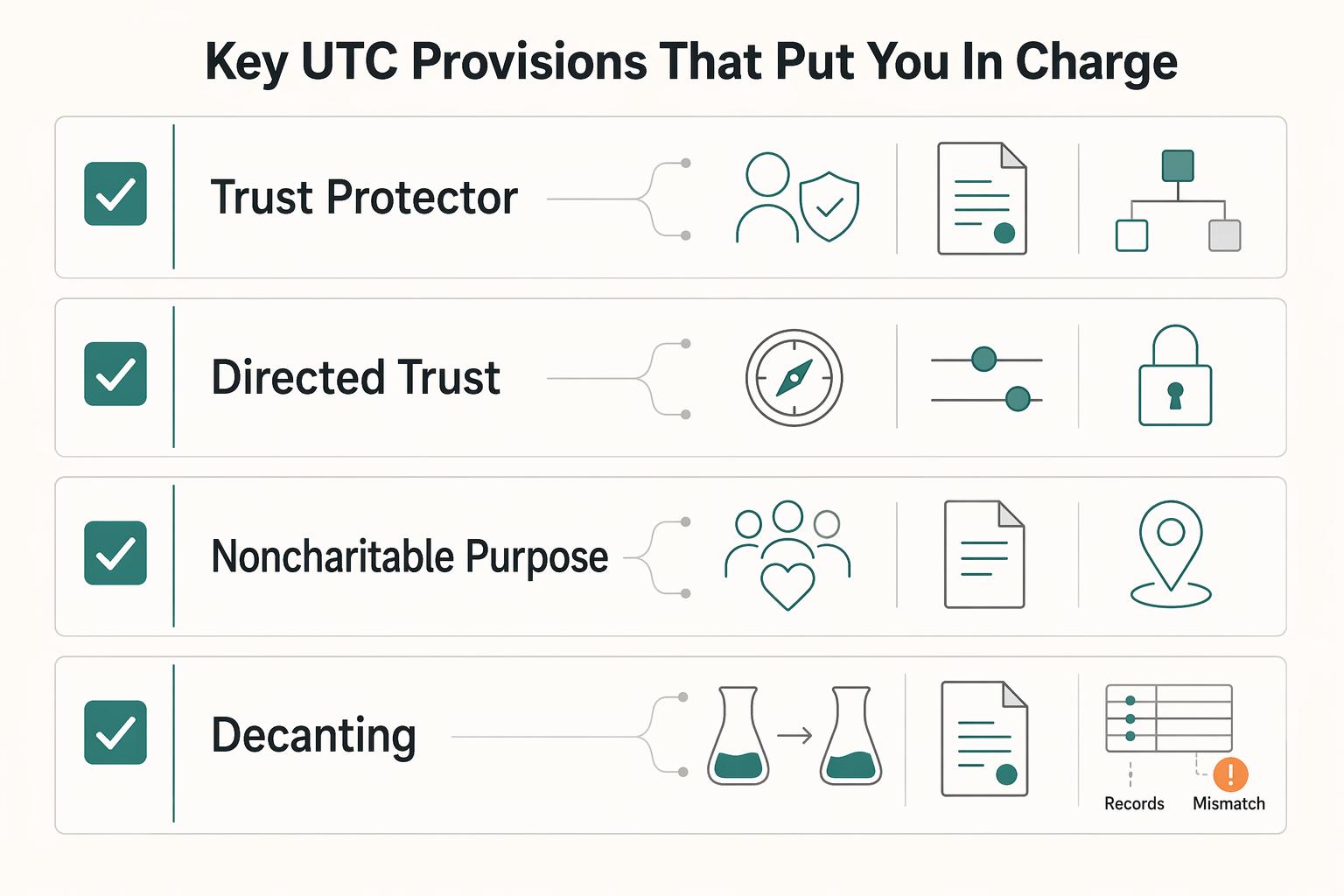
Control comes from drafting clarity, not from tool names. A trust protector, directed trust, noncharitable purpose trust, or decanting clause helps only when your instrument assigns authority clearly and state law supports the structure you want to use.
Before you split or layer authority, check for investment restrictions already in the trust terms. Many trust documents include specific directives, such as instructions to retain a particular asset. If you split roles without reconciling those directives, disputes usually center on who had authority and who carried the risk.
| Tool | What problem it solves | Who holds authority | Main drafting risk |
|---|---|---|---|
| trust protector | Adds an oversight backstop when you do not want the trustee as the only control point | the person or committee named in the instrument | unclear power limits, removal mechanics, or conflict path |
| directed trust | Separates investment decisions from administration | the roles named in the instrument, as recognized by local law | authority splits that conflict with existing investment directives |
| noncharitable purpose trust | Supports a defined purpose structure rather than a standard payout-focused design | the parties and enforcement structure allowed under local law | assuming purpose validity or enforcement rights without state-specific confirmation |
| decanting | May allow updates to an older irrevocable structure in some jurisdictions | the party authorized under local law and the instrument | assuming the power exists or extends as far as you want |
Who can oversee the trustee#
Use a trust protector when your goal is targeted oversight, not constant second-guessing. Draft the role so it is obvious what the protector can do, cannot do, and how replacement works if the relationship fails.
The key guardrail is conflict handling. If the trustee and protector disagree, especially on an investment restriction, your instrument should say whose direction governs and what process applies next.
How duties can be split#
A directed structure can work when you want separate decision-makers for administration and investments. The split should track the trust's existing investment language line by line, especially any retain-in-kind or other specific restrictions.
There is also a litigation risk to address directly. Trust scholarship describes an emerging view that tests investment restrictions against objective prudence and efficiency, potentially without relying on the settlor's subjective intent. If your plan depends on a specific restriction being followed, draft the role boundaries and decision process as if that restriction could be challenged.
When a noncharitable purpose trust is appropriate#
Use this structure when the trust's core goal is a lawful stated purpose, not a standard beneficiary-support pattern. Keep the drafting practical: identify the purpose clearly, identify who can enforce it, and state what happens if the purpose can no longer be carried out.
Do not borrow assumptions from another state form. Purpose recognition and enforcement mechanics are state-law sensitive, so verify them in the state you are actually using.
How an irrevocable trust can still adapt#
Treat decanting and other modification paths as state-law-dependent tools, not automatic features. If flexibility matters, define the adaptation mechanics in advance instead of relying on a later fix.
| Drafting point | What to spell out |
|---|---|
| Role powers | Powers granted to each role, including any investment direction, veto, or replacement authority. |
| Removal and replacement | Removal and replacement mechanics, including successor selection and deadlock handling. |
| Conflict resolution | Conflict-resolution path when authority holders disagree. |
| Amendment limits | Amendment or modification limits, with jurisdiction-specific standards confirmed against the applicable state code. |
Related: What is a 'Settlor' and a 'Trustee' in a Trust?.
How to choose your trust state by verifying the statutes#
Pick your trust state by verification, not reputation. Jurisdiction affects creditor-risk outcomes, governing-law enforceability, administration requirements, and whether your trust has the local nexus the statute expects.
The UTC is not applied identically nationwide. The ULC record shows 37 enactments, so your document and the selected state statutes must align on the exact rules you are relying on.
| State | UTC adoption posture | Self-settled asset-protection trust signal | Creditor-action signal | Administration hook you should verify | Duration rule signal | Privacy signal | Tax context | Digital-asset signal |
|---|---|---|---|---|---|---|---|---|
| Wyoming | Statutes label Title 4 as the "Uniform Trust Code" under § 4-10-101 | Qualified spendthrift trust statute signal present; verify current requirements | Confirm the current creditor-action rule in the official Wyoming statutes | Qualified spendthrift trust language requires the instrument to expressly incorporate Wyoming law for validity, construction, and administration | 2025 legislation states no rule of perpetuities applies to noncharitable purpose trusts | Confirm the current privacy rule in the official Wyoming statutes | No individual or corporate income tax stated by Wyoming | UFADAA short-title legislation enacted; verify trustee access scope |
| South Dakota | Do not assume full UTC adoption; § 55-1-25 says specified sections affirmatively reject many UTC creditor-rights positions | Chapter 55-16 "qualified disposition" framework present | Chapter 55-16 limits creditor actions to transfers with intent to defraud | § 55-16-2 requires express incorporation of South Dakota law for validity, construction, and administration | Confirm the current duration rule in the official South Dakota statutes | Purpose trust statute says no filings, reports, periodic accounting, separate maintenance, appointment, or registration are required, subject to exceptions | No corporate, unitary, or personal income tax stated by South Dakota | Title 55 includes Uniform Fiduciary Access to Digital Assets Act materials; verify section fit |
| Nevada | Do not describe as full UTC state on this record; use Chapter 166 and related statutes | Spendthrift Trust Act of Nevada provides the main asset-protection trust framework | Chapter 166 allows claims where a creditor proves fraudulent transfer by clear and convincing evidence and meets statutory conditions | Chapter 166 can apply to trusts created in or outside Nevada if Nevada nexus conditions are met; if settlor is a beneficiary, at least one trustee must be in state | Chapter 166 contains a dedicated perpetuities section; verify current duration rule | Confirm the current privacy rule in the official Nevada statutes | No individual state income tax | Revised Uniform Fiduciary Access to Digital Assets Act of 2015 in Chapter 722; verify content access limits |
How to read the three-state differences#
Use Wyoming when your strategy depends on a tight governing-law structure tied to Wyoming statutes. The practical checkpoint is whether your instrument expressly incorporates Wyoming law for validity, construction, and administration where the qualified spendthrift trust framework expects it.
Use South Dakota when your decision turns on creditor-rights wording and purpose-trust administration rules. Section 55-1-25 means you should not import assumptions from generic UTC summaries, and any privacy expectation should be tied to the specific trust type you are actually using.
Use Nevada when your main issue is spendthrift-structure creditor risk and nexus compliance. A governing-law clause by itself is not enough if your trustee setup does not satisfy Chapter 166 conditions, including the in-state trustee condition for settlor-beneficiary structures.
Which state fits which profile#
Match the state to your risk profile before you draft:
| Profile factor | Verification focus |
|---|---|
| Asset mix | If digital accounts or crypto are material, verify section-level fiduciary access scope and provider terms. |
| Lawsuit exposure | Compare current creditor-action language, burden standards, and exceptions in the live statutes. |
| Privacy goals | Confirm the exact trust type and statute section that provides the privacy feature you want. |
| Family-governance goals | Test whether your planned structure supports continuity if decision-makers change. |
| Cross-border enforcement concerns | Stress-test conflict-of-laws assumptions against actual nexus and administration facts. |
Before you choose a state#
Confirm these points with state-specific counsel before execution:
- current local statutes and recent amendments
- conflict-of-laws assumptions, especially when assets, trustees, or beneficiaries are in different jurisdictions
- administration requirements in practice, including trustee location, governing-law wording, and acceptance documents
Keep an evidence file with the executed trust, trustee acceptance, situs clause, governing-law clause, and transfer records. A common failure pattern is choosing one state on paper while administering the trust elsewhere, which weakens your argument about which law controls in a dispute. For a step-by-step walkthrough, see A Guide to Trust Accounting.
The UTC in a Borderless World: Protecting Assets from Global Threats#
In cross-border disputes, your protection usually rises or falls on structure, not language. You improve your position when legal title, control roles, and records are clearly separated and consistently administered under the governing state law.
An irrevocable trust can separate legal title from your personal ownership, but it does not erase scrutiny. You may keep a beneficial interest while the trustee controls trust property and must act solely for beneficiaries, in good faith. If a trustee self-deals, that transaction can be attacked even without additional proof of harm, so role-mixing is a real vulnerability. Creditor access limits are state-specific, so confirm the current rule in your chosen jurisdiction before relying on any assumption. Verify any creditor-access requirement against official state legal records before use.
A foreign claimant also cannot simply bypass the U.S. side of the structure when assets and control points are here. In practice, they must engage the U.S. legal process connected to the property, the trustee or manager, and the governing documents. That is why your governing-law clause, forum language, situs facts, and trustee location matter: they shape which state law and court will interpret the trust. These clauses help frame the fight, but they are not automatic immunity.
| Structure | Who controls day-to-day decisions | Primary exposure points | Enforcement friction |
|---|---|---|---|
| Direct personal ownership | You personally | Personal ownership records and direct attachment risk | Low |
| Trust ownership | Trustee under trust terms | Trustee conduct, trust records, distribution patterns | Moderate |
| Trust-owned LLC | LLC manager for operations; trust owns LLC interest | Entity formalities, manager conduct, trust-to-LLC documentation | Higher |
Use this implementation checklist before you rely on the structure:
- Keep a complete chain of title from you to the trust, and from the trust to any LLC.
- Separate trustee and LLC manager roles where practical.
- Set and follow clear distribution-discipline rules.
- Verify trustee location, governing-law wording, and acceptance requirements in the chosen state.
Verify any state compliance requirement against official state legal records before use.
Conclusion: Review the design and confirm the enacted state law fit#
The takeaway is practical: use the Uniform Trust Code as a planning framework, not a promise. It gives you a more predictable starting point because it codifies much of trust common law, but it is a uniform act that states enact in their own versions, not a single national rulebook.
Your next move is to review the trust design before you chase features. In enacted UTC chapters such as Virginia's, the terms of the trust generally prevail over the statute except for mandatory rules. Those rules include the trustee's duty to act in good faith and in line with the trust's terms and purposes. That means your governing documents, governing law clause, and administration facts need to line up with the result you want. If the draft says one thing and the trustee's real conduct says another, expect trouble.
Jurisdiction choice also needs to be treated as an operating decision. A trust's principal place of administration can sometimes be moved, but not just because it is convenient. A proposed transfer, for example, can require notice to qualified beneficiaries at least 60 days in advance, and an objection can stop the move. So check the local statute, the notice mechanics, and who has to sign off before you assume you can change situs later.
What it does do is improve predictability, role clarity, and governance discipline. What it does not do is guarantee creditor protection, prevent every dispute, or override bad drafting and sloppy administration.
So take the practical route: review your trust design, confirm the enacted state law fit, align trustee and other fiduciary roles, and put periodic counsel review on the calendar. If you want to tighten the build, start with our trust setup guide and the article on settlor and trustee roles.
Frequently Asked Questions
What is the uniform trust code in simple terms?
It is a model state trust statute drafted by the Uniform Law Commission, not a federal rulebook. That gives you a common starting point for trust law, but your outcome still depends on the exact text your state enacted. Read the official published state code and your trust document together, not a summary.
Which states have adopted it?
The count changes, so verify the current total with the Uniform Law Commission. "Adopted" only means a state used the model as a base, because states can and do modify the text. Verify current status with the ULC, then pull your state's enacted code before you draft, amend, or move administration.
What are the main practical benefits of a UTC-based state law?
The main gain is a more predictable starting point and easier state-to-state comparison. That can improve drafting discipline, but the enacted statute and your instrument still control the result. Have counsel compare your draft against the official code section by section, using the published text rather than a pre-publication copy or blog chart. | Decision | Control | Creditor exposure | Operational complexity | |---|---|---|---| | Revocable trust | Defined by your state's enacted code and your trust terms | Do not assume protection; creditor treatment is state specific | Varies by state law and drafting details | | Irrevocable trust | Defined by your state's enacted code and your trust terms | Creditor outcomes are jurisdiction specific | Varies by state law and drafting details | | Standard trustee model | Defined by the trust instrument and state code | This label alone does not determine creditor outcomes | Depends on how duties are set in the document and statute | | Directed trust model | Defined by the trust instrument and enacted state code | This label alone does not determine creditor outcomes | Confirm role-allocation rules in your state's enacted code |
Does it improve asset protection by itself?
No, not by itself. Creditor risk turns on state law, trust type, and the exact drafting, not just whether a statute traces back to the UTC. Test the actual creditor-facing sections in your state before treating the trust as protective.
Is a revocable trust protected from creditors?
Do not rely on a blanket yes-or-no rule. The red flag is assuming "living trust" means "shielded assets." A Michigan Supreme Court filing received on 3/6/2026 argued that assets in a revocable living trust were subject to a valid creditor claim and specifically cited MCL 700.7506(1)(c), which shows how granular this analysis gets. Ask for the exact statute citation and confirm whether you are looking at a party's argument or a final court holding.
What is a directed trust, and when is it worth using?
State terminology and mechanics vary. Whether this structure is available, and whether it is worth using, depends on your enacted state law and your instrument. Before using it, confirm the operative state-code text and map each role in the signed trust package.
Try a related tool
Researched and edited by the Gruv editorial team. Gruv builds cross-border billing, payouts, and finance-operations software for global businesses.
Sources
- boe.ca.gov/lawguides/property/current/ptlg/annt/220-000...trusted
- cfo.gov/assets/files/Final%202%20CFR%20Guidance%20-%...trusted
- congress.gov/117/plaws/publ103/PLAW-117publ103.htmtrusted
- courts.michigan.gov/493a59/siteassets/case-documents/briefs/msc/...trusted
- dmv.virginia.gov/sites/default/files/forms/dmv60a.pdftrusted
- law.lis.virginia.gov/vacode/title64.2/chapter7/section64.2-706trusted
- law.lis.virginia.gov/vacode/title64.2/chapter7/section64.2-703trusted
- nebraskalegislature.gov/laws/statutes.phptrusted
Educational content only. Not legal, tax, or financial advice.
Related Posts

Germany Freelance Visa Application Path for Freiberufler and Gewerbe
Choose your track before you collect documents. That first decision determines what your file needs to prove and which label should appear everywhere: `Freiberufler` for liberal-profession services, or `Selbständiger/Gewerbetreibender` for business and trade activity.
When a Trust for Asset Protection Makes Sense for Your Business
Use a trust only after your core liability setup is solid. A trust for asset protection is an escalation layer, not a substitute for entity separation, insurance, or clean operations.
Settlor vs Trustee in a Trust
A trust works best when you treat it as an operating structure, not just a stack of legal documents. The first decision is role design: who writes the rules, who carries them out, who benefits, and who steps in if the first trustee cannot serve? Once you frame it that way, the settlor-trustee split becomes much easier to evaluate.