
Quick Answer
Safe Creative and U.S. copyright registration do different jobs. Safe Creative can help document authorship, timing, and version history with timestamped file evidence, but it does not create copyright or replace U.S. Copyright Office registration when you need to file a U.S. infringement lawsuit for a U.S. work. A practical approach is evidence first for daily work, then formal registration for commercially important or dispute-prone assets.
Document proof early, then secure enforcement rights#
Treat IP as two separate jobs in your workflow: document proof early, then secure enforcement rights when a work becomes commercially important.
In the U.S., copyright exists as soon as your original work is created and fixed in a tangible medium. But ownership, evidence, and enforcement are different layers. A private registry like Safe Creative can strengthen your proof of authorship and date. It does not create copyright rights, and it does not replace U.S. Copyright Office registration when you need to file a U.S. infringement lawsuit for a U.S. work.
| Battlefield | Purpose | Outcome for you | Typical timing | Typical use |
|---|---|---|---|---|
| Automatic copyright at creation | Establish baseline ownership | Protection attaches once the work is fixed | Immediate | Every draft, design, manuscript, recording |
| Evidentiary registration (for example, Safe Creative) | Build proof of authorship and date | Timestamped record and certificate; technical evidence Safe Creative describes as three cryptographic hashes and daily blockchain auditing | When you register the file | Unpublished work, version history, files you plan to share |
| Formal U.S. registration | Preserve U.S. enforcement options | Required step before bringing a U.S. infringement suit for U.S. works; registered works may also be eligible for statutory damages and attorney's fees | Not instant; one cited average processing time is 2.5 months | High-value assets, launches, or work with realistic dispute risk |
Use this sequencing rule: evidence first for everything you create, then escalate to formal registration for assets with meaningful commercial or enforcement risk. If you use Safe Creative for drafts or unpublished work, register before sharing or publishing, confirm the uploaded file matches the version you share, and keep the certificate with your version history.
Do not rely on only one battlefield. Evidence alone does not let you file a U.S. infringement suit, and timing can matter. Late registration can limit remedies, including when you miss the Section 412 window of 3 months after first publication. Conversely, if you register only a few final assets, you may have less timestamped, version-by-version evidence for day-to-day work.
For a step-by-step walkthrough, see What is the 'Berne Convention' for International Copyright?.
Run your IP process in order: evidence, enforcement, contracts#
Run your IP process in this order: document evidence, escalate for enforcement, then lock usage terms in contracts. Each tier covers a different risk, and none replaces the others.
Tier 1: Evidentiary registration for proof#
Use Tier 1 for day-to-day proof of authorship and timing. It strengthens your evidence trail, but it does not create copyright ownership.
In the U.S., copyright is automatic once an original work is fixed, so this tier is about proving what you created and when. For drafts, unpublished work, and version history, register before you share, publish, or send files if you are using an evidentiary registry. Safe Creative recommends that sequence for early proof.
In practice, register the exact file version you are about to share, then store the certificate with the source file, export, and dated project notes. If the registered file and the shared file do not match, your evidence trail is weaker.
Tier 2: Formal government registration for enforcement#
Move to Tier 2 when an asset matters enough that you may need formal enforcement. In the U.S., registration is required before you can file an infringement lawsuit for a U.S. work, and registered works may be eligible for statutory damages and attorney's fees in successful litigation.
| U.S. point | Timing or limit | Article note |
|---|---|---|
| Section 412 remedies window | 3 months after first publication | Timing can change remedies |
| Prima facie evidence window | Within 5 years after publication | U.S. guidance states registration in this period is treated as prima facie evidence in court |
| Group unpublished application path | Up to 10 unpublished works | The Copyright Office states you may register them on one application path |
Timing affects remedies. In the U.S., Section 412 ties certain remedies to registration made within 3 months after first publication, and U.S. guidance states registration within 5 years after publication is treated as prima facie evidence in court. For unpublished U.S. works, the Copyright Office also states you may register up to 10 unpublished works on one application path.
Build these checks into your Tier 2 process:
- Jurisdiction rule: verify the current requirement
- Filing deadline or remedy window: verify the current requirement
- Government portal/form path: verify the current requirement
Outside the U.S., verify local national law before applying U.S. timing logic.
Tier 3: Contract control for commercial use#
Use Tier 3 to control who can use the work, where, for how long, and whether ownership changes. Contracts define the commercial control that evidence records and government filings do not cover.
| Contract point | What to check | Article note |
|---|---|---|
| License scope | Whether use is narrow or broad | Define use by territory and field of use |
| Territory | Where the work can be used | Check every agreement for territory |
| Duration | How long the work can be used | Check every agreement for duration |
| Modification rights | Whether the work can be modified | Check every agreement for modification rights |
| Attribution terms | Whether attribution or change-marking applies | If CC BY terms apply, attribution and change-marking are required |
| Ownership transfer trigger | Whether ownership changes | If ownership is meant to transfer, it must be in a written, signed instrument in the U.S. |
Check every agreement for these points:
- license scope
- territory
- duration
- modification rights
- attribution terms
- ownership transfer trigger
If you license rights, define whether use is narrow or broad by territory and field of use. If CC BY terms apply, attribution and change-marking are required. If ownership is meant to transfer, it must be in a written, signed instrument in the U.S. For commissioned work, do not assume payment alone makes it work made for hire. If this issue comes up often, read Work for Hire vs. Assignment of Rights: A Freelancer's Guide to Owning Your IP.
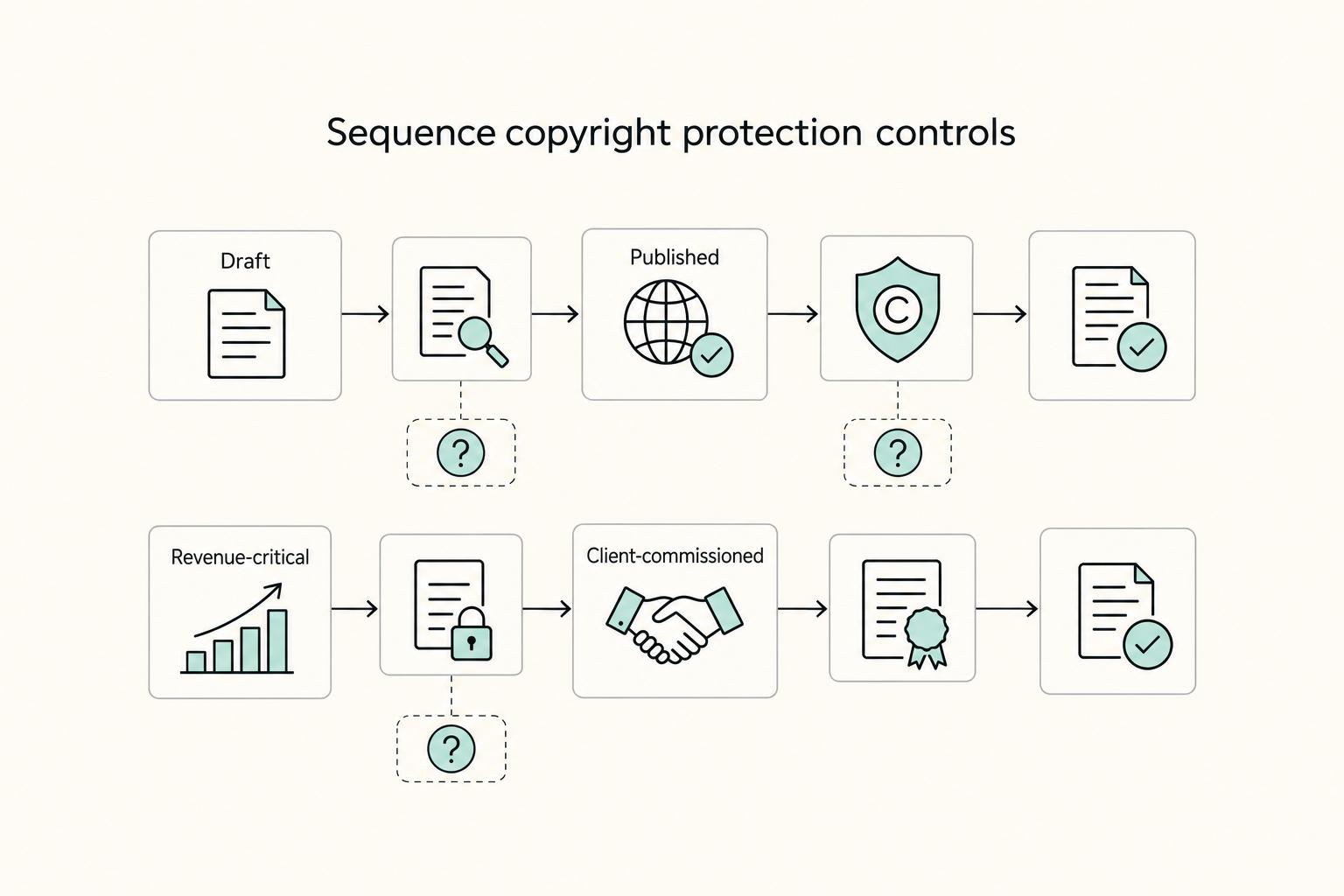
| Asset state | Tier 1 action | Tier 2 action | Tier 3 action |
|---|---|---|---|
| Draft or unpublished | If using evidentiary registration, register the exact file before sharing | Assess whether formal filing is needed yet based on enforcement risk | Set clear pre-release sharing terms |
| Published | Preserve final version and publication-date evidence | Verify jurisdiction rule and file if enforcement matters | Confirm license and attribution terms |
| Revenue-critical | Keep version-by-version proof and source files | Escalate quickly; in the U.S., check the 3-month timing window | Tighten scope, territory, duration, and modification rights |
| Client-commissioned | Register your drafts if contract terms allow | File if you retain rights and enforcement value is real | Define ownership, transfer trigger, and signatures |
Apply this sequence this week. If you use an evidentiary registry, register current drafts and unpublished files before the next time you share them. Flag published or launch-critical assets for jurisdiction-specific filing review. Then audit active client contracts for scope, territory, duration, modification rights, attribution, and signed transfer language.
If you want a deeper dive, read How to Copyright Your Creative Work as a Freelancer.
Use a blockchain-audited registration as an evidence tool#
Use a blockchain-audited registration as an evidence tool, not ownership magic. In practice, it can help you show that a specific file fingerprint existed before a certain time and that related records were not quietly altered later.
The evidence chain in plain language#
A strong Tier 1 record depends on a chain you can explain step by step.
| Step | What happens | Article note |
|---|---|---|
| File fingerprint | A cryptographic hash function turns file contents into a fixed-length value | That value is the file fingerprint |
| Timestamp event | A time-stamping service supports proof that specific data existed before a particular time | Safe Creative says registration date and time are certified with a qualified timestamp |
| Daily audit file | An XML file is generated every 24 hours | Safe Creative says it contains digital fingerprints, not the literal works |
| Ledger anchor | The XML file's hash is incorporated into the blockchain | Safe Creative says the audit file is anchored to a ledger |
| Independent verification | You can recalculate the disputed file's fingerprint and compare it against the registration data and audit artifacts | Independent verification is possible |
- A file fingerprint is created.
A cryptographic hash function turns the file contents into a fixed-length value. That value is the file fingerprint.
- A timestamp event is recorded.
A time-stamping service supports proof that specific data existed before a particular time. Safe Creative says the registration date and time are certified with a qualified timestamp.
- A daily audit file is generated.
Safe Creative says its audit system generates an XML file every 24 hours and that the file contains digital fingerprints, not the literal works.
- The audit file is anchored to a ledger.
Safe Creative says the XML file's hash is then incorporated into the blockchain.
- Independent verification is possible.
You can recalculate the disputed file's fingerprint and compare it with the registration data and audit artifacts.
What this proves, and what it does not#
Anchoring to a blockchain can strengthen your argument that records were not changed later. Safe Creative also says matching fingerprints can show file equivalence against its audit record and help detect changes in registration or audit XML data.
What it does not prove by itself:
- who the real-world creator is
- that submitted author details are true
- that all input facts were accurate when entered
- that a private registry record, by itself, replaces official registration rules where those rules are required
For U.S. works, it also does not replace the Copyright Office requirement to register before filing an infringement lawsuit.
| Decision factor | Centralized log only | Blockchain-audited record |
|---|---|---|
| Tamper resistance | Depends on one provider's internal controls | Adds a ledger anchor designed to resist later alteration |
| Independence | Verification often relies mostly on provider-held records | Verification can use provider artifacts plus ledger transaction data |
| Auditability | Can be harder for outsiders to test without provider access | More testable if you retain audit XML and anchor references |
| Operational dependency | High dependency on provider log access and interpretation | Still depends on provider artifacts, but not only on private logs |
What to store with each registration#
Do not keep only a certificate image. Keep a full evidence pack:
- original file and exact shared or published export
- file fingerprint shown at registration
- timestamp proof or registration certificate with date and time
- audit XML reference and XML hash
- blockchain transaction or anchor reference
- short custody notes: creator, storage location, share date, and shared version
That is what makes the record defensible: this exact file, this timestamp trail, and this version history can be checked by someone else.
A private registry record and a U.S. filing do different jobs#
Treat these as complementary tools, not competing ones: use a private registry record for early evidence tracking, then escalate to U.S. Copyright Office filing when an asset matters enough to justify formal U.S. registration.
A private registry record and a U.S. filing do different jobs. The first supports your evidence trail for authorship, timing, and version history. The second is the formal U.S. registration path, where U.S. legal standards apply.
Choose in sequence#
For most creators and founder-operators, this order works:
- Create and retain evidence as work is created, shared, or revised.
- Triage the asset as routine, revenue-critical, or dispute-prone.
- Escalate selected assets to U.S. filing after a registration-readiness check.
Before formal U.S. filing, screen the work against Chapter 300 checkpoints: fixation, human authorship, and originality. Chapter 300 also identifies works lacking human authorship as non-registrable, so if human contribution is unclear, document it before filing.
If ownership is contract-sensitive, verify chain of title separately before you decide to file. If needed, review Work for Hire vs. Assignment of Rights: A Freelancer's Guide to Owning Your IP.
| Decision factor | Private registry record | U.S. Copyright Office filing |
|---|---|---|
| Speed to evidence | Can be created when you register and retain the record | Verify the current processing window |
| Cost structure | Private service pricing model (verify current plan and limits) | Verify the current filing cost |
| Enforcement capability | Evidentiary support; verify legal effect in your forum | Formal U.S. registration path; verify current enforcement prerequisites |
| Jurisdictional scope | Forum-specific treatment (verify locally) | Governed by U.S. copyright law for U.S. registration determinations |
| Best-fit asset type | Drafts, routine deliverables, unpublished or iterative versions | Finalized, revenue-critical, or dispute-prone U.S.-relevant assets |
Know the legal boundary#
Keep the boundary simple: private registry records are evidence tools, while formal office filing is where U.S. registration determinations are made.
For U.S. strategy, do not blur those roles. Chapter 300 states copyrightability determinations are made under U.S. copyright law. The U.S. making-available report also notes this right is not explicitly enumerated in U.S. law and is handled through existing exclusive rights. That same report analyzes domestic and foreign developments but does not predict outcomes for new technology fact patterns. If litigation is part of your plan, confirm current filing and enforcement rules in the country where you may need to enforce.
Triage your portfolio#
Classify each asset before you choose a registration path.
- Routine assets
Use private-registry evidence first and keep the core record set: original file, shared or exported version, registration record, and custody notes.
- Revenue-critical assets
Keep evidence records during development, then escalate the final commercial version to formal U.S. filing where U.S. enforcement matters.
- Dispute-prone assets
Register early versions promptly, then run a rights and authorship check before formal filing, especially for multi-party, cross-border, or heavily machine-assisted work.
The operating rule is simple: use fast evidence coverage across the board, and spend formal filing effort where non-filing risk is materially higher.
You might also find this useful: How to claim 'copyright' for your self-published book.
After you choose your registration path, lock ownership, usage scope, and transfer terms into each client deal with the freelance contract generator.
Run IP like an operating routine#
Run IP like an operating routine, not a last-minute scramble: capture evidence as you work, keep terms aligned in writing, and verify legal rules from official sources before you rely on them.
Use these terms as separate checks in your process:
- Proof of authorship: records showing you created a specific version at a specific time.
- Ownership: who your documents say controls the rights.
- Enforcement rights: what actions may be available to assert those rights in a dispute.
- Chain of evidence: a traceable path linking original files, later versions, and supporting records.
| Reactive | Early |
|---|---|
| Searches old inboxes and drives after conflict starts. | Captures evidence during drafting, revision, and delivery. |
| Uses one blanket documentation approach with no triage. | Scales documentation and legal review effort when business risk rises. |
| Reviews contract language after work is already moving. | If contracts apply, confirms ownership, license scope, and approvals before production starts. |
| Keeps scattered files with weak version traceability. | Retains source files, exports, timestamps, and signed terms in one record set. |
What counts as "enough" documentation depends on your jurisdiction, contract terms, and risk profile. If a mistake or dispute could materially affect revenue, launch timing, or client relationships, escalate to qualified legal counsel.
Before you act on legal guidance, verify it on an official U.S. government site (.gov) over HTTPS. Treat indexed summaries carefully: inclusion in NLM is not endorsement, so check the direct publisher page or PDF, then confirm the current rule on the relevant official .gov page.
For your next project cycle:
- Log the first meaningful draft and the final delivered version.
- Preserve file names, dates, version notes, and delivery timestamps.
- If contracts are involved, match terms to actual authorship, ownership, license scope, and approvals.
- Store source files, final files, signed agreements, and evidence records together with clear custody notes.
We covered this in detail in How to Watermark Your Creative Work Before Sending to Clients.
When your IP process is in place, make delivery and payout operations easier to track with Merchant of Record for freelancers.
Frequently Asked Questions
Do you own copyright before you register anything?
Usually, yes. In the U.S., copyright exists once the work is created and fixed, so registration does not create ownership. But work made for hire and signed transfers can change who owns the rights.
What does a Safe Creative record actually prove?
It supports evidence of authorship, timing, and file identity. The article says Safe Creative records your declaration, work details, and file-identifying evidence such as hashing, timestamping, and blockchain-audit elements. It does not grant ownership and can still be challenged with contrary evidence.
How is that different from formal registration with an official registry?
Formal registration is a government filing process. In the U.S., it involves an application, fee, and nonreturnable deposit copy or copies, and it is required before filing an infringement lawsuit for a U.S. work. Private registry evidence helps prove facts, while official registration drives country-specific legal effects.
When is a private evidentiary record usually enough?
It is usually enough when your main goal is to document who created what, when, and in which version. That fits routine assets, unpublished work, and projects where court enforcement is unlikely. If the asset is commercially critical or likely to trigger enforcement, treat private evidence as step one.
When should you escalate to official registration?
Escalate when the asset matters enough that you may need court enforcement in a specific country. For U.S. strategy, that generally means registering the finalized commercial version after confirming authorship and ownership status. The article also says to verify current filing fees and requirements before you file.
Can you use a Safe Creative certificate in court?
Yes, as part of your evidence package. It can support file identity, timing, and your authorship declaration, but it is not unchallengeable proof. For U.S. works, it does not replace the registration step required to file suit.
How do you make the certificate actually useful in a dispute?
Keep a clean chain of evidence around it. Store the original working file, the exact registered file, delivery or export versions, timestamped sharing records, draft history, and signed contracts together. A certificate is strongest when a third party can verify the timeline without guesswork.
What are the common failure modes?
One common mistake is assuming proof of authorship equals ownership. A contract can still assign ownership away through work-for-hire or assignment terms. Another failure is poor version control, such as registering the wrong file or losing the link between draft, delivery, and final publication.
What is the best overall strategy?
Build broad evidence coverage early across your daily work, then reserve formal registration for assets where non-filing risk is materially higher. Keep contracts aligned so ownership and enforcement rights are clear before a dispute starts. The article treats evidence, formal registration, and contract control as separate layers that work together.
Try a related tool
Researched and edited by the Gruv editorial team. Gruv builds cross-border billing, payouts, and finance-operations software for global businesses.
Sources
Educational content only. Not legal, tax, or financial advice.
Related Posts

Work for Hire vs Assignment of Rights for Freelancers
A freelance agreement is not just about price and scope. It decides who controls the rights in the work. If the ownership language is loose, rights can move earlier than you expect, cutting down your control once the work is delivered or used.

How to Copyright Your Creative Work as a Freelancer
Move faster by settling who owns what before signing and keeping the contract, deliverables, and project record aligned from kickoff through filing. Deals usually slow down when those pieces drift apart, not because the legal question is unusually hard.
Best Digital Nomad Cities for Safety and Stability in 2026
Treat this as a relocation decision, not a travel mood. The fastest way to make a good call is to run every city through the same three checks in the same order: shortlist signal, stay feasibility, and day-to-day work readiness. Stick to that order and you avoid most expensive mistakes before money leaves your account.