
Quick Answer
Yes - reasonable compensation c-corp decisions should start with services, not ownership. Pay working officers as employees, document role scope and time, benchmark against similar positions, and keep dividend treatment separate. Your deduction position under IRC Section 162 is stronger when the file shows how the amount maps to actual work performed. If the number only makes sense as profit extraction, pause and rebuild the record before payroll runs.
Why classifying salary and dividends correctly is the first step in a defensible C-corp compensation analysis#
For a C corporation owner who works in the business, the issue is simple. Salary for services and dividends for ownership are not treated the same, so your pay structure needs to be defensible.
The IRS baseline is clear. A corporate officer is generally an employee, and officer wages should generally be commensurate with the duties performed. Separately, distributions from earnings and profits are generally dividends. In practice, pay for work and returns on ownership need to stay distinct.
That distinction has real tax consequences. Compensation can be deductible under IRC Section 162 for income tax purposes, while dividends are not. In a closely held corporation, if compensation is set without a services-based rationale, the IRS can question whether part of it is really a non-deductible dividend.
There is no single formula to memorize. The IRS describes reasonable compensation as what would ordinarily be paid for like services by like enterprises under like circumstances, and reasonableness turns on all relevant facts and circumstances. A conservative approach is to keep a consistent record of your role, duties, time, and business context so your pay is explainable without leaning on ownership.
This guide takes a low-stress, defensible approach. Its scope is narrow by design: the U.S. C-corp reasonable compensation analysis.
What reasonable compensation means in a C-corp#
In a C-corp, reasonable compensation means paying a working corporate officer for actual services while keeping returns on stock ownership separate as dividends. The key question is straightforward: would an unrelated company pay a similar amount for similar work under similar circumstances?
In practical terms, this is a classification issue before it becomes a math exercise. There is no single formula because reasonableness depends on multiple facts and circumstances. The line matters for three reasons:
- Deductible wages can reduce corporate taxable income.
- Dividends are non-deductible.
- In closely held corporations, if compensation looks excessive, the IRS can recharacterize part of it as a non-deductible dividend.
Use one simple checkpoint. Can you justify the salary without referring to ownership? Strong support usually points to services performed and comparable salary data. If the rationale is mostly about pulling out profits, you are moving away from a services-based pay position.
One common risk pattern is very high salary with little or no dividends. That is not automatic failure, but it can invite closer review of whether compensation and equity returns are being properly separated.
For a step-by-step walkthrough, see What is 'Reasonable Salary' for an S-Corp? A Guide to IRS Compliance.
Why the IRS pays close attention in closely held corporations#
The IRS pays close attention here because, in a closely held corporation, the same people can set compensation and benefit from it. In a C-corp, higher wages are deductible and can reduce corporate taxable income, while distributions from earnings and profits are generally dividends.
That incentive does not make salary improper. A corporate officer is generally an employee, and wages should generally be commensurate with the duties performed. The real question is whether the amount is actually pay for services under the facts and circumstances.
If compensation appears excessive for the work performed, the IRS can treat part of it as a dividend instead of wages. That can remove the corporate deduction on the reclassified amount and lead to additional taxes, interest, and penalties. Common risk signals include:
- compensation that tracks ownership percentages
- bonuses tied mainly to pretax profitability rather than documented services
- pay that is not commensurate with the duties actually performed
Use the same practical checkpoint. Can you justify the amount without referencing ownership? If the rationale is role, responsibility, time, and what similar businesses pay for similar work, your position is stronger. If the rationale is mainly profit extraction or share split, reclassification risk rises.
Real disputes often follow this pattern. In one closely held C-corp case narrative, spouses each owned 50% of the stock, and the company paid one owner a 2013 package of $381,707 salary plus a $1 million bonus. The IRS then argued that part should be treated as a dividend. The same pattern can arise in companies of different sizes. The more compensation looks like a return on stock, the harder it is to defend as wages for services.
No fixed formula means your facts package does the work#
There is no single percentage rule here. This is a facts-and-circumstances call, so your file should show why pay is tied to services. If you cannot support that record, the deduction position gets weaker.
What matters most in practice#
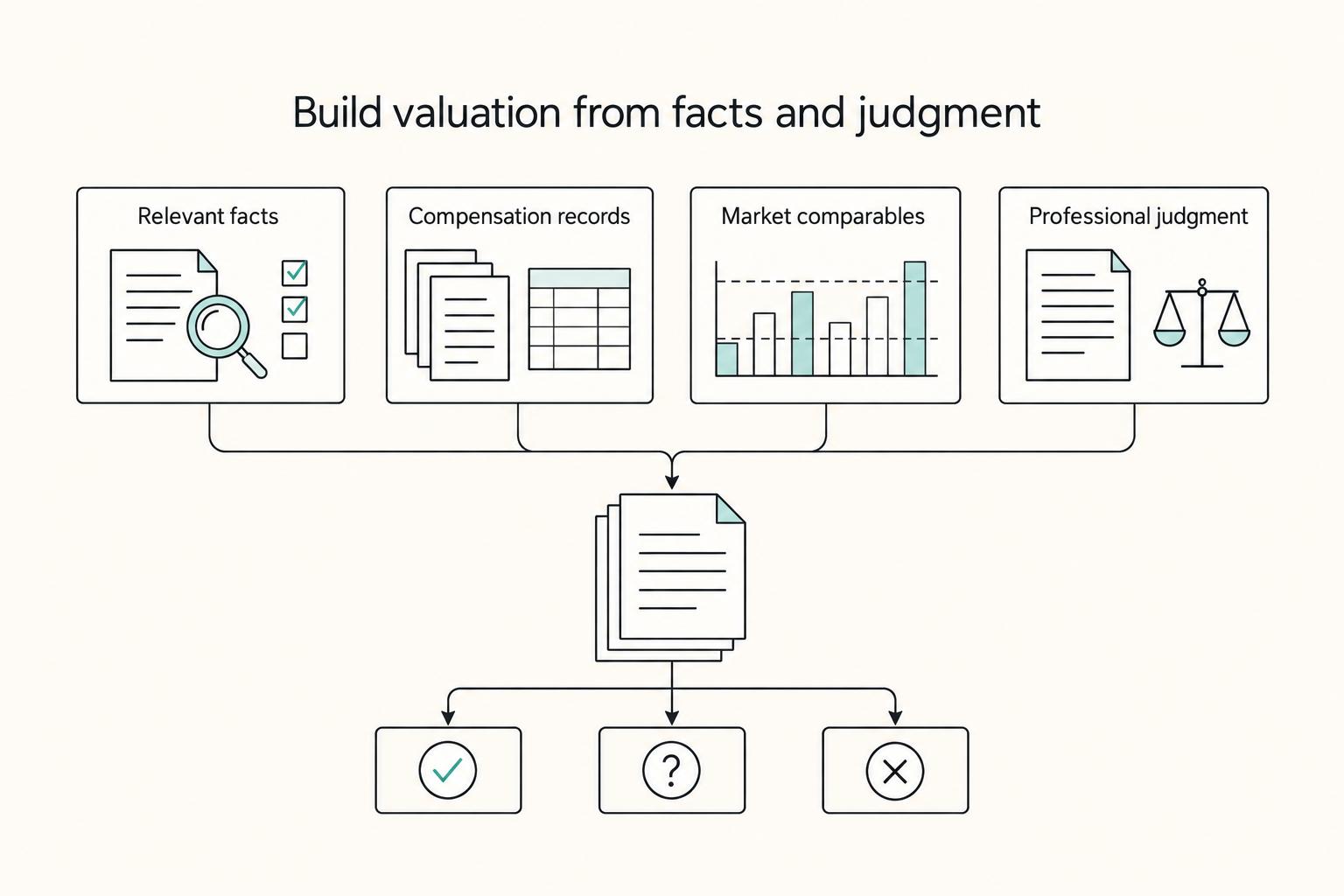
Start with services performed, not ownership, and build your support around the items below.
| Support item | Article detail |
|---|---|
| Relevant facts | Corporate officer's work |
| Compensation records | How compensation was determined |
| Market comparables | Similar work |
| Professional judgment | Applied to those facts and comparables |
That is the practical sequence. Develop the facts first, then use comparables and judgment to set compensation. If you pick the number first and build support later, risk goes up.
Use the investor-return lens#
A useful pressure test is to ask whether the pay looks sensible from an investor-return perspective. This is a decision lens, not a fixed formula or binding rule.
It helps separate service value from ownership value. If the pay only makes sense as profit extraction, you are getting closer to dividend recharacterization risk.
One hard decision rule#
If you cannot explain the amount without relying mainly on ownership, your file is likely not ready. A defensible explanation ties pay to services and comparables, with records you can produce later. If your explanation is mainly "the owner should get the profit," you have not finished the analysis.
Build your evidence file before you set the number#
Set the number only after your file is complete. If a core document is missing, pause the compensation change until you can support it with facts and circumstances.
The IRS reasonable compensation Job Aid describes this as a fact-intensive analysis. Develop relevant facts first, then apply judgment when choosing comparables. It can be used as a practical template for collecting and analyzing information, but it is not binding legal authority. Treat the file as a decision record, not a stack of disconnected documents.
What goes in the evidence pack#
Your file should let a reviewer answer three questions quickly: what services were performed, what comparable work is paid, and how those facts support the amount selected.
- A summary of relevant facts for each shareholder-employee or officer, including services performed and scope.
- Compensation comparables, with notes explaining why each one is reasonably similar. The Job Aid discusses the market approach as the most commonly used method.
- A short memo tying the selected amount to the facts and comparables, including the Section 162 deductibility question.
- Information-collection artifacts and compensation data-source notes used in the analysis.
Add contemporaneous decision records while the decision is fresh#
Keep a clear approval trail. Document when compensation was approved, what facts were considered, and the rationale for the amount as pay for services.
Then keep the implementation record aligned with the decision so the file stays coherent.
A compact file that answers the main tests#
| Document | Why it matters | Audit risk if missing |
|---|---|---|
| Facts summary (services performed and scope) | Supports a facts-and-circumstances reasonable compensation analysis by showing actual work performed | Pay can look ownership-driven instead of service-driven |
| Comparable set + selection notes | Shows how market data and professional judgment were applied | The amount can look reverse-engineered or unsupported |
| Compensation memo tied to services | Connects facts to the final amount and supports Section 162 deductibility analysis | No coherent explanation of why the amount is compensation |
| Information-collection artifacts | Shows how relevant facts were gathered before selecting comparables and setting pay | The analysis can look incomplete or assembled after the fact |
| Compensation data-source notes | Documents where compensation data came from and how it was used | Comparable support can look arbitrary or unverifiable |
| Job Aid scope note | Records that the Job Aid was used as a template, not as binding legal authority | The file can overstate the legal weight of guidance material |
Verification checkpoint#
Use one hard rule. If any key document is missing, do not finalize the change. Complete the file first, then approve the number.
That discipline reduces reconstruction risk later and keeps responsibility where it belongs. Even if a tax professional helps, you are still generally responsible for compliance.
Set compensation with a defensible order of operations#
Use a consistent order every time. Define services, benchmark pay, draft a range, pressure-test the economics, approve and document, then implement in payroll. In a facts-and-circumstances analysis, working backward from a target tax outcome can make the number harder to defend.
Start with services, not salary#
For each corporate officer, lock role scope and time commitment before you pull pay data. The IRS position is that an officer is generally an employee, and wages should generally be commensurate with duties performed. Your file should clearly show what the person does, how much time they spend, and why that work matters.
Use one hard checkpoint here. If someone performs no services or only minor services and is neither paid nor entitled to pay, that person is not considered an employee. Do not pay a title on paper. Pay for actual services.
Build a market-based range, then choose within it#
Once scope is fixed, gather comparables for like services under like circumstances. That matches the IRS definition of reasonable compensation, and the IRS Job Aid describes the market approach as the most commonly used method.
Draft a preliminary range, not a single magic number. If one person is covering multiple functions, say that directly and explain how it affected the selected point in range. Keep the Section 162 lens explicit. The issue is whether the amount is deductible as compensation for services.
Pressure-test before approval#
Before approval, run a commercial-sense check on the proposed amount. This is an internal judgment tool, not an IRS formula. The question is whether the pay still reads as compensation for services based on the full facts and circumstances.
If the rationale only works as ownership extraction, treat that as a red flag and revisit the number. Revisit it whenever the underlying facts and circumstances change materially. A previously supportable amount can drift out of alignment.
| Step | Inputs | Pass-fail checkpoint | Escalate to advisor when |
|---|---|---|---|
| 1. Lock role scope and time | Role descriptions, calendars/time records, current duties | Pass if services and time commitment are clear for each officer | Duties are vague, split across roles, or weakly documented |
| 2. Gather market pay ranges | Comparable roles, business context, role requirements | Pass if comparables reflect like services under like circumstances | Comparables are weak or not truly comparable |
| 3. Draft preliminary range | Service summary + selected comparables | Pass if you can explain why the chosen point fits actual services | Number appears driven mainly by tax result or ownership economics |
| 4. Pressure-test economics | Relevant business facts and circumstances | Pass if the amount still reads as pay for services | Amount is hard to defend without relying on ownership rationale |
| 5. Approve and document | Compensation memo, approval record, effective date, rationale | Pass if records consistently frame pay as compensation for services | Approval is after-the-fact, rationale is thin, or treatment is inconsistent |
| 6. Implement and monitor | Payroll setup and review notes | Pass if payroll execution matches the approved amount and rationale | Payroll treatment drifts, or undocumented advances/loans replace wage treatment |
Implement cleanly and watch for drift#
Once approved, implement it through payroll as wages and make sure payroll records stay consistent with the approved decision. If your memo says one thing and payroll shows another, the file stops being defensible.
If money is advanced as a loan instead of compensation, use arm's-length structure with documented terms, including stated interest and a repayment period. Weak or below-market loan structure can be recharacterized based on substance. A regular review cadence helps you catch drift early, but the key is consistency with services performed and documented facts. After you draft a salary range, pressure-test whether your workflow is repeatable in future cycles, then formalize it with Gruv Docs.
Salary and dividends decisions that reduce reclassification risk#
Once you have a supportable salary range, treat salary and dividend decisions as a defendability call, not a tax-optimization contest. In a C corporation, wages to shareholder-employees are deductible, while dividends are paid from after-tax earnings and are not deductible. That tax difference is exactly why compensation that looks too ownership-driven can invite reclassification risk.
How each pattern is usually read#
Two common patterns come up again and again:
- Salary-heavy: This can be defensible when pay is tied to actual services, supported by comparable salaries, and consistently approved and documented. Risk rises when pay appears designed mainly to drain earnings through wages, especially with little or no dividends and high owner pay.
- Balanced salary plus dividend distribution: This can be defensible when salary remains service-based and any dividend is treated as a separate return on equity. Risk rises when the split is inconsistent or poorly documented, so the rationale changes year to year.
"No dividends ever" is not an automatic failure. But in a closely held company, unusually high owner pay with little or no dividend history can look more like ownership extraction than compensation for services.
Practical tradeoff rule#
If your facts are mixed, choose defendability over optimization. Pull back from aggressive salary levels when comparables are thin, role documentation is weak, or the number only works because it drives corporate tax liability toward zero. Use two checkpoints before finalizing pay:
- documented, consistently applied compensation policies tied to work performed
- market comparables for similar roles in your industry and region
A common scrutiny trigger is a year-end bonus pattern set just large enough to drive corporate tax liability to zero without a clear services-based rationale.
What consistency looks like across years#
Consistency means your rationale is stable and repeatable, not that pay can never change. Compensation can rise when duties or scope rise. It can look opportunistic when pay jumps mainly for tax timing rather than changes in duties or scope.
Keep your annual file aligned across:
- role scope and time commitment
- comparable-salary support
- written approvals and rationale
- consistent application of your documented compensation policy
If you pay dividends in some years and not others, the pattern can still be defensible when it follows business facts rather than tax timing.
Red flags that turn a normal payroll decision into an audit fight#
A major red flag is a payroll decision that cannot be reconstructed from your records. Risk rises when the file is thin, the rationale is unclear, and the record trail does not let a reviewer follow what happened.
What to treat as immediate stop-and-fix signals#
Use these as internal risk checks, not automatic legal conclusions:
| Signal | What is out of sync | Why it matters |
|---|---|---|
| Amount changed | Records do not clearly show what changed in the work or decision | The decision can become hard to reconstruct from records |
| Pay explanation lives in unsaved chats or memory | No clear, retained record | You may be forced into after-the-fact explanations |
| Approval timing, payroll treatment, and written rationale do not line up | One consistent file is missing | Ordinary payroll decisions can become audit fights |
| Bookkeeping labels and supporting documents tell different stories | The same cash movement is described inconsistently | A reviewer may not be able to follow what happened |
Why documentation failures escalate fast#
Examinations often begin with records. IRS examination materials include a "Review of Records" checkpoint, and recordkeeping guidance emphasizes keeping records detailed enough to reconstruct what happened.
If that reconstruction fails, you may be forced into after-the-fact explanations. That is where ordinary payroll decisions can become audit fights.
The one-page rule#
Before finalizing a compensation decision, apply one hard stop. If you cannot defend it on one page, do not finalize it yet.
That page should let a reviewer answer quickly:
- who made and approved the decision
- what changed and why
- how the amount was implemented in payroll
- where the supporting records are stored
If you cannot produce that page now, fix the audit trail first.
Related reading: A Deep Dive into the 'At-Risk' Rules for S-Corp Losses.
Cross-border owner issues that complicate C-corp compensation#
For cross-border owners, a compensation change is not just a payroll decision. Separate cross-border reporting rules can apply alongside U.S. compensation decisions.
Keep the boundary clear. FBAR (FinCEN Form 114) and Form 8938 are adjacent compliance regimes. They do not set salary levels, but changes in foreign accounts or specified foreign financial assets can change what must be reported.
Two touchpoints matter most:
- FBAR (FinCEN Form 114): Filed with FinCEN, not the IRS. Test FBAR if aggregate foreign financial account value exceeds $10,000 at any time during the calendar year.
- Form 8938: Separate from FBAR and does not replace it. Attach it to your annual return and file by that return's due date, including extensions. Thresholds vary by filer type and residence. For a specified domestic entity, comparison points include more than $50,000 on the last day of the tax year or more than $75,000 at any time during the tax year.
Before you change salary, bonus timing, or dividend flow, do four checks:
- map the foreign accounts and assets that could be affected
- test FBAR and Form 8938 separately, since you may need one, the other, or both
- confirm whether you are evaluating as an individual abroad, a specified domestic entity, or neither
- confirm country-specific tax treatment with your local advisor before implementation
A practical risk is changing compensation first and trying to reconstruct reporting later. Keep a compact evidence pack: account inventory, ownership notes, residency facts, and the written approval memo for the pay change. If the company is closely held and might be a specified domestic entity for Form 8938, confirm that point before payroll runs.
How to document and operate the decision through year-end#
Once the amount is set, treat it as an operating process, not a one-time memo. Payroll, books, and year-end wage reporting should tell the same story.
Make payroll and books match the approved decision#
Translate the approved annual amount into clear instructions: pay frequency, effective date, any catch-up timing, and the ledger accounts used for wage expense. If timing changes later in the year, document that change before payroll runs so the record is not reconstructed afterward.
Use a recurring reconciliation checkpoint. Reconcile payroll reports to ledger wage expense, then tie books and records to what is reported on the return. IRM 4.10.4 and 4.10.4.2 ("Minimum Requirements For Examination of Income") support explicit examination checkpoints, and IRM 4.10.4.2.3.5 explicitly calls out reconciliation of books and records to reported income. IRM 4.10.4 also includes evaluation of internal controls for individual business returns.
If paid amounts drift from the approved plan, fix the mismatch in real time. Either document a true-up path or update the decision memo with the changed facts.
Keep the file readable for review#
Keep one plain-language decision file that a reviewer can follow quickly. Include who performed the services, role and expected scope of work, why the amount was chosen, who approved it, and when you will revisit it.
Add short review notes when facts change, and keep approvals with the memo. The goal is a clean audit trail that shows consistent decision-making across payroll, accounting, and return prep.
If you cite Federal Register material in your file, use a source-validity check. FederalRegister.gov says its daily web version is unofficial for legal research until official status is granted, and its XML does not provide legal or judicial notice. Verify against an official edition before treating it as final authority.
Use a periodic review cadence (for example, quarterly)#
A periodic review cadence (for example, quarterly) is a practical internal control that helps catch drift before year-end close. Check:
| Review item | What to check |
|---|---|
| Duties | Whether duties changed materially |
| Profitability | Whether profitability shifted enough to make the original rationale stale |
| Ownership or control | Whether ownership or control changed |
| Year-to-date payroll | Whether it still tracks the approved annualized amount |
| Reconciliations | Whether payroll reports, ledger wage expense, and return-facing totals still reconcile |
If any item changed, refresh the memo before the next payroll run.
Related: How to Choose the Right Business Structure for Your Freelance Business.
When to bring in a CPA or tax attorney immediately#
Bring in a CPA or tax attorney as soon as cross-border reporting risk signals start stacking up, and do it before you finalize the return.
Escalate immediately if any of these apply:
- you may need to report specified foreign financial assets on Form 8938
- FBAR (FinCEN Form 114) may also be required
- your entity may be treated as a specified domestic entity holding specified foreign financial assets
- you are unsure which Form 8938 threshold applies to your filing situation
Treat cross-border reporting as part of the same compliance review, not a separate cleanup. Form 8938 is attached to your annual return and due with that return, including extensions. Filing Form 8938 does not replace FinCEN Form 114 (FBAR) if FBAR is otherwise required. If you are not required to file an income tax return for the year, Form 8938 is not required. The IRS also notes higher Form 8938 thresholds for joint filers and taxpayers residing abroad. For tax years beginning after December 31, 2015, certain domestic corporations, partnerships, and trusts can have their own Form 8938 filing duty as specified domestic entities. For specified domestic entities, one threshold check is whether specified foreign financial assets exceed $50,000 on the last day of the tax year or $75,000 at any time during the year.
If you are calling an advisor, give them a usable evidence pack on day one. Include your filing-status context, foreign-asset and foreign-account lists with values and named owners, and entity records relevant to specified domestic entity status.
Conclusion#
You do not win the reasonable compensation question in a C-corp by guessing a tax-efficient number. You win by showing that officer pay matches actual services, is handled as wages subject to withholding, and is documented in a way that stays clear over time.
The standard is facts and circumstances. The IRS generally treats a corporate officer as an employee, and wages should generally be commensurate with duties; the reasonable-compensation definition cited here comes from exempt-organization reporting guidance, so avoid relying on any single percentage or formula.
Use this execution checklist:
- Define the role first. Document what the officer actually does and the time commitment.
- Build the file before changing pay. Keep comparables for like services under like circumstances and tie the number to duties performed.
- Set pay with a defendability check. If you cannot explain the amount in plain English without leaning on ownership, revise it.
- Document implementation. Show how the decision was carried through payroll records.
- Reassess when facts and circumstances change. Revisit the analysis if duties or time commitment shift.
Treat classification discipline as just as important as salary discipline. If a transfer is treated as a loan, the file should include arm's-length terms such as a stated interest rate, a specified repayment period, and a consequence for failure to repay. Collateral also supports loan treatment.
If labels and substance do not match, tax treatment can change. The IRS notes that a below-market officer or shareholder loan may be treated as a gift, dividend, contribution to capital, payment of wages, or other payment.
If facts are ambiguous, choose the more defensible position and escalate early. A less aggressive position with a clean file is usually easier to live with than repairing weak documentation after an IRS challenge.
If this policy now touches cross-border payouts, tax-document workflows, and audit trails, map the operating model with Gruv.
Frequently Asked Questions
What is reasonable compensation for a C-corp owner-employee in plain English?
Reasonable compensation is pay that matches the services you actually perform, not just your ownership stake. The IRS describes it as what would ordinarily be paid for like services by like enterprises under like circumstances. In practice, wages paid to a corporate officer should generally be commensurate with duties performed.
Why does the Internal Revenue Service (IRS) scrutinize compensation in a closely held corporation?
Officer wages and shareholder distributions are treated differently for tax purposes, so the IRS reviews whether payments are classified correctly. The IRS generally treats a corporate officer as an employee with wages subject to withholding. It also generally treats distributions from earnings and profits as dividends.
What happens if the IRS decides part of my salary is a disguised dividend?
If compensation is deemed excessive, the excess may be reclassified as a dividend. Practitioner sources also warn this can lead to disallowed deductions, additional tax liabilities, penalties, and possible double-tax exposure. That is why compensation support should clearly connect pay to services performed.
Is there a fixed percentage, safe harbor, or formula under the reasonable compensation test?
The IRS materials here frame reasonable compensation as a facts-and-circumstances determination. They do not provide a single percentage or universal formula that fits every C-corp owner-employee.
Which factors matter most under the facts-and-circumstances test?
Start with the core question: what services were performed, and whether wages are commensurate with those duties. Then apply comparability: what is ordinarily paid for like services by like enterprises under like circumstances. The decision is based on the full fact pattern, not one datapoint.
Does paying little or no dividend distribution automatically fail the test?
No. Practitioner guidance says that a no-dividend history, by itself, does not prove compensation is unreasonable. It is one context signal, not an automatic pass or fail.
What information is still uncertain and should be confirmed with a professional before filing?
Confirm any payment where the label may not match substance, especially wages versus dividends versus loans. If you are treating a transfer as a loan, confirm that your file supports loan treatment with contract terms, stated interest, a defined repayment period, and, where applicable, collateral. Also confirm officer-status edge cases, including whether someone who performs no or only minor services and receives no pay is treated as an employee.
Try a related tool
Researched and edited by the Gruv editorial team. Gruv builds cross-border billing, payouts, and finance-operations software for global businesses.
Sources
Educational content only. Not legal, tax, or financial advice.
Related Posts

Digital Nomad Taxes in 2026 With a Defensible Filing Plan
With digital nomad taxes, the first move is not optimization. It is figuring out where you may be taxable, where filings may be required, and what proof supports that position.
How to Choose the Right Business Structure for Your Freelance Business
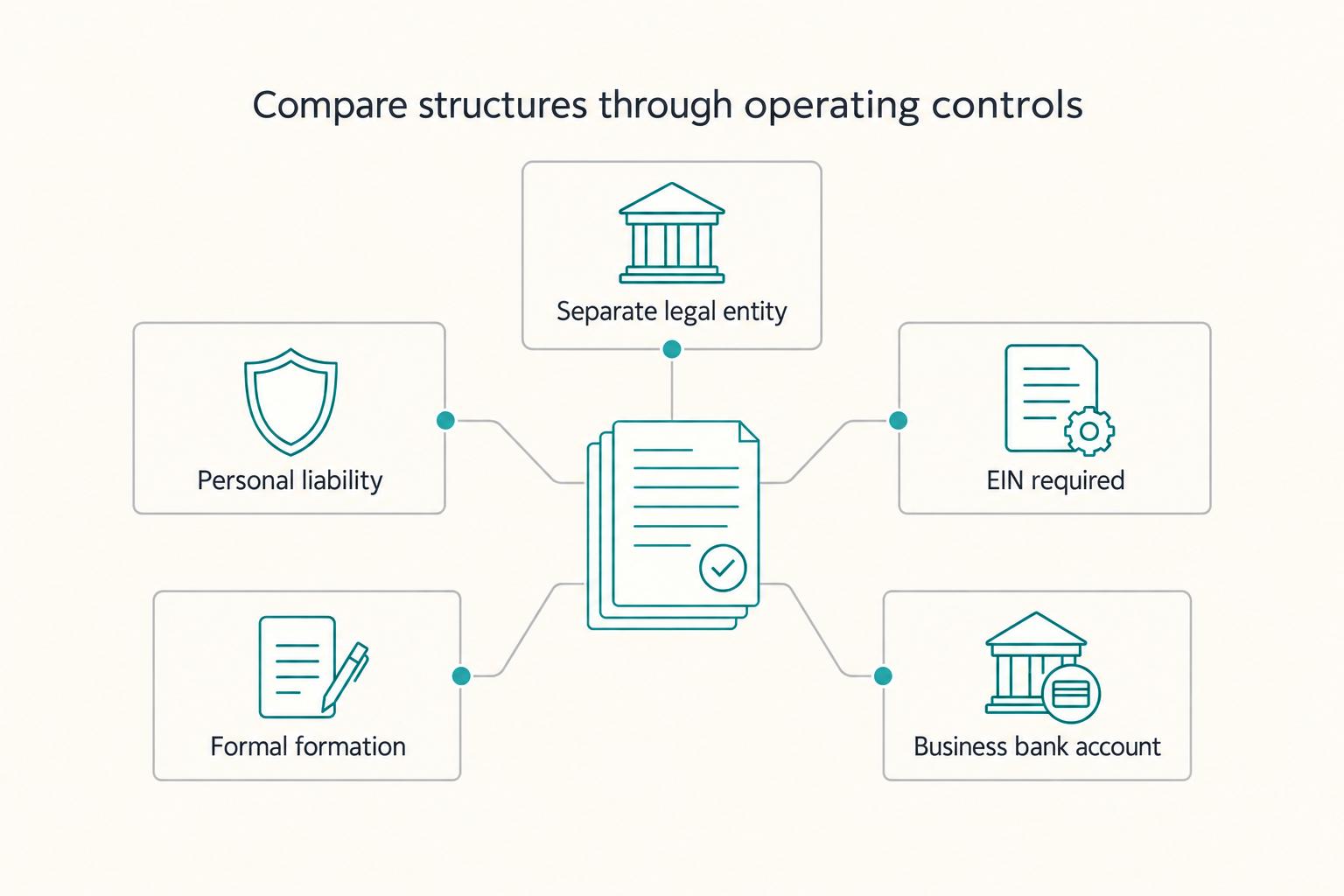
Most freelancers end up in a business structure by default rather than by design, but that accidental choice shapes taxes, personal liability, and payment operations in ways that compound over time. This guide walks independent professionals through four entity types — Sole Proprietorship, Single-Member LLC, S-Corp election, and Corporation — covering the tax treatment, liability exposure, and operational overhead of each. Rather than prescribing a single best answer, it provides a trigger-based framework: start with the structure that fits today, then upgrade when specific signals — indemnification clauses, enterprise KYB requirements, a first hire, or material net profit — make the switch worthwhile. The result is a deliberate, revisable foundation that keeps records clean, reduces onboarding friction, and avoids the expensive mismatches that come from letting structure lag behind business growth.

The Pros and Cons of a C-Corp for a Freelance Business
Entity choice is not just paperwork. It changes how the business is taxed, how ownership can be structured, and how much compliance work you take on. Use this article to make a practical call: keep your current setup, consider an LLC or S-corp path, or move to a C-corp only if the tradeoffs fit where you are headed.