
Quick Answer
Use the mere-exposure effect for personal branding as a disciplined repetition system, not a posting quota. Set a specific objective, focus on high-trust touchpoints, and ship content only when it delivers concrete value tied to your expertise. The practical checkpoint is commercial movement: better-fit inquiries, smoother progress from first contact to signed work, and stronger pricing conversations rather than rising impressions alone.
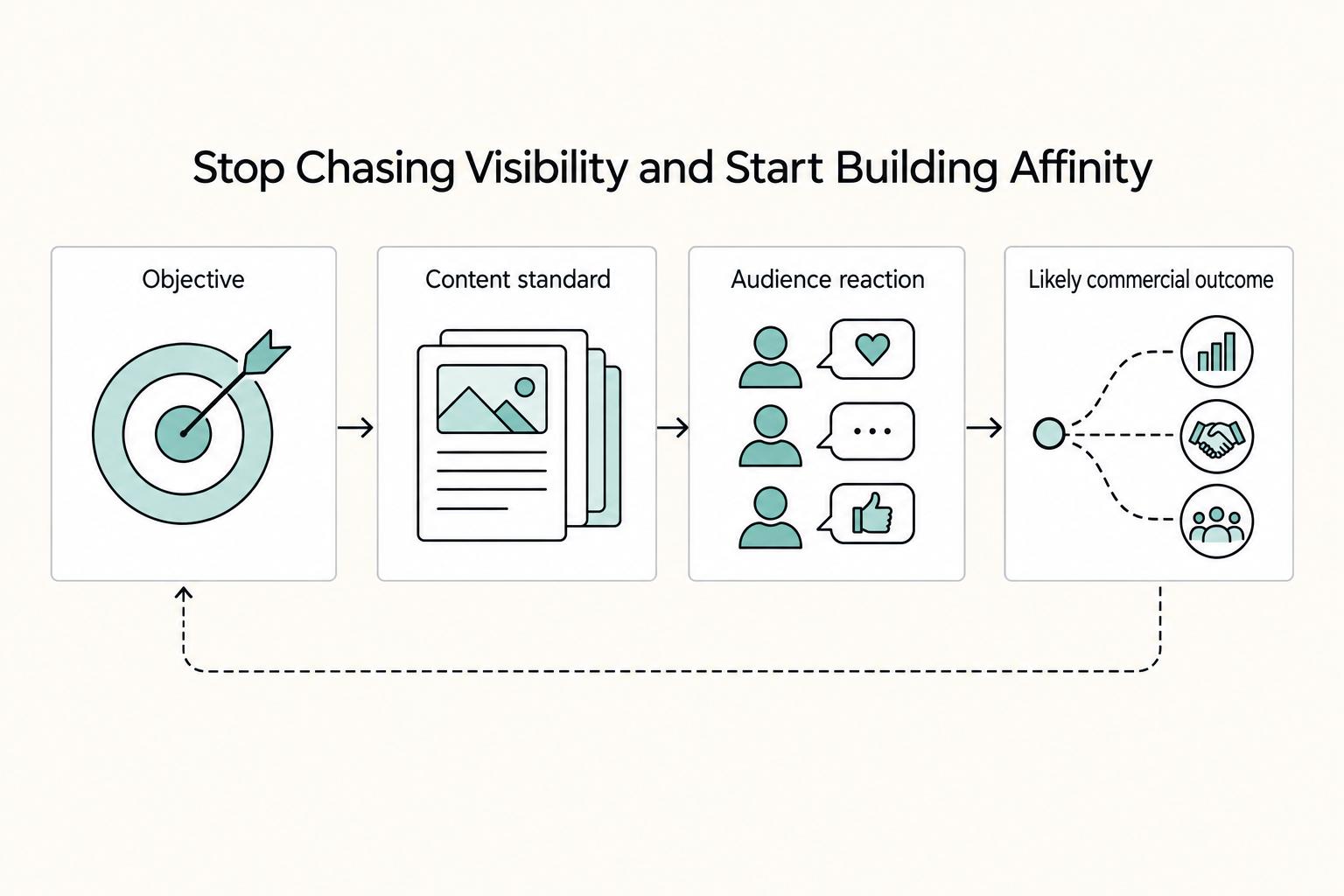
The Mere-Exposure Effect: Stop Chasing Visibility and Start Building Affinity#
For personal branding, the mere-exposure effect matters for one simple reason: repeated exposure can increase preference, often without a fully conscious reason. A Journal of Psychology article from April 2007 puts it plainly: preference increases as exposure increases. In business terms, that can shape early impressions before a buyer compares proposals line by line.
That does not mean visibility alone wins. It means repeated, relevant contact can move you from stranger to known quantity. For an independent professional, that is usually the first real hurdle. Most buyers are not only asking, "Who does this?" They are also asking, "Who feels credible enough to trust with money, time, and reputation?"
A useful way to frame it is this: awareness gets your name into memory, while affinity changes the tone of that memory. Awareness says, "I have heard of you." Affinity says, "You seem like someone who gets this." That second response is where better conversations often start. Not because the psychology guarantees a sale, but because familiarity can make first contact feel easier.
If you want the research checkpoint, the article metadata often cited for this definition is The Journal of Psychology, 141(2):117-25, DOI 10.3200/JRLP.141.2.117-126. You do not need to become a psychologist to use the idea well. You do need to stop treating every impression as equal.
What is the difference between awareness and affinity?#
Visibility-first tactics chase reach. An affinity-first strategy cares about the quality and consistency of the impression you leave. That difference changes what you publish, where you publish it, and how you decide whether it was worth sending.
| Dimension | Visibility driven approach | Affinity driven approach |
|---|---|---|
| Objective | Be seen by as many people as possible | Become familiar and credible to the right people |
| Content standard | Frequent, broad, easy to skim, often generic | Useful, specific, recognizable, tied to your actual expertise |
| Audience reaction | "I see this person around" | "This person consistently says things worth saving or sharing" |
| Likely commercial outcome | You may get noticed but still enter as one of many options | You may be remembered as a plausible fit, not a random name |
That is the real tradeoff. Chasing visibility can inflate activity while doing little for decision quality. Chasing affinity is slower and narrower, but each touchpoint has a better chance of making your positioning stick.
Why does exposure wear out?#
More exposure is not always better exposure. Repetition without substance can create fatigue. People may stop paying attention, mute you mentally, or start associating your brand with filler.
| Signal level | Content examples |
|---|---|
| Low-value posting | recycled slogans; vague "three tips" threads with no point of view; daily updates that could have come from anyone in your category |
| High-signal touchpoint | one sharp observation; one decision rule; one concrete example; one mistake the reader can avoid today |
That is the difference in practice: low-value posts sound interchangeable, while high-signal touchpoints give the reader something specific to keep or use.
A useful checkpoint before you publish is to remove your name from the draft and ask: could any competent person in my field have posted this? If the answer is yes, it is probably feeding visibility more than affinity. Another red flag is channel mismatch. A thoughtful breakdown may strengthen your reputation on LinkedIn, in an email list, or on your site. The same idea may fall flat as a rushed short-form clip because the value got stripped out on the way.
There is also real strategic disagreement here. One marketing commentator has argued companies should "kill all the organic social media activity." You do not need to adopt that hard line, but the warning is worth taking seriously. Posting for the sake of posting is not neutral. It can waste attention, weaken your positioning, and train you to reward volume over substance.
Before you publish anything, run this quick check.
- Channel fit: does this belong where your buyers already pay attention?
- Audience relevance: does it solve, clarify, or sharpen a real buyer question?
- Value density: is there at least one specific insight, example, or decision rule worth remembering?
- Positioning consistency: does this sound like the expert you want to be hired for, not just the creator trying to stay visible?
Once you are clear on what not to publish, the next move is to build repetition on purpose instead of by habit. For a step-by-step walkthrough, see How to Leverage Guest Posting for Freelance Brand Building.
From Tactic to System: A Framework for Controlled Exposure#
Use the mere-exposure effect as a system, not a posting quota: repeat useful work people can recognize, and avoid repetition that adds no value.
Repeated exposure can improve attitudes, but familiarity can also bias people toward what they already know. Your job is to make what they keep seeing genuinely useful and clearly yours.
How do you turn this into a system?#
| Channel type | Examples | Credibility question |
|---|---|---|
| Owned | site, newsletter | Why does this channel make expertise more credible for my audience? |
| Earned | guest features, referrals | Why does this channel make expertise more credible for my audience? |
| Community | industry groups, niche forums | Why does this channel make expertise more credible for my audience? |
- Set one objective before you pick topics.
Write it like this: I want [audience segment] to do [business outcome] after seeing [type of evidence] because they trust me for [specific problem]. Then add a filter: If this does not help that audience move toward that outcome, do not publish it.
- Choose channels by trust signal, not reach.
Sort touchpoints into owned (site, newsletter), earned (guest features, referrals), and community (industry groups, niche forums). For each one, answer: Why does this channel make expertise more credible for my audience? If the answer is weak, skip the channel and protect focus.
- Run a quality gate on every asset.
Publish only when all four checks are clear:
- Problem solved: it answers a real buyer question or hesitation. * Specificity: it includes a concrete example, decision rule, or scenario. * Actionability: the reader can do something differently now. * Differentiation: it reflects your method or point of view, not generic category advice.
- Build from one core asset into a flywheel.
Start with one substantial piece (article, teardown, case note, checklist), then adapt it across channels while keeping the same core claim. That is controlled repetition: the message stays coherent while exposure compounds.
| Dimension | Random posting | Flywheel execution |
|---|---|---|
| Effort | Constant net-new creation and context switching | One core asset, then focused adaptations |
| Consistency | Irregular, energy-dependent | Planned reuse, easier to sustain |
| Message coherence | Topic drift over time | Repetition reinforces the same expertise |
| Expected pipeline impact | Visibility spikes, weak memory | Stronger recall of what you do and why it matters |
As a quick self-test, borrow the spirit of a two-alternative forced-choice check: if your post appeared beside a competitor's, would a good-fit buyer recognize yours by specificity and point of view alone?
For your next cycle:
- Choose one core asset tied to one audience and one business outcome.
- Map repurpose paths across owned, earned, and community touchpoints.
- Set a cadence you can sustain without lowering quality.
- Define review criteria before publishing: saved replies, qualified conversations, repeat readers, or direct buyer questions.
You might also find this useful: How to Create a Content Flywheel for Your Freelance Business.
Connecting Exposure to Business Outcomes#
Treat exposure as working only when it improves buying signals, not just attention. In practice, track three outcomes: lead quality, time-to-trust, and pricing power.
| Workflow tool | What to record |
|---|---|
| Intake form | where they first saw your work; why they reached out now |
| CRM | stage dates from first contact to proposal to signed work |
| Proposal tracker | whether outcomes were full price, scope-adjusted, discounted, or lost |
Likes and reach still help, but as context. They show whether people noticed you; your commercial metrics show whether familiarity is helping the right people choose you.
You can capture this with your current workflow:
- In your intake form, ask where they first saw your work and why they reached out now.
- In your CRM, use stage dates to measure movement from first contact to proposal to signed work.
- In your proposal tracker, log whether outcomes were full price, scope-adjusted, discounted, or lost.
| Metric | Decision intent | Data source | Review cadence | Action when signal drops |
|---|---|---|---|---|
| Lead quality | Are the right buyers arriving already aware of your relevance? | Intake answers, qualification notes, CRM source field | Every two to four weeks | Recheck channel fit and core topic. If inquiry volume rises while fit drops, tighten positioning. |
| Time to trust | Are familiar prospects moving through early sales steps with less explanation? | CRM stage movement (first contact -> proposal -> signed) | Monthly | Check whether recent content became too broad or repetitive. Increase specificity before increasing frequency. |
| Pricing power | Is familiarity supporting cleaner acceptance of your stated price? | Proposal tracker, negotiation notes, won/lost reasons | Monthly or per proposal batch | If discount pressure rises, strengthen proof (examples, outcomes, decision detail), not just posting volume. |
Watch for one pattern: attention up, business signals down. Exposure can lose effectiveness when you push frequency without enough substance, so treat that as a cue to adjust.
For your first reporting cycle:
- Add the two intake fields now: first touchpoint and reason for reaching out now.
- Confirm CRM stage dates are recorded consistently.
- Standardize proposal outcomes: full price, scope adjusted, discounted, lost.
- After 30 to 90 days, set baselines and leave unresolved thresholds marked as pending verification from source records.
- If one metric drops, change one variable first (channel, message specificity, or frequency), then recheck.
We covered the website side of this in detail in Building a Personal Website That Converts for Freelancers.
The Compliance Check: Grow Your Brand Without Diluting It#
Before you publish, run a quick brand-governance check to protect trust. Repeated exposure helps when it makes you easier to trust, not just easier to notice.
Use a short pre-publish routine with four checks: audience fit, claim quality, channel fit, and brand-position consistency. If a post fails one of these, revise it or skip it. Low-signal posting usually creates avoidable drag: weaker trust signals, more poor-fit inquiries, and a less clear market position.
| Decision area | Compliant exposure | Non-compliant exposure |
|---|---|---|
| Content intent | Answers a real buyer question or clarifies your method | Fills the feed with vague takes or trend reactions |
| Quality bar | Claims are supported by an example, artifact, caveat, or direct observation | Claims are broad, borrowed, or hard to verify |
| Channel discipline | Published where your audience expects this depth and format | Posted everywhere without adapting substance |
| Likely business effect | Builds familiarity that supports trust | Builds attention without clear buying relevance |
Claim quality is the key gate. If you cannot point to a note, screenshot, client-safe example, code sample, teardown, or a clear limitation, do not present the claim as fact. Engagement and intent are not the same: in a survey of 713 Facebook users, social media brand engagement did not directly influence purchase intention, while brand trust mediated the effect.
For service professionals, use a repeatable playbook: one clear point of view, one practical implication, and one proof point. For technical experts, use utility-first publishing: a fix, a snippet, a diagnostic, or an annotated answer with enough context to apply it.
Pre-publish checklist for each cycle:
- Audience fit: would a good prospect find this useful now?
- Claim quality: what evidence pack supports the main assertion?
- Channel fit: is this the right depth and format for this platform?
- Brand position: does this make your position clearer, more useful, and more consistent?
- Internal scoring (if used): set a pass threshold you can check against your source records.
If you want a deeper dive, read GDPR for Freelancers: A Step-by-Step Compliance Checklist for EU Clients.
Conclusion: Build Your Brand's Moat#
If you want your name to hold up when a buyer is choosing between several capable options, stop treating visibility as the goal. The better outcome is simpler: repeated, credible familiarity that makes your work easier to evaluate while still giving people enough proof to judge it properly.
That is the practical value of the mere-exposure effect in personal branding. People often prefer what they have seen before, but repetition only helps when it reinforces recognition across multiple touchpoints without tipping into overexposure. Your checkpoint is not reach by itself. It is what you can observe over time: whether the right buyers recognize your offer faster, whether conversations need less basic context-setting, and whether engagement stays healthy instead of fading. If those signs are not improving, more posting is not automatically the answer. Tighten the message, improve the examples, or reduce the noise.
| Dimension | Visibility chasing | Moat building |
|---|---|---|
| Main aim | Be seen by as many people as possible | Be recognized and understood by the right buyers |
| Content pattern | High volume, loose message, trend-led | Consistent message, repeated proof, useful interpretation |
| Buyer signal | More impressions, little change in recognition | Stronger recognition across touchpoints and clearer buyer understanding |
| Common failure mode | Overexposure and weaker engagement | Familiarity masking weak quality when proof is thin |
One caution matters at the end: familiarity can outweigh quality in perception, so do not let repetition cover weak work. Keep an evidence pack close at hand, such as case notes, annotated examples, before-and-after reasoning, or screenshots that show how you think.
Pick your core touchpoints, keep the message consistent, and review those buyer signals on a recurring cadence. If something starts to feel noisy or stale, sharpen the idea instead of simply publishing more often.
Related: How to Manage Your Personal Brand as a Freelancer. Want to confirm what's supported for your specific situation? Talk to Gruv.
Frequently Asked Questions
How do you use the mere-exposure effect for personal branding without being annoying?
Use a simple pre-publish check: intent, usefulness, originality, and audience fit. If a post does not help a real buyer question, add a concrete example, caveat, note, screenshot, or teardown before you publish it. Annoyance can come from repetition without substance, not repetition itself. A good self-check is whether the post would still be worth sending directly to a qualified prospect.
How do you measure whether this is working?
Start by tracking familiarity and preference signals before treating it as a business KPI system. Keep a simple log of touchpoints and note whether relevant people recognize your name, respond more positively over time, or include you in consideration more often than before. Once you have enough real data, you can decide whether to connect those signals to broader sales metrics.
Is mere exposure the same thing as top-of-mind awareness?
No. Familiarity can increase preference, while top-of-mind awareness is about recall. You usually want both, but they are not the same mechanism. Mere exposure makes you feel more familiar and often more likable, while top-of-mind awareness makes your name easier to remember when a need appears.
What does this look like for independent professionals?
For a service professional, it might be a regular note that interprets one market change and explains what a client should do next. For a technical freelancer, it might be a repeated pattern of publishing annotated fixes, code snippets, or issue breakdowns that show how you think, not just what you know. The checkpoint is whether someone can verify your competence from the artifact itself. If your example depends on vague claims with no evidence pack, it is too thin to build trust.
Is using a psychological principle like this ethical?
It is ethical when repetition makes genuine expertise easier to notice, not when it tries to push people past weak evidence. Mere exposure is more likely to help when there is no preexisting negative attitude, so it is unlikely to overcome misleading claims or an already damaged reputation on its own. A useful guardrail is simple: if frequency is compensating for low quality, stop. Trust-building shows your method clearly, while manipulation tries to create preference without enough substance to justify it.
Try a related tool
Researched and edited by the Gruv editorial team. Gruv builds cross-border billing, payouts, and finance-operations software for global businesses.
Sources
Includes 4 external sources outside the trusted-domain allowlist.
- clinicaltrials.gov/study/NCT06443073trusted
- nepis.epa.gov/Exe/ZyPURL.cgitrusted
- pmc.ncbi.nlm.nih.gov/articles/PMC10393126trusted
- pmc.ncbi.nlm.nih.gov/articles/PMC5823266trusted
- betterhelp.com/advice/general/what-is-the-mere-exposure-effectexternal
- brax.io/blog/the-magic-of-the-mere-exposure-effect-o...external
- cognitive-clicks.com/blog/mere-exposure-effectexternal
- htt.it/en/the-mere-exposure-effect-why-seeing-often...external
Educational content only. Not legal, tax, or financial advice.
Related Posts

GDPR Compliance Checklist for Freelancers Working With EU Clients
Start by separating the decisions you are actually making. For a workable **GDPR setup**, run three distinct tracks and record each one in writing before the first invoice goes out: VAT treatment, GDPR scope and role, and daily privacy operations.

How to Manage Your Personal Brand as a Freelancer
Your brand is not a mood board. Think of it as the experience people have of your work: the promise you make, the proof you can show, and the way you present yourself across client touchpoints. Get that clear first, and your fit is easier to read from profile to proposal.

How to Create a Content Flywheel for Your Freelance Business
If you sell expert work, your first marketing decision is not the channel. It is whether your pipeline relies on constant replacement or is designed to build momentum over time. A funnel is designed to capture leads and move them toward conversion. A flywheel emphasizes momentum, long-term growth, and client participation in growth. For a solo business, that distinction matters because capacity is usually limited.