
Quick Answer
Classify each education charge before doing tax math: credit path, Schedule C path, or unconfirmed. Then run both options from one baseline return. For the credit route, confirm eligible student and school status, document Form 1098-T, and prepare Form 8863 support. For the deduction route, keep records showing the course maintains or improves skills in your current services and does not qualify you for a new trade or business. File one treatment per expense and keep matching evidence.
What to verify before comparing the credit and the deduction#
Use one operating rule throughout this decision: classify first, compare second, document third. If you are weighing the lifetime learning credit for freelancers against possible Schedule C treatment, start with what you can verify now on the federal side, not with projected savings.
Start with plain-language labels#
The Lifetime Learning Credit is a federal education credit for qualified tuition and related expenses paid for an eligible student at an eligible educational institution. Your first checks are straightforward: school eligibility, student eligibility, enrollment timing, and tuition records. It can apply to undergraduate, graduate, and professional degree courses, including courses to acquire or improve job skills, and it is worth up to $2,000 per tax return.
The Schedule C path is only a comparison path at this stage. Keep it in an unconfirmed bucket until Step 1 tells you whether it actually applies.
Year-sensitive limits need careful handling. The verified MAGI thresholds here are for tax year 2024: phaseout at $80,000 to $90,000 (non-joint) and $160,000 to $180,000 (joint), with no credit at $90,000 or more (non-joint) or $180,000 or more (joint). For the return year you are filing, use current IRS thresholds after verification.
Decision matrix#
| What you verify | Why it matters | Minimum evidence to keep | Stop-and-escalate trigger |
|---|---|---|---|
| LLC: eligible educational institution | The credit depends on the school being an eligible educational institution (domestic or foreign). | School details, course/billing records, and Form 1098-T. | You cannot confirm institution eligibility or 1098-T status. |
| LLC: eligible student and timing | The student must be enrolled or taking courses, and at least one academic period must begin in the tax year. | Enrollment proof, registration, and academic period dates. | Enrollment timing is unclear for the tax year. |
| LLC: claimable amount | 1098-T helps compute the credit, but the listed amount may not be the amount you can claim. | 1098-T, account statements, payment records, and any adjustments/refunds. | You are using one form amount without reconciling payments and adjustments. |
| LLC: MAGI for filing year | Even valid education costs can produce a reduced credit or no credit at higher MAGI. | Draft MAGI estimate and saved threshold check for the filing year. | You compare options before confirming the filing-year threshold. |
| Schedule C: comparison status | This keeps the deduction path in a placeholder state until verified. | Working notes (invoice, payment trail, course description, dated rationale note). | You still cannot verify deduction treatment confidently. |
Keep the guardrails narrow#
This section gives you decision logic only. It is federal-first. State, residency, and cross-border effects sit outside this first-pass sorting step and should be reviewed later.
The main risk here is false certainty. If 1098-T status, institution eligibility, enrollment timing, or MAGI checks are unclear, pause the comparison and fix the records first. Keep one evidence pack per expense: invoice, payment proof, course description, enrollment record, and a dated note labeling the item as credit path, deduction path, or unconfirmed.
Readiness checkpoint#
Move to Step 1 only if you can verify school status, enrollment timing, the payment trail, and the filing-year MAGI threshold check. Pause if any of those are missing or if your deduction path is still assumption-based. If you need the deeper deduction workflow first, use Can I Deduct Education and Professional Development Costs?. Related: A Guide to the Qualified Business Income (QBI) Deduction for Freelancers.
Step 1: The Compliance Gateway - Do Your Costs Qualify?#
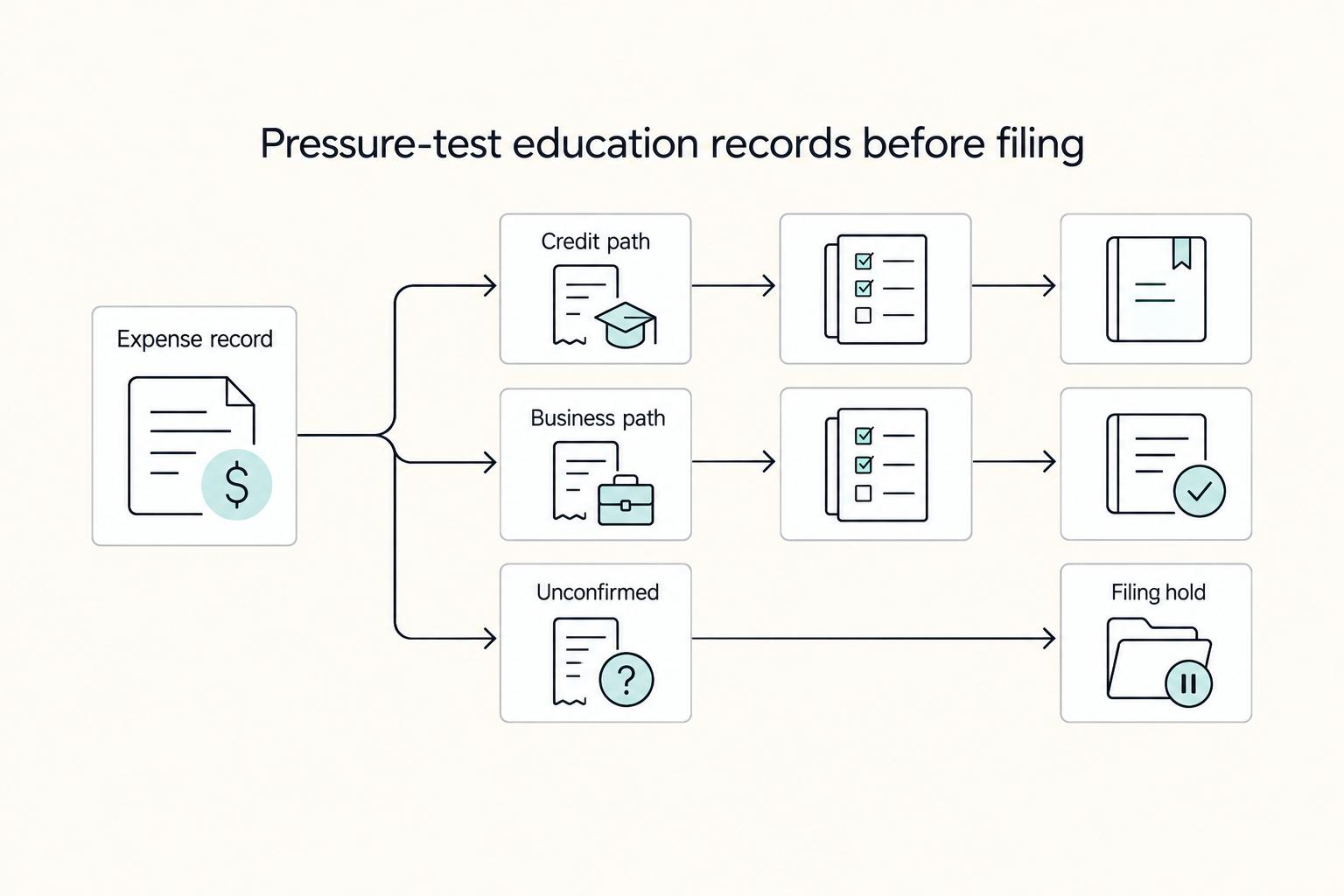
Classify each expense before you compare outcomes. For every education charge, assign one working label: possible credit path, possible business-expense path, or unconfirmed. If your current records do not support a label, keep it unconfirmed.
That also matches how IRS examination materials organize education tax benefits. IRM 4.19.15.3 covers education tax benefits. IRM 4.19.15.3.1 covers AOTC and Lifetime Learning Credit, IRM 4.19.15.3.1.1 focuses on evaluating taxpayer responses, and IRM 4.19.15.3.2 is a separate subsection for Tuition and Fees Deduction.
Classify each expense in plain language#
Keep the first pass simple. For each tuition, course, program, or training charge, ask:
| Working label | When it fits | Support now |
|---|---|---|
| possible credit path | You can support it with your current credit-related filing materials and records | Current credit-related filing materials and records |
| possible business-expense path | You can support it with records that explain what you bought and how it connects to your current work | Records that explain what you bought and how it connects to your current work |
| unconfirmed | Either side is incomplete or mixed | Current records do not support a label |
- Can you support a
possible credit pathwith your current credit-related filing materials and records? - Can you support a
possible business-expense pathwith records that explain what you bought and how it connects to your current work? - If either side is incomplete or mixed, should this stay
unconfirmed?
Record the label in your tracker now. If any filing-year assumption is still pending verification, note that clearly in the file.
Prioritize stronger records first#
Start with official filing materials and primary records, then add your own explanation. Treat marketing pages, partial screenshots, or ad copy as background only. If the file is thin, do not force a classification.
| Compliance gate | Pass | Fail trigger | Immediate next action |
|---|---|---|---|
| Label check | One expense has one label with a short reason | You started comparing savings before labeling | Label it now or keep it unconfirmed |
| Credit file check | Credit-related filing materials and records are consistent | Core credit records are missing or contradictory | Pause credit path and rebuild file |
| Business-purpose check | Your written rationale matches the purchase and current work context | Rationale is vague, retrofitted, or mismatched | Rewrite from facts or keep unconfirmed |
| Mixed-use check | Bundled charges are clearly separated | Multiple charge types are bundled with no clear split | Escalate before claiming |
| Filing-year check | Filing-year assumptions are verified and tracked | You are using copied or prior-year assumptions | Update filing-year checks first |
Escalate ambiguous cases early#
Some fact patterns are not worth guessing through. Escalate when the charge is bundled, key facts conflict, or core records are missing. Move to Step 2 only when the file is defensible on paper. Otherwise, keep the item parked as unconfirmed.
Step 2: The Profitability Calculator - Which Path Maximizes Your Return?#
Once an expense clears classification, the next question is simple: which treatment actually lowers your total federal tax? A practical way to do this is to run both eligible treatments from the same baseline return, then keep the option with the lower total federal tax.
The paths work differently. The Lifetime Learning Credit is a nonrefundable credit on Form 8863. It can reduce income tax, but not beyond your tax liability. Its core limit is 20% of the first $10,000 of qualified expenses (max $2,000 per return). A Schedule C education expense reduces business profit first, which can change income tax and, when applicable, self-employment tax on Schedule SE. You cannot claim both treatments for the same expense.
Compare what changes on your return#
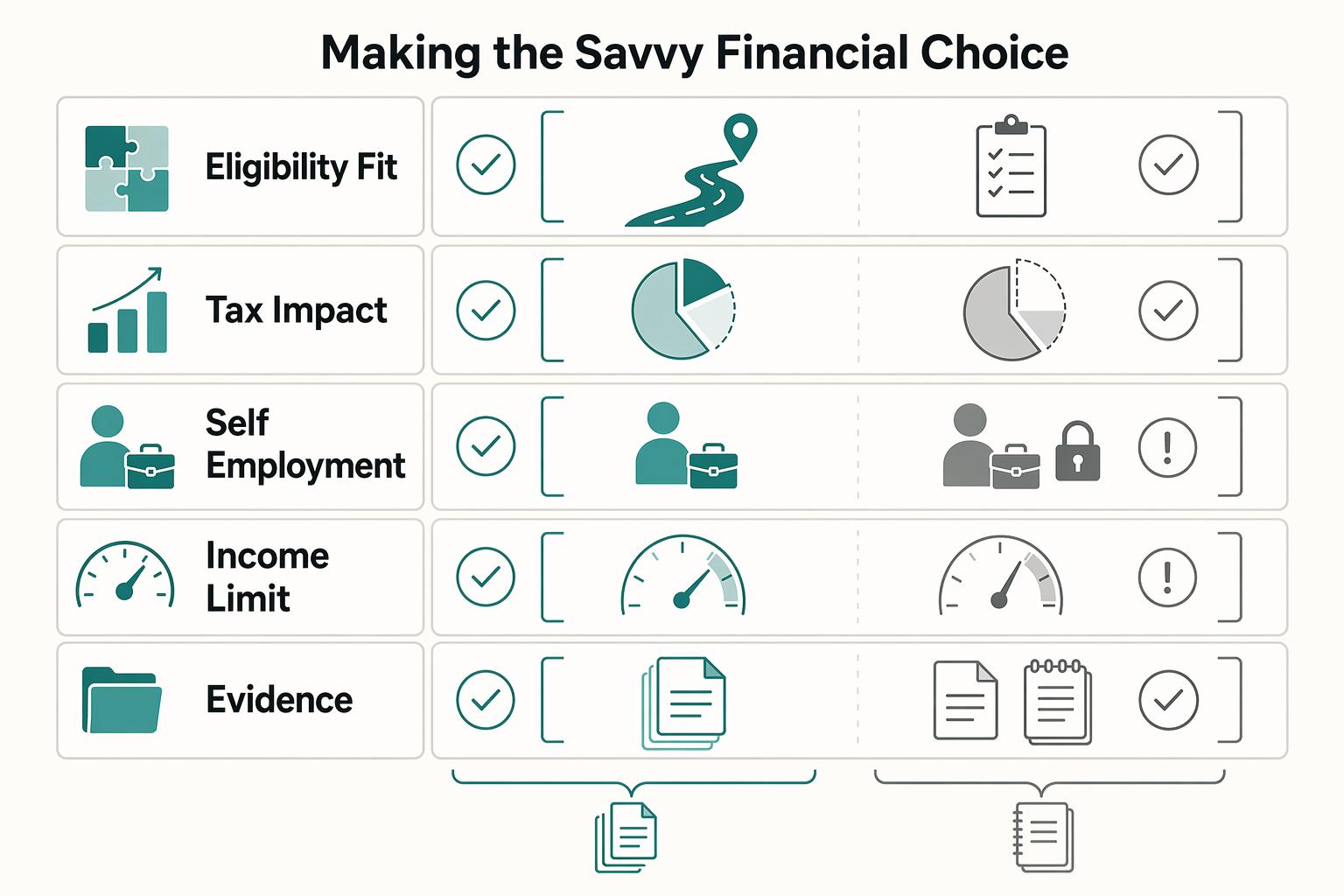
| Decision factor | LLC path | Schedule C path |
|---|---|---|
| Tax effect | Direct income-tax credit; nonrefundable; up to $2,000 per return | Reduces net business profit, which can affect income tax and potentially Schedule SE tax |
| Main forms | Form 8863 with Form 1040 | Schedule C, with possible Schedule SE impact |
| Key eligibility check | Eligible student + eligible institution support; Form 1098-T received unless an instructions-based exception applies | Education maintains or improves skills in your present work and does not qualify you for a new trade or business |
| Documentation burden | Form 1098-T and records supporting the Form 8863 claim | Records showing the expense and its current-work purpose |
| Common disqualifier | Current-year Form 8863 limits/rules not verified (2025 instructions list $180,000 MFJ / $90,000 single-type statuses; verify filing-year rules) | Education qualifies you for a new trade/business, or does not maintain/improve skills needed in your present work |
| Often stronger when | You qualify and can actually use the nonrefundable credit | You have Schedule C profit and the deduction meaningfully changes income-tax and SE-tax exposure |
If your total net self-employment earnings from all businesses are $400 or more, include Schedule SE in your comparison. Self-employment tax is generally figured on 92.35% of net earnings, so deduction-path math is incomplete if you ignore Schedule SE.
Run the scenarios in order#
Run the comparison in a fixed sequence so one scenario does not bleed into the other:
- Build a baseline return with the education expense removed.
- Scenario A: apply the expense only through Form 8863 (credit path), including 1098-T support unless an instructions-based exception applies.
- Scenario B: reset to the same baseline and apply the expense only on Schedule C (deduction path), with records showing current-work skill maintenance/improvement and no new-trade qualification.
- Compare final total federal tax for each scenario, not a single line item.
- Lock one treatment and add a dated rationale note to your file with the supporting records.
For 2026-forward credit claims, include the Pub. 970 SSN requirement check in your credit-path file review.
Pause and escalate when inputs are messy#
This step breaks down when the inputs are messy. Stop and escalate if charges are bundled, eligibility is mixed, or filing constraints are still unresolved. Do not split bundled invoices by guesswork. Get itemized support or keep the item parked.
If you still file in a state, run a separate state check before finalizing. Then review Do I Have to Pay State Taxes While Living Abroad as a Digital Nomad?. If you want a deeper dive, read our guide to a defensible 2026 filing plan.
Step 3: Pressure-test your documentation before you file#
Before filing, use your documentation folder to pressure-test your choice. This is a workflow control, not legal guidance.
Use the folder as a readiness gate#
If you use a one-folder-per-expense workflow, treat it as a go/no-go check before filing. A ready folder should answer these questions quickly:
- What was purchased
- Who sold it, when, and for how much
- How payment matches the charge
- Which treatment you applied
- Why the competing treatment was not used
If any answer is still in your head instead of in the file, mark it not ready.
Keep shared core and path-specific records separate#
Separate the basic purchase file from the treatment file so you can see what is missing at a glance.
| Artifact | Type | What it should show | Status |
|---|---|---|---|
| Purchase context | Shared core | What the product/service was at purchase time | present / missing / needs review |
| Itemized invoice or receipt | Shared core | Provider, item, amount, and date in a labeled record | present / missing / needs review |
| Payment proof | Shared core | Bank/card/processor record that matches the charge | present / missing / needs review |
| Treatment rationale note | Shared core | What you chose, what you did not choose, and why | present / missing / needs review |
| Return workpapers (if applicable) | Path-specific | How the expense ties to your own filing records | present / missing / needs review |
| Guidance copies used (if applicable) | Path-specific | The material you relied on, saved with access date if digital | present / missing / needs review |
Use the status field as the gate:
present: record exists and matchesmissing: stop and obtain itneeds review: incomplete, bundled, inconsistent, or unclear
Make each artifact audit-usable#
Clarity matters more than volume. Prefer labeled records over ambiguous strings. For example, a record like 000102220201/28/2019541430Graphic Design Services may include a date-like value (01/28/2019) and a code (541430), but without defined fields it is hard to interpret reliably. If a document is unclear, replace it with clearer support or add enough context to make it understandable.
Keep a short decision memo in the folder#
A short memo is usually enough if it is specific. Use this template:
- What I bought
- Date purchased
- Provider
- Amount paid
- Chosen treatment
- Competing treatment not used
- Why this choice was made
- Where each supporting document is stored
Escalate unresolved risk before filing#
Consider professional review if any of these remain unresolved:
- Missing invoice or payment mismatch
- Bundled charges with unclear breakout
- Unclear purchase context
- Weak source trail (including unlabeled or hard-to-interpret records)
- Rationale note cannot clearly explain the chosen vs. unchosen path
You might also find this useful: TDS for Indian Freelancers Who Want Cleaner Tax Credit Records.
If you still have unresolved filing questions, pause and talk through your setup with Gruv before filing.
The Final Verdict: From Tax Chore to Strategic Investment#
The throughline is simple: verify eligibility facts first, compare both treatments from one baseline return second, then apply your chosen treatment consistently in your return and support file.
For the credit path, the main tradeoff is clear. The Lifetime Learning Credit is nonrefundable, so it can only reduce tax you otherwise owe. Schedule C treatment follows separate deduction-side rules, so compare both paths on the same return before you decide. Verify the current filing-year limits before you rely on them.
| Path | When you choose it | What you must have on file | What blocks filing |
|---|---|---|---|
| Credit | You can confirm the student is you, your spouse, or a dependent on the return, the courses were at an eligible educational institution, and this path gives the better result in your comparison | Itemized invoice, payment proof, Form 1098-T status, Form 8863 support, and a short note showing how you verified student and institution eligibility | No Form 1098-T status check, unclear institution eligibility, or Form 8863 support not ready for a credit claim |
| Schedule C deduction | Your deduction-side support is documented and your comparison shows this path is better | Itemized invoice, payment proof, Schedule C entry support, and documentation that explains what was purchased and how it connects to your current work | Unclear support for your deduction position, bundled charges without a breakout, or unclear provider records |
| Unconfirmed | Facts are mixed, missing, or conflicting | Core purchase records, comparison workpapers, and an unresolved-issues memo | Any missing baseline document or a classification decision you cannot explain in one paragraph |
Before you file, use these action checks:
- Credit path: confirm eligible educational institution status, verify Form 1098-T status, prepare Form 8863 support, and treat Box 1 as an input checkpoint rather than an automatic claim amount.
- Deduction path: document your rationale, tie entries to Schedule C support, and save the course description or provider page that shows what you actually bought.
For filing discipline, keep your records consistent with the treatment you choose. If a charge still looks plausible both ways, or your facts cross state or country lines, pause and escalate before filing. For a deeper deduction-side walkthrough, see Can I Deduct Education and Professional Development Costs?.
Frequently Asked Questions
What is your first credit-path check?
Verify the student and institution before you run any tax comparison. For the credit path, the student must be you, your spouse if filing jointly, or a dependent on your return. That student must also be enrolled at an eligible educational institution. If institution status is unclear, pause and confirm eligibility first.
Do job-skills courses or online classes qualify for the credit?
Start with institution eligibility. Job-skills or online content may qualify for the credit only when an eligible student takes it at an eligible educational institution. If you cannot confirm school status, treat the item as unconfirmed until you can.
What paperwork matters most on the credit path?
Document Form 1098-T status early and keep Form 8863 support ready. IRS instructions generally require Form 1098-T for the credit, with limited exceptions. If you should have received one but did not, request it after January 31, 2026 and before you file. Keep your records aligned to Form 8863, and verify current-year MAGI thresholds before you rely on them.
What is your first Schedule C deduction check?
Classify the education against your current work before you deduct anything. For self-employment, education is deductible on Schedule C (Form 1040) only when it maintains or improves skills needed in your present work, or is required to keep that work. Keep the course description and a short memo tying the purchase to the services you currently provide.
What is the main deduction-path red flag?
Escalate any program that appears to qualify you for a new trade or business. That is the core disqualifier for the work-related education deduction rule, even if the training could still help your career.
What if you took the course during a slow period?
Document why your line of work stayed the same. A slow period alone does not establish eligibility, but weak records about your present-work connection can create filing risk.
What if one expense seems to fit both paths?
Compare both treatments from one baseline return, then lock one treatment per expense. You cannot reuse the same expense for both an education credit and another deduction, credit, or education benefit. Keep one consistent story across your return and support file.
When should you stop and verify before filing?
Pause when Form 1098-T status is unresolved, institution eligibility is uncertain, the present-work connection is weak, or the program may qualify you for a new trade or business. Also escalate when cross-border facts or institution records are unclear. | Your trigger | What to verify | When to pause | | --- | --- | --- | | Credit path | Eligible student, eligible educational institution, Form 1098-T status, Form 8863 support, payment records, current-year MAGI threshold after verification | 1098-T status unresolved, institution status unclear, or the same expense is also tagged for another education tax benefit | | Schedule C path | Present-work skills connection, Schedule C (Form 1040) support, invoice, payment proof, course description | Possible new-trade qualification or a weak link to your current services | | Unconfirmed | Baseline comparison, missing facts, institution records, dated rationale note | Any fact you cannot explain clearly and consistently before filing | After you choose one treatment per expense, keep your next filing cycle cleaner by centralizing invoicing, payment tracking, and records where supported with Gruv for freelancers.
Try a related tool
Researched and edited by the Gruv editorial team. Gruv builds cross-border billing, payouts, and finance-operations software for global businesses.
Sources
- gao.gov/assets/a318745.htmltrusted
- irs.gov/credits-deductions/individuals/llctrusted
- irs.gov/credits-deductions/individuals/education-cre...trusted
- mn.gov/admin/osp/search/xml-vmpcodes.jsptrusted
- mn.gov/deed/newscenter/publications/trends/septembe...trusted
- tdhca.texas.gov/sites/default/files/pmcdocs/25-MFC-IncomeDet...trusted
- waketech.edu/programs-courses/non-credit/personal-enrichmenttrusted
Educational content only. Not legal, tax, or financial advice.
Related Posts

Digital Nomad Taxes in 2026 With a Defensible Filing Plan
With digital nomad taxes, the first move is not optimization. It is figuring out where you may be taxable, where filings may be required, and what proof supports that position.

Do I Have to Pay State Taxes While Living Abroad as a Digital Nomad?
Living abroad does not end `state income tax` exposure by itself. The first decision is practical: choose a filing position your facts can support, then build records that support the same story all year.
Can I Deduct Education and Professional Development Costs?
Start with this filter: as a freelancer, treat education as deductible only when it is an ordinary and necessary business expense that [maintains or improves skills](https://www.irs.gov/taxtopics/tc513) you already use in your current work, or is required to keep your current status or pay. If you cannot clearly connect it to your present trade or business, do not deduct it yet.