
Quick Answer
The K-1 fiancé(e) visa process starts when the U.S. citizen files Form I-129F, then moves through Department of State consular processing, U.S. entry if the visa is issued, marriage within 90 days of admission, and Adjustment of Status after marriage. Petition approval is not travel permission, a visa does not guarantee admission, and the path works only for a foreign fiancé(e) of a U.S. citizen.
Start here with the K-1 timeline and your decision checkpoints#
Think of the K-1 path as a series of gates, not a single application. The order is Form I-129F with USCIS, DOS visa processing, U.S. entry if a K-1 nonimmigrant visa is issued, marriage within 90 days of admission, and then Adjustment of Status toward a Green Card.
That order matters because each handoff changes timing and risk. The K-1 route runs through USCIS, DOS, and CBP, and approval at one stage does not finish the next. Form I-129F approval is not travel permission. It does not guarantee visa issuance, and a K-1 visa does not guarantee admission at the port of entry.
The full arc in plain terms#
The first filing is Form I-129F (Petition for Alien Fiance(e)) by the U.S. citizen petitioner. If USCIS approves it, the case moves to the National Visa Center (NVC), which issues a case number and forwards the petition to the embassy or consulate.
At the consular stage, the foreign fiancé(e) applies for the actual visa. DOS runs background checks, including fingerprints, and the interview requires documents such as relationship proof and medical exam proof. If issued, the K-1 visa is valid for no more than 6 months and for a single entry.
After entry, the rule is simple and strict: marry the same U.S. citizen petitioner within 90 days. If you do not marry within that window, the foreign national must leave the United States or face possible deportation. After marriage, apply for Adjustment of Status to seek permanent residence.
Who this guide is for. This guide is for people planning a real move while trying to keep the rest of life stable, especially remote professionals juggling paperwork, travel timing, housing, and life logistics. The goal is practical: give you the right order of operations, the checkpoints that matter, and a clear way to react when timing slips.
The checkpoints that matter most.
- Filing checkpoint: Before you submit
Form I-129F, make sure your evidence packet is complete and consistent. Names, dates, and relationship details should align across documents. - Handoff checkpoint: After USCIS approval, confirm your NVC case details for the
DOSphase. Do not treat petition approval as travel clearance. - Interview checkpoint: Prepare relationship and medical documentation before you count on your interview timing holding.
- Post-entry checkpoint: Once admitted, plan around the fixed
90-daymarriage window, then move toAdjustment of Status.
Fees and exact processing times are not covered here, so recheck official USCIS and DOS pages when you file and at each handoff. If your timeline slips, pause irreversible plans, refresh your document set, and make decisions based on your current confirmed stage. For a related planning angle, see Can My Foreign Spouse Live with Me in the US on an E-2 Visa?.
Understand what the K-1 visa is and what it is not#
The K-1 nonimmigrant visa is a fiancé(e)-only route for a foreign fiancé(e) of a U.S. citizen. It is not a spouse path, and it is not permanent residence by itself.
What the K-1 actually does#
The path is specific:
- The U.S. citizen files Form I-129F (Petition for Alien Fiance(e)).
- If a K-1 visa is issued and the fiancé(e) is admitted, the couple must marry in the United States within 90 days.
- After marriage, the next step is Adjustment of Status to seek Lawful Permanent Resident status.
This category does not skip the later green card filing, and the 90-day period is a real deadline, not a planning suggestion.
What it is not#
This route is not the right fit if you are already married, plan to marry outside the United States, or your fiancé(e) is already legally residing in the United States.
Keep the stages separate. USCIS approval of Form I-129F does not guarantee visa issuance by the Department of State, and a K-1 visa does not guarantee admission at the port of entry. Before you make travel or move commitments, confirm your actual stage.
Confirm eligibility before you spend time or money#
Do a real go or no-go check before you pay fees or assemble a full packet. If you cannot explain, in one clear sentence, why your case fits the K-1 nonimmigrant visa path, pause before filing Form I-129F (Petition for Alien Fiance(e)).
Start with sponsor and relationship category#
This route is for someone engaged to a U.S. citizen, and the U.S. citizen starts the process by filing Form I-129F. The sequence matters. Only after petition approval does the fiancé(e) move to the K-1 visa application stage.
If your facts now fit a spouse case, treat that as a route change, not a paperwork detail. USCIS lists K-3/K-4 as separate spouse-related categories tied to a pending Form I-130, not alternate names for a fiancé(e) case.
Check your plan against the K-1 sequence#
A K-1 case is built around one basic flow: enter the United States, marry within 90 days, then apply for Adjustment of Status if you want permanent residence. If your real plan does not match that sequence, stop and verify the correct path before filing.
Build a basic proof file before deciding#
Before you commit, make sure your core facts are easy to document:
- identity records for both people
- relationship evidence showing a real engagement
- financial support evidence requested in the eligibility documentation
- planned marriage timing that fits the 90-day window after arrival
Also confirm the filing basics before you mail anything. Use the current acceptable form edition. USCIS currently shows 01/20/25 for I-129F. Do not mix pages from different editions, verify the fee on the USCIS Fee Schedule page, and file at the USCIS Dallas lockbox.
Use one decision rule: if every gate is clearly yes, proceed with I-129F preparation. If any gate is uncertain, pause and verify with current USCIS guidance before you file. This pairs well with our guide on How to Adjust Status from a K-1 Visa to a Green Card.
Build your document packet before filing Form I-129F#
Build and verify your packet before you finalize Form I-129F. The easiest way to cut preventable filing problems is to make sure key details on the form line up with the records in your packet and that every page passes USCIS edition checks. Treat this as a working packet organizer, not an official exhaustive USCIS evidence list.
| Packet category | What to gather now | What to cross-check before filing |
|---|---|---|
| Identity records | Identity records for both people that support names, dates of birth, citizenship, and other biographic details entered on Form I-129F | Confirm spellings, prior names, and birth dates are consistent across records and the form. Use one legal name format consistently. |
| Relationship timeline records | Date-labeled records you plan to use to explain your relationship timeline and intent to marry in the United States | Make sure your timeline is coherent across messages, travel records, and intent statements, with no obvious contradictions or unexplained gaps. |
| Prior-marriage records (if applicable) | Records showing any prior marriage ended, if either person was previously married | Verify each prior marriage mentioned in the packet has a matching termination record and aligned names. |
| Child records for K-2 cases (if applicable) | Records identifying each child included in a K-2 case | Check each child's name and date of birth are consistent everywhere the child appears in the packet. |
Quality beats volume. More evidence is not always better. Organized, date-labeled evidence is usually more useful than a large unstructured stack. Focus on continuity over quantity so the relationship history and intent to marry are easy to follow.
Verify the packet mechanically before mailing#
Do one final page-level review before filing:
- Confirm every submitted form is the current acceptable edition on the live USCIS page.
- For Form I-129F, the current edition is 01/20/25, but recheck at filing time.
- Do not mix pages from different editions. USCIS may reject the filing.
- Make sure the edition date and page numbers are visible at the bottom of all pages.
- Confirm the current filing fee on the USCIS Fee Schedule page.
- File
Form I-129Fat the USCIS Dallas lockbox and verify accepted payment methods at filing time.
If you find a mismatch you cannot explain in one sentence, pause and fix it before you file.
File correctly so USCIS does not reject your package#
Mechanical accuracy matters as much as substance here. An otherwise strong Form I-129F package can still be rejected for avoidable filing errors, so do one last compliance check before mailing. Use only the current acceptable edition, do not mix pages from different editions, and make sure the edition date and page numbers are visible on every page. If you see 01/20/25, treat it as a checkpoint and reverify on the USCIS I-129F page right before you send.
Use the right lockbox address#
File at the USCIS Dallas lockbox, using the address that matches your delivery method. USCIS also states this form is not adjudicated at international offices.
| Delivery method | Address for Form I-129F |
|---|---|
| USPS | P.O. Box 660151, Dallas, TX 75266-0151 |
| FedEx, UPS, DHL | 2501 South State Highway 121 Business, Suite 400, Lewisville, TX 75067-8003 |
Confirm fee and payment the same day#
Check the current I-129F fee on the Fee Schedule page the day you finalize the package, since an incorrect or incomplete fee can cause rejection. For mailed filings paid by card, USCIS says you can use Form G-1450.
Before sealing the envelope, run this quick pre-send check:
- confirm all required signatures are present
- confirm the form edition date and page numbers are visible, and that pages are not mixed across editions
- confirm the lockbox address matches your delivery method
- confirm your payment setup matches current USCIS fee guidance
If anything looks inconsistent, fix it before mailing.
Navigate the handoff from USCIS to consular processing#
USCIS approval is a handoff, not the finish line. The consular stage with the U.S. Department of State still comes after it, and petition approval does not mean visa issuance.
USCIS frames the early checkpoints as determining your basis to immigrate, filing the immigrant petition, and waiting for a petition decision. If the person is already in the United States, USCIS describes adjustment of status as the in-country path instead of consular processing.
Treat this phase as prep time, not a completed milestone. USCIS handles the petition decision, and consular processing happens through a U.S. consulate abroad, so more steps and outcomes still come later.
Treat the waiting period as prep time#
Use this gap to get ready for the consular stage instead of just waiting. Keep your petition record and related documents organized, and make sure core details stay consistent across everything.
Focus on a few consistency checks:
- names and biographic details matching across records
- dates aligning across petition materials and related documents
- a complete copy of what was already filed for reference
Do not make irreversible moves too early. Keep major life decisions flexible until the consular side is moving and your next steps are clearer. Avoid locking in nonrefundable travel, lease exits, shipping, or job transitions based only on petition approval or online timeline averages.
Use official channels, not internet averages#
For status and next actions, rely on official sources first: USCIS for the petition record, then Department of State and consulate instructions for consular processing. USCIS also advises checking with the consulate before submitting a petition.
If local consulate instructions are available, use them as your operating checklist and recheck before acting. That is a clearer basis for decisions than planning around someone else's timeline. Related reading: A Guide to Getting a Long-Stay Visa in France.
Prepare for interview and pre-travel logistics without creating new risk#
Once the case reaches this stage, consistency is your main safeguard. Consular review can evaluate identity and eligibility together, so the goal is a clean file and a travel plan that can absorb delays without creating avoidable cost.
Build the interview file around four categories#
Use one organized packet with four lanes:
- Identity records: names, dates, and other biographic details should match across documents, since K visa screening uses biographical, biometric, and photographic data.
- Relationship evidence: include clear proof such as photos, chat records, travel receipts, and affidavits, organized by timeline and relevance.
- Medical and interview readiness: follow your embassy or consulate instructions and keep appointment materials together so nothing is missed.
- Child documentation for K-2 visa cases: if a child is applying under a K-2 visa, keep that child's records aligned with the principal file so names, dates, and relationships are consistent.
Treat your filed petition as the master record. Keep interview materials aligned with it.
Do a credibility check before the interview#
Before interview day, compare what you plan to say with what appears in your filed petition and supporting documents. Key identity and relationship timeline details should line up. Unexplained differences can create avoidable questions.
Also run a completeness check. Missing or incomplete records can stop progress and may trigger additional requests or delays. Confirm every required form is signed, dated, and complete, and keep a full copy of your original filing for reference.
If an application is treated as suspect, consular posts can send it for additional interagency review. You cannot control that step, but you can reduce avoidable friction by keeping identity and relationship evidence coherent from the start.
Plan relocation like the date may move. Assume timing can shift, and plan housing, remote-work continuity, and cash runway accordingly. Keep housing commitments flexible where possible, avoid nonrefundable moves before visa issuance, and make sure your work setup can handle a changed travel window.
Keep enough cash buffer for duplicated housing, rebooking, and longer handoff periods. If your evidence quality feels borderline, delay optional travel spending. Keep backup documentation organized in one place, with both digital scans and a physical core set for identity, relationship timeline, and any K-2 child file. You might also find this useful: How to Prepare for the US Citizenship Test (Naturalization Test).
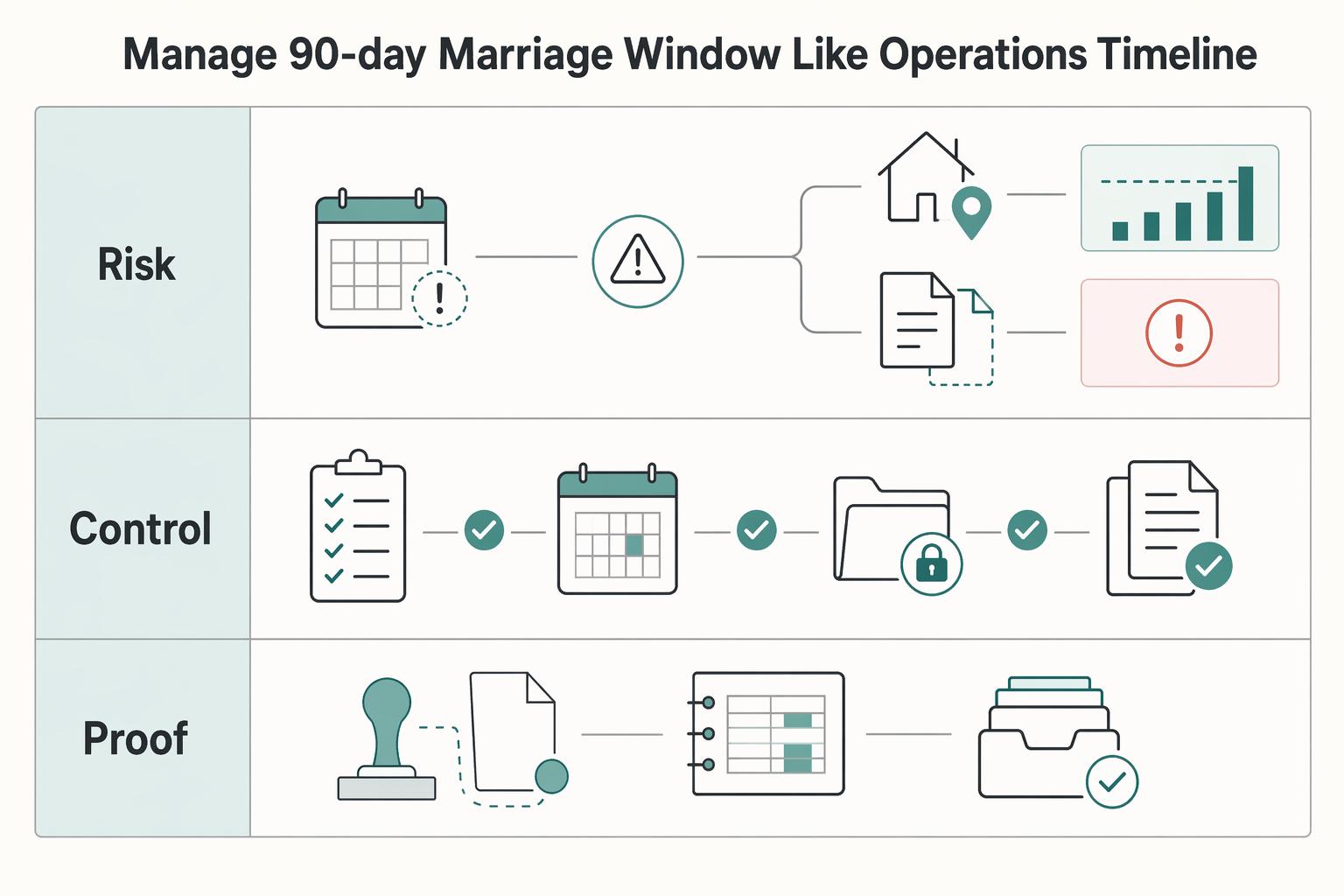
Manage the 90-day marriage window like an operations timeline#
After entry, your priorities change quickly. Your non-negotiable is simple: complete the legal marriage within 90 days of U.S. admission and track the paperwork as you go. The K-1 nonimmigrant visa is tied to that window, not an open-ended stay path.
Use the admission date as day zero. Do not count from visa issuance or the date on the visa foil. Confirm the date on your I-94 arrival record, save it, and calendar the 90-day deadline immediately.
| Day range after admission | Priority action | Legal/civil checkpoint | Keep for later immigration paperwork |
|---|---|---|---|
| Day 0 to 7 | Confirm admission date and mark day 90. | Verify your local marriage process and required records. | I-94 copy, entry record backup, scheduling confirmations |
| Day 8 to 30 | Collect required marriage documents and schedule the legal step. | Confirm where and how the legal marriage is completed in your location. | Application or booking records, ID copies used, official instructions |
| Day 31 to 60 | Complete the legal marriage as early as practical. | Keep legal marriage timing separate from optional celebration planning. | Marriage paperwork, clerk or officiant records, payment receipts |
| Day 61 to 90 | Use only as contingency buffer. | Reconfirm legal completion and certificate issuance timing. | Certified marriage certificate when available, organized digital and physical file |
Treat document continuity as part of risk control. Keep names, dates, and biographic details consistent across your petition records, entry record, and marriage record, and resolve any errors as soon as they appear.
If marriage cannot realistically happen within the 90-day window, get immigration legal advice immediately. Do not wait for a last-minute administrative fix. Missing the deadline can have serious consequences. Related: 183-Day Rule Explained: Stop the Tax Myths Before They Cost You.
Handle delays, denials, and plan changes with clear next moves#
When your case hits trouble, identify the problem type first, then act. Filing defects, evidence gaps, timeline slippage, denials, and relationship-plan changes call for different next moves.
Start with the failure mode, not the emotion#
For Form I-129F, a common delay pattern is package quality. Missing paperwork is a frequent delay driver, and missing or incomplete records often trigger a Request for Evidence (RFE). Even one missing page can stop progress and add weeks or months.
Make your first checkpoint mechanical. Pull your filed copy and verify every form is signed, dated, and fully completed, with all required pages present.
If X happens, do Y#
| Situation | Immediate move | Grounded note |
|---|---|---|
| Package rejected for a filing defect | Use the notice to correct the specific defect before you refile | Filing defects call for a different next move than evidence gaps, denials, and plan changes |
| Request for Evidence (RFE) | Respond directly and completely with organized evidence that matches what is already in the record | Missing or incomplete records often trigger an RFE |
| Denial | Review the notice carefully and base next steps on what that notice says for your case | Next steps depend on the notice language for your case |
| Timing slips | Treat downstream plans as movable | Processing pauses can disrupt weddings, job start dates, school terms, and family reunification timing |
| Relationship plan changed | Reassess category fit before taking the next filing step | Plan changes can affect category fit |
Do not base decisions on older excerpts alone. USCIS identifies the USCIS Policy Manual as its centralized policy source and says to verify older Adjudicator's Field Manual material against newer policy resources. USCIS also states parts of AFM Chapter 21.1 were partially superseded as of August 1, 2025, and AFM 21.3 (spouse petition) was superseded as of October 17, 2025.
Treat overstay and status questions as case-specific. If timing issues arise, rely on the language in your USCIS notice and get qualified immigration legal advice before acting.
Cover children and adjacent visa paths without confusing the reader#
Treat K categories as separate lanes. K-1 nonimmigrant visa is the fiancé(e) path, K-2 visa is for a child in that path, and K-3 visa and K-4 visa belong in the spouse-based context.
| Category | Who it covers | Filing anchor | Checkpoint that matters |
|---|---|---|---|
K-1 nonimmigrant visa | Fiancé(e) of a U.S. citizen | Form I-129F | Intent to marry within 90 days after admission |
K-2 visa | Child of a K-1 beneficiary | No separate petition required to classify the child as a K nonimmigrant | Child must be unmarried, under 21, and may accompany or follow to join |
K-3 visa | Spouse of a U.S. citizen | Form I-129F in the spouse context | Spouse-based category, not fiancé(e)-based |
K-4 visa | Child of a K-3 beneficiary | No separate petition required to classify the child as a K nonimmigrant | Adjustment has added age and Form I-130 checkpoints |
When K-2 is relevant#
K-2 matters when the principal case is K-1 and there is a qualifying child. A child of a K-1 or K-3 nonimmigrant may apply if the child is unmarried and under 21, and no separate petition is required to classify the child as a K nonimmigrant.
Set up practical document control early. Keep the child's and principal applicant's records organized and consistent across forms and supporting records. This is a process tip, not a special rule from the form instructions.
If marital status changes before issuance#
If marital status changes before visa issuance, reassess the route based on category fit. K-1 is for a fiancé(e), while K-3 and K-4 are spouse-context categories.
For K-4, adjustment eligibility includes specific checkpoints. The child must have been under 18 when the petitioner and the K-3 parent married, and Form I-130 must be filed on the K-4's behalf before the K-4 reaches 21. If those facts apply, recheck category fit before moving forward.
Plan the post-marriage transition to permanent residence#
After marriage, the next move is Adjustment of Status. The key filing is Form I-485.
In this K-1 path, USCIS ties adjustment to marriage to the original U.S. citizen petitioner, and you must be physically present in the United States when Form I-485 is filed. Once the marriage occurs, you are treated as an immediate relative in this process.
Get the order right#
- Confirm the marriage occurred within
90 daysafter K-1 admission. - Build the packet from the current
Form I-485instructions, since USCIS directs applicants to review those instructions before applying. - Properly file
Form I-485while physically present in the United States.
Before submission, run a final consistency check against the current Form I-485 instructions.
Treat work and address admin as case planning, not side tasks#
If you work remotely, plan this period as an admin-heavy transition. Do not build your work plan around assumptions about authorization timing after filing Form I-485. Set expectations with your employer or clients early.
If your address changes while the case is pending, follow current USCIS update guidance and keep confirmation records. Keep organized copies of your filing materials and USCIS notices so you can respond quickly if questions come up.
Know the hard boundary. If the K-1 beneficiary does not marry the U.S. citizen petitioner, USCIS says they generally cannot adjust through another Green Card eligibility category from that K-1 path. If marriage does not occur within 90 days after admission, the person must leave the United States or face possible deportation risk.
Rules and filing details can change, so confirm the current Form I-485 instructions and current official USCIS guidance before you submit.
Use this timeline to move forward with fewer surprises#
If you want fewer surprises, treat the process as four checkpoints: eligibility first, evidence packet second, filing accuracy third, then timeline control after entry. At each checkpoint, the standard is the same: prove it in writing now, not later.
Start with a real go or no-go check#
Before you file Form I-129F, confirm the core facts are true and easy to document. For fiancé(e)-based filing, the petitioner must be a U.S. citizen; both people must be legally free to marry; both must intend to marry within 90 days of admission; and the couple must have met in person within the last two years unless a listed exception applies.
| Eligibility point | Article says | Proof focus |
|---|---|---|
| Petitioner status | The petitioner must be a U.S. citizen | Records for U.S. citizenship |
| Marital status | Both people must be legally free to marry | Records for legal freedom to marry |
| Marriage plan | Both must intend to marry within 90 days of admission | Intent-to-marry evidence and planned marriage timing |
| In-person meeting | The couple must have met in person within the last two years unless a listed exception applies | Qualifying in-person meeting history |
If any point is unclear, pause and resolve it before filing.
Build proof that matches each checkpoint. Build your packet to answer eligibility questions directly, not as a general relationship archive. Keep evidence organized for citizenship, legal freedom to marry, the in-person meeting requirement, and any child who will need K-2 classification.
A practical checklist:
- Eligibility proof: records for U.S. citizenship, legal freedom to marry, and qualifying in-person meeting history
- Form consistency: names, dates, and prior marital history that match what you enter on Form I-129F
- Child records, if relevant: identity and relationship records tied clearly to the principal case, since USCIS states no separate petition is required to classify the child
- Retention set: one complete copy of everything submitted, plus an organized file for post-entry steps
File carefully, then recheck before each handoff#
Filing accuracy is a hard checkpoint. USCIS states that missing or invalid signatures lead to rejection, so signatures and current instructions are non-negotiable.
Use current USCIS materials when you file. The instruction set referenced here is Form I-129F Instructions 01/20/25, and if older USCIS resources conflict, the USCIS Policy Manual controls.
After entry, the priority changes. K-1 admission is tied to marriage within 90 days, then the couple can pursue Adjustment of Status.
Prepare marriage logistics and record-keeping before travel, not after arrival. Keep marriage records, entry records, and your full petition copy organized for the next filing stage.
Build your document checklist and date plan now. Then verify current USCIS and DOS requirements right before filing and again before each later step. When you are ready to align relocation timelines with cross-border money operations, contact Gruv to confirm coverage and workflow fit for your market.
Frequently Asked Questions
What is the K-1 fiancé visa process in plain steps?
The U.S. citizen files Form I-129F, USCIS decides the petition, and the case then moves through consular visa processing. If the visa is issued and the beneficiary is admitted, the couple must marry within 90 days and then pursue Adjustment of Status. Petition approval alone does not authorize travel, and a visa does not guarantee admission.
Who qualifies for a K-1 visa?
The petitioner must be a U.S. citizen, both people must be legally free to marry, and both must intend to marry within 90 days of admission. The article also says the couple generally must have met in person during the 2 years before filing. If any of those points are unclear, resolve them before filing.
What form starts the K-1 process?
Form I-129F starts the process. The article says to file it at the USCIS Dallas lockbox and to confirm you are using the current edition shown on the USCIS page before mailing. Keep one complete and consistent form set.
How long do we have to marry after entering the U.S.?
You have 90 days from admission on a K-1 nonimmigrant visa to marry. Count from the admission date, not from visa issuance, and use the I-94 as the key record. This timeline is fixed, so plan around it from day one.
Can a K-1 visa be extended?
No. The 90-day admission period cannot be extended. The article also says a K-1 visa, once issued, is valid for no more than 6 months and for a single U.S. entry.
What happens if we do not marry in time?
The K-1 path is tied to marrying the same U.S. citizen petitioner within 90 days. If marriage does not happen within that window, the person must leave the United States or face possible deportation risk. The article advises getting immigration legal advice immediately if marriage cannot realistically happen in time.
Can children come with a K-1 applicant?
Yes. Eligible children may come through the K-2 category, and the article says no separate petition is required to classify the child as a K nonimmigrant. Keep each child's records consistent with the principal case across the petition and later processing.
Researched and edited by the Gruv editorial team. Gruv builds cross-border billing, payouts, and finance-operations software for global businesses.
Sources
- br.usembassy.gov/visa-for-fiancee-of-u-s-citizen-k-1-and-mino...trusted
- congress.gov/crs_external_products/R/PDF/R44310/R44310.6.pdftrusted
- congress.gov/event/119th-congress/house-event/118426/texttrusted
- federalregister.gov/documents/2025/11/03/2025-19747/collection-a...trusted
- govinfo.gov/content/pkg/CFR-2023-title8-vol1/pdf/CFR-202...trusted
- travel.state.gov/content/travel/en/us-visas/immigrate/family-...trusted
- travel.state.gov/content/dam/visas/K1/LGS_Lagos.pdftrusted
- usa.gov/fiance-visatrusted
Educational content only. Not legal, tax, or financial advice.
Related Posts

The 2026 Global Digital Nomad Visa Index for 50+ Countries
Start with legal fit, not lifestyle filters. The practical order is simple: choose a route you can actually document, then decide where you want to live. That single change cuts a lot of wasted comparison work and stops you from falling in love with places that were never a real filing option.

183-Day Rule Tax Myths That Trigger Residency Filing Mistakes
If you are a mobile freelancer or consultant, start here: the "183 day rule tax" idea is not a single universal test. It is a shortcut phrase people use for different residency rules that do not ask the same question. If you mix federal and non-federal residency logic, you can create filing risk even when your travel calendar looks clean.
How to Prepare for the US Citizenship Test (Naturalization Test)
You have already handled complicated, high-stakes processes. Treat your Application for Naturalization the same way. This is not a test you cram for at the last minute. It is a compliance process that rewards accuracy, consistency, and calm execution.