
Quick Answer
File Form 911 only after you have used the IRS notice or account-response path and can prove those attempts. The strongest TAS request asks for one defined relief action, then attaches a dated timeline, exact notice and response copies, and delivery or upload confirmation. If your file still cannot show what was filed, what was sent, and what remains unresolved in order, rebuild that tax-year record first and escalate after the sequence is documentable.
Sort your case into one lane: Prevent, Respond, or Escalate#
Start by putting your case in one lane before you do anything else. If your records are incomplete, you are in Prevent. If you have a live IRS notice with a deadline, you are in Respond. If you already used normal IRS channels and can now document hardship or an IRS process failure, you are in Escalate.
That first sort matters more than most people think. A lot of tax stress is not really about complexity. It is about sequence. People try to escalate before they can document what happened. Or they keep sending notice responses when the real problem is that they cannot prove what was filed, paid, or mailed in the first place. Once that happens, you spend time writing explanations when what is missing is a clean record.
Most avoidable mistakes come from mixing lanes. Escalation fails when the real problem is a documentation gap, and notice responses fail when the proof is scattered. If you are not sure where you are, use the simplest test available: what is the immediate bottleneck right now? If the bottleneck is your own file, you are in Prevent. If the bottleneck is a specific notice with a due date and stated response path, you are in Respond. If the bottleneck is that you already used the stated path and the matter is still unresolved despite documented attempts, you are in Escalate.
The lanes are not labels for you. They are labels for your next move. You can move from one lane to another over time, but you should not act as if you are in all three at once. The same tax year may start in Prevent, move into Respond when a notice arrives, and only later become an Escalate case if the normal process stalls. That is normal. What causes trouble is skipping the step your file actually requires.
| Lane | You are here when | Best next move |
|---|---|---|
| Prevent | Filing history or support records are scattered | Build one complete tax-year file before the next notice |
| Respond | You have a notice, deadline, or active account issue with a stated response path | Send a tracked response packet through the required channel |
| Escalate | You already tried normal IRS channels, the issue is unresolved, and hardship or process failure is documentable | File Form 911 with one specific relief request tied to proof |
Use that table as a triage tool. When you sit down to work the issue, pick the row that matches the evidence you actually have on hand. If your file does not yet support the lane you want, fix the file first. That is not delay. That is how you stop making the same problem more expensive.
Prevent#
Your first defense is a verifiable file, not a longer explanation. For each tax year, keep the filed return, supporting records, filing proof, payment proof, and then IRS notices and your responses in date order.
| Order | File item | What it should show |
|---|---|---|
| 1 | Filed return | The exact filed return for that tax year |
| 2 | Supporting records | Support what is on that return |
| 3 | Filing proof | That the return was filed |
| 4 | Payment proof | Any payment tied to that year |
| 5 | IRS notices | What the IRS sent for that year, in date order |
| 6 | Your responses | What you sent in reply, with proof of submission or delivery |
That sounds simple, but a usable file is more specific than a folder full of tax documents. You are not just collecting papers. You are making the tax year traceable. Someone should be able to pick up the file and follow the story of that year from start to finish without asking you to fill in gaps from memory. In practice, that year file works best in a strict sequence:
- the exact filed return for that tax year
- the records that support what is on that return
- proof that the return was filed
- proof of any payment tied to that year
- every IRS notice for that year in date order
- every response you sent in reply, with proof of submission or delivery
That sequence matters because it mirrors how disputes usually develop. First comes the filing position. Then comes the support for that position. Then comes proof that the IRS received what you filed or paid. Then comes the notice history. If your file jumps around that sequence, you usually lose time on basic reconciliation instead of solving the issue.
Use one checkpoint: can someone trace the issue from the filed return to the source records, then to filing and payment proof, then to the notice history without your narration? If not, the file is not ready for escalation.
That test is harder than it sounds, and it is worth running honestly. Many people discover that what they really have is a partial file plus a mental explanation. They know what happened, but they cannot show it cleanly. The IRS process works better when your file does not depend on your memory, your inbox search function, or an oral timeline you recreate under pressure.
The most common breakdowns are missing filed versions, missing delivery proof, or missing exact sent packets. Each of those creates a different kind of problem:
- A missing filed version means you may have drafts, worksheets, or later edits, but not the exact return that was submitted.
- Missing delivery or submission proof means you may know you sent something, but you cannot show when or through what channel.
- Missing exact sent packets means you may have some documents and some notes, but not the exact set of pages the IRS actually received.
Those failures become expensive because they blur the basic questions every later step depends on: What was filed? What support existed at the time? What was sent in response? When was it sent? Through which channel? If you cannot answer those questions from the file itself, later arguments get weaker even when your underlying position is sound.
Operational discipline helps more here than more words. Label the tax year clearly. Separate years from each other. Keep notices with the year they belong to. If a notice packet was sent, keep the exact packet as sent, not a reconstructed version made later from similar documents. If a payment was made, keep the proof that shows the payment and the year it relates to. If you responded to a notice, keep both the notice and your response together so the connection is obvious.
A practical way to test readiness is to imagine handing the file to a representative, or to your future self six months from now. Would the order make sense without explanation? Would the key document for each step be easy to spot? Could the person tell the difference between a support document, a filed return, a notice, and a later response? If not, the file still needs work.
Another common Prevent mistake is over-collecting the wrong material while the critical item remains missing. People often gather broad background records because that feels productive. But the issue may still be that they do not have the exact filed return, the exact notice, or the exact response that went out. A thinner file with the right chain is stronger than a larger file with no clear throughline.
That is why the checkpoint is so useful. It forces you to ask whether the file proves the sequence, not just whether it contains related material. A coherent file should let you answer, in order:
- What was filed?
- What supports it?
- How do you know it was filed?
- How do you know any payment was made?
- What did the IRS send next?
- What did you send back?
- How do you know your response was delivered or submitted?
If any step in that chain is weak, stop there and repair it before drafting a bigger response or thinking about escalation. A weak chain tends to stay weak. It does not become stronger because you attach more pages or write a longer explanation.
There is also a mindset shift here. Prevent is not passive. It is not "wait and hope nothing arrives." It is active file control. It is where you remove ambiguity before a notice forces you to work on a deadline. If you do this work while calm, the later response usually becomes shorter, cleaner, and more targeted.
Action trigger: if that chain is incomplete, pause and rebuild the file before you draft a response. That pause is often the cheapest move available. It may feel slower in the moment. But it prevents a worse pattern: responding quickly with an incomplete packet, then spending the next round trying to explain what should have been documented in the first round. In IRS matters, that kind of drift is how manageable cases turn into long ones.
Respond#
Treat each notice as its own tracked case. Lead with the issue, attach only the proof that answers that issue, and state the action you want the IRS to take.
| Layer | Includes | Purpose |
|---|---|---|
| Anchor | Notice copy, tax year, deadline, and response channel | Keeps the packet anchored to the correct case |
| Position | Short statement of the issue and one requested outcome | Shows what point you are addressing and what action you want |
| Proof | Only exhibits that answer the stated issue | Supplies the proof |
| Tracking | Call log, upload record, mailing record, or other submission proof | Protects you later if there is a question about what was sent and when |
This is where even organized people lose traction. They get a notice, feel urgency, and send a broad package that mixes years, issues, explanations, and unrelated backup. The result is not always a stronger response. Often it just makes it harder to see the document that actually resolves the notice.
The notice should drive the packet. Start with the stated issue. Identify the tax year. Confirm the deadline. Confirm the required response channel. Then build around that. A good notice response is usually not the longest one. It is the one that answers the notice directly, through the channel the notice requires, with a packet that is easy to follow and easy to prove was sent.
Build your response packet around these items:
- notice number, tax year, deadline, and required response channel
- exact notice copy and filed return for that year
- only exhibits that answer the stated issue
- one specific requested outcome, such as correcting the account, removing a proposed change, or applying a payment already made
- dated log of calls, uploads, mailings, and submission or delivery proof
Each of those elements does a different job. The notice number, year, deadline, and channel keep the packet anchored to the correct case. The exact notice copy and filed return identify the dispute. The exhibits supply the proof. The requested outcome tells the IRS what action you want taken. The dated log and proof of submission protect you later if there is a question about what was sent and when.
The phrase "only exhibits that answer the stated issue" matters more than it looks. Relevance matters. If the notice is about a specific account issue, send the records that address that issue. If the notice turns on whether something was filed or paid, send the proof that speaks to that point. If the packet includes a large amount of unrelated material, you increase the odds that the response becomes harder to process rather than easier to resolve.
This is especially important when you have multiple open matters. Keep each notice response distinct. Do not assume that because two problems involve the same tax year they belong in the same response unless the notice itself puts them together. If you combine separate issues in one packet, you can end up obscuring the exact action the current notice is asking for.
Lead with the issue. You do not need a long narrative. Usually, the first page or first portion of the response should make three things clear: what notice you are replying to, what point you are addressing, and what outcome you want. The supporting documents should then match that framing. If your response asks for one thing but your exhibits mainly support something else, the packet is doing too many jobs at once.
One requested outcome is better than a list of alternatives. If what you want is account correction, say that. If what you want is removal of a proposed change, say that. If what you want is application of a payment already made, say that. A response becomes weaker when the requested result is vague, shifting, or buried in the middle of the packet.
Keep exact copies of everything you send and the matching submission proof in one place. If the posting history is unclear, confirm what has posted before you respond. How to Get a Transcript of Your Tax Return from the IRS
That last point matters because many response failures are really record failures after the packet goes out. The issue is not only what you sent, but whether you can later show the exact packet and the proof tied to that packet. If you cannot, you may end up re-creating the history when the better move would have been to open the folder and point to the exact response.
If it helps, think of the packet in layers:
- Anchor layer: the notice copy, tax year, deadline, and response channel
- Position layer: the short statement of the issue and the one requested outcome
- Proof layer: the specific exhibits that answer the issue
- Tracking layer: the call log, upload record, mailing record, or other submission proof
If one of those layers is missing, the response becomes harder to defend later. For example, a strong proof layer without a tracking layer leaves you vulnerable if there is later disagreement about whether the response was submitted. A strong anchor layer without a proof layer leaves you with a well-labeled packet that still does not answer the notice.
The dated log is more useful than many taxpayers realize. It does not need to be elaborate. It just needs to be accurate and consistent. If you called, note the date. If you uploaded, note the date and keep the submission proof. If you mailed something, note the date and keep the delivery proof. Over time, that running log becomes the bridge between Respond and Escalate if the matter later stalls.
Notice work also benefits from disciplined exclusion. Do not attach documents just because they are related in a broad sense. Do not attach records for another year unless they directly answer the issue in the current notice. Do not rely on an explanation that wanders into background the notice did not raise. A focused packet is easier to review and easier to reproduce if you need to escalate later.
There is a practical reason. Once you have used the notice route correctly, the next question is whether the problem is still moving through normal channels or whether it has stalled. You can only answer that if your own response path is clean. If the packet was diffuse, incomplete, or poorly tracked, it becomes harder to tell whether the normal channel failed or whether the response itself never cleanly addressed the notice.
That is why treating each notice as a tracked case is so effective. It gives you a record of what happened inside the normal process. You can then tell the difference between an issue that is still being worked through that process and one that has reached the point where escalation may be appropriate.
Some of the most common Respond mistakes look like this:
- replying without preserving the exact notice being answered
- sending support for a different issue than the one stated in the notice
- asking for several outcomes instead of one clear action
- mixing multiple years into one packet without a clean reason
- failing to keep exact sent copies
- failing to keep proof of the actual submission or delivery
None of those mistakes are dramatic, but together they create drag. They also weaken your next move because escalation depends on showing what you already did through normal channels.
After a clean notice response, ask whether the problem is still moving through normal channels or has stalled. Action trigger: if you used the notice route correctly and the issue still is not moving, prepare an escalation file. That trigger matters because escalation works best when it grows out of a documented notice history. If you can show the notice, your response, the proof of submission, and the unresolved status, you are no longer describing frustration in general terms. You are showing a process history.
Escalate#
The IRS Taxpayer Advocate Service is for cases that remain unresolved after normal channels, or where you believe an IRS process or procedure is not working as it should. It is not a first step, and TAS says Form 911 is not for legal advice or tax return preparation advice.
| Basis example | What the article says | Evidence to match |
|---|---|---|
| Immediate threat of adverse action | Significant hardship can include an immediate threat of adverse action | The relevant notice history should be in the packet |
| Delay | Significant hardship can include a delay of more than 30 days in resolving taxpayer account problems | Your timeline and records should show the delay |
| Significant costs | Significant hardship can include significant costs if relief is not granted, including representation fees | The packet should be organized around that claim |
That means escalation is not a substitute for building the file or using the notice route correctly. It comes after those steps, not instead of them. If you move into escalation too early, the problem often shows up immediately. You cannot document prior attempts, your requested relief is broad or unclear, and your evidence does not line up with the hardship or process failure you are claiming.
Use Form 911 after you can show prior attempts and state one defined relief request. Form 911 specifically asks you to describe the relief requested, so keep that request narrow and tie it to the proof in your packet. Before filing, verify the current form labels and instructions.
That "one defined relief request" is a practical discipline, not just a drafting preference. A narrow request is easier to support, easier to understand, and easier to measure against the record. If your packet is built around several complaints, several possible remedies, or a general statement that the whole matter is unfair, the escalation is less controlled than it should be.
Think of escalation as a proof-backed request, not a venting channel. The file should show what happened in the normal process, what remains unresolved, what hardship or process failure is now at issue, and what single relief action you want. When those pieces line up, the escalation packet becomes much stronger.
Build the escalation packet so each item does visible work:
- completed Form 911 with one defined relief request
- timeline of prior IRS contacts and normal-channel attempts
- copies of notices, responses, uploads, letters, and delivery proof
- evidence tied to your basis, whether hardship or process failure
- Form 2848 if an authorized representative will act for you
The completed Form 911 is not just a formality. It frames your request. If your wording is narrow and consistent, the rest of the packet can support it directly.
The timeline is where many escalations become clear or fall apart. A useful timeline is chronological and specific. It should show the sequence of what you did through normal IRS channels, what you sent, and what remained unresolved after those attempts. If your timeline reads like a narrative of frustration without clear dates, contacts, or submission points, it is harder to use. If it reads like a dated sequence of attempts and outcomes, it becomes an operational record.
The copies of notices, responses, uploads, letters, and delivery proof do the heavy lifting. They show that the issue did not skip the normal route. They also help establish whether the problem is that the process stalled, that something was not posted, or that your earlier attempts did not produce movement.
The evidence tied to your basis is where escalation has to stay disciplined. If your basis is hardship, the evidence in the packet should support that hardship. If your basis is process failure, the evidence should show the failure in process. A common weakness in escalation packets is mismatch: the request claims one thing, but the attached documents mainly prove something else.
Form 2848 matters when an authorized representative will act for you. If representation is part of the escalation, make sure that authority is included clearly so the packet is not slowed by an avoidable handoff issue.
Match your evidence to the hardship or failure you are claiming. Under 26 U.S.C. § 7811, significant hardship can include an immediate threat of adverse action, a delay of more than 30 days in resolving taxpayer account problems, or significant costs if relief is not granted, including representation fees. Filing Form 911 does not make a TAO automatic.
That sentence captures the discipline most escalation packets need. Do not just state hardship or process failure in general terms. Match the proof to the basis. If you are claiming delay, your timeline and records should show the delay. If you are claiming immediate threat of adverse action, the relevant notice history should be in the packet. If you are claiming significant costs if relief is not granted, the packet should be organized around that claim rather than around unrelated background.
A compact escalation file usually works better than a sprawling one when it is built around a narrow request and matched evidence. Bigger is not inherently better. The value is in alignment:
- the relief request matches the unresolved issue
- the timeline shows prior attempts
- the notices and responses show use of normal channels
- the evidence supports the claimed hardship or process failure
If one of those alignments is missing, fix that first. For example, if you have a narrow request but no clean proof of prior attempts, the packet is not ready. If you have proof of prior attempts but the requested relief is too broad, narrow the request before filing. If you have the timeline and notices but your evidence does not actually support the hardship basis you are using, rebuild that portion before you submit.
Two handling rules matter in practice: email submissions are not encrypted, and TAS says it will not reply by email to emailed Form 911 submissions. If your case is accepted, TAS assigns a case advocate. If you do not hear back within 30 days, contact the office where you submitted Form 911.
Those rules matter because they affect how you manage the file after submission. If you choose email, understand the tradeoff that TAS itself states. Keep exact copies of what you sent. Keep proof of submission. Do not assume the reply channel will mirror the submission channel. Once the form is submitted, your file should still stay active and organized. You may need to confirm where it was sent, when it was sent, and what exact packet was included.
This is also where the earlier lanes pay off. A clean Prevent file and a disciplined Respond history make escalation much easier to document. Without those, escalation can turn into a reconstruction project at exactly the moment you need a controlled request.
A few failure patterns show up repeatedly in escalation work:
- using Form 911 before normal channels were actually used
- filing with a broad complaint instead of one defined relief request
- claiming hardship or process failure without matching evidence
- omitting the timeline of prior attempts
- relying on memory instead of exact copies and delivery or submission proof
- expecting email reply after emailing the form
Those are not minor drafting issues. They go directly to whether the escalation can show why it belongs in that lane at all.
It also helps to be honest about what escalation cannot fix. If the real problem is that your filed return, support, or response history is incomplete, the solution is still to repair the record. TAS is not a shortcut around that. Escalation is strongest when it rests on a complete trail showing that the normal route was used, the issue remained unresolved, and the requested relief is tied to proof.
Action trigger: if you cannot document prior attempts and evidence yet, go back to Prevent or Respond and complete the record first. That move can feel like backtracking, but it is usually the right kind. It is better to step back one lane and create a defendable file than to escalate with a packet that does not yet show why escalation is justified.
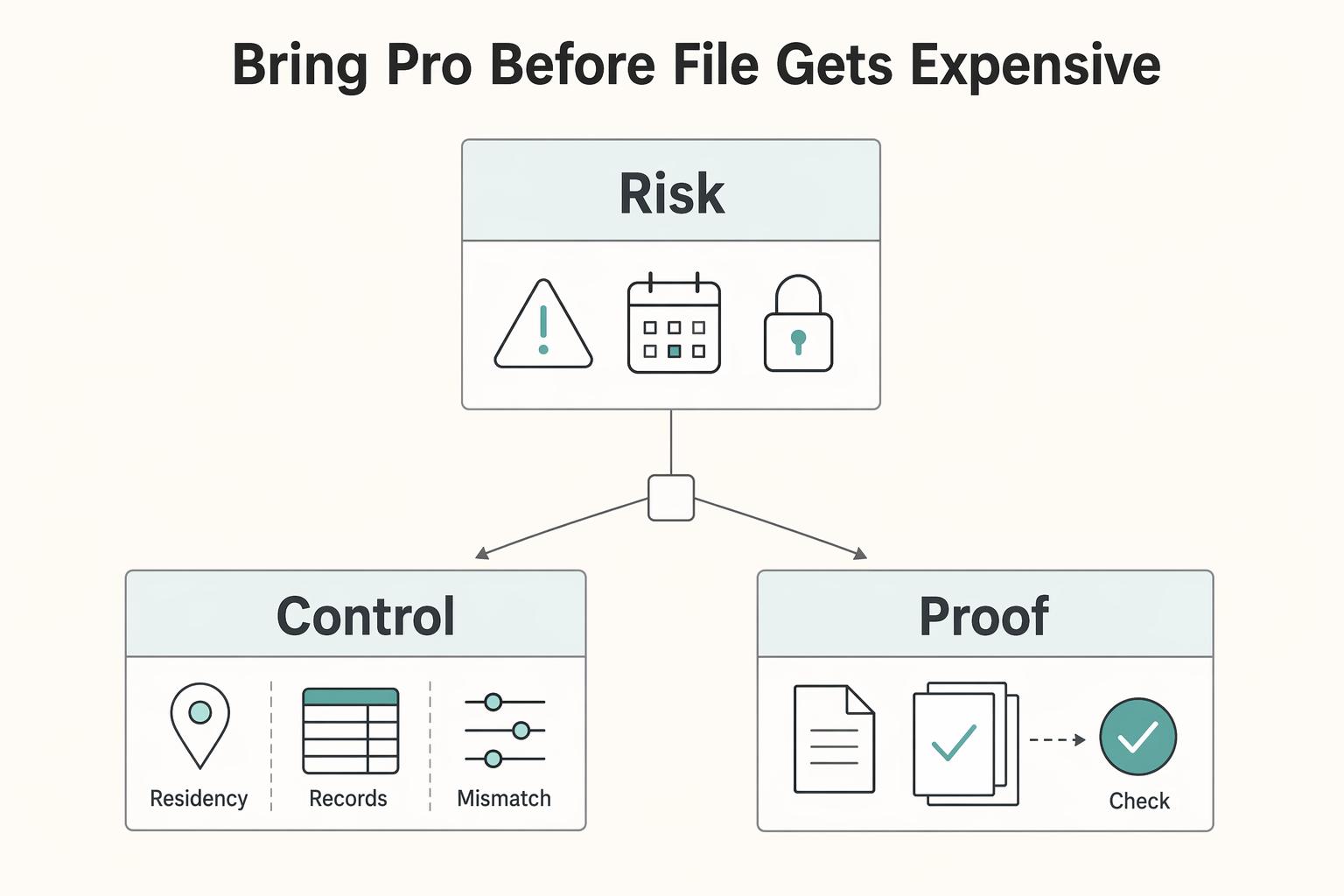
Bring in a pro before the file gets expensive#
Use practical triage, not a formal IRS rule. If the bottleneck is reconciliation, amendments, or multi-year filing cleanup, accounting support is often the cleaner first move. If you are facing immediate adverse action risk or a dispute centered on legal argument, bring in legal representation earlier.
That distinction saves time because it matches the kind of help to the bottleneck. Some cases are document- and reconciliation-heavy. They require careful cleanup, alignment across years, and a file that can actually support the next step. Other cases turn on urgency, pressure, or legal argument. In those matters, waiting too long to involve legal representation can make the path harder than it needs to be.
You do not have to solve that decision abstractly. Ask what is blocking resolution right now. If the answer is "we still need to reconcile the records and rebuild the filing history," that points one way. If the answer is "there is immediate adverse action risk or the dispute centers on argument," that points another.
You have the right to representation. With Form 2848, an authorized representative can represent you before the IRS, advocate, negotiate, and argue facts and law. IRS guidance says attorneys, CPAs, enrolled agents, and enrolled actuaries usually can represent taxpayers.
The practical value of representation is not only knowledge. It is also file control. A good representative can usually work faster when the handoff is clean. A messy handoff means the first stage of paid help becomes reconstruction instead of strategy. That is why the timing point matters so much: bring in help before the file gets expensive, not after the file has already become a pile of partial records and missing proof.
Whether you hire help early or later, give your representative the same handoff you would need yourself. That means the complete year file, the notice file, exact sent copies, delivery proof, a contact log, and a one-sentence requested outcome.
That one-sentence requested outcome is especially useful. It forces clarity. If you cannot state in one sentence what outcome you want, the representative often has to spend extra time first figuring out the objective before they can work on the path to get there. A clean handoff tells them what happened, what was already tried, what proof exists, and what result you are trying to secure.
The handoff should let the representative see, quickly and in order:
- what was filed for the year at issue
- what records support that filing
- what notices have been received
- what responses have already been sent
- what proof exists for those responses
- what channel history exists through calls, uploads, mailings, or letters
- what single result you want now
If that package is ready, professional help starts with analysis and action. If it is not, it often starts with file recovery. Sometimes that is still necessary, but it is rarely the cheapest point to begin it.
This is why early professional help can make sense even before a final strategy is chosen. If your file is still being reconstructed, the right advisor can help impose order before another missed step creates a new problem. Reconstruction under deadline is harder than reconstruction before the next notice or escalation point.
Action trigger: if your file is still being reconstructed, professional help should start now, not after another missed step. That does not mean every issue requires full representation immediately. It means that once the file itself has become the bottleneck, waiting often costs more than deciding.
For a broader planning guide, read our guide to a defensible 2026 filing plan. Before you escalate, organize filings, notices, and response history in one place with the Tax Residency Tracker. If the issue is still unresolved after documented IRS attempts, get a second set of eyes on your next compliant move via Contact Gruv.
Quick FAQ#
When should I file Form 911?#
File Form 911 after you have tried normal IRS channels and still cannot resolve the issue, especially if you can show financial hardship or an IRS process problem. TAS is not a first step, and Form 911 is not for legal advice or tax return preparation advice. Before you file, make sure your packet shows the notice or account issue, what you sent through the normal route, what remains unresolved, and one specific relief request tied to proof. If you cannot show that clean sequence from the file itself, tighten the file first.
Can TAS help with a levy or other collection action?#
Sometimes, yes, especially when the IRS issue is causing financial difficulty or the process is not working as intended. Do not assume Form 911 automatically stops collection action. If the risk is urgent, lead with the collection notice and deadline, your prior IRS contact history, and records showing immediate financial harm. Keep the packet tightly focused on the current adverse action risk and the specific relief you are requesting.
When is professional representation the safer move?#
Professional representation can be the safer move when collection pressure is rising, the issue depends on legal argument, or the facts are complex. If cost is a barrier, a Low Income Taxpayer Clinic may be an option. LITCs are independent of the IRS, generally serve taxpayers at or below 250% of federal poverty guidelines, and usually handle disputes under $50,000. Verify current Publication 4134 guidance before relying on those thresholds.
Does TAS cost money, and what should I do after filing?#
TAS services are free and confidential. If you submit Form 911 by email, remember that email submissions are not encrypted and TAS says it will not reply by email, so keep exact copies and proof of submission. If you hear nothing after 30 days, contact the office where you originally submitted your request. Keep the submitted Form 911, the exact packet, and your dated timeline together so follow-up does not turn into reconstruction.
What if my issue is really tax debt settlement, not an IRS process problem?#
If your main issue is debt settlement, TAS may be a less direct fit than an IRS settlement path. Start with this Offer in Compromise guide before treating it as an advocate case. If you are mainly trying to resolve the debt itself through a settlement path, start there first. Related: How the IRS Classifies Your Side Hustle as a Hobby or Business.
Frequently Asked Questions
When should I file Form 911?
File Form 911 after you have tried normal IRS channels and still cannot resolve the issue, especially if you can show financial hardship or an IRS process problem. TAS is not a first step, and Form 911 is not for legal advice or tax return preparation advice. Before you file, make sure your packet shows the notice or account issue, what you sent through the normal route, what remains unresolved, and one specific relief request tied to proof. If you cannot show that clean sequence from the file itself, tighten the file first.
Can TAS help with a levy or other collection action?
Sometimes, yes, especially when the IRS issue is causing financial difficulty or the process is not working as intended. Do not assume Form 911 automatically stops collection action. If the risk is urgent, lead with the collection notice and deadline, your prior IRS contact history, and records showing immediate financial harm. Keep the packet tightly focused on the current adverse action risk and the specific relief you are requesting.
When is professional representation the safer move?
Professional representation can be the safer move when collection pressure is rising, the issue depends on legal argument, or the facts are complex. If cost is a barrier, a Low Income Taxpayer Clinic may be an option. LITCs are independent of the IRS, generally serve taxpayers at or below 250% of federal poverty guidelines, and usually handle disputes under $50,000. Verify current Publication 4134 guidance before relying on those thresholds.
Does TAS cost money, and what should I do after filing?
TAS services are free and confidential. If you submit Form 911 by email, remember that email submissions are not encrypted and TAS says it will not reply by email, so keep exact copies and proof of submission. If you hear nothing after 30 days, contact the office where you originally submitted your request. Keep the submitted Form 911, the exact packet, and your dated timeline together so follow-up does not turn into reconstruction.
What if my issue is really tax debt settlement, not an IRS process problem?
If your main issue is debt settlement, TAS may be a less direct fit than an IRS settlement path. Start with this Offer in Compromise guide before treating it as an advocate case. If you are mainly trying to resolve the debt itself through a settlement path, start there first. Related: How the IRS Classifies Your Side Hustle as a Hobby or Business.
Try a related tool
Researched and edited by the Gruv editorial team. Gruv builds cross-border billing, payouts, and finance-operations software for global businesses.
Sources
Educational content only. Not legal, tax, or financial advice.
Related Posts

Digital Nomad Taxes in 2026 With a Defensible Filing Plan
With digital nomad taxes, the first move is not optimization. It is figuring out where you may be taxable, where filings may be required, and what proof supports that position.

A Guide to the IRS Offer in Compromise (OIC) Program
**Use a compliance-first checklist to make a clear go-or-no-go decision on an Offer in Compromise based on your facts.**

The Freelance Payment Penalty: A Modeled Audit of Platform Fees, FX Spreads, and Payout Delays
The money rarely disappears through a single, easy-to-spot fee. The real loss is stacked. A marketplace takes its commission, a processor adds a charge for international cards, a bank or payment company converts the currency at a spread, a platform holds the funds before release, and a wire sheds a little to intermediaries on the way in. Each layer looks defensible on its own, but the worker feels the combined result as a smaller deposit and a later payday.