
Quick Answer
Yes - if you want broad work flexibility, the uk global talent visa is usually strongest when you run it as a staged plan. Most applicants complete endorsement and then visa permission, though some file both together and eligible prestigious-prize holders can skip endorsement. Build evidence that is attributable and independently verifiable, then start UK earnings recordkeeping immediately after approval so later extension or settlement reviews are easier to support.
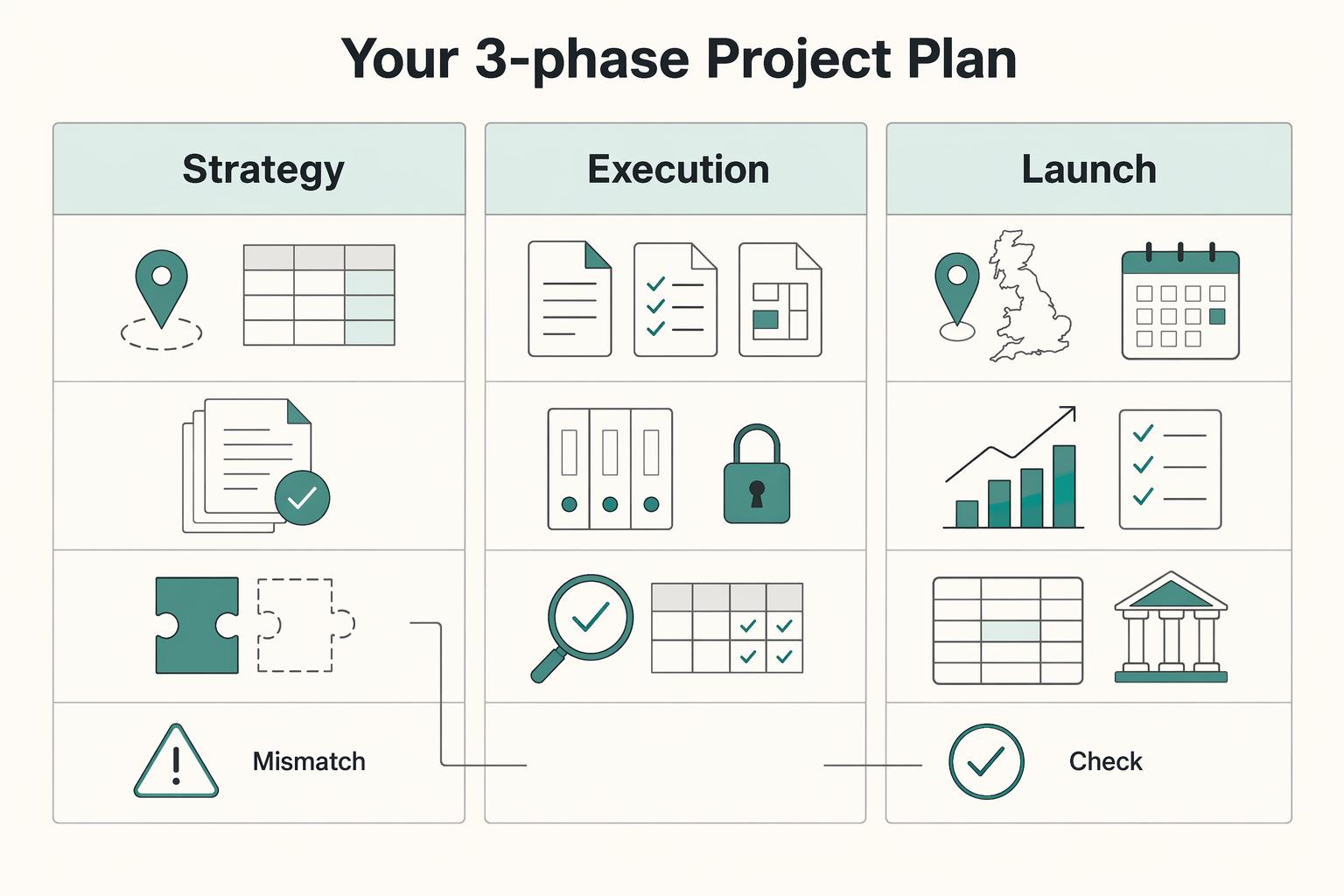
Three phases: set scope, prepare materials, then work compliantly#
Use this as a three-phase working framework: set scope, prepare your application materials, then set up how you will work compliantly after approval. The post-approval compliance checkpoints here are grounded; visa-process specifics should still be treated as items to verify against current official guidance.
Here is the scope of each phase. Strategy defines what is confirmed versus still unverified. Execution turns verified requirements into one consistent application pack. Launch starts after approval and focuses on how you will work, earn, and handle compliance in practice.
| Phase | Primary objective | Key decisions | Core documents or evidence | Common failure points |
|---|---|---|---|---|
| Strategy | Confirm scope and unknowns | Which requirements are confirmed, and which still need verification? | Current official guidance notes, issue list, draft timeline | Building evidence before confirming requirements |
| Execution | Build a clean, consistent application pack | What stays in, what needs explanation, what still needs verification | Final document set and version checks | Inconsistent names or dates, stale documents, unsupported claims |
| Launch | Start working compliantly in the UK | Are you trading, employed, or both? Do you need to set up a business? Do you need to report income to HMRC? | HMRC-focused checklist and income/activity notes | Unclear trading status, delayed HMRC checks when unsure |
Your main post-approval checkpoint is trading status. GOV.UK says you need to set up a business if you trade in goods or services. If you start working for yourself, you may need to report income to HMRC. For occasional sales or property rental income, check whether you need to tell HMRC. If you are unsure whether your activity counts as trading, contact HMRC for advice. You can also run a business and be employed at the same time, so a mixed work model can be valid.
If you want a deeper dive, read the 2026 Global Digital Nomad Visa Index.
Phase 1: Pre-Application Strategy: De-Risking Your Investment#
Do not draft evidence yet. First lock three decisions: which route you are pursuing, how you will position your profile, and how you will actually work in the UK after approval.
If your plan includes independent work, connect this phase to compliance now, not after approval. GOV.UK says you need to set up a business if you "trade" in goods or services, and its examples include selling regularly to make a profit. It also says that if you start working for yourself, you may need to report income to HMRC. If you are unsure whether you are trading, contact HMRC. GOV.UK also states you can run a business and be employed at the same time.
Choose the route before you choose the story#
Start with route fit, because story-building gets expensive once you have picked the wrong lane. Use this as a due-diligence matrix, not a final rules summary. Treat route differences as live-rule questions and verify current official rules before you commit.
| Route | Verify before choosing | Why this check matters |
|---|---|---|
| Global Talent | Current official eligibility, required approvals, and permitted work setup for your case | Prevents building a heavy evidence case for a route that may not fit your real work model |
| Skilled Worker | Current official eligibility, required approvals, and permitted work setup for your case | Reduces the risk of planning around assumptions that are not confirmed in current rules |
| HPI | Current official eligibility, required approvals, and permitted work setup for your case | Helps you test near-term feasibility against your longer-term plan |
If you expect a mixed model, meaning employment plus independent work, verify that exact setup first, not after you have drafted evidence.
Positioning yourself without over-claiming#
The practical risk here is not modesty or ambition on its own. It is mismatch. Avoid both errors: over-claiming leadership you cannot prove and under-positioning evidence you actually can prove.
Use this evidence-readiness check before you set your positioning:
- Each major claim has third-party proof.
- Dates, titles, employers, and project names are consistent across documents.
- Your personal contribution is clearly separated from team outcomes.
- Your strongest examples are recent and straightforward to verify.
- At least some proof shows external recognition.
Use this risk test before you commit. If your strongest claims need long confidential context or mostly describe company outcomes without isolating your role, treat that as over-claiming risk. If you have multiple independently verifiable achievements but default to a lower-claim position out of caution, treat that as under-positioning risk. Verify the current route timeline from official UK government or endorsing-body records before you use it.
Field fit is a verification task, not a branding exercise#
Pick the field your evidence can actually carry. The wrong label creates avoidable explanation work and weakens otherwise solid proof. Use this as a profile-fit worksheet, then confirm current official mapping from official UK government or endorsing-body records before you rely on a field label.
| Your evidence cluster | Worksheet prompt | Common mismatch error |
|---|---|---|
| Research or academic work | Check whether your strongest proof is publications, grants, institutional roles, or research outputs | Framing as broad "innovation" when evidence is primarily academic |
| Arts, culture, or creative output | Check whether your strongest proof is public creative work, credits, commissions, exhibitions, or critical recognition | Leaning on seniority claims instead of documented creative contribution |
| Digital product, startup, or technical leadership | Check whether your strongest proof is independently provable product, engineering, startup, or platform-building work | Using a "tech" label when evidence is mostly general operations or marketing |
As a quick coherence check, pick your five strongest items and see which field they fit without extra explanation. Verify current official mapping before you rely on any specific field label.
Budget for the application and the first compliance turn#
Budget is a Phase 1 decision gate, not something to tidy up later. Build a simple planning sheet with four lines:
- Mandatory government charges
- Per-dependent cost impact
- Optional professional support
- Document refresh costs
Confirm the current fees and healthcare surcharge from the official GOV.UK guidance before you budget.
Also budget admin time for early compliance. If you expect self-employment, first check whether you need to send a tax return before registering. GOV.UK states this explicitly. The page example says HMRC must be told by 5 October 2025 for the previous tax year 6 April 2024 to 5 April 2025, and late notification could lead to a penalty. It also says you can tell HMRC by registering for Self Assessment, including cases where you are waiting for a Unique Taxpayer Reference (UTR).
Phase 1 is not just a visa exercise. It is where you confirm that your route choice fits how you will earn, invoice, and operate in practice.
For a step-by-step walkthrough, see The E-2 Treaty Investor Visa: A Path to US Residency for Entrepreneurs.
Before you commit to a pathway, use the Visa Cheatsheet for Digital Nomads. It helps you pressure-test your route choice, document plan, and timing assumptions.
Phase 2: Endorsement and visa as two stages with different checks#
Treat Phase 2 as two stages with different checks, even if you file them together. Stage 1 is about proving you meet endorsement criteria. Stage 2 is the visa application, where your endorsement must still be valid.
Work Stage 1 and Stage 2 as different files#
For most applicants, this is a two-part process. The main exception is the prestigious prize route, where eligible prize winners can go straight to the visa stage.
| Stage or route | Main step | Key requirement or timing |
|---|---|---|
| Stage 1: Endorsement | Submit a focused evidence set that proves you meet the criteria. | For the digital technology pathway: CV, 3 letters of recommendation, and eligibility evidence capped at a maximum of 10 documents. |
| Stage 2: Visa application | Apply for entry clearance or permission to stay and complete identity verification. | If you apply after endorsement is granted, submit Stage 2 within 3 months of your endorsement letter. |
| Prestigious prize route | Go straight to the visa stage if you are an eligible prize winner. | This is the main exception to the two-part process. |
Stage 1: Endorsement (eligibility check) Your job is to submit a focused evidence set that proves you meet the criteria. For the digital technology pathway, this includes a CV, 3 letters of recommendation, and eligibility evidence capped at a maximum of 10 documents.
Stage 2: Visa application (immigration check) Your job is to apply for entry clearance or permission to stay and complete identity verification. Endorsement does not automatically mean visa approval. If you apply after endorsement is granted, submit Stage 2 within 3 months of your endorsement letter. Identity is verified through the UK Immigration: ID Check app or at a visa application centre for biometrics.
You can file sequentially or at the same time. If you file both together and endorsement is refused, the visa application is rejected and the visa application fee is returned.
Execution timeline checklist#
Use the timeline below as a working plan, not a promise on processing speed.
| Step | Inputs | Owner | Output | Dependency |
|---|---|---|---|---|
| Evidence shortlisting | CV, achievements list, third-party proof | You | Ranked evidence inventory | Phase 1 route and profile choice |
| Referee outreach | Referee shortlist, briefing pack | You | 3 confirmed referees (digital technology route) | Evidence map by criterion |
| Stage 1 submission | CV, 3 letters, capped evidence set (digital technology route) | You | Endorsement application filed | Complete Stage 1 pack |
| Stage 2 submission | Endorsement result, identity document, visa form | You | Visa application filed | Endorsement valid and filed within 3 months of the endorsement letter |
Timings are pathway-specific, not universal. Some eligible academic or research fast-track cases show about 2 weeks for endorsement, while arts and culture pages show 8 weeks. Visa decisions are usually shown as 3 weeks outside the UK and 8 weeks inside the UK after online submission, identity checks, and documents.
Map every document before you upload it#
A clean evidence pack is usually won or lost before upload. Map each document first so you know exactly what it is doing in the file. Use one line per document with three tags:
- Criterion tag: the endorsement criterion this item supports
- Claim type: what it proves, for example innovation, impact, independent validation, role clarity, or future contribution
- Proof strength: direct, indirect, or weak
Then run this quality filter before final selection:
- Originality: shows something distinctive you built, led, or created
- Impact: shows a concrete outcome
- Independent validation: supported by third-party evidence
- Role clarity: makes your personal contribution clear
Cut items that need long backstory, rely on unverifiable confidential claims, or show company success without clearly showing your role.
Make recommendation letters operational#
Recommendation letters often fail because they stay generic. For digital technology, referees should be established experts who have known your work for at least 12 months. The letters should explain how you would contribute to the UK digital technology field.
| Letter point | What the article says |
|---|---|
| Referee standing | For digital technology, referees should be established experts. |
| How long they have known your work | They should have known your work for at least 12 months. |
| UK contribution | The letters should explain how you would contribute to the UK digital technology field. |
| Specific contributions | Each letter should describe specific contributions with clear role detail. |
| Route positioning | Each letter should align those contributions to your route positioning: established leader or potential leader. |
Use this briefing pack template for each referee:
- Your current CV
- One-page case summary
- The criterion or claim type their letter should support
- 3-5 fact bullets (project, date, your role, outcome)
- One sentence on your planned UK contribution
Before submission, run a criterion-alignment check. Each letter should:
- Explain how the referee knows your work
- Describe specific contributions with clear role detail
- Align those contributions to your route positioning (established leader or potential leader)
If Stage 1 is refused, endorsement review is narrow: request it within 28 days, and you cannot add new evidence during the review.
We covered this in detail in A Guide to Getting a Golden Visa in Spain.
Phase 3: Build a clean compliance trail after approval#
After approval, the real job is building a clean compliance trail from your first paid UK work. Common delay points are structure choice, tax registration, money separation, and weak earnings evidence that does not clearly link to your endorsed field.
With this visa, you can be an employee, self-employed, and a director of a company. You still cannot access most public funds or work as a sportsperson, so your launch choices should be deliberate from day one.
What to do in the first weeks and what can wait#
The first few weeks matter because early mess is hard to reconstruct later. Focus first on the items that affect tax, company setup, and evidence quality.
| Priority | Task | Article note |
|---|---|---|
| Do now | Choose your trading route before first invoice/signature where possible. | If you plan to use a limited company, register it before trading. If you will be a sole trader, register through Self Assessment and verify the current deadline for telling HMRC you need a return from official HMRC guidance. Late registration can trigger penalties. |
| Do now | Set up clean banking rails. | For limited companies, keep company and personal finances separate and use a business bank account for company transactions. |
| Do now | Create tax checkpoints immediately. | Track Self Assessment filing and payment dates against current official HMRC guidance and monitor VAT registration if taxable turnover in the last 12 months goes above £90,000. |
| Do now | Open your evidence archive from payment one. | Store key records, for example invoices or payroll records, bank statements, payslips, accountant letters, and accounts, in one searchable place. |
| Can wait | Brand refresh, website updates, and non-essential tooling changes. | Lower early compliance risk. |
Do now (before or as first paid work starts):
- Choose your trading route before first invoice/signature where possible.
If you plan to use a limited company, register it before trading. If you will be a sole trader, register through Self Assessment and verify the current deadline for telling HMRC you need a return from official HMRC guidance. Late registration can trigger penalties.
- Set up clean banking rails.
For limited companies, keep company and personal finances separate and use a business bank account for company transactions.
- Create tax checkpoints immediately.
Track Self Assessment filing and payment dates against current official HMRC guidance and monitor VAT registration if taxable turnover in the last 12 months goes above £90,000.
- Open your evidence archive from payment one.
Store key records, for example invoices or payroll records, bank statements, payslips, accountant letters, and accounts, in one searchable place.
Can wait (lower early compliance risk):
- Brand refresh, website updates, and non-essential tooling changes.
Choosing between sole trader and limited company by work pattern#
There is no universal best option here. Pick the structure that matches your risk profile, client expectations, and admin capacity.
| Decision point | Sole trader | Limited company |
|---|---|---|
| Liability | You are personally liable for business debts (unlimited liability). | Separate legal entity with limited liability. |
| Admin burden | Register via Self Assessment; verify current filing rules and deadlines from official HMRC guidance. | Higher admin: confirmation statement at least annually, plus accounts and company tax filings. |
| Tax treatment | You are taxed personally on business profits through Self Assessment. | Company pays Corporation Tax, and you may also have personal tax on salary or other extraction. |
| Operational trade-off | Lower formal setup overhead, but no liability ring-fence. | More ongoing compliance tasks, but liability is ring-fenced. |
Build an ILR-ready evidence system you can repeat#
If extension or settlement is part of your plan, build the evidence trail as you go. For Global Talent extension or settlement, you must show UK earnings linked to your endorsed expert field. There is no minimum earnings level, so evidence quality is often the deciding factor.
For each engagement, keep a clear evidence chain together, for example:
- Invoice or payroll record
- Bank line showing payment received
- Field-link evidence that makes the endorsed-field connection explicit
- Where relevant, supporting records such as accountant confirmation or statutory accounts
If earnings documents do not clearly show the field link, expect to provide extra evidence. Use a consistent naming convention for retrieval. This is operational best practice rather than a legal requirement. For example: YYYY-MM_Client_DocType_Project_Status.ext.
Run this routine:
- Monthly reconciliation: match invoice or payroll and bank receipt, then confirm the UK earnings trail and field-link clarity.
- Quarterly audit check: ask whether a reviewer could quickly see what you did, who paid you, and how it aligns to your endorsed field. If not, add clarifying project summaries or accountant confirmation while details are fresh.
If settlement is your goal, track your timeline and travel from the start. Eligibility may be after 3 or 5 years depending on your field and how you apply. Continuous residence also includes the 180 days outside the UK in any 12 months limit.
IR35 contract review before signing#
This is one of the places where contract wording and real working practice both matter. IR35 (off-payroll working rules) can apply when you work through an intermediary. There is no single statutory employment test, and status depends on contract terms plus actual working practices.
Use this pre-sign checklist:
- Scope/deliverables: define project outputs, milestones, and acceptance criteria.
- Control terms: avoid staff-like day-to-day control language where the engagement is meant to be independent.
- Substitution language: include genuine substitution rights where appropriate.
- Invoicing clarity: tie invoices to deliverables, dates, and service descriptions so tax and settlement evidence stay aligned.
Before entering long engagements through a company, check HMRC status treatment for that specific engagement and use the Check Employment Status for Tax tool where relevant. In most cases, the client determines status, with small-client private-sector exceptions. Related: Understanding the UK's Statutory Residence Test (SRT).
Conclusion: Maintain records and re-check rules before each immigration step#
You now have the core tools to run this process well: a clear sequence, a practical checklist, and the decision points that help prevent avoidable delays. The next step is execution, not guesswork.
Phase 1 was strategy. First decide whether you can apply directly with an eligible prestigious prize or need endorsement. Then choose the right route for your profile, because the Home Office does not choose it for you. In one line: endorsement strategy means selecting the correct route before you assemble your case.
Phase 2 was execution. For most applicants, this is a two-part process, and endorsement does not guarantee visa approval. You can file endorsement and visa together or separately. If you file separately, submit the visa application within 3 months of your endorsement letter. You also need to complete identity checks and avoid booking travel before a decision. In one line: application execution means getting sequence, timing, identity, and submission steps right.
Phase 3 was post-approval planning. You can choose permission for up to 5 years at a time and work with broad flexibility, but future immigration steps still depend on your records. For extension, you must be able to show earnings in your expert field. Settlement timing depends on pathway, which may mean 3 or 5 years. In one line: post-approval compliance means maintaining usable evidence for future steps.
Your next actions:
- Verify live GOV.UK guidance for the current endorsing body, prize list, fees, health surcharge, and decision timing.
- Organize your submission file before applying: route-specific evidence, identity documents, and fee plan.
- Start your ongoing records now so you can show work and earnings in your expert field when required.
The practical takeaway is autonomy with responsibility. You can work in the UK with broad flexibility, subject to visa conditions. You keep that flexibility by maintaining records, following visa conditions, and re-checking rules before each immigration step.
You might also find this useful: A Deep Dive into the UK's 'High Potential Individual' Visa.
Once your move plan is set, use the Tax Residency Tracker to keep your UK day-count and compliance records organized from day one.
Frequently Asked Questions
What do “endorsement” and “visa stage” mean?
Endorsement is the expert-body review of whether you meet Global Talent criteria. The visa stage is the immigration permission application. For most people, this is a two-part process: endorsement first, then visa permission. Some applicants can submit both applications together, and eligible prestigious-prize winners can apply without endorsement.
Do you need a job offer for the uk global talent visa, or should you use a sponsored route instead?
For digital technology, you do not need a job offer for Global Talent. If you want flexibility to freelance, be employed, or run your own company without being tied to one sponsor, Global Talent is usually the better fit. If you already have a sponsoring employer, Skilled Worker may be the cleaner route. | Decision point | Global Talent | Skilled Worker | |---|---|---| | Job offer | Not required for digital technology | Required before you apply | | Sponsorship | No employer sponsor needed | Requires an approved sponsor and a certificate of sponsorship | | Work flexibility | You can be an employee, self-employed, or a company director, and you can change or stop work without telling the Home Office | Your permission is tied to sponsored employment, and changing to a different employer requires updating your visa |
Who reviews digital technology applications now?
As of publication, GOV.UK states that digital technology endorsement applications are reviewed by Tech Nation. A 2025 Home Office contract award names Tech Nation Group Limited for digital-tech endorsing services through 15 April 2028. You should still check the live GOV.UK page before you submit, because endorsing arrangements can change.
How do you choose between exceptional talent and exceptional promise?
Choose exceptional talent if your evidence already shows recognized leadership in digital technology. Choose exceptional promise if your profile is earlier-stage and your case is stronger on trajectory than current market recognition. GOV.UK notes exceptional promise applicants are likely to have less than 5 years of experience in technology.
What evidence do you actually need for the digital technology endorsement?
You must submit a CV, 3 recommendation letters, and eligibility evidence capped at 10 documents. The guidance requires at least 2 documents showing recognition as leading or potential talent, plus at least 4 documents across 2 other qualifying areas. You cannot reuse the same document for more than one criterion. Strong evidence is clear, attributable to you, and independently verifiable.
How long does the process take, and what order should you follow?
Treat timelines as variable and verify them on GOV.UK on the day you file, because official digital-tech pages currently use different wording for endorsement timing. Decide up front whether you will file endorsement and visa together or as separate steps. If you file separately, submit the visa application within 3 months of your endorsement letter. Before travel planning, confirm the live visa decision window for inside-UK versus outside-UK applications.
How do you prove earnings for extension or settlement if you are self-employed or work with overseas clients?
You must show UK earnings linked to the expert field you were endorsed in. For each engagement, keep records that show payment and make the field link clear. There is no minimum earnings threshold in the cited guidance. Prioritize evidence that an independent reviewer can verify.
When can you apply for settlement, and what should you track now?
Settlement timing can be 3 years or 5 years, depending on your qualifying pathway. Track absences from day one against the 180 days in any 12 months rule, and keep your UK earnings evidence organized continuously. Before you apply, confirm the current settlement document list and form names on live GOV.UK guidance.
Try a related tool
Researched and edited by the Gruv editorial team. Gruv builds cross-border billing, payouts, and finance-operations software for global businesses.
Sources
Includes 2 external sources outside the trusted-domain allowlist.
Educational content only. Not legal, tax, or financial advice.
Related Posts

The 2026 Global Digital Nomad Visa Index for 50+ Countries
Start with legal fit, not lifestyle filters. The practical order is simple: choose a route you can actually document, then decide where you want to live. That single change cuts a lot of wasted comparison work and stops you from falling in love with places that were never a real filing option.

Understanding the UK's Statutory Residence Test (SRT)
Treat SRT like ops, not folklore. You want a repeatable workflow you can run monthly so your tax-year answer is boring, documented, and easy to defend.
UK High Potential Individual Visa Plan for a 2026 UK Move
Use this as a pre-spend check, not a motivation boost. Before you pay for optional services, commit to move dates, or lock flights, check current official visa guidance and treat route fit and core eligibility as unverified until you have clearly confirmed them.