
Quick Answer
Yes. If you market services to German clients, treat your site as likely in scope under Marktortprinzip and § 5 DDG, even when your business is abroad. Run three checks: German audience targeting, commercial intent, and a realistic hire-or-pay path. When that signal is positive, publish a clearly labeled Impressum with legal identity, physical address, and direct email contact, and keep it separate from your Datenschutzerklaerung.
Why Your German Clients Secretly Judge Your Website (And How to Win Their Trust)#
German prospects often run a quick trust check before they contact you. They want to see who operates your site and how to reach you. If that path is missing or unclear, you can lose the conversation before it starts.
In practice, your Impressum is not just a legal formality. It is also a visible professionalism signal, especially in B2B, where buyers use basic transparency as a credibility filter when they compare service providers.
What a prospect verifies first#
Prospects rarely review this like lawyers. They scan for identity, reachability, and clarity. That lines up with the core disclosure logic in § 5 DDG and § 18 MStV. Provider details should be easy to recognize, directly reachable, and permanently available. A visitor should not have to hunt for who you are or how to contact you.
Typical checks include:
- your name or business name
- your address
- a direct electronic contact route, including email
- representative details if you operate as a legal entity
Signals buyers notice fast#
| Signal on your site | What a German buyer may infer | What to fix now |
|---|---|---|
| No legal-notice link in the footer | Hard to verify who runs the business | Add a clearly labeled link such as "Impressum" or "Kontakt" on every page |
| Link is buried or vaguely labeled | Basic checks are harder than they should be | Keep access obvious and straightforward; practice guidance commonly expects access within about two clicks |
| Notice shows only a brand name | Unclear who is responsible for the site | Add full name or company name and representative details where relevant |
| Address is missing or incomplete | Business identity looks uncertain | Add complete address details consistent with your business identity |
| Contact path is vague (for example, form-only) | Communication may be slow or difficult | Add a direct electronic contact option, including email |
| Notice details conflict across your site or other client-facing materials | Records look inconsistent | Align names, addresses, and entity details wherever prospects verify your business |
Keep it visible, clear, and consistent#
A common miss is not missing information. It is hiding the right information behind weak navigation. If visitors cannot find your legal notice quickly from any page, trust drops before they ever assess your work. Treat this as a publish gate. Then confirm legal scope in the next section.
Before you publish, run this micro-check:
- Visibility: Is the legal-notice link clearly labeled and easy to find from every page?
- Clarity: Does the notice clearly show identity, address, and electronic contact path?
- Consistency: Do those details match wherever prospects check your business information?
If one of these fails, fix it before launch. For German buyers, this first check can influence whether they contact you at all.
You might also find this useful: How to Write a Legally Compliant Invoice in Germany.
The Litmus Test: Do You Really Need an Impressum?#
If your site helps you market or sell to German clients, start from the assumption that an Impressum is likely required. The key trigger is market activity, not where your business is incorporated.
That is the logic behind the Marktortprinzip (market location principle). The rules follow the market you serve. In this context, the requirement is tied to commercial websites under § 5 DDG.
Use three tests, not one#
Do not rely on a single signal. Use this quick self-check:
| Test | Question |
|---|---|
| Audience targeting | Are German clients part of the market you are trying to reach? |
| Commercial intent | Is the site meant to generate business or revenue (for example, service promotion, ads, or affiliate links)? |
| Transactional readiness | Can a German visitor realistically move from browsing to hiring or paying you? |
Ask the questions as a set:
- Audience targeting
Are German clients part of the market you are trying to reach?
- Commercial intent
Is the site meant to generate business or revenue (for example, service promotion, ads, or affiliate links)?
- Transactional readiness
Can a German visitor realistically move from browsing to hiring or paying you?
If Audience targeting = yes and at least one of the other two is also yes, treat that as a strong in-scope signal and publish an Impressum.
Quick comparison table#
| Your situation | Risk signal | Action |
|---|---|---|
| You are based outside Germany but market services to German clients | Market served is Germany, regardless of incorporation country | Add an Impressum |
| Your site includes affiliate links | Affiliate links are a clear commercial marker | Treat the site as commercial and add one |
| You do not actively target Germany, but a German visitor can hire you through your site | Potential for a German transaction is present | Assume likely scope and add one |
| Your site is purely hobby content with no monetization and no client-acquisition path | Commercial signal is weaker on these facts | Lower current risk; reassess if that changes |
| You have service pages/lead capture and Germany is part of your client market | Audience targeting plus transaction path | Add an Impressum before launch |
Practical check before publishing#
Once you treat the site as in scope, the next step is simple. Make sure the notice is complete and easy to find. At minimum, include your full name or company name, a valid physical address, and contact information. Depending on your setup, transparency details can also include trade register information and VAT identification numbers.
Edge-case caution for mixed-use sites#
Mixed-use sites are where people get caught out. A portfolio can move into commercial scope quickly once you add monetization, affiliate links, ads, or a path for paid work.
If a German visitor can reasonably conclude they can hire you from that site, do not wait for edge-case certainty. Treat an Impressum as required. If you want a deeper dive, read Germany Freelance Visa: A Step-by-Step Application Guide.
What Your Impressum Must Contain and Where to Place It#
If your site is in scope under § 5 DDG (business-like digital services typically offered for payment), your Impressum has to do two jobs at once: identify the right provider and stay easy to find at all times. Under § 5 DDG, provider information must be easy to identify, directly reachable, and continuously available. If either the content or the placement fails, the page is weaker than it looks.
Start with the entity that actually does business#
Start with the party that signs contracts and issues invoices, because that is the identity your site should present. If you are a sole proprietor or freelancer, publish your legal name and the address where you are established. A brand name can appear, but it does not replace your legal identity.
If you operate through a registered company, publish the full registered company name, legal form, and authorized representative. If registered, add the register name and registration number exactly as recorded. If you publish journalistic-editorial content, check whether § 18 MStV applies and include the responsible person's name and address when required.
Practical note: verify current law text before publishing legal details. The core provider-information basis is § 5 DDG (and § 18 MStV where applicable).
| Required element | Why it matters | Common mistake | What to publish |
|---|---|---|---|
| Legal name and physical address | Identifies who is responsible and where they are established | Using only a brand, profile name, or a PO box/email combination | Freelancer: full personal name + street address. Company: full registered name + street address |
| Email contact | Must enable fast electronic contact, including email | Contact form only, or an unmonitored inbox | A working business email address |
| Legal form and authorized representative | Required for legal entities | Company name without legal form, or no representative | Company only: legal form + authorized representative |
| Register and registration number | Required if registered | Wrong register details, outdated number, or omission | Register name + exact registration number |
| Supervisory authority | Required where the service needs official authorization | Leaving this out in regulated activities | Competent supervisory authority (if applicable) |
| VAT ID or business identification number | Required if you have one | Publishing nothing despite having one, or mixing identifiers | VAT ID and/or business identification number (if applicable) |
| Editorially responsible person | Required for journalistic-editorial telemedia when applicable | Assuming general provider details are always enough | Name + address of responsible person (if § 18 MStV applies) |
Before publishing, validate each line against your official records so the page stays aligned when details change.
Copy-ready template#
Use this format and remove fields that do not apply:
your full legal name or full registered company name, your legal form (if applicable) your street and house number, your postal code and city, your country

Represented by: authorized representative (companies only) Contact: Email: your business email address Register: register name, registration number Supervisory authority: authority name (if applicable) VAT ID / Business ID: number (if applicable) Responsible for journalistic-editorial content: name and address (if applicable) ```

Keep naming consistent across your Impressum, invoices, and contract signature block so the same responsible party appears everywhere.

### Pre-publish checks that prevent avoidable misses

Findability can fail even when the content is complete. A complete notice still underperforms if users cannot reach it quickly from the pages that matter.

| Check | What to confirm |
| --- | --- |
| Label | Use an explicit label such as "Impressum" (or "Anbieterkennzeichnung"). |
| Placement | Keep the link visible in the footer or header so it is easy to identify and directly reachable. |
| Key pages | Confirm the same path is available from key pages such as the homepage, service pages, blog pages, and contact page. |
| Two-click usability | Use the two-click approach as a usability check, not as a replacement for statutory wording. |
| Availability | Test permanence on desktop and mobile, including private browsing, to make sure the page is continuously available. |

Before launch, click the path yourself from your homepage, service pages, blog pages, and contact page. Then test the same path on mobile and in private browsing. If one of those checks fails, fix the path before you publish.

If you want one practical rule, use this: publish the identity that actually contracts with clients, verify each required field against official records, and make the page impossible to miss.

For another compliance reference, read [A Guide to India's Data Protection Law (DPDP Act) for Foreign Companies](/blog/a-guide-to-indias-data-protection-law-dpdp-act-for-foreign-companies).

Once your Impressum draft is complete, run your listed VAT details through the [VAT Number Validator](/tools/vat-number-validator) before you publish.

## Solving the Privacy Dilemma: Your Address and Virtual Offices

For most freelancers, this is where compliance and privacy collide. You need an address that protects you, but it also has to work as a real business contact point. Do not assume any rented address solves that by default. Use an address where important mail can actually be received and handled, or keep your own address until that setup is in place.

Treat the address line as operational, not cosmetic. It should keep working if someone sends business mail or a legal notice. That is where some low-cost mailbox products can fall short. If you plan to cite legal wording, verify the current statute text before publishing any quote or legal label, especially around § 5 DDG and any interpretation you rely on.

| Address option | Compliance fit | Privacy impact | Operational risk |
| --- | --- | --- | --- |
| Home address | Can be a straightforward fit if this is your real business location and you can receive mail there | Low privacy | Personal exposure, including doxing, stalking threats, and targeted legal harassment |
| Coworking or mailbox address | Case by case only | Medium privacy | Higher if the service is mostly mail forwarding or the contract is unclear about official notices |
| Virtual office or Impressum service | Can fit if the provider offers a real physical address and documented mail handling | Higher privacy | Medium to high if the service looks compliant but excludes signed mail or legal documents |

Before you sign with any provider, confirm three points in writing. If sales says "yes" but the contract says "mail forwarding only," treat that as unsafe.

- **Mail acceptance capability:** who physically accepts mail, whether registered mail is handled, and whether the address is staffed during business hours.
- **Legal-notice handling:** how notices are logged, scanned, forwarded, and escalated if you do not respond immediately.
- **Contract clarity:** whether the agreement permits use in your legal notice and whether exclusions apply to court, official, or signed-for deliveries.

If you already published an address that does not reliably receive mail, fix the address setup first. Then update your Impressum, contact page, invoice footer, contract signature block, and business profiles so the same entity and address appear everywhere. Keep the new provider contract and mail-handling terms on file, and do not shut down the old route until you confirm nothing important is still arriving there. Related: [Taxes in Germany for Freelancers and Expats](/blog/germany-taxes-for-freelancers).

## A Critical Distinction: Impressum vs. Privacy Policy

Keep these as separate pages. Your **Impressum** tells people who is responsible for the site and how to reach that provider. Your **Datenschutzerklaerung** explains what personal data is processed and who is responsible for that processing.

For the Impressum duty, use the current DDG-era legal-notice framing. Treat [GDPR Articles 13 and 14](https://eur-lex.europa.eu/eli/reg/2016/679/2016-05-04/eng) as a separate privacy-disclosure duty. If you blur the two, it becomes harder for people to find the right information, and required details are easier to miss.

| Document | What it must answer | Who it applies to | Typical trigger | What breaks when you blur it |
| --- | --- | --- | --- | --- |
| Impressum / Anbieterkennzeichnung | Who operates the site and where they can be reached | Site providers that must show provider identity | You provide a digital service subject to provider-identification duties | Identity details get buried in other legal text and become harder to find |
| Datenschutzerklaerung (Art. 13 GDPR) | What data you collect directly from visitors and controller identity/contact details | Controllers collecting data directly from the person | Personal data is collected directly from the person | Required disclosures are missing or controller details are incomplete |
| Datenschutzerklaerung (Art. 14 GDPR) | What data you process when it was not collected directly from the person, including timing duties | Controllers using indirectly sourced personal data | Personal data was not obtained directly from the person | Article 14 timing duties are missed, including the outer limit of one month |

Keep separate pages for **Impressum** and **Datenschutzerklaerung**, and use explicit labels (`Impressum`, `Datenschutzerklaerung`), not vague labels like "Legal" or "Info." Keep the Impressum directly reachable and not embedded in FAQ, terms, or privacy text. Cross-link the two pages where relevant.

Common freelancer mistakes to avoid include:

- Copy-pasting privacy text into the Impressum and treating that as complete.
- Omitting clear controller or responsible-party identity and contact details in the privacy notice.
- Not updating privacy disclosures after changing site functions.

This pairs well with our guide on [A German Freelancer's Guide to Permanent Establishment Risk in the US](/blog/a-german-freelancers-guide-to-permanent-establishment-risk-in-the-us).

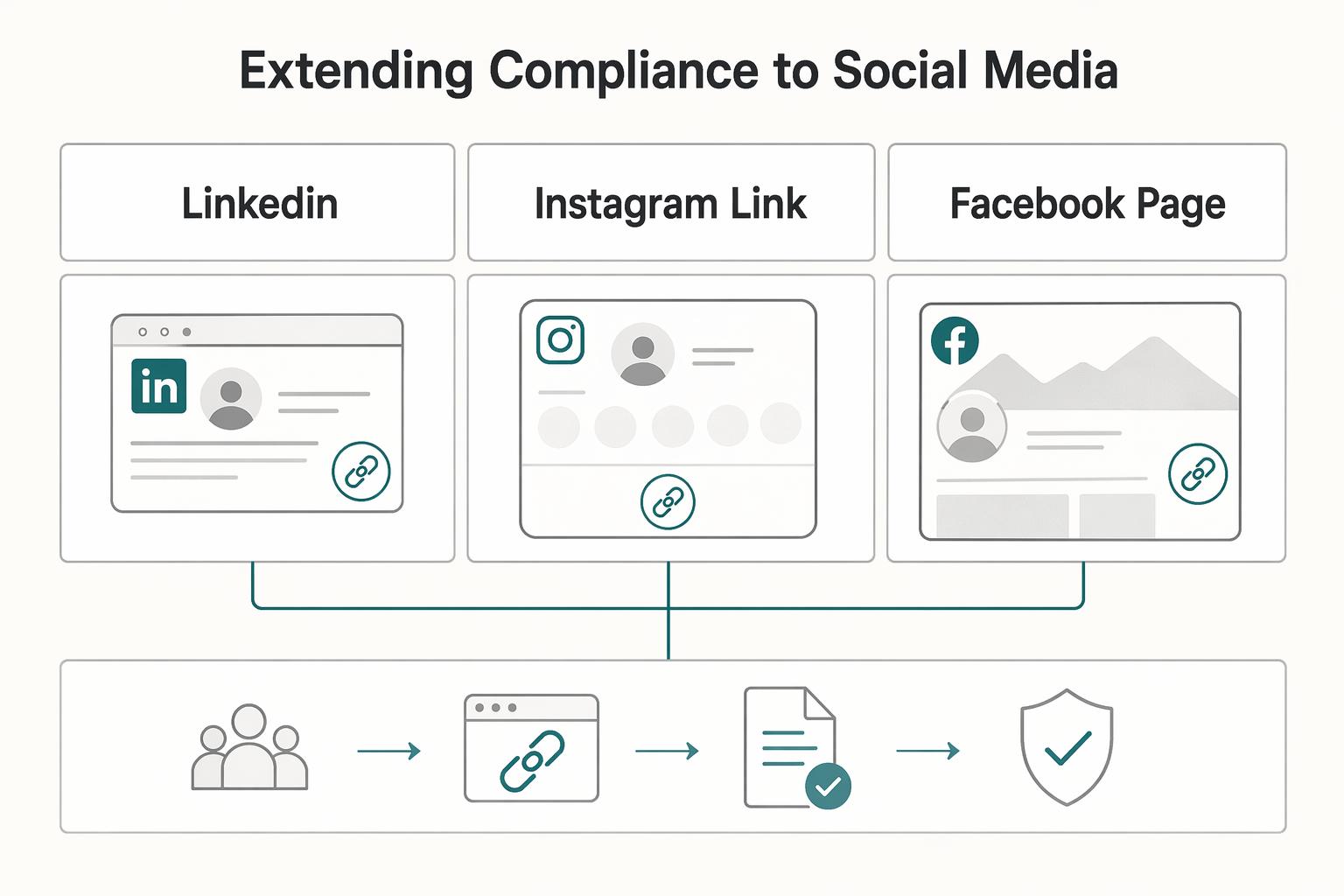
## Beyond Your Website: Extending Compliance to Social Media

If you use a social profile for business, treat it as part of the same compliance surface. Visitors should have a clear path from that profile to your Impressum. The obligation is described as extending beyond websites to business-use social accounts, and commercial use can apply even if users are not charged directly.

Use a simple filter:

- **Likely private use:** the profile is personal and not used to promote or support your services.
- **Likely business use:** the profile promotes your services or includes ads or affiliate activity.

For execution, use a plain usability standard: a visitor should be able to reach your full Impressum quickly from the profile, including when you use a link hub. This is a practical compliance check, not a claim of a legally fixed click-count rule.

| Platform | Where to place the link | How to label it | Compliant path check |
| --- | --- | --- | --- |
| LinkedIn | In a visible public profile area that supports external links | Use a clear legal label (for example, `Impressum` or `Legal notice`) | Visitor can follow the public link path and land on your Impressum page |
| Instagram / X with link hub | Use the bio link (or similar public link entry), then keep the legal notice visible in the hub | Use a clear legal label or direct URL | Visitor can follow the link path and reach the correct Impressum URL |
| Facebook Page | Include an Impressum link in a visible page information area | Clear legal-notice label or direct URL | Visitor can find the notice from the page without digging through posts |

### Quick profile audit

Watch for simple failures that are easy to miss: a link exists, but the label is vague. The hub works on desktop, but not logged out on mobile. The profile points to an old domain.

| Check | What to confirm |
| --- | --- |
| Link present | There is a real path from profile to Impressum. |
| Label clear | Avoid vague labels like "Website". |
| Destination correct | The link opens the actual Impressum page. |
| Path reliable | Test on mobile and logged out; redirects and link hubs should still resolve correctly. |

Run a quick live test:

- **Link present:** click from the public profile and confirm there is a real path to your Impressum.
- **Label clear:** avoid vague labels like `Website`.
- **Destination correct:** make sure the link opens the actual Impressum page.
- **Path reliable:** test on mobile and logged out so redirects and link hubs still resolve correctly.

Issues to check for include generic `Website` labels, legal-notice links buried inside a hub, and outdated profile fields after domain or profile updates. Fix those first. For a step-by-step walkthrough, see [How a US-based SaaS consultant should structure a contract with a German enterprise client](/blog/us-saas-consultant-contract-structure-for-german-enterprise-client).

## The True Cost of Non-Compliance

If your notice is missing, incomplete, or hard to reach, one common early risk is an **Abmahnung**. For you, that can mean urgent legal admin, immediate fixes, and time pulled away from client work.

Enforcement is described as active, including legal professionals scanning for violations. This is not limited to large companies, and it can affect low-revenue operators too. For freelancers selling into Germany, a small compliance miss can become a costly distraction quickly.

| Trigger | Who may initiate | Typical next step | Cost exposure |
| --- | --- | --- | --- |
| Missing or defective Impressum on your website | Often a competitor or their legal representative (Abmahnung) | Review the allegation, correct the notice promptly, and consider legal advice before responding | Warning-related legal costs can apply; use a current fee range only after verification |
| Missing, broken, or unclear notice path on a business social profile, shop, or other business channel | Competitor complaint, legal representative, or other challenger | Correct the entry point, test public paths, and document that links resolve to the right page | Similar warning-related cost exposure may apply; use a current fee range only after verification |
| Non-compliance escalates beyond a private warning | Relevant authority or formal enforcement path | Remedy the issue and respond through the applicable legal channel | Reported fine exposure can reach up to €50,000; this is not automatic, and the current legal basis should be verified |

A common pattern is that a missing or defective notice gets spotted, a warning or complaint arrives, and delivery work pauses while pages and profiles are fixed. Poor handling can increase the risk of escalation.

The hidden commercial cost is often larger than the headline number. If a prospect checks your footer or profile and cannot find a clear legal notice, trust can drop. In practice, that can mean slower deal cycles, more diligence friction, and avoidable back-and-forth before signature.

Also watch scope. Risk is described as extending beyond your main website to business social accounts, online shops, and even business-use email signatures. Fixing only one channel can still leave exposure elsewhere.

Use this prevention checklist now:

- Audit every public business entry point: website, shop, social profiles, and business email signature.
- Fix in this order: missing notice, broken links, unclear labels (for example `Website`), then outdated details.
- Capture evidence of each fix: dated screenshots, final public URLs, and a short change log of what changed and when.

We covered this in detail in [A Deep Dive into the German Trade Tax ('Gewerbesteuer') for Freelancers](/blog/a-deep-dive-into-the-german-trade-tax-gewerbesteuer-for-freelancers).

## From Compliant to Confident

A complete, easy-to-find Impressum helps a German prospect verify you before first contact. That is the practical value of compliance. It can reduce avoidable hesitation, even though it cannot guarantee a deal.

Regulators frame the Impressum as provider identification for consumer protection. In practice, your buyer is asking a simpler question: does this site belong to a real, reachable business? If your footer uses a clear `Impressum` or `Kontakt` label and the page is easy to notice, directly reachable, and continuously available, you clear that first trust check quickly.

### Confidence framework

| Layer | What your prospect is checking | What to show |
| --- | --- | --- |
| Legal baseline | Are you properly identifiable under the duty to provide provider information? | Name and address, plus contact details for fast electronic communication, including email; add supervisory authority details where required; add register name and number where registered. |
| Operational reliability | Can someone reach you quickly? | A current contact path that enables fast electronic communication. |
| Market-fit professionalism | Is your legal notice easy to find and access? | Clear `Impressum` or `Kontakt` labeling and uninterrupted access without major intermediate steps. |

### What to review now

- Fix findability first: clear footer label, working link, and direct access without major intermediate steps.
- Fix required details next: identity and contact information, then authority or register details where applicable.
- Confirm the required details are complete and current on your live site.
- If issues are found, correct them promptly.

This is not branding copy. It is risk control that makes verification easier. Related reading: [The Best Way for a German Agency to Pay a US-Based Freelancer](/blog/the-best-way-for-a-german-agency-to-pay-a-us-based-freelancer). If you want this compliance cleanup to connect cleanly with invoicing and cross-border payment operations, [talk to Gruv](/contact).
Try a related tool
Researched and edited by the Gruv editorial team. Gruv builds cross-border billing, payouts, and finance-operations software for global businesses.
Sources
Includes 5 external sources outside the trusted-domain allowlist.
- anti-fraud.ec.europa.eu/document/download/4bceb3c4-3b7d-4c01-b59b-58...trusted
- eur-lex.europa.eu/eli/reg/2016/679/2016-05-04/engtrusted
- eur-lex.europa.eu/legal-content/EN/TXTtrusted
- aimix.io/en/blog/what-is-impressumexternal
- bfdi.bund.de/DE/Buerger/Inhalte/Telemedien/Telemedien.htmlexternal
- buzer.de/5_DDG.htmexternal
- captaincompliance.com/education/the-complete-guide-to-impressum-le...external
- copywriter-martin.win/digital-marketing/content-social/impressum-e...external
Educational content only. Not legal, tax, or financial advice.
Related Posts

Germany Freelance Visa Application Path for Freiberufler and Gewerbe
Choose your track before you collect documents. That first decision determines what your file needs to prove and which label should appear everywhere: `Freiberufler` for liberal-profession services, or `Selbständiger/Gewerbetreibender` for business and trade activity.
Taxes in Germany for Freelancers and Expats
Low-stress compliance in Germany comes from decision order, not tax tricks. Use this sequence: confirm core facts, apply conservative temporary assumptions, verify the few points that can break invoices or filings, and keep one evidence file that explains each decision.
How to Write a Legally Compliant Invoice in Germany
The goal is simple: send a Rechnung that meets German requirements and is easy to review and pay. Use the same order every time: legal minimum fields first, payment terms second, pre-send risk checks third. Treat it as a defensive sequence, not a design template or a complete legal checklist for every case.