
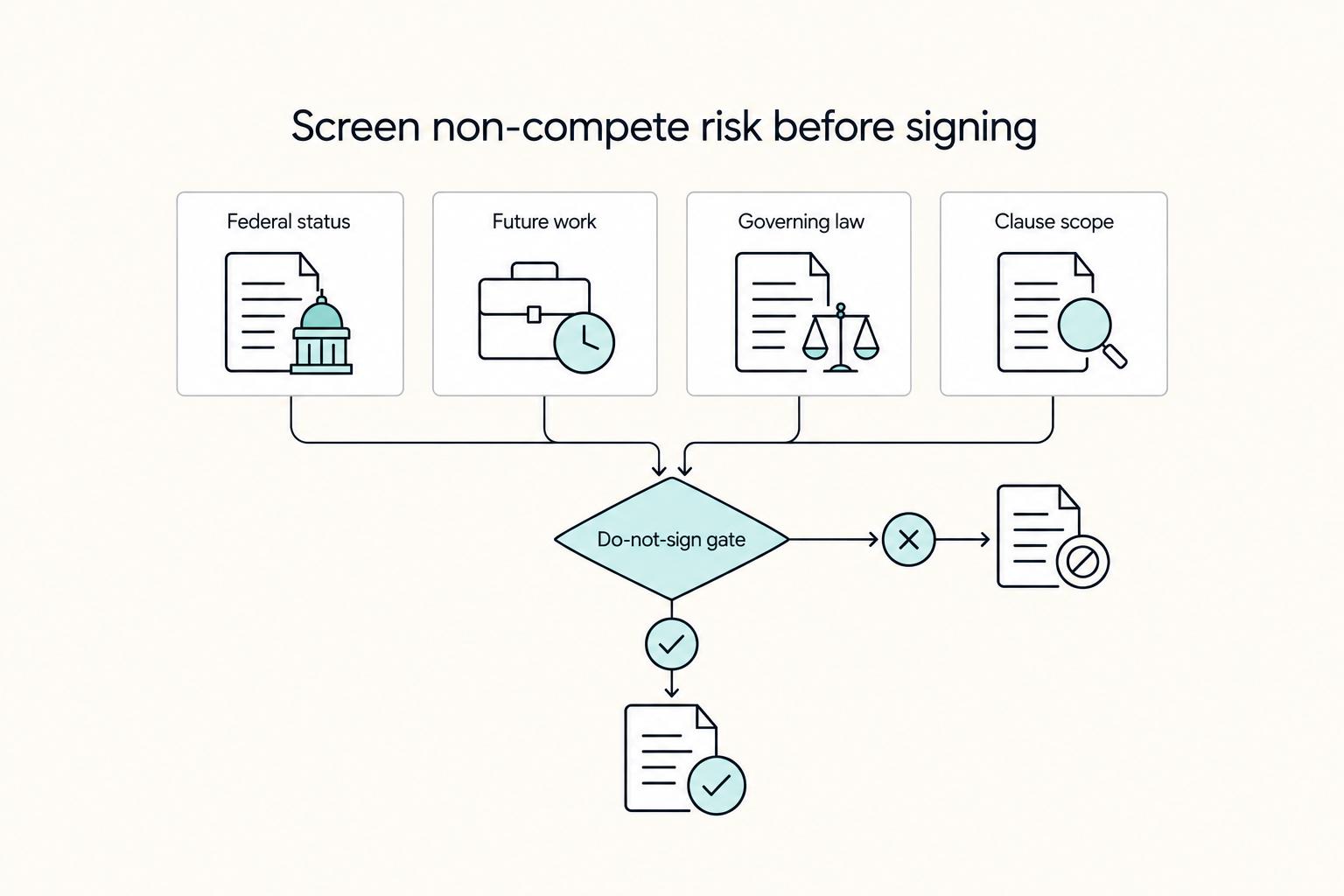
Quick Answer
No. The FTC non-compete rule is not in effect or enforceable, so freelancers should treat restrictive language as a live contract risk. Before signing, review the exact restraint text, governing law, forum, classification language, and incorporated terms. If the clause is broad, negotiate it down or swap in tighter confidentiality, IP, or non-solicitation protections.
Why Your Contract Still Drives Your Non-Compete Risk#
The practical issue is simple. You can still be asked to sign restrictive language that limits future clients or service lines, even though the federal rule is not in effect. The FTC's 2024 rule was stopped on August 20, 2024, before its planned September 4, 2024 effective date. In 2025, the Commission voted to dismiss its appeal and accede to vacatur, and it later removed the Non-Compete Rule from the Code of Federal Regulations effective February 12, 2026.
So your real risk sits in the contract. Confirm what the clause says, which state law governs the agreement, and how the contract classifies your role. Noncompete enforceability has long been reviewed under state law rather than one nationwide rule.
Use this guide as a three-step method for the moments that matter most:
- Assess: Verify governing law, your classification, and the exact trigger for the restriction, including whether it applies after termination or only during the engagement.
- Negotiate: Narrow the clause to specific competitors, a defined service scope, and a short duration, or push to remove it before work starts.
- Neutralize: If the client has a legitimate concern, offer tighter confidentiality, IP, and non-solicitation terms instead of a broad post-engagement restraint.
A common mistake is assuming the 2024 FTC noncompete rule settled your contract risk. It did not. Another is focusing on rates and payment terms while missing restrictive language buried in legal sections, attachments, or later amendments. Keep the draft, your redlines, and written confirmation of any carveout so the final paper trail matches the deal you think you made.
Review the actual restriction alongside worker status and applicable law before signing. The following screen helps identify business impact and drafting issues; it does not decide enforceability for an individual contract.
The Intelligence Briefing: What Is the Real Status of the FTC Non-Compete Ban?#
The practical answer: the federal rule is not in effect and not enforceable, so do not assume a future nationwide outcome will fix a broad restraint after you sign. Check the restraint text, governing law, forum, and worker-classification language before you assume you are protected.
| Date | Event | Article wording |
|---|---|---|
| April 23, 2024 | Final rule announced | The FTC announced the final rule |
| August 20, 2024 | District court order | Stopped FTC enforcement |
| September 4, 2024 | Planned effective date | The rule was stopped before this date |
| October 18, 2024 | FTC appeal | The FTC appealed |
| September 5, 2025 | Steps to dismiss appeal | The FTC said it took steps to dismiss its Fifth Circuit appeal |
| February 12, 2026 | Removed from the Code of Federal Regulations | The Non-Compete Rule was removed effective on this date |
The timeline separates the unsuccessful nationwide rule from contract-specific risk. The FTC confirms that the rule is not in effect and is not enforceable. Removal from the CFR does not prevent separate enforcement under existing law: the FTC’s November 2025 Gateway order, for example, prohibited that company from enforcing specified noncompetes.
| Track | Who it affects | Where risk shows up | Reader action |
|---|---|---|---|
| Federal rule track | Anyone expecting the FTC rule to void a clause automatically | Reliance on a rule that is currently not in effect | Treat restrictions as a live drafting issue and negotiate before signing |
| Separate agency enforcement | Workers affected by a particular unlawful restraint | The FTC may pursue particular agreements under existing law despite the nationwide rule’s removal | Do not assume either automatic cancellation or the absence of enforcement; review the agreement and applicable law |
| State-law contract risk | Anyone with governing-law and forum clauses in their agreement | Governing-law clause, forum clause, and restraint wording | Review those terms together before deciding whether risk is acceptable |
What to verify before you rely on any assumption#
Before you debate fairness or enforceability, make sure you have the full contract picture:
| Check | Where to look | Why it matters |
|---|---|---|
| Restraint text | Non-compete, exclusivity, conflict, restricted services, or post-termination covenant | The restraint may appear under different labels |
| Governing law and forum | Governing-law clause plus venue or arbitration terms | A favorable governing-law clause may still be costly if venue or arbitration terms are burdensome |
| Classification language | Main contract and attachments | Confirm how the agreement describes your role across documents |
| Incorporated restrictions | Exhibits, IP terms, policies, or amendments | Limits are often spread across incorporated terms |
| Negotiation record | Drafts, redlines, and written carveout confirmations | The final paper trail should match the deal |
Work through those five checks before you decide the clause is harmless, and keep drafts, redlines, and written carveout confirmations so the final paper trail matches the deal.
For independent contractors, do not assume the current federal rule status resolves this risk for you. A broad restraint can still limit future client work depending on contract terms and applicable law. If the clause reaches a wide competitor set, multiple service lines, or multiple markets after the engagement ends, treat it as a material business risk. In cross-border contracts, governing law and forum mechanics may add complexity. For related context, see What is a 'Restrictive Covenant' in an Employment Agreement?.
Your Personal Risk Matrix: How to Measure Your Non-Compete Exposure#
Use this as a business-risk screen before signing or renewing. Consider the impact on future work, enforcement pressure and applicable law, then scan the clause itself. A material restriction deserves review even if it is the only issue; counting red flags cannot establish legal safety.
Review the three lenses first#
Start with business impact, then move to enforcement posture and governing law. That sequence usually tells you faster whether you are looking at routine cleanup or a clause that can materially affect your pipeline.
- Industry and role exposure
- Would this clause block a meaningful share of how you actually earn?
- Could "competitive services" be read to cover adjacent services such as advisory, implementation, or other core offers?
- Does the restriction conflict with your current statement of work, service descriptions, and active pipeline?
- Client enforcement posture
- Does the contract include aggressive enforcement mechanics such as fast injunctive relief language, one-sided fee pressure, or broad enforcement rights?
- Is the restriction repeated outside the main clause in IP terms, exhibits, policies, or incorporated documents?
- Are you relying on verbal comfort instead of narrowed written terms?
- Governing-law exposure
- Which law governs the clause, and where must disputes be heard?
- Does forum location create cost or leverage pressure even if enforceability is debatable?
- If you are Washington-based, do forum and choice-of-law terms conflict with Washington protections for covered noncompetes?
| Legal environment type | Likely enforceability posture | Your default contract response |
|---|---|---|
| Broad void or near-void rule | Some states broadly void covered noncompetes, with exceptions. Minnesota’s statute includes independent contractors in its employee definition; agreement timing and statutory exceptions still matter. | Redline overbroad text anyway; a weak clause can still create cost and pressure |
| Conditional statutory rule | Enforceability depends on statutory conditions, such as in Oregon | Verify each statutory condition against your facts before signing |
| Washington-based signer protections | For 2026, Washington earnings thresholds are $126,858.83 for employees and $317,147.09 for independent contractors, measured from the enforcing party. The over-18-month presumption is in the employee provision. Covered law/forum protections also apply. Beginning June 30, 2027, enacted law makes all covered noncompetition covenants void regardless of when entered. | Match your status, earnings, duration, and law/forum terms to the statute, then redline conflicts |
Scan the clause like an operator#
Once the three lenses show you the pressure points, read the clause line by line. You are looking for the terms that quietly expand scope or make a fight expensive. Check these terms in order:
- Governing law
- Forum/venue
- Definition of "competitive services"
- Affiliate coverage such as parent, subsidiary, or future affiliates
- Geographic reach
- Post-termination survival language
- Whether parallel restrictions reappear in exhibits, policies, or incorporated terms
Treat broad planned-business language, a global forum with no practical tie, expansive affiliate definitions, and open-ended survival language as high-friction drafting risks.
Triage your result#
At this point, make a decision instead of collecting more ambiguity:
- Lower apparent business exposure: narrow services, bounded duration and a workable forum. Confirm applicable statutory conditions and the final text; these features alone do not establish enforceability.
- Medium exposure: one material issue such as broad affiliate coverage or a hard forum clause.
Next action: redline before signing. - High exposure: multiple lens red flags, cross-border forum pressure, or language that could block a major share of your market.
Next action: escalate for legal review before you commit.
How to Negotiate Restrictive Terms Before You Sign#
When the risk matrix shows friction, negotiate the text early and directly instead of debating headlines. Your goal is to protect the client's real interests without agreeing to language that can overreach your future work.
Start at proposal stage#
A good time to surface this issue is before legal sends the final paper. Raise restrictions early, and frame the discussion around what you can agree to: confidentiality, deliverables, and client relationship protections.
You can use this script: "I operate as an independent business and can agree to strong confidentiality and project-specific protections. I cannot agree to broad restrictions on unrelated future client work. If your standard terms include post-engagement restraints, please share them in the first draft."
Ask for the full contract set at the same time: main agreement, SOW, exhibits, policies, portal terms, and incorporated guidelines.
Review scope, space, and span in that order#
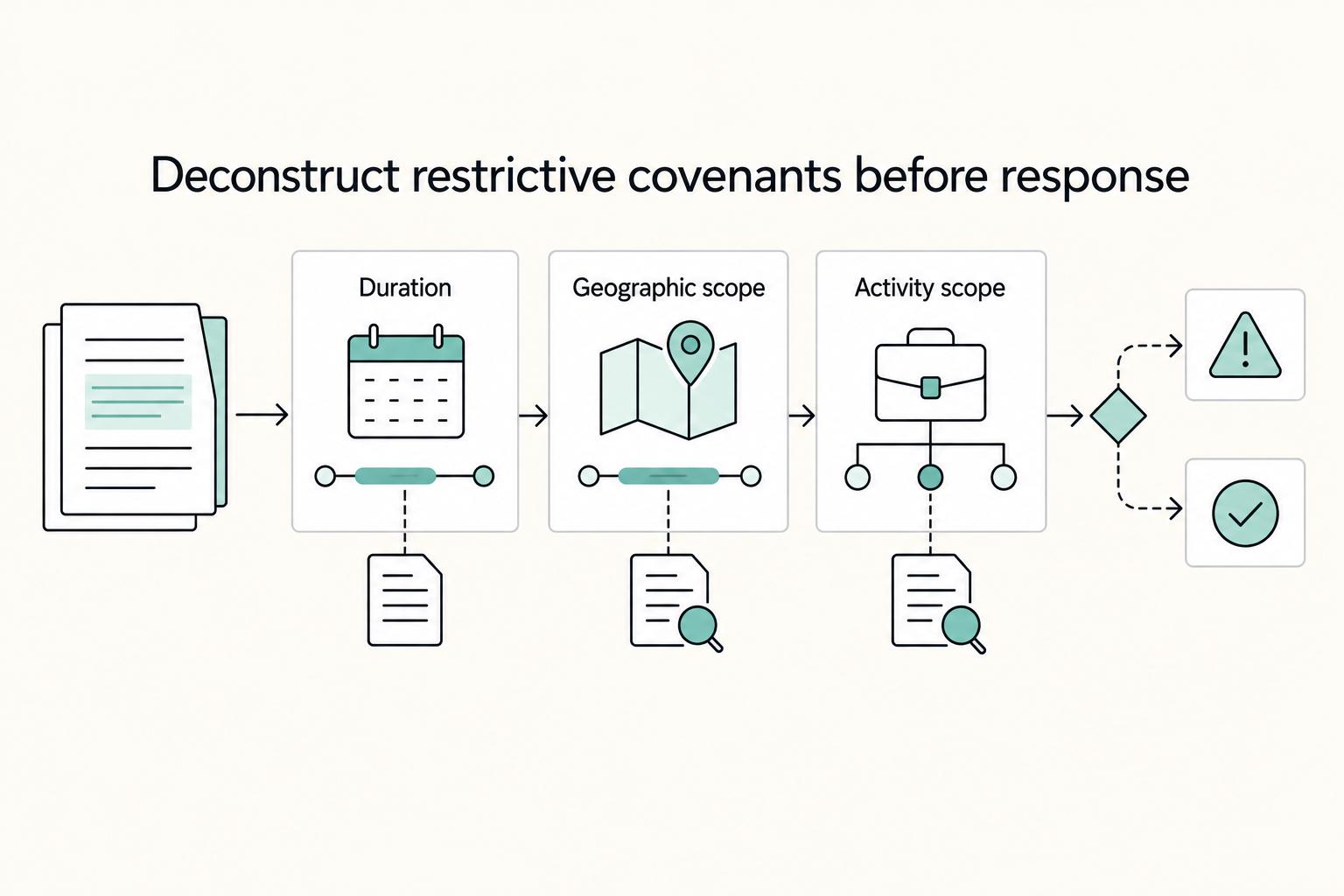
Use this order to get to business impact quickly. Treat it as a practical review framework, not an FTC-defined legal test.
| Dimension | Question | Drafting concern |
|---|---|---|
| Scope | Is the restriction limited to clearly defined competitive activity? | Broad wording can capture unrelated services |
| Space | Is the geographic reach tied to the actual engagement? | Reach may be broad without a defined business need |
| Span | Does the restriction end on a fixed date? | Open-ended or survival wording can continue the restriction |
Then check the control terms that can change negotiation risk even when the main wording looks negotiable: governing law, venue or forum, affiliate definitions, and survival language.
If the client cites a law or agency decision, ask for the provision and its effective date. A rule announcement, a court order and a law taking effect next year can have different implications for the contract you are signing today.
Use short revision scripts#
Use these prompts to discuss narrower drafting; a narrower restriction still needs to comply with applicable law.
- Scope: "I can agree to limits tied to the named competitors or the specific service category, not all work in the relevant industry."
- Space: "Please remove the geographic restriction or limit it to the defined market relevant to this engagement."
- Span: "Please set any post-engagement restriction to a fixed end date and avoid open-ended survival wording."
- Law/forum: "Please revise governing law and venue to [preferred jurisdiction], or remove terms that make dispute handling impractical."
- Affiliates/survival: "Please limit 'Affiliate' to entities directly involved in this project and confirm survival applies only to confidentiality/payment terms, not broad future-work limits."
- Threshold placeholder: "If this term depends on a statutory threshold, insert the current verified figure before signature."
Before you sign, compare your redline, acceptance emails, clean execution copy, and incorporated documents side by side.
Choose a fallback structure, not just an objection#
A good fallback does more than say no. It gives the client a cleaner way to protect the interest they actually care about.
| Option | Client protection goal | Potential impact on freelancer mobility | Typical negotiation difficulty |
|---|---|---|---|
| Broad non-compete | Broad competitive risk control | Higher | Higher |
| Narrowed non-compete | Targeted protection for defined activity | Moderate | Moderate |
| Non-solicit plus NDA | Protect relationships and confidential information directly | Lower | Low to moderate |
If helpful, position a targeted non-solicit plus NDA as an alternative structure to discuss. For deeper context, see A Guide to Non-Solicitation and Non-Compete Clauses.
Escalation path before signature#
Keep negotiating when the other side is engaging and the problem is mainly drafting scope. Pause signature when scope, geography, affiliate coverage, or survival language stays broad or unclear.
Get counsel involved before signing when terms are cross-border, law or forum terms add practical pressure, or restrictions appear across multiple documents. You might also find this useful: A Deep Dive into the 'Confidentiality' vs. 'Non-Disclosure' distinction in contracts. Before you send redlines, draft a tighter fallback package with the Freelance Contract Generator.
Three Checks to Run on Any Restrictive Clause#
Treat this as routine risk control before you sign. Focus on three checks: whether the clause can block or penalize your future work, which governing law will apply if a dispute happens, and whether the restriction is narrowly tied to a stated business concern.
Start with the clause, not the label#
Read the term for what it does, not what it is called. If it prohibits future work, penalizes you for it, or effectively prevents you from working in your field, treat it as a non-compete in practice, even if it appears in an appendix or policy.
Because the rule is not in effect and not enforceable, contract text still drives your day-to-day risk. Review the full execution stack side by side: main agreement, SOW, exhibits, portal terms, and incorporated policies. A risk to watch for is narrowed language in redline followed by broader text returning in the final package.
Check governing law before you debate fairness#
Read the governing-law clause and forum terms together, then check whether mandatory protections override the chosen law. The contract’s label alone does not settle which law a court will apply.
If your MSA, SOW, platform terms, or acceptance flow point to different legal frameworks, treat that as an enforceability issue, not just a drafting inconsistency. In cross-border deals, escalate earlier, not later.
Narrow overreach or propose a targeted swap#
When the client raises a legitimate protection concern, ask for edits that match that concern: defined scope, fixed end date, and no blanket geography or industry-wide reach. Broad drafting can create risk. In the Gateway matter, the FTC described restrictions that typically barred workers from the pet cremation service industry anywhere in the U.S. for one year.
If a broad future-work ban is the sticking point, propose a narrower structure, such as targeted non-solicitation language plus a tight NDA, and confirm that approach under the contract's governing law. That keeps protections focused on relationships and confidential information instead of unrelated future work.
What to do now#
- Verify governing law in the execution copy and every incorporated document.
- Flag any term that blocks, penalizes, or effectively prevents future work.
- Redline scope, duration, and geography so they match the actual engagement.
- Consider a targeted non-solicitation clause plus NDA as a narrower alternative where appropriate.
- Pause and get legal review if the deal is cross-border, documents conflict, or enforceability is unclear.
Keep the full contract record, including drafts, redlines, incorporated terms, and acceptance emails. Clear documentation and timely escalation protect your autonomy when the legal footing is uncertain. We covered this in detail in A Biotech Consultant's Guide to IP Protection in Contracts. If a client pushes a broad restriction, propose a narrower confidentiality path using the NDA Generator.
Frequently Asked Questions
Is the FTC ban on non-competes active right now?
No. The 2024 FTC Noncompete Rule never took effect after the August 20, 2024 court order, and the FTC removed it from the CFR effective February 12, 2026. State law and separate enforcement under existing law can still affect a particular restriction.
If the rule is not in effect, should I accept a broad clause?
An inactive nationwide rule does not make a broad restriction safe to accept or automatically enforceable. Review what future work it restricts, the relevant state protections, governing law and forum; negotiate the language before signing.
When should I treat a clause as a serious red flag?
Flag a clause that reaches unrelated service lines, future affiliates, a large part of your client market or an indefinite post-engagement period. These are business-risk signals rather than a legal test. A single material issue can justify legal review.
What should I say back to the client?
Use a short script: "The FTC rule is currently not in effect, but I need these terms clarified in writing and legally reviewed before I sign."
Which law controls whether the clause is enforceable?
Start with the governing-law and forum clauses, then check mandatory protections tied to where you live and work. A contract’s choice of law may not override those protections. Conflicting terms across the MSA, SOW and policies need resolution before signature.
What should I check before I sign?
Compare the execution copy with your redlines and written approvals, including every incorporated document. Check the restricted services and parties, duration, geography, governing law, forum and remedies; confirm that any agreed carveout appears in the final text.
What if the client says the clause is "standard"?
“Standard” wording does not establish enforceability or make it suitable for your business. Ask the client to explain the interest being protected and narrow the text to that interest, subject to applicable law.
When should I stop negotiating and get legal review?
Get legal review before signing when a material restriction remains unclear, the contract spans jurisdictions, documents conflict or the law/forum terms make a dispute costly. Negotiation can clarify business terms, but it does not replace checking enforceability.
Try a related tool
Researched and edited by the Gruv editorial team. Gruv builds cross-border billing, payouts, and finance-operations software for global businesses.
Sources
- app.leg.wa.gov/RCW/default.aspxtrusted
- app.leg.wa.gov/RCW/default.aspxtrusted
- federalregister.gov/documents/2026/02/12/2026-02866/revision-of-...trusted
- federalregister.gov/documents/2023/01/19/2023-00414/non-compete-...trusted
- ftc.gov/news-events/news/press-releases/2024/04/ftc-...trusted
- ftc.gov/legal-library/browse/rules/noncompete-ruletrusted
- lni.wa.gov/workers-rights/workplace-policies/non-compet...trusted
- oregonlegislature.gov/bills_laws/ors/ors653.htmltrusted
Educational content only. Not legal, tax, or financial advice.
Related Posts

Non-Solicitation vs Non-Compete for Freelancers and Consultants
Choose the narrowest restrictive covenant that protects a real risk and still lets you keep earning. For freelancers and consultants with multiple engagements, broad restrictions can cut off pipeline long before any dispute starts.
What is a 'Restrictive Covenant' in an Employment Agreement?
For a global professional, autonomy isn't a benefit; it's the business model. It is the core asset—the very product—you offer to the market.

The Freelance Payment Penalty: A Modeled Audit of Platform Fees, FX Spreads, and Payout Delays
The money rarely disappears through a single, easy-to-spot fee. The real loss is stacked. A marketplace takes its commission, a processor adds a charge for international cards, a bank or payment company converts the currency at a spread, a platform holds the funds before release, and a wire sheds a little to intermediaries on the way in. Each layer looks defensible on its own, but the worker feels the combined result as a smaller deposit and a later payday.