
Quick Answer
U.S. yacht crew working abroad can claim the Foreign Earned Income Exclusion only if they can support a foreign tax home, meet a qualifying test such as 330 full days in a 12-month period under the Physical Presence Test, and file Form 2555 with their return. The article recommends conservative day counting, full income reporting, and strong contract, travel, and pay records.
A lot of the stress U.S. yacht crew feel around taxes comes from not having a clear process. The rules can be technical, but the bigger problem is usually inconsistent records, assumptions, and last-minute filing. What you need is a practical way to make the claim, support it, and file it cleanly.
This guide gives you that process. The goal is not to stretch the rules. It is to handle the Foreign Earned Income Exclusion with the same discipline you bring to the job.
Step 1: Establish Your Foundation (The Tax Home Test)#
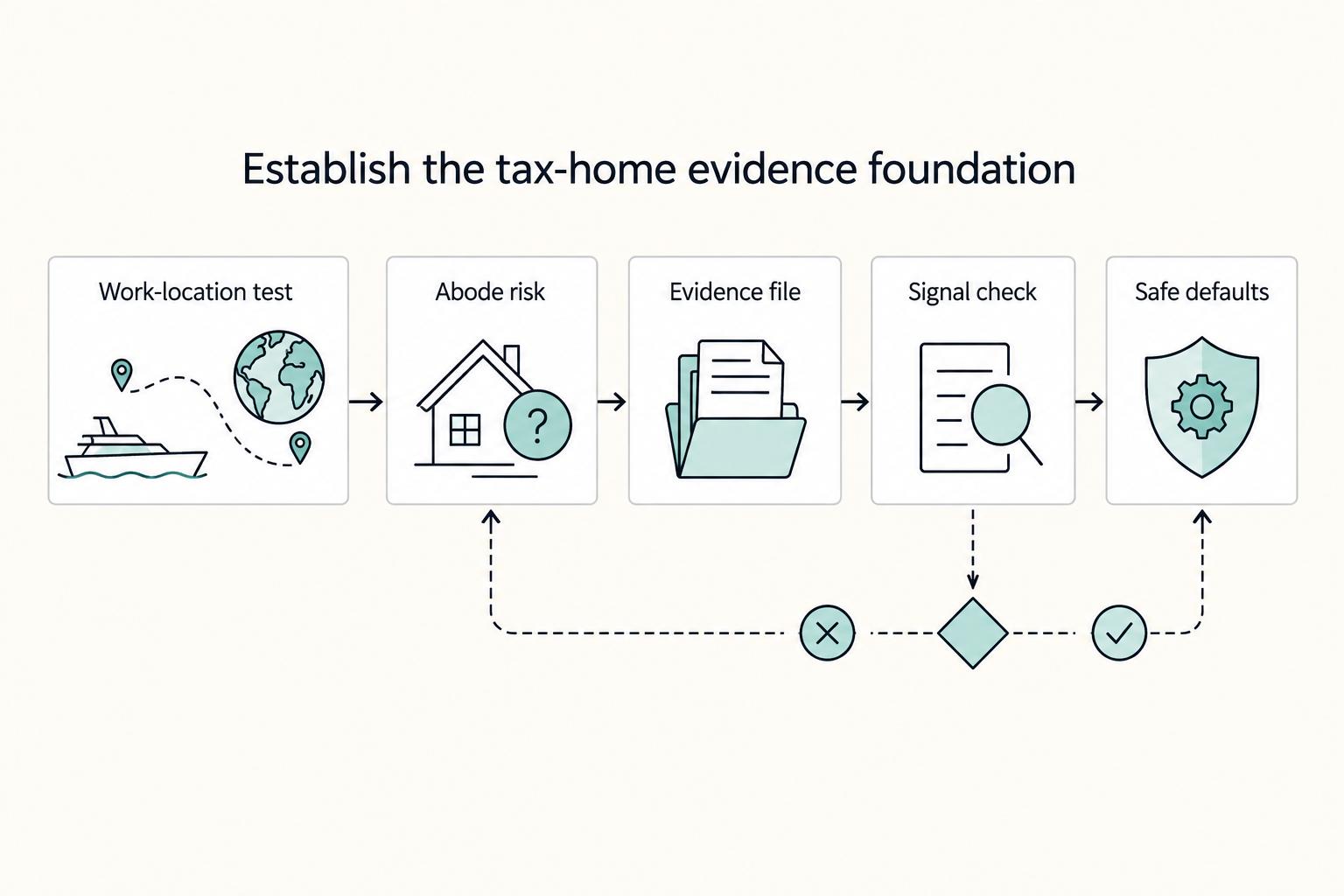
Your position starts here: first confirm a foreign tax home, then test whether your U.S. abode facts pull that claim back into the United States.
Start with the work-location test#
For the exclusion, your tax home is the general area of your main place of business, employment, or post of duty. Treat this as a work-location test, not a personal "where home feels like" test.
For yacht crew, the practical question is simple: where were you actually posted and working, and can you prove it with records? Do not assume a foreign flag or yacht job title is enough. Your tax home must be in a foreign country throughout the qualifying period. For this rule, a foreign country includes territorial waters and airspace, but not international waters, and territorial waters are within 12 nautical miles of that foreign country.
Then check the abode risk#
Once the work-based tax-home case is in place, check abode risk. Abode turns on your family, economic, and personal ties. If your abode is in the United States for a period, you are not treated as having a foreign tax home for that period.
Two shortcuts are not reliable on their own:
- Keeping a U.S. dwelling does not automatically mean your abode is in the United States.
- Constant travel by itself does not automatically resolve abode risk.
If you have no regular main place of business and no regular place you live, you may be treated as itinerant, and your tax home is where you work. You still need to show your work base was in a foreign country and that your overall ties do not point back to a U.S. abode.
Build your evidence file from the contract outward#
Your Seaman's Employment Agreement (SEA) or employment contract is a starting point, but it is not enough on its own. Before you rely on it, confirm it clearly shows your employer and vessel, your role, your employment dates, and any stated post of duty, operating area, or foreign assignment details.
| Item | Section detail | Use in the file |
|---|---|---|
| SEA or employment contract | Verify employer and vessel, role, employment dates, and stated post of duty, operating area, or foreign assignment details if included | Starting point before you rely on it |
| Signed contract versions and amendments | Keep signed versions and amendments | Shows the contract matched reality |
| Pay records | Keep pay records | Shows the contract matched reality |
| Vessel itinerary or port-call records | Keep itinerary or port-call records | Shows the contract matched reality |
| Travel records | Keep arrival and departure dates | Shows the contract matched reality and supports qualifying-period details |
| Visa or residence details | Keep if you later use bona fide residence | Supports residence-period details if you use bona fide residence |
If the contract is vague, for example with broad "worldwide" language, or it does not match actual vessel operations, flag it early for advisor review. Then keep the records that show the contract matched reality.
This file supports Form 2555 reporting, including your tax home and the date it was established. It also supports qualifying-period details if you use the physical presence test, including arrival and departure dates, and visa or residence-period details if you use bona fide residence. Missing requested Form 2555 information can lead to disallowance.
Quick signal check#
| Helps support foreign tax home | Can signal ongoing U.S. abode | What to verify |
|---|---|---|
| Signed crew contract tied to foreign-country duty or regular work in foreign territorial waters | U.S. residence is still your normal off-hitch base | Contract terms match actual vessel schedule |
| Port logs, itineraries, and travel records show repeated foreign-port work patterns | Family, economic, and personal ties remain centered in one U.S. location | Evaluate the full pattern, not one data point |
| Visa or residence records support longer-term presence abroad (if claiming bona fide residence) | U.S. records or life pattern still show the U.S. as your practical home base | Borderline facts need professional review |
| Records show duties in foreign territorial waters, not mainly international waters | Repeated returns to the same U.S. dwelling between contracts | International waters are not a foreign country for the exclusion |
Safe-default next actions#
- Set up your file now: signed SEA or contract, amendments, pay records, port logs, travel records, and a note of when your tax home was established.
- Maintain records as you go: keep itinerary and arrival and departure dates current so Form 2555 preparation stays straightforward.
- Escalate early if facts are mixed: vague contract terms, heavy time in international waters, or substantial ongoing U.S. ties are all reasons to get a review.
If this step holds up, the next job is day counting. If you want a deeper dive, read the digital nomad tax guide.
Step 2: Master Your Calendar (The Physical Presence Test)#
This is the part where control matters most. Confirm the current day-count rules first, classify each date conservatively, then test the period you plan to claim against records you can defend.
Verify the rule before you count anything#
Do not rely on memory, crew folklore, or old summaries for day-count treatment. For this section, the FEIE day threshold, transit-day treatment, international-waters treatment, and U.S. territory treatment should be confirmed from current primary FEIE authority or with a qualified tax professional before you count days in your favor.
Publication 17 can still help as context, but it says it reflects IRS interpretations and is not a substitute for law or a complete source. It also directs readers to check IRS.gov/Pub17 for future developments. Use this sequence:
- Confirm current day-classification rules from primary authority or advisor guidance.
- Classify every date based on where you were physically located.
- Recheck the period you intend to rely on before filing.
If a day is ambiguous, leave it uncounted until you can support it.
Classify each day with a conservative matrix#
Use three labels in your log: provisional qualifying, provisional nonqualifying, and needs rule verification.
| Yacht-routing scenario | Counts as qualifying day now? | Working label | Safe-default action |
|---|---|---|---|
| Full day in a foreign port or clearly within a foreign country's territorial area | Confirm with the relevant authority | Provisional qualifying | Keep provisional only; count only after current authority or advisor guidance confirms treatment and your records support it |
| Full day in a U.S. port, marina, or shipyard | Confirm with the relevant authority | Provisional nonqualifying | Keep as nonqualifying in your internal draft unless current rule text supports a different result |
| Full day in international waters | Confirm with the relevant authority | Needs rule verification | Do not count until current authority confirms treatment |
| Depart U.S. port and end offshore on the same date | Confirm with the relevant authority | Needs rule verification | Hold uncounted pending confirmed arrival and departure treatment |
| Arrive in the U.S. from offshore or from a foreign port | Confirm with the relevant authority | Needs rule verification | Hold uncounted pending confirmed partial-day treatment |
| U.S. transit or layover between foreign points | Confirm with the relevant authority | Needs rule verification | Hold uncounted until rule treatment is confirmed |
| Full day in Puerto Rico, Guam, U.S. Virgin Islands, or another U.S. territory | Confirm with the relevant authority | Needs rule verification | Hold uncounted until territory treatment is confirmed |
Run an audit-ready daily log workflow#
Your log should let a third party reconstruct your movement without guessing.
- Consider recording each day with: date, vessel, claimed location, classification label, and a brief basis note.
- Link evidence as you go where available: passport activity, flight records, crew travel bookings, itinerary or port records, shipyard or marina documents, payroll timing, and employer travel instructions.
- Reconcile on a regular cadence, for example monthly: resolve conflicts between your log and third-party records before filing.
- Keep corrections transparent: preserve the original entry, note the revision, and explain why the classification changed.
If records are missing or conflicting, treat the day as uncounted until you resolve it.
Risk checklist for common traps#
Before you lock in the period you plan to claim, run this check:
| Trap | Default handling |
|---|---|
| Shipyard stays | Do not assume sleeping onboard changes classification without confirmed rule support |
| U.S. territories | Do not treat them as foreign-country days without confirmed rule support |
| Transit days | Do not classify them from memory or ticket summaries alone |
| Ambiguous dates | Default to nonqualifying or uncounted until documented |
Escalate to a pro when complexity clusters#
Get a professional review before filing Form 1040 or 1040-SR if any of these apply:
- mixed itineraries across foreign ports, international waters, U.S. stops, and U.S. territories
- frequent U.S. touchpoints, including shipyard periods, repeated U.S. transit, or frequent crew-change entries
- multiple days that cannot be classified without assumptions
- repeated mismatches between your personal log and third-party records
The point is not to push every close call your way. Count only the days you can prove. Related: 183-Day Rule Explained: Stop the Tax Myths Before They Cost You.
Step 3: File with Confidence (The Audit-Proofing Process)#
Even a valid claim fails if the return is filed incorrectly. Report the income on your U.S. return, then claim the exclusion through the current filing process in your software or with your preparer, even if you expect little or no tax due. To claim FEIE-related benefits, you must have foreign earned income and a foreign tax home.
The common mistake is skipping income reporting because you expect it to be excluded. Do not do that. Before filing, confirm the annual cap for the tax year you are filing, then apply it correctly on the return. The IRS cap is $130,000 for 2025 and $132,900 for 2026, and part-year qualification requires a qualifying-day adjustment.
Pick the most defensible 12 month window#
Choose the window you can prove, not the one that only looks best in a spreadsheet. Test each candidate 12 consecutive months that includes part of the tax year. Confirm at least 330 full days, and remember a full day is 24 consecutive hours from midnight to midnight in a foreign country or countries. Those 330 days do not need to be consecutive.
If you do not reach 330 full days, the physical presence test fails regardless of the reason, and days spent in a foreign country in violation of U.S. law are not treated as qualifying presence.
Once you select a window, line up all records to that same period. Also reconcile income timing. The excludable amount is tied to when the income was earned, not just when it was paid.
Build the evidence pack before you submit#
Set up one filing folder for each tax year with:
| Evidence category | What it should show |
|---|---|
| Foreign-earned income records | Compensation for services and when that income was earned |
| Tax-home support | Your foreign tax home position for the period claimed |
| Day-count proof | A daily record that identifies full qualifying days and non-qualifying days |
| Travel/location support | Records that help substantiate the day count and selected 12-month window |
Then pressure-test the file against common weak points:
| Scenario | Strong documentation pattern | Weak documentation pattern | Common failure point |
|---|---|---|---|
| Choosing among multiple 12-month windows | One selected window clearly documented with 330+ full qualifying days | Window chosen for outcome without clear day-level support | Insufficient proof of qualifying days |
| Day count near the threshold | Full-day logs reconciled to travel or location records | Partial-day assumptions or unexplained gaps | Days that do not qualify as full days |
| Part-year qualifier | Qualifying-day adjustment shown and tied to the selected window | Full-year exclusion applied without qualifying-day adjustment | Overstated exclusion amount |
| Housing exclusion also claimed | FEIE amount reduced to reflect housing exclusion | FEIE claimed without reducing for housing exclusion | Exclusion computed above allowed amount |
Final checkpoint before filing: confirm your foreign earned income, foreign tax home, selected window, day-count math, and income timing all align. If your records do not support the filing position, resolve the mismatch or escalate to a qualified cross-border tax professional.
You might also find this useful: The Physical Presence Test: A Day-by-Day Guide for the FEIE.
Before you file, run your travel log through the Tax Residency Tracker so your day counts and supporting notes are organized in one place.
Confirm tax home, day count, and exclusion math before filing#
A strong filing has three things working together: your tax home is in a foreign country, your count reaches 330 full days in a 12 consecutive months period, and your return reports the income with an exclusion calculation your records support.
That is the baseline for claiming FEIE, including for yacht crew. Before you file, verify your count using the IRS full-day rule: 24 consecutive hours, midnight to midnight. Missing 330 fails the physical presence test no matter why the days were missed.
Your next move#
| Your current position | What to do next |
|---|---|
| On track | Lock your best 12-month window, confirm your tax-home position is still abroad, and keep the worksheet that ties qualifying days to the filing year. |
| Missing records | Rebuild your day log before filing and reconcile dates to your travel and work records. If records conflict, pause and resolve the conflict first. |
| Mixed U.S. ties | Re-check whether your tax-home position still points to the U.S. If your work pattern is abroad but your ties are mixed, get a professional review before claiming the exclusion. |
| State-risk uncertainty | Treat federal eligibility and state filing exposure as potentially separate decisions, and resolve state uncertainty before you submit. |
If you qualify for only part of the year, adjust the maximum exclusion by qualifying days. For 2026, the maximum FEIE is $132,900 per person, limited to foreign earned income and your supported qualifying period.
As a safe default for your next filing cycle:
- maintain continuous day-count, travel, and work records
- reconcile the log to the dates, income, and qualifying period used on the return
- confirm tax home, the
330-daytest, and the exclusion calculation all support the same filing position
Bring in a cross-border tax professional when:
- your residency signals conflict, especially around tax home or conflicting U.S. ties
- your logs are incomplete, reconstructed late, or inconsistent with other records
- your state domicile exposure is unclear and you cannot make a defensible filing position
For a step-by-step walkthrough, see US Estimated Taxes for Freelancers Abroad With FEIE in the Mix.
If you want a quick sanity check on exclusion planning before you escalate to a tax pro, start with the FEIE Calculator.
Frequently Asked Questions
Should you use the Physical Presence Test or the Bona Fide Residence Test?
For most yacht crew, the safer default is the Physical Presence Test because it is objective and based on 330 full days in a 12-month period. The Bona Fide Residence Test depends on facts and circumstances, and living abroad for one year by itself does not automatically qualify you. Use day count unless your facts clearly support bona fide residence.
Can you keep a U.S. mailing address or bank account?
Yes, but those facts can still hurt you if they support the view that your abode is in the United States. If your personal base still looks U.S.-centered, you can fail the tax-home test even with substantial time abroad. Keep address and account use administrative only and keep records showing your work base and qualifying period stayed abroad.
If your pay goes into a U.S. account, is it still foreign earned income?
Yes. The deposit location does not control sourcing for personal-service income, because the key factor is where you performed the services. Classify income by work location first, then support it with pay records, contract dates, itinerary extracts, and travel logs.
What if you miss 330 days by a few days, or spend time in international waters?
If you do not hit 330 full days, that 12-month window fails even if the shortfall came from illness, family issues, vacation, or employer orders. A qualifying day is 24 consecutive hours from midnight to midnight, and time on or over international waters does not count as foreign-country time. Test multiple 12-month windows and keep international-water days separate from foreign-country days in your log.
Do you still need to file if the exclusion wipes out your U.S. income tax?
Yes. You still report the income and claim the exclusion by attaching Form 2555 to Form 1040 or 1040X, and you do not file Form 2555 by itself. File even if tax due looks low, confirm the annual cap for the filing year, and remember the exclusion does not reduce self-employment tax.
Try a related tool
Researched and edited by the Gruv editorial team. Gruv builds cross-border billing, payouts, and finance-operations software for global businesses.
Sources
Educational content only. Not legal, tax, or financial advice.
Related Posts

Digital Nomad Taxes in 2026 With a Defensible Filing Plan
With digital nomad taxes, the first move is not optimization. It is figuring out where you may be taxable, where filings may be required, and what proof supports that position.

183-Day Rule Tax Myths That Trigger Residency Filing Mistakes
If you are a mobile freelancer or consultant, start here: the "183 day rule tax" idea is not a single universal test. It is a shortcut phrase people use for different residency rules that do not ask the same question. If you mix federal and non-federal residency logic, you can create filing risk even when your travel calendar looks clean.

The Physical Presence Test: A Day-by-Day Guide for the FEIE
Start with one objective: qualify for the Foreign Earned Income Exclusion through the Physical Presence Test using facts you can prove, not assumptions you hope survive review. This is not a loophole hunt, and it is not just a math exercise. The goal is a filing position that is clear, repeatable, and defensible.