
Quick Answer
No: for most unpaid client invoices between businesses, the fair debt collection practices act is not the rule that controls your next step. Start with your signed agreement, invoice trail, and applicable state law, then follow a documented sequence from reminder to formal demand. Pause for legal review when debt purpose is mixed, an individual debtor is involved, or representation issues appear.
Why the FDCPA is a Red Herring for Your Business (And What Actually Matters)#
If you are collecting an unpaid invoice from a business client, the Fair Debt Collection Practices Act (FDCPA) usually should not drive your next step. Start by classifying the debt, confirming whether you are collecting your own receivable or for someone else, reviewing your contract terms, and checking applicable state law.
The issue is scope. The FDCPA is aimed at consumer-purpose debt and debt collectors, while business debt is generally outside that core coverage. For overdue B2B work, your first legal anchor is usually the agreement and transaction record, not consumer collection rules.
What usually governs instead#
For most freelancers and consultants, your strongest collection position comes from contract law: the enforceable obligations in your MSA, SOW, proposal, or service agreement.
| Source | When it matters | What to review |
|---|---|---|
| Contract law | For most freelancers and consultants | MSA, SOW, proposal, or service agreement |
| UCC Article 2 | When the transaction is for goods | Whether the dispute is about delivered goods or a purely services engagement |
| State law | When state debt collection rules or stronger consumer protections may matter | Applicable state debt collection rules in addition to federal scope |
UCC Article 2 can matter, but only when the transaction is for goods. If the dispute is about delivered goods, those rules may be relevant. If the engagement is purely services, do not assume Article 2 controls.
State law still matters. Federal law does not displace all state debt collection rules, and states can provide stronger consumer protections. That does not automatically turn your B2B invoice into a consumer-debt case, but it does mean federal scope is only one part of the analysis.
Quick scope test#
| Situation | Debt type | Who is mainly regulated | What triggers risk | What you should do next |
|---|---|---|---|---|
| You hired a third party to collect a personal credit card or medical debt | Consumer debt | Debt collector collecting for another | Consumer-purpose debt and covered collector conduct, including contact timing limits like 8 a.m. to 9 p.m. | Use a consumer-debt-compliant process and specialist counsel or agency support |
| You are collecting your own unpaid consulting invoice from a business client | Commercial service debt | Usually not governed by this federal consumer statute | Weak contract terms, poor records, or state-law compliance issues | Pull the signed contract, confirm invoice history, and collect under your agreement and applicable state law |
| You are collecting payment for delivered goods sold to a business | Commercial goods debt | Usually contract law plus commercial sales rules | Treating a goods dispute like service-only debt and missing goods-specific terms | Check whether UCC Article 2 applies and review delivery, acceptance, and payment terms |
| You are collecting your own debt but using a different name that makes you appear to be a third party | Mixed risk issue | A creditor can be treated as a debt collector in this naming-based exception | Using a name other than your own in collection communications | Send demands under your real business name and fix templates before escalation |
Boundary conditions#
Some files are not cleanly classified: mixed-use debt, sole-proprietor accounts used for both personal and business purposes, or bundled goods-and-services contracts. In those cases, verify debtor identity, debt purpose, and the controlling contract documents before you act. If classification is unclear, escalate to counsel instead of guessing.
Before you send a harder demand, confirm the legal entity on the contract, the invoice trail, what was delivered, and whether the transaction is services, goods, or both. In many B2B files, the contract and transaction record drive the path forward more than consumer-collector rules.
The Pre-Emptive Strike: Fortifying Your Contracts#
Your contract is your first collection control, so tighten payment mechanics before work starts. The exact legal requirements for timing, delivery, and dispute handling are jurisdiction-specific, so verify them under your governing law.
| Contract point | What to specify |
|---|---|
| Payment clock | What starts the payment clock |
| Invoice delivery | How invoices are delivered |
| Payment methods | Which payment methods you accept |
| Currency | Which currency controls |
| Transfer costs | How transfer-related costs are handled |
Start with the payment clause and make it explicit. Define what starts the payment clock, how invoices are delivered, which payment methods you accept, which currency controls, and how transfer-related costs are handled. These are drafting choices. Add jurisdiction-specific language only after you verify it under your chosen governing law.
Late fees need verification, not bravado#
Draft late-fee language for enforceability, not pressure. Exact fee caps, percentages, and accrual thresholds are not provided here, so treat them as unconfirmed until you verify them for your jurisdiction.
For legal research, do not rely only on web display versions of Federal Register entries. Confirm against an official Federal Register edition and the linked official PDF on govinfo.gov. Also confirm whether the item is final or proposed before you draft around it.
Make fee recovery terms match the dispute path#
Fee-recovery language only helps if it matches the rest of the contract. Governing-law, venue, dispute-forum, and notice mechanics should be validated with counsel before you rely on them.
Keep the legal entity consistent across your agreement, invoices, and demand communications so those terms are usable in practice.
Shut down slow-pay dispute tactics#
A good dispute clause narrows the room for delay without turning every disagreement into a standoff. The right notice format, response window, partial-payment rule, and service-acceptance standard still need local verification.
| Issue | Practical clause option (verify locally) | Weak clause |
|---|---|---|
| Notice format | Uses written notice to a defined channel with enough detail to identify the disputed line item or deliverable | Says the client should "notify you promptly" |
| Response window | Sets a defined period to raise disputes after invoice receipt or delivery acceptance | No deadline, so objections can appear much later |
| Partial-payment handling | States how undisputed and disputed amounts are handled during a dispute | Lets a small dispute freeze the full invoice |
| Service-acceptance criteria | Ties acceptance to defined contract events | Uses vague language like "subject to client satisfaction" |
If you run one cleanup this quarter, review your MSA, SOW, proposal, and invoice template together. Most collection risk starts in the gaps between those documents. You might also find this useful: The Best Collection Agencies for Small Businesses.
Before you send the next proposal, draft your baseline terms with the freelance contract generator and then tailor jurisdiction, fee, and escalation language with counsel.
Push overdue invoices through a staged, documented process#
A staged, documented process lets you push overdue invoices without making the situation personal. For most B2B invoices, the FDCPA and Regulation F do not directly govern the account. Their basic guardrails still make good policy: stay accurate, use your real business identity, avoid pressure tactics, and keep records ready for review.
Escalate by policy, not frustration. Set reminder intervals based on your contract terms and AR policy, and add a deadline window after legal review before you reference an agency or counsel. If your tone, channel, or sender changes every time stress rises, you create confusion and weaken your evidence trail.
Stage the account before you send anything#
Before each message, confirm the contract entity name, invoice number and amount, payment trigger, and support for any extra charges. If the agreement or governing law does not authorize a fee, interest charge, or collection cost, do not add it.
| Stage | Objective | Tone | Required evidence to attach | Trigger to escalate |
|---|---|---|---|---|
| Friendly reminder | Remove friction and surface admin blockers | Light, service-oriented, factual | Invoice copy, payment link or wire details (if normally included) | No payment confirmation, no reply, or "please resend" without processing |
| Direct follow-up | Get a clear status from a responsible contact | Firm, professional, concise | Invoice copy, short account summary, prior reminder thread | No response from billing contact, missed promised payment date, or dispute raised without specifics |
| Formal demand | Create a clean record tied to contract obligations | Formal, controlled, non-emotional | Invoice, statement of account, relevant contract excerpt, proof of delivery or acceptance, prior correspondence | No payment by stated deadline window, partial payment without explanation, or repeated non-response |
| Final pre-handoff notice | Give one last clear chance before external escalation | Short, direct, final | Prior demand, updated balance, handoff notice | Deadline expires without payment or documented resolution |
At stage one, send from the same business identity shown in your contract and invoices. Do not switch to a different name that implies a third party.
At stage two, ask for one concrete outcome: a payment date, written dispute details, or confirmation the invoice is in processing. If they claim a problem, require the disputed line item or deliverable in writing.
At stage three, lead with documents, not emotion. If part of the amount is disputed, answer that dispute with backup and continue collection on any undisputed balance where your contract and applicable law allow it.
Borrow the right boundaries from consumer law#
Even when consumer law does not apply, its conduct limits still make useful internal controls. Communicate at reasonable times, provide a simple opt-out for electronic outreach, avoid public social pressure, and route contact to counsel when you know the debtor is represented.
If the account could involve a natural person or a possible personal, family, or household obligation, pause and get legal review before further escalation.
Do not do this#
- Do not switch channels randomly. Use your contract notice email, standard billing email, and one business phone path, and log every touchpoint.
- Do not threaten agency placement, legal action, credit reporting, or suspension unless you have approved that step and intend to execute it.
- Do not add fees, interest, or penalties unless permitted by the agreement or applicable law.
- Do not argue the account in public, including social media, client communities, or shared Slack channels.
- Do not repeat the same demand after a written dispute without addressing the issue with documents.
Use one message format and consistent escalation criteria#
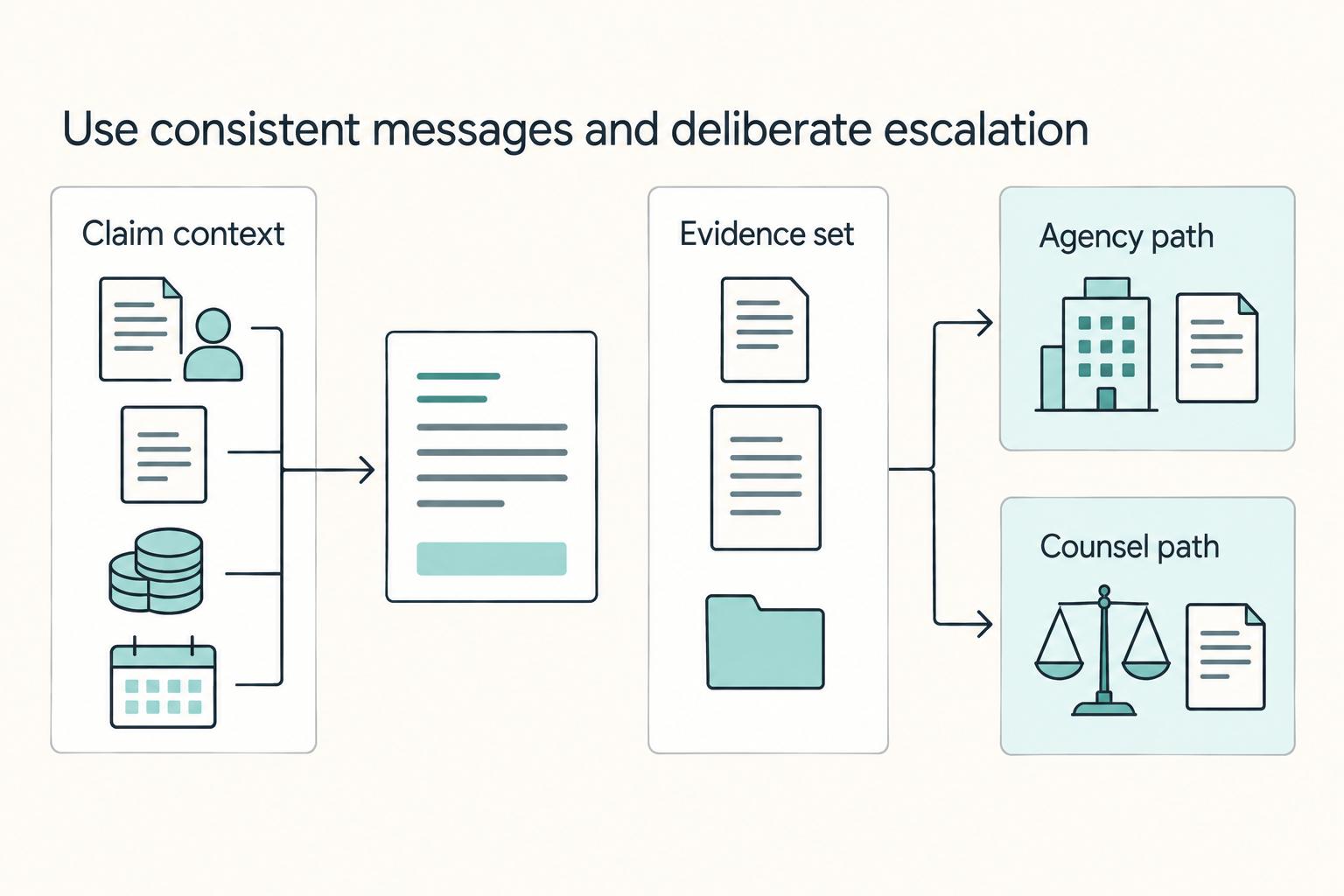
Consistency matters more than volume. Use one message format every time. Identify the contract party and invoice number, state the amount due and payment trigger, attach the current evidence set, request one specific response, and name the next step only if you are prepared to take it.
Use internal handoff criteria the same way each time: no response across approved channels, a broken payment promise, or a dispute that needs contract interpretation rather than billing cleanup. Choose the escalation path deliberately:
- Send to a commercial collection agency when documentation is clean, legal complexity is low, and the main issue is non-response.
- Send to counsel when there is a substantive contract dispute, cross-border enforcement complexity, or legal risk in the next communication.
For a step-by-step walkthrough, see A guide to the 'Fair Credit Billing Act' (FCBA).
The Escalation Point: When and How to Hire a Commercial Collection Agency#
Escalate when self-collection has stopped producing progress and you have a clean file ready for handoff. Do not use a calendar-only rule. Use a trigger rule: if you are repeating the same demand with no new response, decide between agency placement, counsel, or write-off.
Use a trigger sequence, not a days-past-due rule#
- Classify the debt first. The FDCPA applies to personal, family, or household debt, and does not apply to corporate, business, or agricultural debt. If the unpaid invoice is owed by a company under a business contract, stay in the commercial lane. If facts are mixed or unclear, pause and get legal review before placement.
- Confirm self-collection is truly exhausted. Agency placement can be reasonable when repeated outreach produces no meaningful movement. If the core issue is contract interpretation, a threatened counterclaim, or a legal dispute, route to counsel instead.
- Test file strength before handoff. Verify the contract entity, claimed balance, payment trigger, proof of delivery or acceptance, and complete contact history. If those are weak, placement can increase friction and risk.
- Run a simple decision screen. Use placeholders, not guesswork: expected net recovery =
[A] - [F] - [H × R] - [L].
| Decision factor | What to check | Placeholder |
|---|---|---|
| Expected net recovery | What you reasonably expect to recover after costs | [A] - [F] |
| Internal time cost | Remaining team time to manage follow-up and disputes | [H × R] |
| Relationship risk | Value of preserving the client relationship | [L] |
| Documentation strength | Whether core evidence is complete and usable | Strong / Mixed / Weak |
If expected net recovery is clearly positive, documentation is strong, and the relationship is already damaged or dormant, placement may be rational. If documents are thin, relationship value is still high, or legal complexity is rising, prefer counsel or write-off.
Consumer and commercial are not interchangeable#
The biggest mistake here is treating any collection agency as interchangeable. The debt type and communication rules have to match the file.
| Decision point | Consumer collection agency | Commercial collection agency |
|---|---|---|
| Legal scope | Built for covered consumer debt (personal, family, or household). | Used for business debt; corporate, business, and agricultural debt are outside that FDCPA scope. |
| Typical debt type | Personal accounts such as household obligations. | Company invoices, trade debt, unpaid B2B service fees. |
| Communication style | Contact limits are tighter; if represented, contacts must go through counsel, and workplace contact is restricted when employer rules prohibit it. | Business-focused outreach to company contacts, with clear, accurate, documented communications. |
| Fit for freelancer B2B invoices | Often a poor fit for a clean company-to-company file. | Often the right lane when the obligation is clearly commercial. |
If classification is wrong, risk rises quickly because communication rules can change with debt type. Start with fit, then test controls, then lock the authority line in writing.
Vet the agency in a practical order#
| Check | What to confirm |
|---|---|
| Identity and fit | Legal entity, operating name, and that it regularly handles commercial invoice files |
| Claims | Any stated credentials, memberships, or specialty positioning |
| Compliance controls | How calls, emails, disputes, and payments are logged, and what records you can review |
| Visibility | Status updates and key communications during the placement |
| Fee terms and authority boundaries | Who can settle, who can escalate, and what requires your written approval |
- Verify identity and fit. Confirm the legal entity, operating name, and that it regularly handles commercial invoice files.
- Verify claims. Check any stated credentials, memberships, or specialty positioning before you rely on them.
- Check compliance controls. Ask how calls, emails, disputes, and payments are logged, and what records you can review.
- Confirm visibility. Make sure you can review status updates and key communications during the placement.
- Lock fee terms and authority boundaries in writing. Define who can settle, who can escalate, and what requires your written approval.
Your oversight duties#
Hiring an agency does not outsource your judgment. Keep control of the file by setting written instruction boundaries, keeping your own complete record set, requiring written approval before major escalation, and reviewing agency conduct against your instructions.
- Set written instruction boundaries: approved balance, supporting documents, approved contacts, and escalation limits.
- Keep your own complete record set: placement package, contract, invoices, delivery proof, prior correspondence, and agency updates.
- Require written approval before major escalation, including settlement, legal referral, or material posture changes.
- Review agency conduct periodically against your instructions and pull the file if tone, facts, or targets drift.
This is a legal and brand-control issue, not just admin. In covered consumer-debt contexts, FDCPA-related claims can create exposure for the client, and even routine-looking collection actions can trigger allegations and damages claims. The practical rule is simple: classify correctly, place only supported files, and supervise as if the agency is speaking in your name.
If you want a deeper dive, read The Silent Profit Killer: How to Stop Margin Erosion in Your Freelance Business.
Use FDCPA-style conduct rules as your internal collection policy#
Use FDCPA-style conduct rules as your internal playbook even when they may not be the law for your B2B file. The FDCPA usually does not govern collection of your own business invoices, but its standards can help you keep outreach firm, accurate, and defensible.
Do not rely on a shortcut like "invoice = business debt." The key boundary is purpose. Obligations tied primarily to personal, family, or household purposes, especially where a natural person is obligated, carry higher consumer-law risk. Pause and escalate to counsel if you see mixed-use facts, a personal guarantor dispute, an individual debtor issue, or a claim that charges were personal rather than business.
Run validation and contact limits as operating steps, not legal trivia:
- If the amount is disputed in writing within the dispute window, pause collection activity and answer in writing with verification details from your file.
- Keep one complete file: contract, change scopes, invoices, delivery or acceptance proof, contact log, dispute messages, and any counsel notices.
- Treat Regulation F's recordkeeping benchmark as a practical reference: retain compliance records for a durable period. It uses three years after last collection activity for covered collectors.
If the debtor says they are represented, or asks for no direct contact, shift channels without debate. Confirm the lawyer or formal channel in writing and route future messages there.
| Pro behavior | High-risk behavior |
|---|---|
| Neutral, factual messages tied to contract, invoice, and deadline | Misleading threats or repeated contacts intended to pressure |
| Contact timing kept to reasonable windows, with 8 a.m. to 9 p.m. local time as a guardrail | Late-night or early-morning outreach or channel flooding |
| Exact balance and basis stated in your real company name | Inflated charges, bluffing consequences, or using another name to imply a third party |
| Debt details shared only with authorized account contacts | Disclosure to coworkers, family, or public channels |
Use this as a CEO policy checklist:
- Classify the debt before first outreach.
- Collect only in your real company name.
- Pause and verify in writing when disputed.
- Move to counsel or formal channels when representation appears.
- Check applicable state law instead of assuming federal rules are the full framework.
Conclusion: Verify the facts, document contacts, and escalate on evidence#
When a payment issue starts, your next move should be operational: verify the facts, document every contact, and escalate only when the file is complete.
That shift keeps you out of reactive collection mode. Start with the signed agreement, the balance you are tracking, invoice numbers, payment history with dates, and a clean log of calls and emails. If settlement comes up, confirm every term in writing. If a call turns abusive, end it and log what happened.
| If you are stuck in this pattern | Move to this operating habit |
|---|---|
| Escalating before the record is complete | Review the agreement, balance, and communication history before each step |
| Treating each late payment as an argument to win | Keep outreach factual, limited, and tied to a written cadence |
| Letting calls and memory run the process | Build and maintain one case file with invoices, payment records, emails, and call notes |
| Pausing enforcement on verbal promises | Require dates, amounts, and any settlement terms in writing |
If you want to put this into practice this week:
- Confirm your payment and escalation language is clear in your agreement before work starts.
- Keep one reminder cadence instead of ad hoc follow-ups.
- Set escalation triggers and apply them consistently.
- Prepare a handoff packet with the agreement, invoices, payment history, and communication log if you need outside review.
You do not need a dramatic response to every late invoice. You need a controlled process: classify the issue, document the record, communicate professionally, and escalate on evidence. That can protect your brand, support steadier cash flow, and give counsel a usable file when facts are mixed or the dispute becomes serious.
If you are weighing outside help, see The Best Collection Agencies for Small Businesses.
If you want fewer payment disputes in practice, standardize how you bill and follow up with the free invoice generator.
Frequently Asked Questions
Does the fair debt collection practices act apply to my unpaid client invoice?
Usually no, if your invoice is truly business debt. The FTC says business debts are not covered by the FDCPA, which is aimed at personal, family, and household debts. If the debt type is unclear or disputed, classify it carefully and get legal guidance before proceeding.
Does it matter whether I collect in-house or hire a third party?
Yes. The federal rules discussed here focus on debt collectors collecting covered consumer debts, so a handoff can change compliance obligations. If you refer a file, provide complete and accurate documentation so the collector can verify the right person and amount before attempting collection.
What actually controls my options on a business debt?
Your contract and applicable law may control next steps, so get legal review before escalation or legal threats. Avoid guaranteeing outcomes and keep your records complete.
How should I contact a late-paying client without creating new risk?
Keep outreach factual, limited, and documented. Before contact, verify the correct party and amount owed, and make sure you have enough documentation to support the debt. In consumer-debt scenarios, do not call before 8 a.m. or after 9 p.m. local time unless agreed, stop using channels the consumer asks you to stop using, and use limited-content voicemail messages when applicable.
What is the cleanest escalation checklist?
Use a short escalation path with written records at each step. Before escalation, confirm the file supports the right person and the right amount. If key documentation is missing, or identity/amount is disputed, pause collection activity and escalate for review before demands, referral, or legal action.
Try a related tool
Researched and edited by the Gruv editorial team. Gruv builds cross-border billing, payouts, and finance-operations software for global businesses.
Sources
- consumer.ftc.gov/articles/debt-collection-faqstrusted
- fdic.gov/consumer-compliance-examination-manual/vii-3...trusted
- federalregister.gov/documents/2021/01/19/2020-28422/debt-collect...trusted
- files-prod.consumerfinance.gov/f/documents/cfpb_fair-debt-collection-practi...trusted
- files.consumerfinance.gov/f/201603_cfpb-fair-debt-collection-practices...trusted
- files.consumerfinance.gov/f/201503_cfpb-fair-debt-collection-practices...trusted
- ftc.gov/sites/default/files/documents/public_events/...trusted
- uscode.house.gov/view.xhtmltrusted
Educational content only. Not legal, tax, or financial advice.
Related Posts

Stop Freelance Profit Margin Erosion Before It Hits Cashflow
Revenue can hold steady while the business underneath it gets weaker. What comes in matters, but what you keep after the work is delivered is the clearer signal of health.
Taxes in Germany for Freelancers and Expats
Low-stress compliance in Germany comes from decision order, not tax tricks. Use this sequence: confirm core facts, apply conservative temporary assumptions, verify the few points that can break invoices or filings, and keep one evidence file that explains each decision.
Collection Agencies for Small Businesses: Use a Payment Assurance System First
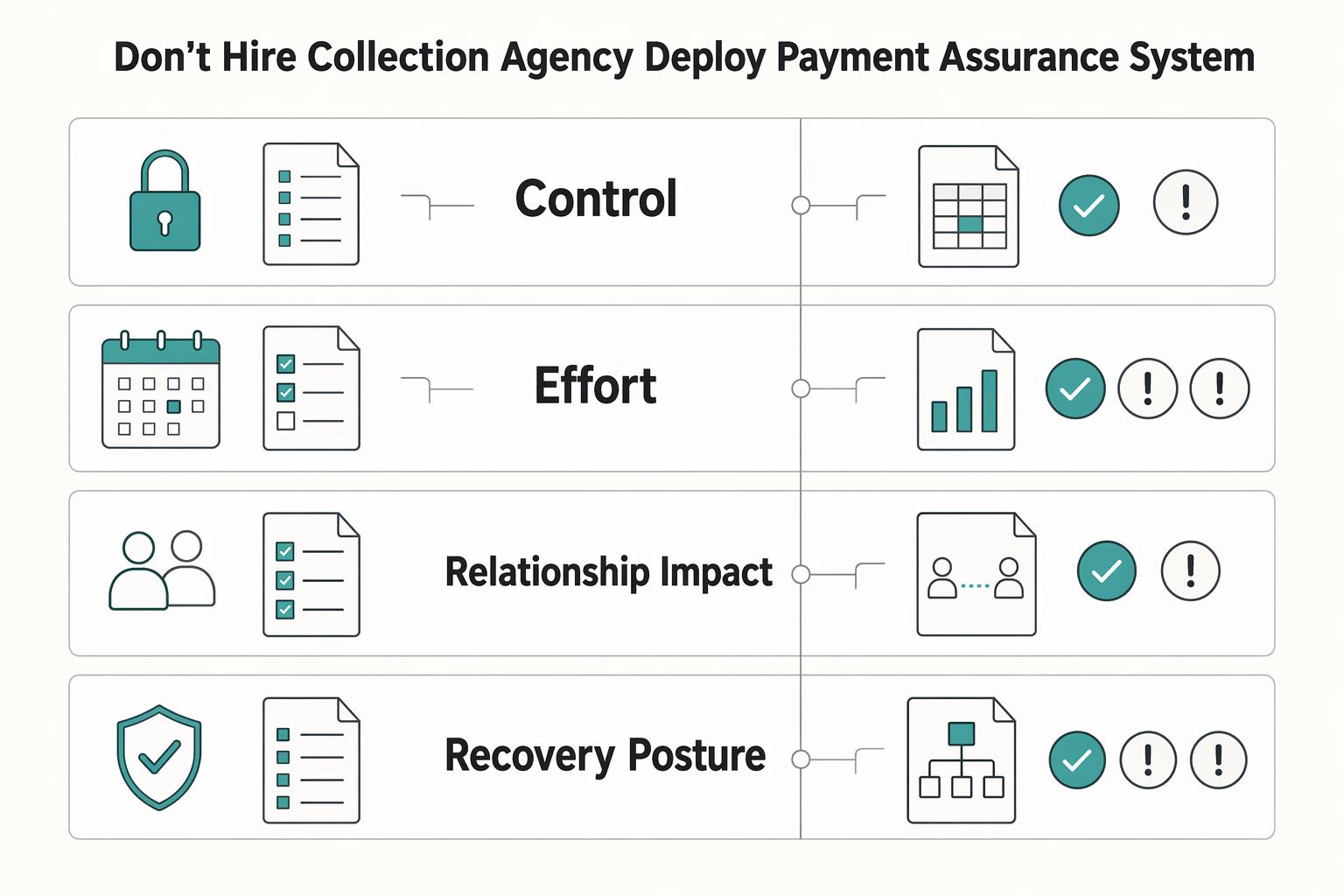
If you're searching for the **best collection agencies for small business**, the short answer is this: a collection agency is a later-stage tool, not your default operating model. Start with a payment assurance system that protects cash flow, keeps client relationships workable, and gives you a clear escalation path when invoices go past due.