
Quick Answer
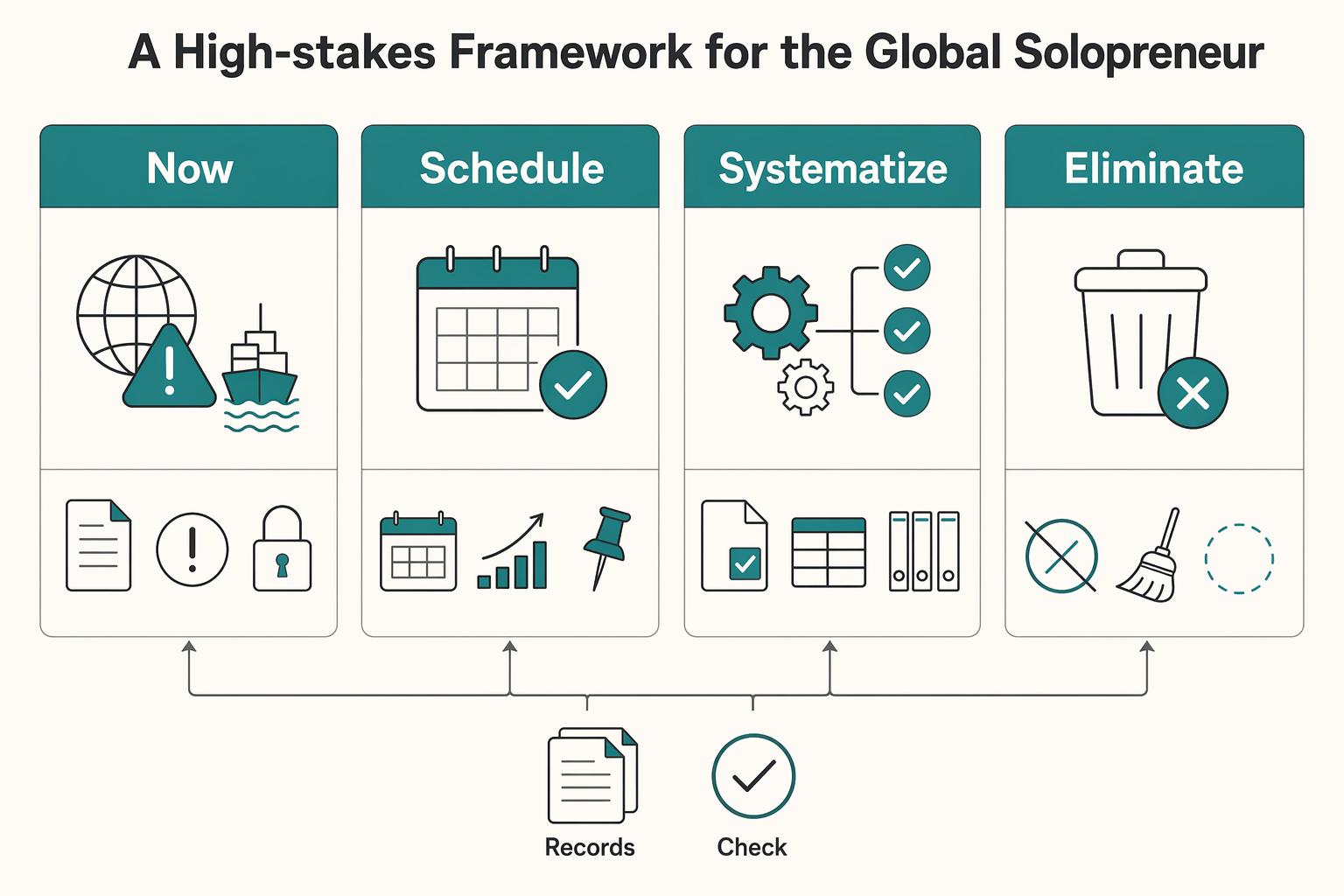
Use the Eisenhower Matrix by sorting tasks in a solo cross-border business by exposure and proof, not by noise. Put immediate filing, cash, access, or client-delivery risk in Q1, schedule preventive reviews in Q2, systematize recurring record work in Q3, and remove duplicate or mixed-record cleanup in Q4. Close each task with a dated note, checklist, or saved confirmation, then review weekly.
Redefining the Quadrants: A High-Stakes Framework for the Global Solopreneur#
Your urgent lane should hold exposure, not noise. In a solo cross-border business, a task is urgent when waiting raises the chance of filing trouble, weakens client delivery, or leaves money or records exposed. That is the version of the eisenhower matrix for prioritization that holds up when you are the one making the call under pressure.
The classic quadrants still work, but they need tighter decision rules. In practice, Q1 is containment, Q2 is prevention, Q3 is repeatable admin with proof, and Q4 is avoidable cleanup. If a task has no clear evidence output, it usually is not classified well enough yet. If you cannot say what record, note, checklist, or saved confirmation will exist when the work is finished, you are probably sorting by feeling rather than operating consequence.
| Quadrant | Decision rule | Cross-border example | Evidence output |
|---|---|---|---|
| Q1 Do now | Waiting creates immediate filing, cash, access, or delivery exposure | Your tax return is moving forward and your Form 8938 review is still unresolved | Verification note dated, filing decision recorded, attach-to-return checkpoint confirmed if required |
| Q2 Schedule | Nothing is broken today, but delay increases the chance of a rushed or wrong decision later | You need to verify whether your specified foreign financial assets are above the appropriate reporting threshold | Calendar date, verification note confirming the current threshold with the tax authority, next review trigger |
| Q3 Systematize | The task repeats and should not depend on memory | Monthly capture of account counts, maximum values, and asset changes that feed Form 8938 preparation | One checklist, one owner, one storage path, one completion signal |
| Q4 Eliminate | The activity creates future reconstruction work with little upside | Storing statements in multiple places or mixing business and personal records so you must rebuild the trail later | Boundary rule written down, duplicate storage removed, cleanup source cut off |
Classify without guessing#
Before you react to a task, force one clean pass through the basics:
| Check | What to do | Decision cue |
|---|---|---|
| Run the exposure test | Ask what gets worse in a week: filing readiness, account access, client delivery, or cash collection | If the answer is real damage soon, treat it as Q1 |
| Name the exact obligation | If the task is about Form 8938, say that explicitly | The trigger is whether the total value is above the appropriate reporting threshold |
| Separate verification checkpoints | Keep distinct notes for threshold verification, asset-change review, and the attach-to-return checkpoint when required | One checked box is not proof the full Form 8938 workflow is settled |
| Define the proof before you start | Use a closeout such as threshold verified on the review date, asset change reviewed, form attached to return if required, next review date logged | A weak closeout is done |
| Add prevention now | Create the record step now if the task will come back next month or next tax season | Do not wait for the next scramble |
- Run the exposure test. If this slips a week, what actually gets worse: filing readiness, account access, client delivery, or cash collection? If the answer is "real damage soon," treat it as Q1.
- Name the exact obligation. If the task is about Form 8938, say that explicitly. The IRS describes it as the form used to report specified foreign financial assets, and the trigger is whether the total value is above the appropriate reporting threshold, not a number you should pull from memory.
- Separate verification checkpoints. Keep distinct notes for threshold verification, asset-change review, and the attach-to-return checkpoint when required. One checked box is not proof the full Form 8938 workflow is settled.
- Define the proof before you start. A weak closeout is
done. A strong closeout isthreshold verified on the review date, asset change reviewed, form attached to return if required, next review date logged. - Add prevention now. If this task will come back next month or next tax season, create the record step now instead of waiting for the next scramble.
If you get stuck between quadrants, do not keep debating labels. Ask what the very next reliable output is. If the next output is containment and proof, it is Q1. If the next output is a dated review with a document list, it is Q2. If the next output is a standing checklist, it is Q3. If the next output is deleting a duplicate source or tightening a boundary, it is Q4.
A practical note on verification: Form 8938 itself points you to the instructions and the latest information. Treat that as a warning against stale assumptions. Even though the IRS About Form 8938 page was last reviewed on 23-Jan-2026, you should still log the date you checked and the source you used.
Build Q3 and Q4 around evidence#
For Form 8938 work, the most useful operator detail is what the form asks you to produce. Part I, Foreign Deposit and Custodial Accounts Summary, requires account counts and maximum values. The form also asks whether any foreign assets were acquired or sold during the tax year. If you cannot answer those questions from a standing record, the problem is not speed. It is record design.
| Monthly pack step | Action | Artifact or note |
|---|---|---|
| Collect statements | Collect the statements into the single storage path | Statements are in one storage path |
| Update the recurring log | Update the recurring log while the documents are open | The log captures account name, statement location, maximum value tracked, and whether any asset was acquired or sold during the period |
| Note asset changes | Note whether there was any acquisition or sale to follow up on | Acquisition or sale is noted for follow-up |
| Mark the pack complete | Mark the pack complete | You are producing the exact pack that lets you answer the same questions again without rebuilding the trail |
That is Q3 in practical terms. Assign one owner, even if that owner is you. Use one storage path for statements and support files. Keep one recurring log that captures account name, statement location, maximum value tracked, and whether any asset was acquired or sold during the period. A common failure mode is finishing the task in your head but leaving no artifact that lets future-you or your preparer verify it.
A workable monthly sequence is simple: collect the statements into the single storage path, update the recurring log while the documents are open, note whether there was any acquisition or sale to follow up on, and then mark the pack complete. That sequence matters because it turns a vague reminder into a closeable unit of work. You are not just "keeping up with records." You are producing the exact pack that lets you answer the same questions again without rebuilding the trail.
Q4 is where you stop creating your own cleanup. Cut duplicate folders, vague file names, and mixed record boundaries that force reconstruction later. If a record belongs to the business, it goes in one place under one naming rule. If it does not, keep it out. That small boundary decision does more for prioritization than another color-coded board.
Once you classify work by exposure and proof, your weekly review gets sharper. The next section turns that into a repeatable rhythm, and if you want the operating habit behind it, start with a solid weekly review for your freelance business.
Related: How to Manage Multiple Freelance Projects Without Losing Your Mind.
Connecting the Quadrants: Your Unified Defense System#
Your matrix works only when tasks move, not when they get parked. In this workflow, every Q1 fix should produce one next action: a Q2 prevention date, a Q3 repeat rule, or a Q4 removal decision. If a task ends at handled, it usually comes back.
That is the urgency trap in practice: urgent-feeling work gets done now, while important follow-up gets deferred. You stay active, but the underlying risk stays open.
Turn incidents into controls#
After each live issue, do a fast handoff:
| Incident | Immediate containment | Prevention or system step | Required proof artifact |
|---|---|---|---|
| Client work stalls because an access, approval, or billing detail is missing | Restore delivery or payment first | Add a pre-start checklist and one pre-billing review point | Saved confirmation, updated checklist, next review date |
| A reporting question appears late and may affect two related obligations | Split it into separate verification tasks instead of treating it as one answer | Create one dated verification note for each obligation; confirm the current threshold with the tax authority | Two separate verification notes with check dates |
| Month-end records are incomplete because files are spread across locations | Reconstruct only what is needed to close the current gap | Set one storage path, one naming rule, and one recurring capture step | Reconciled folder, naming rule documented, current month marked complete |
If obligations are related, still verify them independently. The test is simple: can you point to separate artifacts?
Design controls you can actually trust#
Use five parts for each control: trigger, inputs, rule, completion signal, and exception owner. Keep them plain enough that you can audit them quickly.
Add one failure signal so silent breakdowns show up early. Useful signals include: trigger date passed with no artifact, the same incident appears in two weekly reviews, or completion depends on memory instead of a stored record.
If someone cannot verify completion from the artifact alone, the control is too weak.
Weekly checklist: review outputs, not effort#
Use one output-driven checklist each week:
- List live incidents that affect delivery, cash, access, or readiness.
- Record one prevention step for each incident.
- Convert each prevention step into either a scheduled check (Q2) or repeat rule (Q3).
- Confirm one completion signal and one exception owner for every active control.
- Remove one cleanup source (Q4) that keeps recreating work.
- Verify that every related-obligation check has its own dated note, not a combined checkbox.
If an issue repeats without a dated prevention step and stored artifact, the loop is broken. To strengthen the cadence, use a practical weekly review for your freelance business. You might also find this useful: The Best Personal Productivity Systems for Freelancers.
Run the Matrix Weekly With Pass/Fail Completion Standards#
This works only as a system, not a one-time sort. Run the matrix on a weekly rhythm, and start each review with one plain master task list before you classify anything so urgency does not drive the whole board.
| Review standard | Pass when | Required record |
|---|---|---|
| Board update | Every open task is in exactly one quadrant with one clear next action | The board shows one quadrant and one next action for every open task |
| Scheduled action | Every Q2 task has either a dated calendar block or a dated defer decision | A dated calendar block or dated defer decision exists for every Q2 task |
| Procedure doc | Each recurring Q3 task has a trigger, steps, one storage location, and one completion artifact | The procedure doc includes the trigger, steps, one storage location, and one completion artifact |
| Removed noise | Each Q4 item is actually deleted, muted, unsubscribed, or closed | The Q4 item is deleted, muted, unsubscribed, or closed |
| Verification note | The record shows what you checked, when you checked it, and records the current rule as pending official verification until confirmed | The verification note shows what you checked, when you checked it, and records the current rule as pending official verification until confirmed |
Use pass/fail completion standards so you can prove the review is done:
- Board update: Pass when every open task is in exactly one quadrant with one clear next action.
- Scheduled action: Pass when every Q2 task has either a dated calendar block or a dated defer decision.
- Procedure doc: Pass when each recurring Q3 task has a trigger, steps, one storage location, and one completion artifact. If you assign execution, you still own accountability for the outcome.
- Removed noise: Pass when each Q4 item is actually deleted, muted, unsubscribed, or closed.
- Verification note: Pass when the record shows what you checked, when you checked it, and records the current rule as pending official verification until confirmed.
| Ritual | Trigger | Scope | Stop condition |
|---|---|---|---|
| Quick scan | Start of day or after disruption | Current Q1 items and today's commitments | True urgencies are isolated, and non-urgent items are reclassified |
| Weekly review | Your standing weekly review block | Full board plus recurring work | Q2 is dated, Q3 is documented, and Q4 is removed |
| Reset review | Repeated rework or the same issue returning | Items that keep bouncing into Q1 | One prevention step or one procedure update is saved |
If a stop condition is not met, the ritual is still open. Time spent does not count as completion.
When everything feels urgent, triage in this order:
- Capture everything into one master list.
- Mark only items that require immediate action as Q1.
- Move important but not immediate items to Q2 with a date.
- For repeated work, document the procedure before the next cycle.
- Remove or mute low-value noise.
Implementation is simple: run the weekly review, choose the system that fits how you work, then add outside support only if the review shows sustained overload. Start with How to Conduct a Weekly Review for Your Freelance Business, then use How to Manage Your Time Effectively as a Freelancer to tune your setup. If you need coverage confirmation for your country or program, Talk to Gruv.
Frequently Asked Questions
How should you adapt the matrix if you work alone?
If you work alone, treat Q3 as systematize or simplify before it becomes a recurring interruption, not delegate immediately. Keep ownership when the task still needs your judgment, and define one clear next step so it does not depend on memory. Start with a full task capture before you sort so the latest message does not drive your priorities.
What are practical examples for each quadrant?
Place the task by consequence and timing, not by noise. Q1 covers a payment account issue blocking an invoice or client delivery today, Q2 covers a recurring reporting or recordkeeping obligation that needs a dated review, and Q3 covers monthly collection of statements, receipts, and client documents using one storage location and checklist. Q4 is removing duplicate reminders, chatter, or old notes after you already logged the verified next step.
What is the difference between urgent and important?
Urgent needs immediate attention. Important should be planned and scheduled. A live access failure is urgent, while a scheduled obligation review is important because it helps you avoid last-minute decisions.
Is this method useful for risk management, not just productivity?
Yes. The matrix helps you choose the right next action: do now, schedule, systematize, or remove. It also helps prevent the common failure mode of trying to do everything at once.
What is the biggest mistake people make?
The biggest mistake is trying to do everything at once or leaving Q2 too vague to schedule. Work you cannot schedule usually slides back into Q1. Write the next step in plain language and put it on your calendar.
Try a related tool
Researched and edited by the Gruv editorial team. Gruv builds cross-border billing, payouts, and finance-operations software for global businesses.
Sources
Educational content only. Not legal, tax, or financial advice.
Related Posts
How to Manage Your Time Effectively as a Freelancer
Most freelancers struggle not because they work too few hours, but because they misallocate the hours they have—treating time as an infinite resource rather than a finite business asset with a real cost per unit. The solution is a three-layer operating system: a Time Budget Framework that commits hours to four categories before any client work is booked, a Weekly Operating Template that assigns those categories to specific calendar windows, and a monthly Admin Audit Checklist that reconciles invoicing, bookkeeping, and compliance records. Multi-client orchestration requires a WIP limit, dedicated client windows, and a capacity decision rule run before accepting new engagements. Together, these systems replace reactive decision-making with a repeatable structure that keeps delivery quality consistent, records audit-ready, and the freelance practice operationally durable.

How to Manage Multiple Freelance Projects Without Losing Your Mind
If this feels hard, the issue is often not your craft. It is a lack of operating control: too many open commitments, a calendar filled with delivery blocks, an inbox setting priorities, and tasks that feel urgent because no clear next action exists.

The Best Productivity Systems for Freelancers: GTD, PARA, and Second Brain
**Treat productivity as a system you can run under load, not a vibe you summon on demand.** Client work is messy by default: requests scattered across Gmail and Slack, scope shifting midstream, and the annoying truth that "done" does not always mean "paid."