
Quick Answer
Start by separating three decisions: governing law, dispute forum, and, if used, arbitration seat. In common law vs civil law contracts, length is not the key signal; enforceable clarity is. Make scope, acceptance, payment timing, and change control explicit, then verify the contracting entity before signature. After kickoff, keep one usable record set of approvals, invoices, and amendments. For EU B2B invoices, confirm VAT registration in VIES before relying on reverse-charge treatment.
Treat Cross-Border Contract Risk as a Clause and Enforcement Problem#
When an overseas contract feels unfamiliar, the risk is often a legal-system mismatch, not a "bad" document. Your expectations may be shaped by one tradition while the draft is shaped by another. In contracts shaped by common law or civil law, you protect yourself by identifying the terms that control payment and enforcement before you negotiate everything else.
Start with five terms:
- Governing law: which law applies if there is a dispute.
- Jurisdiction: which court has authority to decide the case.
- Payment risk: the cross-border risk that a foreign buyer does not pay.
- Enforceability: whether contract obligations can be enforced by law.
- De-risking: reducing exposure through decisions you control before signing, in the clauses, and after signature.
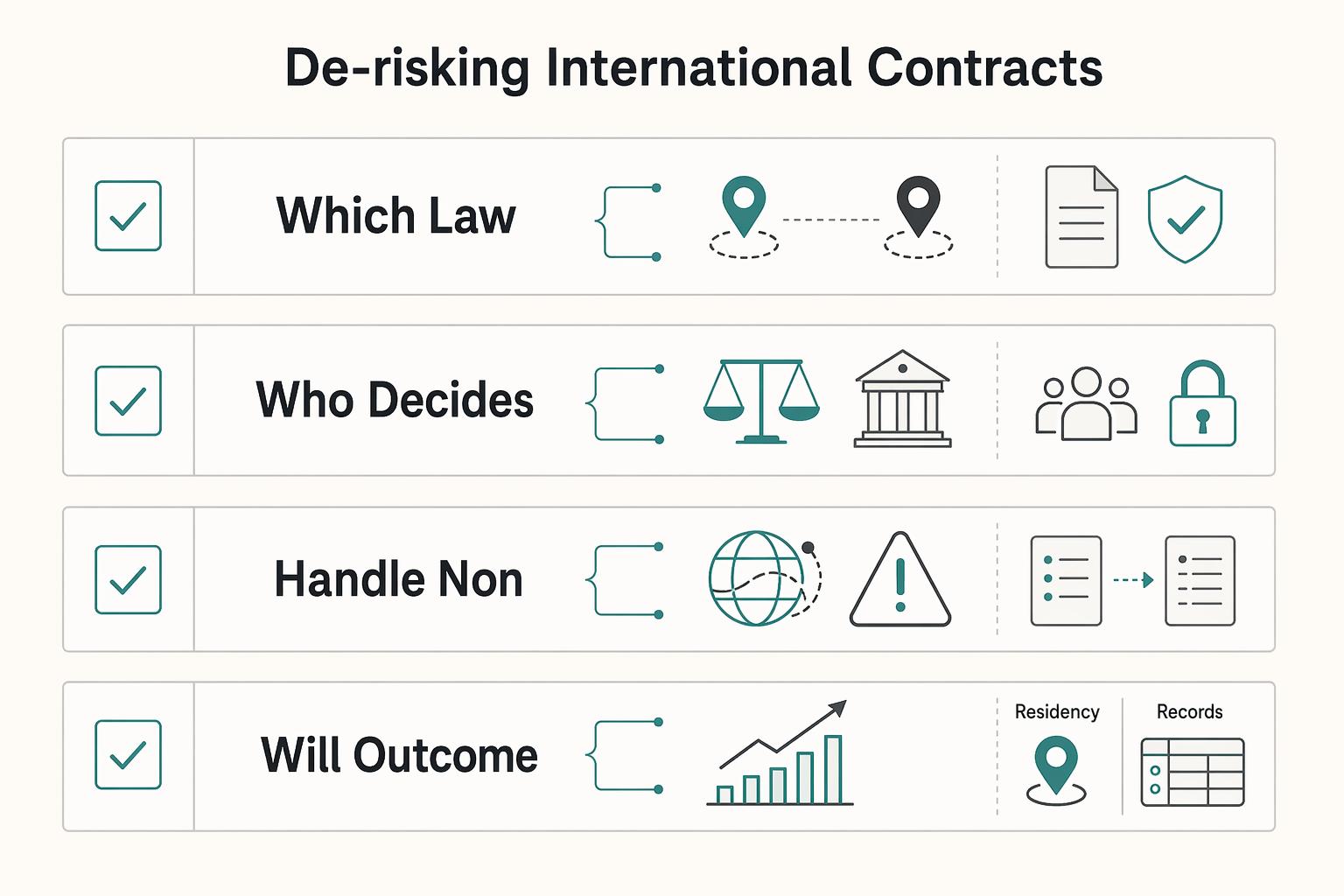
| Risk question | Why it matters | Where this guide addresses it |
|---|---|---|
| Which law governs this contract? | Parties can often choose the applicable law, and courts generally honor that choice. In the EU, Rome I allows choice of law for all or part of a contract. | Part 1 |
| Who decides the dispute? | Governing law and jurisdiction are different decisions, and mixing them up can weaken your position. | Part 2 |
| How do you handle non-payment? | Non-payment is a core cross-border risk, so your enforcement route matters alongside your invoice terms. | Parts 2 and 3 |
| Will your outcome be enforceable across borders? | Court and arbitration clauses follow different enforcement paths, so you need a realistic plan before disputes happen. | Part 2 |
Use this playbook in three steps. Before signing, confirm governing law, forum, and whether your enforcement path is workable for this relationship. In the contract, lock scope, payment terms, and dispute resolution language. After signature, keep clean records: the signed agreement, statement of work, invoices, acceptance emails, and approved changes.
Treat cross-border risk as a clause-and-enforcement problem, not a style problem. A common failure pattern is agreeing on price first, then discovering too late that a dispute must be handled in the other party's forum under unfamiliar law, with weak documentation and no practical path to collect.
If you want a deeper dive, read Germany Freelance Visa: A Step-by-Step Application Guide.
The Foundational Difference: Why International Contracts Feel So Alien#
International contracts feel alien because legal systems rank authority differently once you move past the contract text. In both systems, a valid contract is binding, but what fills gaps is not the same. Common law leans on judicial decisions and precedent, while civil law leans on written codes and statutes.
Use this reading rule first: do not judge protection by draft length. A short civil-law contract may be backed by code defaults, and a long common-law draft may still miss what matters. Risk usually sits in the gap between what you assume is covered and what the governing law actually supplies.
| Issue | Common law reading posture | Civil law reading posture | What this means for your draft | Your safest action |
|---|---|---|---|---|
| Source hierarchy | Contract text plus judge-made decisions and precedent drive interpretation. | Contract text sits within code and statutory defaults. | The same clause can work differently under different governing law. | Confirm governing law first, then review every key clause in that legal context. |
| Gaps and omissions | Silence on a key point can become a dispute. | Code defaults may fill some gaps. | Your preferred default may not apply. | Spell out scope, payment timing, acceptance, changes, and termination. |
| Drafting style | Detailed drafting often allocates risk expressly. | Concise drafting can rely more on codified rules. | A short draft is not automatically weak, but hidden defaults can cut against you. | Ask which terms are intentionally left to law and which are meant to override it. |
| Validity language | Consideration is a necessary element in common-law contract doctrine. | Do not assume consideration maps cleanly; for example, French Civil Code Article 1128 lists consent, capacity, and lawful/certain content. | Copy-pasted terms across systems can add confusion, not protection. | Avoid mechanical template imports; focus on clear obligations and lawful, certain content. |
| Judge role | Judges rely more on prior rulings when resolving disputes. | Judges focus more on applying codified law to facts. | Wording matters in both, but your factual record is still critical. | Keep a clean evidence file: signed contract, SOW, approvals, invoices, change notes, and acceptance records. |
How you should read each style#
Start with a simple assumption: if governing law is common law, critical protections usually need to be explicit. Define deliverables, exclusions, payment triggers, acceptance, and delay consequences in the contract text.
If governing law is civil law, ask what the code supplies by default and whether those defaults actually help you. A short draft may be workable, but you still need to know which gaps are being left to the code. Watch for civil-law governed drafts packed with undefined common-law terms. In practice, that mix is a recurring source of confusion.
What good faith changes in practice#
Good faith is a review issue, not a slogan. In international trade, the UNIDROIT Principles require parties to act in good faith and fair dealing, and that duty cannot be excluded under those Principles; major international instruments relevant to cross-border sales also use good-faith language.
Use that as a negotiation and conduct standard, not as a substitute for precision. If scope shifts, payment timing slips, or delivery problems appear, document the facts and the proposed fix in writing so your record shows reasonable conduct.
Why consideration and cause are not drafting trivia#
Cross-border reviews go off track when teams assume one system's validity language applies everywhere. Common-law doctrine treats consideration as necessary, while French reform removed "cause" from validity conditions, with commentary noting that the practical change may be more semantic than dramatic.
Your practical move is simpler than the doctrine debate. Spend less time on transplanted formulas and more time on enforceable clarity. Confirm party identity, signing authority, deliverables, payment triggers, and lawful, certain contract content before signature.
That leads to the next step: run a pre-signing check that tells you which law fills your gaps and whether that default position protects your cash flow.
For a step-by-step walkthrough, see How a US Freelancer Should Draft a Governing Law Clause with an Asian Client.
Part 1: The Pre-Flight Checklist: Assess Your Risk Before You Negotiate#
Before you negotiate scope or fees, work in this order: identify governing law, forum, and seat; scan clause-level risk; then verify the legal entity. If you skip the sequence, you can negotiate solid commercial terms inside a contract that is still hard to enforce.
Action 1: Identify governing law, forum, and arbitration seat first#
Start here because these are separate controls, not synonyms.
Governing law is the legal system that applies to the contract in a dispute. Jurisdiction is a court's authority to hear and decide the dispute. If the contract uses arbitration, the seat of arbitration is the legal place whose procedural law governs the arbitration and influences where award challenges are filed.
Use a simple decision branch:
- Accept: governing law and dispute venue are workable for a dispute of your likely size.
- Negotiate: the clause locks you into the client's home venue and an alternative court forum or arbitration seat is realistic.
- Escalate for legal review: the clause is missing, inconsistent, or mixes court and arbitration language in a way you cannot interpret confidently.
Do not treat silence as neutral. Where Rome I applies, parties can choose governing law; if they do not, fallback rules determine it. Read court-selection wording carefully too. An exclusive effect can apply unless the parties clearly say otherwise.
Action 2: Run a clause-level risk scan before you mark up business terms#
The right test here is function, not draft length. Whether the draft reads like common law or civil law, the practical question is the same: is money, delivery, and the dispute path clear enough to enforce?
| Signal in the draft | Why it matters | Immediate action |
|---|---|---|
| No governing law clause, or too vague to identify one legal system | If law is not chosen, fallback rules may decide later during a dispute | Request an express governing-law clause now. If refused, pause signing. |
| Only the client's home courts are named | Enforcement can become harder and more expensive for you | Request an alternative forum or arbitration seat. If they refuse, reassess deal risk before proceeding. |
| Arbitration is mentioned but no seat is named | If parties do not agree the place, the tribunal may determine it later | Rewrite to name the arbitration seat explicitly; pause until corrected. |
| Payment says "upon completion" or acceptance is undefined | Ambiguity can trigger payment disputes | Rewrite to milestones, delivery dates, and objective acceptance criteria. Define approver, deadline, and deemed acceptance. |
| Party identity details do not match records | You may contract with the wrong entity | Request full legal name, registered address, registration or tax details, and signer authority. Do not sign until records align. |
This is where cross-border deals often drift off course. Teams negotiate scope, price, and timing, but leave the payment trigger, acceptance standard, or dispute path vague enough to fail later.
Action 3: Verify the counterparty is legitimate in the right registry#
Do not rely on the draft alone to tell you who you are contracting with. Verify the legal entity in the registry that matches the jurisdiction and the tax context.
For EU B2B work, verify VAT registration through VIES. VIES is a search tool that queries national VAT databases; it helps confirm VAT registration status for cross-border trade, but it does not verify ownership, solvency, or payment reliability.
Outside the EU, use the equivalent official registry for that jurisdiction, covering business registration and, where relevant, tax registration. Examples include UK Companies House, US SEC EDGAR for filing companies, and Australia's ABN Lookup. For UK VAT checks, note that GB VAT validation in VIES ceased on 01/01/2021, so use the applicable UK route instead.
Save your check record: registry used, search date, and exact legal name searched. If the contract name, invoice party, tax details, or signer identity do not line up, fix that before you discuss scope changes, milestones, or payment timing.
Pre-signing gate: proceed to scope and payment drafting only if all three are true.
- You know the governing law and court forum or arbitration seat.
- You fixed any clause that can block payment or force a bad dispute path.
- You verified the exact legal entity in the correct jurisdiction-specific registry.
Related: How to Write a Jurisdiction and Choice of Law Clause.
Part 2: Forging Your Shield: The Three Clauses You Must Control#
Once governing law, forum or seat, and the true contracting entity are settled, the contract rises or falls on three clauses: scope, payment, and dispute resolution. These are the points that decide whether you absorb extra work, wait for cash, or spend too much to enforce your rights.
Scope and deliverables#
If you only describe the project, scope will not protect you. Scope has to stop unpaid expansion. If a request changes effort, timing, dependencies, or deliverables, require a written change order before you do the work.
| Element | What to define |
|---|---|
| Inclusions | list tasks, deliverables, formats, and milestones |
| Exclusions | state what is out of scope, especially implementation, extra rounds, third-party coordination, training, and post-launch support |
| Acceptance criteria | define what counts as accepted for each deliverable; a workable test is whether services meet stated quality and quantity requirements |
| Revision boundaries | set review-round limits, who can request changes, and what is a revision versus new work |
| Change-order trigger | any request outside stated scope, timetable, or assumptions requires a written change order with updated price and timeline |
Support the clause with evidence you can actually use later. Attach the scope as a versioned exhibit and retain each milestone acceptance record, whether that is an email approval, signed checklist, or project-tool approval. A common failure mode is gradual "one more edit" creep when revision limits were never defined.
Payment terms and currency#
Payment clauses should tie the clock to events you can prove. "Upon completion" invites argument. A stronger sequence is invoice trigger, due event, due date, late-payment handling, currency, and tax wording.
| Term | What to specify |
|---|---|
| Invoice trigger | contract signature, delivery of a named milestone, or acceptance under defined criteria |
| Due event and due date | within X days of invoice date or within X days of acceptance of Deliverable 2 |
| Late payment | for EU business transactions, baseline maximum is 60 days unless expressly agreed otherwise and not grossly unfair; public authorities generally pay within 30 days; EU summary guidance also references at least 8 percentage points above the ECB reference rate and a minimum fixed sum of €40 |
| Currency and allocation of FX or bank costs | set one contract currency and state who bears conversion and transfer costs so the receipt amount is predictable |
| Tax details to verify | Confirm the exact VAT treatment, any registration threshold, and any mandatory invoice wording through jurisdiction review, official source records, and tax adviser or counsel records before using the invoice template. |
Before the first invoice, make sure the contract currency, invoice currency, and purchase order match. For EU cross-border B2B services, verify whether Article 196 places VAT liability on the recipient, and confirm VAT status in VIES before relying on reverse-charge treatment.
Dispute resolution#
This clause only works if you separate the decisions inside it. Governing law, forum, and arbitration design are not the same thing. A forum selection clause chooses the court and location. If you choose arbitration, specify the seat, the legal place, separately from governing law.
If cross-border enforcement is the main risk, arbitration can offer a stronger enforcement path because the New York Convention sets common standards for recognition of arbitration agreements and enforcement of foreign or non-domestic awards, and Article III requires contracting states to recognize and enforce arbitral awards. Court litigation can still be the right choice in narrower cases, but cross-border court-judgment enforcement can be more fragmented depending on where enforcement is needed. The 2005 Hague Choice of Court Convention entered into force on 1-X-2015 and its status table listed 39 contracting parties as of 27-XI-2025.
| Factor | Court litigation | Arbitration |
|---|---|---|
| Enforceability across borders | Can be stronger when assets and parties are concentrated in one jurisdiction, or where a relevant court-judgment convention clearly helps | Often stronger for multi-country enforcement due to the New York Convention framework |
| Cost predictability | Can be harder to pre-shape because local procedure and appeal routes may apply | More controllable when you define institutional rules and arbitrator count; ICC notes a presumption in favour of a sole arbitrator, and ICDR allows options to manage time and cost |
| Speed | Can suit straightforward local disputes or urgent court remedies | Can be efficient if clause drafting is clear; unclear wording can create delay and uncertainty |
Use a practical rule. If enforcement may require action in multiple countries, arbitration is often the safer default, with the seat, rules, and arbitrator count clearly named. If deal value is lower, assets are in one reliable jurisdiction, and you want a simpler path, an exclusive court forum may be enough. In either path, keep venue selection neutral by using criteria you can actually apply: language, travel burden, document access, and enforcement practicality.
You might also find this useful: A deep dive into the 'choice of law' and 'jurisdiction' clauses for international freelance contracts.
Before you send redlines, draft cleaner scope and acceptance terms with the SOW Generator.
Part 3: Shift From Negotiation to Execution Control After Signing#
Once the contract is signed, the job shifts from negotiation to execution control. Protect scope, cash flow, and relationship quality while delivery is moving. Stay cooperative in tone, and route any change to scope, cost, timeline, or approval authority into written change control before you act.
Use "good faith" as a collaboration cue, not a scope exception#
Good faith can improve how you work together, but it does not automatically change the boundaries you negotiated. As a practical rule, if a request appears to fit the signed scope and acceptance criteria, confirm it and deliver it. If it appears to change deliverables, revision rounds, dependencies, timeline, or price, pause and document the change before proceeding.
| Client request | Your response path | Contract artifact |
|---|---|---|
| "Can you make two small extra revisions?" | Check revision limits and acceptance criteria. If still within agreed rounds, confirm in writing and set a delivery date. | Recap or approval email |
| "Can you also train our internal team?" | If training is excluded or unpriced, treat it as potential new work and send scope, fee, and timing for approval before scheduling. | Written scope/fee update |
| "We need this milestone one week earlier." | Check impact on workload, dependencies, and other deadlines. If impact exists, document revised timing and any fee change before proceeding. | Revised milestone plan with written approval |
| "Legal wants a different sign-off path." | Pause milestone acceptance until authority is clear, then confirm who can approve deliverables and request changes. | Written confirmation of approvers |
Keep an operating record, not a message trail#
Your evidence file should be usable, not just complete. A long inbox thread may not be enough when finance, legal, or delivery teams need a clear project record.
| Record item | What to capture |
|---|---|
| Meeting recap | what was requested, decided, owner, and date |
| Decision log | decision, approver, and effective version |
| Approval trail per milestone | who accepted what, and when |
| Written change records | scope delta, price delta, timeline delta, approval |
Keep naming consistent across the invoice, recap, deliverable filename, and approval message. If those labels drift, your evidence weakens even when the work quality is strong. Set document retention based on your contract terms and applicable professional guidance.
Treat communication style as execution risk#
Communication differences become project risk when they blur approvals, deadlines, or authority. At kickoff, confirm in writing the primary contact, backup contact, who can approve deliverables, who can request changes, and how deadline changes are authorized.
If sign-off authority is unclear, stop treating comments as acceptance. Ask for the named approver before the next milestone so you do not ship against non-binding feedback.
Escalate in steps that match the signed contract#
A practical escalation path is short, documented, and consistent with the agreement. That helps keep routine project friction from turning into unstructured conflict and protects your position on approvals, payment, and change control.
- Send an informal issue note: problem, project impact, and requested fix.
- If unresolved, escalate to the client's commercial owner or manager in writing.
- If still unresolved, send formal notice using the method defined in the agreement.
- If needed, use the dispute path described in the signed contract.
Related reading: California AB5 Law for Independent Contractors.
Conclusion: Protect Payment Clarity, Scope Boundaries, and Enforceability on Every Deal#
Use one decision standard on every cross-border deal: choose terms and process that protect payment clarity, scope boundaries, and enforceability. That is the practical value of understanding the common law/civil law divide in contracts.
Treat this as a repeatable operating habit, not a one-time review. First, assess risk early. Confirm the governing law clause and the forum clause, and treat them as separate decisions. If those terms are vague, outcomes become less predictable before any dispute starts.
Next, tighten the clauses that determine whether the contract works in practice. Scope and payment terms should be specific enough to run, and dispute language should be clear enough to use. If it only says "arbitration," tighten it before signature so the process is usable.
Then manage execution as if you may need to prove performance later. Keep one clean record set: the signed contract, agreed changes, invoices, and formal notices. Do this consistently because mandatory rules can still apply even when the parties choose the governing law.
| Before review | During negotiation | After signature |
|---|---|---|
| Confirm governing law, jurisdiction or arbitration path, and whether mandatory local rules could limit party choice. | Tighten scope, payment, notice method, and dispute wording. If using arbitration, make the clause clear enough to avoid uncertainty and delay. | Store the signed version, agreed changes, invoices, and formal notices in one file. |
| Check whether missing terms are intentional or leave your risk unaddressed. | Convert vague wording into operational terms you can invoice and enforce. | Match delivery, acceptance, and invoicing to the contract record. |
Bottom line: across both systems, the stronger contract is the one you can perform, prove, and enforce. Escalate to local counsel when mandatory rules, employment-contract limits, forum enforceability, or jurisdiction-specific constraints appear.
This pairs well with our guide on Portugal NHR vs Spain Beckham Law for High-Earning US Expats in 2026.
If VAT handling is still unclear before invoicing, run a quick check with the VAT Reverse Charge Checker.
Frequently Asked Questions
Why is my European client contract so short?
Short answer: a short contract is not automatically a problem, and it is not automatically safe. In many civil law settings, written codes and statutes fill gaps, while common-law drafting can spell more out because precedent carries more weight. Next step: confirm the governing law, scope, payment trigger, acceptance method, and dispute path in writing before work starts.
What does “good faith” mean in practice?
Short answer: treat it as a behavior standard, not a free pass for extra unpaid work. Its legal effect depends on governing law, so your operating rule should stay practical and consistent. Next step: stay cooperative in tone, but document every change to scope, timing, price, and approvals before you proceed.
How do I protect myself if the contract does not mention consideration?
Short answer: do not assume this doctrine works the same way across systems. Your day-to-day protection is a clear written record of deliverables, dates, acceptance criteria, payment terms, and who can approve changes. Next step: use signed amendments or versioned change orders for any milestone, fee, or deadline change. | Situation | Default move | Escalate when | |---|---|---| | Short contract under unfamiliar governing law | Verify scope, payment, acceptance, dispute path, and notice method in writing before work starts | Key terms stay missing or the client resists adding them | | Client asks for “small” extra work | Check the request against signed scope and revision limits; issue a written change before starting | The request becomes recurring unpaid expansion | | Tax treatment or reverse-charge status is unclear | Pause invoicing; verify client business status, service type, and current local rule | You cannot confirm the current rule or documentation expectations | | Arbitration clause only says “arbitration” | Get the process details written into the contract so escalation is usable | The clause remains vague as payment or scope risk rises |
What is the biggest VAT or reverse-charge mistake?
Short answer: assuming one published rule applies to every service and jurisdiction. The cited UK technical reverse-charge guide is explicitly for building and construction services, so you should not use it as a universal cross-border services rule. Next step: verify client business status, legal entity details, and whether reverse charge applies to your service, then confirm current invoice and documentation requirements with local official guidance before issuing the invoice. Keep those verification notes with the contract and invoice file.
Is arbitration better than going to court for a dispute?
Short answer: it can be useful for cross-border disputes when the clause is specific enough to run. A vague clause can slow or weaken escalation when payment or scope conflicts appear. Next step: make sure the clause states how a claim starts, what procedure applies, how notice is given, and where the process is anchored.
Should you hire a lawyer to review every international contract?
Short answer: no. You usually need review when terms are unfamiliar, one-sided, or high-impact on payment, liability, or tax risk. Next step: use your standard template for repeat work, and send materially different contracts for review before signature.
When should you get local counsel?
Get local review if any of these appear: governing law is unfamiliar and core terms are thin, especially payment, acceptance, notice, or dispute path. tax treatment or reverse-charge wording is still unclear after verification. client legal entity details do not reconcile cleanly; for UK entities, verify against Companies House details, including incorporation context such as Form IN01. dispute language is vague or locked to a forum you did not negotiate. liability, IP ownership, or indemnity terms are broader than your normal baseline If one trigger is present, pause template handling and get local advice before the next milestone, invoice, or scope change.
Try a related tool
Researched and edited by the Gruv editorial team. Gruv builds cross-border billing, payouts, and finance-operations software for global businesses.
Sources
- acquisition.gov/far/subpart-43.2trusted
- acquisition.gov/far/subpart-46.5trusted
- digitalcommons.law.buffalo.edu/cgi/viewcontent.cgitrusted
- eur-lex.europa.eu/EN/legal-content/summary/combating-late-paym...trusted
- guides.sll.texas.gov/legal-formstrusted
- jud.ct.gov/publications/PracticeBook/PB.pdftrusted
- law.cornell.edu/wex/civil_lawtrusted
- law.cornell.edu/wex/common_lawtrusted
Educational content only. Not legal, tax, or financial advice.
Related Posts

Germany Freelance Visa Application Path for Freiberufler and Gewerbe
Choose your track before you collect documents. That first decision determines what your file needs to prove and which label should appear everywhere: `Freiberufler` for liberal-profession services, or `Selbständiger/Gewerbetreibender` for business and trade activity.

Write Jurisdiction and Choice of Law Clauses You Can Enforce
Treat this clause package as an enforcement tool, not boilerplate. If governing law, court authority, and filing location do not fit how the deal actually works, you can end up fighting about procedure before you ever reach the unpaid invoice, IP misuse, or scope breach.

The Freelance Payment Penalty: A Modeled Audit of Platform Fees, FX Spreads, and Payout Delays
The money rarely disappears through a single, easy-to-spot fee. The real loss is stacked. A marketplace takes its commission, a processor adds a charge for international cards, a bank or payment company converts the currency at a spread, a platform holds the funds before release, and a wire sheds a little to intermediaries on the way in. Each layer looks defensible on its own, but the worker feels the combined result as a smaller deposit and a later payday.