

Quick Answer
Use the bona fide establishment test feie query as shorthand for the IRS bona fide residence test, then select the FEIE route your documentation can defend on Form 2555. Residence requires an uninterrupted foreign-residence period that includes a full tax year, while physical presence requires 330 full days in a 12-month window. Confirm status, treaty condition for certain U.S. residents, and overseas home-for-tax positioning before you proceed. If those facts conflict, pause and get pre-filing review.
Residence, not establishment: two FEIE paths and the filing facts that choose between them#
Use the IRS term first: this FEIE path is the Bona fide residence test, not an official "bona fide establishment" standard. We use bona fide establishment test feie here as search shorthand, but the rules and Form 2555 use residence-test language.
This route differs from the Physical presence test. The residence path asks whether you were a bona fide resident of a foreign country for an uninterrupted period that includes an entire tax year. For calendar-year taxpayers, that means January 1st through December 31st. The physical presence path is time-based: 330 full days during any period of 12 consecutive months. A full day is 24 consecutive hours from midnight to midnight.
The key point: days abroad alone do not settle the residence test. IRS guidance treats bona fide residence as a facts-and-circumstances question. It looks at your intent or purpose and your activities, and it also says living abroad for one year does not automatically make you a bona fide resident.
This guide helps you make a defensible filing decision with clear records, not a creative argument. By the end, you should have three practical outputs:
- a yes-or-no view on whether the residence path is plausible on your facts
- a focused documentation checklist to support Form 2555
- clear points where professional review is the safer move before filing
Two checkpoints matter from the start. FEIE applies only to qualifying individuals with foreign earned income who file a U.S. tax return reporting that income. And Form 2555 includes Part II - Taxpayers Qualifying Under Bona Fide Residence Test, so your timeline, country details, and residency story should line up on paper.
Travel needs careful handling too. Brief or temporary trips back to the United States, or elsewhere, can still fit bona fide residence if you clearly intend to return. But your overall facts and records still need to support that position.
From here, we lock the terminology, move through the eligibility gates, compare the two FEIE routes, and build the documentation you need for a clean filing position.
Start with the right term so you do not file on a bad assumption#
Use the IRS term from the start: Bona fide residence test. "Bona fide establishment test" is not the label used in IRS FEIE guidance or in Form 2555.
The terminology check is simple. IRS uses "Foreign earned income exclusion - bona fide residence test," and Form 2555 uses Part II - Taxpayers Qualifying Under Bona Fide Residence Test. If your notes, CPA email, or document folder still says "establishment," rename it so your records match the test you may actually claim.
Lock the language you will use#
Use these terms consistently in your file:
- Bona fide residence test for the residence-based FEIE route
- Physical presence test for the time-based alternative
- Form 2555 Part II for the form section tied to the residence test
This is more than wording. The residence route can qualify you for the Foreign Earned Income Exclusion and may also connect to the foreign housing exclusion and foreign housing deduction. Using the correct term early helps keep your timeline, country details, and housing records aligned to the same test.
For a step-by-step walkthrough, see Qualifying for the FEIE with Physical Presence or Bona Fide Residence.
Pass the eligibility gate before comparing strategies#
Do the gate check first. If your taxpayer status, treaty condition, or tax-home requirement is unclear, pause there and fix that before you compare FEIE strategies.
Confirm who you are for FEIE purposes#
The bona fide residence route is available to a U.S. citizen or a U.S. resident within IRC section 7701(b)(1)(A), but those two paths are not identical.
If you are a U.S. resident under IRC section 7701(b)(1)(A), there is an added condition: you must also be a citizen or national of a country with which the United States has an income tax treaty in effect. So for residents, your file has to support both U.S. resident status and the treaty-country citizenship or nationality condition.
Check tax home before you model anything else#
Your tax home must be in a foreign country. Treat this as a foundation, not a cleanup item. IRS guidance also ties day-count treatment to that same requirement: days abroad can count only while your tax home is in a foreign country. And living abroad for one year, by itself, does not automatically make you a bona fide resident.
The pause rule that saves rework#
Before you go deeper, confirm that you can document all three points cleanly:
| Check | What to confirm |
|---|---|
| Taxpayer status | You are a U.S. citizen or a U.S. resident under IRC section 7701(b)(1)(A) |
| Treaty condition for residents | If you are a U.S. resident, you meet the income tax treaty citizenship or nationality condition |
| Tax home | Your tax home was in a foreign country |
If any one of these points is incomplete or contradictory, stop and resolve it before deeper FEIE planning. Related: 183-Day Rule Explained: Stop the Tax Myths Before They Cost You.
Compare bona fide residence and physical presence before you commit#
Once status and tax-home requirements are clear, choose the FEIE route you can prove most cleanly on Form 2555. The safer choice is usually the one your records support with less interpretation, not the one that sounds simpler.
If you searched bona fide establishment test feie, the IRS qualification choice is this: Bona fide residence test versus Physical presence test.
| Issue | Bona fide residence test | Physical presence test |
|---|---|---|
| Core eligibility logic | You must be a bona fide resident of a foreign country or countries for an uninterrupted period that includes an entire tax year. For calendar-year taxpayers, that is January 1 through December 31. | You must be physically present in a foreign country or countries for 330 full days during any period of 12 consecutive months that includes part of the year at issue. |
| Who can use it | Available to a U.S. citizen, or to a U.S. resident under IRC section 7701(b)(1)(A) who is also a citizen or national of a country with which the United States has an income tax treaty in effect. | Applies to both U.S. citizens and U.S. residents within the meaning of IRC section 7701(b)(1)(A). |
| What the IRS is testing | A facts-and-circumstances residency position. One year abroad alone does not automatically establish bona fide residence. | A time-based test based only on how long you stay abroad. It does not depend on the kind of residence you establish or your intentions about returning to the United States. |
| U.S. travel effect | Brief or temporary trips back to the United States can still fit if you clearly intend to return to your foreign residence. | Day counting is strict. A full day is 24 consecutive hours, beginning and ending at midnight. If you are not abroad for at least 330 full days, you fail regardless of reason. |
| Filing implication on Form 2555 | The instructions include Part II - Taxpayers Qualifying Under Bona Fide Residence Test. Your residency period and tax-year timeline should align with that position. | This confirms physical presence is a separate FEIE route, but does not provide a line-by-line Form 2555 comparison. Confirm current instructions before filing, especially if you switch tests or use a partial-year 12-month window. |
| Known vs unknown | Known: full-tax-year requirement, facts-and-circumstances standard, temporary U.S. trips can be compatible if return intent is clear, treaty condition applies to certain U.S. residents. | Known: 330 full days, any 12 consecutive months, full day = midnight to midnight, your tax home must be in a foreign country while counting days. To confirm: check current Form 2555 line details and any newer IRS clarifications directly with the IRS. |
The tradeoff is straightforward: bona fide residence can be more forgiving of short U.S. trips, while physical presence is more mechanical but easier to fail on day count.
Before you commit, run one checkpoint against your records:
- If you lean physical presence, count only full foreign days and verify your chosen 12-month window.
- If you lean bona fide residence, verify an uninterrupted foreign-residence period that includes the full tax year you are claiming on Form 2555.
Scenario 1#
A freelance product designer leaves the United States in August, sets up in Mexico, and works there through the next summer. She returns to the United States for ten days in December and another week in April. For the current tax year, bona fide residence is usually harder to defend because the timeline does not include a full January 1 through December 31 foreign-residence period.
On these facts, physical presence is often more defensible if she reaches 330 full days in a qualifying 12 consecutive months and her tax home stayed in a foreign country while those days were counted. The main risk is overcounting partial travel days as full foreign days.
Scenario 2#
A U.S. citizen consultant has lived and worked from Spain since before January 1 and keeps that base all year. He returns to the United States for several client and family trips, including a six-week summer stay and shorter holiday trips. The physical-presence route can become fragile, or fail outright, if those U.S. days push him below 330 full days abroad.
Here, bona fide residence may be more defensible if records show uninterrupted foreign residence for the full tax year and the U.S. trips were brief or temporary with clear intent to return to Spain. The risk is weak residency evidence during longer U.S. stays.
Use a simple decision rule: choose the route with stronger proof, not the cleaner story. If both routes seem possible, check current IRS guidance and the latest Form 2555 instructions before filing.
Understand how IRS fact patterns are judged in practice#
For the Bona fide residence test, the IRS is judging a facts-and-circumstances pattern, not just time abroad. That differs from the Physical presence test, which is based only on time abroad.
Days are a gate, not the full test#
You still need an uninterrupted foreign-residence period that includes an entire tax year. For calendar-year taxpayers, that means January 1 through December 31. But meeting that timeline does not automatically establish bona fide residence.
IRS guidance is explicit on both points: bona fide residence is determined by your facts, and living abroad for one year by itself does not automatically qualify you. A specified foreign work period can still fail this test, even if it lasts one tax year or longer.
Practical signals the IRS position depends on#
In practice, the position often turns on whether your facts look like real residence abroad rather than a temporary stint.
| Signal | What supports it |
|---|---|
| Intent after U.S. trips | Brief or temporary U.S. trips can fit, but only if you clearly intend to return to your foreign residence, or a new foreign bona fide residence, without unreasonable delay |
| Activity pattern | Your activities and overall pattern should look like actual residence in the foreign country you claim, not a temporary setup that happened to last |
| Base coherence | Your stated foreign base and purpose for being abroad should stay consistent |
Filing checkpoint#
Before filing, run a simple stress test:
- If your explanation depends on multiple exceptions, treat filing risk as higher.
- If you call a U.S. trip "temporary," make sure your timeline supports a prompt return abroad.
- If your residence story and foreign-base story do not line up, resolve that mismatch before you file.
If your narrative requires you to explain away multiple awkward facts instead of showing one consistent pattern, your residence position may be fragile.
Handle travel and temporary returns without breaking your residency story#
A U.S. trip does not automatically break the Bona fide residence test; the question is whether your overall fact pattern still supports bona fide residence in a foreign country and a clear intent to return there without unreasonable delay.
| Travel record item | What to document |
|---|---|
| Purpose | Why you traveled |
| Timing | Departure and return dates |
| Ties maintained abroad | What stayed active in your foreign-country life while you were away |
| Planned return and actual return | What showed intent to return without unreasonable delay and what confirmed you returned |
Treat each U.S. trip as something you may need to explain in your records. A practical order is:
- Purpose: note why you traveled.
- Timing: record departure and return dates.
- Ties maintained abroad: capture what stayed active in your foreign-country life while you were away.
- Planned return and actual return: document what showed intent to return without unreasonable delay and what confirmed you returned.
Use one consistency check: your travel timeline and explanation should align across your records. If you describe a trip as temporary, your records should match that position.
The risk is usually the pattern, not the label. Long or repeated U.S. stays with weak foreign-residence facts can undermine your position. And a setup that still looks like a fixed-duration assignment can be harder to defend as bona fide residence.
If your travel pattern is borderline, treat it as a facts-and-circumstances call. If your facts are easier to prove with day counts than with residence intent, reassess whether the Physical presence test is the better fit.
Build the evidence pack before tax season#
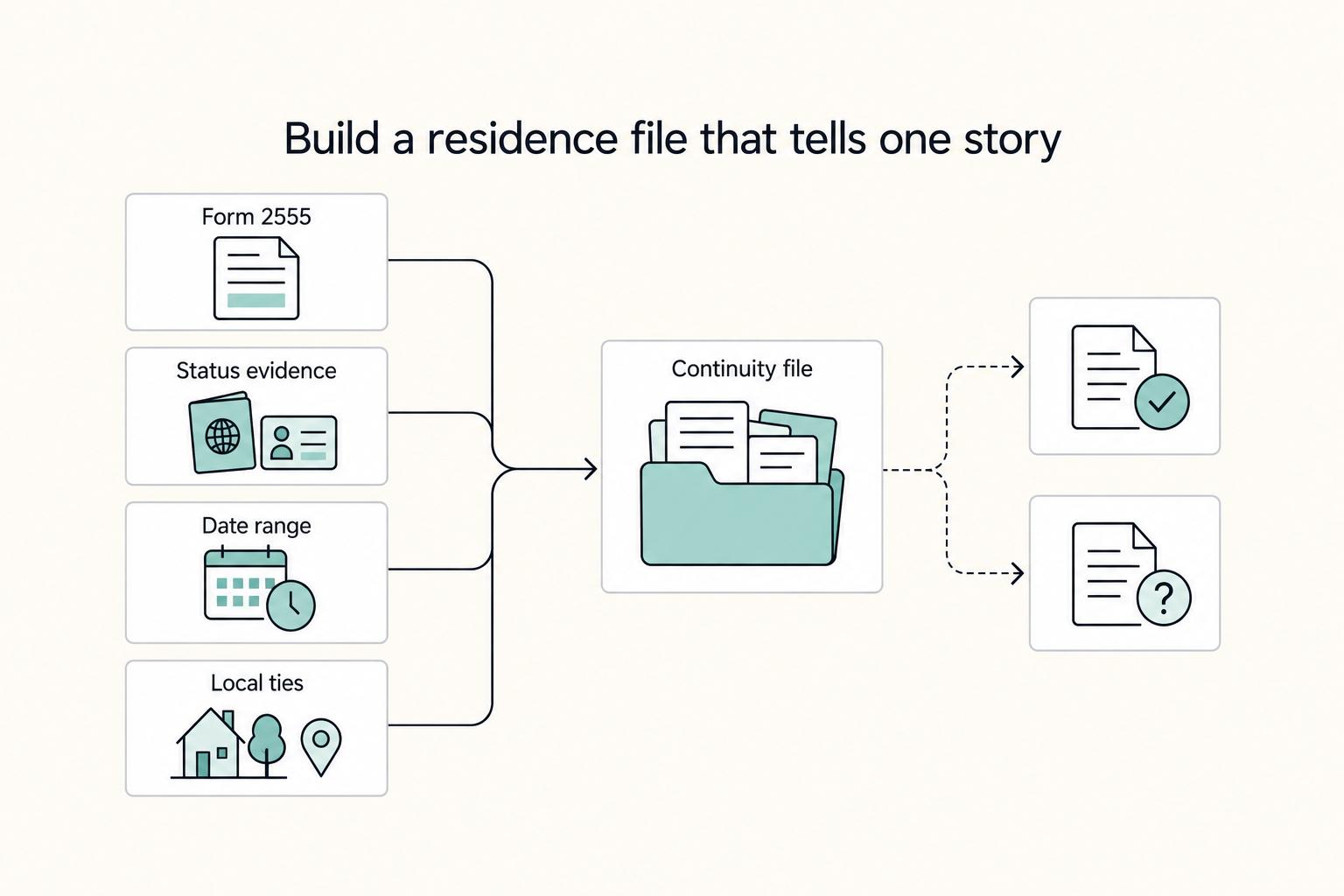
Build one defensible file so each material Form 2555 claim is supported by dated records, not memory. For a bona fide residence position, the core proof is an uninterrupted foreign residence period that includes an entire tax year, plus records that support your foreign base and foreign earned income reported on a U.S. return.
Keep day-count records too. If your residence case later looks weaker, you may need to test the Physical presence test as a backup.
| Form 2555 claim or checkpoint | What you are proving | Primary support to keep | Additional backup |
|---|---|---|---|
| Part II, Bona fide residence period | You were a bona fide resident of a foreign country for an uninterrupted period that includes an entire tax year. For calendar-year filers, that is January 1st through December 31st. | Dated residency timeline, passport and travel log, residence permit or visa, housing records covering the year | Lease renewals, local registration records, insurance records, school or dependent records tied to the foreign address |
| Foreign tax home (for physical presence counting, if needed) | Your tax home was in a foreign country while counting days abroad under the physical presence test. | Foreign address records, work calendar showing activity abroad, client or contract records tied to that location | Utility bills, local bank statements, coworking invoices, foreign tax filing or tax payment records |
| Temporary U.S. trips did not end residence | Trips were temporary, and you clearly intended to return to your foreign residence. | Trip log with purpose, departure and return dates, tickets or itineraries, proof you resumed life abroad after each trip | Emails confirming return plans, appointment records abroad, rent payments or recurring bills that stayed active while you were away |
| Foreign earned income reported on return | You are a qualifying individual with foreign earned income, and you file a return reporting that income. | Invoices, contracts, bookkeeping ledger, bank statements or payment processor records showing earned income | Forms received from clients, engagement letters, client correspondence matching invoiced work |
| Physical presence backup, if needed | You were physically present in foreign countries for 330 full days in 12 consecutive months. A full day is 24 consecutive hours, midnight to midnight. | Day-count calendar, passport entries, flight records | Hotel receipts, card statements abroad, calendar exports that confirm location on questioned dates |
For a Foreign Earned Income Exclusion claim, a practical starter pack is one full-year timeline, one foreign-base file, one income file, and one travel record that matches the timeline.
For audit resilience, keep overlap. Bona fide residence is facts-and-circumstances based, and living abroad for one year alone does not automatically establish bona fide resident status.
Use a maintenance cadence you can actually keep#
The IRS does not require a monthly or quarterly schedule. This optional cadence can help prevent gaps:
- Monthly archive: save statements, invoices, travel confirmations, visa or permit updates, and one foreign-address proof-of-life item. Use
YYYY-MMfile names so records sort cleanly. - Quarter-end reconciliation: match your travel log to passport stamps, flight emails, and calendar entries. Confirm that address history, housing continuity, and work location still support your foreign-base position.
- Pre-filing final review: review against the Form 2555 instructions, especially Part II - Taxpayers Qualifying Under Bona Fide Residence Test. Confirm dates, continuity of your foreign base, and income reporting. If needed, test physical presence against the 330 full days rule using the IRS full-day definition.
Checkpoint: if someone asked you to prove any month without your narration, your records should do most of the work.
If one document is missing, replace the fact, not the form#
A missing document can weaken a claim, so replace it with multiple independent records that prove the same fact and date range.
If a lease is missing, use records like a residence permit, rent payments, and utility or internet bills for the same period. If a passport stamp is missing, use boarding passes, airline receipts, and a card statement showing return to the foreign country after travel.
Add a short dated note explaining what is missing, what substitutes you used, and the period covered. Before filing Form 2555, confirm that each major claim has at least one primary record and, for close calls, one independent backup.
Use this as your working checklist: keep residency dates, tax-home signals, and Form 2555 support organized in the Tax Residency Tracker.
File in a clean sequence to reduce rework and contradictions#
A practical sequence is to lock your qualification position first, complete Form 2555 from that position, and then reconcile housing and self-employment interactions. This sequence helps keep the return consistent and reduces rework.
Lock the residency position before you touch the math#
Choose your qualification route for the year before you fill any downstream forms. For a residence-based position, that means your Part II - Taxpayers Qualifying Under Bona Fide Residence Test facts are already fixed. For this route, you need bona fide residence in a foreign country for an uninterrupted period that includes an entire tax year. For calendar-year taxpayers, those dates include January 1st through December 31st. Living abroad for one year alone does not automatically establish bona fide resident status.
If the residence case is weak, test whether 330 full days in 12 consecutive months supports the Physical presence test. Do not blend both paths in your working papers without first deciding which one you are actually relying on.
Checkpoint: every date entered on Form 2555 should already appear in your timeline file.
Complete Form 2555, then check housing interactions#
Once the qualification basis is fixed, complete Form 2555 using that same fact pattern. Then review the Foreign housing exclusion and Foreign housing deduction using the same dates, country, and foreign-residence narrative.
If you claim the housing exclusion, apply it directly in your FEIE calculation because FEIE is limited to foreign earned income minus housing exclusion. For 2026, keep the limits already reflected in your worksheets aligned: FEIE maximum $132,900 per qualifying person, housing limitation generally 30%, and $39,870. Check that Form 2555 and housing records reflect the same country and period.
Run a conflict check with Schedule SE#
Before filing, run a dedicated consistency check for Schedule SE (Form 1040). Do not assume FEIE resolves self-employment tax treatment.
The Schedule SE instructions include "U.S. Citizens or Resident Aliens Living Outside the United States," so your overseas status and FEIE position still need to align with how self-employment activity is described elsewhere in the return. Match the business activity period, country references, and taxpayer narrative across Form 2555, income records, and Schedule SE treatment.
Finish with an end-to-end consistency review#
Do one final pass before filing:
- Dates match across Form 2555, travel log, income records, and housing support.
- Country references match from start to finish.
- Taxpayer status is consistent as U.S. citizen or U.S. resident alien.
- Every material claim has supporting documentation.
- Every document ties to one line-item filing decision.
Operator checkpoint: do not file until every claim maps to a document and every document maps back to a filing decision.
Related reading: A Deep Dive into the Foreign Housing Exclusion for US Expats.
Know when to escalate to a tax professional#
If your FEIE position depends on treaty status, unclear tax-home facts, or a test switch you cannot clearly justify, consider a pre-filing review before submitting Form 2555.
Treaty-dependent resident cases#
Escalate when your U.S. resident position depends on an income tax treaty interpretation under the Bona fide residence test. For certain U.S. residents, this route is not just "I lived abroad." It also depends on treaty-country citizenship or nationality status.
Before filing, make sure your logic fits in one short note: your residency status, the treaty-country citizenship or nationality fact you rely on, and a draft Form 2555 position that matches those facts. If you cannot state that cleanly, escalate.
Tax home conflicts are not a paperwork problem#
Escalate when your claimed foreign base and your operating facts point to different places. The Physical presence test uses 330 full days in 12 consecutive months, but this route also depends on having your tax home in a foreign country.
Run one timeline with three columns:
- Where you were physically located
- Where you performed or managed the work
- What document supports each entry
If those columns do not tell one consistent story, get professional review before filing.
Test switching needs a factual reason#
Switching between the Bona fide residence test and the Physical presence test is not automatically wrong, but you should be able to point to a factual reason you can prove. Bona fide residence is facts-and-circumstances based and must include an entire tax year for calendar filers. Physical presence is based on time abroad.
Ask one direct question: what new fact caused the switch? Your Form 2555 draft should make the chosen route obvious and internally consistent.
Return consistency can change risk#
Escalate if your Form 2555 position conflicts with how your return reports the same income. Claiming FEIE requires filing a return that reports the income, so Form 2555 should be consistent with the rest of that filing.
Potential red flags include a draft Form 2555 position that does not match your documented facts or a return draft that tells a different story about the same income. If either applies, pay for a review before you file.
Do not ignore related reporting that sits next to FEIE#
Qualifying for FEIE is not the same as finishing your international reporting. Treat Form 2555 and foreign account reporting as separate checks, then reconcile them before you file. If Form 8938 or Schedule SE might apply to your facts, review those separately too.
FEIE applies in the context of a U.S. return that reports the income, and a common mistake is assuming excluded income does not need to be reported at all. It still does. If your process ends at "I qualify," you may miss adjacent obligations. IRS international FAQ answers are general guidance and are not citable legal authority.
Separate the checks before filing#
Keep these as separate workstreams:
- FEIE / Form 2555: Your exclusion position on the U.S. return, including reported income.
- FBAR (FinCEN): Separate foreign financial account reporting.
- FATCA / Form 8938: Separate review path when applicable; confirm threshold rules with the relevant authority.
- Schedule SE: Separate self-employment tax review when applicable; this does not support any blanket claim that FEIE automatically removes
Schedule SEexposure.
Passing the Bona fide residence test or the Physical presence test (330 full days in 12 consecutive months) does not, by itself, resolve those other items.
Minimum cross-check before you submit Form 2555#
- Confirm the return reports the income you plan to exclude.
- If you held foreign financial accounts during the year, run a separate FBAR review.
- If
Form 8938could apply, run a separate review and do not infer the answer from FEIE status alone. - If you had freelance or consulting income, run a separate
Schedule SEreview. - Reconcile names, dates, and country facts across return drafts, account records, and business records.
Keep one single source of truth sheet#
| Category | Track | Why |
|---|---|---|
| FEIE | Test used, qualifying period, Form 2555 draft status | Keeps exclusion logic consistent |
| Financial accounts | Account list, ownership or signature authority, country | Supports a separate FBAR review and flags other account-reporting checks |
| Entities and income | Entity or client, income type, where work was performed | Keeps return treatment aligned with business records |
| Filing checks | Return, Form 2555, FBAR review, Form 8938 review, Schedule SE review | Helps prevent missed adjacent filings |
If you do one extra control, keep this sheet current and review it before filing.
Set up your records so compliance is easier next year#
Use one audit-ready archive for the tax year so every FEIE position and every Form 2555 input can be traced back to a dated record. The goal is not a perfect vault. The goal is a return that is easy to prepare, easy to reconcile, and hard to contradict.
A simple structure is one tax-year folder with three subfolders: residency and foreign-base support, income and Form 2555 support, and account-reporting support for separate foreign-account reviews (for example, FBAR and Form 8938, if applicable). In each subfolder, keep source documents plus a short index note with the date, country, and why the item matters.
If you are using the bona fide residence route, keep a clear residency timeline showing the uninterrupted period, including the full calendar tax-year window of January 1 through December 31. If you are using physical presence, keep a day-count file and reconcile it before assuming you reached 330 full days in a 12-month period.
Your minimum archive should include:
- Residency timeline, travel log, and records that support your foreign tax home/work base and intent to return to your foreign residence after brief trips.
- Income records used to prepare the U.S. return and
Form 2555. - Foreign account statements or summaries used for separate account-reporting review (including
FBARandForm 8938if those filings apply). - A final filed-return pack with the return,
Form 2555, and your year-end reconciliation sheet.
If you use Gruv, keep exports and traceable transaction history where supported and enabled. Use them to reconcile payment dates, amounts, and transaction flow when your draft return and records do not match.
Treat documentation as an ongoing operations task, not a filing-season scramble tied only to FEIE. Archive monthly, reconcile during the year, and run a pre-filing check before submission.
Conclusion#
Pick the FEIE route you can prove, not the one that sounds better. If you're searching bona fide establishment test feie, the practical question is which position you can document cleanly on Form 2555 with consistent dates, residence facts, and tax-home facts.
If your uninterrupted foreign residence includes an entire tax year and your facts support real residence abroad, the bona fide residence route may be stronger. If your records clearly show 330 full days during any period of 12 consecutive months and your tax home is in a foreign country, the physical presence test may be easier to defend because it is strictly time-based. Do not force a preferred test after the facts are already set.
Before filing, confirm three things:
- Your chosen test matches your strongest evidence.
- Every key claim on
Form 2555ties to dated records. - Your timeline is consistent across your travel history and income reporting.
If your facts are mixed or treaty-dependent, escalate early. That is especially important if you are a U.S. resident rather than a U.S. citizen and are relying on the treaty-country condition for the bona fide residence route.
File once, with a clean record. FEIE still requires filing a U.S. return that reports the income, so your documentation needs to be clear and consistent before you submit.
If your facts are mixed or treaty-sensitive, review your workflow before filing and contact Gruv.
Frequently Asked Questions
Is the bona fide establishment test the same thing as the bona fide residence test for FEIE?
The IRS FEIE guidance uses bona fide residence test as the term. If you searched for bona fide establishment test feie, you are likely looking for the bona fide residence test.
Do I need a full tax year abroad to use the bona fide residence test?
Yes. For a calendar-year taxpayer, your uninterrupted residence period must include an entire tax year: January 1 through December 31. Living abroad for a year by itself does not automatically make you a bona fide resident.
Can I travel back to the United States and still qualify under bona fide residence?
Yes. Brief or temporary trips to the United States can still be compatible with bona fide residence. The key is whether you clearly intended to return to your foreign residence, or to a new foreign bona fide residence, without unreasonable delay.
Who can use this test, and how is a U.S. resident treated differently from a U.S. citizen?
The test applies to U.S. citizens and to certain U.S. residents within the meaning of IRC section 7701(b)(1)(A). For a U.S. resident, there is an added condition: the person must be a citizen or national of a country that has an income tax treaty in effect with the United States.
What does the IRS evaluate besides time spent in a foreign country?
This test is not only a day count. IRS guidance says the analysis may include your intention or purpose for being in the foreign country, your activities there, and foreign tax payment, among other facts and circumstances. That is the main contrast with the physical presence test, which is based only on how long you stay in a foreign country or countries.
What documents should I keep to support Form 2555 and my tax-home claim?
These IRS excerpts do not provide an exact Form 2555 document checklist. Keep records that support the facts you are relying on, such as your residence period or day count, travel dates, intent and activities abroad, and any foreign tax payment information relevant to your filing. You claim the exclusion by filing a U.S. return that reports the income.
When should I choose bona fide residence instead of physical presence if my travel is irregular?
There is no single rule for irregular travel patterns. Bona fide residence depends on facts and circumstances, including an uninterrupted foreign residence period that includes the full tax year. Physical presence is time-based: 330 full days in 12 consecutive months, with a full day defined as 24 consecutive hours from midnight to midnight; missing that threshold fails the test regardless of the reason.
Try a related tool
Researched and edited by the Gruv editorial team. Gruv builds cross-border billing, payouts, and finance-operations software for global businesses.
Sources
Includes 2 external sources outside the trusted-domain allowlist.
- ftb.ca.gov/file/personal/residency-status/part-year-and...trusted
- irs.gov/individuals/international-taxpayers/foreign-...trusted
- irs.gov/individuals/international-taxpayers/foreign-...trusted
- americanpacifictax.com/bona-fide-residence-test-irsexternal
- taxesforexpats.com/expat-tax-advice/how-to-avoid-problems-when-...external
Educational content only. Not legal, tax, or financial advice.
Related Posts

Digital Nomad Taxes in 2026 With a Defensible Filing Plan
With digital nomad taxes, the first move is not optimization. It is figuring out where you may be taxable, where filings may be required, and what proof supports that position.

183-Day Rule Tax Myths That Trigger Residency Filing Mistakes
If you are a mobile freelancer or consultant, start here: the "183 day rule tax" idea is not a single universal test. It is a shortcut phrase people use for different residency rules that do not ask the same question. If you mix federal and non-federal residency logic, you can create filing risk even when your travel calendar looks clean.
The Bona Fide Residence Test: A Deep Dive for US Expats
If your facts support a full, uninterrupted calendar year abroad, the residence route is often the cleaner way to claim the Foreign Earned Income Exclusion. For calendar-year filers, that means January 1 through December 31. If your year will not support that uninterrupted span, do not try to force it. Plan around the [Physical Presence Test](https://www.irs.gov/individuals/international-taxpayers/foreign-earned-income-exclusion-physical-presence-test) instead: 330 full days abroad within any 12-month period, with a foreign tax home during the period you claim.