
Quick Answer
Use the Ben Franklin Effect in client work by making small, bounded asks that improve the project, such as requesting client-only context, milestone decisions, or implementation input. Done well, this builds mutual investment, creates clearer approvals, reduces scope and handoff risk, and makes your value harder to compare on price alone.
Don't Just Be Liked. Be Indispensable: A Risk-Management Guide to the Ben Franklin Effect#
In client work, the Ben Franklin Effect matters when it creates mutual investment. Being liked is not what protects your work. What protects it is a relationship where the client has put time, judgment, and internal context into the project, not just approved a proposal.
That distinction matters because client work is rarely a simple power story. A client may control budget and authority, but you still have room to influence outcomes through service, speed, quality, and workable terms. When you make your contribution explicit and harder to swap out, you are less likely to be treated like a commodity vendor whose job is to be pleasant and cheap.
Before kickoff, use a practical test: can you name the client's needs, concerns, goals, and fears in plain language? Can you also state your value beyond price, such as service, speed, quality, access, or payment terms? If not, you are probably leaning on charm and responsiveness more than you realize.
| Rapport behavior | Partnership behavior | Likely project consequence |
|---|---|---|
| Being easy to like, agreeable, always available | Asking for the client's specific input where their internal knowledge matters | Clearer decisions tied to the client's actual context |
| Keeping conversation friendly but vague | Defining your value in service, speed, quality, and terms, not just fee | Less commodity treatment and fewer price-only comparisons |
| Absorbing ambiguity to avoid friction | Getting client buy-in on key choices early | Lower risk of late-stage surprises when key choices were left unclear |
| Winning work mainly by being cheaper | Positioning your unique contribution so you are harder to swap out | Better margin protection and less pressure from walk-away threats |
A simple risk lens helps. Relationship risk is being liked but not trusted with meaningful judgment. Delivery risk is unclear scope, weak client input, or late decisions that slow the work. Commercial risk is being pushed into price competition or easy replacement. The point of the Ben Franklin Effect in client work is not to become more charming. It is to reduce those risks by clarifying interests and showing clear value beyond price.
One red flag is worth naming early. If your main differentiator is price, you are training the client to compare you on price and threaten to walk. That hurts margin and can turn normal project bumps into replacement pressure. A stronger move is to document where your work creates value outside price, then ask for client contributions that improve the result and tie them into the process.
The useful part of this idea is not "ask for favors" in the casual internet sense. It is understanding why the right asks can change how clients see the work, and why most advice on the Ben Franklin Effect misses the point. Related: Thailand's Long-Term Resident (LTR) Visa for Professionals.
What Is the Ben Franklin Effect (And Why Most Advice Fails You)?#
The Ben Franklin Effect is the idea that a person may like you more after doing you a favor. In client work, most bad advice fails because it focuses on random favors instead of work-relevant asks.
The name comes from an 18th century anecdote: Franklin asked a rival in the Pennsylvania Assembly to lend him "a certain very scarce and curious book" for a few days, then returned it in about a week with thanks. Franklin later reported that the rival, who had not spoken to him before, treated him with "great civility." The practical takeaway is not charm; it is a small, bounded request with clean follow-through.
A common explanation is cognitive dissonance: after helping, people may align their attitude with that behavior to stay consistent with how they see themselves. But this is not a guaranteed outcome in every setting. A 1969 study often cited on this effect reported different liking outcomes across request conditions, which is a good reminder to treat this as context-sensitive, not magic.
In practice, use asks that improve the work itself.
| Ask type | Example | Signal | Usefulness for the project |
|---|---|---|---|
| Low-value social ask | "Can you recommend a coffee place near your office?" | Friendly but mostly social | Little impact on scope or decisions |
| Low-value convenience ask | "Can I borrow a charger?" | May read as unprepared | No clear project value |
| Work-relevant strategic ask | "Can you mark which audience segment matters most before I draft?" | Uses client context only they have | Improves decision clarity |
| Work-relevant strategic ask | "Can you review these two positioning options and pick the one your team can sell?" | Builds ownership of a key choice | Connects execution to client input |
Use this filter:
- Keep the ask if it helps delivery decisions, implementation, or shared ownership of real project choices.
- Drop the ask if it mainly tries to make you seem more likable.
- Make each ask bounded: one decision, one document, or one clear input by a specific time.
You might also find this useful: A freelancer's guide to 'Liking' (in the Cialdini sense).
Ask for expertise, then milestone decisions, then integration#
Use this sequence to build co-ownership, not likability: ask for expertise first, then milestone decisions, then implementation integration. That progression gives the relationship a stronger base than rapport alone and helps reduce replaceability and scope drift.
This approach is most useful when the work is still less structured. In those moments, your asks signal how the project will be run. Specific, low-friction requests for client-only context read as professional project leadership.
Step 1. Ask for expertise, not background#
Start by lowering assumption risk. Your first ask should target internal context only the client can provide and that will change your decisions.
Ask for one bounded, decision-useful input: the material behind the initiative, a key audience priority, a prior failed attempt, or a constraint. If you only get generic collateral, the request was too broad.
A tight version: "Before I draft, can you share the material your team used to decide this project, and the one audience segment that matters most? That will help me make the first pass fit your internal reality."
Trigger: After kickoff, before first draft or recommendation. Ask: One bounded request for internal context only they can provide. Signal: Specific material or a direct decision answer, not just "see attached."
Step 2. Ask for a milestone decision, not open-ended feedback#
After discovery, use your next ask to support scope control. Get client input on roadmap choices before more work is committed.
Useful responses are concrete: milestone confirmation, sequence corrections, approval gates, or priority choices. "Looks good" is not enough for co-ownership.
Try: "I drafted a one-page roadmap with three milestones. Can you mark where internal approval needs to happen and whether the sequence matches how your team works?"
Trigger: When a roadmap, outline, or milestone plan exists. Ask: One review tied to sequence, approvals, or priority. Signal: Annotated roadmap, milestone approval, or a clear decision point.
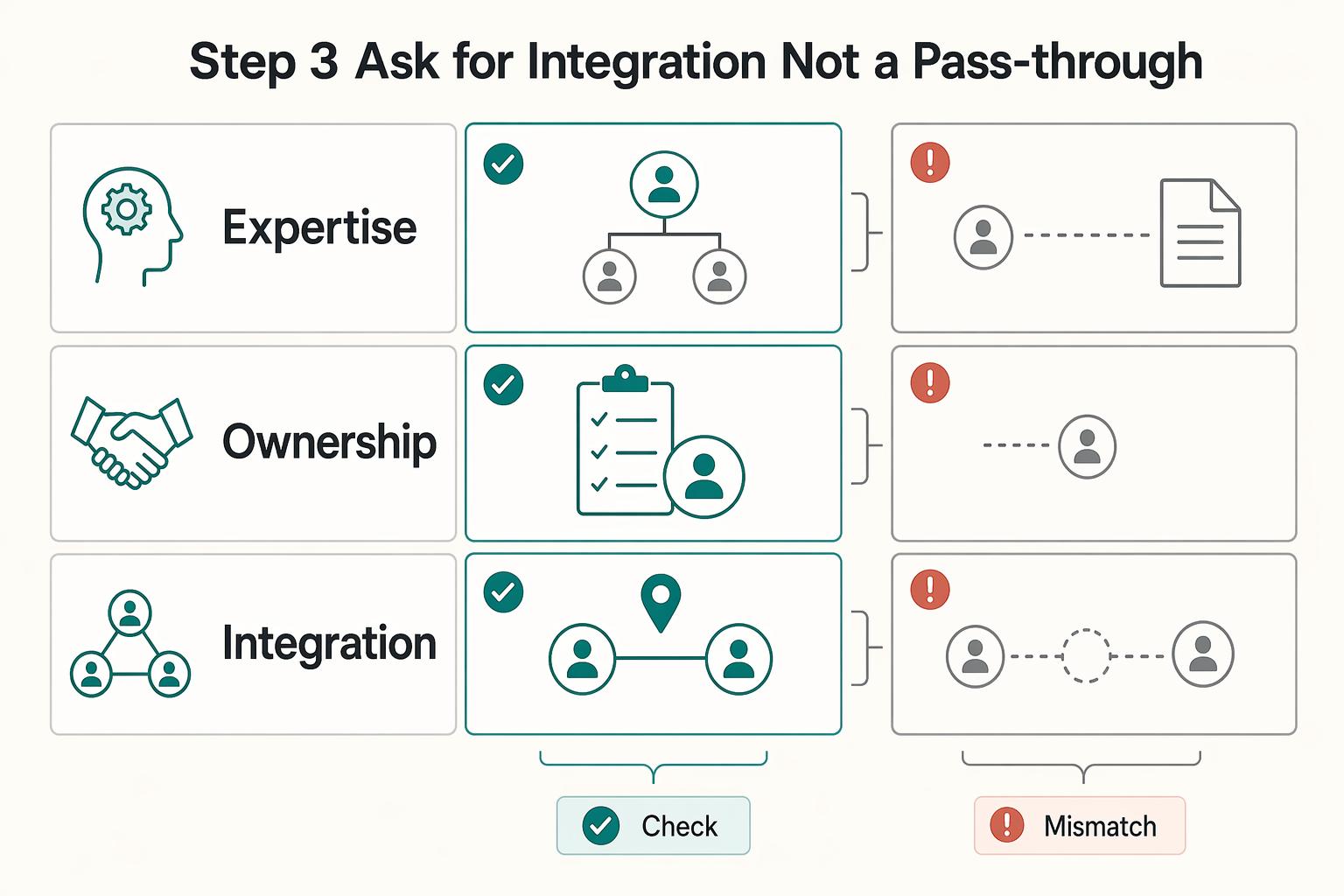
Step 3. Ask for integration, not a pass-through#
Before handoff, reduce single-contact dependency. If another team must execute, ask for a direct introduction before pressure increases.
The signal is specific: named intro, stakeholder response, and clarity on ownership or constraints. "I'll pass it along" without a direct connection keeps risk in place.
A practical version: "To make handoff cleaner, could you introduce me to the person implementing this on your side so we can confirm constraints and avoid rework?"
Trigger: Before handoff or any stage requiring another internal team. Ask: One direct intro to the stakeholder carrying execution. Signal: Named intro, response, and implementation constraints clarified.
| Step | Weak ask | Strong ask | Why it helps |
|---|---|---|---|
| Expertise | "Send anything helpful." | "Share the material behind this initiative and the main audience segment." | Improves alignment with decision-useful context |
| Co-ownership | "Any feedback?" | "Mark approval points and confirm milestone sequence." | Creates usable decisions and supports scope control |
| Integration | "Keep me posted." | "Introduce me to the implementation owner so we can confirm constraints." | Reduces single-contact risk and supports cleaner handoff |
The sequence stays the same: the client contributes context, helps shape direction, then helps embed execution. If you want a deeper dive, read GDPR for Freelancers: A Step-by-Step Compliance Checklist for EU Clients.
The 4 Rules for Making 'Strategic Asks' That Enhance Authority#
Use strategic asks only when they improve a real project decision. If a request will not change your draft, roadmap, or handoff, cut it, narrow it, or handle it yourself.
1. Ask for client-only value. Ask for internal context, constraints, or priorities you cannot get from outside materials. This reinforces authority because you are requesting expertise, not rescue. Avoid trivial favors or basic information you could have found yourself. Self-check: What will change in my draft, roadmap, or handoff because of this answer?
2. Keep the ask low-friction. Make it easy to answer in one reply, one annotation pass, or one short intro email. A one-page roadmap, two options, or one named question produces cleaner decisions than "thoughts?" Avoid broad asks that create document dumps or push your analysis work back to the client. Self-check: Is this clear enough to answer quickly without guesswork?
| Weak ask | Strategic ask | Client effort required | Authority signal | Likely project impact |
|---|---|---|---|---|
| "Send anything helpful." | "Send the material behind this initiative and name the main audience segment." | Low to moderate | You are aligning to internal reality | Better first draft, fewer wrong assumptions |
| "Any feedback on this?" | "Please mark where approval needs to happen on this one-page roadmap." | Low | You are managing decisions, not fishing for opinions | Cleaner scope and sequencing |
| "Keep me posted on implementation." | "Please introduce me to the person implementing this so I can confirm constraints." | Low | You are protecting handoff quality | Cleaner handoff and clearer ownership |
3. Time it to the project stage. Follow the sequence from the last section: expertise first, milestone review once a roadmap exists, then integration before handoff. Good timing makes your ask feel operationally necessary; bad timing makes even a smart ask feel random. Self-check: Is this the next decision the project actually needs?
4. Make sure the ask is genuine. This works when the request is real and tied to better work. If you cannot explain how the ask improves the project, do not send it. Self-check: Would I still ask this if there were no relationship upside for me?
The harder cases are when the client is quiet, overloaded, or nonresponsive. The FAQ covers those edge cases.
For a step-by-step walkthrough, see A guide to 'Maslow's Hierarchy of Needs' for understanding client motivation.
Your Business Isn't Built on Likability; It's Built on Trust#
If you want a durable client relationship, optimize for trust, not likability. In many professional relationships, there simply is not enough interaction time to run on friendship dynamics: one cited benchmark is about 50 hours to reach even "casual friend" status, while some professionals may spend only two to five hours per year in actual client meetings. So use behavior and decisions as your signal, not warmth alone.
| Likability-led dynamic | Trust-led dynamic |
|---|---|
| What you see | Pleasant tone, positive comments, light challenge |
| How you work | More reliance on assumptions |
| What to track | General rapport |
This is where the Ben Franklin Effect can be useful as a tendency, not a guarantee. The core idea is that doing someone a favor can increase liking, and one explanation is cognitive dissonance (beliefs shifting to match behavior). In practice, that means asking for small, real input that improves the work and then visibly using it, not asking for random favors.
Also watch the downside: if an ask feels performative, unnecessary, or like manipulation, people may resist it.
This week, make one practical shift:
- Keep doing: requests that clearly improve a real deliverable.
- Stop doing: trying to win trust through friendliness alone.
- Change: make one concrete, necessary request and keep the response in writing as part of your project record.
We covered this in detail in The Psychology of Freelance Client Retention for Long-Term Relationships.
Frequently Asked Questions
What does this look like in real client work?
It looks like a small request tied to a real decision. You might ask the client to choose the audience segment that matters most or confirm the internal term their team uses. The point is to use client-only knowledge and then visibly apply that input to the work.
Is the ben franklin effect for client relationships manipulative?
Treat it as a tendency, not a trick. If the ask is fake, unnecessary, or mainly about getting them to like you, do not send it. If it improves the work and you would make it anyway, you are on firmer ground.
How do you tell a useful favor from scope creep in the moment?
Check who owns the request, whether it changes agreed deliverables, and whether change control is needed. If it sharpens work already sold, it likely stays inside scope. If it adds a new output, audience, channel, review round, or extra research work, document revised scope, fee, and timeline before starting.
When should you start using this with a new client?
Use it once you have enough context to make a credible request. In practice, that usually means after you have read the brief, reviewed what they already sent, and can show why their input matters. If the ask sounds like homework you should have done yourself, wait and do the homework first.
What if the client says no or ignores the ask?
If they say no, thank them, proceed with your best judgment, and note the assumption in writing. If they ignore it, narrow the request to one decision, one deadline, and one fallback before repeating it. If they still do not answer, keep moving and avoid building delivery around the missing input.
Can this help you manage project risk and operations?
It can help as a practical habit, not a guarantee. Small asks can create written clarity around the success metric, target audience, approval owner, implementation constraint, or billing details. Those records make the work easier to defend, execute, invoice, and hand off.
Try a related tool
Researched and edited by the Gruv editorial team. Gruv builds cross-border billing, payouts, and finance-operations software for global businesses.
Sources
- bclawreview.bc.edu/articles/876/files/63b52e70d3dab.pdftrusted
- dsc.duq.edu/cgi/viewcontent.cgitrusted
- en.wikipedia.org/wiki/Ben_Franklin_effecttrusted
- ithaca.edu/sites/default/files/2024-12/icsm.f24.pdftrusted
- leeds-faculty.colorado.edu/dahe7472/Judge%20and%20zapata%201149.full.pdftrusted
- milnepublishing.geneseo.edu/future-is-now/chapter/understanding-artifici...trusted
- nysed.gov/sites/default/files/programs/standards-instr...trusted
- pmc.ncbi.nlm.nih.gov/articles/PMC8763848trusted
Educational content only. Not legal, tax, or financial advice.
Related Posts

GDPR Compliance Checklist for Freelancers Working With EU Clients
Start by separating the decisions you are actually making. For a workable **GDPR setup**, run three distinct tracks and record each one in writing before the first invoice goes out: VAT treatment, GDPR scope and role, and daily privacy operations.

Thailand's Long-Term Resident (LTR) Visa for Professionals
For a long stay in Thailand, the biggest avoidable risk is doing the right steps in the wrong order. Pick the LTR track first, build the evidence pack that matches it second, and verify live official checkpoints right before every submission or payment. That extra day of discipline usually saves far more time than it costs.
From Persuasion to Protection: A Freelancer's Guide to Cialdini's Liking Principle
If persuasion language makes you wary, keep that instinct. A safer approach is to use persuasion as transparent trust-building, not as a charm tactic.