
Quick Answer
Yes. Buy the pass only after matching it to your route and first paid stop, then verify entry conditions for each entrance. It covers entrance or standard amenity day-use fees across the interagency network, but not expanded amenity charges like camping, special tours, permits, or ferries. The passholder must be present with valid photo ID, and some high-traffic locations still require a reservation. If your plan depends on one specific gate, confirm that gate’s acceptance details before departure.
Entry Planning Beyond the Purchase#
If you are planning a long U.S. stay with national park weekends built into your calendar, the real job is not learning the name of the pass. It is avoiding the kind of gate-day mismatch that costs time or access when you are already on the road. This guide focuses on that practical problem.
The core tension is simple. The America the Beautiful pass, which the National Park Service identifies as an interagency pass, is one option at fee-charging national parks. But it does not remove the need to check site-level rules.
NPS says most sites it manages are free to visit. Some require an entrance pass, and a few high-traffic sites may also require a reservation. So even if you have a pass, you can still hit a failure point if your first stop has a separate reservation requirement or uses a different admission setup than you assumed.
That matters more on longer, multi-stop trips than it does on a one-off vacation. Long stays usually mean more moving parts and a higher chance that your first paid site is not the only paid site on the itinerary.
At fee-charging national parks, NPS notes that visitors may need either a standard pass, a park-specific annual pass, or an America the Beautiful pass, and only one of those is required. So the real decision is not "pass or no pass." It is which pass fits your travel pattern, and what still needs to be checked outside that purchase.
A good starting rule is to treat the pass as one part of entry, not the whole entry plan. Before you leave, confirm four things:
- whether each planned stop is free or requires an entrance pass
- which pass type fits your paid stops (standard, park-specific annual, or America the Beautiful/interagency)
- whether any planned high-traffic site also requires a reservation
- whether each stop has site-specific entry rules you need to handle separately
That is the thread for the rest of this guide. First, we will pin down what the pass actually covers and where common misunderstandings start. Then we will narrow to pass selection and a simple verification routine for each stop before you travel. If you remember one thing, make it this: a pass can simplify a multi-park trip, but it does not replace checking the exact rules of the place you are about to enter.
If you are planning the broader trip too, we covered that in The Best Digital Nomad Cities in Latin America in 2026.
What the America the Beautiful Pass actually covers#
The America the Beautiful Pass is a federal admission pass, not a blanket travel bundle. It is also called the Interagency Pass or the National Parks and Federal Recreational Lands Pass, and it covers entrance fees or standard amenity (day-use) fees at participating federal recreation areas.
| Item | Covered? | Notes |
|---|---|---|
| Entrance fees | Yes | At participating federal recreation areas |
| Standard amenity (day-use) fees | Yes | At participating federal recreation areas |
| Camping | No | Expanded amenity fee excluded |
| Parking | No | Expanded amenity fee excluded |
| Special tours | No | Expanded amenity fee excluded |
| Special permits | No | Expanded amenity fee excluded |
| Ferries | No | Expanded amenity fee excluded |
| Concessioner-managed entrances | Verify | May not accept the pass |
It applies across areas managed by six federal agencies: the National Park Service, U.S. Forest Service, U.S. Fish and Wildlife Service, Bureau of Land Management, Bureau of Reclamation, and U.S. Army Corps of Engineers.
What it does not cover matters just as much: expanded amenity fees such as camping, parking, special tours, special permits, and ferries are excluded. Lands managed by concessioners may also not accept the pass, so confirm who operates your exact entrance before you go.
Use rules matter at the gate. The pass is issued to one person, and that pass holder must be present with valid photo ID each time it is used.
Coverage also depends on the site fee model:
- At per-vehicle sites, one pass covers the holder and passengers in one non-commercial vehicle, or up to two motorcycles.
- At per-person sites, one pass covers the holder plus 3 adults age 16 or older (maximum 4 adults total).
| Known from official guidance | Verify before you rely on it |
|---|---|
| Covers entrance or standard amenity day-use fees | Current pass prices and category-specific eligibility |
| Works across six named federal agencies | Whether your exact entrance is concessioner-managed |
| Pass holder must be present with valid photo ID | Whether your site also requires a reservation |
If you are mapping visits now, see The Best Hiking Trails in the US National Parks.
Choose the right pass type for your situation#
Choose by eligibility and time horizon, not by park name. If you expect frequent visits over a year, start with annual options. If you qualify for a lifetime category, compare that first so you do not renew unnecessarily.
NPS guidance is direct: "Review all pass options below and decide which pass is best for you." At parks that charge entrance fees, visitors only need one pass type among a standard pass, a park-specific annual pass, or an America the Beautiful pass, so the key is choosing the right pass family before you buy.
| Pass type | What the material confirms | Typical first place to check or buy | What to verify before purchase |
|---|---|---|---|
| Resident Annual Pass | Listed by USGS as a 2026 annual pass | USGS Store recreational passes page | Current price, eligibility, delivery or pickup details |
| Non-Resident Annual Pass | Listed by USGS as a 2026 annual pass | USGS Store recreational passes page | Current price, eligibility, format options |
| Senior Annual Pass | Listed by USGS; annual category | USGS Store recreational passes page | Eligibility proof, documentation, current price |
| Senior Lifetime Pass | Listed by USGS; lifetime category | USGS Store recreational passes page | Eligibility proof, documentation, current price |
| Military Pass | Listed by USGS | USGS Store recreational passes page | Eligibility proof, who qualifies, current price if any |
| Access Pass | Listed by USGS | USGS Store recreational passes page | Eligibility proof, documentation, format and issuance details |
| 4th Grade Pass | USGS says available at site locations only | Participating site locations first | Exact documents required and where your first site issues it |
| Volunteer Pass | USGS says available at site locations only | Participating site locations first | Current qualification rules and which sites issue it |
How to choose quickly#
If you are relocating for about a year and expect regular federal-site visits, begin with annual options. In this material, the annual options shown are Resident Annual, Non-Resident Annual, and Senior Annual.
If you may qualify for lifetime eligibility, compare lifetime versus annual before purchase, especially Senior Lifetime versus Senior Annual. The long-term value can be better, but only after you confirm access and issuance requirements.
If you are choosing Military, Access, 4th Grade, or Volunteer categories, make documentation your first checkpoint. These categories are confirmed, but complete proof requirements are not provided here, so verify them before purchase.
Start with the right purchase path#
For most categories in this section, start on the USGS Store recreational passes page and use its "Determine Which Pass Is For You" flow. That helps you narrow to the right pass family before you decide on format or fulfillment.
For 4th Grade Pass and Volunteer Pass, start with participating site locations because USGS lists both as site-location-only. Confirm this early so you do not end up on the wrong purchase path close to departure.
Keep a short "verify before purchase" checklist for any missing price, proof, or issuance details.
Decide digital or physical before you travel#
Choose the format based on what you can present reliably at the gate, but first make sure you are buying the right product. On Recreation.gov, a Digital America the Beautiful Pass is for multiple locations, while a Digital Site Pass is for a single location.
| Option | What is confirmed here | Best fit | Check before travel |
|---|---|---|---|
| Digital America the Beautiful Pass | Sold for visits to multiple locations | Multi-stop trips across federal recreation areas | How you will present it at entry, and whether the named pass holder can show valid photo ID |
| Physical interagency pass | Same interagency pass family, with no shipping/pickup guarantees confirmed in this section | Trips where you want a simple hand-to-ranger format | Where you will obtain it and the timing needed |
| Digital Site Pass | Sold for one location only | Single-site visits | That you are not using it as a substitute for a multi-location interagency pass |
The key gate rule is straightforward: each pass is issued to one person, and that pass holder must be present with valid photo ID each time the pass is used. So the format choice is not only digital versus physical; it is also about pass-holder-and-ID readiness.
If your first stop is high traffic, treat entry as a two-check process: pass plus any required reservation. If connectivity or day-of logistics feel uncertain, plan a backup presentation path before you leave.
For 2026 planning, treat EXPLORE Act discussion as background, not as your operating checklist. Right before departure, re-check the current Recreation.gov product page and current NPS pass guidance for the exact format and entry requirements you plan to use.
Whichever format you choose, coverage limits stay the same: expanded amenity fees (like camping, parking, special tours, special permits, or ferries) are not included by default, and concessioner-managed lands may not accept the pass.
Build your no-surprises document checklist#
Build one entry packet before you leave so you can prove purchase details, category eligibility if relevant, and your backup path if plans change.
| Entry item | What to include | Notes |
|---|---|---|
| Pass and purchase details | Your pass plus matching purchase confirmation details | Order email, confirmation number, exact product name |
| Photo ID | Valid photo ID for the traveler who will present the pass | That traveler must be present at entry when the pass terms require it |
| Offline backups | Screenshots, saved PDFs, and a printed copy of key confirmations | Backup path if plans change |
| Category-proof documents | Any category-proof documents you plan to present | Verify the exact acceptable proof on the current official page before travel |
| Nearby pickup alternatives | Nearby NPS pass-issuing pickup alternatives | Include in one fallback folder |
Core entry packet#
Bring:
- Your pass (digital or physical) and matching purchase confirmation details for passes obtained via Recreation.gov or the USGS Store (order email, confirmation number, exact product name).
- A valid photo ID for the traveler who will present the pass, and that traveler present at entry when the pass terms require it.
- Offline backups: screenshots, saved PDFs, and a printed copy of key confirmations.
Category-pass checkpoint#
If you plan to use a category-specific pass, for example a Military Pass, Access Pass, or 4th Grade Pass, verify the exact acceptable proof on the current official page before travel. Do not rely on memory or old screenshots.
One point is clear from the USGS Store: 4th Grade and Volunteer Passes are available at site locations only. Plan pickup accordingly, and confirm issuing locations through National Park Service pass-location guidance.
Party-setup and fallback check#
Before each stop, confirm whether that site uses per-vehicle or per-person entry so your group assumptions stay accurate.
Create one fallback folder with:
- Offline or printed confirmations
- Any category-proof documents you plan to present
- Nearby NPS pass-issuing pickup alternatives
That folder gives you a recovery path if your first entry plan fails.
Follow a 30-day to gate-day timeline#
Avoid gate surprises by choosing your pass path early, then using the final two weeks to verify the first stop.
| Timing | Main task | Key checks |
|---|---|---|
| 30+ days out | Pick one pass path and map your first gate | Decide whether a standard pass, park-specific annual pass, or America the Beautiful pass fits the first paid stop |
| 14 days out | Confirm first-stop rules that can still block entry | Check pass acceptance, reservation or timed-entry reservation rules, and site-specific entrance exceptions |
| 7 days out | Lock your proof pack and test it offline | Include your pass and proof of pass ownership in formats you can access without signal |
| Travel day | Present proof first, then resolve extras | If blocked, ask what is blocking entry, pay the standard entrance fee if needed, and correct the setup before the next stop |
30+ days out: pick one pass path and map your first gate#
At sites that charge entrance, plan around one qualifying option, not multiple purchases: a standard pass, a park-specific annual pass, or the America the Beautiful pass. Use your route to decide what fits first, especially if a short-window standard pass (1-7 days) or a one-year park pass is enough for your first paid stop.
Map your candidate parks in calendar order. If your first stop is free, you may have more flexibility before buying. Most NPS-managed sites are free, so do not assume every stop needs paid entrance coverage.
Choose your purchase or management channel, such as Recreation.gov or the USGS Store, based on how you will present proof at your first site.
14 days out: confirm first-stop rules that can still block entry#
Check the official page for your first paid stop and confirm:
- your pass option is accepted there
- whether a reservation or timed-entry reservation is also required
- any site-specific entrance exceptions you need to handle in advance
A valid pass may still not be enough at high-traffic locations that require reservations.
7 days out: lock your proof pack and test it offline#
Freeze one entry packet and run a quick first-gate simulation with it. Include your pass and proof of pass ownership in formats you can access without signal.
If your trip includes unstaffed federal recreation sites, be ready to display a pass or show proof of ownership. If you use accessories, remember the limits: a hangtag is display-only, and decals are not valid at staffed entrance sites.
Travel day: present proof first, then resolve extras#
At entry, present the pass or proof first so staff can validate your admission basis before you discuss add-ons or optional services.
If something does not match, use this fallback sequence:
- Ask exactly what is blocking entry, for example pass type, reservation, or proof format.
- If you need entry that day, pay the standard entrance fee and keep the receipt.
- Correct the setup through official site guidance before your next stop.
Verify site rules that can void your plan#
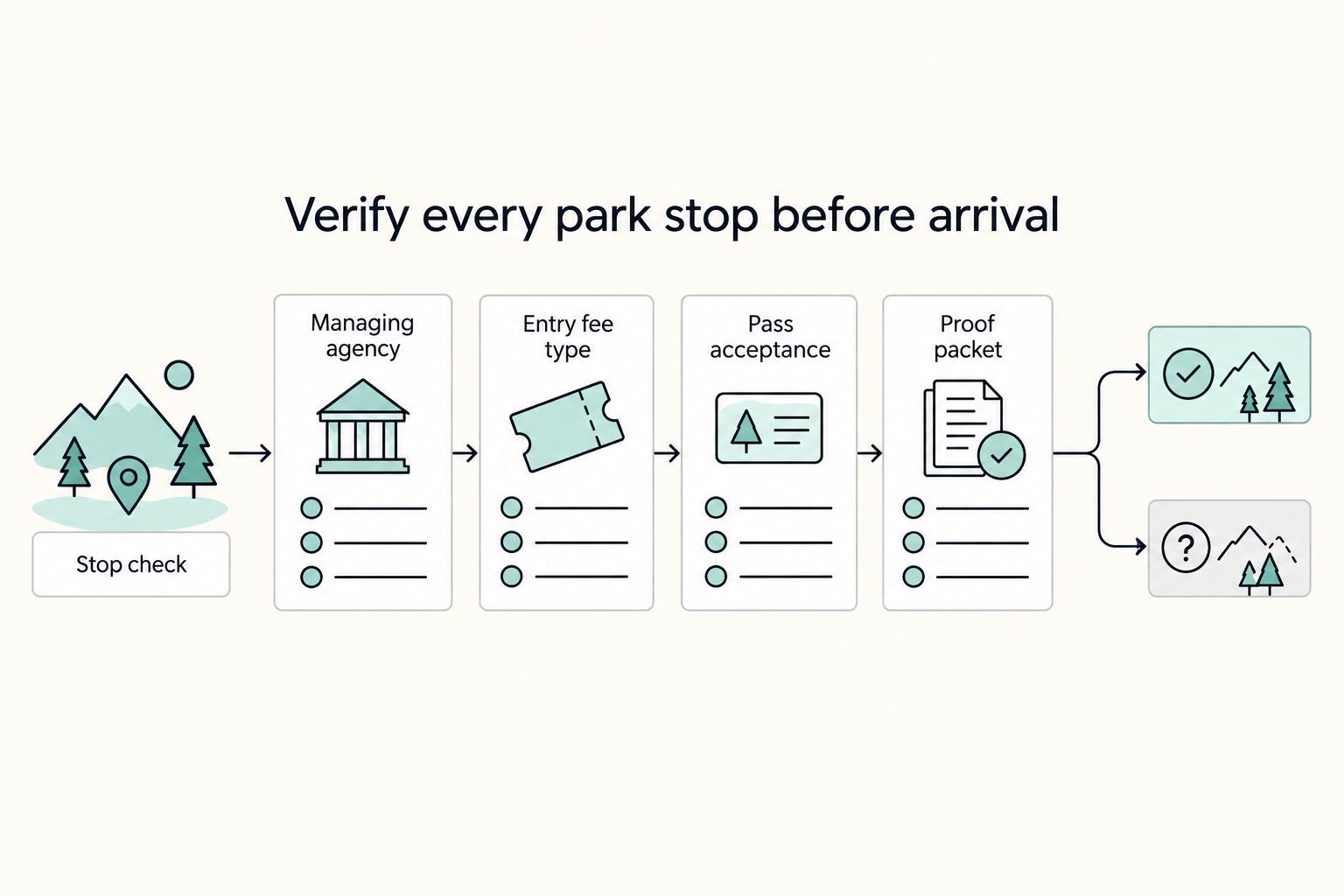
Treat every stop as its own rule check: confirm the managing agency, confirm how that site charges entry, and confirm that your specific entrance accepts the interagency pass you carry.
Run the same three checks every time#
Use one repeatable check at each stop:
- Managing agency
Verify who operates the site and the entrance you plan to use on that location's official page.
- Fee model
Confirm how entry is charged at that location so your group math matches the actual gate setup.
- Pass acceptance at that entrance
Confirm that your exact entrance accepts the pass, rather than assuming all access points are handled the same way.
Budget for charges outside basic entry#
The annual pass can still be a practical default for multi-stop travel, with reporting that it costs $80 and gives access to more than 2,000 federal recreation sites. But that does not mean every on-site cost is included.
If a stop relies heavily on concessioner services or expanded amenities, budget for separate charges even with an America the Beautiful pass.
Check pass condition, not just trip logistics#
Your plan can also fail if the pass itself is treated as invalid. Reporting on 2026 guidance says updated "void if altered" rules can invalidate passes with stickers or other markings on the face, including when the printed image is covered.
Practical rule: verify each entrance, keep the pass unaltered, and carry a cost buffer for site-level charges outside basic entry coverage.
Mistakes that cause turn-aways and extra fees#
To avoid gate problems, treat pass condition and live site rules as your two non-negotiable checks.
The clearest documented turn-away risk here is pass condition. Reporting published on January 9, 2026 says the National Park Service updated policy to discourage defacing the pass image, and that passes may be void if a printed image is covered. Before travel, inspect the front of your card; if anything on the face is covered or altered, assume entry could be challenged and fix it before you go.
A second avoidable mistake is relying on a summary page instead of current official instructions. Site access steps and fee handling can change, so confirm the live National Park Service page for your specific stop and the purchase-channel details tied to your pass. Keep your confirmation and screenshots with your trip documents so you can resolve mismatches quickly at the entrance.
Final checklist before you buy and go#
Before you buy, confirm three things in advance: the pass matches the fee you need to cover, you can present valid proof at the gate, and each planned stop accepts the pass under its current rules.
Buy for a reason you can defend#
Start with the fee you are actually trying to cover. The pass applies to Entrance or Standard Amenity Fee(s) at participating federal recreation sites, which is broad but not universal for every fee scenario.
If you are a non-U.S. resident, check this early: NPS states a separate nonresident fee applies at 11 highly visited parks, charged per person age 16 and older. Do not assume any interagency pass removes that separate charge unless the current official park or NPS policy for your case says so.
If the official seller page does not clearly show current price, eligibility basis, or required proof for your pass type, verify that before purchase.
Pack for the gate you will actually face#
Choose a format you can reliably present in real gate conditions. At staffed entrances, you may need to show the pass itself. At unstaffed sites, you need to display the pass or show proof of ownership, so checkout confirmation alone is not enough.
Carry a small evidence set that works online and offline:
- the pass itself, if physical
- valid photo ID for the pass holder
- purchase confirmation or proof of ownership saved offline
- any eligibility proof tied to your pass category, if applicable
For open-topped vehicles, decals are not valid for entry at staffed entrances. Plan to present the actual pass.
Validate each stop, not just the trip#
Passes are valid at thousands of federal recreation sites, but your itinerary only works if each stop checks out on current official pages.
| Check | What to confirm | Why it matters |
|---|---|---|
| Fee model | Whether the site charges per vehicle or per person | This changes group cost and entry assumptions |
| Pass acceptance | That your exact entrance accepts the pass | Avoids gate surprises |
| Nonresident fee risk | Whether your stop is one of the 11 parks with the separate nonresident fee for non-U.S. residents age 16+ | Prevents budget and entry mismatches |
If official park guidance and seller guidance do not line up, treat that as a red flag and recheck before departure.
Frequently Asked Questions
What does the America the Beautiful Pass cover, and what does it not cover?
It generally covers entrance fees and standard amenity day-use fees at participating federal recreation sites, and USGS says these passes are valid at thousands of federal recreation sites. It does not generally cover special recreation permit fees or fees charged by concessioners. A valid pass also does not erase other access rules, because some high-traffic parks still require a reservation.
Who must be present when the pass is used at a gate?
The passholder should be present and ready to show the pass at entry. These passes are described as non-transferable, and photo ID may be required to verify ownership. For annual passes, a missing passholder signature is a real failure point because the cited guidance says the pass is not valid without that signature.
How many people can enter on one pass at per-vehicle versus per-person sites?
At per-person fee sites, the annual pass covers the owner plus up to 3 accompanying adults age 16 and older. Children 15 and under are not charged an entry fee under the cited FAQ. At sites that are not charging per person, entry-count rules can differ, so check the specific park page if your group is splitting up or arriving separately.
Should I buy a digital pass or a physical pass for a multi-park trip?
Do not assume there is a general winner between digital and physical formats. Before buying, verify the current seller rules and make sure you can present the pass or proof of ownership when required. At staffed entrances, decals for open-topped vehicles are not valid by themselves and you must show the pass; at sites without entrance stations, you must display a pass or show proof of ownership. Also note that a hangtag is only a display accessory, not valid entry on its own.
Can a Digital America the Beautiful Pass be purchased as a gift?
Do not rely on summaries for this one. Do not assume current gift rules for the digital product are confirmed, so check the live seller terms before purchase. That matters even more because passes are described as non-refundable and non-transferable.
Where should I buy or pick up my pass if I need it before my first park day?
Start with the National Park Service pass page and the current official seller page you plan to use, such as USGS Store guidance for pass handling. If timing is tight, verify the exact issuing location, availability, and hours on the official page before you drive there.
What details are still unknown from summaries and must be confirmed on official pages?
Confirm the site's fee model, whether a reservation is still required, and whether that exact entrance accepts the interagency pass the way you expect. Also confirm current digital product rules, gift eligibility, and local sales or pickup options. If an official park page and a seller page do not match, treat that as a red flag and recheck before travel.
Try a related tool
Researched and edited by the Gruv editorial team. Gruv builds cross-border billing, payouts, and finance-operations software for global businesses.
Sources
- blm.gov/sites/default/files/docs/2021-04/New%20Mexic...trusted
- blm.gov/sites/blm.gov/files/uploads/IM2012-128_att1.pdftrusted
- congress.gov/committee-report/119th-congress/senate-repor...trusted
- doi.gov/pressreleases/department-interior-announces-...trusted
- en.wikipedia.org/wiki/America_the_Beautiful_Passtrusted
- federalregister.gov/documents/2025/07/16/2025-13271/medicare-and...trusted
- fs.usda.gov/sites/default/files/media/2015/06/The_USDA_F...trusted
- govinfo.gov/content/pkg/CHRG-115hhrg32637/html/CHRG-115h...trusted
Educational content only. Not legal, tax, or financial advice.
Related Posts

The 2026 Global Digital Nomad Visa Index for 50+ Countries
Start with legal fit, not lifestyle filters. The practical order is simple: choose a route you can actually document, then decide where you want to live. That single change cuts a lot of wasted comparison work and stops you from falling in love with places that were never a real filing option.
The Best Hiking Trails in the US National Parks
The right pick from the **best hiking trails us national parks** list is the one that fits the job you need it to do. Decide that first, and you can cut most of the noise before you compare routes. Here, "return on time invested" is just a planning lens: what you get back for the hours spent researching, driving, hiking, and recovering. "Jobs-to-be-Done" is a simple way to define what this hike needs to do on this trip.
Full-Time RVing on a Budget for Freelancers Who Need Reliable Cashflow
Before you compare rigs, choose your domicile and make it provable. This comes first because a cheap setup can get expensive fast when your license, vehicle records, banking profile, and client paperwork do not match.