
Quick Answer
Start by applying the 80/20 rule for freelancers to three decisions: risk, clients, and admin. Keep a weekly trigger-consequence-action risk register, check client profitability with effective hourly rate plus revision and payment behavior, and track one week of non-billable work before automating anything. Use impact-risk-effort to choose what gets prime attention so urgent noise does not crowd out margin protection.
Beyond Productivity: The 80/20 Rule as a Decision Filter#
The 80/20 rule for freelancers is not mainly about squeezing more tasks into a day. It is a decision filter. Rather than treating 80/20 as a universal law, use it to find the small set of actions that drives most meaningful outcomes. For a business of one, that focus can lower avoidable risk, improve judgment, and help protect margin when your attention is limited.
The reset is simple. Stop asking, "How do I get more done?" and start asking, "What few things most affect stability, profit, and mental clarity?" That shift matters because you are also the one setting the pace of your business. In the leadership framing behind this section, strong leaders are less "superhuman" and more like Chief Emotions Officers who set the emotional thermostat. If your week is driven by inbox spikes and low-value urgency, you become the bottleneck.
| Area | Busy operator | Resilient owner |
|---|---|---|
| Focus | Reacts to whatever is loudest | Protects the few tasks with outsized impact |
| Decisions | Says yes quickly to reduce discomfort | Weighs impact, risk, and effort before committing |
| Metrics | Counts activity and responsiveness | Watches what protects margin and reduces drag |
| Weekly actions | Clears backlog | Reviews risks, profitable work, and recurring friction |
Use a simple filter before you act: impact, risk, effort. If something has high impact, lowers risk, and takes modest effort, do it first. If it looks urgent but has low impact and does not reduce risk, it probably does not deserve prime attention.
That filter is most useful in three places. First, catastrophic risk: identify the few mistakes that can do real damage, and check them before you ship work. Second, true profitability: identify which clients and services deserve more attention, not just which ones keep you busy. Third, operational drag: isolate the repeated admin tasks that keep breaking your focus.
In practice, verify your priorities with evidence, not mood. A useful checkpoint is to timebox one focused block and mark it complete when the work is done. If inbox interruptions keep breaking that block, you have found a real failure mode, not a discipline problem.
For the next week, start by auditing these:
- the tasks that create the most stress before you even start them
- the clients or projects that consume attention out of proportion to value
- the admin work you repeat so often it feels invisible
- the decisions you keep postponing because they feel uncomfortable, not unclear
If you want a deeper dive, read Digital Nomad Health Insurance: A Comparison of Top Providers.
The 80/20 of Catastrophic Risk: Isolating Your Career-Ending Mistakes#
You do not need to master every rule. You need to control the small set of mistakes that can create tax exposure, reporting failures, or payment disputes you cannot exit cleanly.
Keep a short risk register#
Use a simple trigger -> consequence -> action format, and review it weekly.
| Risk | Trigger | Consequence | Action |
|---|---|---|---|
| Tax residency exposure | You work across borders, split time across jurisdictions, or assume one universal 183-day rule. For U.S. federal tax residency, the substantial presence test uses 31 days in the current year and 183 days across the current year plus the prior two years. State rules differ: New York uses 184 days or more plus a permanent place of abode test, while California focuses on temporary or transitory purpose. | You may be treated as a resident where you did not expect it, including tax on all income sources in places like California. | Keep a dated travel log, retain entry/exit evidence, and review state ties before year-end. Escalate if you changed base, added a lease, or split time across states or countries. |
| Cross-border invoicing and VAT handling | You invoice a business client in another country using a domestic template. In the EU, place of taxation determines which country's VAT rules apply, and invoices are generally required for most B2B supplies. | Noncompliant invoices, VAT handling errors, and avoidable cleanup during audit or client finance review. | Confirm B2B status, confirm place of taxation, then update invoice wording and tax treatment. Confirm the current registration threshold with the relevant tax authority or advisor where local registration thresholds or member-state rules apply. |
| Foreign account reporting | Combined foreign financial accounts exceed $10,000 at any time in the year. For some U.S. taxpayers, Form 8938 may also apply above $50,000, depending on filing status and circumstances. | Missed reporting can create a compliance issue even when income was reported. | Reconcile highest annual balances, file FinCEN Form 114 when required, and calendar April 15 with automatic extension to October 15. |
If you cannot produce the travel log, invoice, or balance record in five minutes, tighten the control.
Harden the four clauses that do most of the protective work#
Most serious contract friction comes from vague scope, weak payment terms, unclear liability boundaries, or messy exits.
| What to define | Risk if vague | Minimum protection to include |
|---|---|---|
| Scope of work | Scope creep, rework, disputes over what was included | Deliverables, exclusions, revision limits, approval points |
| Payment terms | Late payment, nonpayment, cash-flow pressure | Rate or fee, invoice schedule, due date, late-payment consequences where allowed, pause rights for overdue invoices |
| Liability cap | One dispute creates outsized business exposure | A written limitation-of-liability clause reviewed for your jurisdiction and service type |
| Termination | You get stuck in a bad-fit engagement | Notice period, payment for completed work, handoff terms, kill-fee logic if applicable |
Screen client risk before renewal or expansion#
Before renewal, scope expansion, or a retainer, classify each account across four checks.
| Check | High-risk signal | What to do before expanding |
|---|---|---|
| Behavioral red flags | Repeated urgency pressure, boundary pushing, verbal-only changes | Reset communication and approval rules in writing |
| Payment reliability | Pattern of late payment or invoice disputes | Tighten payment terms and enforce pause rights |
| Scope discipline | Frequent out-of-scope asks framed as minor | Reconfirm exclusions, change-order flow, and revision limits |
| Documentation quality | Missing approvals, scattered records, unclear decisions | Standardize sign-off, file storage, and decision records |
If a client is weak in two or more checks, fix terms before you expand the work.
Execution checklist for this section#
| Action | What to review or do |
|---|---|
| Review first | Travel days, signed contracts, overdue invoices, and foreign account balances that crossed a reporting trigger |
| Standardize in templates | Cross-border invoice fields, scope exclusions and revision limits, payment terms, and termination language |
| Escalate to a qualified advisor | Multi-country residency questions, EU place-of-taxation uncertainty, and foreign-asset reporting beyond your normal operating baseline |
We covered this in detail in How to use a 'Decision Journal' for your freelance business.
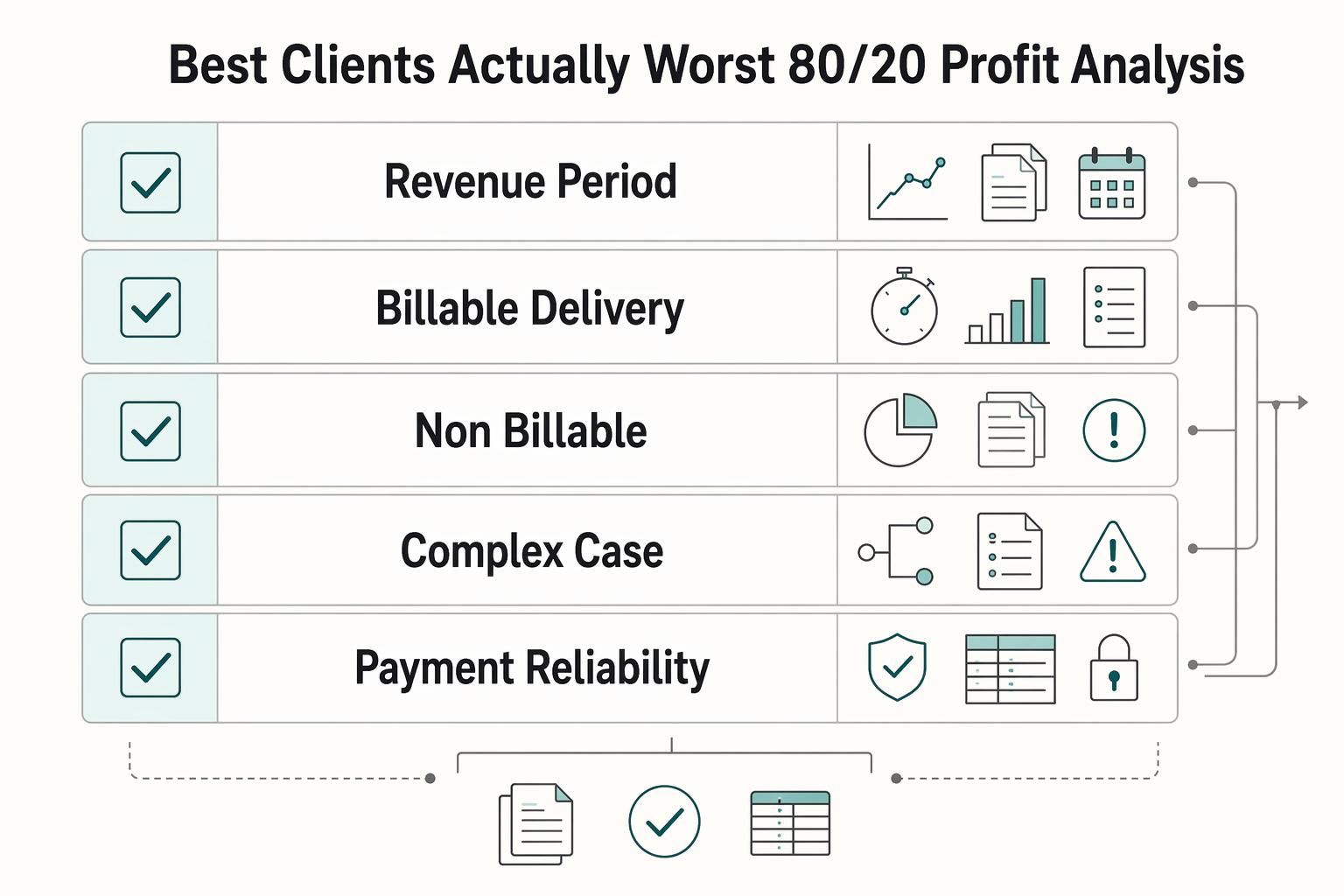
Are Your Best Clients Actually Your Worst? An 80/20 Profit Analysis#
Your highest-revenue client can still be your weakest client in real profitability. Use the 80/20 rule here as a directional filter: rank accounts by what they leave you after billable work, non-billable load, and operational drag, not by invoice totals alone.
Audit each client with the same review window and the same inputs: invoices sent, payments received, delivery time, communication volume, revision rounds, reporting/admin load, and follow-up effort. Use effective hourly rate as a signal, then pressure-test it with delivery complexity, payment reliability, revision churn, and opportunity cost (what this account blocks you from taking on).
| Audit field | Client profile A | Client profile B |
|---|---|---|
| Revenue (period) | Enter revenue for the selected period from invoices or bookkeeping records. | Enter revenue for the selected period from invoices or bookkeeping records. |
| Billable delivery workload | Enter billable delivery time for the selected period. | Enter billable delivery time for the selected period. |
| Non-billable workload | Review communication, reporting, revision, and collection workload. | Review communication, reporting, revision, and collection workload. |
| Delivery complexity | Rate as low, medium, or high after reviewing the work. | Rate as low, medium, or high after reviewing the work. |
| Payment reliability | Rate as reliable, mixed, or unreliable after reviewing payment history. | Rate as reliable, mixed, or unreliable after reviewing payment history. |
| Revision churn | Rate as low, medium, or high after reviewing revision history. | Rate as low, medium, or high after reviewing revision history. |
| Opportunity cost | Rate as low, medium, or high after reviewing alternative uses of that capacity. | Rate as low, medium, or high after reviewing alternative uses of that capacity. |
| Stress or effort level | Rate as low, medium, or high after reviewing the effort required. | Rate as low, medium, or high after reviewing the effort required. |
| Clears your floor rate? | Mark yes or no after comparing the work with your floor rate. | Mark yes or no after comparing the work with your floor rate. |
| Tier decision | Choose grow, repair, watch, or release after completing the audit. | Choose grow, repair, watch, or release after completing the audit. |
High stress rarely aligns with high profitability. In an effort-versus-income view, low-income/high-stress accounts are the danger zone because they lower effective hourly rate and reduce capacity for better work. High-revenue accounts can land in the same zone when complexity rises, approvals sprawl, revisions loop, or payments become inconsistent.
Decide the next move#
Do not jump from insight to firing; replace first, then release.
| Move | When | Trigger |
|---|---|---|
| Standardize | The work is profitable but messy | Repeated status pings, fragmented feedback, or inconsistent billing rhythm |
| Re-scope | Delivery keeps expanding beyond the agreed work | Recurring side requests, approval delays, or revision loops |
| Reprice | The account is strategically useful but no longer clears your floor rate | After full effort is counted |
| Exit | Stress, payment friction, or disruption stays high | After you standardize terms and tighten scope |
Optimize Your Service Offerings#
Run the same analysis across service lines, not just client names. Map each offer by margin quality and operational drag, then decide where your sales focus should go next quarter: push offers that are repeatable and clean to deliver; package tighter, reprice, or phase out offers that create chronic drag.
Implementation checklist#
- Pull one consistent period of data per account: revenue, billable/non-billable load, communication volume, revision history, payment behavior, and delivery complexity.
- Rank clients by revenue, effort/stress, and floor-rate clearance, then assign a tier decision: grow, repair, watch, or replace then release.
- Review quarterly when possible, and at minimum annually, so margin drift is corrected before it becomes your default.
You might also find this useful: The Best Personal Productivity Systems for Freelancers (GTD.
Taming the 'Admin Tax': Applying 80/20 to Your Operations#
Use the 80/20 lens here to fix the few admin patterns that create most of your drag and avoid trying to optimize everything at once.
| Step | Focus | Key detail |
|---|---|---|
| 1 | Capture non-billable work first | Track one normal week: task, time spent, trigger, client-facing or not, and whether it caused rework or delay |
| 2 | Group and rank what you captured | Rank each type by time drain and error risk |
| 3 | Standardize the process, then automate | Lock the steps first, then add automation where repetition is stable |
| 4 | Handle pricing friction as an operations signal | Use prewritten talk tracks and tighten intake language so expectations are clearer earlier |
| 5 | Run a short quality-control check before rollout | Test the normal path and key exception paths, assign one owner, define off-path client behavior, and keep a rollback path |
| 6 | Include marketing channels in the same audit | Evaluate channels by operational load as well as lead volume |
1) Capture non-billable work first#
Track one normal week of non-billable work as it happens: task, time spent, trigger, client-facing or not, and whether it caused rework or delay. Pull from your calendar, inbox, reminders, and handoff messages so you are working from records, not memory.
2) Group and rank what you captured#
Group tasks by type, then rank each type by:
- Time drain
- Error risk
Start with the items that score high on both. A shorter task that repeatedly creates confusion or rework can deserve priority over a longer task that runs cleanly.
3) Standardize the process, then automate#
If you automate a messy process, you usually scale the mess. Lock the steps first, then add automation where repetition is stable.
| Operations area | Manual approach | Standardized approach | Automation trigger |
|---|---|---|---|
| Intake | Custom replies and scattered discovery questions | Single intake form, fixed qualification questions, saved replies | You keep chasing missing basics |
| Scheduling | Back-and-forth booking messages | Defined booking windows, confirmation template, clear reschedule rules | Scheduling loops keep repeating |
| Invoicing | Rebuilding invoices and reminders each cycle | Invoice template, fixed send rhythm, standard payment instructions | Follow-up and reminder work repeats every cycle |
| Follow-ups | Ad hoc nudges | Defined checkpoints with saved follow-up language | Approval or asset chasing becomes routine |
| File handoff | One-off delivery notes and links | Handoff checklist, naming rules, consistent delivery template | Version confusion or missing files keeps happening |
4) Handle pricing friction as an operations signal#
If the same pricing objection keeps appearing, treat it as a process issue, not just a sales annoyance. Use prewritten talk tracks for price-pressure moments, and tighten intake language so expectations are clearer earlier. The goal is not to win every pricing debate, but to work with clients who understand delivered value and fit your operating model.
5) Run a short quality-control check before rollout#
Before full rollout of any automation:
- Test the normal path and key exception paths.
- Assign one owner for failures and fixes.
- Define how you handle off-path client behavior.
- Keep a rollback path to the previous manual method.
6) Include marketing channels in the same audit#
Evaluate channels by operational load as well as lead volume. If a channel regularly brings leads that require heavy education, repeated pricing debates, or custom delivery handling, account for that admin burden in your channel decisions.
Use a simple cadence to keep this section of operations healthy: weekly admin-tax review, monthly process cleanup, and quarterly stack consolidation. If you want a related workflow companion, see How to Manage Your Time Effectively as a Freelancer.
Conclusion: Make 80/20 a Decision Habit for Risk, Clients, and Admin#
Treat the 80/20 rule for freelancers as a decision habit, not a productivity slogan. You are not trying to do more with less forever. You are trying to build a durable business by protecting the few areas that can hurt you most, keeping the clients that hold up under your own profit review, and cutting the repeat admin that quietly drains your week.
That is the role shift that matters. If you only manage tasks, you stay stuck in the time-for-money trap, and there is no 25th hour coming to rescue you. A durable operator can work from three simple artifacts: a risk ledger, client selection standards, and an operating checklist. Those can give you a checkpoint before problems get expensive.
Keep the recap practical. On risk, maintain a short ledger of the mistakes that could create outsized damage, plus the document or record you would need to prove what happened. On clients, review profitability using your own time entries, revision history, meeting load, invoice records, and payment behavior instead of revenue alone. On operations, look for the small number of recurring admin tasks that deserve a template, automation, or cleaner handoff. A common failure mode is cutting "small" tasks that were actually protecting cash flow or delivery quality.
If you want a practical starting point, do this next, this week:
- Update your risk ledger and add one proof item beside each risk.
- Review your last month of client work and flag one account with strong margin and one with hidden drag.
- Replace one repeat admin step with a template or simple automation.
- Write a one-page operating checklist for invoicing, approvals, and weekly review.
If scope creep, late-night questions, and constant pipeline stress still define your work, the answer is probably not more effort. It is better selection, clearer boundaries, and tighter operating discipline.
For a step-by-step walkthrough, see A Guide to 'Deep Work' for Freelancers.
Frequently Asked Questions
How can you use the 80/20 rule for freelancers to reduce risk?
Start with the “vital few”: the small set of recurring actions that prevent outsized problems and support paid delivery. Build a one-page risk list with the task, trigger, owner, and next review date. If a requirement is unclear, mark it for verification instead of guessing. Review it monthly and before major client or market changes.
What should you focus on first if your week feels overloaded?
Check your billable-hours share before changing anything, because it is a concrete signal of whether your time is going to paid work or disappearing into low-return tasks. Then rank work by impact: paid delivery and core risk controls first, admin simplification next. If you cannot point to revenue, protection, or a clearer handoff, it is a candidate to cut, delegate, or standardize. Do this sort in your weekly review.
How do you tell which clients are actually your best clients?
Treat client concentration as a testable hypothesis: a minority of clients may drive most revenue. Then compare how much time and admin each client consumes so you can see where value is concentrated versus where drag is concentrated. A common miss is keeping a “big” client that consumes disproportionate effort. Recheck this before renewals or pricing changes.
What if your client mix does not look anything like an 80/20 split?
That is normal. The Pareto Principle is a directional heuristic, not a fixed law, so the better question is which few inputs are driving most of the result or most of the damage. If the pattern is 70/30 or 60/20 in your business, you can still use it to decide what to protect, price differently, or stop doing. Rerun the analysis each quarter instead of forcing the ratio.
What tools actually help without creating more admin?
Choose tools that reduce non-money tasks and automate recurring admin where possible. You want fewer handoffs between tools, not more. Prioritize clear time tracking so you can monitor billable share, and keep workflows simple enough to run without extra cleanup. Test one live client cycle before expanding your stack.
How does this help with burnout, not just productivity?
Burnout often comes from spending your best energy on work with little return, which is exactly the pattern the 80/20 rule is meant to expose. When you cut low-value tasks and simplify recurring admin, you can reduce overload as well as hours worked. The red flag is feeling busy while your paid-work share keeps slipping. Track energy notes beside time entries for two weeks.
How often should you review all of this?
Use a simple rhythm: weekly checks for billable-hours share and new friction, with periodic deeper reviews for client concentration and simplification opportunities. Keep the same lens each time: what most protects results, what drives the strongest return, and what can be cut or automated. If you only review when something breaks, you will usually be deciding too late. Put the review points on your calendar now.
What is the biggest mistake people make when applying the pareto principle?
They treat it like a rigid formula and start cutting too fast. A task can look small and still prevent a bigger downstream problem, so verify its role before you remove it. The right cut is low-return work with low protective value, not every non-billable activity. Label each recurring task as revenue, protection, or noise before you change it.
Try a related tool
Researched and edited by the Gruv editorial team. Gruv builds cross-border billing, payouts, and finance-operations software for global businesses.
Sources
- academia.edu/9959086/The_80_20_Principle_The_Secret_of_Ac...trusted
- clame.nyu.edu/Resources/E0225A/311367/TheTippingPointMalco...trusted
- ftb.ca.gov/file/personal/residency-status/index.htmltrusted
- home.treasury.gov/system/files/131/General-Explanations-FY2000...trusted
- irs.gov/businesses/small-businesses-self-employed/re...trusted
- irs.gov/businesses/corporations/do-i-need-to-file-fo...trusted
- legis.iowa.gov/docs/publications/IACS/802519.pdftrusted
- ljfo.vermont.gov/assets/Uploads/2b8d141249/2_FY2011_Budget_De...trusted
Educational content only. Not legal, tax, or financial advice.
Related Posts

Digital Nomad Health Insurance Comparison for Long-Stay Moves
Use focused time now to avoid expensive mistakes later. Start with a practical `digital nomad health insurance comparison`, then map your route in [Gruv's visa planner](/tools/visa-for-digital-nomads) so we anchor policy checks to your real plan before pricing pages pull you off course.
How to Manage Your Time Effectively as a Freelancer
Most freelancers struggle not because they work too few hours, but because they misallocate the hours they have—treating time as an infinite resource rather than a finite business asset with a real cost per unit. The solution is a three-layer operating system: a Time Budget Framework that commits hours to four categories before any client work is booked, a Weekly Operating Template that assigns those categories to specific calendar windows, and a monthly Admin Audit Checklist that reconciles invoicing, bookkeeping, and compliance records. Multi-client orchestration requires a WIP limit, dedicated client windows, and a capacity decision rule run before accepting new engagements. Together, these systems replace reactive decision-making with a repeatable structure that keeps delivery quality consistent, records audit-ready, and the freelance practice operationally durable.

The Best Productivity Systems for Freelancers: GTD, PARA, and Second Brain
**Treat productivity as a system you can run under load, not a vibe you summon on demand.** Client work is messy by default: requests scattered across Gmail and Slack, scope shifting midstream, and the annoying truth that "done" does not always mean "paid."