
Quick Answer
Start by treating the thailand elite visa as the current Thailand Privilege route, then run a written-checkpoint process before you spend money. Verify passport fit, prior immigration issues, and case ownership first, and pick only one or two tiers you can justify. Keep documents internally consistent, wait for documented status updates, and book fixed travel only after approval and issuance steps are clearly confirmed.
How to apply for Thailand Privilege without being misled by outdated Thailand Elite guidance#
For current planning, treat Thailand Elite Visa and Thailand Privilege Visa as the same program, with new applications handled through the current Thailand Privilege Card structure.
This rebrand can create confusion. You may still see old package names, mixed terminology, and pages that make the program look like separate routes. One agent overview also refers to a Privilege Entry Visa (PE). That is useful context, but for practical steps, stick to current Thailand Privilege naming so your forms, emails, and provider conversations stay aligned.
This guide is a practical playbook for remote professionals planning a long stay. It focuses on the decisions that matter first, what to verify before you spend money, what to prepare early, and where delays can show up.
Keep these checkpoints in mind before you proceed:
- Approval is not automatic. Screening and background checks still apply.
- Thai Immigration approval is a real gate in the process.
- Timelines can vary by nationality.
- One published process checkpoint states that payment is made only after approval.
This guide stays with grounded public guidance and avoids blanket promises. It does not treat this route as automatic work authorization, permanent residency, or citizenship, because the available guidance does not support those claims.
For a step-by-step walkthrough, see A guide to getting a freelance 'Artist Visa' in Germany.
Thailand Elite and Thailand Privilege mean what in practice#
In practice, Thailand Elite Visa is the older name and Thailand Privilege Visa is the current name for the same membership-based route, with Thailand Privilege Card Company Limited as the operator.
The visa issued under this program is described as a Privilege Entry (PE) Visa, framed as a long-term multiple-entry tourist visa. One non-official article labels it a Special Tourist Visa, but treat that label as unconfirmed unless an official channel verifies it for your case. Operationally, do not treat this route as work-authorizing.
Use this wording in forms, emails, and document names:
- Thailand Privilege Visa for the program name
- Thailand Privilege Card Company Limited when the operator name is required
- Privilege Entry (PE) Visa only for the visa issued under the membership
If your documents mix terms like "Thailand Elite," older package labels, and "golden visa," stop and ask for the current equivalent in writing before you move forward. Also avoid treating this route as a property-investment golden visa category. For related context, see Thailand's Long-Term Resident (LTR) Visa for Professionals.
Membership tiers and costs side by side#
Start with your timeline and household plan, then compare price and points. The first real fork is often Bronze versus Gold. Higher tiers look more like long-term or family-planning decisions.
| Tier | Duration seen in current excerpts | Fee seen in current excerpts | Who it may fit |
|---|---|---|---|
| Bronze Membership | 5 years | THB 650,000 | Cost-sensitive applicants who want the lowest published entry price and can proceed without published Privilege Points |
| Gold Membership | 5 years | THB 900,000 | Applicants who expect to stay several years and may use points-linked services enough to justify paying THB 250,000 more than Bronze |
| Platinum Membership | 10 years | THB 1,500,000 | Applicants with a longer relocation horizon, especially where family application support may matter |
| Diamond Membership | 15 years | THB 2,500,000 | Longer-term movers or households that value a longer validity window and higher published points |
| Reserve Membership | 20 years | THB 5,000,000 | High-budget cases where the longest published term and highest published points matter more than upfront cost |
Bronze and Gold represent a price-versus-points tradeoff. One 2026 comparison shows Bronze at THB 650,000 with 0 points per year and Gold at THB 900,000 with 20 points per year.
What is stable, and what you should verify#
Published pricing appears more consistent than tier structure and points format.
One 2025 guide says the program was overhauled in late 2023 and streamlined into four levels, while other excerpts still present Bronze through Reserve as five tiers. Points are also presented differently across sources. Some show annual figures like 20, 35, 55, and 120, while others show larger figures like 20,000, 40,000, 70,000, and 120,000.
Before paying, get written confirmation from the operator for your exact tier name, fee, validity period, current points format, and any family add-on or discount terms.
How to use older Thailand Elite advice without guessing#
Older Thailand Elite material is still useful for general context, but not for package matching. There is no clear one-to-one mapping from legacy package names to current Bronze, Gold, Platinum, Diamond, and Reserve labels.
If an article, PDF, or agent message uses a legacy package name, ask for the current equivalent in writing before you compare price or benefits.
Price is only one filter#
Do not choose on price alone. Use three filters together:
- Stay pattern: If your Thailand plan is still uncertain, paying upfront for 10, 15, or 20 years can be premature.
- Family plans: One comparison page links family application support to Platinum, Diamond, and Reserve and shows a THB 500,000 family discount only on those tiers. Another source references discounts up to 90%. Treat both as confirm-first items.
- Benefit usage: Higher published points only matter if you expect to use the related services.
A practical shortlist usually looks like this:
- If you are solo and price-sensitive, compare Bronze and Gold first.
- If family support is central, model the household cost now and request current written terms for Platinum, Diamond, and Reserve.
- If your upgrade case depends on premium benefits, verify that those benefits are current and relevant to your move before deciding.
If you want a deeper dive, read London, UK: A Guide for Expats and Remote Workers.
Eligibility gates to check before you spend time#
Before you compare tiers, confirm that you can clear the real approval gates. This is the fastest way to avoid wasted effort, because immigration screening and background checks still apply and timing can vary by nationality.
| Gate | What to confirm | Note |
|---|---|---|
| Passport and nationality fit | Your passport is currently accepted for new applications | Get written confirmation under the current Thailand Privilege Card program |
| Thailand immigration history | Any prior Thailand immigration issue, including overstay or other complication | Flag it early |
| Background-screening risk | Any criminal record or pending matter | Disclose it up front before filing |
| Final approval path | Intake is preparation, not approval | Immigration screening and background checks still apply |
Use this pre-check first:
- Passport and nationality fit: Get written confirmation that your passport is currently accepted for new applications under the current Thailand Privilege Card program.
- Thailand immigration history: Flag any prior Thailand immigration issue early, including any overstay or other complication.
- Background-screening risk: If you have any criminal record or pending matter, disclose it up front so you can get guidance before filing.
- Final approval path: Treat intake as preparation, not approval.
A complete file is not the same as an approved file. Two applicants with similar documents can still move at different speeds.
What to verify before you pay anyone#
Use written confirmation from the operator as your checkpoint, not sales copy. Confirm passport acceptance, whether your history raises concerns, and whether additional screening may apply.
Keep one simple record set: the written confirmation, your passport bio-page scan, and a short factual summary of any prior Thailand immigration issue.
If you have any prior issue, pause and get it in writing#
If you have any prior Thailand immigration issue, do not rely on verbal reassurance from a marketer or agent. Get written clarification from the operator before paying any third-party fee.
Role clarity matters here. An Official GSSA can support intake, but agent guidance is not final approval. Final decisions involve the program operator and, where applicable, the Royal Thai Embassy or Royal Thai Consulate-General handling visa issuance. Related reading: A Guide to Dubai's 'Retirement Visa'.
Who does what in the application sequence#
The safest way to manage this process is to keep one intake channel, wait for written confirmation from the program side, and then follow the written instructions for your case. This is a practical sequence, not a universal official order for every jurisdiction. Immigration screening and background checks still apply, and timing can vary by nationality.
| Working stage | Main actor | What happens | Go checkpoint | Pause checkpoint |
|---|---|---|---|---|
| Initial inquiry | You, with the program directly or one GSSA intermediary | You confirm fit under the current program and submit intake details | You have written confirmation you are being processed under the current program | You only have verbal assurances, or multiple channels are requesting overlapping submissions |
| Program-side review | The program side, with screening in the background | Your application moves through program-side review and screening | You receive written case confirmation from the program side | Screening items are still unresolved in writing |
| Consular step where applicable | The consular channel named in your written instructions | If your case requires a consular step, follow the route provided in writing for your jurisdiction | You have written instructions naming the exact route for your case | You are guessing between channels, including Thai eVisa, without case-specific written direction |
| Arrival-stage follow-through | Thai Immigration plus the support channels you were directed to use | You follow the written arrival-stage instructions tied to your case | You have written arrival-stage instructions and saved approvals and receipts | Your travel date is near, but final written instructions are still missing |
Role boundaries to keep clear#
For new applicants, the program side handles applications under the current Thailand Privilege Card program. A GSSA is an intermediary support channel, not the final decision-maker. If a consular step is involved, use the written route for your jurisdiction rather than assuming a universal process.
A universal Thai eVisa path for this route is not confirmed, so rely on written case instructions rather than assumptions.
One-channel rule#
Use one intake channel unless you are explicitly told to switch. Parallel submissions do not automatically mean refusal, but they can create administrative confusion and unclear ownership of your file.
Before sending major documents or payments, confirm in writing:
- Who is the handling entity
- Which email or case reference is the primary record
- Whether any file is already open under your passport details
Practical stop/go rule#
Proceed only when all three are documented: one handling channel, written program-side confirmation, and written case-routing instructions for your jurisdiction. Pause when any one of those is missing.
Document pack to assemble before applying#
Document readiness is one of the few parts of this process you can control. Build one complete file set before you open the case, and follow written instructions over memory. Missing or inconsistent files can trigger extra document requests and delay.
| Item | Requirement | Note |
|---|---|---|
| Identity document copies | Requested in writing | Start with a working pack |
| Signed application materials | Requested for your route | Follow written instructions over memory |
| Payment evidence | Once payment is requested | Add it after payment is requested |
| Authorization or case-confirmation letter | Requested by your processing channel | Match the written instructions for your exact route |
| Program-side confirmation | Prioritize it in the file | Confirm the case is moving under the correct channel |
Start with a working pack. Then match it to the written instructions for your exact route:
- Identity document copies requested in writing
- Signed application materials requested for your route
- Payment evidence, once payment is requested
- Any authorization or case-confirmation letter requested by your processing channel
Among these, prioritize written program-side confirmation that your case is moving under the correct channel.
Keep the file internally consistent#
Many avoidable delays come from missing or mismatched files that trigger additional document requests. Keep identity details identical across your documents, forms, payment records, and correspondence.
Before submission, run a quick hygiene check:
- Match passport name, passport number, and date of birth across forms, receipts, and confirmation emails
- Ensure scans are legible, complete, and final-version files
- If someone else paid on your behalf, include a short note tying that payment to the applicant
Build one main record set#
Keep one organized record so every party sees the same version history, including if issuance is completed in Thailand or overseas.
Use a folder structure like this:
01 Passport and identity02 Signed forms03 Program confirmations04 Issuance instructions and appointment records05 Payment receipts and transfer proofs06 Emails and correspondence07 Final submitted set08 Arrival-stage approvals and receipts
Use dates in filenames and mark final documents clearly.
Ask for missing rules in writing#
The excerpts also include LTR process examples: qualification endorsement comes first, then visa issuance in Thailand or overseas, and timing depends heavily on document readiness. They also say processing can take longer when additional documents are requested.
A full official Thailand Privilege/Elite checklist is not provided here, and full refusal or appeal detail is not provided either. LTR timing examples (around 20 working days for endorsement and 1-3 working days for pre-approval) are not guarantees and should not be treated as Thailand Privilege/Elite timelines.
If anything is unclear, ask for written clarification before you pay or book travel. Keep those clarifications in the same folder.
Timeline checkpoints from planning to arrival#
Sequence is your main risk control. For a Thailand Privilege move, only move to the next commitment when a written checkpoint is in place.
| Phase | What you are waiting on | Common delay point | Stop or go signal |
|---|---|---|---|
| Decision and tier selection | Final route and handling channel | Route changes mid-process, unclear ownership | Go only when your route and case handler are confirmed in writing |
| Screening and status wait | Written status updates and any follow-up document requests | Extra document requests can add time | Stop major spending until written status confirmation is received |
| Issuance planning | Clear post-approval instructions for your case | Missing or inconsistent case paperwork | Go on nonrefundable travel only after issuance steps are clearly scheduled |
| Pre-arrival logistics | Stable flight and accommodation details | Last-minute changes, incomplete details for entry forms | Go when details are stable enough to file pre-entry data accurately |
| First days in Thailand | Completed entry and initial local setup | Missing records from arrival or admin steps | Go on longer-term commitments after entry is complete and records are organized |
Thailand Privilege-specific processing timing is not fixed here. Treat the stretch between submission and your next written status confirmation as variable time, not a fixed calendar promise.
Where timelines usually slip#
Arrival-side delays usually show up in three places:
- Traveler details are incomplete or inconsistent before TDAC submission
- Flight or accommodation details change at the last minute
- People lose time or money to fake sites that request unnecessary TDAC-related fees
Treat each stage as a separate checkpoint rather than one continuous timeline.
A practical buffer rule#
If your status is still pending, avoid fixed lease starts and nonrefundable flights. Use cancellable or movable bookings until you have written confirmation and a scheduled next step.
For arrival prep, stabilize your first address and flight details before filing TDAC. TDAC replaced the paper TM6 card, is submitted within 72 hours of travel, and uses details like passport number, flight information, arrival date, and accommodation address. Because TDAC data goes to Thai Immigration before entry, accuracy matters.
Stop and go checkpoints#
- Stop: Status is verbal, implied, or only in chat.
- Go: You have written confirmation tied to your passport identity details.
- Stop: Your flight or address is still likely to change right before departure.
- Go: You can submit TDAC accurately within the 72-hour window and keep the submission record.
- Stop: A TDAC-related payment request appears on a suspicious site.
- Go: You are using confirmed channels and keeping receipts, screenshots, and final travel records together.
This pairs well with our guide on Asia Remote Work Visa Planning for Thailand, Japan, Malaysia, and Indonesia.
Family add-ons and promotion windows without confusion#
If family inclusion is even somewhat likely during your visa horizon, price the household now, not later. Current materials describe a supplementary promotion, often labeled "Next Member," at THB 500,000 for certain tiers only. Treat that as a limited-time condition, not a universal entitlement.
A practical starting point for family-planning comparisons is Platinum Membership, Diamond Membership, and Reserve Membership. That does not confirm automatic eligibility for all three. It tells you where to verify terms first.
| Tier | What to assume now | Published base reference |
|---|---|---|
| Platinum Membership | Check whether supplementary terms are currently active for your case | 10 years, THB 1,500,000 |
| Diamond Membership | Check active add-on terms in writing before payment | 15 years, THB 2,500,000 |
| Reserve Membership | Verify carefully because this tier is invitation only | 20 years, THB 5,000,000 |
Use a fixed verification sequence: review the current tier table for validity, fee, and annual points, then get written confirmation of any active supplementary offer for your exact tier. If you apply through an agent, confirm that they hold a current GSSA certificate issued by Thailand Privilege Card Co., Ltd. That helps reduce fraud, document-error, and delay risk.
Caveat: Promotion language can change. Confirm active terms before submission, even if an intermediary references a "Next Member" or "Next Family Member" offer.
Decision rule: if family plans are plausible, compare the total household cost now instead of assuming you can add members later on the same terms.
Need a separate visa-and-tax case study? Read A Guide to Colombia's Digital Nomad Visa and Tax Implications.
Comparing Thailand Privilege with other long-stay routes#
This route is easiest to justify when you want convenience first and can absorb a high one-time fee. If you are comparing it with other long-stay options, use this section as a decision checkpoint, then verify route-specific rules directly before you commit.
Thailand Privilege, formerly Thailand Elite under the prior branding, is presented as a paid membership tied to a long-stay visa experience. Public materials frame it as convenience-led, with quoted one-time fees of 650,000 THB to 5,000,000 THB and validity cited in one source at 5 to 20+ years.
Screening still applies, including passport and background checks, and timelines can vary by nationality. New applicants are directed to the current program structure. Source wording also differs on status language, so verify legal classification in current official guidance before deciding.
| Route | What is grounded here | What to verify before deciding |
|---|---|---|
| Thailand Privilege Card | Convenience and lifestyle positioning through paid membership, with screening still active | Exact tier, current package terms, and intake channel in writing before payment |
| O-A Long-Stay Visa | Not covered with usable operational detail in this guide | Current official eligibility, renewal rhythm, and document requirements from Thai immigration or consular sources |
| LTR Visa | Framed as a 10-year renewable route with stricter category-based criteria and heavier financial or professional proof | Whether you clearly meet the current category and evidence thresholds |
| Visa Exemption / Visa on Arrival | Not covered with long-stay planning detail in this guide | Whether either route supports your actual long-stay plan under current official rules |
When the premium may be worth it#
The premium can make sense when convenience and potentially lighter eligibility documentation than stricter category-based routes matter more than minimizing upfront spend. That is often the case when your profile does not map cleanly to stricter category-based criteria.
When another route may fit better#
If you already qualify for a rule-based long-stay route and are comfortable with its evidence burden, a paid convenience model may be unnecessary. Use Global Digital Nomad Visa Index as a broad comparison lens, then make the final call using Thailand-specific rules and current program terms.
Related: A Deep Dive into Thailand's Long-Term Resident (LTR) Visa for Tech Professionals.
Common failure modes and how to recover fast#
Many avoidable problems start when names, requirements, and status updates are treated as final before they are confirmed in writing. A practical way to reduce delays is to rely on written instructions from the operator, the relevant consular channel, or Thai Immigration.
Old names can create new mistakes#
Different naming across pages can create confusion and may push you into the wrong process. Recovery action: ask one written question before you pay or prepare documents. "Which current membership tier and handling entity applies to my case today?" If the reply is vague, pause and re-confirm.
Incomplete document sets can fail quietly#
Missing or mismatched paperwork can lead to back-and-forth instead of a clear rejection. Recovery action: work from one written checklist, keep a dated record of requests, and make sure your records match exactly across forms and identity documents.
A separate Thailand visa-on-arrival checklist for Indian travelers shows how specific details can be: passport validity of at least 6 months and photo size 35mm x 45mm with a white background. Do not treat those as Thailand Privilege requirements. Use them as a reminder to verify exact specs for your case in writing.
Handoffs can be where cases get lost#
This can be an operational failure point. Delays can come from unclear ownership between parties. Recovery action: send a short status request and ask for:
- your current case status
- the entity handling the next step
- the exact item still outstanding
If responses conflict, reply on one shared thread and ask who currently owns the case.
Approval is never something to assume#
Payment capacity is not the same as approval certainty. A reported 2025 enforcement action revoked approximately 10,000 temporary stay permits, mostly in student visa categories, after a misuse review of education-based visas. That is not evidence about Thailand Privilege specifically, but it is a useful reminder that immigration permissions are conditional.
Red-flag rule: if advice conflicts across sales pages, prioritize written instructions from the program owner, the relevant consular post, and Thai Immigration over marketing copy.
You might also find this useful: A Deep Dive into Uruguay's Digital Nomad Visa and Tax Benefits.
Decision rules to choose a tier without overpaying#
The safest default is to choose the lowest tier that fits your current plan. Only move to a higher-priced tier when you can name a specific reason you will use. Use this order:
- 1) Stay length: If your plan is still exploratory, anchor to the lower end first. Community-source guidance describes the broader program as roughly 5 to 20 years, so avoid paying for a long horizon you are not confident you will use.
- 2) Cost/value fit: If your budget assumptions are still loose, model a conservative case now instead of pricing only a best-case scenario. Community-source guidance indicates pricing can range from several thousand to tens of thousands USD, sometimes with multi-year payment structures.
- 3) Benefit usage: Separate core immigration convenience from lifestyle or travel perks. If your main goal is a smoother long-stay route, do not prepay for premium-style benefits you cannot clearly see yourself using repeatedly.
Use a confidence threshold before you commit#
A practical checkpoint is to choose only when your timeline, budget, and overall move plan are reasonably stable. That is not an official rule. It is a risk-control rule to avoid locking into a higher tier while your move plan is still unstable.
Before paying, make sure you can answer these in writing:
- your expected Thailand entry timing
- your realistic up-front budget if pricing ranges from several thousand to tens of thousands USD
- which benefits you expect to use often enough to justify added cost
Red flags that mean step down or pause#
Step down a tier if your long-term commitment is still uncertain. Pause if your timeline or budget assumptions are still moving. If you cannot clearly name which premium benefits you will use, treat that as a signal not to upgrade yet.
Before any payment, get written confirmation from the operator for your shortlisted tier's current terms. Package details can change, so validate current duration, benefits, and payment structure directly before you commit.
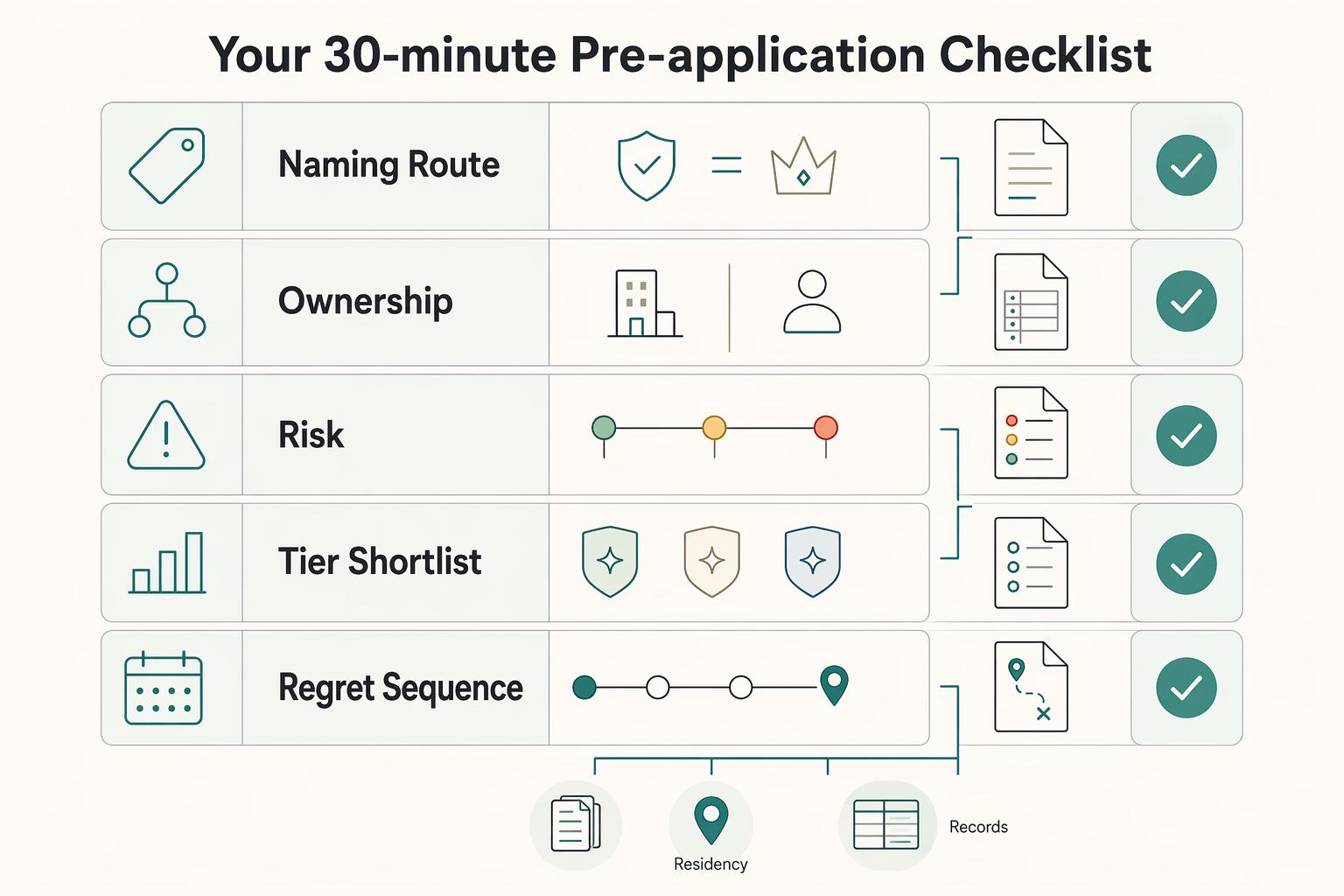
Your 30-minute pre-application checklist#
Before you submit, lock five items down in writing: naming, channel, screening risk, tier shortlist, and your no-regret timeline. Most avoidable delays start with confusion on those basics.
| Checkpoint | Lock down in writing | Note |
|---|---|---|
| Naming and route | Treat Thailand Elite Visa and Thailand Privilege Visa as the same program under current branding | Record whether you are working directly with the operator or through a GSSA |
| Step ownership | Who submits your case, who issues payment instructions, and who confirms approval milestones | Pause if those answers are unclear |
| Screening risk | Prior overstay issues, criminal-history issues, nationality-related handling risk, and past visa complications | Avoid assumptions until your case is confirmed |
| Tier shortlist | One primary tier and one fallback, each with a written reason | Published one-time fees range from 650,000 THB to 5,000,000 THB |
| No-regret sequence | Confirm channel, submit, wait for documented approval or next-step instruction, complete issuance or affix steps, then book non-refundable flights or lock housing | Keep the plan reversible until milestones are documented |
- Confirm naming and route
Use Thailand Elite Visa and Thailand Privilege Visa as the same program under current branding, and treat new applications as part of the current route. Record whether you are working directly with the program operator or through a GSSA channel.
- Verify who owns each approval step
A GSSA can be a valid intake channel, but not final decision authority by default. Ask who submits your case, who issues payment instructions, and who confirms approval milestones. If those answers are unclear, pause before sharing more documents.
- Pre-check screening risk
Do a direct self-check for prior overstay issues, criminal-history issues, nationality-related handling risk, and past visa complications. Screening and timelines can vary by nationality, and PE versus SE sticker types can carry different stay-per-entry allowances, so avoid assumptions until your case is confirmed.
- Shortlist 1 to 2 tiers with written reasons
Pick one primary tier and one fallback based on your stay plan and expected benefit use. Keep the reason concrete. With published one-time fees ranging from 650,000 THB to 5,000,000 THB, vague upgrades are expensive.
- Set a no-regret sequence before non-refundable spend
Prepare a clean document set and a simple verification log with date, contact, entity, document, and milestone before submission. Then follow this order: confirm channel, submit, wait for documented approval or next-step instruction, complete issuance or affix steps, then book non-refundable flights or lock housing. One source cites 4 to 8 weeks for background checks, and timing can vary, so keep your plan reversible until milestones are documented. On arrival, verify your entry stamp before leaving the airport.
Before you submit anything, sanity-check your relocation assumptions against other country pathways in this digital nomad visa planning tool.
Conclusion#
Many problems in this process come from sequence mistakes and unclear decision rules, not from a lack of information. Trouble often starts when you choose a tier before defining your real use case, rely on a sales summary instead of written confirmation, or commit to flights and housing before screening and visa handling are cleared.
Use naming discipline so outdated terms do not create current errors. Public materials present Thailand Privilege as the same program formerly known as the Thailand Elite Visa, and older package names, fee tables, and benefit summaries can still circulate. Public pricing examples show variation across sources, so do not base payments, budgets, or family planning on screenshots or third-party comparison pages.
At each checkpoint, verify terms with the operator, then confirm immigration or issuance steps through the relevant official immigration or consular channel. Keep a short verification log with the date, contact point, tier discussed, required documents, and next action. If instructions conflict, pause and resolve the discrepancy in writing before moving money or making bookings.
Build buffer into your timeline. Public reporting links case handling to due diligence involving consular services tied to the applicant's country of citizenship, and published timelines are not one fixed date for every case. One source describes a typical range of one to two months, so build plans around variance, not a best-case date.
Keep the program in the right category. Public materials describe long validity, including reported terms of 5 to 20 years, but not a path to permanent residency or citizenship. One cited source also says it initially did not entitle holders to work in Thailand, so treat it as a long-validity stay route, not automatic work authorization or a residency path.
Run the 30-minute checklist, choose the tier that matches your actual stay pattern, and proceed only when your document pack and timeline assumptions are validated against current written guidance. If anything is unclear at the tier, screening, or consular checkpoint, wait and verify before you proceed.
Once your visa timeline is locked, map how you will invoice clients and receive cross-border payments with clear records by starting with Gruv for freelancers.
Frequently Asked Questions
What is the difference between the Thailand Elite Visa and the Thailand Privilege Visa?
In public FAQ materials, they are presented as the same program under updated branding. One FAQ source says the rebrand from Thailand Elite to Thailand Privilege took effect on October 1, 2023, and you may also see it labeled as a Privilege Entry Visa (PE).
Who can apply for a Thailand Privilege Card, and what can block approval?
A documented blocker is a Thailand overstay record. Screening includes due diligence and background checks with Thai Immigration and authorities, so approval is not automatic. For family applications, you should expect to provide proof of relationship to the core member.
How much does the program cost across Bronze, Gold, Platinum, Diamond, and Reserve tiers?
Published one-time fees are THB 650,000 for Bronze, THB 900,000 for Gold, THB 1.5 million for Platinum, THB 2.5 million for Diamond, and THB 5 million for Reserve. Publicly listed additional member fees are THB 1,000,000 for Platinum, THB 1,500,000 for Diamond, and THB 2,000,000 for Reserve. One source also describes Reserve as invitation only with a cap of 100 applicants per year.
What is the exact application sequence between Thailand Privilege Card Co., Ltd., Thai Immigration, and consulates?
Public evidence supports checkpoints, not one universal handoff sequence across all cases. Documented checkpoints include submitting a completed application form, undergoing screening with Thai Immigration and authorities, and receiving an approval milestone where the client is notified by email. One FAQ source also says an existing Non-Immigrant Visa must be cancelled before Privilege Entry Visa validation. If your channel cannot confirm step ownership in writing, pause before non-refundable travel bookings.
How long does approval usually take, and why do timelines vary by applicant profile?
Plan for variation instead of a fixed promise. Cited timelines differ: one estimate is about 1 to 3 months, another is no longer than 20 working days, and one FAQ explicitly says timing depends on the location of the applicant. Keep flights and housing refundable until you have the approval email and your affix or validation step confirmed.
Can remote professionals rely on this visa for long stays, and how does it compare with the O-A Long-Stay Visa?
Use it with clear limits in mind. One FAQ source frames it under a Tourist Visa category and says it does not allow the holder to legally apply for a work permit to work in Thailand. If you stay continuously for more than 90 days, you still need the 90-Day Report. For retirement-route comparisons, see A Guide to the O-A Long-Stay Visa for Retirees in Thailand.
What changed recently in membership promotions, including family add-on offers?
The clearest documented recent change is the branding shift on October 1, 2023. Some tiers also include explicit additional member fees, which matters if you may add family later. Live terms for any current Next Family Member promotion are not confirmed, so verify active promotion terms before payment.
Try a related tool
Researched and edited by the Gruv editorial team. Gruv builds cross-border billing, payouts, and finance-operations software for global businesses.
Sources
- 2021-2025.state.gov/report/custom/e03b3c77c0trusted
- 2021-2025.state.gov/wp-content/uploads/2019/05/176589.pdftrusted
- chrissmith.house.gov/uploadedfiles/1995.02.07_foreign_relations_a...trusted
- cia.gov/readingroom/document/cia-rdp88-01314r0001000...trusted
- congress.gov/105/plaws/publ277/PLAW-105publ277.pdftrusted
- faa.gov/air_traffic/publications/atpubs/AIP/aip.pdftrusted
- govinfo.gov/content/pkg/FR-1987-04-22/pdf/FR-1987-04-22.pdftrusted
- govinfo.gov/content/pkg/USCOURTS-dcd-1_01-cv-02224/pdf/U...trusted
Educational content only. Not legal, tax, or financial advice.
Related Posts

The 2026 Global Digital Nomad Visa Index for 50+ Countries
Start with legal fit, not lifestyle filters. The practical order is simple: choose a route you can actually document, then decide where you want to live. That single change cuts a lot of wasted comparison work and stops you from falling in love with places that were never a real filing option.

London, UK: A Guide for Expats and Remote Workers
Get two calls right early and the rest of the move gets easier: how you'll be in the UK, and where you'll work when conditions are less than ideal. Make those decisions before you lock dates or prepay a long stay. If you book first and sort the basics later, admin and work reliability usually collide in your first week.
Planning a Thailand O-A Long-Stay Visa Without Avoidable Delays
For a retirement move to Thailand, start by choosing the visa route and confirming which issuing-post instructions apply to your case. If you are considering the **thailand o-a visa retiree** path, first confirm that O-A actually fits your situation before you build the rest of your file.