
Quick Answer
Start by sorting your facts into one path: education credits (AOTC or LLC) or a self-employed business-education deduction. For tax deductions for college students, credits are generally claimed through Form 8863 and supported by Form 1098-T plus payment records. If you are filing Schedule C, the education must support your current work and not qualify you for a new profession. The strongest choice is the one you can document clearly from enrollment through filing.
Classify Your Education Costs Before You Claim Anything#
Use this guide if you need to classify education costs correctly before you claim anything. If you want a blanket rule, this is not that article: the IRS treats student education benefits differently from self-employed work-education deductions.
For education tax breaks tied to college costs, start by choosing the right lane. A few key terms help before you do that:
| Lane | Who it is for | Core rule |
|---|---|---|
| Student education benefits | Students and families evaluating education credits | Focus on the American Opportunity Tax Credit (AOTC) or Lifetime Learning Credit (LLC). You can claim one or the other, not both for the same student and expenses. |
| Self-employed work-education deduction | Sole proprietors reporting on Schedule C (Form 1040) | Education must maintain or improve skills in your present work, or be required for your current status, and cannot qualify you for a new trade or business. |
- A tax credit reduces tax owed dollar for dollar.
- A tax deduction reduces taxable income, which can reduce tax owed.
- Qualified education expenses are tuition, fees, and related costs for an eligible student at an eligible institution. Room and board is not included.
- Work-related education is tied to your current work, not training for a new profession.
Start with your lane, not your preference#
Start with the facts, not the outcome you want. If you are a student or parent, first confirm whether a credit applies and who gets to claim it. Students claimed as dependents generally do not claim education credits themselves.
If you are self-employed, first test whether the course supports the work you already do rather than preparing you for a different business.
Gather records before you decide#
Build your file before you make the claim decision. Start with Form 1098-T for credits, then add payment records and documentation for scholarships, grants, or other tax-free educational assistance. Tax-free educational assistance reduces the qualified expenses you can use for education credits.
Beginning in 2026, claims for AOTC or LLC require an SSN and generally require Form 8863 with the return. Start with documentation, then decide what to claim. Do not rely on Form 1098-T alone, and do not put career-change education on Schedule C.
You might also find this useful: A Guide to Claiming the American Opportunity Tax Credit as an Expat.
The Standard Toolkit: Education Tax Credits and Deductions#
The fastest way to sort this out is to separate current education expenses from student loan interest. Test credits first for tuition-related costs, then test the student loan interest deduction separately for loan repayment interest.
For credits, the eligible student can be you, your spouse if filing jointly, or a dependent you claim. AOTC and LLC are not interchangeable, and married filing separately disqualifies you from both credits.
Quick comparison#
| Benefit | What it is | Who it fits | What expenses count | Main limits | Usually ruled out when |
|---|---|---|---|---|---|
| American Opportunity Tax Credit (AOTC) | Partially refundable education credit, up to $2,500 per eligible student. Up to 40% with a max of $1,000 may be refundable. | Eligible student in the first four years of postsecondary education. | Qualified tuition and related required expenses, including required books, supplies, and equipment. Required books and supplies can count even if not paid to the school. | Filing status and MAGI limits apply. Verify current filing-year thresholds before filing. No double benefit on the same expenses. | Married filing separately, income above the verified limit, ineligible student status, or the same expenses already used for another benefit. |
| Lifetime Learning Credit (LLC) | Nonrefundable education credit worth up to $2,000 per tax return. | Education expenses that do not fit AOTC rules. | Qualified tuition and related expenses. Books, supplies, and equipment count only if required to be paid directly to the school. | Filing status and MAGI limits apply. Verify current filing-year thresholds before filing. Nonrefundable credit. | Married filing separately, income above the verified limit, no tax liability to offset, or the same student and same expenses already used for AOTC. |
| Student loan interest deduction | Above-the-line deduction for qualified student loan interest. Not an itemized deduction. Maximum is the lesser of $2,500 or interest paid. | Borrowers paying qualified student loan interest. | Qualified student loan interest paid. | MAGI phaseout applies. Verify current filing-year thresholds before filing. Claimed on Form 1040/1040-SR with Schedule 1. | Income at or above the verified cutoff, or no qualified interest paid. |
No double-dipping applies. You can claim AOTC and LLC on the same return only if they are not for the same student and not for the same expenses. Also, room and board, transportation, insurance, and medical expenses, including student health fees, are nonqualified for these credits, and private high school tuition does not qualify.
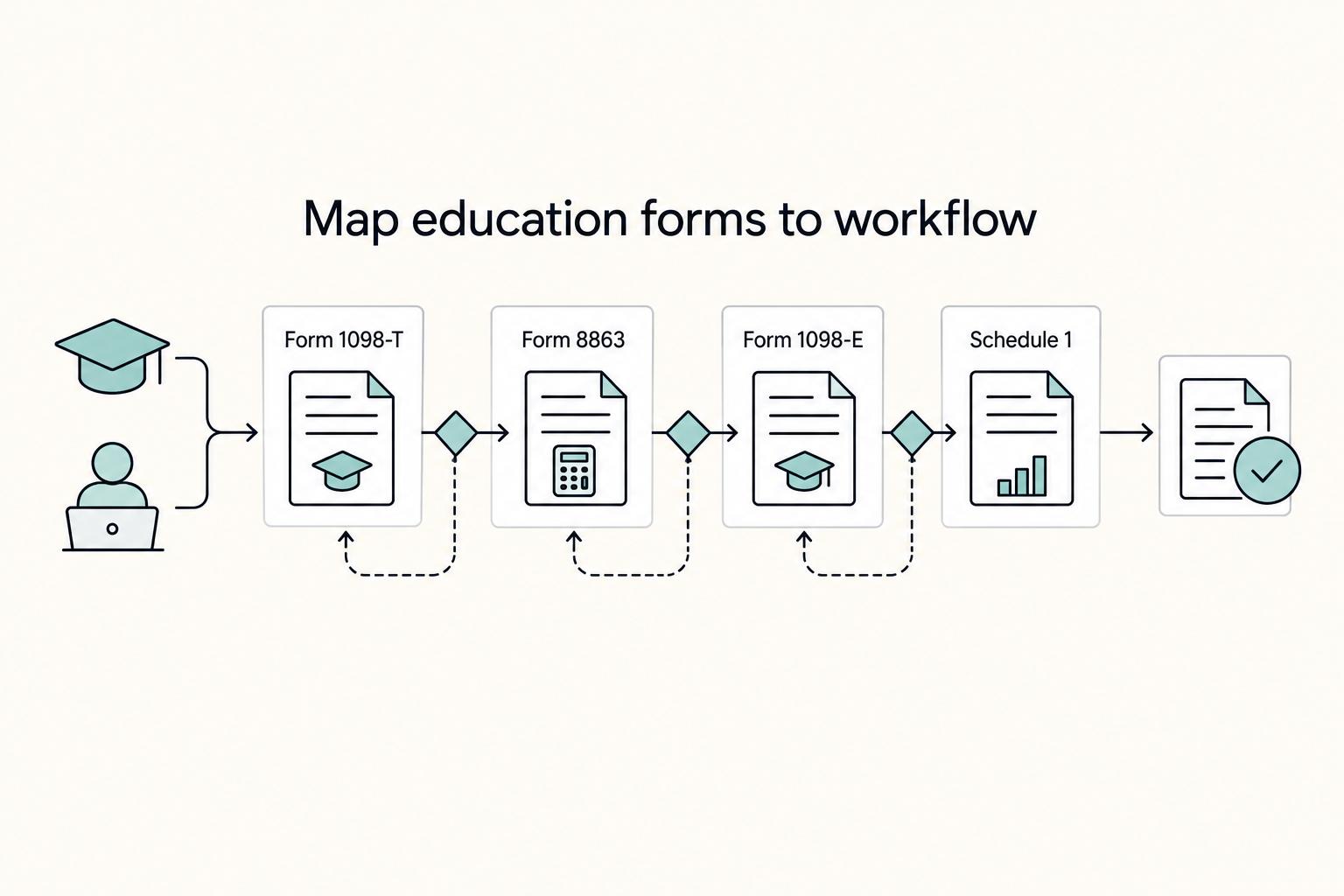
What the forms do in the workflow#
The forms matter, but they do different jobs:
| Item | Role | Key note |
|---|---|---|
| Form 1098-T | Supports education credit calculations | Treat it as an input, not your final number. |
| Form 8863 | Calculates and claims AOTC or LLC | This is the form that actually calculates and claims the credit. |
| Form 1098-E | Reports student loan interest received by the lender | The deduction is then claimed on Form 1040/1040-SR with Schedule 1. |
| Form 1040/1040-SR with Schedule 1 | Claims the student loan interest deduction as an adjustment to income | Used after Form 1098-E reporting. |
If Form 1098-T is missing or incorrect, contact the school and reconcile your records. A missing 1098-T does not automatically bar a credit when an exception applies, but you still need to substantiate enrollment at an eligible institution and the amounts paid.
Records to keep#
Keep a minimum file with 1098-T or 1098-E, school billing statements, enrollment records, payment confirmations, and receipts for required books or equipment. For AOTC, third-party receipts for required books and supplies can matter even if you did not pay the school directly. For LLC, those costs generally count only when they had to be paid directly to the school.
Decision checkpoint#
At this point, you should know whether you are in the education-credit lane or the student-loan-interest lane.
If you have an eligible student, supportable tuition records, and you likely meet the verified filing-status and income rules, continue with the AOTC or LLC decision in the next section. If your facts are mainly about loan repayment, keep the student loan interest deduction in scope. If credits are blocked by filing status, income, or expense type, you may need a different tax treatment outside these three options.
Before filing, verify current filing-year MAGI thresholds for AOTC, LLC, and the student loan interest deduction from official IRS records. If you want a deeper dive, read our guide to a defensible 2026 filing plan.
The Professional's Advantage: The Business Expense Deduction#
For self-employed filers, this deduction works only when the education clearly supports the work you already do. It is a separate lane from AOTC and LLC. Credits follow student-specific rules; this deduction turns on whether the cost is an ordinary and necessary business expense directly connected to your current trade or business. The same expense cannot be used for both.
Use a strict pass/fail test first#
Run the positive tests first. Your education should meet at least one:
| Test | Type | Result |
|---|---|---|
| Maintains or improves skills needed in your present work | Positive test | If yes, continue. |
| Required by your employer or by law to keep your present salary, status, or job | Positive test | If yes, continue. |
| Needed to meet the minimum educational requirements for your current profession | Disqualifier | If yes, treat it as non-deductible under this rule. |
| Part of a program that qualifies you for a new trade or business | Disqualifier | If yes, treat it as non-deductible under this rule. |
- It maintains or improves skills needed in your present work.
- It is required by your employer or by law to keep your present salary, status, or job.
Then run the disqualifier tests:
- It is needed to meet the minimum educational requirements for your current profession.
- It is part of a program that qualifies you for a new trade or business.
If either disqualifier applies, treat it as non-deductible under this rule. A degree outcome by itself does not automatically disqualify the expense. The real question is whether the education supports your current business rather than qualifying you for a new one.
Quick scenario grid#
| Scenario | Likely result | Why |
|---|---|---|
| Self-employed consultant takes an advanced course directly related to services already provided to clients | Likely fit | Maintains or improves skills used in the current business. Document the direct business connection and apply the ordinary-and-necessary standard. |
| Freelancer enrolls in the first program needed to meet entry requirements for a profession | Clear non-fit | Costs that satisfy minimum educational requirements are nondeductible. |
| Existing professional takes a broad certificate or degree that overlaps current work but could also support other career paths | Gray area | It depends on whether the facts show current-skill improvement or qualification for a new trade or business, so document business purpose carefully. |
What makes the claim defensible#
For self-employed filers, the course title matters less than the record you keep around it. A defensible claim starts with a clean business-purpose file.
Keep records that show the payee, amount paid, proof of payment, date incurred, and description of the item. Then keep documents that tie the education to current business activity. Save the syllabus, enrollment confirmation, receipts, completion certificate, and a short memo explaining how the coursework maintains or improves skills used in your current client work.
Before filing, do a consistency check. Can you explain the deduction in a few plain sentences as a current-business expense without leaning on a future career pivot? Keep the classification consistent on Schedule C, and do not reuse the same education expense for a credit or any other education tax benefit.
For a related read, see The Best Bank Accounts for College Students.
Your Decision Framework: Choosing the Optimal Strategy#
Choose the path you can document and defend first. Then compare tax impact only after you verify current cutoffs in official IRS guidance.
Credit and deduction paths may follow different rule sets. That frames the decision, but current eligibility rules still control.
What to check first#
| Path | Eligibility fit to confirm first | Claim mechanics (plain language) | Documentation burden | Likely audit risk |
|---|---|---|---|---|
| Education credit path | Confirm you meet current education-benefit rules, including any current cutoffs | Apply this path only if current IRS education-benefit rules fit your filing facts | Keep records that support eligibility, payments, and how expenses were treated | This article does not quantify audit risk; treat it as uncertain until current IRS rules are verified. |
| Business expense deduction path | Confirm this path is available for your facts under current IRS rules | Apply this path only if current IRS rules support deduction treatment for your facts | Keep records that support eligibility, payments, and the factual basis for this path | This article does not quantify audit risk; treat it as uncertain until current IRS rules are verified. |
| Pause and escalate | Facts are mixed, incomplete, or can support more than one interpretation | Do not force a claim decision before professional review | Build a complete evidence pack before review | Treat as elevated until facts and current rules are verified. |
Validate current cutoffs#
Keep these values unresolved until you verify current rules in official .gov guidance:
- Current threshold pending official .gov verification
- Current calculation pending official .gov verification
Do not treat Treasury OTA working papers as binding eligibility authority. They may help frame discussion, but they are works in progress and may not reflect official Treasury policy positions.
Follow this if/then sequence#
Once you know which lane you are in, use this sequence to avoid mixing rules or forcing a claim.
- If your facts do not clearly fit a single path, pause path selection.
Gather missing facts and verify current IRS rules before deciding.
- If one path appears to fit, run that path's current-rule checks first.
If the facts fail those checks, do not use that path.
- If more than one path still appears possible, pause before choosing.
Do not assume interaction rules until you verify current IRS guidance for your filing facts.
- If the facts are gray, escalate before filing.
Gray-area cases should be reviewed by a tax professional before you submit a claim.
Reusable example structure#
Use this structure when you need to test a real case before filing.
- Profile
Record your current work and income facts from your own source records.
- Education purpose
State the education purpose and confirm it against your source records.
- Eligibility test result
Confirm the eligibility result against the official IRS rules and current thresholds.
- Likely claim path
Confirm the likely claim path after reviewing your documentation and current calculations.
Final checkpoint before filing: if you cannot explain eligibility, payment trail, and rule checks in plain language on one page, pause and escalate.
Related: Do I Have to Pay State Taxes While Living Abroad as a Digital Nomad?.
Before you pick credit vs deduction, lock your residency assumptions so your filing logic stays consistent across borders: Track your residency timeline.
Mitigating Risk: How to Audit-Proof Your Deduction#
If you claim the business-education deduction, your file should tell a clean, dated story. It should show that the course supported your current business skills.
This deduction is narrow. Your education expense is generally in bounds only if it maintains or improves skills for your present work, or is required to keep your current job, pay, or status. It is out of bounds if the program qualifies you for a new trade or business, or meets minimum entry requirements for that field. If you are self-employed, you generally report this on Schedule C (Form 1040), and you cannot reuse those same expenses for an education credit.
Define the records before you collect them#
A contemporaneous record is a dated note made at or near the time of the expense or use. It can state what the course teaches, which current services or tasks it supports, and why it does not qualify you for a new line of work.
| Term | Meaning | Key note |
|---|---|---|
| Contemporaneous record | A dated note made at or near the time of the expense or use | It can state what the course teaches, which current services or tasks it supports, and why it does not qualify you for a new line of work. |
| Proof of payment | Shows who you paid, how much, and when, plus evidence the payment actually cleared | A card statement or canceled check helps, but it is not enough on its own without business-purpose context. |
| Business-purpose linkage | The full trail showing the expense belongs to business activity, not personal use | Your note, course materials, and business records should align. |
Proof of payment shows who you paid, how much, and when, plus evidence the payment actually cleared. A card statement or canceled check helps, but it is not enough on its own without business-purpose context.
Business-purpose linkage is the full trail showing the expense belongs to business activity, not personal use. Your note, course materials, and business records should align.
Use a stop-or-review flow#
The easiest way to avoid a weak claim is to stop early when the facts do not hold up.
- Confirm the current-work link first.
If you cannot explain in plain language which current skill the course maintains or improves, stop.
- Screen for disqualifiers immediately.
If the program appears to qualify you for a new trade or business or satisfy minimum entry requirements, do not treat it as a deductible work-education expense.
- Escalate gray cases before claiming.
If the facts can be read both ways, label it clearly: Review with a tax professional before claiming.
Build the evidence pack#
| Document | What it supports | Common failure point | Safe default action |
|---|---|---|---|
| Dated note | Your intent and current-work connection at enrollment | Written much later, vague, or framed as a career change | Write a one-page note when you enroll and store it with the invoice |
| Invoice or receipt | Payee, amount, and course identity | Missing detail or only a checkout confirmation | Save the full provider invoice, preferably as a PDF |
| Payment record | Amount paid, date paid, and payment method | Shows a charge but not what it was for | Match each payment record to the related invoice |
| Course description or syllabus | Skills taught and fit with current work | Only marketing copy, or page changes later | Save a dated copy at purchase and keep the final syllabus if available |
| Completion or attendance record | Additional support that you took the training | No record of participation | Keep any available certificate, transcript, grade report, or portal record |
| Related cost receipts | Books, supplies, lab fees, and similar course-tied costs | Personal or optional items mixed in | Keep separate receipts and note why each item was required |
Connect the course to income activity after completion#
Do not stop at enrollment records. Keep dated proof that you applied the skill in your existing business, such as updated service descriptions, client deliverables, workpapers, proposals, or invoices.
Keep a short narrative in your file. Note what you studied, which current service it improved, when you used it, and which records prove that use. Before filing, verify that every payment ties to a course document and every course document ties to business purpose.
Keep records for at least the general 3-year assessment window after filing. In cases of substantial omitted income, that window can extend to 6 years, so longer retention is a practical safeguard.
This pairs well with our guide on Top 10 Tax Deductions for Freelancers.
Conclusion: Choose One Education Tax Treatment and Document It#
The rule is simple: choose the one education tax treatment your facts support, then confirm which option gives you the stronger net tax result. Use each expense dollar once. For the same student and the same expenses, you cannot claim more than one education benefit.
Make the decision with your actual return inputs, not assumptions. If you qualify for an education credit, run the American Opportunity Tax Credit or Lifetime Learning Credit on Form 8863 and compare that result against any separately eligible deduction. If you are self-employed and the education maintains or improves skills needed in your present work, or is required to keep your present salary, status, or job, the expense may be deductible on Schedule C. If the program qualifies you for a new trade or business, that deduction path is not available.
For credits, Form 1098-T is generally required, so confirm it is in place in the usual case and match it to your payment records before filing. Do not treat 1098-T box amounts as automatic claim amounts. If you are claiming under an exception without a 1098-T, keep records that substantiate qualified tuition and related expense payments.
Before you file#
- Confirm you meet the eligibility rules for the path you chose.
- Run a credit-versus-deduction comparison using one shared expense pool, assigned once.
- Build your documentation set now: Form 1098-T, invoices, payment confirmations, and records that support qualified tuition payments and any business-purpose or employer-requirement test.
Escalate to a qualified tax professional if your facts span multiple states or countries, include a treaty-based position, or mix student and business use in the same program. State treatment can differ from federal treaty treatment, and treaty-based positions generally require disclosure on the return.
Document your chosen treatment now, map each expense to that treatment, and store the support together before you file. We covered this in detail in The Most Overlooked Tax Deductions for Freelancers.
If your education costs, client payments, and compliance records are getting hard to manage, talk to Gruv about an audit-ready setup tailored to your workflow.
Frequently Asked Questions
What's the difference between the AOTC and LLC?
The American Opportunity Tax Credit (AOTC) applies for up to 4 tax years and covers tuition, certain fees, and course materials. The Lifetime Learning Credit (LLC) has no limit on the number of years it can be claimed. Both are claimed on Form 8863. For AOTC, the credit is up to $2,500, and up to 40% (up to $1,000) may be refundable.
Which is better: the LLC or a business expense deduction?
Neither is automatically better, and this section does not include full business-deduction eligibility rules. The LLC is a credit claimed on Form 8863. If you are comparing LLC with another tax benefit, do not use the same expense for both; each expense should be used once. If your facts are mixed or cross-border, get advisor review before filing.
What are qualified education expenses for the LLC?
Start with tuition and required fees for enrollment or attendance at an eligible post-secondary institution. For education credits, room and board and transportation are non-qualifying expenses. A simple filter works well here: if a charge is required for enrollment or attendance, keep it. If it is living or travel-related, exclude it.
Can I claim an education credit for my child's tuition?
This section does not include the full dependency tie-breaker rules, so confirm who is eligible to claim the student before filing. Keep Form 1098-T, tuition records, and payment proof aligned to the same filer. If the facts are mixed or cross-border, get advisor review before filing.
Do I need a Form 1098-T to claim an education credit?
Generally, yes, because eligibility for AOTC or LLC typically requires you or your dependent to have received Form 1098-T from an eligible school. The IRS notes exceptions, so do not assume the rule applies the same way in every case. Match Form 1098-T to your payment records, and if you claim AOTC, include the school’s EIN on Form 8863. If the facts are mixed or cross-border, get advisor review before filing.
Is the Tuition and Fees Deduction still available?
Do not assume it is available for your filing year. Confirm current status from official IRS records before filing, then compare only the options that are currently valid for your facts. For this decision, keep the focus on AOTC and LLC. If the facts are mixed or cross-border, get advisor review before filing.
Try a related tool
Researched and edited by the Gruv editorial team. Gruv builds cross-border billing, payouts, and finance-operations software for global businesses.
Sources
Educational content only. Not legal, tax, or financial advice.
Related Posts

Digital Nomad Taxes in 2026 With a Defensible Filing Plan
With digital nomad taxes, the first move is not optimization. It is figuring out where you may be taxable, where filings may be required, and what proof supports that position.

Do I Have to Pay State Taxes While Living Abroad as a Digital Nomad?
Living abroad does not end `state income tax` exposure by itself. The first decision is practical: choose a filing position your facts can support, then build records that support the same story all year.
Claiming the American Opportunity Tax Credit as an Expat
**For an expat, an AOTC claim stays low-stress if you handle it in order: confirm eligibility, build your proof, then file Form 8863.** In practice, substantiation is usually the hard part, not the form.