
Quick Answer
Start with the fund year closest to when you expect withdrawals, then confirm the real risk path before investing. This target-date funds guide shows why two same-year options can differ materially in equity exposure, fixed-income construction, and post-retirement policy. In a 401(k), also verify whether you were defaulted through a QDIA and whether that default still fits your timeline. The practical approach is to choose one option you understand, document why, and monitor it with a short repeatable check.
Start here and decide if a target-date fund fits your reality#
A target-date fund can be a strong fit if you want a low-maintenance retirement option in a 401(k)-style plan, not a high-touch trading strategy. The basic move is simple: choose the fund closest to your expected retirement year and revisit that choice with a short checklist when your situation changes.
Who this is for#
A target-date fund, sometimes called a target retirement fund, is built for people who do not want to actively manage retirement savings. It holds a mix of stocks, bonds, and other investments, and that mix shifts automatically to become more conservative as retirement gets closer.
If you want to make frequent tactical changes, this will probably feel too limiting. If you want one fund to handle allocation shifts inside a retirement account, it is a practical starting point.
What it does and does not do#
The main benefit is a lower decision burden, not protection from loss. Early allocations are often more stock-heavy, which can mean more return potential but also more volatility. As the target date approaches, the mix usually shifts toward bonds and cash instruments, which are generally less volatile than stocks. A target-date fund can still lose value, so treat it as a long-term approach, not a guarantee.
Where this guide is focused#
This guide focuses on 401(k) plans and similar participant-directed retirement plans, where target-date funds are common and many plans use them as the Qualified Default Investment Alternative, or QDIA. That makes your first check straightforward. Confirm in plan materials whether your plan defaulted you into a QDIA and whether the target year lines up with your expected retirement timing and risk tolerance. Convenience can help you stay consistent, but default does not automatically mean personal fit.
Build the right mental model before choosing a fund#
If you want one-fund simplicity, think of a target-date fund as a managed allocation that changes over time, not a promise. The real decision is whether that allocation path fits your timeline and your ability to stay invested when markets get rough.
Know the terms that matter#
A target-date fund (also called a target retirement fund, and sometimes labeled lifecycle or age-based) is usually presented as a managed mutual fund tied to a future date, most often retirement. The glide path is the fund's time-based allocation plan. In this context, asset allocation means the mix inside the fund, typically stocks plus fixed income (bond funds), with a more conservative mix as the target date gets closer.
What you are actually buying#
In plain English, you are buying a packaged allocation instead of choosing each investment yourself. Your first practical check is to open the prospectus, fact sheet, or plan investment page and find the glide path or allocation chart. If you cannot clearly see how the mix changes over time, you do not understand the fund well enough to choose it.
The tradeoff to accept up front#
These funds are designed to become more conservative as the target date gets closer. For some investors, that can make the ride easier to live with, but it can also mean giving up some upside in strong stock markets. One cited case study reported 14.55% over three years for a target-date fund versus 21.48% for the S&P 500. That is a useful reminder that convenience can come with a performance tradeoff.
If you want a straightforward retirement default, start with a short list of target-date options before adding complexity. Build your own multi-fund mix only if you have a clear reason and you know you will maintain it consistently.
Understand what the glide path does and does not protect you from#
A glide path can reduce risk as retirement gets closer, but it cannot remove loss risk or fix a bad behavioral fit. Your job is to confirm how the fund moves from growth assets toward more defensive holdings and choose a path you can actually stick with in a downturn.
What actually changes over time#
In a target-date fund, the glide path is the plan for automatically changing the stock-and-bond mix as the target date approaches. Early allocations are often growth-heavy, then shift toward more fixed income and, in some designs, safer assets.
What matters most is how fast that shift happens. Some glide paths get much more conservative close to the target date, while others move more gradually. Those choices reflect different priorities. Some designs lean more toward safety and liquidity near retirement, while others keep more equity exposure for investors expected to stay invested longer.
That is why labels are not enough. Glide paths are not interchangeable, and with more than 100 strategies in the market, same-year funds can still follow very different risk paths.
What it does not protect you from#
A more conservative allocation near retirement does not eliminate loss risk. Sequence risk still matters, especially around the years when you begin using the money.
If large drawdowns would make the strategy hard to follow, a more conservative glide path may be a better fit than one you are unlikely to hold through stress.
Verify the post-date policy before you buy#
Before you choose a fund, confirm whether allocation changes continue after the target year or stop at a landing point. If you skip this step, you can end up with a post-retirement risk level you did not expect.
Use the prospectus, fact sheet, or 401(k) investment page and read the glide path past the target date. Provider materials can make this concrete. Vanguard, for example, shows a 90% stock allocation at age 20 on one glide path and notes that some trust investors at age 65 can freeze a 50% equity allocation by converting. Treat that as a verification example, not a universal rule.
Compare same-year funds before you pick one#
Put same-year options side by side before you choose. The year in the name does not tell you enough, so treat each fund as its own decision.
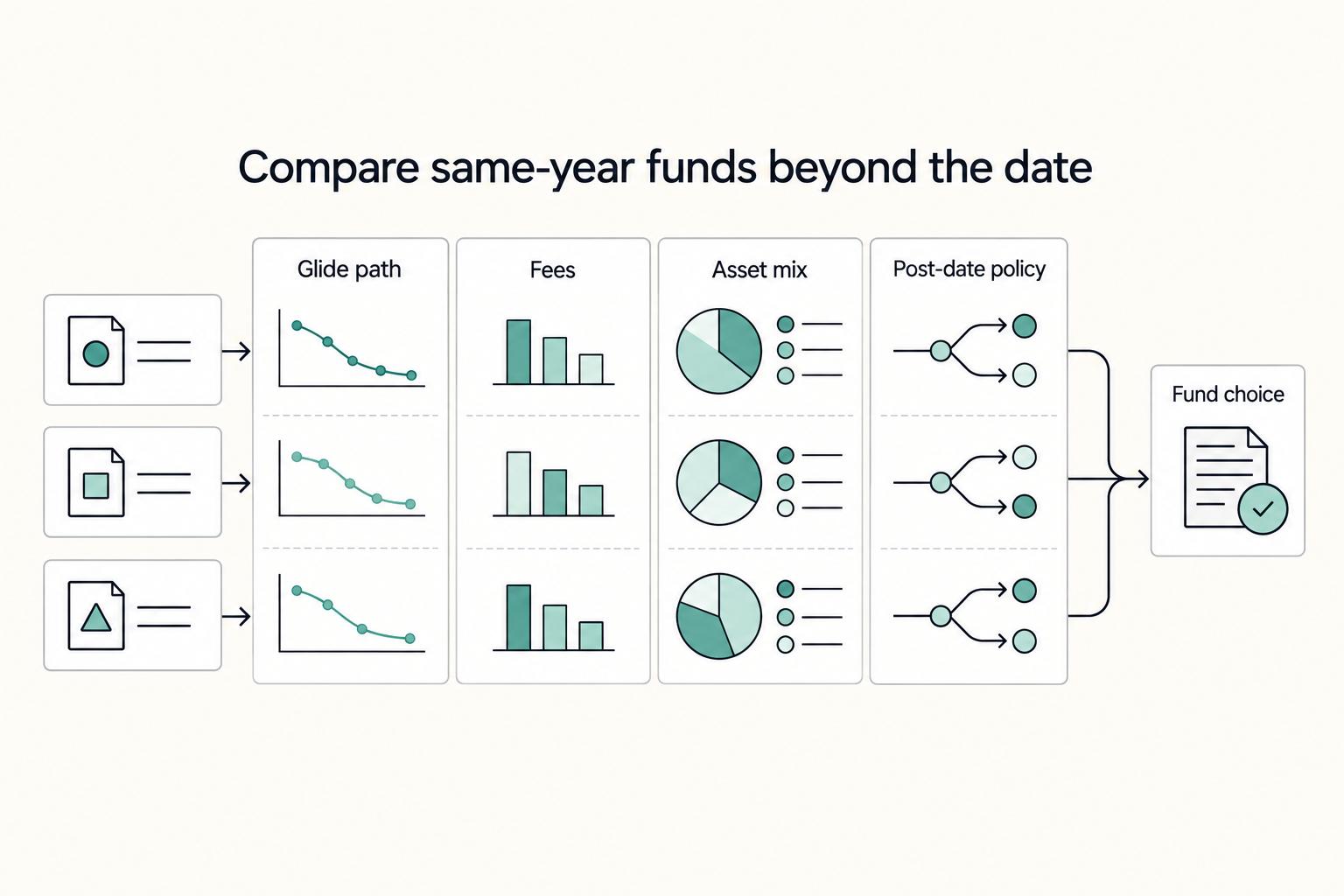
Most target-date funds are named in five-year increments, which can make same-year funds look interchangeable. They are not. Compare what actually drives outcomes: glide path slope, equity exposure near the target date, fixed-income mix, and what happens after the target date.
Use one comparison sheet for same-year options#
| Same-year fund | Glide path slope | Equity near target date | Fixed-income mix | Post-date policy | Plan-listed details |
|---|---|---|---|---|---|
| Plan option A (2065) | Steeper or more gradual shift | Record disclosed level, or relative position if only relative data is shown | Broad bonds only, or bonds plus cash-like sleeves | Stops at a landing allocation, or continues changing | Confirm exactly how your plan lists the option |
| Plan option B (2065) | Steeper or more gradual shift | Record disclosed level, or relative position | Broad bonds only, or bonds plus cash-like sleeves | Stops at a landing allocation, or continues changing | Confirm exactly how your plan lists the option |
Use your plan materials and fund documents, then compare like with like.
What to verify before trusting the name#
Start with the post-date policy. Some funds are managed through the expected retirement year, while some also include a during-retirement approach, and that difference changes what you are buying.
Next, check the fixed-income construction. "More conservative" can still mean very different bond-and-cash mixes, so compare the underlying mix, not just the label.
Finally, verify the exact plan-listed option. Do not assume a same-year fund with a similar name is equivalent to what your plan actually offers.
Name-only selection can be weak due diligence. Selection and monitoring have been a fiduciary focus in the target-date category, which is a good practical standard for you too. Compare product design, not just the year in the title. Related: Tax Implications for an Australian Resident Owning a US LLC.
Pick the right target year when your income is uneven#
Start with the fund year closest to when you expect to retire, then adjust only if that risk level will be hard for you to hold during stress. The goal is not perfect precision. It is choosing a year you can live with through weak markets and uneven business periods.
Use retirement year as the anchor#
Use your expected retirement year as the default starting point. If you expect to retire around 2060, review the 2060 option first.
Then verify what that year actually means in your plan. Same-year funds can carry very different risk. Equity at the target date has ranged from about 20% to 60% across funds. Pull the fact sheet or prospectus for your exact plan-listed option and check how much equity it holds near the target date and how the glide path changes over time.
Let behavior and business volatility break the tie#
When cash flow is steady and contributions are predictable, you may be comfortable staying with the baseline year if the glide path fits your tolerance. When income is uneven and contributions are irregular, you may prefer a more conservative glide path.
If market losses plus business pressure would likely push you to stop contributing or sell, a slightly earlier target year may help reduce risk. That usually means moving to a glide path with less equity exposure sooner.
Use one simple if-then rule#
If your income swings are large and you are less likely to stay invested during stress, consider a slightly earlier target year. If your income is stable and you can stay invested through normal drawdowns, stick with your retirement-year baseline unless the actual glide path looks mismatched.
Keep this separate from market timing. Picking 2055 instead of 2060 because your cash flow is volatile is a risk-tolerance decision, not a prediction about next year's market. If your expected retirement date changes later, you can switch to a different fund. Related reading: A Guide to Backdoor Roth IRAs for High-Earners.
Know how plan rules shape your options#
| Document | What to confirm |
|---|---|
| Official investment menu or administrator materials | Which target-date series and years are available |
| Prospectus for the exact fund on the menu | The fund's objectives and underlying investments |
| Plan-issued investment information | Details for the exact option in your account |
Your plan rules set the menu, so your best choice is the best option your plan actually offers. In many 401(k) plan setups, a target-date fund may be there because it is the Qualified Default Investment Alternative (QDIA), not because it is automatically the best fit for you.
A QDIA is the default investment a plan fiduciary selects for participants who do not make an election. The U.S. Department of Labor notes that many plan sponsors use target-date funds in that role. The Pension Protection Act of 2006 facilitated automatic enrollment using default investments, including target-date funds.
In a participant-directed individual account plan (like a typical 401(k)), you direct your account within the plan's investment menu. The plan fiduciary selects and monitors that menu. Your job is to choose carefully from what is available in your plan, not from every fund in the market.
If your plan offers one target-date series, your main decision may be the target year. If it offers multiple series, do not treat same-year funds as interchangeable. Funds with identical target dates can still use different strategies and allocations. Before you act, check plan-level documents for the exact option in your account:
- your plan's official investment menu or administrator materials, to confirm which target-date series and years are available
- the prospectus for the exact fund on that menu, because the fund's objectives determine its underlying investments
- any plan-issued investment information for that option
Treat the default as a starting point, not a personalized recommendation. These funds can lose money, so confirm the exact fund name on your plan menu and read that fund's prospectus before accepting the default or switching funds.
Use a pre-investment checklist that catches most mistakes#
| Check | What to verify | Pass / Fail |
|---|---|---|
| Target year fit | Does the year line up with when you expect withdrawals to begin, not just a planned retirement age? | Pass / Fail |
| Glide path type | Does the fund keep shifting after the target year, or mostly stabilize at that date? | Pass / Fail |
| Equity level at retirement | How much is still in stocks around the target year? Target-date funds can still hold substantial equity then. | Pass / Fail |
| Post-date allocation behavior | Does equity keep falling after the target year? Some examples show about 50% stocks at target year and 25% equities a few years later. | Pass / Fail |
| Underlying funds and returns | Have you reviewed the underlying funds and historical returns? | Pass / Fail |
| Prospectus | Do you have the prospectus for the fund you are considering? | Pass / Fail |
| Fee disclosures | Have you checked the published fee field, such as an expense ratio, where available? | Pass / Fail |
| Downside behavior expectations | Can you describe how this fund could behave in a bad market near your withdrawal window? | Pass / Fail |
| Role of cash equivalents | Does the fund shift toward bonds and cash equivalents as it gets more conservative, and are you comfortable with that tradeoff? | Pass / Fail |
| Core or entire allocation | Is this your main one-fund holding, or will you layer other funds on top? | Pass / Fail |
| Final gate | Can you explain in one sentence how this fund's asset allocation changes over time? | Pass / Fail |
Before you buy, verify how the fund's asset allocation changes over time, how that matches your withdrawal timing, and which documents support the choice. A short checklist helps you avoid choosing by target year alone.
Start with fit, not branding#
Start with withdrawal timing. Choosing one of these funds is tied to when you expect withdrawals to begin, and the fund is designed to become more conservative as that date approaches.
Then check the glide path itself. You have to do the research because glide paths vary by fund. One series may be around 75% stocks and roughly 25% bonds earlier on, around 50% stocks at target year, and continue lowering equities afterward. Another series can follow a different path.
Pull the documents before you decide#
Build a small evidence pack for each fund option before investing: the prospectus, fee disclosures, and a review of underlying funds and historical returns.
Review documents for the exact fund option you are considering, then confirm the prospectus and fee details match that option.
For fees, use the published field, not a vague description. One example fund page shows an expense ratio listed as 0.67 / 0.67%. That is only an example of format, not a benchmark.
Check the risk you will feel, not just the story#
Assume loss risk is still possible and test your expectations now. Ask what this fund could do in a sharp market drop near your withdrawal period.
Also review the role of cash equivalents. As the allocation becomes more conservative, the fund may shift toward bonds and cash equivalents to help reduce market volatility.
Decide whether it is your whole allocation#
Decide upfront whether this is your core allocation or your entire allocation. If you add overlapping stock or bond funds on top, you can unintentionally change the fund's intended mix.
Use the final gate before you invest. If you cannot explain in one sentence how this fund's allocation changes over time, pause and review again.
Avoid the most expensive target-date fund mistakes#
Some costly mistakes happen when a one-fund choice turns into autopilot. The convenience is real, but you still need to confirm that the fund fits your withdrawal timing, risk tradeoffs, and overall account mix.
Treat set and forget as low maintenance, not no maintenance#
A target retirement fund can work well as a one-fund option, but "set it and forget it" should not mean "review never." If your timeline or expected withdrawal timing changes, the original target year may stop matching the job you need the fund to do.
Keep the review practical. Pull the current materials for the exact option you hold and make sure you still understand the essentials. This matters most when stress hits. Contribution and withdrawal behavior can have a powerful impact on outcomes, so a stale choice can become a problem at the worst time.
Do not stack overlapping target-date options by accident#
Holding multiple dated funds can make your allocation harder to read unless each one has a clear role. If you mix them without a specific reason, you may be creating your own allocation blend without clearly defining the result.
That is easy to miss because a target-date fund is already a packaged fund-of-funds structure. Before adding overlap, check your holdings and confirm each fund has a distinct purpose. If you cannot explain the overlap simply, treat it as a warning sign.
Lower volatility is not the same as no loss risk#
A more conservative mix can reduce short-term volatility, but it does not remove loss risk. It also changes your exposure to other risks, including inflation and longevity risk.
That tradeoff is the core judgment call. There is no single allocation that is optimal across market, inflation, and longevity risks at the same time. If you focus only on short-term calm, you can increase a different risk that matters later.
The fund name is a label, not the decision#
The date in the name is a starting point, not a full risk description. Near-dated funds can have different objectives, and those objectives can lead to dramatically different equity exposure even when the year label looks similar.
Focus on the design, not the branding. Confirm the exact fund in your plan and the fund's intended role after retirement. The 2008 dispersion in near-dated fund results is a useful reminder that same-year funds can behave very differently.
Run a light monitoring routine after you invest#
After you choose a fund, your job is to confirm that it still fits your situation and that your 401(k) plan still offers the option you think you own.
A Target-date fund (TDF) already handles one core task automatically: it follows a preset glide path that typically shifts more conservative as the target date gets closer. Your monitoring should stay narrow and practical. That preset path may not adjust to changing market conditions, and it cannot detect changes in your personal timeline, risk tolerance, or goals.
Use a repeatable review rhythm#
Use a routine you will actually keep. The point is consistency, not constant tinkering.
Each check can be simple: confirm the exact fund name and target year, and make sure you still understand the fund's role in your plan. If your menu uses year-labeled options such as a 2065 fund, verify the exact series rather than assuming same-year options are interchangeable.
When you do a deeper review, focus on fit, not short-term performance: target year, glide path, and whether this option still fits your retirement investing in the plan. Keep the checklist tight so you do not react to noise.
Track only three things#
| What to check | What you are verifying | What should make you pause |
|---|---|---|
| Target year | The year still matches when you expect to draw from the account | You now expect to draw from the account sooner or later than planned |
| Glide path | The risk mix still matches your comfort level and goals | The current stock/bond mix no longer fits your risk tolerance |
| 401(k) plan menu | You still hold the intended TDF series, with current materials available | The option changed, disappeared, or is unclear in the menu |
Names can look similar in employer plans, but design choices can differ. If the menu changes, review current fund materials before defaulting to inaction.
Define your own forced-review triggers#
Set personal triggers in advance so you are not making decisions ad hoc under stress. The main risk to watch is personalization. A preset path does not account for your specific circumstances. If your timeline, goals, or risk tolerance changes, consider an out-of-cycle review instead of waiting for your next routine check.
Keep a one-page decision log#
Keep records simple if that helps you stay consistent. A one-page note can capture the date, what changed, what you checked, and what action you took. That gives you a clear trail of why you stayed put or made a change while the fund continues following its preset path.
Confirm what rules apply in your country and program#
Confirm scope first: U.S. rules and agencies only help if your plan is actually in that scope. Employee Retirement Income Security Act of 1974 (ERISA), the U.S. Department of Labor (DOL), and the DOL's Employee Benefits Security Administration (EBSA) are U.S.-specific retirement-plan references.
ERISA is a U.S. federal baseline for most voluntarily established private-industry retirement and health plans, but it does not cover every arrangement. In general, it excludes plans established or maintained by governmental entities and churches, and it also excludes certain plans maintained outside the United States primarily for nonresident aliens. If your setup is cross-border or outside a typical U.S. employer plan, do not assume U.S. guidance applies as-is.
Keep sources in the right lane. General investor-education materials can help with context, but your plan-specific terms come from your employer's official plan documents and the provider materials for the exact target-date fund (TDF) in your menu. When in doubt, confirm applicability against the full regulatory text and your plan's official documents.
That same discipline applies to fund selection. Same-year funds can have different risk and performance because fund design varies. Use this confirmation path before changing allocations:
- Ask your plan administrator which official documents control your investment choices and any plan-specific restrictions.
- Check plan-provided information on features and funding, then match it to provider materials for the exact fund series and target year.
- If anything conflicts or is unclear, pause and confirm in writing before you change allocations.
Tie this to your broader cashflow protection system#
If you are making major financial choices alongside broader business or cashflow decisions, keep those decisions on separate tracks and document both.
Start with a scope check. Not every rule applies to every situation. For example, §1026.43 applies to consumer credit secured by a dwelling and does not apply to credit primarily for business, commercial, or agricultural purposes. If a rule is out of scope, do not use it as your decision anchor.
Then keep a simple evidence trail for every change you make. Record retention is a practical control, not admin busywork: keep confirmations so you can show what changed, when it changed, and whether execution matched your instructions.
If any step depends on a license or authorization, confirm that it is currently in effect before you proceed. Where no authorization is in effect, related transactions can be prohibited, so treat authorization status as a live checkpoint, not a one-time assumption.
Make one clear decision and automate it#
Make one durable choice: pick a target-date fund (TDF) you understand, review its glide path, and let the built-in rebalancing handle the routine work. The goal is not a perfect fund. It is a decision you can stick with.
A TDF can be a strong low-maintenance option, but it targets an outcome and does not guarantee one. If you were defaulted into a Qualified Default Investment Alternative (QDIA), treat that as a starting point, then confirm it still fits your own timeline and risk tolerance.
Do the shortlist now, not someday#
This week, open your plan menu and shortlist the dated funds available closest to your expected retirement year. Keep it short.
Then verify with current fund materials and plan documents, not the year label alone. Confirm what the glide path does at the target date and after it. If you cannot explain that in plain language, pause before choosing.
If two nearby options both look reasonable, pick the risk profile you are most likely to hold through a bad market. One practical risk is abandoning the strategy later.
Keep the evidence pack small and real#
Leave yourself a short record: the exact fund name, target year, why you chose it, and which current materials you reviewed. That note helps when market noise makes second-guessing feel urgent.
If your plan includes a brokerage window, review the participant-level disclosures before using it. In ERISA participant-directed individual account plans, a brokerage window is not itself a designated investment alternative, so treat it as an added layer of choice and responsibility.
A short checklist you can maintain#
If your plan includes a brokerage window, review the participant-level disclosures before using it. In ERISA participant-directed individual account plans, a brokerage window is not itself a designated investment alternative, so treat it as an added layer of choice and responsibility. Use this before you invest and when your situation changes:
- The target year matches your expected retirement timing, or you intentionally chose a different year for risk reasons.
- You can explain the glide path in one sentence, including what happens at and after the target date.
- You know whether this fund is your plan's QDIA default or a manual choice.
- You reviewed current fund materials and relevant plan disclosures, including brokerage-window disclosures when applicable.
- You are ready to automate contributions and avoid switching unless your timeline, plan menu, or risk capacity changes.
If you want a next step beyond this target-date funds guide, see A Guide to Choosing a 401(k) Investment Plan. For most readers, the right move is simple: make one clear choice this week, document why, and automate it.
For a different investing topic, see A Freelancer's Guide to Angel Investing and Venture Capital.
Frequently Asked Questions
What is a target-date fund and who is it best for?
A target-date fund is a one-step retirement investing portfolio that changes over time as you get closer to retirement. It is often a practical fit if you want a hands-off approach and do not want to actively manage retirement savings. The tradeoff is control: you get automatic rebalancing, but you are relying on the fund manager's allocation decisions.
How do I choose the right target year without overthinking it?
A common starting point is the year closest to when you expect to retire. Then choose the nearest fund label, which is commonly offered in five-year increments like 2030, 2035, 2040, or 2045. If you are deciding between nearby options, compare their risk profiles rather than relying on the year label alone.
What is a glide path in plain English?
A glide path is the fund's formula for how its investment mix changes over time. Early allocations are usually heavier in stocks, then shift toward more conservative holdings like bonds and cash instruments as retirement approaches. Since managers can adjust glide paths, check current fund materials rather than assuming the design stays fixed.
Are target-date funds safe or guaranteed in retirement?
No. They may become more conservative over time, but they are not guaranteed to meet their objective or protect principal. A more conservative mix can still lose value.
Can two funds with the same target year have very different risk?
Yes. Funds with the same year label are not all built the same way and may use different glide paths and holdings. Do not rely on the year alone. Verify current allocation and design details in fund documents.
What is the difference between to and through retirement funds?
The key check is what happens after the target year. Through-retirement designs continue investing after that date. If a fund uses "to retirement" language, confirm in the prospectus or plan materials how allocation is handled at and after the target date.
Why are target-date funds often the default in a 401(k) plan?
Many plan sponsors use them as the plan's Qualified Default Investment Alternative (QDIA). A QDIA is the default chosen by a plan fiduciary when a participant does not make an investment election. If you were defaulted into one, review the selected year and glide path against your own timeline and risk tolerance.
Try a related tool
Researched and edited by the Gruv editorial team. Gruv builds cross-border billing, payouts, and finance-operations software for global businesses.
Sources
- aero.nd.gov/image/cache/AIRPORT_MANAGERS_MANUAL_COMPLETE...trusted
- ccag.ca.gov/wp-content/uploads/2014/07/SFOCLUP_Vol-II_Ap...trusted
- consumerfinance.gov/rules-policy/regulations/1026/43trusted
- dol.gov/agencies/ebsa/about-ebsa/our-activities/reso...trusted
- dol.gov/sites/dolgov/files/ebsa/laws-and-regulations...trusted
- gao.gov/assets/gao-24-105364.pdftrusted
- home.treasury.gov/policy-issues/international/outbound-investm...trusted
- myncretirement.gov/documents/files/governance/boarddocs/12-x-c-...trusted
Educational content only. Not legal, tax, or financial advice.
Related Posts

Japan Digital Nomad Visa 2026: Six-Month Planning Runbook
Treat this as your operating model: identify the right mission first, commit to one route, and keep dated records before you make irreversible plans. That is what keeps the rest of your timeline, paperwork, and decisions coherent.

Tax Implications for an Australian Resident Owning a US LLC
There is no one-size-fits-all shortcut for US LLC tax decisions across Australia and the United States. Setting up a US Limited Liability Company (LLC) is one step; getting the tax treatment right in both systems is where risk starts. If you are handling **australian owning us llc tax** decisions, treat this as a classification and documentation problem first, not a shortcut hunt. If you run a business of one, your job is to pick the defensible path and keep the paperwork tight.
Choose Your 401(k) Investment Plan in 30 Minutes
Treat this as a cash flow and behavior decision first, and a fund-picking exercise second. The goal is to help you make a workable choice from a real plan menu without guessing, chasing what is hot, or changing course every time markets move.