
Quick Answer
Choose summer jobs for high school students by screening for three outcomes: work you can document, adults who can coach and reference you, and skills you will repeat enough to improve. Then verify setup details before starting, including permit requirements by state and whether the role is employee or contractor work. During the summer, keep a simple proof log with dates, duties, tools, and measurable outputs so applications and resume bullets are specific and defensible.
Judge a Summer Job by Proof, People, and Skills#
If you are choosing among summer jobs for high school students, pay should be one filter, not the whole decision. The better lens is career capital: the proof, people, and skills you can carry forward after the summer ends.
Think of career capital as what the job leaves you with after the money is spent. You do not need a perfect score on all three, but you should know which pillar a job clearly strengthens before you say yes. One warning up front: it is easy to underrate the Professionals pillar, even though relationships can shape school-to-career transitions alongside knowledge and skill.
| Pillar | Decision question to ask before accepting | Why it matters in practice | How to verify quickly |
|---|---|---|---|
| Portfolio | Will this job give you something specific you can point to later? | A job is usually easier to explain on applications and in interviews when you can show outputs or measurable results, not just list a title. | Ask what you will actually produce, improve, organize, sell, design, track, or help run. If the answer stays vague, that is a signal. |
| Professionals | Will you work around people who can teach you, vouch for you, or connect you to the next opportunity? | Social capital is the value embedded in networks, mentors, and community connections. Relationships often affect who hears about interviews, internships, and openings. | Ask who you report to, how often you will work directly with experienced staff, and whether strong performers can use supervisors as references. |
| Proficiency | Will you leave with a skill that is useful outside this one workplace? | Some jobs mainly trade hours for cash. Others also teach habits or tools you can reuse in future roles. | Ask what you will be trained to do in week one, what you should be able to do alone by the end of summer, and how performance is checked. |
The Professionals pillar deserves extra weight because access is uneven. Research on social capital points to a real failure mode: students with fewer useful connections can face workforce-entry barriers even with similar academic credentials. Not all connections are equally useful, either. Granovetter's 1973 work on weak ties identified why looser professional connections can open new doors: they often move in different circles than close friends and family.
A good fit job usually has at least one strong adult supervisor, repeat contact with coworkers who know the field, and a realistic path to a reference or introduction. A weak fit job may be convenient and pay fine, but you mostly work alone, rotate through shift coverage, and finish the summer with no one who can describe your work in detail.
Before you go deeper into each pillar, use this quick checklist on any role you are considering:
- Can you name one thing you will be able to show later?
- Can you name one person you are likely to learn from or stay in touch with?
- Can you name one skill you expect to perform better by August than you do now?
If you cannot answer at least two of those with specifics, keep looking. The next three sections show how to judge each pillar one by one.
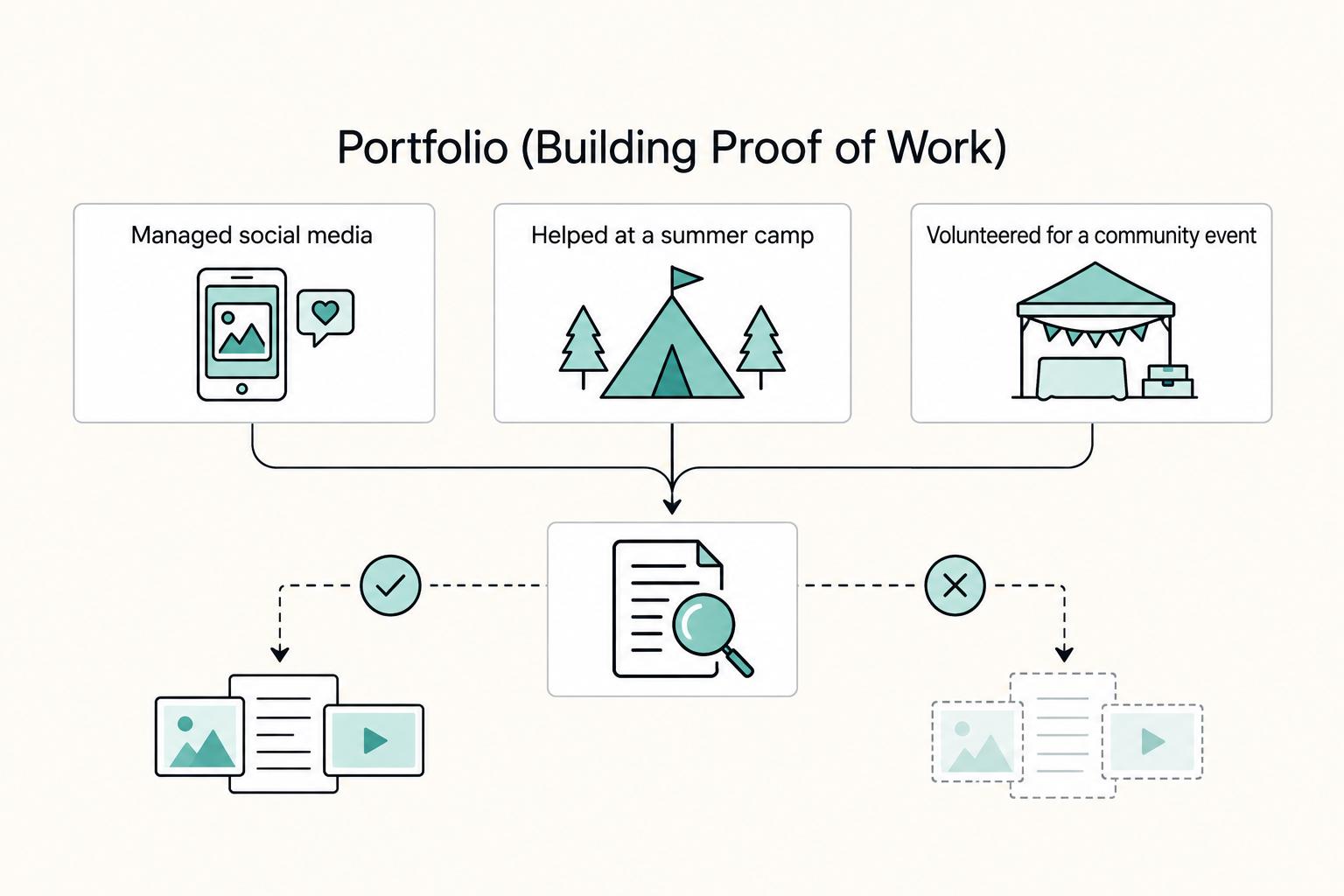
Pillar 1: Portfolio (Building Proof of Work)#
Coach your teen to pick roles that produce proof, not just a paycheck. If a job will not leave them with something they can show, explain, or verify later, treat it as cash-only.
A career portfolio is a collection of work experiences and accomplishments, and the value is in the evidence inside it. Ask this before they accept any role: what can you save by August that shows what you did and what changed?
Usable proof usually fits four buckets:
- Artifacts: flyer, photo set, spreadsheet, social post, menu update, sign-up form, event checklist, before-and-after screenshot
- Outcomes: a result you can verify before stating it
- Role clarity: what they owned vs what they only supported
- Documented process: goal, constraints, steps, feedback, and what they changed
Documenting failed attempts can still strengthen the portfolio. A miss with clear notes shows learning and judgment.
What good proof looks like on paper#
| Task-only description | Evidence-based bullet |
|---|---|
| Managed social media for a local business | Created and scheduled weekly social posts, maintained a content calendar, and tracked engagement trends; then add a result you can verify from your own records |
| Helped at a summer camp | Supported daily check-in and activity setup for the camper group, updated attendance records, and improved pickup flow; then add a result you can verify from your own records |
| Volunteered for a community event | Built the registration sheet, organized volunteer assignments, and ran event-day sign-in for a community event; then add a result you can verify from your own records |
Strong bullets show scope, output, and result. Convert task-only lines while details are still fresh.
Before they say yes, ask three quick questions: what will you produce, can you keep a copy or screenshot, and who can confirm the result? If answers stay vague, or all work is confidential with no redacted sample, that is a portfolio red flag.
A simple capture routine that works#
Use a simple three-step flow: gather content, separate work by section, then convert projects into resume-ready proof.
- Save evidence weekly. Keep screenshots, links, drafts, photos, before-and-after examples, positive feedback, and any tracker that supports a result.
- Label each artifact clearly. Use a consistent format so it is searchable later: date + organization + project + role + status (for example:
2026-07 library-summer-reading flyer draft approved). - Sort by section. If work spans different fields, keep separate sections so role-relevant samples are easy to find.
- Create two outputs per project.
- Resume bullet: action + output + result
- Interview story: problem + what I did + what changed + what I learned
Keep the portfolio digital so it is easy to send, update, and tailor. A clean folder, slide deck, or simple page is enough when the evidence is clear.
Portfolio-friendly work is not limited to traditional jobs. Internship tasks, volunteer projects, or small service projects can all work when they produce clear deliverables you can save. Next, use Pillar 2 and Pillar 3 to judge who your teen will learn from and which skills they will actually build.
For a step-by-step walkthrough, see A Guide to Tax Deductions for College Students.
Pillar 2: Professionals (Building a Strategic Network)#
After confirming a role can build proof, screen it for mentor access. For summer jobs for high school students, your upside usually comes from adults who can observe your work, coach you, and later describe your contribution clearly.
Job title is secondary. A modest role with regular supervision can be more valuable than a flashy title with little feedback. Prioritize access to people who teach, review, and explain decisions.
Screen the environment before saying yes#
Some programs make mentor access explicit. Bank of America says its 2026 Student Leaders program connects more than 300 students to employment, skills development, and service, includes a paid six-week nonprofit internship, and adds a Leadership Summit with peer and leader access. Wolfram describes a two-and-a-half-week high school research program where students work under expert mentors and publish a computational essay and an interactive research paper. Use these as benchmarks for what intentional guidance looks like.
Most summer roles are less structured, so pre-screen the environment:
| Role environment | Signs of high mentor access | Signs of low mentor access | What to verify before accepting |
|---|---|---|---|
| Local business or office support | Repeat contact with the same manager or owner, visible projects, direct feedback | Mostly solo tasks, constant rush, supervisor rarely present | Who assigns your work, who reviews it, and how often you work with that person |
| Nonprofit, school, or community program | Named supervisor, planning/admin work, exposure to multiple functions | One-off tasks, no clear supervisor, little review | Whether you can own a project from start to finish |
| Skilled trade, studio, or creator business | Side-by-side demonstration, correction, real tools or client work | Only errands/cleanup, no explanation, no questions encouraged | Whether you can observe the full workflow, not just support the edges |
| Career-connected or dual-enrollment pathway | Built-in advising plus workforce exposure in a coordinated pathway | Partnerships still forming, inconsistent employer access by region | Whether employer relationships are active now, not just planned |
If no one can name who will train and review your work, treat that as a red flag. Lumina’s reporting on accelerated pathways supports this pattern: some regions already run integrated advising and career-connected learning, while others are still building the needed relationships.
Earn a reference through execution#
Strong recommendations come from observable performance, not general friendliness. To make a future endorsement easy to write:
- Be reliably on time and consistent on core tasks.
- Own one or two recurring responsibilities instead of waiting for every instruction.
- Keep a simple record of outputs, fixes, and positive feedback.
By the end, your supervisor should be able to confirm specific contributions, not just say you were helpful.
Use a repeatable informational interview workflow#
- Request: Ask one professional whose work interests you for a short career conversation.
- Prepare: Bring 3-4 specific questions about their work, skills, and path.
- Follow up: Send a brief thank-you and mention one concrete takeaway.
- Maintain: Reconnect only when you have a real update, question, or next step tied to their advice.
This applies across settings, not just office roles: trades, nonprofit operations, local professional services, and creator-led businesses can all provide strong mentorship when access is real.
You might also find this useful: How to Start a Business as a Teenager.
Pillar 3: Proficiency (Acquiring High-Value Skills)#
Use this pillar to choose roles that build skills you can reuse and prove later. For summer jobs for high school students, the key decision is not "soft vs. hard" but "Which role gives me repeated practice in skills that transfer to my next step?"
Soft skills are interpersonal abilities and personal attributes that work across settings. Hard skills are technical abilities in specific areas. The Congressional Research Service also separates foundational skills, basic digital skills, and soft skills into distinct areas. To evaluate any role, use three checks: transferability, practice frequency, and future usefulness in your next class, club, job, or project.
If a role sounds impressive but gives only occasional reps, treat it as a weak skill builder. A simpler role with daily practice is often stronger.
| Skill pathway | What you actually learn | How to prove improvement | Where it transfers next |
|---|---|---|---|
| Customer-facing service | Communication, listening, handling requests, staying calm, punctuality, task completion | Track shifts covered, common requests handled, supervisor feedback, and fewer corrections over time | Retail, hospitality, campus jobs, interviews, student leadership |
| Operations or admin support | Organization, checklists, scheduling, data accuracy, basic digital tools, follow-through | Save before/after docs, list recurring tasks you owned, note faster completion or fewer errors | Office support, nonprofit operations, school projects, coordination roles |
| Digital or content support | Writing, editing, posting workflows, file management, research, basic tool use | Keep drafts, revision history, published links, and examples of feedback applied | Marketing support, creator workflows, student org communications, early freelance work |
Look for blended roles, not one-skill roles#
The best early roles often build three lanes at once: communication, operations, and digital execution. You might answer customer emails, update a signup sheet, and draft an event post in the same week. That mix gives you better evidence, better interview stories, and better input for career exploration decisions.
Before you accept, confirm two things: which tasks happen every week, and who reviews your work. If no one can explain either, skill growth is likely thin.
Treat a micro-business as one optional training path#
A small service business is one option, not a requirement. It can work when you already have one usable skill, like tutoring, basic editing, lawn care, or simple design, and want structured practice with client communication, deadlines, and revisions.
Use a scope guard to avoid overcommitment:
- one clear offer
- one client type
- one project at a time, or a fixed weekly hour cap
- one simple log of requests, deliverables, and feedback
This matters because burnout is a real risk when work and school pressures stack up. A stable routine and clear priorities make the workload more manageable.
End each week with a short skill-capture checklist for this pillar:
- skills practiced repeatedly
- tools used
- problems solved
- feedback applied
- reliability proof (showed up on time, completed tasks)
These notes turn into resume bullets, interview stories, and inputs for your portfolio section. Related: How to Find Your First Freelance Client.
Set Up Paperwork, Withholding, and Records From Day One#
Your first compliance win is simple: do not start work until the paperwork flow is clear in writing. Before your first shift or first invoice, confirm which forms apply, how payment will be processed, and which year-end document you should expect.
Keep the W-4 and worker-classification check at the center of your setup. IRS Publication 963 (Rev. 5-2025) includes Chapter 4, Determining Worker Status, which is a practical checkpoint for asking better questions. The same publication also says it is informational and cannot be cited as legal authority, so use it as guidance, then confirm your exact situation with the payer and current IRS materials at irs.gov/forms.
| Setup area | Paperwork flow to confirm | Tax withholding to confirm | Recordkeeping expectation | Ask for professional help when |
|---|---|---|---|---|
| W-4 | When it must be completed and where it is submitted | Whether payroll withholding is being handled through the employer process | Keep a copy with onboarding/payroll documents | The form is requested but instructions are unclear for your situation |
| W-2 employee path | Offer/onboarding docs, pay stub access, payroll portal, and year-end form process | Exactly what payroll is withholding and what still may be your responsibility | Save pay stubs, onboarding records, and payroll messages | Day-to-day work setup and classification label do not seem to match |
| 1099 contractor path | Contract terms, invoice process, payment timing, and year-end reporting flow | Whether any withholding occurs or whether you must plan payments yourself | Track all income, expenses, invoices, contracts, and client communications | There is no contract, no audit trail, or classification remains unclear |
Use this checklist from first paycheck to first filing cycle:
- Separate finances early: use separate accounts if possible, or at least separate tracking for income and expenses from day one.
- Keep one document folder: contracts, invoices, pay stubs, receipts, and payment screenshots.
- If you are paid as a contractor, set aside a conservative portion of each payment for taxes, then verify whether estimated tax payments or other filing steps apply to your situation.
- Involve a parent or guardian when the first tax document arrives, classification is unclear, or income comes from multiple sources.
The most common failure mode is loose cash handling with no log. Fix that early, and the rest of compliance gets much easier.
We covered this in detail in How to Record High-Quality Audio for Your Videos.
Conclusion: Choose One Role, Verify It, Then Track Your Proof#
Choose the role that leaves you with proof, people, and skills you can still use after summer ends. If two jobs pay about the same, pick the one that gives you work samples, a supervisor who can confirm your results, and tasks that sharpen skills you can name on a resume.
Use the three filters in plain terms. Portfolio means you can point to something real: a project, tracked output, or a before-and-after result. Professionals means you worked around adults who can verify your dates, duties, and strengths, not just say you "helped out." Proficiency means you got better at a transferable skill such as customer service, scheduling, inventory, writing, or using a tool your next employer will recognize.
Before you commit, verify the setup. A strong checkpoint is the official posting or program page, not a screenshot or reposted listing. For example, USDA points students to a USAJobs search, and its Pathways Internship Program can run in summer, fall, spring, or year-round. That matters because prior workforce guidance reported that many local areas believed summer programs improved when integrated with school-year programming, rather than run as summer-only efforts. Older guidance also noted an accountability gap: year-round youth programs had performance standards, while summer programs did not. If a role has vague duties, no named supervisor, or no clear application path, treat that as a red flag.
For summer jobs for high school students, your next step is simple:
- Pick one opportunity using Portfolio, Professionals, and Proficiency as your filter.
- Verify the employment setup and eligibility on the official page before applying or starting.
- Track proof while you work: dates, duties, numbers, tools used, schedules, pay records, and work samples.
- Turn that proof into resume bullets and ask for supervisor confirmation before your last week.
That is the real career move: not chasing prestige, but building documented experience in a way that is useful, honest, and compliant.
Frequently Asked Questions
How can a job help with college applications or future applications?
A role is easier to use in future applications if you document it while you do it. Keep a simple record of dates, title, supervisor name, tools used, and tracked outputs such as customers helped per shift, items stocked, or posts scheduled, and fill those numbers in only after you verify them from schedules, logs, or messages. Before your last week, ask your supervisor for one practical evidence pack: permission to list them as a reference, a short note confirming your dates and duties, and one or two specific strengths they observed.
What are the best online options if your teen wants flexible work?
Start by separating employee roles from contractor or micro-service work, because setup, supervision, and legal requirements can differ by role and location. If you use a listings site, treat it as a search tool, not a placement service. SummerJobs.com lets you search by keyword and location, but you still have to apply exactly as each posting instructs, and many camp counselor listings there set 18 as the minimum age. Also check timing early, because many seasonal employers begin hiring in February. | Option | Setup effort | Supervision | Skill proof | Paperwork and tax complexity | Fit for beginners | | --- | --- | --- | --- | --- | --- | | Employee role | Often lower. Usually a formal application and employer onboarding. | Often higher. Usually a clear manager and scheduled shifts. | Moderate unless you track results during the job. | Often more standardized through employer payroll, but still save forms and pay records. | Often a clearer starting point for first-time workers. | | Contractor or micro service role | Often higher. You may need a written agreement, invoices, payment tracking, and parent review. | Varies by client and project. | Stronger if you finish clear deliverables. | Can be higher. Classification and tax handling vary by jurisdiction, so verify before work starts. | Better only if the work terms, local rules, and paperwork are clear. |
Does your teen need a work permit?
That depends on the state, so verify current rules on official labor pages before applying or starting work. In New York, youths under 18 need working papers. The state says those papers serve as the official employment certificate, and the guidance is organized by ages 14 to 15 and 16 to 17, with a noted switch to digital working papers in 2027. Use official NY.gov pages for New York checks, and do not assume New York rules apply elsewhere.
How should your teen list a summer job on a resume?
Write bullets from evidence, not memory. Convert duties into outcomes such as Handled transaction volume verified from register records with accurate cash procedures or Updated inventory records each week, with counts verified from logs, and keep the backup in case a school, employer, or recommender asks. For summer jobs for high school students, one avoidable problem is vague wording like "helped customers" with no numbers, tools, or context.
Try a related tool
Researched and edited by the Gruv editorial team. Gruv builds cross-border billing, payouts, and finance-operations software for global businesses.
Sources
- clame.nyu.edu/fulldisplay/E1F0GB/316770/First%20Resume%20F...trusted
- cms.gov/Regulations-and-Guidance/Guidance/Manuals/do...trusted
- congress.gov/crs-product/R47059trusted
- cooper.edu/engineering/stem/summertrusted
- courts.ca.gov/documents/cfac-20220617-materials.pdftrusted
- dol.ny.gov/youth-ages-14-17trusted
- eeoc.gov/best-practices-private-sector-employerstrusted
- govinfo.gov/content/pkg/GOVPUB-L41-PURL-gpo8059/pdf/GOVP...trusted
Educational content only. Not legal, tax, or financial advice.
Related Posts

How to Handle Taxes for a Side Hustle
If you want less stress at filing time, use sequence instead of shortcuts. When one year includes payroll income, contractor income, and time in more than one country, the order of operations matters. This guide gives you a defensible path so you can make each decision once, document it, and avoid rebuilding the return later.

How to Find Your First Freelance Client
For your first client, the goal is not visibility, momentum, or a full pipeline. The goal is one paid project with scope and payment timing clarified in writing. A testimonial is useful, but it is not the win. Paid work with clear terms is the win.
How to Start a Business as a Teenager
Operate like a CEO by running your week in three lanes: strategy, cash control, and documented execution, all tied to a profit goal. If you are figuring out **how to start a business as a teenager**, this is the first shift that matters. Treat your work as a business asset, not a casual project.