
Quick Answer
Start with a full loan map in StudentAid.gov and each servicer account, then separate federal, private, and refinanced balances before changing repayment. File your U.S. return with Form 2555 if FEIE applies, and treat any lower payment estimate as provisional until your current program notice confirms it. For cross-border payments, verify posting in the servicer portal, not just transfer status.
Build One Complete Loan Inventory Before You Change Anything#
Before you change a repayment plan, make extra payments, or refinance, build one complete loan inventory. Open StudentAid.gov for your federal overview, each servicer dashboard for billing and status, and your latest statements for rate terms and capitalization language.
Start by separating federal and private loans. Their repayment tools and downside risk are different. Federal loans can include income-driven repayment based on income and household size, with payments that can be as low as $0 in some cases. Private lenders are not required to offer relief, so if cash flow tightens, the outcome is less predictable.
Pull the inventory before you form an opinion#
Do not optimize around assumptions. Start at StudentAid.gov, map every loan to the company handling billing and payments, and reconcile mismatches before you do anything else. It is common to have multiple loans and multiple servicers. Use this first-pass checklist:
| Checklist item | Detail |
|---|---|
| Loan type | Program name |
| Current servicer | Login location |
| Interest rate | Structure listed in your statements |
| Capitalization triggers | In statements or disclosures |
| Current repayment status | Including deferment or forbearance |
| Autopay | Status, linked account, and due date |
| Delinquency or default | Flags |
| Loan category | Flexibility | Downside risk | Protections | Action priority |
|---|---|---|---|---|
| Federal Direct loans | Higher relative flexibility, including income-driven options tied to income and household size | Administrative or status-tracking mistakes can raise costs, including capitalization events | Federal repayment options and borrower protections | Confirm type and status first, then optimize workflow |
| Private student loans | Lender-specific and generally less predictable | Relief is discretionary, so payment stress can escalate faster | Contract-based terms; hardship options vary by lender | Review early for payment stress, terms, and delinquency risk |
| Refinanced or consolidated loans | Case by case based on current loan terms | Misclassification risk if you rely on old labels | Verify current terms before assuming which options apply | Verify current owner, servicer, and category before any change |
Capitalization and delinquency are the two flags not to skim#
Check these two items first. Capitalization adds unpaid interest to principal, which increases future interest cost, so verify exactly when it can happen, especially around forbearance transitions. If a federal loan remains unpaid for 270 days, it can move toward default, so a "past due" flag needs immediate follow-up.
Map your aid history to the loan types you actually hold#
Once the inventory is clean, tie it back to your aid history so your records explain the loan mix you have today. FAFSA is the core federal aid application for federal loans, work-study, and grants. For participating schools, undergraduate Direct Loan eligibility can include a Pell-eligibility determination step.
Use that map to label Direct Subsidized vs. Direct Unsubsidized loans correctly, and mark unknowns explicitly instead of guessing. A Direct Subsidized Loan does not accrue interest during certain in-school, grace, and deferment periods, while a Direct Unsubsidized Loan does not require financial need for eligibility. Where rules or thresholds are not yet confirmed, leave the detail out until you can verify it against the current official source, your servicer, or your school records. Related: A Guide to 529 Plans for US Expats.
The Expat Arbitrage: How the FEIE Can Legally Reduce Your Federal Loan Payment to $0#
Once you know which loans are federal, the next question is how your filed tax position appears in the income documents a repayment review uses. FEIE only applies if your position is valid and filed on your U.S. return. The IRS material here confirms FEIE tax rules, not student-loan payment formulas.
In practice, the sequence is simple. File your U.S. return, claim FEIE on Form 2555 if you qualify, then verify how your repayment program evaluates income. Any payment impact is program-specific and is not established by the IRS FEIE excerpts alone. Do not assume the result. Confirm it in your plan records.
What must be true first#
FEIE is not automatic. You must be a qualifying individual and file a U.S. tax return reporting the income. You also need foreign earned income, a foreign tax home, and qualification through either the physical presence test or the bona fide residence test.
For physical presence, the threshold is 330 full days in any 12 consecutive months, and a full day is 24 consecutive hours from midnight to midnight. The days do not have to be consecutive, but missing 330 fails that path regardless of reason, including illness, vacation, family problems, or employer orders.
For bona fide residence, the issue is continuity: bona fide residence in a foreign country for an uninterrupted period that includes an entire tax year. If you may need the adverse-conditions waiver, check the current IRS Revenue Procedure for eligible countries and dates.
The FEIE limit is updated annually. For tax year 2026, the maximum exclusion is $132,900 per person (limited to foreign income earned). If you also claim the foreign housing exclusion, calculate that first because it reduces the income available for FEIE.
| Eligibility path | FEIE implication | Documentation burden | Common failure point | Escalate to a qualified tax advisor when |
|---|---|---|---|---|
| Physical presence test | Can support FEIE eligibility when you can document 330 full days in a 12-month window | High when travel is frequent | Day-count errors, especially non-full travel days | Your count is close to 330 or travel records conflict |
| Bona fide residence test | Can support FEIE eligibility based on uninterrupted foreign residence that includes an entire tax year | Moderate to high | Residence continuity facts are incomplete or inconsistent | You moved mid-year or your residency facts are mixed |
| Adverse-conditions waiver | May preserve FEIE eligibility when departure was forced by qualifying conditions | High | Relying on hardship without current IRS country guidance | You left due to war, civil unrest, or similar events and need waiver support |
Operational sequence (owner / action / output)#
The practical goal is to create a file that supports the tax position, then separately confirm how any repayment program treats that filed income.
| Owner | Action | Output |
|---|---|---|
| You | Confirm your FEIE path, whether physical presence, bona fide residence, or possible waiver | A short file memo plus supporting records |
| You (+ tax advisor if needed) | File your U.S. return and include Form 2555 | Filed return that reports income and claims FEIE |
| You | Review current IRS Form 2555 instructions (Who Qualifies, Waiver of Time Requirements, When To File) | A current-year filing checklist |
| You | Verify separately how your repayment program evaluates filed income | Program guidance or account notes confirming the process used for your case |
| You | Archive proof | One folder with return, Form 2555, travel or residency evidence, and program confirmations |
Compliance-risk checklist#
The common failures here are procedural, not theoretical. Track deadlines on one calendar: tax filing timing, extension timing, and any program-specific income-update deadlines that apply to you. Keep documentation audit-ready: travel log, residency evidence, filed return, and Form 2555 support. Re-verify annually: current FEIE limit and any IRS adverse-conditions waiver updates. Do not assume downstream repayment effects from FEIE alone. Confirm treatment directly in your current program records.
You might also find this useful: How to Create a 'Hire Me' Page That Converts.
Your Global Treasury: A Framework for Paying US Debt Without Losing on FX Fees#
A lower required payment only helps if you can deliver it on time from abroad. A practical setup is a two-account bridge: convert funds in a multi-currency account, move USD to your U.S. checking account, then pay your servicer through ACH.
Choose the rail before you move money#
For recurring debt payments, pick the rail before the month gets busy. Direct international wires can work, but ACH is a U.S. batch network positioned as efficient and low-cost once funds are already in the U.S.
| Payment rail | Cost transparency | Speed predictability | Failure risk | Reconciliation effort |
|---|---|---|---|---|
| Direct international wire to servicer | Varies by bank. Verify current fee/rate details before sending. | Moderate. Cutoff windows and internal bank review can delay delivery. | Elevated if details are wrong. Wrong beneficiary details are a common return cause, and returned wires may come back reduced by fees. | Can be substantial. You may need to trace across sending, intermediary, and recipient banks. |
| Multi-currency account -> U.S. checking -> ACH to servicer | Provider-dependent. Verify current fee/rate details before sending. | Can be easier to manage because FX timing and debt-payment timing are separated. | Routing/account errors can still cause failures, so validate details before sending. | Structured handoff. You can verify provider status, U.S. bank receipt, then servicer posting in order. |
Set up the two-account bridge once#
Do the setup work once so the monthly cycle becomes boring.
- Pick your bridge provider. Confirm local-currency support, transfer tracking with updated ETA, and visible transfer limits, which can vary by currency pair and funding method.
- Pick your U.S. hub account. Use a checking account that supports ACH, has clear online statements, and is dedicated to debt payments.
- Complete compliance checks early. Expect identity verification and possible security or compliance reviews that can delay transfers.
- Test the path with a small transfer. Save confirmations and confirm USD lands in your U.S. account before scheduling full monthly amounts.
- Pre-wire a backup route. Keep either a second verified provider or enough USD buffer in the U.S. account to cover one cycle.
Run the monthly cycle like an ops checklist#
Treat this like payment operations, not a casual transfer.
| Monthly step | Timing or rule | What to verify |
|---|---|---|
| Set payment calendar | Count backward from each due date using the servicer's posting window; for example, use 2 to 4 business days for MOHELA and 3 to 5 business days for Edfinancial | If you have multiple servicers, pay each one |
| Apply one FX rule | Convert the amount due plus buffer, or pre-convert on a fixed schedule | Do not leave conversion and payment to the due date |
| Verify each handoff | Track provider progress, confirm U.S. bank receipt, then confirm servicer posting | "Sent" does not always mean funds are posted at the recipient bank |
| Close the loop | Bank debits alone are not enough | Verify posting at the loan servicer |
| Handle exceptions | If the transfer qualifies as a remittance transfer, cancellation may be available within 30 minutes (if conditions are met), with refunds after a valid request within 3 business days | If recipient details are wrong, contact the provider right away |
- Set your payment calendar. Count backward from each due date using your servicer's posting window. For example, use
2 to 4 business daysfor MOHELA and3 to 5 business daysfor Edfinancial; other servicers can differ. If you have multiple servicers, pay each one. - Apply one FX rule. Convert the amount due plus buffer, or pre-convert on a fixed schedule. Do not leave conversion and payment to the due date.
- Verify each handoff. Track provider progress, confirm U.S. bank receipt, then confirm servicer posting. "Sent" does not always mean funds are posted at the recipient bank.
- Close the loop in the servicer portal. Bank debits alone are not enough. Verify posting at the loan servicer.
- Handle exceptions immediately. If recipient details are wrong, contact the provider right away. If the transfer qualifies as a remittance transfer, cancellation may be available within
30 minutes(if conditions are met), with refunds after a valid request within3 business days.
The capital-protection rule is simple: separate FX conversion from debt execution so you can isolate failures quickly and fix the right step.
For a step-by-step walkthrough, see The Pros and Cons of Work-Study Programs. Before you lock in your transfer workflow, run one side-by-side cost check with the payment fee comparison tool so your monthly loan payment method is based on real fees, not assumptions.
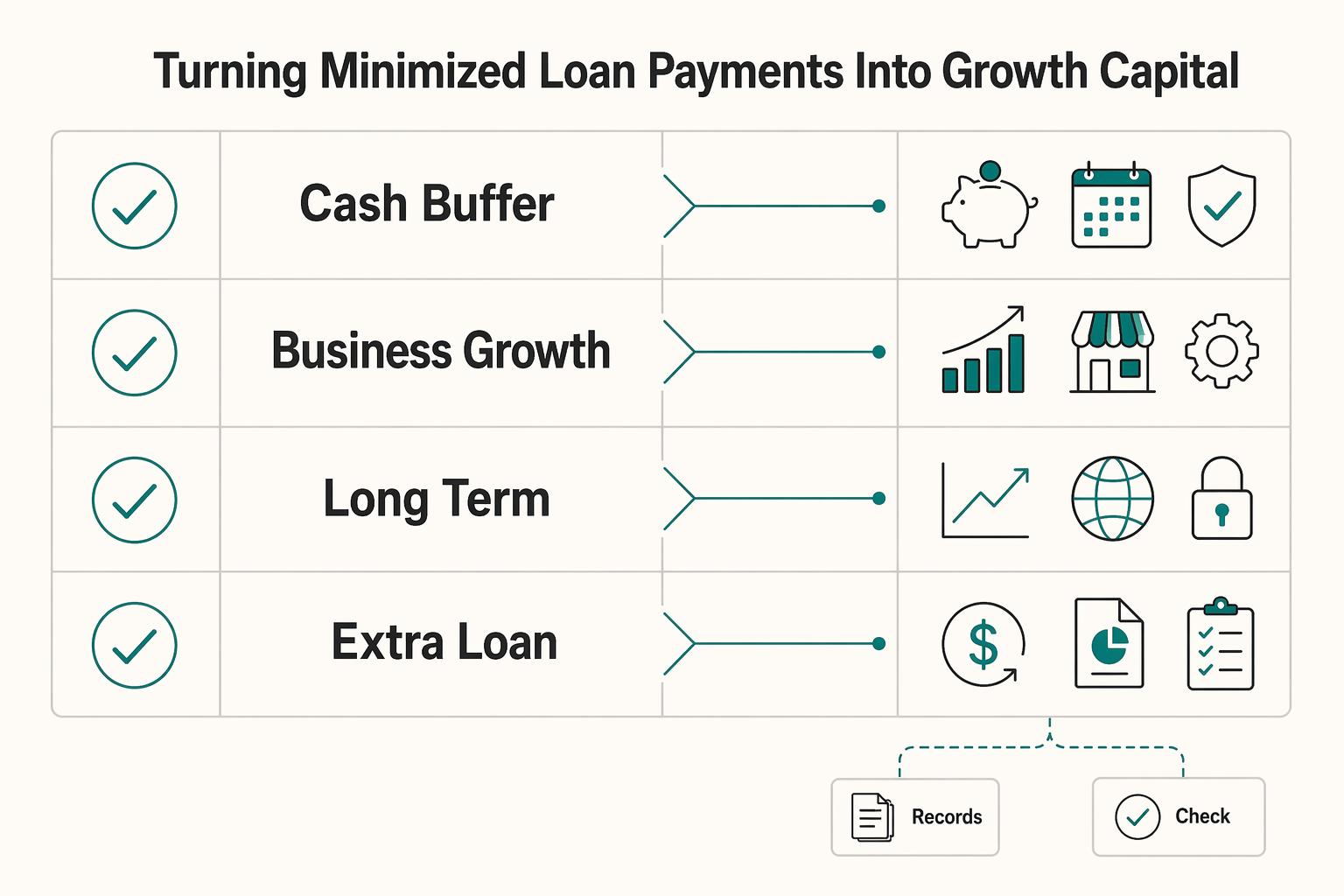
From Liability to Leverage: Turning Minimized Loan Payments into Growth Capital#
If the payment is lower and remains reliable, the real decision is what to do with the cash you did not send. Treat minimized loan payments as planned operating cash, not as money that quietly disappears into general spending.
Use this freed-cash method each month.
Freed cash = prior required monthly loan outflow - current required monthly loan outflow - any new admin, transfer, or compliance costs required to keep that lower payment in place.
Annualize only after the monthly figure is stable for several cycles. Add any monthly and annual example only after verifying it against the current official source, servicer statement, school record, or financial records. Do not build a plan from a one-month anomaly.
Set your allocation sequence before you choose amounts. Stabilize your cash buffer first, then deploy surplus to growth or long-term resilience. If one delayed client payment, weak month, or transfer issue would force you to miss essentials or unwind positions, keep directing most freed cash to reserves.
If your lower payment depends on 2026 policy assumptions, treat that as conditional. The Federal Register item published on 01/30/2026 at 91 FR 4254 (Docket ID ED-2025-OPE-0944) is labeled a Proposed Rule. FederalRegister.gov also states its online edition is an unofficial informational resource, and the XML does not provide legal notice. Verify against the official printed PDF or an official Federal Register edition before committing long-term spending.
| Allocation path | Liquidity impact | Risk level | Time-to-payoff | Reversibility | Downside if income drops |
|---|---|---|---|---|---|
| Cash buffer | High liquidity preserved | Low | Immediate protection, indirect payoff | High | Lowest strain |
| Business growth spend | Liquidity reduced | Medium to high | Uncertain | Medium | Can hurt if revenue lags |
| Long-term resilience accounts | Liquidity reduced | Medium | Long | Low to medium | Harder to access quickly |
| Extra loan prepayment | Liquidity removed | Low return variability, high cash lockup | Direct debt reduction | Low | You may need cash you already sent away |
Pair that table with a monthly execution checklist:
- Allocate freed cash the same day you confirm the required payment posted.
- Keep a monthly evidence pack with the servicer notice, payment confirmation, and allocation log.
- Review whether growth allocations produced measurable results or only increased fixed costs.
- Adjust the mix when business volatility, client concentration, seasonality, or policy status changes.
We covered this in detail in A guide to 'book advances' and 'royalties'.
Conclusion: Take Control - Your Student Debt is Now Part of Your Global Strategy#
Treat this as an operating checklist: classify each loan, verify repayment inputs, run a traceable payment process, and redeploy cash only after official updates.
Start with portfolio triage. List each balance and map the repayment options that actually apply. Aim for clarity. You should know which obligations may change through plan terms and which ones need to be scheduled as fixed monthly commitments.
Then optimize repayment using verified inputs. If you may use the foreign earned income exclusion, confirm the core requirements first: foreign-earned income and a tax home in a foreign country. If you are qualifying through physical presence, use the IRS standard of 330 full days in any 12 consecutive months, with each full day counted as 24 consecutive hours from midnight to midnight. Also remember that excluded income is still reported on a U.S. tax return. Do not treat projections as final until your return is filed and you have official notices in hand.
Keep the payment process boring and provable. Use only channels your servicer accepts, run a test before relying on automation, and save both bank proof and servicer confirmation with posting dates. Redeploy cash only after the required payment is confirmed.
| Priority | What you do next | What confirms it is working |
|---|---|---|
| Portfolio triage | List each loan and record the repayment options available | You can identify the valid repayment path for each balance without guessing |
| Repayment optimization | Verify FEIE eligibility facts, file correctly, and compare your projections with official notices | You are making decisions from filed records and current notices, not estimates |
| Cross-border payment workflow | Test your payment route, track cutoff times, and archive confirmations | Payments post by the due date and proof is easy to retrieve |
| Cashflow redeployment | Reallocate money only after payment and compliance records are current | You fund reserves or other goals without increasing payment risk |
On each cycle, monitor your servicer statement, your payment proof, and any income or travel change that could affect FEIE eligibility. If eligibility or income shifts, stop relying on old projections and wait for updated official notices before changing your plan. Verify the current recertification timing against the latest official notice or servicer record, then update your checklist with the exact deadline shown in your latest notice.
If you want a deeper dive, read Should Your Freelance Business Accept Credit Cards?. As you finalize your repayment plan for this cycle, use the FEIE calculator to pressure-test your assumptions.
Frequently Asked Questions
How does FEIE interact with an income-driven repayment plan?
Treat FEIE and your loan payment as related, but not automatically linked. FEIE can change what appears on your U.S. return, but that does not guarantee an automatic change to income-driven repayment amounts. Keep any lower-payment forecast provisional until official loan-program communications confirm what is due.
What should you check before claiming FEIE?
Start with the IRS eligibility checkpoints: your tax home must be in a foreign country, and one qualification path requires 330 full days in foreign countries during any 12 consecutive months. A full day is 24 consecutive hours, and missing the day-count threshold does not pass that test for reasons like illness, vacation, family issues, or employer orders. If your case is unclear, use the IRS Interactive Tax Assistant before you make planning decisions.
How should you pay U.S. loans while living abroad?
Payment-channel and posting details are servicer-specific. Follow your servicer's official instructions for accepted methods, cutoff times, and posting timelines, and keep your payment records.
Will a very low calculated payment hurt your credit?
Treat broad claims about credit impact from low or $0 calculated payments as unverified and confirm account and credit-reporting outcomes directly through official channels.
What if your income goes above the exclusion amount?
Use the current IRS limit for the applicable tax year when you model this, subject to the lesser-of-income rule. Also remember income is applied to the year earned for exclusion timing. If your income or FEIE eligibility changes mid-year, re-check your tax position promptly and confirm any loan-plan impact through official program communications.
What are the real compliance risks?
For FEIE, key risks include missing qualification requirements, failing to file a return that reports the income, or losing the required day count. Keep records that support your tax home and travel days, and remember that income from services performed in a foreign country in violation of U.S. law does not qualify as foreign earned income. If you must leave a country due to adverse conditions (such as war or civil unrest), check current IRS guidance on possible time-requirement waivers.
Does FAFSA timing matter if you or your family are also planning aid?
Yes. FAFSA uses tax return data from two years before the award year. For example, the 2026-27 FAFSA uses 2024 tax information. You can track status in StudentAid.gov under My Activity, and FAFSA guidance states most scholarships and grants, including Pell Grants, are generally not taxable income.
Try a related tool
Researched and edited by the Gruv editorial team. Gruv builds cross-border billing, payouts, and finance-operations software for global businesses.
Sources
- consumerfinance.gov/ask-cfpb/what-happens-if-i-default-on-a-fede...trusted
- consumerfinance.gov/paying-for-college/repay-student-debt/federa...trusted
- ecfr.gov/current/title-12/chapter-X/part-1005/subpart...trusted
- edfinancial.studentaid.gov/Finding-Your-Student-Loanstrusted
- edfinancial.studentaid.gov/auto-paytrusted
- fsapartners.ed.gov/knowledge-center/fsa-handbook/2025-2026/vol8...trusted
- irs.gov/individuals/international-taxpayers/foreign-...trusted
Educational content only. Not legal, tax, or financial advice.
Related Posts
Should Your Freelance Business Accept Credit Cards?
Offer card payments, but stay in control of how money reaches you. The goal is not a smoother checkout screen. It is predictable cash you can use to run the business.
A Guide to 529 Plans for US Expats
**Run a risk-first workflow that protects liquidity, clarifies control, and prices in tax uncertainty before you fund a 529 account.** The goal is simple: choose a safe default you can defend later, and avoid "helpful" moves that create admin chaos when your situation changes.
Create a Freelance Hire Me Page That Qualifies Better Clients
More inquiries are not the goal. You want better inquiries, routed through terms you can actually deliver on. A strong hire me page does two jobs at once: it helps the right buyer raise a hand, and it prevents loose intake, payment confusion, and overpromising once they do. Keep this model in mind: