
Quick Answer
Choose the module that matches your current state: Recovery after travel strain or poor sleep, Focus before demanding work, and Resilience when stress is high but movement capacity is steady. For staying fit in a hotel room, keep the block short, controlled, and quiet enough for your space. Start with a traction and setup check, then reduce pace or range as soon as stability slips. End by logging module, body state, and later energy so tomorrow’s choice is clearer.
Your Workout is Your Highest-ROI Business Strategy#
When you're training in a hotel room, treat each session like a return decision. Do what fits today's constraint, not what sounds most ambitious.
The hotel data behind "wellness ROI" is mixed. In a HotStats-backed comparison of 11,000+ hotels, "major wellness hotels" with wellness generating more than $1 million per year or at least 10% of total revenue showed 1% gross operating profit-per-room growth. Properties with minor wellness offerings showed 5%. One reported reason is fixed operating burden, especially payroll.
At the same time, other industry reporting shows wellness integration can lift room revenue, in some cases by up to 30%. Some operators also judge fitness success through guest satisfaction rather than direct revenue attribution.
The practical takeaway is simple: more effort is not automatically better. Match the session to the problem in front of you, then check whether it actually helped. Use the table below as a planning heuristic, not a validated timing protocol.
| Current state | Recommended workout intent | Practical timing choice | Near-term tradeoff |
|---|---|---|---|
| You are low-energy and feel off-rhythm after travel | Low-friction recovery movement | The earliest slot you can execute consistently | Lower stimulus now, better odds you keep momentum |
| You feel physically stiff from sitting and meetings | Controlled strength-focused work | A protected block when you can move with control | Less "all-out" feeling, usually lower recovery cost |
| Your main constraint is schedule compression | Short session with a hard stop | The first workable gap in your day | Incomplete coverage, but better than skipping |
| You are tempted to overcorrect after a missed day | Moderate, repeatable effort | Any slot you can repeat tomorrow | Feels conservative, but protects consistency |
Run a quick checkpoint after each session: note the start time, what you did, how you felt before, and how you felt a few hours later. If the session made your next work block worse or made tomorrow less likely, reduce duration or intensity next time. Then choose from three short modules based on what you need now.
If you want a deeper dive, read How to Integrate Calendly with Your Website.
The Modular Protocol: Three 15-Minute Workouts for Your Strategic Needs#
If you want a simple in-room training plan, pick the module that matches your current state, not your motivation. These modules are practical heuristics, not proven prescriptions: choose Focus for a structured lead-in, Recovery for a gentler reset, and Resilience for steady moderate work when mental load is high.
Before minute one, make the room usable. Clear enough space to lie down or take one long step. Check floor traction with slow reps, and use only stable supports, not rolling chairs or soft bed edges.
| Module | When to choose | Best training feel | Do this | Avoid this | Stop or scale signals | Same-day self-check (not guaranteed) |
|---|---|---|---|---|---|---|
| Focus | You have demanding work soon and want a structured ramp-up | Brisk, deliberate, controlled | Upright full-body patterns (march/step taps, squat pattern, incline push, hinge) | Breathless sprint pacing, rushed reps, long floor blocks | Breathing spikes, form shortens, pace turns frantic | Did you start work feeling more organized or more scattered? |
| Recovery | Travel, poor sleep, or long sitting left you stiff and hard to start | Smooth, easy, low-friction | Controlled mobility + light strength, supported patterns, slower transitions | Jumping, forced range, fast up-down transitions | Pinching, wobble, dizziness, stiffness worsens | Did movement and task-starting feel easier or harder later today? |
| Resilience | Mental load is high, body is capable of moderate work | Steady, repeatable, never frantic | Tempo bodyweight circuit across legs, push, hinge/bridge, core, holds | Punishment mindset, chasing exhaustion, constant add-ons | Tempo keeps speeding up, reps lose shape, stress rises | Did you finish steadier, or more keyed up than before? |
Focus#
Use Focus when the next block requires sharp execution, and keep it as a ramp, not a test. Build from simple upright patterns: brisk march or step taps, chair squat or partial squat, wall or desk push-up, and standing hinge with reach.
| If | Adjust Focus by |
|---|---|
| Space allows | Swap march for reverse lunge steps |
| Knees are sensitive | Reduce squat depth or use sit-to-stand |
| Wrists are sensitive | Use a higher incline |
| You feel less organized by minute five | Reduce range or pace right away |
The boundary is control. If you feel less organized by minute five, reduce range or pace right away.
Recovery#
Use Recovery when your body feels a step behind. The job is to prioritize easy, usable movement, not to win the session. Choose low-friction patterns such as wall ankle rocks, supported hinge, gentle rotation, glute bridge or an elevated option, and slow sit-to-stand.
If floor work is impractical, keep it standing with wall slides, calf raises, alternating reaches, and split-stance weight shifts. If shoulders are irritated, skip overhead positions and stay at chest height. Do not let this drift into intensity. If transitions get rushed or discomfort climbs, simplify and slow down.
Resilience#
Use Resilience when you need steadiness more than stimulation. It sits between Focus and Recovery. Run controlled strength patterns: squat-to-chair, incline push-up, bridge or hinge, dead bug or forearm plank, then a hold such as split-stance or a suitcase hold with a backpack.
In tight rooms, keep everything in one spot. For sensitive joints, improve hand support, shorten holds, and use shorter ranges you can repeat cleanly. The common failure mode is adding more as soon as it feels manageable. Keep tempo even and finish with reps that still look like the first set.
After any module, log one line: start time, module, what you actually did, and how you felt 2 to 4 hours later. Repeat the module if it matched the problem without making the next day harder. Switch modules if it solved the wrong problem. Scale down range, pace, or complexity if it made you worse.
Related: The Best At-Home Workout Equipment for a Small Space.
Match the session to your current state, then adjust timing#
Start by matching the session to your current state, then adjust timing before you change anything else. If you are underslept or stiff after travel, start with Recovery. If you are wired and need to perform soon, use Focus. If you are mentally depleted but still physically capable, use Resilience. A 15-minute block that fits today is usually better than forcing the wrong module at the wrong time.
| Current state | Best module order | Timing guidance | Sleep-risk tradeoff | Fallback when your schedule breaks |
|---|---|---|---|---|
| Underslept, stiff after travel, or sleep timing feels off | Recovery first, then optional Focus only if you feel steadier later | Start Recovery after long sitting. If you add Focus, place it earlier in local daytime. | More stimulating work can raise short-term alertness, but may work against bedtime when your rhythm is already off. | Do a shorter Recovery block instead of skipping. |
| Wired, restless, and you need sharper function for demanding work | Focus only, or Focus then stop | Place Focus before the work block it should support. If sleep has been fragile, avoid adding another late session. | Timing is a cue, not a promise. | Run one controlled round and stop. |
| Mentally depleted, overloaded, but physically okay | Resilience first, optional Recovery later if you need to downshift | Use it when mental load is high. If evening timing seems to push bedtime later, retime before changing modules. | Timing is a cue, not a promise. Late sessions may not fit your sleep pattern. | Strip it down to one repeatable round and stop there. |
Direct calls for common travel states#
When sleep is poor, start with Recovery and treat it as the main session. In the first 1 to 2 days after arrival, track two checkpoints: whether bedtime moves closer to local time and whether daytime concentration improves. If not, retime sessions first before you rewrite the whole routine.
| Travel state | Recommended module | Watch or adjust |
|---|---|---|
| Sleep is poor | Start with Recovery and treat it as the main session | In the first 1 to 2 days after arrival, track whether bedtime moves closer to local time and whether daytime concentration improves; if not, retime sessions first |
| You feel wired | Do Focus before demanding work and keep it controlled | If it leaves you too revved up, shorten or retime the next session |
| You feel mentally drained | Use Resilience instead of chasing a frantic session | If stress rises during the block, stop or scale down |
If you feel wired, do Focus before demanding work and keep it controlled. If it leaves you too revved up, shorten or retime the next session.
If you feel mentally drained, use Resilience instead of chasing a frantic session. If stress rises during the block, stop or scale down.
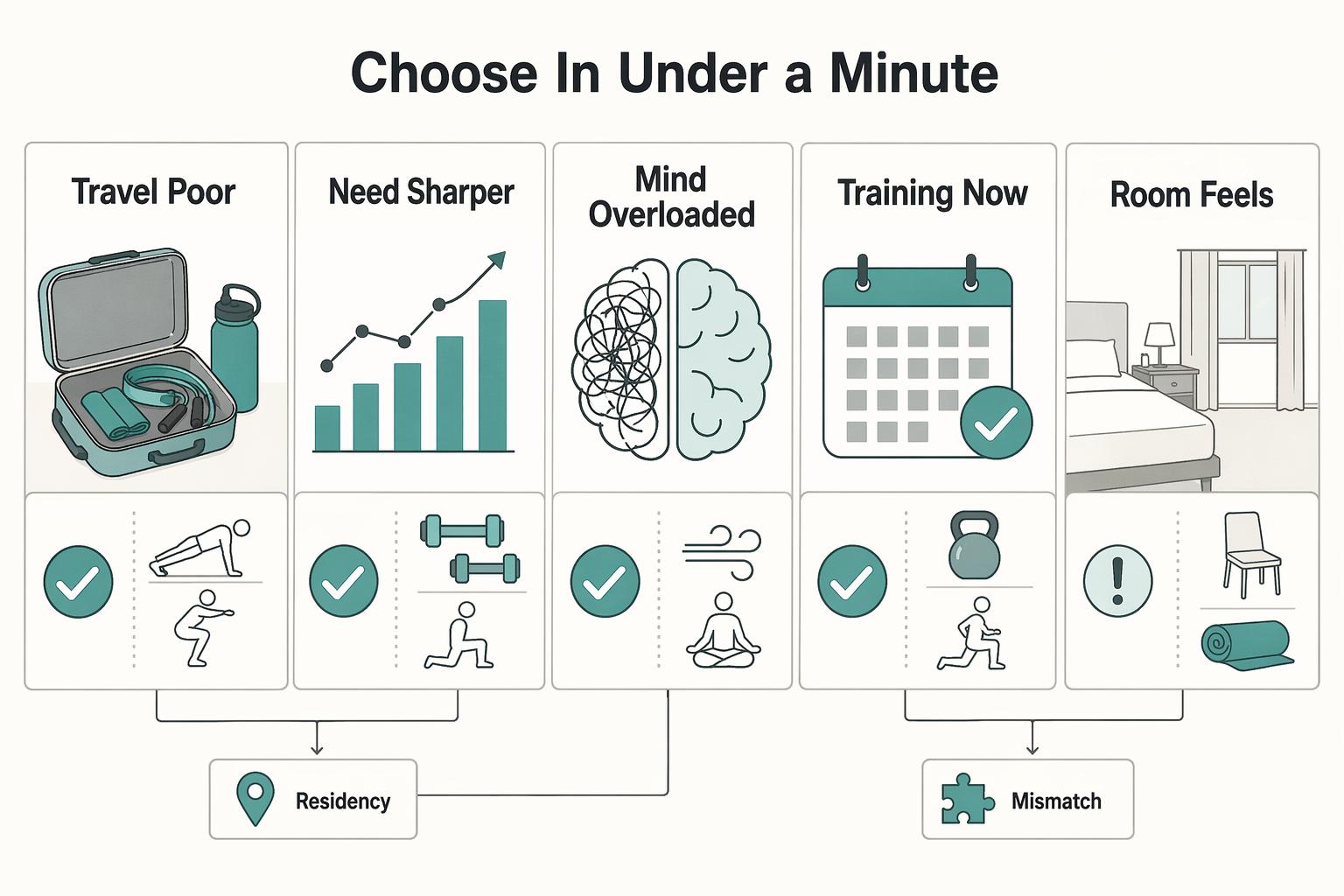
Choose in under a minute#
| Prompt | Action |
|---|---|
| Travel or poor sleep disrupted your rhythm? | Choose Recovery |
| Need sharper function soon for real work? | Choose Focus |
| Mind overloaded, body still trainable? | Choose Resilience |
| Training now may push bedtime later? | Keep today easier, then move the next session earlier |
| Room feels awkward or noisy? | Switch to low-impact floor patterns if sound carries or footing feels risky |
If your schedule collapses, do the smallest version that still matches your state.
For a step-by-step walkthrough, see Digital Nomad Visa vs Tourist Visa for Staying Legal Abroad.
Once you pick your workout decision rules, reduce the next travel variable by checking your destination options in the digital nomad visa cheatsheet.
The Stealth Mode Protocol: Zero-Impact, Zero-Noise Execution#
If you need to train discreetly, treat "zero-noise" as a target, not a guarantee. A practical order is to reduce impact first, then manage how sound travels through the room, then adjust your position relative to other people.
| Order | What to check before minute one | Why it comes first |
|---|---|---|
| 1 | Clear a stable training area and, when possible, set up farther from shared walls or floor zones. | Separation helps limit what reaches others. |
| 2 | Test traction and surface stability (floor, carpet, towel, mat). If anything shifts, stay floor-based and slow. | Unstable footing can increase noise and control loss. |
| 3 | Assume furniture is untrusted until checked on site. Only use support surfaces that feel stable. | Unverified supports can fail and create impact noise. |
| 4 | Add a mat or folded towel only if it improves grip and softens contact. | Path control helps absorb transmitted sound. |
| 5 | Keep your audio low enough to notice outside cues, including emergency vehicles. | Noise control should not remove important awareness. |
| 6 | Slow transitions, especially down to the floor and back up. | Abrupt changes increase impact and startle risk. |
| Higher-impact move | Quieter swap | Main cue | Easier option | Harder low-impact option |
|---|---|---|---|---|
| Burpee | Squat to walkout plank, then stand | Step back and forward, no hop | Hands elevated on a stable surface | Add a push-up in plank |
| High knees | Slow marching knee drive | Lift with control, place foot softly | Smaller range march in place | Add a top pause each rep |
| Jump squat | Slow squat, brief pause, stand | Quiet feet, no rebound | Box squat to a checked stable surface | Longer pause or added reps |
| Mountain climber | Slow knee drive from high plank | Keep hips steady, reduce foot slap | Elevated plank on stable support | Brief hold on each knee drive |
Stay fully low-impact when footing is questionable, sound clearly carries, joints are irritated, or transitions stop being smooth. Reintroduce harder movement only as a personal progression step when the setup stays quiet and stable across sessions. If you need a strict cutoff, set it only after you've verified the room and your ability to keep it quiet and controlled.
After each session, log two checks: quiet and stable. If both are yes, keep this variation or progress one step next time. If either is no, downgrade first.
Conclusion: You Are in Control#
You can stay consistent by using one repeatable decision loop, not by forcing a heroic session. In practice, this means matching today's constraint, running the quietest version you can control, and moving on.
Use the same module logic each time. Choose Recovery when travel, long sitting, or poor sleep leaves you stiff or off rhythm. Choose Focus when you feel usable but flat. Choose Resilience when space and energy are steady. Apply Stealth whenever noise is the limiting factor.
If the choice is unclear, go one level easier and let the room prove it can support more. If footing is slick, space is cluttered, foot contact is loud, or furniture shifts, simplify immediately.
What to do next:
- Pick the module by the constraint most likely to break the session.
- Run the quietest version you can control cleanly in that room.
- Log one short note right after: module, body state, and whether the setup stayed stable and quiet.
Treat that note as the starting point for the next session. If standing work felt unstable, begin floor-based next time. If traction and noise were solid, reuse that setup. Mindset framing may change how exercise is perceived, but the evidence here comes from a small, specific hotel-worker study with a 4-week follow-up, so do not treat it as a guarantee. For a broader next step, read How to Stay Healthy and Fit While Traveling.
You might also find this useful: How to Choose Airline and Hotel Loyalty Programs for a Relocation.
If this trip is turning into a longer stay, build your next-step admin plan with the digital nomad visa planner.
Frequently Asked Questions
What is the single most effective hotel room workout?
Choose the option that matches your main blocker today, not what worked on a different trip. If you are unsure, start with Recovery and keep the session controlled.
How can you work out without disturbing neighbors?
Use controlled, lower-impact bodyweight movements and keep the session in-room when possible. If reps are not both quiet and comfortable, stay floor-based for the full session.
What should you do if travel leaves you drained or out of sync?
Start with Recovery and keep the goal modest, so you keep moving without making your setup or body feel worse. Carry a water bottle and drink consistently through the day as a practical checkpoint you can control. If even light movement feels like too much, take a walking route later instead of forcing a formal session.
Can you build muscle with only in-room workouts?
Use this guide to protect training continuity during travel, not to promise a specific muscle-building result. If the room limits you, keep one or two anchor bodyweight moves consistent and drop complexity before you drop the habit.
What minimal equipment should you pack?
Pack gym clothes and running shoes in the same place every trip, and add a fitness tracker only if you already use one. If those basics are missing, follow-through is much less likely. If you want one extra tool, pack resistance bands because they are lightweight, portable, and suitcase-friendly.
How do you stay consistent when business travel gets chaotic?
Attach your session to a trigger you control, like after check-in, after coffee, or before your shower. If the day still collapses, do a short quiet floor block or a brisk walking loop. If that also fails, skip without drama and restart at the next trigger.
How do you choose right now if energy, local time, and noise constraints are all mixed up?
Choose by the constraint most likely to break the session first. If noise is the blocker, apply Stealth first. If your body feels stiff or off, pick Recovery. If you feel steady, pick Focus or Resilience based on what you can do cleanly at this hour. If it still feels unclear, start with controlled floor work and reassess.
What if you do not want to leave the room at all?
Keep it simple and train in-room with bodyweight work. If standing movement feels cramped or awkward, switch to floor-based work and finish there.
Try a related tool
Researched and edited by the Gruv editorial team. Gruv builds cross-border billing, payouts, and finance-operations software for global businesses.
Sources
- ada.gov/law-and-regs/design-standards/standards-guid...trusted
- alma.edu/wp-content/uploads/2023/07/Academic-Catalog.pdftrusted
- arcadiaca.gov/Document%20Center/Government/City%20Clerk/Ag...trusted
- cedars-sinai.edu/content/dam/cedars-sinai/education/documents...trusted
- cms.gov/Regulations-and-Guidance/Guidance/Manuals/Do...trusted
- dash.harvard.edu/bitstreams/7312037c-7142-6bd4-e053-0100007fd...trusted
- dir.ca.gov/oshsb/documents/Hotel-Housekeeping-Musculosk...trusted
- ecfr.gov/current/title-28/chapter-I/part-36trusted
Educational content only. Not legal, tax, or financial advice.
Related Posts

How Remote Professionals Stay Healthy During Long Stays Abroad
Use this sequence before workload, housing, and travel friction make health tasks harder to execute. If you are traveling for months, treat this as four pass-fail gates. A gate is closed only when you have a written output you can verify.

How to Integrate Calendly with Your Website
Start with a simple three-step launch sequence: choose the embed path that fits the page, lock in your real availability, then validate the booking flow before you publish. That turns a Calendly embed into a client-facing booking process, not just a design element on the page.
The Best At-Home Workout Equipment for a Small Space
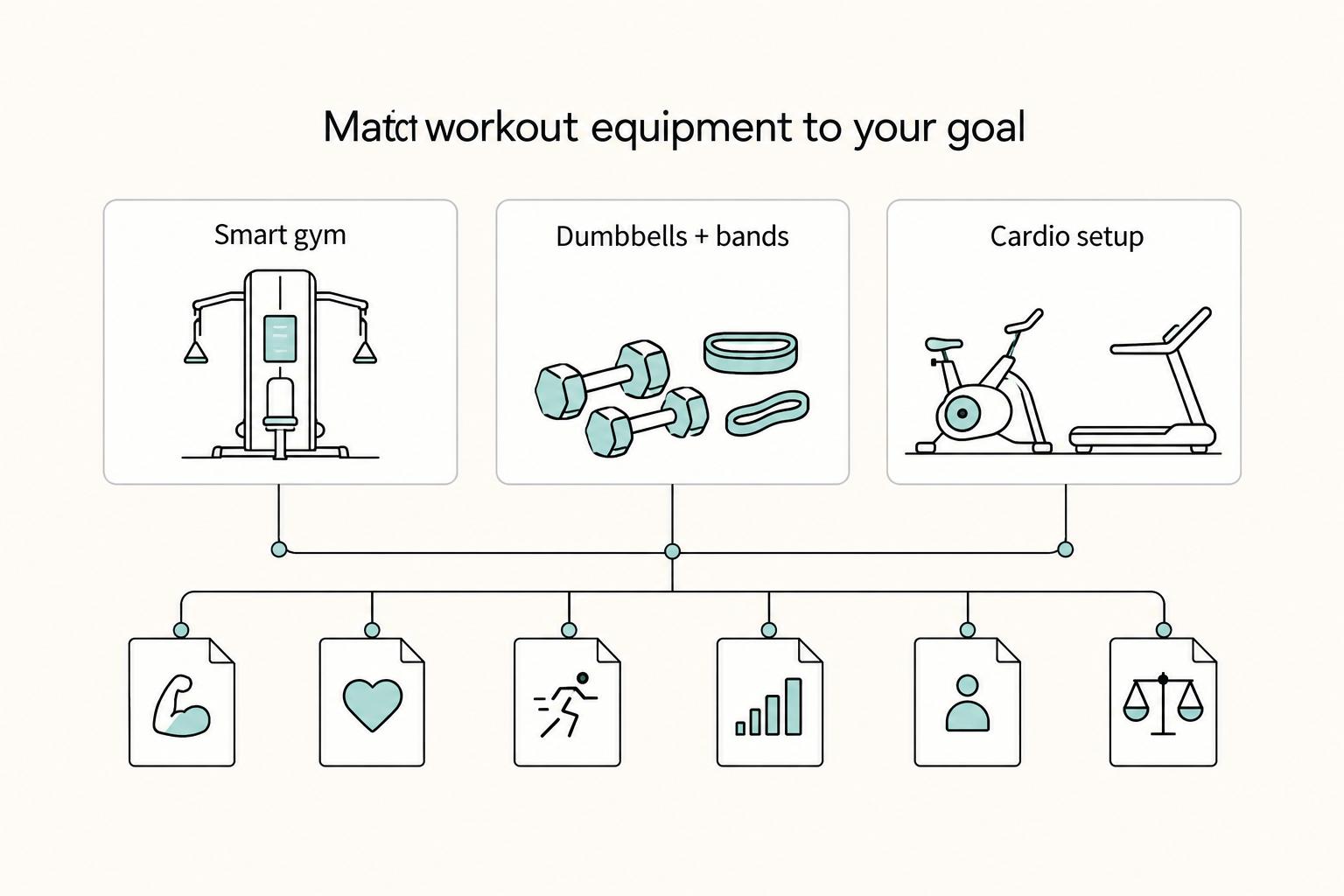
If you're choosing at-home workout equipment for a small space, start with your weekly plan, not a product list. The goal is a setup you'll use consistently so you can work toward the [CDC weekly target](https://www.cdc.gov/physical-activity-basics/guidelines/adults.html): 150 minutes of moderate activity or 75 minutes of vigorous activity, plus 2 days of muscle-strengthening work, without filling your home with low-use gear.