
Quick Answer
Yes. For statute of frauds freelance matters, an email thread can support enforcement when it clearly shows offer, direct acceptance, consideration, and definite terms. Use a written agreement when the project cannot be completed within the governing performance period, when goods meet the applicable UCC threshold, or when copyright ownership is being transferred. In cross-border engagements, specify governing law and keep acceptance records with signed files and payment documentation.
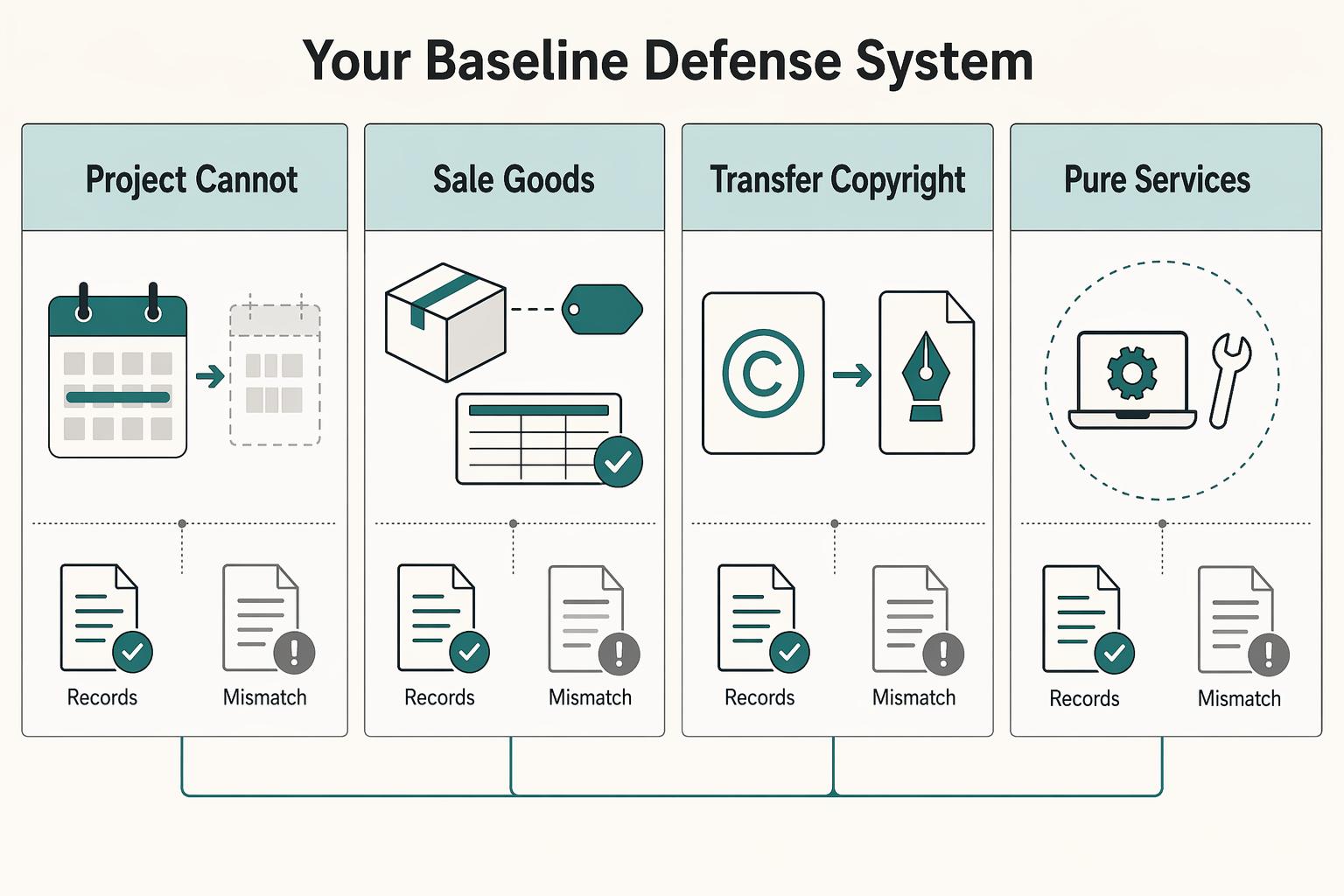
The Statute of Frauds: Your Baseline Defense System#
Use this as your first risk screen: if a deal hits a common trigger, do not rely on a verbal promise. Get a written record before work starts, money changes hands, or rights are transferred.
The basic rule is simple. Some contracts must be in writing and signed to be enforceable. For freelance work, start with three checks. Can this deal be fully performed within the governing law's trigger period, often one year? Is this a sale of goods at or above the applicable UCC threshold, commonly $500, rather than a pure services engagement? Are you transferring copyright ownership instead of only granting a license?
| Deal scenario | Written record likely required | Minimum proof to keep | Common failure point |
|---|---|---|---|
| Project that cannot be completed within the governing law's trigger period (often one year) | Likely yes | Dated agreement or confirmation email with scope, timing, price, and acceptance | Assuming a long verbal retainer is enough because delivery starts later |
| Sale of goods at or above the applicable UCC threshold (commonly $500) under the applicable state version | Likely yes | Writing showing a sale contract was made, signed by the party you may need to enforce against | Treating a mixed services-and-deliverables deal as "just consulting" and ignoring the goods piece |
| Transfer of copyright ownership | Yes | Written transfer language signed by the copyright owner | Delivering files or final assets without a signed assignment |
| Pure services completed quickly with no IP transfer | Maybe not by this doctrine, but still wise | Clear written scope, fee, payment terms, and acceptance | Assuming lower formality means lower dispute risk |
Duration trigger#
If full performance cannot happen within the governing law's trigger period, often one year, treat a writing as mandatory for screening purposes.
Document the start date, end date or milestone schedule, payment timing, and a clear sentence that both sides intend to be bound.
Goods trigger#
For goods deals within UCC scope, assume a writing is required once the relevant threshold is met. Public UCC text is widely adopted but still state-based, so verify the current local threshold before you build it into policy.
Your record should show that a sale contract exists and be signed by the party you may need to enforce against. Include quantity and other key terms where possible; a writing can still qualify even if some terms are missing or incorrect. In merchant-to-merchant confirmations, written objection timing can matter, including a 10-day objection window in UCC text.
IP ownership trigger#
If ownership is being transferred, use signed written transfer language. Delivering source files, designs, or other assets by itself does not transfer copyright ownership.
Spell out whether the deal is an assignment or a license, which assets are covered, and when the transfer takes effect. If transfer is conditioned on full payment, say so directly. Electronic records and signatures can carry legal effect, but electronic form alone does not fix missing terms, unclear assent, or the wrong signer. If you need a stronger contract frame, start from an MSA and tighten the IP clause.
Use this section as a baseline screen, not jurisdiction-specific legal advice. Rules can expand by state and contract type, so confirm governing law before assuming a verbal deal is enforceable.
Related: A Deep Dive into the 'Assignment' Clause in a Freelance Contract.
When an Email Thread Is Enough to Show Contract Formation#
Once you know a deal should be documented, the next question is whether email is enough. It can be, but only if the thread is clear enough to show contract formation without guesswork.
Use email when terms are settled and acceptance is explicit. For significant work, use a written agreement; a signed MSA is often the stronger baseline. Your pre-start test is simple: does the final thread clearly show the core formation points, including offer, acceptance, and consideration?
Use this pre-start checklist#
- Offer: One clear proposal with essential terms in one place, for example scope, timeline, and price or other core terms.
- Acceptance: A direct written yes. Silence or non-response is not valid acceptance.
- Consideration and mutual obligation: Clear value exchange, with you delivering the work and the client paying the agreed amount.
- Confirmed agreement: The thread shows a confirmed offer and acceptance, not unresolved negotiation.
- Essential terms: Key terms are concrete enough to execute, for example price, quality, or quantity as relevant.
If the thread still leaves key terms open to interpretation, the record is too thin. Use the table below as a quick quality check.
| Checkpoint | Weak email thread | Defensible confirmation email |
|---|---|---|
| Offer clarity | Terms are scattered or unclear | One clear message states essential terms |
| Acceptance language | No reply or ambiguous reply | Direct written acceptance of stated terms |
| Consideration | Work or payment obligations are unclear | Value exchange is explicit (work for payment) |
| Final confirmation | No single point confirming the deal | Final thread confirms offer and acceptance |
When to escalate beyond email#
Escalate to a signed MSA and written project terms when the work is significant or when payment, content, or usage disputes are more likely.
What to do after any client call#
Send one final confirmation email that pulls the agreed terms into one place. Ask for explicit written assent before work starts.
Then protect the record:
- Keep the final terms and acceptance in the same thread where possible.
- Make sure essential terms are specific enough for both sides to perform.
- Keep the final written exchange and related files together so the agreement record stays clear.
For statute of frauds purposes, the issue is not "email or contract." It is whether your record is defensible. For a step-by-step walkthrough, see A Guide to the 'Right of First Refusal' in Contracts.
The Cross-Border Shield: Fortifying Your International Agreements#
Cross-border work raises the stakes. A clear written contract is your baseline, not your finish line. Ambiguous verbal agreements can increase non-payment and dispute risk, and enforceability can get more complicated across borders.
Your governing law clause matters, but it works best alongside clear written acceptance and strong records. Make sure the final email thread shows a confirmed offer and acceptance, and keep signed files plus payment records together. That will not remove every dispute, but it can reduce avoidable process fights.
Build one enforceability package, not isolated clauses#
Treat the contract, acceptance trail, and payment records as one package:
| Package element | What it covers |
|---|---|
| Governing law | which law interprets the contract |
| Confirmed offer and acceptance | a clear acceptance record in your final email thread |
| Signature and records trail | signed files, final version history, and timestamps kept together |
| Payment verification records | transaction details checked and retained |
If those pieces do not line up with your invoicing and acceptance trail, enforcement gets harder. Keep the final version, approval record, and timestamps together in one clean file trail.
Choose a forum you would actually use#
If you include a dispute forum, treat it as a practical choice, not a substitute for evidence. The core protection is still a clear written agreement, confirmed offer and acceptance, and complete records.
Use this quick test:
- Is governing law clearly stated in the contract?
- Does your acceptance trail show a confirmed offer and acceptance?
- Can you quickly produce signed files, final versions, timestamps, and payment records?
For larger or ongoing work, consider a signed MSA plus clear work orders.
Contract terms vs invoicing controls#
| Area | Set in the contract | Control in invoicing and records |
|---|---|---|
| Enforceability baseline | Governing law and clear written terms | Keep confirmed offer and acceptance with the final contract record |
| Signature and proof | Confirm what records evidence agreement | Archive signed copies, final acceptance emails, timestamps, and version history |
| Payment execution | Clear payment instructions and responsibilities | Verify transaction details and keep detailed wire/payment records |
| Payment provider choice | Select a provider that fits your workflow | Weigh fees, global reach, and ease of use, and keep exportable records for delays or disputes |
Your cross-border payment discipline should match your contract discipline. For international wire transfers, verify transaction details and keep detailed records.
Risk-control checklist#
| Stage | Action |
|---|---|
| Before kickoff | confirm governing law and document clear written terms |
| At acceptance | keep a final thread that shows confirmed offer and acceptance |
| At payment | verify transaction details and retain wire and remittance records |
| If challenged | preserve the signed agreement, final acceptance thread, invoice set, payment instructions, remittance or wire records, and version history |
You might also find this useful: When a Severability Clause Helps or Hurts a Freelance Contract.
Before you lock cross-border terms, create a clean written baseline for scope, IP transfer, and change handling with the Freelance Contract Generator.
From Defense to Offense: How Strong Contracts Attract High-Value Clients#
Good contract habits do more than reduce downside. They show clients how you operate before the work starts. In practice, clear written terms and a documented offer and acceptance do two things at once: they give you a better record if something goes wrong, and they show clients that your process is stable.
Some prospects treat that structure as friction. Better-fit clients can treat it as professionalism. That is not a legal guarantee, but it can be a useful screening pattern.
| What you see in negotiation | Likely risk profile | Recommended response |
|---|---|---|
| "Let's start now and sort paperwork later." | Higher risk of non-payment and disputes from unclear terms | Pause kickoff until you have a written contract or a clear confirmation email showing offer and acceptance as a baseline record |
| Resistance to clear written scope, revision boundaries, or payment timing | Higher risk of later disputes from ambiguity | Narrow scope, tighten terms, reduce exposure, or walk if essentials stay unconfirmed in writing |
| Careful review of terms with specific questions | Potentially lower process risk and cleaner administration | Proceed after confirming written terms and an acceptance record |
| Comfort with milestones, change requests, and IP timing | Potentially better fit for larger or ongoing engagements | Use a written agreement that clearly captures scope, payment terms, and change handling |
If you are aiming for higher-fee work, make the delivery model explicit: scoped deliverables, revision limits, payment controls, IP ownership timing, and change-order rules. These terms do not guarantee higher pricing, but they can support a more credible fee discussion because the client can see what is included and what is not.
Qualify before kickoff#
Use a simple call framework:
| Framework point | Details |
|---|---|
| Red-flag language | requests to start now and define paperwork, scope, or payment later |
| Must-confirm terms | written scope, offer and acceptance record, payment terms, and governing law for cross-border deals |
| Go/no-go rule | if these points stay vague or unconfirmed in writing, do not start significant work |
Used consistently, written agreements become a practical business asset. They create a reliable record of terms and reduce disputes tied to oral ambiguity. They can also signal professionalism and help screen for better-fit clients over time.
For more on this, see Freelance Liability Clauses That Limit Risk Without Stalling the Deal.
Conclusion: You Are the Architect of Your Certainty#
The through line is simple: if you want enforceability, scope control, payment predictability, and cross-border clarity, set the written record before work starts. Treat contract documentation as part of delivery, not cleanup after the project is already moving.
This is a practical control step, not paperwork for its own sake. If a project cannot possibly be completed within one year, or includes tangible goods priced at $500 or more, a written agreement becomes especially important. For cross-border work, include a governing law clause up front so it is clear which law applies if the relationship breaks down.
| Reactive habit | Process-driven habit |
|---|---|
| Starts work after a call and assumes details are understood | Sends one written agreement or one clear confirmation email with offer, terms, and direct acceptance |
| Handles scope changes informally | Documents scope changes in writing before added work starts |
| Invoices from memory or scattered chat messages | Ties payment timing to documented terms or acceptance points |
| Leaves cross-border legal terms undefined | States governing law before kickoff |
| Threatens termination at the first serious issue | Documents each breach instance and checks whether it is material before escalating termination |
Use one verification rule every time: your file should show who is contracting, who accepted, what was promised, and when acceptance happened. If you use email, keep the full-offer message and the client's clear written acceptance together in one retained record.
Good documentation improves your position, but it does not erase dispute risk. Not every breach supports termination, so preserve evidence first and assess whether the breach is material or minor.
What to do next:
- Use a written contract for significant projects.
- Confirm offer and acceptance in one retained record.
- Add a governing law clause to cross-border deals.
- Document scope, payment terms, and any change approvals before kickoff.
- Store the contract, key emails, and breach notes in one client file.
This process protects your time, reduces avoidable disputes, and supports stronger service delivery through clear documentation. If you want a deeper dive, read Germany Freelance Visa: A Step-by-Step Application Guide. When your contract process is set, connect it to compliant global payment operations and payout visibility with Gruv for Freelancers.
Frequently Asked Questions
Is an email a legally binding contract?
It may be, but treat it as a risk question, not a guarantee. In Illinois, one framework asks whether the written record shows offer, acceptance, consideration, identifiable material terms, and mutual assent. Enforceability still depends on jurisdiction, contract type, and evidence quality. Send one final confirmation email with all final terms and ask for direct written acceptance you can retain.
How does the statute of frauds apply to international work?
There is no single rule that applies across all jurisdictions. For cross-border work, start by clarifying which jurisdiction's law will govern the agreement and get local legal guidance for the contract type. A governing law clause can reduce ambiguity, but it does not cure weak terms or weak evidence. Keep a clean written record of parties, terms, and acceptance.
What key terms must be in a freelance contract to make it enforceable?
There is no universal minimum list that works in every jurisdiction, so use this as a practical baseline and verify local rules. Make sure the record clearly captures both parties' full legal business names, scope that defines what “done” looks like, offer and acceptance, consideration, identifiable material terms, and mutual assent. In Illinois, certain contract types must be in writing under the Statute of Frauds. Effective July 1, 2024, engagements of $500 or more in a 120-day period require a written contract and payment within 30 days of service completion. Compare your template to this checklist, then confirm jurisdiction-specific requirements before relying on it.
Does the UCC $500 rule for “goods” apply to digital products?
Classification of digital products under a $500 “goods” threshold can be jurisdiction-specific and fact-specific. The safer path is to document the deal in writing regardless of classification arguments. Put parties, scope, deliverables, payment terms, and acceptance in one written agreement.
What happens if my client and I only have a verbal agreement?
The biggest risk is proof. Without documentation, proving terms can be nearly impossible, and the risk goes up when scope or payment changes were never captured in writing. Send a same-day recap of terms and get a clear written acceptance reply.
Can a contract be a collection of different messages and emails?
It may be, but fragmented records create avoidable disputes about final terms. If scope, price, or timing changed across messages, you may end up arguing over which message was the final offer and which reply was acceptance. Evidence quality matters as much as legal theory here. Consolidate final terms into one controlling message or document and get a clear written yes.
What if we agree to change the project verbally after the contract is signed?
Verbal changes are a common source of scope and payment disputes because proof gets weaker when changes are not documented. Use a short written change order or email addendum with updated scope, fee, and timing, and wait for written approval before starting.
Try a related tool
Researched and edited by the Gruv editorial team. Gruv builds cross-border billing, payouts, and finance-operations software for global businesses.
Sources
- anti-fraud.ec.europa.eu/document/download/3afa0dfb-65d3-4675-b534-80...trusted
- calbar.ca.gov/Portals/0/documents/admissions/Examinations/...trusted
- copyright.gov/title17/92chap2.htmltrusted
- law.cornell.edu/uscode/text/15/7001trusted
- law.cornell.edu/uscode/text/17/204trusted
- law.lis.virginia.gov/vacode/title11/chapter1/section11-2trusted
Educational content only. Not legal, tax, or financial advice.
Related Posts

Germany Freelance Visa Application Path for Freiberufler and Gewerbe
Choose your track before you collect documents. That first decision determines what your file needs to prove and which label should appear everywhere: `Freiberufler` for liberal-profession services, or `Selbständiger/Gewerbetreibender` for business and trade activity.

Master Service Agreement for Freelancers in Long-Term Client Engagements
If you expect repeat work with the same client, set the contract architecture first: one reusable MSA for standing terms, then project documents for each engagement. The point is not just speed. It is making sure your baseline terms are set before they repeat across future projects. Treat each document as a separate layer:

The Freelance Payment Penalty: A Modeled Audit of Platform Fees, FX Spreads, and Payout Delays
The money rarely disappears through a single, easy-to-spot fee. The real loss is stacked. A marketplace takes its commission, a processor adds a charge for international cards, a bank or payment company converts the currency at a spread, a platform holds the funds before release, and a wire sheds a little to intermediaries on the way in. Each layer looks defensible on its own, but the worker feels the combined result as a smaller deposit and a later payday.