
Quick Answer
Use social proof for freelance website pages as risk evidence, not praise. Organize proof into operational, financial/compliance, and reputational risk so buyers can quickly see what uncertainty is reduced. Then collect and publish assets through a repeatable five-step closeout workflow: request feedback, capture specifics, confirm permission, store approved wording, and publish only that approved version. If a claim cannot be verified, shorten it, anonymize it, or hold it.
Why 'Trust Me' Fails: The Critical Shift from Persuasion to Risk Mitigation#
If your website or proposal asks a buyer to simply believe you, you are asking them to carry the risky part of the decision. A better approach is to treat social proof for freelance website pages as evidence that lowers uncertainty, not as decoration that makes you sound impressive.
That framing matters most when you do not have much of a track record yet. A February 2026 study on online stores found that external social proof signals can reduce skepticism when an entity lacks an established track record. It used a small correlational sample of 50 students, so it should not be stretched into a broad B2B rule. The practical takeaway is simpler than the research language. Proof helps when it lets a cautious buyer answer, "What could go wrong here, and why is this person less likely to cause it?"
Use a working risk lens, not a persuasion lens#
You do not need a grand theory. You need a clean rule for every testimonial, case study, client logo, or result snippet you publish. Before anything goes live, ask:
| Risk | Buyer fear | Proof should mention |
|---|---|---|
| Operational risk | Missed deadlines, vague updates, handoff problems, rework, or needing too much internal supervision | How you communicate, how you manage delivery, and how well you fit into an existing team |
| Financial or compliance risk | Budget drift from unclear scope, work that has to be redone, weak documentation, or careless handling of sensitive information | Clear scope control, reliable delivery, documented decisions, measurable savings, or a careful review process |
| Reputational risk | Hiring you will make the buyer look careless if the engagement goes badly | What changed, how you worked, and why the result felt dependable |
Then ask two quick questions:
- What risk does this reduce?
- What business outcome does this support?
The studies above do not validate a specific freelance risk taxonomy, so treat the three buckets below as a practical checklist.
Operational risk is the fear that you will create friction. That usually means missed deadlines, vague updates, handoff problems, rework, or needing too much internal supervision. Proof that reduces this risk should mention how you communicate, how you manage delivery, and how well you fit into an existing team.
Financial or compliance risk is the fear that your work will create cost, exposure, or cleanup. In freelance engagements, that can mean budget drift from unclear scope, work that has to be redone, weak documentation, or careless handling of sensitive information. Proof here should point to clear scope control, reliable delivery, documented decisions, measurable savings, or a careful review process.
Reputational risk is the fear that hiring you will make the buyer look careless if the engagement goes badly. This is often the hidden one. A manager wants to be able to defend the decision internally. The most useful proof is concrete enough to repeat in a meeting: what changed, how you worked, and why the result felt dependable.
This is where many freelancers get stuck. They publish praise that sounds warm but gives a buyer nothing usable. "Amazing to work with" may be pleasant to read, but it does not help someone justify the spend or protect their own credibility.
Set an evidence standard before you publish anything#
Set the bar before you publish, because polished claims that cannot be checked often make buyers more cautious, not less. A December 2025 scenario study on persuasion and deception showed that persuasive techniques can also be used in misleading ways. The warning for you is straightforward. If a proof asset sounds slick but cannot be verified, it may increase suspicion instead of trust.
A practical fix is to keep a small evidence pack behind each public claim. That can be a client approval email, a dated screenshot, a redacted KPI snapshot, a project summary, or notes showing what was delivered and when. You may never publish those backups, but having them changes how you write. It forces precision.
Use this as a hard checkpoint. If you cannot answer "how do I know this is true?" for a testimonial or result statement, do not put it on your site yet. If a claim is strong but sensitive, shorten it, anonymize it, or move it into a private proposal where you can add context.
| Weak claim pattern | Why it fails buyer review | Stronger proof pattern | Where to use it on-site |
|---|---|---|---|
| "Clients love working with me." | Vague, unverifiable, no business consequence | "Weekly updates, clear next steps, and on-time delivery meant our team did not have to chase progress." | Homepage testimonial strip, services page |
| "I helped lots of brands grow." | Volume is not evidence of fit or outcome | "For a B2B client, I rebuilt the case study page set and gave sales a cleaner asset they could reuse in outreach." | About page, proposal intro |
| "I'm detail-oriented and professional." | Self-description is the weakest form of proof | "Project files were organized, approvals were documented, and revisions stayed inside the agreed scope." | Proposal, process page |
| "I get results fast." | "Results" and "fast" mean nothing without context | "The first deliverable was approved with minor edits, which kept the launch date intact." | Case study, sales page |
In practice, the safer bet often beats the more charismatic pitch. Your job is not to sound more convincing than everyone else. It is to make the buyer feel that choosing you is easier to defend, easier to manage, and less likely to create regret.
Once that standard is clear, the next step is to build a repeatable way to collect proof, including material you can still use when client names or details cannot be shared publicly.
If you want a deeper dive, read GDPR for Freelancers: A Step-by-Step Compliance Checklist for EU Clients.
How to Build Your Arsenal: Securing High-Impact Proof (Even Under NDA)#
Treat proof capture as part of project closeout, not a marketing task you leave for later. Run one repeatable workflow after each project so you publish only claims you can support and have approved.
Run this five-step workflow after every project#
Trigger it when the final deliverable, or a major milestone, is approved.
- Request feedback.
- Capture usable proof.
- Confirm publish permission.
- Store the approved version in one proof library.
- Publish only from that approved version.
Use short scripts so this stays easy to run every time:
- Request script: "Now that the project is wrapped, I'm documenting outcomes and what worked well in delivery. Could you share 3-5 sentences on the result, the working process, and anything you're comfortable with me sharing publicly?"
- Follow-up script: "Quick bump in case this got buried. Even brief notes help. If easier, I can draft a short version for your approval."
- Internal checklist: outcome captured; process-quality detail captured; source document saved; permission status marked (
yes/no/private only); final wording approved or pending.
Keep a small evidence pack per asset: client note/email, your draft excerpt, approved edits, and a dated supporting file (for example, a project summary). Then keep the library tight: collect only what you need and store it in one well-defined location.
Ask for proof that answers buyer risk#
Generic praise is rarely usable. Ask for specifics tied to the risk your buyer is managing.
- Operational risk: "What about communication, deadlines, or revisions made this easier to run?"
- Financial/compliance risk: "Did this reduce rework, delays, confusion, or avoidable cost? What changed?"
- Reputational risk: "If you had to explain internally why hiring me worked, what would you point to?"
If feedback comes back vague, send one clarifier: "Would you be comfortable adding one concrete example?"
| Situation | Weak version | Stronger version |
|---|---|---|
| Feedback request | "Can you write me a testimonial?" | "Could you share a few lines on the result, how the project felt to manage, and what you're comfortable publishing?" |
| Proof asset | "She was amazing." | "Weekly updates, clear revision rounds, and organized files meant our team did not have to chase progress." |
| NDA phrasing | "Built growth strategy for Client X with internal KPI dashboard screenshots." | "Supported a B2B software team with a messaging and case-study refresh; public version excludes internal tools, screenshots, and client identifiers." |
Use an NDA decision tree before anything is published#
| Condition | Public action |
|---|---|
| Name, logo, quote, or results are explicitly approved for public use | Publish only the approved wording |
| The work can be shared without identifying the client | Anonymize and remove identifying context |
| Details expose internal strategy, payment information, security posture, or protected identity information | Exclude them from public proof |
Add this line to your internal process: "Add approval requirement after legal verification." Anonymization can help, but it is not an automatic publish green light.
When client-specific proof is limited, prioritize third-party proof in this order: credentials tied to your service, vetted speaking appearances with clear organizer/topic, then independent mentions that match what you actually sell.
You might also find this useful: How to use the 'StoryBrand' framework for your freelance website.
The Deployment Matrix: Mapping Your Arsenal to the Client Journey#
Use your proof by buyer stage, not just by topic. A page can rank and still produce little pipeline if your proof stays top-of-funnel when the buyer is already comparing options.
| Stage | Buyer question you must resolve | Buyer risk at this stage | Best proof format | Placement channel | Action you want next | Common misstep |
|---|---|---|---|---|---|---|
| Stage 1: Awareness | "Is this person credible enough to keep reading?" | Spending time on someone unproven | Fast, scannable signals: approved logos, verified metrics, relevant credentials, vetted speaking/publication mentions, short approved quote fragments | Home page, service page, LinkedIn or portfolio profile | Click deeper, request details, book a call | Vague praise, guessed numbers, or claims you cannot verify |
| Stage 2: Consideration | "Are they a fit for my situation?" | Choosing examples that do not match the real problem | One to two relevant case studies plus testimonials tied to the same problem type | Proposal, pitch deck, follow-up after discovery | Reply, shortlist, ask scope questions | Using your "best" proof instead of the most relevant proof |
| Stage 3: Decision | "Will this be safe and manageable to execute?" | Delays from unclear process, ownership, or handoff | Process proof: communication expectations, approval flow, revision handling, handoff clarity | Final call, pre-signing summary, onboarding outline | Sign with fewer execution objections | Talking only about outcomes and leaving delivery mechanics unclear |
Stage 1. Lead with proof the buyer can scan in seconds#
At the awareness stage, lead with proof the buyer can scan and trust in seconds. If logos are not approved, do not replace them with hype; use only approved alternatives such as a verified metric, a relevant credential, a vetted mention, or an anonymized result line. If verification is pending, use a clear placeholder: "Add current verified metric after review."
Stage 2. Check each case study for relevance before adding it#
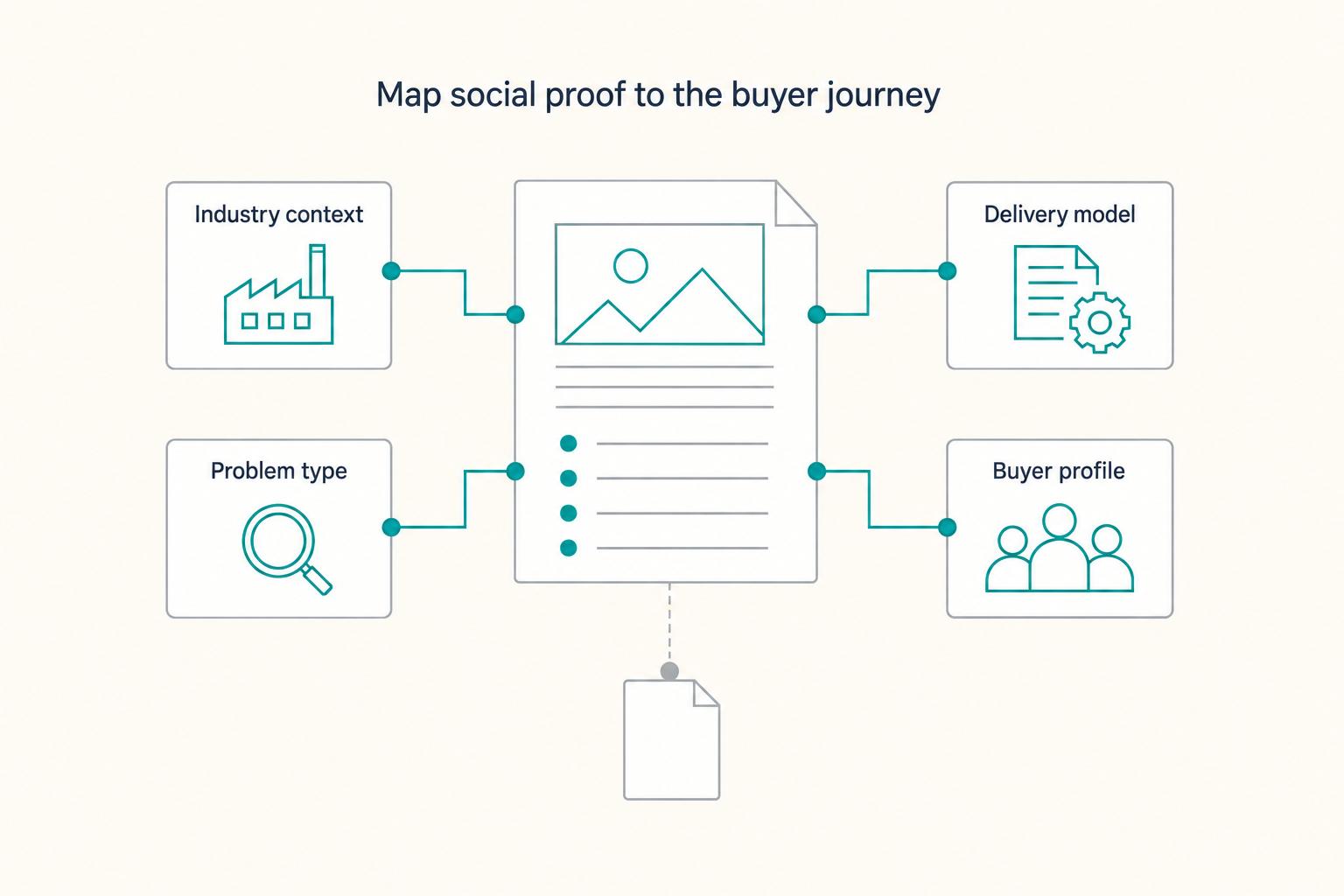
In proposals, relevance beats prestige. Before you add any case study or testimonial, check:
| Check | What to verify |
|---|---|
| Industry context | Does this match the buyer's market or operating environment? |
| Problem type | Does it address the same friction named in discovery? |
| Delivery model | Was the work delivered in a similar format (advisory, retained, or project-based)? |
| Buyer profile | If this reader is closer to budget approval, does your proof address ROI, competitive risk, and strategic fit? |
Stage 3. Show how the work will run before signature#
At the decision stage, reduce execution risk by showing how the work will run, not just what outcomes you can promise. Use a short pre-signing confidence pack with four items: communication cadence, approval ownership, revision path, and handoff structure. Keep it simple and specific so the buyer can see fewer unknowns before signature.
Once you map proof this way, the next questions are implementation details: how much proof to show, what to do when proof is thin, and how to handle approvals. That is where the FAQ helps. Related: A Guide to Using Case Studies to Win Freelance Clients.
Conclusion: Stop Collecting Praise, Start Building Your Case#
Your goal is not to sound more persuasive. It is to make the buying decision feel less risky. That shift matters because you can still lose work, even when your offer and pricing are solid, if another option looks more proven.
By now, you should have the core pieces. You have a way to collect proof on purpose, an approval-safe approach when names and logos are off limits, and a method for placing evidence where it helps most. The strongest proof is still the most specific: actual numbers when approved, before-and-after context, and a client quote when you have permission to use it. If you cannot publish those yet, use a clear placeholder such as "Add verified result after review" and keep moving.
Just as important, do not isolate proof on one testimonials page and call it done. Credibility is shaped across the whole site, and the same evidence can support sales calls, follow-up emails, landing pages, and message replies. Watch for the obvious failure mode. Weak praise, inflated claims, or anything that feels manipulated can damage trust rather than build it.
Use this short checklist next:
- Audit your current proof assets: testimonials, case notes, review screenshots, logos, outcome claims.
- Flag weak claims: vague praise, unsupported numbers, missing approval, unclear attribution.
- Gather the missing evidence: outcome metrics, before-and-after details, process feedback, approved wording.
- Place proof by journey stage: broad trust signals early, deeper case studies in consideration, process and reliability proof near the decision.
Publish only what is approved, verifiable, and still accurate. Treat proof on your freelance site as an operating process, not a one-time content update.
For a step-by-step walkthrough, see How to Create an FAQ Page for Your Freelance Website. Want to confirm what's supported for your specific situation? Talk to Gruv.
Frequently Asked Questions
How do you show proof if an NDA blocks names and logos?
If an NDA limits what you can show, shift from who the client was to what problem you solved and how the work felt to manage. Use case notes without identifying details, process-focused testimonials, and placeholders such as “Add verified outcome metric” or “Add approved client wording after review.” Before you publish anything, confirm which details and wording are approved to share.
What should you ask for in a testimonial?
Keep it tight and use the strongest prompt structure: What, Why, and How. Ask what problem the client had, why it mattered, and how your work changed the result or experience. Vague praise like “great to work with” sounds pleasant but tells a buyer almost nothing.
What if you cannot use client logos at all?
You can still build trust with specific context and approved customer-created proof. Use industry descriptors, role-based attribution, review or post excerpts if approved, and short outcome lines with placeholders until you verify them. That often feels more credible than unsupported self-claims.
How should you quantify results when the client did not hand you a number?
Use verified information first. If hard numbers are unavailable, describe the felt change clearly instead of inventing precision. | Impact type | Evidence source | Simple calculation method | Best placement | | --- | --- | --- | --- | | Quantified outcome | Approved report, recap, or analytics snapshot | Compare a clearly defined before/after period using only verified numbers | Case study, proposal | | Non-quantified outcome | Approved testimonial or client feedback | Use a specific felt-change statement and Add verified outcome metric as a placeholder | Service page, proposal | | Mixed evidence | Partial numbers plus approved wording | Pair one verified data point with Add approved client wording after review | Decision-stage summary |
What counts as implied proof, and when is it enough?
Think of implied proof as credibility signals around the work, not direct praise about it: detailed project context, approved review excerpts, or customer-created mentions. It helps when direct testimonials are thin, but it still needs to be specific and verified. Apply this approach on your site, in proposals, and in decision-stage materials.
Try a related tool
Researched and edited by the Gruv editorial team. Gruv builds cross-border billing, payouts, and finance-operations software for global businesses.
Sources
Includes 5 external sources outside the trusted-domain allowlist.
- dukespace.lib.duke.edu/bitstreams/c77a95ef-3cae-45d1-84ab-7e9d0eab2...trusted
- getty.edu/publications/conserving-canvas/_assets/downl...trusted
- repository.upenn.edu/bitstreams/c08112ac-d50a-4798-893a-cfe5d0568...trusted
- beingfreelance.com/season-20/case-study-buddy-joel-klettkeexternal
- benny.ghost.io/blog/membership-social-proof-marketing-exampleexternal
- blog.hubspot.com/service/psychology-social-proofexternal
- curator.io/blog/social-proof-examplesexternal
- dreyfus.fr/en/author/nathalie-dreyfusdreyfus-fr/page/3external
Educational content only. Not legal, tax, or financial advice.
Related Posts

GDPR Compliance Checklist for Freelancers Working With EU Clients
Start by separating the decisions you are actually making. For a workable **GDPR setup**, run three distinct tracks and record each one in writing before the first invoice goes out: VAT treatment, GDPR scope and role, and daily privacy operations.

Use Case Studies to Win Better-Fit Freelance Clients
The point of case studies is not to sound impressive. It is to help a buyer approve you faster by lowering the risk they feel when hiring an outside specialist. When your proof is vague, scattered, or hard to verify, clients often default to someone whose work feels easier to trust.

The Freelance Payment Penalty: A Modeled Audit of Platform Fees, FX Spreads, and Payout Delays
The money rarely disappears through a single, easy-to-spot fee. The real loss is stacked. A marketplace takes its commission, a processor adds a charge for international cards, a bank or payment company converts the currency at a spread, a platform holds the funds before release, and a wire sheds a little to intermediaries on the way in. Each layer looks defensible on its own, but the worker feels the combined result as a smaller deposit and a later payday.