
Quick Answer
Start by structuring each engagement so legal terms live in an MSA and project commitments live in an SOW, then document every change before doing extra work. In small business litigation, outcomes often depend on what you can produce, so keep one complete record of approvals, deliverables, invoices, and payment status. If conflict escalates, use your contract’s dispute sequence and track deadlines early rather than negotiating without a process.
Set the Contract Terms That Reduce Avoidable Disputes#
If you want to reduce avoidable disputes, separate the relationship terms from the project terms. Use an MSA for the standing legal framework and an SOW for the specific work.
A Master Service Agreement (MSA) is the umbrella contract for an ongoing relationship. A Statement of Work (SOW) defines the project details and becomes the practical yardstick for whether the work was delivered as agreed. Put durable legal terms in the MSA. Put live project facts in the SOW: deliverables, timeline, fees, assumptions, and acceptance steps.
Do not assume one document will automatically control if the two conflict. Add a hierarchy clause that says which document governs.
Build around two documents#
Your MSA should cover the terms that repeat across projects: payment obligations, ownership timing, governing law, dispute forum, notice mechanics, and termination. Your SOW should be specific enough that an outside reviewer can tell whether performance met the contract.
Vague language creates room for argument. Concrete deliverables, revision limits, response deadlines, and named approvers leave less room.
Before you sign, confirm the basics that often create enforcement problems later. Check the correct legal entity name, signer authority, the billing entity and invoice contact, and the contract notice address.
Clauses that help prevent fights#
| Clause | Problem it prevents | What to include | What goes wrong if missing |
|---|---|---|---|
| Scope and deliverables | "We thought this was included" disputes | Specific deliverables, exclusions, assumptions, client dependencies, revision limits, acceptance method | Scope creep gets reframed as your original obligation |
| Approval and change process | Informal expansion and endless edits | Named approver, approval deadline, written change-order requirement, fee/timeline impact before extra work starts | Messages and calls get treated as binding scope changes |
| Payment obligations | Late payment and invoice disputes | Deposit requirement, invoice schedule, due date trigger, payment method, stop-work right, taxes/withholding handling | You deliver first and argue later about timing, deductions, or fees |
| Ownership transfer | IP handoff disputes | Pre-existing IP, final work product definition, transfer timing, any pre-payment license | Client may claim ownership before final payment clears |
| Governing law and forum | Venue and procedure fights before merits | Choice of law, court forum or arbitration clause, language, notice mechanics | You spend time and money fighting where the case belongs first |
| Termination | Mid-project cancellation disputes | Termination rights, payment for work performed, treatment of reserved time, return of materials | Project stops and payment obligations become contested |
Governing law determines which law applies to a dispute, and forum selection strongly influences where the dispute is heard. Courts generally honor governing-law clauses, and forum clauses can control unless exceptional circumstances apply. If you leave both open, you increase the chance of an early procedural fight before anyone reaches the merits.
If a case proceeds in U.S. federal court, discovery is broad but still limited by relevance, privilege, and proportionality. Default limits matter for planning and cost exposure. Depositions are generally limited to 1 day of 7 hours, and interrogatories are generally capped at 25.
Cross-border checks before you sign#
Cross-border deals need a few extra checks up front because uncertainty gets expensive fast.
| Check | What to confirm |
|---|---|
| Jurisdiction and forum | Choose governing law and dispute forum explicitly. |
| Service and notice mechanics | Separate contract notice rules from formal service of process. If Hague Service Convention channels are relevant, account for Central Authority routing and required forms. |
| ADR drafting | If using arbitration, define seat, rules, language, and notice mechanics in writing. |
| Currency, tax, and payment friction | State invoice currency, transfer-fee allocation, tax treatment, and required payer paperwork, for example, a requested Form W-8BEN. |
Payment terms that lower risk#
Payment terms are one of your cleanest risk controls, not just a billing detail. In practice:
- Collect an upfront deposit before scheduling work.
- Set a clear due date tied to invoice date or milestone acceptance.
- Keep a contractual stop-work right for overdue invoices, based on the grace period in your agreement.
- Add late charges, interest, withholding treatment, and collection-cost language only after local-law review.
Tie final delivery and ownership transfer to cleared final payment. Keep one complete file with the signed MSA, active SOW, change orders, invoices, delivery evidence, and written approvals. If a dispute does arise, that record makes resolution much easier.
Before you send your next proposal, build your baseline terms and scope in one place with the Freelance Contract Generator.
Your Operational Shield: Turning Daily Work into an Unbreakable Defense#
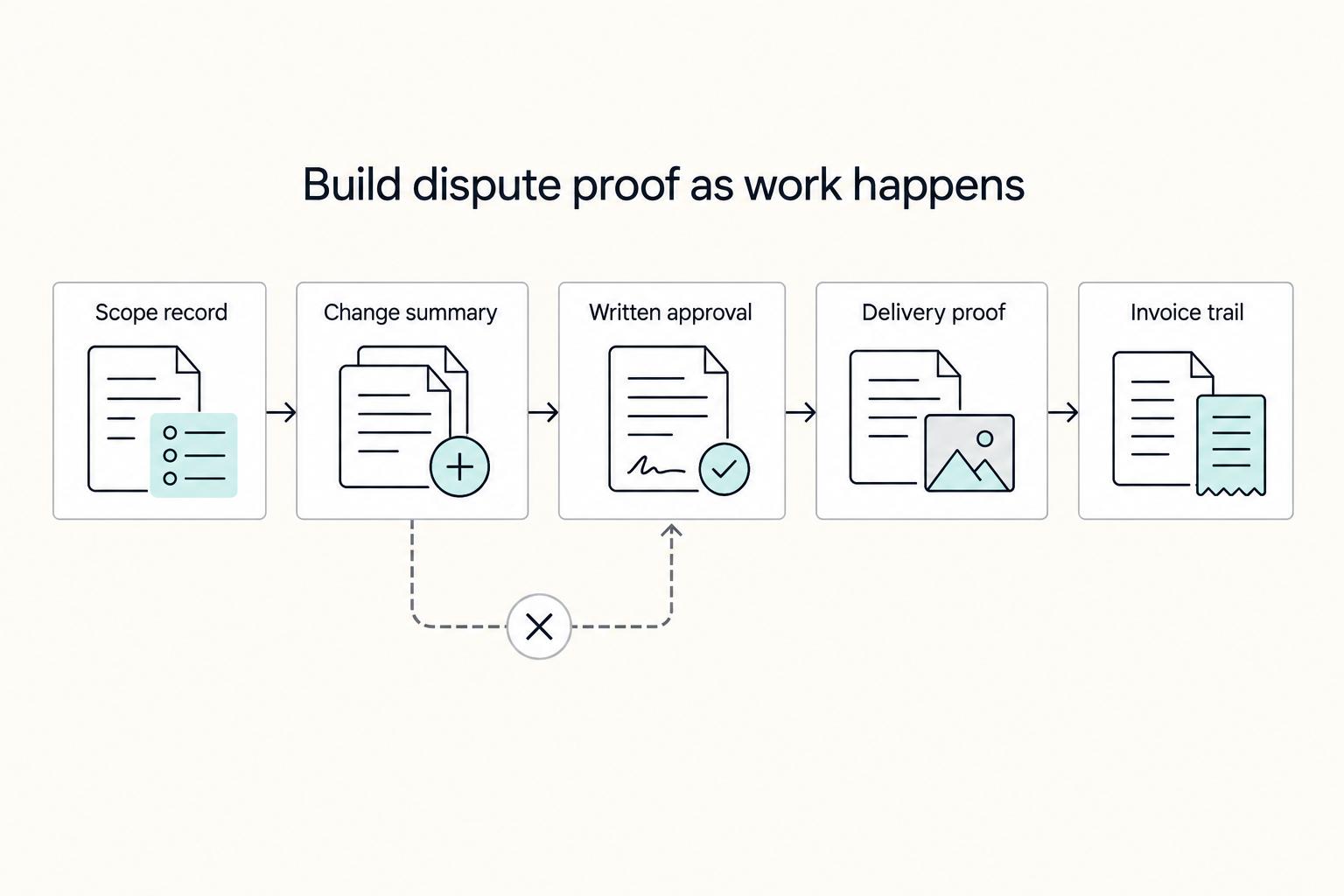
A solid contract sets expectations, but your day-to-day operations usually decide how defensible your position will be if a client challenge appears. In practice, the real dispute question is often simple: what can you show was requested, approved, delivered, and paid?
Build evidence while the work is happening#
Build the record while the work is live. If you wait until conflict starts, you are reconstructing facts from memory. Focus on the items most likely to be disputed later: what was requested, approved, revised, delivered, and paid. A repeatable habit here does more for you than a perfect clause nobody follows.
Use a consistent evidence routine:
- Send a same-day recap after substantive calls with decisions, owner, deadline, and open items.
- Capture approvals in writing, even when the discussion happened live.
- Keep dated versions or tracked revisions so you can show what changed and when.
- Store the contract set, recaps, approvals, invoices, and delivery records in one client matter folder.
| Common failure | Safer replacement habit |
|---|---|
| Verbal "go ahead" only | Written approval before added work starts |
| Decisions scattered across chat/email/apps | One approved channel plus recap stored in the matter folder |
| Files overwritten with no history | Dated versions or tracked revisions |
| "Quick extra" done informally | Treat as scope change with written pricing/timeline approval |
Handle records carefully too. Project files can include customer information, employee records, and transactional archives, and one handling mistake can create penalties or damages. U.S. federal data-privacy lawsuits reportedly doubled from 2020 to 2024, so data handling and access controls should sit inside your dispute-prevention process. Regulatory text can change quickly, so check current requirements before you rely on old compliance assumptions.
Use a repeatable scope-change response#
Scope disputes often start with an unrecorded "small" request. Use the same response every time scope moves.
- Trigger condition
New deliverable, extra revision cycle, faster timeline, additional stakeholder group, or any request outside signed SOW assumptions.
- Response template
"Happy to do that. I'll send a short addendum confirming scope plus any fee or timeline impact for approval before I begin."
- Suggested addendum fields
Reference to original SOW, changed work description, fee impact, timeline impact, dependency changes, and approval line or reply instruction.
- Stop-work rule
If your contract includes a stop-work right, pause added work until written approval is in place.
Before you start the changed work, make sure the approved addendum and the active project files match. Misalignment there is an easy way to create later conflict.
Close the file like you expect questions later#
A disciplined closeout can lower the odds that a routine disagreement turns into a formal dispute later. Before you mark the project complete, finalize:
- Final acceptance record
- Deliverable handoff log, including what was sent, when, and to whom
- Invoice reconciliation against the SOW and approved addenda
- IP transfer confirmation based on your contract's payment terms
Then create a dispute-ready archive in one location. Include the signed MSA, active SOW, addenda, meeting recaps, approvals, final deliverables, handoff log, invoice trail, and proof of payment or outstanding balance. That can make dispute resolution faster and keep the facts clear if questions come up later.
Related: A Guide to Choosing and Working with a Small Business Lawyer.
Move the Dispute Into Writing and Follow Your Contract's Path#
When conflict appears, slow it down, move it into writing, and follow the dispute path your contract already sets. That is how you reduce the odds that a tense project turns into litigation.
Use your first response window well#
Your first response should acknowledge the issue and anchor the discussion to the record. Even if the complaint came by call or chat, reply in writing before you discuss remedies. Use this sequence for that first written response:
- Acknowledge
Confirm you received the concern and are reviewing it.
- Empathize
Recognize the business impact without admitting fault.
- Clarify
Ask which deliverable, deadline, or invoice is disputed, and tie the discussion to the signed SOW, approved changes, and acceptance record.
- Set next step
Give a short review window and list what you will verify.
A simple template:
Thanks for raising this. I understand why this is frustrating. I'm reviewing the signed SOW, approved changes, delivery record, and invoice status now. Please reply with the specific deliverable or requirement you believe was missed so I can address it against the agreed scope.
Before you propose any fix, verify four items in your matter folder: the current SOW, addenda, the latest approved work version, and payment status.
Escalate by clause, not emotion#
Once one exchange does not resolve the issue, stop improvising. Escalate in the order your contract requires. Some agreements and model clauses use direct discussion, then mediation, then arbitration, and clear wording matters because ambiguity can delay resolution.
Follow a scoped path:
- Informal resolution
Try to resolve the issue directly using the documented project record.
- Documented cure request
State the disputed item, the contract section or deliverable involved, the supporting records, and the action requested. Do not invent a cure deadline unless your contract provides one.
- Mediation trigger
If your clause calls for it, initiate mediation. It is a voluntary, confidential process led by a neutral mediator to help both sides reach agreement.
- Arbitration trigger
If unresolved claims must be arbitrated under your clause, move there rather than continuing open-ended negotiation.
- Counsel handoff
Handoff should follow procedural posture, not frustration. If you are served with a complaint, escalate immediately. In U.S. federal court, filing and service start the case, scheduling deadlines can begin early, discovery requires evidence exchange, and depositions can run up to one day of seven hours unless otherwise ordered or stipulated.
Choose the forum with your eyes open#
The right forum depends on which risk matters most to you: privacy, enforceability, cost control, or preserving the relationship.
| Option | Privacy | Timeline control | Cost predictability | Cross-border enforceability | Relationship impact |
|---|---|---|---|---|---|
| Mediation | Usually confidential | Often high, since it is voluntary and scheduled by the parties | Can be easier to scope by session and prep | Depends on settlement terms and local enforcement route | Often least adversarial |
| Arbitration | More private than court, but not fully sealed if an award is challenged or enforced in court | Moderate, and clause design can set time/cost controls (for example, number of arbitrators) | Can be more predictable when clause scope is clear | Stronger cross-border position under the New York Convention framework | Can be more adversarial than mediation |
| Court litigation | Generally public, with broad federal-record access through PACER | Low, because court controls the calendar | Can become less predictable once motions, discovery, and depositions expand | May be more complex across jurisdictions than arbitral awards | Can be hard on the relationship |
If cross-border enforceability is your main risk, arbitration may have the edge. If privacy and business continuity matter most, start with mediation when your contract allows it.
Exit cleanly when trust is gone#
When the relationship is no longer workable, a controlled offboarding process matters more than one last argument. Use a clean sequence:
- Send contract-required notice.
- Deliver only paid work per the agreement.
- Issue final accounting.
- Revoke access to shared tools and accounts.
- Archive a dispute-ready file with the signed agreement, approvals, delivery proof, invoices, payment records, and key communications.
Before you revoke access, export shared-drive contents, access logs, and key message threads.
Set the Dispute Path, Build Proof, Calendar the Escalation#
You do not need to guess your way through a client dispute. You need three repeatable habits: set the dispute path in the contract, create usable proof while the work is active, and treat escalation as a calendar-driven process instead of a panic event.
Set the dispute path early (prevents process fights)#
Before work starts, make sure your agreement states where disputes are handled, how notice must be given, whether mediation is part of the process, and how termination works. That reduces avoidable conflict about procedure before anyone reaches the underlying facts. If conflict grows, you will have a signed contract, a current SOW, written change approvals, and a notice clause you can point to.
Build proof as you deliver (creates evidence you can produce)#
Disputes usually turn on whether you can show scope, approval, delivery, and invoicing in a clear sequence. After any scope change, send a short written summary of the scope, timeline impact, and fee impact, then wait for written approval before doing the added work.
The common mistake is doing extra work first and pricing it later. If the matter reaches formal discovery, Rule 26 initial disclosures and Rule 34 document requests can require production of the emails, files, and messages you rely on.
| Area | Reactive behavior | Defensible behavior |
|---|---|---|
| Contract setup | Starts work on vague terms | Signed agreement with forum, notice, scope, termination, and ADR terms |
| Project execution | Accepts verbal changes | Confirms changes and approvals in writing |
| Payment friction | Chases late payment informally | Sends invoice, reminder, notice, and preserves delivery proof |
| Dispute response | Argues facts from memory | Builds chronology, preserves records, and checks deadlines |
Run escalation by calendar (helps you respond under pressure)#
If you are served with a federal complaint, the case starts with filing and service, not trial. The standard answer deadline is 21 days after service under Rule 12. If service is waived, the response window can be 60 days, or 90 days if you are outside a U.S. judicial district. This is when your evidence pack matters most: the signed contract, SOW, approvals, invoices, delivery records, and a dated timeline.
| Scenario | Timing | Article detail |
|---|---|---|
| Served with a federal complaint | 21 days after service | The standard answer deadline is 21 days after service under Rule 12. |
| Service is waived | 60 days | The response window can be 60 days. |
| Outside a U.S. judicial district after waiver | 90 days | The response window can be 90 days. |
Use this routine on every engagement:
- Before kickoff, confirm the dispute clause, notice method, and termination steps.
- During delivery, document approvals, changes, and delivery proof in real time.
- At the first payment or performance issue, send a factual written notice and preserve records.
- If formal papers arrive, calendar deadlines immediately, preserve relevant records, and involve counsel early.
If you want a compliance-first payment workflow with clearer records before disputes escalate, talk with Gruv.
Frequently Asked Questions
What claim most often pulls a freelancer or consultant into small business litigation?
Many disputes begin as breach of contract claims: one side says the other did not perform required obligations without legal justification. For you, that can show up as nonpayment, scope disagreements, or arguments about whether a deliverable met the agreed requirement. Small issues can escalate quickly when terms or records are unclear. Start by collecting all records related to the dispute, including your signed agreement, current SOW, written approvals, delivery proof, invoices, and key message history in one folder.
Which contract clauses matter most if you want fewer disputes?
The clauses that matter most are the ones that remove ambiguity about where disputes are handled, how scope changes are approved, how termination works, and when key obligations are complete. They will not prevent every conflict, but they do reduce avoidable mistakes caused by unclear contract language. Next step: review your agreement and flag anything unclear on notice steps, approval requirements, dispute path, and exit process.
How do you reduce risk when the client is in another country?
Set the dispute framework before work starts, because contract enforceability and process can be jurisdiction-specific. Cross-border conflict can get harder to resolve when neither side can show which rules apply or where the dispute should be handled. Confirm that your contract states governing law, forum, notice method, and whether mediation or arbitration is required, then verify local enforceability with counsel where needed.
Is mediation or arbitration better than court?
Mediation is typically voluntary and non-binding, with a neutral mediator helping both sides try to settle. Arbitration is a private adjudication process where an arbitrator issues a final, binding decision. Either can be faster, more private, or lower cost than court in some cases, but that is not guaranteed in every jurisdiction or fact pattern. Read your dispute clause and confirm whether mediation is optional, arbitration is mandatory, or both apply in sequence. For a deeper breakdown, see our mediation guide.
What is the safest way to handle scope creep before it turns into a legal fight?
Treat new requests as out of scope until they are documented against the current SOW and approved in writing. One avoidable failure mode is doing extra work first and debating scope, timing, and payment afterward. Send a short written change summary with the impact on timeline and fees, and proceed only after written approval is on record.
Can you legally end the engagement with a difficult client?
In many cases, yes, but the safest path is to follow the contract’s termination process exactly. Notice, cure rights, final delivery duties, and payment treatment can vary by agreement and jurisdiction, so improvising can increase your risk. Issue contract-compliant notice, complete required paid deliverables, send final accounting, and preserve records before closing access.
What should you expect if the dispute moves into a formal case?
Expect tighter deadlines, heavier documentation, and less informal back-and-forth. A case can run from several months to a year or several years, and discovery commonly includes written requests plus depositions where testimony is under oath. Preserve all dispute-related records immediately, stop routine deletion of relevant files or messages, and prepare a clean chronology for counsel.
Try a related tool
Researched and edited by the Gruv editorial team. Gruv builds cross-border billing, payouts, and finance-operations software for global businesses.
Sources
- congress.gov/crs_external_products/IF/HTML/IF11246.web.htmltrusted
- ecfr.gov/current/title-40/chapter-I/subchapter-J/part...trusted
- fac.gov/assets/compliance/2023-Compliance-Supplement...trusted
- irs.gov/forms-pubs/about-form-w-8-bentrusted
- irs.gov/individuals/international-taxpayers/withhold...trusted
- law.cornell.edu/rules/frcp/rule_30trusted
- law.cornell.edu/rules/frcp/rule_26trusted
- oregon.gov/das/Procurement/Guiddoc/SOWWritingGuide.pdftrusted
Educational content only. Not legal, tax, or financial advice.
Related Posts

Germany Freelance Visa Application Path for Freiberufler and Gewerbe
Choose your track before you collect documents. That first decision determines what your file needs to prove and which label should appear everywhere: `Freiberufler` for liberal-profession services, or `Selbständiger/Gewerbetreibender` for business and trade activity.
Freelance Mediation for Client Disputes That Need a Clear Outcome
When direct negotiation stalls, move to a structured settlement process while both sides are still exchanging facts in writing. The point is to keep control: settle if you can, then move to the next option if cooperation or evidence breaks down.

The Freelance Payment Penalty: A Modeled Audit of Platform Fees, FX Spreads, and Payout Delays
The money rarely disappears through a single, easy-to-spot fee. The real loss is stacked. A marketplace takes its commission, a processor adds a charge for international cards, a bank or payment company converts the currency at a spread, a platform holds the funds before release, and a wire sheds a little to intermediaries on the way in. Each layer looks defensible on its own, but the worker feels the combined result as a smaller deposit and a later payday.