
Quick Answer
A trust makes sense only after your baseline liability setup is solid. First use an LLC or corporation, business insurance, and clean bookkeeping and contract practices to contain routine risk. Review a domestic trust when substantial personal wealth outside the business could be threatened by a major claim. Consider a foreign trust only if your assets, banking, or operations are materially cross-border and you can handle the added compliance burden.
Where a Trust Fits Once the Liability Baseline Is Solid#
Use a trust only after your core liability setup is solid. A trust for asset protection is an escalation layer, not a substitute for entity separation, insurance, or clean operations.
Think in three tiers, in order:
- Tier 1: contain routine business risk.
- Tier 2: protect personal wealth with a domestic trust.
- Tier 3: consider a foreign trust only if your cross-border facts justify the added compliance burden.
Fix the baseline before adding trust complexity#
If you still operate as a sole proprietorship, start there first. A sole proprietorship is not a separate legal entity, so business debts and obligations can reach you personally.
For most readers, Tier 1 means an LLC or corporation plus business insurance. The entity helps separate business liabilities from personal assets, within the limits of entity law. Insurance covers gaps the entity alone will not. Use this baseline checklist:
- Keep a business bank account and card strictly for business use.
- Sign contracts in the entity name, not your personal name.
- Keep bookkeeping, records, and formalities current.
- Do not mix personal and business funds.
- Treat personal guarantees as personal exposure, even if you have an entity.
- Avoid undercapitalization and formality lapses that can give a court grounds to disregard the entity.
Courts can pierce the corporate veil and impose personal liability. Common triggers include commingling funds, weak records or formalities, and undercapitalization. Personal guarantees create another direct path to personal exposure. In SBA lending, owners at 20% or more may be required to sign an unlimited personal guaranty.
| Structure | Fit | Protection scope | Operational burden | Typical use case |
|---|---|---|---|---|
| Baseline entity + insurance | Most independent professionals and small firms | Separates routine business liability from personal assets, within entity-law and policy limits | Low to moderate | Service business with normal contract risk and no major personal asset base yet |
| Domestic trust | When your personal wealth has grown beyond what you want exposed to a catastrophic claim | Can strengthen personal-asset separation planning under U.S. trust law, depending on state law and case facts | Moderate | Primarily U.S.-based assets and operations, with a need for stronger personal-asset separation |
| Offshore trust | Narrower cases with cross-border exposure and high admin tolerance | Can add structural complexity, but not automatic or absolute protection | High | Significant international assets or accounts and capacity for ongoing reporting and trustee coordination |
Protect personal assets, not day-to-day operations#
Move to a domestic trust review when Tier 1 is clean but no longer enough for the wealth you hold outside the business.
For U.S. tax classification, a trust is domestic only if it meets both tests:
- Court test: a U.S. court can exercise primary supervision over administration.
- Control test: one or more U.S. persons control all substantial decisions.
If either test fails, the trust is foreign for U.S. tax purposes. Domestic asset-protection rules vary by state. For example, one statute, South Dakota 55-16-9, limits creditor actions unless the transfer was made with intent to defraud that specific creditor.
Foreign structures can fit, but compliance becomes a core workload#
A foreign trust is any trust that does not meet the U.S. domestic trust tests. The tradeoff is straightforward: you may add structural complexity, but you also take on materially heavier compliance and administration.
| Requirement | Article detail |
|---|---|
| Form 3520 | for certain foreign-trust transactions or ownership; generally due the 15th day of the 4th month after tax year-end |
| Form 3520-A | generally due the 15th day of the 3rd month after the foreign trust's tax year-end |
| FBAR, FinCEN Form 114 | if aggregate foreign account value exceeds $10,000 at any time during the year; due April 15, with an automatic extension to October 15 |
| FATCA reporting | may apply, with thresholds starting at at least $50,000 for some taxpayers; higher thresholds can apply by filing status or residence |
If you go this route, build these filings into your annual workflow and keep the supporting records organized. Plan for ongoing reporting and records management in addition to formation.
When to escalate#
Do not use a one-size-fits-all dollar rule here. Escalate when your risk profile, asset mix, or operational reality has clearly changed. Use this checklist when that happens.
| Signal | Article detail |
|---|---|
| Major claim would threaten substantial personal wealth | Your Tier 1 setup is clean and insured, but a major claim would now threaten substantial personal wealth outside the business. |
| Contracts or financing require personal guarantees | Your contracts or financing increasingly require personal guarantees. |
| Substantial investments or real estate personally | You hold substantial investments or real estate personally. |
| Materially cross-border assets, banking, or operations | Your assets, banking, or operations are materially cross-border. |
If any of these apply, confirm any current thresholds with your adviser.
If a claim, creditor action, or bankruptcy risk is already visible, get legal advice before transferring assets. Bankruptcy law includes a 10-year lookback under 11 U.S.C. 548(e)(1) for certain trust transfers.
If you want a deeper dive, read Sole Proprietorship vs. LLC: The Definitive Guide for Global Freelancers.
The Myth of 'Giving Up Control': Captaining Your Ship Through Delegation#
The real control question is not what a summary says, but what your signed documents and governing law actually permit. Trust-governance rules are not established, so treat this section as a verification worksheet, not legal guidance.
Where authority actually sits#
Use this table as a design worksheet, not a legal default map. If a power is not explicit in the executed documents, treat it as unavailable until your counsel confirms otherwise.
| Role | Primary Authority | Built-in Checks |
|---|---|---|
| Grantor | List only authority that is explicitly written in the final instrument | List who can review, limit, or replace that authority under the signed terms |
| Trustee | List each operational decision category and the named decision-maker in the final draft | List any review, replacement, or oversight language tied to that role in the signed terms |
| Trust protector | List any authority only if it is explicitly drafted in the executed documents | List any limits only if they are explicitly written and verified |
Keep trust protector drafting practical#
Default trust protector powers or limits are not confirmed. Keep this role practical: document only what is explicitly written, and treat anything unclear as unverified until counsel confirms it.
Before signing, confirm these points:
- Map each major decision category to a named actor in the final draft.
- Identify where each authority is written in the executed instrument.
- Identify who can review, limit, or replace each authority under signed terms.
- Flag any unclear authority as unverified until counsel confirms it.
- Store the executed instrument and governance summary together so you can verify authority quickly later.
You might also find this useful: A Guide to Superannuation for Australian Freelancers.
Domestic or Offshore: Choose the Jurisdiction on Your Facts#
Choose jurisdiction based on your facts, not marketing. Start with domicile stability, where assets sit, where clients and counterparties are, and where a claim is most likely to be filed first.
Under U.S. tax rules, a trust is domestic only if it meets both the court test and the control test. If not, it is treated as foreign. That classification affects administration and reporting, so confirm it early with counsel.
Start with these fit questions:
- Can you document a stable domicile?
- Where are the assets you plan to transfer or hold?
- Where are your clients, contracts, and likely claimants?
- Which forum is most likely to issue the first judgment?
When a domestic jurisdiction fits#
A domestic path can be easier to run when your life and assets are mostly U.S.-based and concentrated. You may be able to keep trustees, banking, and administration in one legal environment.
| Path or example | Fit or requirement | Article note |
|---|---|---|
| Domestic path | your life and assets are mostly U.S.-based and concentrated | you may be able to keep trustees, banking, and administration in one legal environment |
| Delaware | requires at least one qualified trustee | ties that role to in-state status and administration functions |
| Nevada | requires an in-state trustee in certain settlor-beneficiary spendthrift structures | ties applicability to in-state connections such as declared domicile |
The tradeoff is forum risk across states. States generally must give effect to other states' judicial proceedings, so a favorable trust statute does not remove litigation exposure from other forums. Plan for that risk instead of assuming the statute name solves it.
Execution details matter too. Delaware requires at least one qualified trustee and ties that role to in-state status and administration functions. Nevada requires an in-state trustee in certain settlor-beneficiary spendthrift structures and ties applicability to in-state connections such as declared domicile. Do not treat those summaries as complete; confirm current jurisdiction-specific eligibility details before relying on the structure.
When offshore earns its complexity#
Offshore can be worth the added complexity when your exposure is genuinely cross-border and enforcement risk spans multiple countries. Cross-border judgment recognition is generally governed by local law and comity, not by an automatic global handoff.
That can add enforcement friction, but it is not absolute protection. Outcome risk still depends on local law, case facts, and document quality.
A major cost is operational discipline. If your structure is foreign for U.S. tax purposes, you may need Form 3520 filings, and a separate Form 3520 is required for transactions with each foreign trust. FBAR may apply when aggregate foreign accounts exceed $10,000. It is due April 15, with an automatic extension to October 15. You may also need Form 8938, with a baseline $50,000 threshold and higher thresholds for some taxpayers. Common failure modes are missed filings and weak records.
| Decision field | Domestic jurisdiction | Offshore jurisdiction |
|---|---|---|
| Best-fit profile | You can document stable U.S. domicile, assets are mostly U.S.-based, and likely claimant forum is predictable | Your domicile, assets, or business footprint is cross-border and enforcement exposure is spread across countries |
| Protection mechanics | Relies on state trust law plus correct trustee qualification and in-state administration | Relies on local foreign-law recognition rules and added cross-border enforcement friction |
| Operational burden | Can be lower if trustees, banking, and assets are already domestic | Can be higher due to multi-country coordination across trustees, banks, and advisors |
| Compliance or admin duties | Trustee qualification, administration formalities, forum-risk planning, and state-specific duties that need confirmation for the target jurisdiction | U.S. reporting stack may include Form 3520, FBAR over $10,000 aggregate, and possibly Form 8938 from the $50,000 baseline |
| Common failure points | Weak domicile proof, trustee mismatch, thin in-state administration, ignoring interstate judgment risk | Treating offshore as guaranteed protection, missing reporting deadlines, incomplete transfer or account records |
Before you choose, get written confirmation from counsel on domicile facts, likely plaintiff forum, and asset-transfer and administration feasibility. Also confirm trustee-eligibility rules in the target jurisdiction and the exact U.S. reporting obligations. If your facts are stable and domestic, a domestic route may be the cleaner starting point. If your exposure is truly cross-border, test whether offshore complexity is justified by your actual risk.
Related: A Guide to Estate Planning for Digital Nomads. Before you finalize trust documents, pressure-test your client risk terms with this freelance contract generator so your contract language and protection strategy stay aligned.
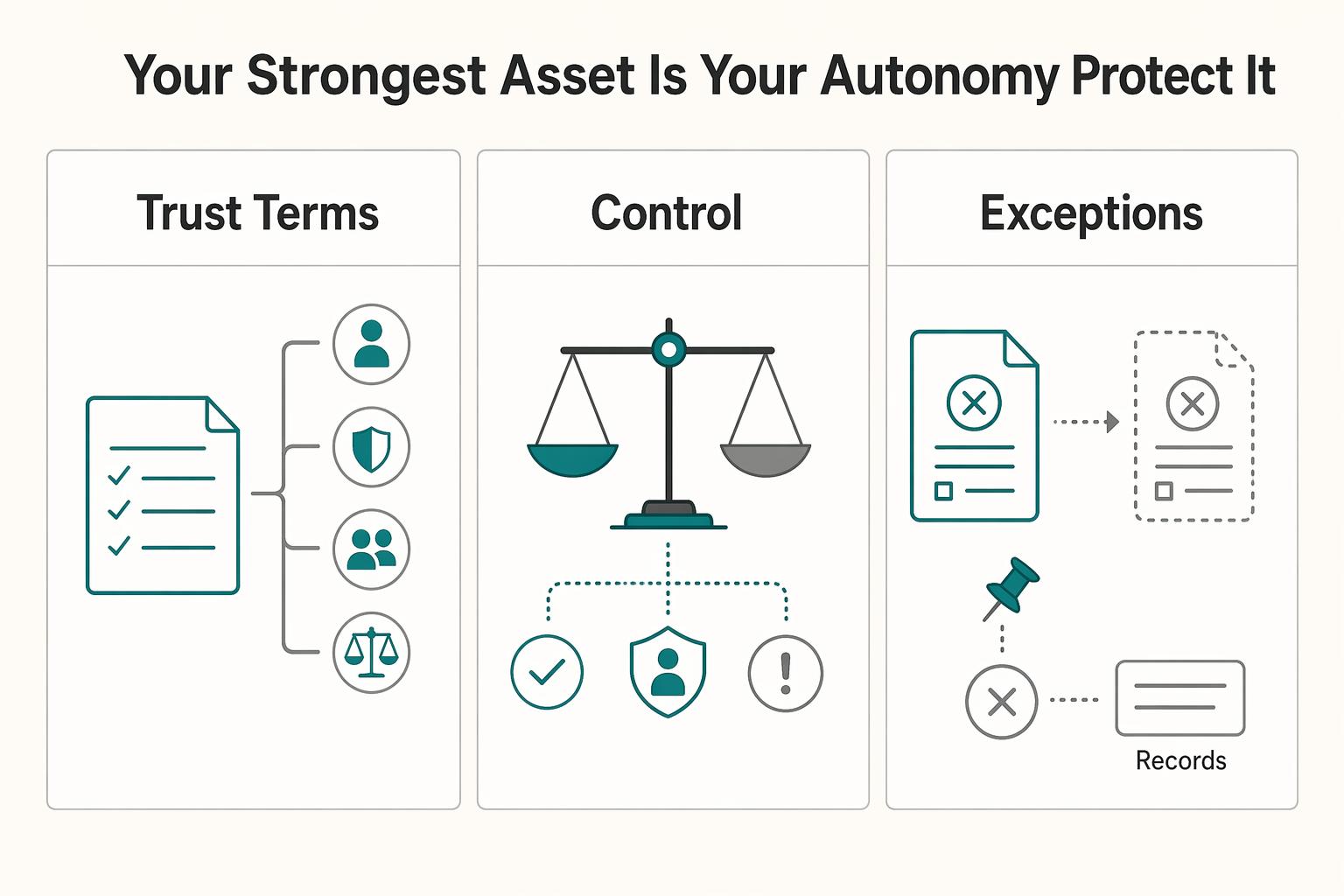
Your Strongest Asset is Your Autonomy. Protect It.#
The goal is autonomy you can keep. A trust helps when you treat it as deliberate delegation, not a paper formality. Start with your broader legal plan, then use the trust to govern specific assets under written terms.
The control issue is the real design choice. Trust planning can address control concerns through the trust terms and, where included, reserved settlor or protector powers. In practice, you still set the framework by naming the trustee, successor trustee, beneficiaries, and written distribution standards. In an irrevocable living trust, you do not keep a free right to reverse the transfer after setup.
That tradeoff is what gives the structure durability. The trustee holds property for beneficiaries, and a successor trustee can step in at death or incapacity so administration continues when you cannot act. If delegation is only cosmetic, validity risk can rise. When trust assets are treated like a personal account, validity can be challenged, including sham-trust allegations.
Before you sign, put the operating sequence in writing. Confirm the trustee or co-trustee. Confirm whether a protector role exists and exactly what powers the document grants. Then set a review cadence. After that, align the trust documents with related records, your asset list, and transfer paperwork so they do not conflict.
| What you still control | What you no longer control directly | Why this improves resilience |
|---|---|---|
| The trust terms you approve at setup, including beneficiaries and distribution standards | Ad hoc personal use of trust-owned assets | Clear written rules are easier to follow and administer consistently |
| Who serves as trustee and who is named as successor trustee | Sole personal control if you die or become incapacitated | Continuity is built into the structure |
| Whether protector powers are included, and only the powers stated in the document | Informal off-document decision-making | Written authority reduces mismatch and avoidable disputes |
- Review with counsel before signing: trustee, successor trustee, beneficiaries, distribution standards, and any protector powers written into the trust.
- Confirm the funding file: asset list, transfer documents, and trust records.
- Align trust terms with related records so documents do not conflict.
- Set a recurring review cadence so roles and assets stay aligned.
For a step-by-step walkthrough, see The Best Jurisdictions for an Offshore Asset Protection Trust.
If your protection plan includes cross-border client payments, talk with Gruv to confirm market coverage, compliance gating, and operational fit before you implement.
Frequently Asked Questions
What is a trust, in practical terms?
A trust is a legal arrangement in which a trustee holds and directs assets for beneficiaries. It requires a grantor or settlor, a trustee, and trust property. It can coordinate how assets are handled more fully than separate account settings alone.
How do you decide whether a trust for asset protection is worth considering now?
Consider it when your actual exposure has changed and simpler protections are already tight. Look at which assets you would transfer, your tolerance for ongoing administration, and setup and upkeep costs your advisers can verify. If the upkeep outweighs the risk, strengthen simpler protections first and revisit later.
What is better if you live and work across countries: domestic or offshore?
Neither domestic nor offshore is automatically better if you live and work across countries. The choice depends on your residency facts, asset location, and enforcement exposure. If those facts change often, weigh flexibility and administration burden as part of the decision.
Is an LLC better than a trust?
An LLC and a trust solve different problems, so there is no universal better choice. A trust applies to assets you formally transfer into trust ownership. Protection outcomes are not automatic and depend on proper setup and funding. Any LLC comparison should be confirmed with counsel for your jurisdiction and use case.
Can you just use POD or TOD designations instead?
POD and TOD designations can help with specific accounts, but they are not a complete plan. The article notes account fragmentation and missed accounts as a failure mode. Use them as a supplement, not your only approach.
What should be ready before implementation?
Have a legally binding trust document prepared with an estate planning attorney, then fund it by transferring assets such as money into a trust-named account. Before signing, confirm the grantor or settlor, trustee, and trust property. If a transfer could involve sanctions or blocked property, ask whether a specific OFAC license is required before execution.
Try a related tool
Researched and edited by the Gruv editorial team. Gruv builds cross-border billing, payouts, and finance-operations software for global businesses.
Sources
- bia.gov/sites/default/files/media_document/407_narr_...trusted
- congress.gov/89/crecb/1965/02/09/GPO-CRECB-1965-pt2-8-2.pdftrusted
- constitution.congress.gov/browse/essay/artIV-S1-1/ALDE_00013015trusted
- delcode.delaware.gov/title12/c035/sc06/index.htmltrusted
- ecfr.gov/current/title-26/chapter-I/subchapter-F/part...trusted
- federalreserve.gov/supervisionreg/legalinterpretations/reg-w-fr...trusted
- govinfo.gov/content/pkg/GPO-CRECB-1965-pt3/pdf/GPO-CRECB...trusted
- irs.gov/businesses/small-businesses-self-employed/re...trusted
Educational content only. Not legal, tax, or financial advice.
Related Posts

Sole Proprietorship vs LLC for Global Freelancers in 2026
For most freelancers in 2026, the practical default is still simple: use the simplest structure you can run cleanly, then formalize when risk actually rises. If your work is still in validation mode and the downside is contained, a sole proprietorship is often the practical starting point. When contract exposure, delivery stakes, or dispute risk starts climbing, forming an LLC deserves earlier attention.
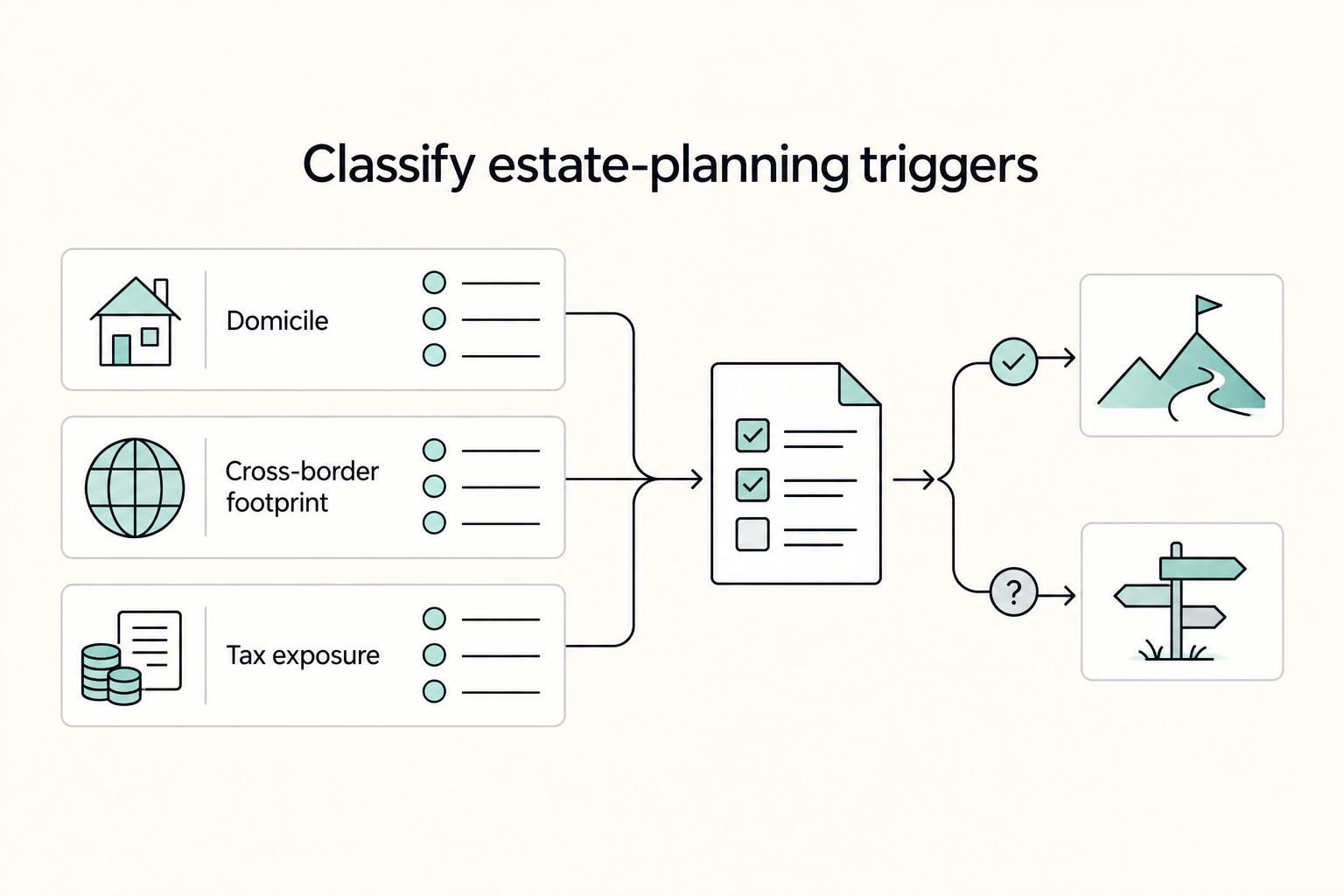
Estate Planning for Digital Nomads: Legal Intent and Cashflow Continuity
Treat estate planning for digital nomads as a two-part continuity system: legal intent plus operational execution, so your business keeps moving when you cannot. The common trap is thinking, "I have a will, so I'm covered." If you run a business-of-one, cashflow, logins, and process often live in your head until you deliberately externalize them.

A Guide to Superannuation for Australian Freelancers
**Treat superannuation for freelancers australia as a repeatable operating decision, not a guess you make under invoice pressure.** As the CEO of a business-of-one, your job is to turn fuzzy compliance questions into a simple system you can run on demand. Freelance income moves, contract terms shift, and one wrong super call can squeeze cashflow or create a compliance problem you only notice later.