
Quick Answer
Start by verifying the live state and local statute before you rely on any lease language, then build a file you can defend. Keep the signed lease, move-in checklist, dated photos or walkthrough video, repair messages, receipts, forwarding address, and proof of delivery in one place. If money is withheld, request line-by-line support and compare each charge to your records. In Washington, a written lease and signed, dated move-in checklist can change the outcome of a deposit dispute.
A security deposit is not a minor line item. It is often a meaningful amount of cash tied up for the life of a lease, and the outcome at move-out usually turns on process, not luck.
This guide treats the deposit lifecycle as a documentation and decision problem. The point is not to help you find a place to live. It is to help you protect your money from the moment you review the lease through the moment the funds are returned or a deduction is challenged.
Phase 1: Pre-Deployment - A Rigorous Due Diligence Framework#
Your best deposit protection work happens before you sign and again in the first hour after you get the keys. If the lease is vague, the move-in record is sloppy, or delivery proof is missing, you are giving up the evidence you will need later.
Review the lease like a refund document#
Read the deposit clause on its own and turn it into a short decision checklist. If an answer is missing or conflicts with state law, stop and get a written correction before you pay.
| Checkpoint | What to verify | Grounded note |
|---|---|---|
| Allowable deductions | What can be taken from the deposit under the lease and state law | Common categories include unpaid rent, damage beyond normal wear and tear, cleaning, keys, or other charges; in California, cleaning deductions are limited to restoring the unit to the same level of cleanliness it had at move-in |
| Return timeline | The governing state rule before relying on examples | California: 21 days after move-out; New York: 14 days after vacatur; Washington: 30 days after termination and vacancy |
| Notice requirements | The exact trigger and delivery rule for your state | Texas ties the duty to your written forwarding address; in California, after you give notice, the landlord must tell you in writing that you have the right to ask for a pre-inspection |
| Move-out standards | The standard for cleaning, repairs, and key return under the lease and the verified state rule | Confirm the standard you are being held to for cleaning, repairs, and key return |
| Conflict path | Where a dispute goes if you disagree with deductions | In New York City, guidance generally points contested deposit disputes to Small Claims Court |
| Washington written checklist | Whether deposit withholding terms are in a written lease or rental agreement and a signed, dated move-in checklist copy was provided | The article says collecting a deposit without that written checklist at the start can create liability for the deposit amount |
- Allowable deductions: What exactly can be taken from the deposit under your lease and state law? Common categories include unpaid rent, damage beyond normal wear and tear, cleaning, keys, or other charges. In California, cleaning deductions are limited to restoring the unit to the same level of cleanliness it had at move-in.
- Return timeline: Verify the governing state rule before relying on examples. California gives 21 days after move-out, New York gives 14 days after vacatur, and Washington gives 30 days after termination and vacancy.
- Notice requirements: Verify the exact trigger and delivery rule for your state. In Texas, the refund and itemized-description duty is tied to your written forwarding address. In California, after you give notice, the landlord must tell you in writing that you have the right to ask for a pre-inspection.
- Move-out standards: Confirm the standard you are being held to for cleaning, repairs, and key return under the lease and the verified state rule.
- Conflict path: Confirm where a dispute goes if you disagree with deductions. In New York City, guidance generally points contested deposit disputes to Small Claims Court.
One state-specific checkpoint matters more than most readers expect: in Washington, deposit withholding terms must be in a written lease or rental agreement, and the landlord must provide a signed, dated move-in checklist copy. If a Washington landlord collects a deposit without that written checklist at the start, that can create liability for the deposit amount. That is not a technicality. It changes your bargaining position.
Build a move-in record you can actually retrieve later#
Use a triple-documentation approach, but make it searchable. Your evidence only helps if you can pull the exact photo, video clip, and checklist line item in two minutes when a deduction letter arrives.
Capture the unit in one consistent order: exterior or entry door, then each room clockwise, then inside cabinets, appliances, windows, floors, walls, fixtures, and any visible defect. Record one continuous video walkthrough first, then still photos, then complete a written master checklist. Keep the checklist in one document, not scattered across messages and notes.
Use filenames that sort cleanly by date and room, for example: 2026-03-24_Unit4B_Kitchen_OvenDoor_01.jpg and 2026-03-24_Unit4B_Bedroom1_WindowTrack_video.mp4. That naming style is not legally required, but it solves a common failure mode: you have proof, but you cannot match it to the landlord's claim. Turn on timestamp metadata if your device supports it, and photograph anything that could later be called damage, especially stains, chipped paint, cracked trim, appliance wear, and carpet condition.
Create a delivery chain and verify how the deposit is being held#
Do not stop at collecting evidence. You also need proof that it was sent. Email the landlord or property manager one organized package with an attachment index in the body, save the sent email, save any acknowledgment, and copy the whole thread plus files into one backup folder. If the lease requires a portal upload, certified mail, or another notice method, use that too. Email is useful for speed, but it is not universally sufficient for every formal notice. Keep the file long-term after you verify any state-specific timing rules that apply.
Before funds move, verify these points in writing:
| Issue | What the landlord should confirm | What you should do |
|---|---|---|
| Holding method | The account or bond method required by the state. Florida, for example, allows a separate non-interest account, a separate interest-bearing account, or a surety bond, and requires written notice within 30 days of receipt. | Ask for the handling notice and save it with your lease. |
| Interest treatment | Whether interest is paid, retained, or not required under the applicable rule. Do not assume interest is owed everywhere. | Confirm the rule for your state before treating interest as recoverable. |
| Itemized deductions | Whether deductions must be itemized and what backup must be attached. California requires an itemized statement and receipts or invoices for deductions over $125.00; Texas requires a written description and itemized list when part of the deposit is retained, subject to the statute. | Keep your payment proof, photos, and checklist ready to match against any itemization. |
| Authority to act | Whether the property manager is authorized to receive notices, approve inspections, and handle the deposit on the owner's behalf. | If authority is unclear, send important notices to both the manager and the owner named in the lease. |
If you are checking the finer points of security deposit rules by state, pair this phase with A Guide to Landlord-Tenant Laws for Your State. The rule that decides your outcome is usually not abstract. It is one deadline, one notice requirement, or one missing document.
Want a quick next step for "security deposit laws by state"? Try the free invoice generator.
Decoding "Normal Wear and Tear": The Most Contested Gray Area#
This is the move-out dispute point that often determines whether you keep more of your deposit. Before you accept any deduction, classify each charge item-by-item using your move-in record, your tenancy records, and the landlord's written support.
Use one standard for every line item: do not decide from labels like "cleaning" or "repairs" alone. Decide from evidence.
| Category | What to compare first | What to request in writing | Provisional status before state-law check |
|---|---|---|---|
| Walls | Move-in photos/video vs move-out photos for the same spots | Itemized room-level notes, photos, and scope of work | State-specific standard pending official statute verification. |
| Flooring | Move-in baseline, location pattern, and current condition | Itemized notes, photos, and repair/replacement basis | State-specific standard pending official statute verification. |
| Appliances | Move-in condition, maintenance history, and current condition | Fault description, service history, invoice/estimate basis | State-specific standard pending official statute verification. |
| Fixtures | Move-in checklist entries and current condition | Itemized notes, photos, and repair necessity | State-specific standard pending official statute verification. |
| Cleaning | Move-in cleanliness baseline vs documented move-out condition | Line-by-line cleaning charges and supporting records | State-specific standard pending official statute verification. |
Run each deduction through the same four-part test#
| Check | Question | Evidence in text |
|---|---|---|
| Condition at move-in | What do your signed checklist, dated photos, and video show for this exact item? | Signed checklist, dated photos, and video |
| Expected aging from ordinary use | Does the current condition fit normal use under the standard you verified for your state? | Verified state standard |
| Evidence of misuse or avoidable damage | Is there clear documentation linking this condition to tenant-caused damage? | Clear documentation linking the condition to tenant-caused damage |
| Repair necessity and amount | Can the landlord document what work was needed and why this specific charge matches that work? | Documentation of needed work and the matching charge |
If the landlord sends a lump sum, reply in writing and ask for a line-by-line itemization plus supporting records for each line.
Handle gray-zone items without overcommitting#
- Negotiate partial responsibility when records show mixed causes and the documentation supports only part of the claimed amount.
- Push back and escalate when the claim is vague, unsupported, or inconsistent with your move-in package.
- Pause legal arguments until verified when your state standard is still unclear; then restate your position using that verified standard.
The objective is simple: separate ordinary use from chargeable damage with documents, not assumptions.
Related: How to Invest in Real Estate as a Digital Nomad.
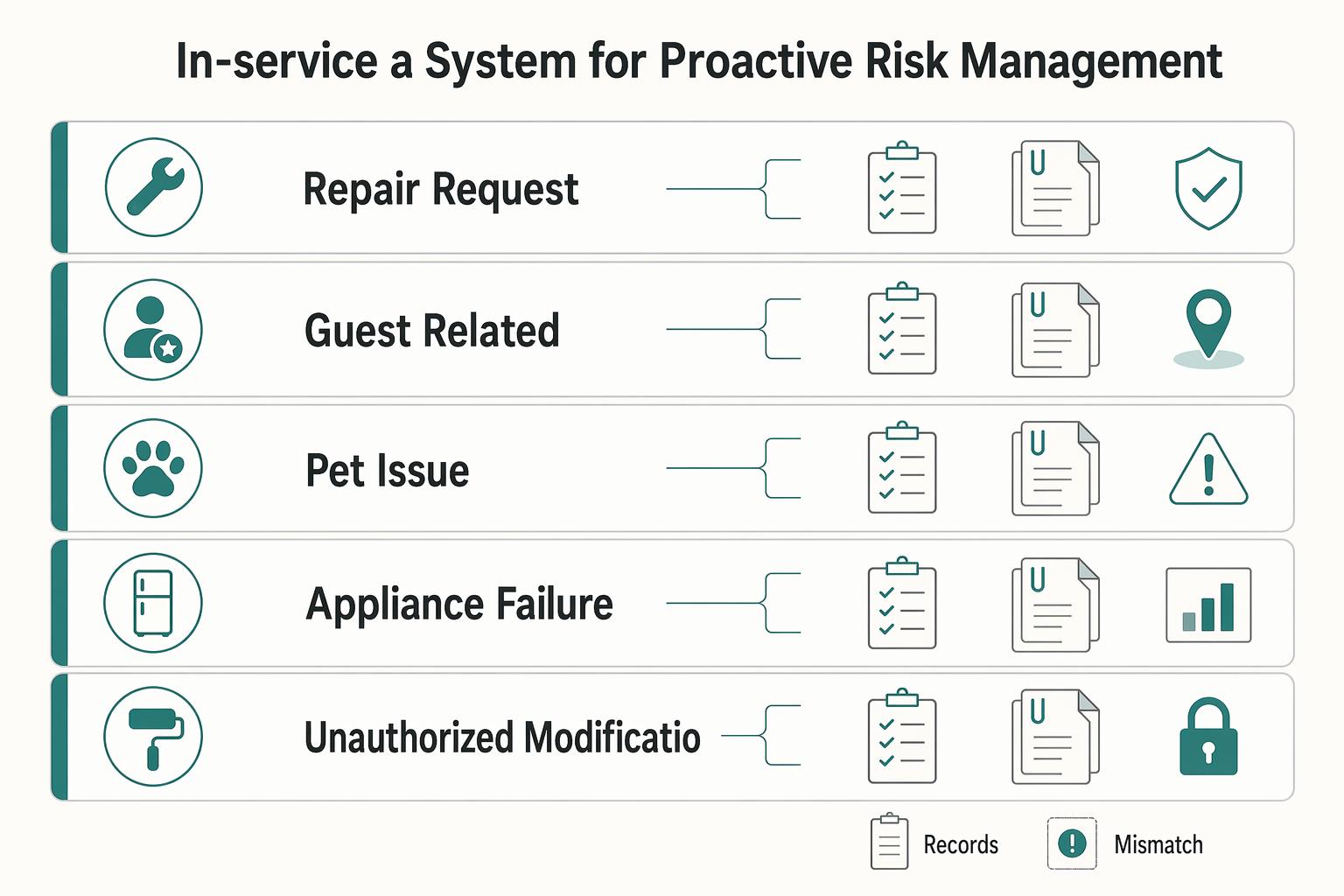
Phase 2: In-Service - A System for Proactive Risk Management#
During the lease, protect your deposit by documenting every condition change in writing. If you report repairs clearly, get approvals before making changes, and treat inspections as evidence checkpoints, you reduce avoidable deduction disputes later.
Use one repeatable incident log for every repair issue:
- Send written notice as soon as you spot the issue.
- Attach dated photos or short video.
- Record location, first-noticed date, and whether the issue is worsening.
- Track follow-ups in writing.
- Save receipts, payment proof, and completion confirmation.
This matters because written notice can be legally relevant in some jurisdictions. Virginia, for example, requires written notice of needed repairs, and New York notes that county and town rules can change what applies, so verify local notice rules and deadlines before relying on any template.
| In-lease scenario | What to document | Deduction risk |
|---|---|---|
| Repair request | Written notice, dated photos, follow-ups, completion message | Lower if you reported promptly |
| Guest-related damage | What happened, photos, repair invoice, messages with landlord | Higher if damage is clear and avoidable |
| Pet issue | Photos, cleaning or repair records, lease pet terms | Medium to high depending on condition |
| Appliance failure | Error details, prior maintenance requests, owner response | Lower if failure appears age-related |
| Unauthorized modification | What changed, whether approval exists, restoration plan | High without written permission |
Use a permission protocol before any alteration work starts. For cosmetic changes (paint, shelving, fixture swaps), get written approval first. For structural or wall-penetrating changes, confirm scope, who pays, restoration responsibility, and who authorized it, then keep that approval in one place (single folder or email thread).
For inspection readiness, run a pre-inspection checklist:
- Clean and remove leftover items.
- Test lights and appliances.
- Fix minor tenant-side issues you can address.
- Compare each room to your move-in photos and checklist.
- If your state allows pre-move-out inspection requests, verify the current response window from official state statute or counsel records before relying on it.
After any inspection, send a same-day recap email that confirms:
- What was reviewed.
- What issues were identified.
- What you agreed to address.
- Any deadline-dependent next step, with the current response window verified from official state statute or counsel records before use.
California guidance says landlords must notify tenants of the right to ask for an initial inspection, and if requested, it must occur within the two weeks before move-out.
Phase 3: Recovery - The Asset Recapture Protocol#
Treat move-out as a documented closeout, not a fight. Your objective is to keep a clean record at each step so valid deductions are clear and weak deductions are easy to challenge.
Close out with a same-day inspection record#
Ask for a final walkthrough before you hand over possession, if the landlord will do one. Bring your move-in photos, checklist, repair notices, and any written alteration approvals. During the walkthrough, compare each room to your move-in record, note each flagged item, and capture current photos or short video of those exact areas.
Send a same-day written recap with: date, attendees, items discussed, what you agreed to address, and what you dispute. This closes the gap between what was said and what is later claimed.
Review each deduction before you accept or dispute it#
When the itemized deductions arrive, review each line against three checks before you respond:
| Check | What to verify | If it fails |
|---|---|---|
| Lease terms | The lease clearly allows that specific charge | Dispute the charge and ask for the lease basis |
| Verified rule | Timing and handling match the current official rule you verified | Dispute and request correction |
| Evidence quality | Dated photos, invoices, receipts, or clear itemization support the amount | Dispute unsupported or vague line items |
For legal-rule checks, verify against official sources rather than unofficial summaries. FederalRegister.gov states its content is unofficial and says legal research should be verified against an official edition, including the linked printed PDF. The eCFR also flags that Federal Register documents can modify displayed text, so confirm freshness markers before you rely on what you read.
If you need a starting point, use A Guide to Landlord-Tenant Laws for Your State, then verify the live rule.
Escalate in order and keep your file ready to file#
If the deposit is not returned as required, send a formal demand letter first. Keep it calm and specific, and include:
- Your name and mailing address
- Rental property address
- Move-out date
- Deposit amount paid
- What you received (or did not receive)
- Rule relied on, verified from official statute or counsel records
- Current deadline verified from official statute or counsel records
- Amount demanded
- Current remedy verified from official statute or counsel records
- Response deadline
- Delivery method with proof of delivery
If that does not resolve the issue, prepare your filing packet immediately so you can act without rework. Keep one organized file with the lease, move-in/move-out evidence, walkthrough recap, deduction notice, repair and communication logs, deposit payment proof, demand letter, and proof of delivery. Add a one-page itemized claim summary showing each disputed deduction, why you dispute it, and which evidence supports your position.
For the Global Professional as Landlord: Managing Deposits from Abroad#
If you manage deposits from abroad, your process is only defensible when account setup, notices, and deductions are documented from day one. Keep your control model simple: delegate fieldwork, require your written approval for money decisions, and retain the core records yourself.
Start with the holding account before you accept any deposit. In Washington, deposit funds must be placed in a trust account, with a written receipt and depository notice. New York treats deposits as tenant trust funds and prohibits co-mingling. Massachusetts requires a separate, interest-bearing account in a Massachusetts bank.
| Requirement type | Verified examples | Your control action |
|---|---|---|
| Holding method | Washington trust account; New York trust-fund treatment and no co-mingling; Massachusetts separate interest-bearing Massachusetts account; Florida allows landlord or agent holding methods, including a separate non-interest-bearing account | Open the compliant account before intake. Keep bank setup proof, account title, and a written no-co-mingling procedure. |
| Disclosure duty | Washington requires written receipt and depository notice | Put the exact disclosure workflow in your lease packet and manager SOP. State-specific disclosure rule pending official statute verification. |
| Interest handling | New York interest-account rule for buildings with six or more apartments and 1% annual administrative expense allowance; Florida includes a permitted method tied to 5 percent simple interest | Verify whether interest is required, who receives it, and any allowed administrative deduction. State-specific interest rule pending official statute verification. |
| Return process | California 21-day itemized statement timing; New York 14-day return timing; Washington 30-day window for a full and specific retention statement; Florida 30-day claim-notice timing | Calendar the deadline at move-out and require draft notice review before send. State-specific return rule pending official statute verification for the property location. |
What you can delegate and what you should not#
You can delegate inspections, photo capture, receipt collection, mailing logistics, and draft tenant communications. You should require written approval before any deduction is asserted, any amount is withheld, or any deadline notice is sent in your name. Texas law distinguishes the landlord from a manager or agent unless your lease represents otherwise, so your documents should clearly assign final authority.
| Task | Status | Control |
|---|---|---|
| Inspections | Can delegate | You can delegate inspections |
| Photo capture | Can delegate | You can delegate photo capture |
| Receipt collection | Can delegate | You can delegate receipt collection |
| Mailing logistics | Can delegate | You can delegate mailing logistics |
| Draft tenant communications | Can delegate | You can delegate draft tenant communications |
| Asserting a deduction | Require written approval | Written approval before any deduction is asserted |
| Withholding any amount | Require written approval | Written approval before any amount is withheld |
| Sending a deadline notice in your name | Require written approval | Written approval before any deadline notice is sent in your name |
Keep the audit-defense file yourself: signed lease, move-in checklist, account records, statutory notices, move-out media, invoices, receipts, deduction approvals, and proof of return or mailing. Do not assume your manager has a complete file when a dispute starts.
Put property-manager controls in the contract#
Your management agreement should state these controls in plain language:
- No undocumented deduction can be charged to the deposit.
- Each proposed charge must include dated photos, a move-in baseline, and invoice/receipt support (or a written estimate where state law permits).
- The manager must escalate any charge they cannot verify against the checklist, lease, and state rule.
- The manager must send draft notices early enough for your written approval before legal deadlines.
These controls matter most where deductibility depends on move-in documentation. Washington ties retention defensibility to the written checklist and also requires a full and specific retention statement within 30 days. California adds an evidence threshold: when deductions exceed $125.00, invoices or receipts must be attached.
Cross-border handoffs that affect the deposit#
Keep cross-border handling deposit-specific. IRS Publication 527 says refundable deposits are not income when received if you plan to return them, and amounts you keep are included in income in that year. Route retained-deposit treatment, withholding questions, and any filing item you still need to verify to licensed tax counsel early.
If a payer or intermediary acts as a withholding agent, IRS guidance says that party can be personally liable for required withholding. If Form W-8 ECI applies, handle it through your tax advisor and store the final signed copy in the same deposit file. For state execution, verify live rules for the property location and use local counsel when city or county overlays may apply.
For a step-by-step walkthrough, see A Guide to California's Meal and Rest Break Laws.
Know Your Legal Landscape: A State-by-State Guide to Security Deposit Laws#
Your next move is simple: verify the live rule where your property is located before any deposit decision. Use this state-by-state chart as a checklist, not as final legal authority.
Before you sign a lease, collect a deposit, send a deduction notice, or challenge a withholding, save the current state statute text and the page it came from. Then check whether city or county housing rules change how that state rule applies.
If a summary points you to the Truth in Lending Act (15 U.S.C. 1601) or Regulation Z (12 CFR 1026) as the main authority, treat that as a warning sign for this topic. That framework is for consumer credit disclosures and related credit restrictions, not a verified state rental-deposit rule.
How to use this table: Treat each cell as a verification prompt, then confirm the current state statute and any city or local override before you act.
| State | Deposit cap rule | Return timeline | Itemized deduction notice rule | Deposit interest rule | Local override check |
|---|---|---|---|---|---|
| California | Verify current statute | Verify current statute | Verify current statute | Verify current statute | Verify city/county housing rules |
| New York | Verify current statute | Verify current statute | Verify current statute | Verify current statute | Verify city/county housing rules |
| Texas | Verify current statute | Verify current statute | Verify current statute | Verify current statute | Verify city/county housing rules |
| Florida | Verify current statute | Verify current statute | Verify current statute | Verify current statute | Verify city/county housing rules |
Landlord checklist
- Document: Save the statute text you are relying on in your deposit file.
- Notify: Use written notices that match the current rule you verified.
- Return: Calendar the verified return workflow before move-out is complete.
- Dispute: Pause any deduction if your file does not support it.
Tenant checklist
- Document: Save move-in records and a copy of the live rule before move-out.
- Notify: Request required notices in writing.
- Dispute: Compare each deduction to your records and the verified rule.
- Return: If details are unclear, stop and verify the statute before money moves.
Conclusion: Take Control of Your Capital#
Treat the deposit as your money, not as a vague end-of-lease issue. You will not control every outcome, but you can make disputes easier to prevent, easier to challenge, and less likely to drag on if you handle the file the same way every lease cycle.
Keep the three core moves simple. First, lock down documentation. Save the signed lease, move-in checklist, dated photos or video, repair emails, receipts, and proof that the landlord received key messages. A failure point can be delivery proof, not just the evidence itself. If you cannot show when the checklist, forwarding address, or dispute letter was sent, a good photo set may still lose force.
Second, keep communication written and boring. Ask for repairs by email, confirm any permission in writing, and request an itemized statement if money is withheld. If your state gives you a pre-inspection or initial inspection right, use it. If a deduction arrives, compare it against your move-in baseline before arguing about normal wear and tear.
Third, escalate by verified deadline, not by frustration. The state-law section matters because timing and remedies are not universal, and local rules can change the result. Verify the live rule where the property sits, then act on the deadline and remedy you can support.
Before you close this out, do these four things:
- Recheck the comparison section for your exact state or local rule.
- Put the deposit return deadline on your calendar using your move-out date.
- Save one evidence folder with payment proof, condition proof, and your forwarding address.
- Revisit the FAQ above if your issue is cleaning, late return, or an out-of-state landlord.
Risk first takeaway: good records, written notice, and timely escalation protect cash flow better than last-minute arguments after the money is already stuck.
Frequently Asked Questions
How do you improve the odds of getting your deposit back?
Build an evidence file early instead of relying on memory. Keep your lease, move-in checklist, dated photos or video, repair messages, receipts, and forwarding address in one place. Before move-out or any dispute, verify the current state and local rules where the property is located. If deductions are listed, respond in writing with your evidence and ask for documentation that supports each charge.
What is the biggest documentation mistake to avoid?
Do not stop at collecting photos and videos. A common miss is not keeping a clear, dated record of what you shared and when. Send one dated message with your checklist, photo folder, and video links, then save the sent message and attachments. If a dispute starts later, reply in that same thread and attach the relevant records before arguing over the amount.
What should you do if the return deadline passes?
If you think the return timeline has passed, verify the current rule first in the property’s state and city. Avoid legal threats until you confirm the live requirements. After verification, send a dated written request (trackable delivery helps) that includes your move-out date, forwarding address, deposit amount, and the rule you are relying on. If there is still no response, consider mediation, a tenant-help office, or small claims only after confirming the current local filing process.
Can a landlord deduct for cleaning?
Treat cleaning deductions as case-specific and rule-dependent. Review your lease, your move-in and move-out records, and any proof of cleaning before accepting or disputing a charge. Ask for invoices or other backup for the deduction, then respond in writing if the charge does not match your records. Before escalating, verify local rules through A Guide to Landlord-Tenant Laws for Your State.
If you are a remote or out-of-state landlord, what matters most?
Prioritize record control and deadline tracking. Distance can make response timing and documentation harder, so your process needs to be tighter. Keep lease records, deposit receipts, bank records, inspections, photos, invoices, and notice-delivery proof in one folder. Use calendar reminders and local support when needed, and verify current state and city rules before sending notices or moving funds.
Try a related tool
Researched and edited by the Gruv editorial team. Gruv builds cross-border billing, payouts, and finance-operations software for global businesses.
Sources
- ag.ny.gov/resources/individuals/tenants-homeowners/ten...trusted
- ag.ny.gov/resources/individuals/tenants-homeowners/ten...trusted
- app.leg.wa.gov/rcw/default.aspxtrusted
- app.leg.wa.gov/rcw/default.aspxtrusted
- dhcd.virginia.gov/sites/default/files/Docx/landlord-tenant/fin...trusted
- federalregister.gov/documents/2025/01/06/2024-29824/home-investm...trusted
- flsenate.gov/Laws/Statutes/2025/0083.49trusted
- irs.gov/forms-pubs/about-form-w-8-ecitrusted
Educational content only. Not legal, tax, or financial advice.
Related Posts
Should Your Freelance Business Accept Credit Cards?
Offer card payments, but stay in control of how money reaches you. The goal is not a smoother checkout screen. It is predictable cash you can use to run the business.
How to Invest in Real Estate as a Digital Nomad
**Run anything with money and moving parts like an operations system (cash, docs, delegation, and controls), not a "passive income" vibe.** Real life stress-tests weak spots. You change time zones, a client pays late, and something breaks at the worst moment. As the CEO of a business-of-one, your job is to build a setup that keeps working when you are not available on demand.
Landlord-Tenant Laws by State for Remote Owners
A lot of landlord advice assumes you are local, reachable, and able to handle legal and physical tasks yourself. If you own from another state or country, that assumption breaks quickly. The real risk is not inconvenience. It is missed notice windows, mishandled service, unverified registration gaps, and delayed enforcement when something goes wrong.