
Quick Answer
Yes - Section 1202 can support significant federal gain exclusion, but only when your shares were issued by an eligible domestic C corporation, acquired at original issuance, and held long enough. After issuance, keep active-business and redemption checks running as facts change, and maintain lot-level support that can survive diligence. The practical approach is to treat qualification, maintenance, and exit reporting as separate controls, then complete a state-tax review before signing a transaction.
Beyond the Rules: A Founder's System for QSBS Certainty#
You are managing two risks at once: building the company and protecting your personal tax outcome. With QSBS, that means running an evidence and review process from day one, not doing a one-time check and hoping it holds until exit.
In plain language, QSBS refers to stock that may receive this treatment when the requirements are met. One distinction matters early: company-side eligibility and shareholder-side eligibility run on separate tracks. If both hold up, a future gain may receive favorable federal tax treatment under the applicable rules when you claim it.
Failures often come from proof gaps, not just misunderstanding the headline rules. So the job is not only to learn the rules. It is to understand the requirements, prove eligibility, and maintain it while you avoid common pitfalls.
Checklist versus system#
| One-time checklist | Ongoing system |
|---|---|
| Confirms facts once | Re-checks company-side and shareholder-side facts at key moments |
| Relies on memory later | Retains the records needed to prove eligibility |
| Finds issues late | Triggers review when company or ownership facts change |
Use this path through the rest of the article: confirm eligibility, maintain it over time, and keep documentation ready when you need to claim it. In Stage 1, you confirm the starting facts and build the core proof file. Escalate to a qualified tax professional as soon as records are incomplete or a company or ownership change could affect the analysis.
Stage 1: Prove and Document Eligibility at Issuance#
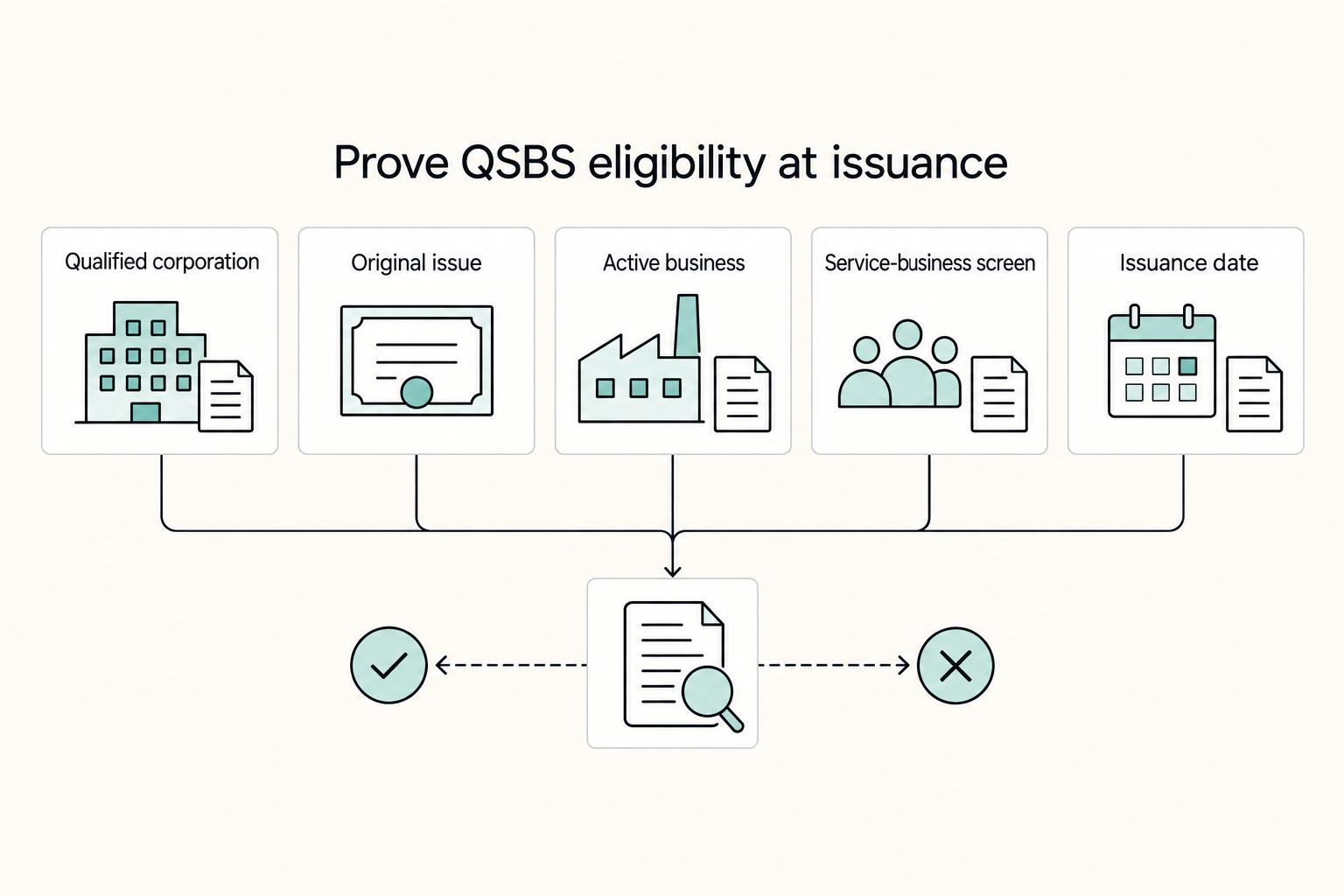
Stage 1 determines whether your future position is defensible. If a core fact is wrong at issuance, or you cannot prove it later, fix it before shares are issued. For QSBS, run three separate tests: issuer eligibility, acquisition method, and holding-period start.
The three gates you need to clear#
You qualify only if the stock is issued by the right company at the right time. The issuer must be a domestic C corporation, and the gross-asset test must be met both before issuance and immediately after issuance, including amounts raised in that issuance. Keep the current gross-asset threshold pending in your deal memo until counsel verifies it against current law, filing instructions, and source records before use.
| Gate | Requirement | Article note |
|---|---|---|
| Issuer eligibility | The issuer must be a domestic C corporation, and the gross-asset test must be met both before issuance and immediately after issuance, including amounts raised in that issuance. | Keep the current gross-asset threshold pending until counsel verifies it against current law, filing instructions, and source records before use. |
| Original-issue acquisition | You must receive the shares at original issuance, directly from the company or through an underwriter, for permitted consideration: money, non-stock property, or qualifying services. | A secondary purchase from another holder is a fail-fast issue. |
| Holding-period start | The acquisition date is tied to the first day you are treated as holding the stock for tax purposes. | If the start date is unclear, escalate immediately so you do not build the rest of the timeline on the wrong date. |
You also need original-issue acquisition: you must receive the shares at original issuance, directly from the company or through an underwriter, for permitted consideration: money, non-stock property, or qualifying services. A secondary purchase from another holder is a fail-fast issue.
In the cited Section 1202 special-rule context, the acquisition date is tied to the first day you are treated as holding the stock for tax purposes. If the start date is unclear, escalate immediately so you do not build the rest of the timeline on the wrong date.
Qualify now or fix before issuance#
Before you accept shares, make a clean go/no-go call. Use these red flags to separate a workable issuance from one that needs to stop for review.
- Qualify now: issuer is a domestic C corporation, the gross-asset threshold is verified for the issuance timing, acquisition is original issue, and the business is not obviously in a disqualified service profile.
- Fix before issuance: any one item is unresolved.
Common red flags include:
- secondary share purchase instead of original issue
- missing contemporaneous financials for the issuance window
- unclear holding-period start mechanics
- value driven mainly by founder reputation, skill, or personal services
Also screen for active-business fit now. Section 1202 requires the company to meet active-business rules for substantially all of your holding period. That includes using at least 80 percent by value of assets in the active conduct of qualified trades or businesses.
Build your QSBS Origination File like an operator#
Treat the Origination File as a practical proof file, not a legally required template. Assign an owner internally, keep a shareholder copy with your permanent tax records, and make sure the documents are executed, dated, and final.
| Core record | Why it matters in diligence/audit | What to do if missing |
|---|---|---|
| Charter and corporate-status records showing domestic C-corp status | Supports issuer eligibility on the issuance date | Obtain final corporate-status documents now; if status is unclear at issuance, pause and resolve before issuing |
| Executed issuance documents and capitalization records | Supports original issuance, issue date, and share tracking | Reconstruct from signed consents and executed agreements, not email summaries |
| Contemporaneous financial statements or balance sheet at issuance | Supports gross-asset test before and immediately after issuance | Have finance and counsel assemble dated statements tied to closing; if contemporaneous support is unavailable, treat as a material gap |
| Consideration evidence, including payment, property transfer, or service-comp records | Supports permitted consideration and basis tracking | Collect wire records, transfer documents, and compensation records now; do not rely on memory later |
| Written company representation or reporting support | Shows the Section 1202 analysis and shareholder-reporting readiness | Request written representation at or before issuance; if refused, document why and escalate to tax counsel |
Screen service-business risk before you accept shares#
Do this early. Service-business risk is easier to address before issuance than after. Product-led value can be easier to support than founder-dependent service value, but neither is automatic.
| Profile | Risk signal | Action before issuance |
|---|---|---|
| Product, process, or IP value that is transferable beyond one person | Lower immediate service-exclusion risk, but still requires full statutory review | Document the operating model and escalate if facts are mixed |
| Revenue tied mainly to founder billable time, personal brand, or individual relationships | Higher risk under listed service-field exclusions and reputation or skill language | Escalate to tax counsel before issuance and document the analysis |
Section 1202 excludes listed service fields, including health, law, engineering, architecture, and accounting, and also businesses where the principal asset is reputation or skill. If your model is hybrid, get counsel review while the terms and documentation can still be shaped. Related: A Freelancer's Guide to Angel Investing and Venture Capital.
Stage 2: The 5-Year Maintenance Protocol#
Stage 2 is about preservation, not waiting. Your stock stays on a Section 1202 path only if the company remains a C corporation and continues to meet active-business requirements during substantially all of your holding period. You also need records that prove it.
That is the shift from Stage 1 to Stage 2: after issuance, the work is continuity. Earlier issuances may continue to qualify after later changes, but only when the ongoing requirements are still met and documented. Use that continuity rule for every material corporate action. If facts change, your file must change with them.
Re-test on triggers, with named owners#
There is no sourced rule requiring a fixed quarterly or annual cadence. Re-test when facts move, and assign an owner each time.
| Trigger | Owner | Keep |
|---|---|---|
| Major financing closes or cash balance increases materially | CFO/controller, with tax counsel copied | Dated financials, cash-use plan, treasury or investment policy updates, board materials, and closing documents |
| Business model or revenue mix shifts | CEO + legal | Board deck, updated product or service description, customer-contract profile, and a short written qualified-trade analysis |
| Treasury or investment policy changes | Finance | Approvals, statements, policy changes, and a written use-of-funds memo; if assets are held for investment, document why they are reasonably expected to be used in the business within 2 years |
| Cap table actions or financing-structure changes | Legal + finance | Consents, cap table and ledger updates, repurchase or tender documents, and side letters |
Treat any move toward excluded categories as a re-test-now event, and escalate before signing buybacks or other repurchase arrangements.
Focus the active-business check on the 80% test#
The practical Stage 2 check is whether at least 80 percent by value of assets are still used in the active conduct of a qualified business. After major financings, this can be an early place where risk appears.
For each re-test, keep an evidence pack with dated balance sheets or financials, board materials tied to operating use, a current budget or operating plan, and treasury documentation that connects cash and investments to business deployment. The goal is a contemporaneous record, not a retroactive story.
Redemption tripwires#
Do not treat buybacks as routine paperwork. Classify any repurchase before it closes.
| Buyback situation | Expected impact on eligibility | Immediate escalation step |
|---|---|---|
| Company buys stock from you or a related person during the 4-year period beginning 2 years before issuance | Newly acquired shares may be tainted under the shareholder-level redemption rule | Pause, map related persons, verify dates to issuance, and get tax-counsel review before closing |
| Company buys back stock from shareholder(s) with aggregate value exceeding 5 percent during the 2-year period beginning 1 year before issuance | Stock issued in the tested window may be at risk under the company-level significant-redemption rule | Calculate aggregate value at each purchase date, map issuances in-window, and escalate |
| Indirect, affiliate, or mixed repurchase that is hard to classify | Do not assume the rule does not apply | Pull agreements, approvals, cap table, ledger, and counsel memo immediately |
Continuity rule for pivots and new rounds#
A financing round or pivot does not automatically preserve or destroy earlier stock. Earlier issuances may retain treatment only if the ongoing requirements continue to be met and documented.
Before any material action, ask four questions: does this change C-corp status, active-business facts, treasury posture, or redemption exposure? If yes, involve tax counsel before closing.
Keep Stage 2 records as long as they are material to your tax position. The general IRS baseline is 3 years from filing, but QSBS support may stay material through the holding period, the sale, and the return that claims the exclusion.
If your residency or work location changes during the holding period, keep a dated evidence trail for your tax records with the Tax Residency Tracker.
Stage 3: The Strategic Exit & Realization Plan#
At exit, protect the claim you built in Stages 1 and 2. Before signing anything, verify three facts for each lot: acquisition date, whether you have held it for more than 5 years, and which Section 1202 exclusion bucket applies.
Under the excerpted rules, stock acquired after September 27, 2010 falls in the 100 percent bucket under Section 1202(a)(4). Stock acquired after February 17, 2009 and on or before September 27, 2010 falls in the 75 percent bucket under Section 1202(a)(3). Section 1202(a)(1) describes a 50 percent exclusion for qualifying gain from stock held more than 5 years. If you have multiple grants or exercises, run this lot by lot.
Decide before the deal decides for you#
Make the timing call before the first binding deal documents.
| Path | When to use it |
|---|---|
| Sell now | You are already past the more-than-5-years mark and your file supports the position for each lot. |
| Roll over | Exit timing is before five years and you want to preserve a possible Section 1202 path; do this only with tax counsel because this does not confirm Section 1045 eligibility, timing windows, or reinvestment mechanics. |
| Hold longer | Timing is flexible and you are close to the five-year mark. |
Transaction-readiness checklist#
Before diligence starts, run a pre-exit audit that ties each expected claim back to the records built in Stage 1 and maintained in Stage 2.
| Claim you expect to make | Evidence to have ready |
|---|---|
| You acquired each lot on a specific date | Issuance or purchase records, exercise records if relevant, board approvals, cap table, stock ledger |
| You held each lot for more than 5 years | Dated acquisition records plus projected or actual closing timeline |
| You are using the correct exclusion bucket | Acquisition-date mapping to the February 17, 2009 and September 27, 2010 boundaries |
| Your eligibility position is supportable on business-activity classification | Stage 2 monitoring memos and related eligibility documentation |
| No later transaction changed the risk profile | Redemption or repurchase, tender, merger, and side-letter documents; counsel analysis where applicable |
A practical standard is to prepare a one-page lot schedule before diligence starts, with the document location for each key fact.
Deal-event risk comparison#
Not every exit is a plain sale, and that is where trouble starts. If the deal is anything other than a straightforward cash sale of your shares, get tax counsel involved before signing.
| Deal event | Where treatment can break down | Escalate to tax counsel before signing when |
|---|---|---|
| Straight sale of your shares | Lot history, dates, or gain math is incomplete or inconsistent | Any lot-level facts do not reconcile to ledger and deal papers |
| Merger or stock-for-stock exchange | Transaction characterization is not a plain sale or exchange fact pattern | Consideration or structure is mixed or complex |
| Company redemption or tender | Repurchase mechanics can create eligibility uncertainty | The company, an affiliate, or related parties are repurchasing shares |
| Exit before five years | Exclusion path may not be available on current facts | Closing date is before, or may move before, the holding threshold |
File the return like you expect questions later#
Treat filing as the final proof test, not an administrative afterthought. This does not confirm specific forms, adjustment codes, or line-by-line filing mechanics, so finalize filing mechanics with tax counsel.
- Confirm current IRS guidance and advisor instructions before filing.
- Reconcile proceeds, basis, and closing adjustments to signed deal documents, statements, and your lot schedule.
- Prepare a short computation memo showing gross gain, applicable exclusion percentage, and reported taxable amount.
- Retain the return copy and full support file while the position remains material.
Before filing, make sure the return numbers reconcile to transaction records.
Conclusion: Work the Three Stages and Review Before Exit#
You protect a QSBS outcome with process, not memory: prove the facts at issuance, re-check eligibility when facts change, and pause for review before exit whenever something is unclear.
Use the three-stage system as an operator checklist:
- Stage 1 - Qualification at issuance: Build an origination file that proves original issuance, C corporation issuer status, and what was true on the issuance date.
- Stage 2 - Maintenance during holding period: Keep dated review notes when facts change, including material business or ownership changes. Confirm the issuer still meets active-business requirements for substantially all of your holding period, including whether activity drifts into excluded service fields.
- Stage 3 - Exit and reporting: Map each lot to its holding period, confirm the applicable Section 1202 treatment for that lot under current rules, and reconcile sale records to Form 8949 and Schedule D.
Watch the same red flags every time: reconstructed records instead of dated issuance support, unclear issuer history after major corporate changes, and state treatment assumed from federal treatment.
The practical default is simple. If issuer status, business-activity classification, state conformity, or rollover mechanics are uncertain, stop and run a pre-exit review with a qualified tax advisor before deal timing gets tight.
Do this now: organize your origination file, lot map, and state-treatment records, then schedule the compliance review before the transaction calendar starts driving the decision.
When you are ready to operationalize this checklist with audit-ready payment and payout records, review implementation options and coverage details in Gruv Docs.
Frequently Asked Questions
How do you verify at issuance that your shares are even in play for Section 1202?
Start with the basics: can you document when and how the lot was issued, and can you show that both company-level and shareholder-level eligibility screens were addressed at that time? If your lot records, cap table, and supporting company documents line up, keep the file current. If any link is missing, pause and fix it before you rely on the position. Bring in a tax advisor when your evidence depends on reconstructed summaries instead of dated primary records.
What should you do if the company’s business activity changed or looks borderline?
Treat this as a fresh review point, not a close-enough call. If the company pivoted, added a new line, or sits in a gray area, document what changed and revisit the eligibility assumptions before you treat the claim as stable. Bring in a tax advisor when operating facts or investor-rights terms create real ambiguity.
Can you sell before the required holding period is met?
Maybe, but the answer is fact-specific. Holding-period requirements are a separate checkpoint, so document deal timing and lot history before signing. Escalate to a tax advisor when closing timing is fluid or your lot history is complex.
How should you handle federal-rule checks and reporting?
Handle federal-rule checks and reporting as one workstream. Federal treatment depends on current-law requirements and your filing year, so verify the current rules before you lock in deal assumptions. Build one evidence file that ties lot records to deal documents, and involve a tax advisor if the record is incomplete or inconsistent.
Does issuer entity type change the analysis?
Yes. Entity type is a threshold eligibility question tied to what issued your lot on the issuance date. If the company history includes conversions, mergers, or multiple related entities, verify that history lot by lot instead of relying on current branding or current structure. Use a tax advisor when the issuance path is not straightforward in the formation and governance records.
Is this only a federal benefit, or does state treatment also matter?
State treatment is a separate check from federal treatment. If your residency or filing footprint changed, verify each relevant state's current treatment separately from the federal analysis. Get state-focused tax advice when multi-state residency, sourcing, or move-year facts are in play. | Federal treatment | State treatment check | Action for you | |---|---|---| | Section 1202 treatment may apply if your facts qualify | Keep residence-at-sale and other filing-state treatment pending until verified against current law, filing instructions, counsel, and source records before use | Model federal and state outcomes separately before signing | | Federal reporting requirements should be confirmed for your filing year | State reporting treatment should be confirmed separately | Check current federal and state filing instructions together | | A supportable federal claim still depends on lot-level records | State treatment should be validated for residency and filing facts | Keep one evidence file with lot records, sale documents, and residency support |
Try a related tool
Researched and edited by the Gruv editorial team. Gruv builds cross-border billing, payouts, and finance-operations software for global businesses.
Sources
Includes 3 external sources outside the trusted-domain allowlist.
- irs.gov/businesses/small-businesses-self-employed/ho...trusted
- irs.gov/instructions/i8949trusted
- sba.gov/blog/qualified-small-business-stock-what-it-...trusted
- uscode.house.gov/view.xhtmltrusted
- bdo.com/insights/tax/qualified-small-business-stock-...external
- plantemoran.com/explore-our-thinking/insight/2021/08/the-sec...external
- qsbsexpert.com/qualified-small-business-stock-qsbs-frequent...external
Educational content only. Not legal, tax, or financial advice.
Related Posts

Digital Nomad Taxes in 2026 With a Defensible Filing Plan
With digital nomad taxes, the first move is not optimization. It is figuring out where you may be taxable, where filings may be required, and what proof supports that position.
A Freelancer's Guide to Angel Investing and Venture Capital
**Build a decision system that protects your operating cash first, then treat angel investing as an optional use of true surplus.** If you are considering angel investing as part of broader wealth building, you need controls that keep "startup investing" from quietly raiding rent, taxes, or payroll. Knowledge feels productive, but constraints keep you solvent. As the CEO of a business-of-one, your job is to protect the operating cash that keeps the machine running.

The Freelance Payment Penalty: A Modeled Audit of Platform Fees, FX Spreads, and Payout Delays
The money rarely disappears through a single, easy-to-spot fee. The real loss is stacked. A marketplace takes its commission, a processor adds a charge for international cards, a bank or payment company converts the currency at a spread, a platform holds the funds before release, and a wire sheds a little to intermediaries on the way in. Each layer looks defensible on its own, but the worker feels the combined result as a smaller deposit and a later payday.