
Quick Answer
Handle the two Schedule B forms separately: prioritize Schedule B (Form 1040), especially Part III, for foreign account disclosures, and use Schedule B (Form 1116) only to track foreign tax credit carryovers by income category. For many US expats, the immediate risk is answering the Form 1040 foreign-account questions incorrectly, while Form 1116 mistakes usually waste carryovers rather than replacing disclosure duties.
How to Handle a Trio of Confusing Forms Without Missing the One That Matters
If you run your own global business of one, focus is scarce. The U.S. tax code is good at stealing it, and few examples are more confusing than "Schedule B," a label the IRS uses for three different documents.
That confusion is more than an annoyance. It can lead you to work the wrong problem, miss a disclosure question that matters, or overlook a carryover that could help in a later year. The fix is practical: sort out which Schedule B is actually in play, get the Form 1040 disclosure work right first, and treat Form 1116 carryovers like an asset that needs tracking.
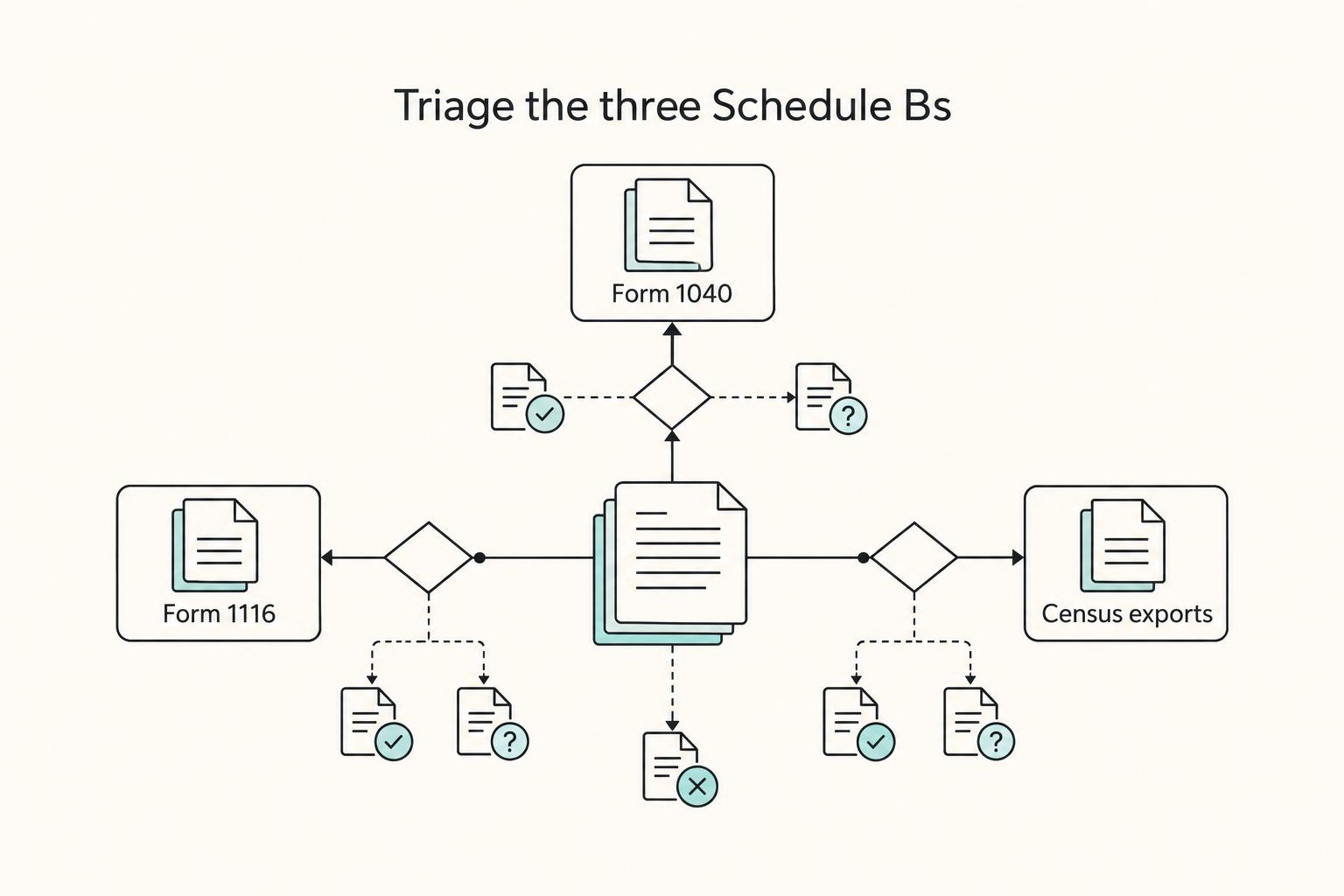
Step 1: Triage - Which Schedule B Demands Your Attention?#
Start by matching "Schedule B" to its parent form. For a personal return, the immediate compliance issue is usually Schedule B (Form 1040). Schedule B (Form 1116) is a separate foreign tax credit carryover schedule, and Census Schedule B belongs to export reporting, not individual income tax filing. Use these four rules to sort it quickly.
| Form | What it does | Why you care | What action to take now |
|---|---|---|---|
| Schedule B (Form 1040) | Reports interest and ordinary dividends, and includes Part III foreign account and trust questions | It can directly affect your Form 1040 filing, especially if you have foreign accounts | Check whether your interest or dividends exceed the current filing-year threshold, and separately check whether you had foreign account financial interest or signature authority |
| Schedule B (Form 1116) | Reconciles prior-year and current-year foreign tax credit carryovers | It helps preserve foreign tax credit amounts that may offset U.S. tax in other years | If you are filing Form 1116 with carryovers, pull prior returns and track carryovers by income category |
| Census Schedule B | Classifies exported goods for U.S. trade reporting | Usually irrelevant to an individual return | Ignore it unless you are handling export reporting for goods |
Decision rule 1: if you are preparing Form 1040 and you have foreign financial accounts, prioritize Schedule B (Form 1040), Part III. This goes beyond interest and dividends. Part III also asks whether you had a financial interest in, or signature authority over, a foreign financial account and whether you are required to file FinCEN Form 114, commonly called the FBAR.
Decision rule 2: if you are using foreign tax credit carryovers on Form 1116, open Schedule B (Form 1116). This schedule is for carryover reconciliation, not for reporting bank interest or ordinary dividends.
Decision rule 3: keep Schedule B (Form 1116) carryovers separated by income category. Do not treat carryovers as one pooled balance. Keep category labels consistent from year to year and support them with prior Form 1116 records.
Decision rule 4: if you end up in export codes or shipping classifications, you are looking at Census Schedule B, not your individual tax filing.
If you keep one priority in mind, make it this: get Schedule B (Form 1040), especially Part III, right first. That is where foreign account disclosure connects to the rest of your return. You might also find this useful: A Guide to Schedule E (Supplemental Income and Loss) for Foreign Rental Property.
Step 2: Answer Part III correctly and know when FBAR filing follows#
Treat Part III as a decision gate, not a memory test. It is where your Schedule B (Form 1040) answers can send you down a separate FBAR filing path.
Treat Part III as a decision gate#
In practice, two triggers matter here: an income trigger and a foreign account relationship trigger. The second one is easy to miss. It turns on your relationship to the account, meaning financial interest or signature or other authority, not on whether the account produced taxable income.
The form logic is straightforward. If you answer that you had a qualifying foreign account relationship, Schedule B then asks whether you are required to file FinCEN Form 114 and, if required, to list the foreign country or countries where the accounts are located. A wrong Part III answer can create compliance risk even when account income is low or zero.
| Trigger | What you check | What filing it drives | What to document now |
|---|---|---|---|
| Taxable interest or ordinary dividends over $1,500 | Your yearly total taxable interest and ordinary dividends | Schedule B (Form 1040) | Statements, payer names, and totals used on the return |
| Financial interest in a foreign account | Whether you had a financial interest in a foreign bank, securities, mutual fund, cash-value insurance, or other foreign financial account | Schedule B Part III, and potentially FinCEN Form 114 if aggregate foreign-account value exceeded $10,000 at any time during the year | Account holder name, account identifier, institution, country, account type, maximum value |
| Signature or other authority over a foreign account | Whether you could control funds without ownership, for example signatory authority | Schedule B Part III, and potentially FinCEN Form 114 | Proof of authority, account details, and maximum value if reportable |
| Joint ownership of a foreign account | Whether you jointly held the account with another person | Schedule B Part III, and potentially FinCEN Form 114 | Ownership evidence and full maximum account value (each joint owner reports the entire value on FBAR) |
Practical rule: answer the disclosure question based on the account relationship first. Then determine whether a separate FBAR filing is required.
Build records before filing season#
The safest approach is to keep a live account inventory and capture each account's highest value during the year. FBAR uses an aggregate value test across foreign financial accounts, so several smaller accounts can still trigger filing.
| Item | What to keep |
|---|---|
| Account name | Account name |
| Number or designation | Number or designation |
| Institution | Institution |
| Type | Type |
| Maximum value | Highest value during the year; use a reasonable approximation if needed |
| Retention | These records for 5 years |
Use a reasonable approximation of each account's maximum value for the year, and keep records showing the account name, number or designation, institution, type, and maximum value. Retain them for 5 years.
Know the common failure modes#
Most misses come from a few bad assumptions: answering "No" because no taxable income was generated, applying a per-account test instead of an aggregate test, or missing signature-authority and joint accounts. Do not file the FBAR with the tax return. It is filed separately through BSA E-Filing.
| Issue | Common mistake | Grounded check |
|---|---|---|
| Account income | Answering "No" because no taxable income was generated | Answer the disclosure question based on the account relationship first |
| Threshold test | Applying a per-account test instead of an aggregate test | Confirm whether aggregate foreign-account value exceeded $10,000 at any time during the year |
| Account relationship | Missing signature-authority and joint accounts | Include accounts you owned, jointly owned, or had signature or other authority over |
| Filing method | Filing the FBAR with the tax return | File it separately through BSA E-Filing |
| Timing reference | Using older June 30 wording | Verify current-year guidance; IRS guidance states April 15 with an automatic extension to October 15 |
| Penalty figures | Relying on stale figures | Check current standards before you file or amend |
For timing, verify current-year guidance before filing. IRS guidance states April 15 with an automatic extension to October 15. Older June 30 wording still appears in some regulatory text, so use the current instructions each cycle. For penalties, do not rely on stale figures. Check current standards before you file or amend.
Safe default checklist
- Build one master inventory of all foreign financial accounts you owned, jointly owned, or had signature or other authority over.
- Capture each account's maximum yearly balance.
- Confirm whether aggregate foreign-account value exceeded $10,000 at any time during the year.
- Escalate to a qualified tax professional before answering Part III if you have unusual account types, missing records, entity-owned accounts, or uncertainty about reportability.
Step 3: Accelerator - Turn Schedule B (1116) Into a 10-Year Tax Advantage#
Treat Schedule B (Form 1116) as a running carryover record, not a once-a-year form task. Used well, it helps you use eligible credits before they expire and makes uneven tax years easier to manage.
Schedule B (Form 1116) reconciles prior-year and current-year foreign tax credit carryovers, and those balances move from year to year. Excess foreign taxes may be carried back to the prior tax year and carried forward to future tax years, but any amount still sitting from the 10th preceding tax year expires unused.
Treat it like a running balance, not a one-year calculation#
Start each filing cycle with last year's Schedule B (Form 1116). The total on Schedule B line 3, column (xiv) is included on Form 1116, Part III, line 10, together with any carrybacks to the current year. Those amounts need to align.
Track everything by Form 1116 income category, not as one pooled credit amount. Interest and dividends are generally passive category income, and passive carryovers are handled within that same category.
| Filing year pattern | What it means in practice | What you do |
|---|---|---|
| Higher foreign tax year | Foreign taxes in a category may exceed that category's current FTC limitation | Claim the allowable amount now, then track unused amounts for carryback or carryforward |
| Lower foreign tax year | Current foreign taxes may be below the category limitation | Review prior carryovers in that same category and apply eligible amounts before they age out |
| Older carryovers | Balances can expire if left unused | Monitor oldest-year balances first, including amounts approaching the 10th preceding tax year |
This only works if you stay disciplined. If category tracking slips even for one year, it becomes much harder to use older credits confidently later.
Use the same carryover workflow every filing cycle#
- Review prior carryovers by category from last year's Schedule B (Form 1116).
- Map current foreign-source income into the correct Form 1116 category.
- Apply current-year credits, then carryovers or carrybacks where allowed, and confirm that Schedule B line 3, column (xiv) flows to Form 1116 line 10 where applicable.
- Document what remains by year and category so upcoming expirations are visible.
Use investment income and client mix as planning signals#
If your foreign-source interest and dividends are passive category income, passive carryovers are most useful when you continue to have foreign-source passive income that can absorb them. The key is correct source and category mapping each year, not assumptions based on account labels.
Client mix matters for the same reason. The decision point is whether you have foreign-source income in the relevant Form 1116 category. If your income profile shifts, your carryover usage rate can shift with it.
You also cannot claim the foreign tax credit on taxes tied to income you exclude under FEIE or the foreign housing exclusion. If income is excluded, the associated taxes are not available for the credit.
Know when to involve a cross-border tax pro#
Bring in help when the facts move beyond straightforward carryover tracking, especially in situations like these:
| Situation | Special handling noted | Why it stands out |
|---|---|---|
| Treaty re-sourced income | Separate foreign tax credit limitation handling and separate Form 1116 computations for treaty re-sourced amounts | Moves beyond straightforward carryover tracking |
| Foreign tax changed after filing | Schedule C (Form 1116) redetermination handling | Can affect relation-back or carryover years |
| Section 951A category income | The usual Form 1116 line 10 carryover or carryback treatment does not apply in that category | Moves beyond straightforward carryover tracking |
The rule of thumb is simple: maintain carryovers annually by category, and escalate early when treaty, redetermination, or section 951A issues appear. If you want a deeper dive, read the digital nomad tax guide.
Step 4: The Strategic Choice - Integrating Schedule B with FEIE vs. FTC#
Do not start this choice with a generic rule. Start with what is already on your return. Schedule B (Form 1040) reports interest and ordinary dividends, while FEIE is a voluntary Form 2555 election for foreign-earned income from personal services. If you have meaningful Schedule B income or existing Schedule B (Form 1116) carryovers, FEIE is not automatically the first move.
The connection matters because Schedule B Part III asks about foreign financial accounts and usually the country where each account is located. When taxable interest or ordinary dividends are over $1,500, Part III of Schedule B must be completed. Use Part III as a control check against the accounts generating your income and any related foreign tax documents.
Start with earned income versus Schedule B income#
The first cut is not complicated. Foreign-earned income is compensation for your services. Schedule B income is interest and ordinary dividends. That split is the core decision input because FEIE applies to the earned slice, while Schedule B income stays in the U.S. tax calculation.
Use a decision table, not a gut call#
| What your return looks like | FEIE often gets the first look | FTC deserves the first full model | Why it changes the choice |
|---|---|---|---|
| Mostly salary or consulting income, very small Schedule B totals | Test whether Form 2555 can exclude up to the current exclusion limit | Still model FTC if foreign tax paid is material | FEIE only addresses earned income |
| Earned income plus noticeable interest or dividend income from foreign accounts | FEIE may still help on services income | FTC often becomes more attractive because it is designed to relieve double taxation on foreign-source income | Schedule B income remains in your U.S. tax picture |
| Prior-year FTC carryovers already tracked on Schedule B (Form 1116) | Use caution before excluding more income if it reduces credit use | Strong candidate when category carryovers may expire | Look closely at the tax cost of losing carryover use |
What changes the answer is not the label on the election. It is the interaction among your earned income, your investment income, and any carryovers you are trying not to waste.
Follow this choice sequence before you file#
- Review your income mix. Separate earned income from interest and dividends using your draft return and statements. If it is on Schedule B, do not treat it as FEIE-eligible.
- Check your foreign tax profile. If you elect FEIE or the foreign housing exclusion, you cannot claim the foreign tax credit on taxes tied to excluded income.
- Check your carryover position. Review Schedule B (Form 1116) by category, not as one pool. Unused amounts can carry back to the previous year and forward up to 10 tax years, and any remaining carryover from the 10th preceding year expires unused.
- Model future-year implications. FEIE is voluntary, but once chosen it continues for later years unless revoked, and re-choosing within 5 tax years after revocation requires IRS approval.
The stacking rule is where FEIE can change the result#
This is the point many people miss. If you claim FEIE, tax on your remaining non-excluded income is computed using the rates that would have applied without the exclusion. In practice, that can raise the rate applied to your remaining taxable income, including interest and dividends reported on Schedule B.
Action step: model both FEIE and FTC paths before filing. Then reconcile Schedule B Part III account countries, Schedule B income lines, and any Form 1116 carryovers so your election is based on one consistent return. Related: 183-Day Rule Explained: Stop the Tax Myths Before They Cost You. Before you lock in your filing approach, run a quick disclosure sanity check with the FBAR calculator.
Confirm Schedule B applies, file matching disclosures, and keep records#
Control comes from running this as a sequence: confirm whether Schedule B (Form 1040) applies, file disclosures that match the facts, and keep records ready for the next cycle.
Start with triage. As a U.S. citizen or resident alien abroad, your worldwide income is still in scope, and qualifying for FEIE or the foreign tax credit does not remove the filing requirement. Confirm whether Schedule B (Form 1040), Interest and Ordinary Dividends, is part of your return and whether foreign tax credit work is also needed.
Then handle the compliance side carefully. Your return, account list, and disclosure answers should all reflect the same account ownership and income facts. If you rely on the automatic two-month filing extension for eligible taxpayers abroad, attach the required statement to your return. Remember that interest can still accrue on unpaid tax after the regular due date.
Finish with documentation discipline. Keep the records that support your reported interest, dividends, and any foreign tax credit position so you can file cleanly next year and respond quickly if questions come up.
What to do now#
- Confirm the correct Schedule B (Form 1040) use case for your return.
- Verify that foreign-account disclosures align with your actual ownership and reporting history.
- Reconcile reported interest and ordinary dividends to your statements before filing.
- Preserve your return, account statements, foreign tax records, and any extension statement for future filing cycles.
If account ownership, reporting history, or foreign tax credit treatment is unclear, pause and get cross-border tax advice before filing.
Consistent compliance is the real advantage here. When your facts, forms, and records stay aligned, filing gets easier and long-term tax decisions improve. We covered this in detail in FBAR and FATCA Reporting for US Expats. If you want a repeatable, low-stress filing workflow beyond this guide, start with the tools library.
Frequently Asked Questions
Do you have to file Schedule B just because you have a foreign bank account?
Possibly. The income-based trigger depends on the current filing-year instructions, and foreign-account ownership may also create Schedule B reporting duties under those instructions. Low or zero investment income does not automatically mean you can skip review.
What is the difference between Schedule B for Form 1040 and Form 1116?
Schedule B (Form 1040) reports interest and ordinary dividends and includes Part III foreign account and trust questions. Schedule B (Form 1116) reconciles prior-year and current-year foreign tax credit carryovers by income category. Keeping them separate helps you avoid mixing disclosure work with carryover tracking.
Does filing Schedule B automatically mean you will owe more U.S. tax?
No. Filing Schedule B is a reporting step, not automatic proof that you owe more U.S. tax. Whether additional tax is due depends on your full return. If foreign income was taxed abroad, review Form 1116 before assuming you are being taxed twice.
Can you use the foreign tax credit on interest and dividends reported on Schedule B?
Often yes, if the interest or dividends are foreign-source and you paid qualifying foreign income tax on them. The claim is made on Form 1116, and interest and dividends are generally passive category income. If taxes were paid to more than one country or U.S. territory, use separate country columns and lines and report amounts in U.S. dollars unless Part II instructs otherwise.
What happens if you miss a foreign-account disclosure or answer Schedule B foreign-account questions incorrectly?
A wrong or missing Schedule B foreign-account answer can create compliance risk even when account income is low or zero. The exact consequences depend on current-year rules and your facts, so review the return promptly to see whether a correction is needed. If multiple years may be involved, speak with a qualified tax professional.
Try a related tool
Researched and edited by the Gruv editorial team. Gruv builds cross-border billing, payouts, and finance-operations software for global businesses.
Sources
Educational content only. Not legal, tax, or financial advice.
Related Posts

Digital Nomad Taxes in 2026 With a Defensible Filing Plan
With digital nomad taxes, the first move is not optimization. It is figuring out where you may be taxable, where filings may be required, and what proof supports that position.

183-Day Rule Tax Myths That Trigger Residency Filing Mistakes
If you are a mobile freelancer or consultant, start here: the "183 day rule tax" idea is not a single universal test. It is a shortcut phrase people use for different residency rules that do not ask the same question. If you mix federal and non-federal residency logic, you can create filing risk even when your travel calendar looks clean.

The Freelance Payment Penalty: A Modeled Audit of Platform Fees, FX Spreads, and Payout Delays
The money rarely disappears through a single, easy-to-spot fee. The real loss is stacked. A marketplace takes its commission, a processor adds a charge for international cards, a bank or payment company converts the currency at a spread, a platform holds the funds before release, and a wire sheds a little to intermediaries on the way in. Each layer looks defensible on its own, but the worker feels the combined result as a smaller deposit and a later payday.