
Quick Answer
Build your scenius and creative community as a portfolio, not a single scene. Assign each room a job, set sharing boundaries up front, and track whether participation improves a live decision, sharpens an artifact, or creates a relevant introduction. Use mastermind sessions for strategic calls, niche groups for specific blockers, and broad networks for light market signal. If a group keeps consuming time without producing decision-quality gains, downgrade or exit.
Why the Old 'Scenius' Model Falls Short When You Work Alone#
Creative community can help, but for a solopreneur it is rarely free. If you work alone, every collaboration choice is also a control choice. It affects who gets your time, who sees unfinished thinking, and who shapes your next move.
| Checkpoint | What recent activity should show | If you cannot verify it |
|---|---|---|
| Solved problem | One solved problem | Keep participation light |
| Useful introduction | One useful introduction | Keep participation light |
| Boundary on sharing | One clear boundary on sharing | Keep participation light |
The older romantic story suggests that if you immerse yourself deeply enough in the right circle, better work and better opportunities will follow. In practice, your operating reality is less forgiving. You may be juggling client deadlines, sharing digital drafts, replying across different schedules, and trying to protect a clear point of view under your own name. In that context, participation is not neutral. It has a cost, and vague participation can charge full price.
A better question is not, "How do I find my scene?" It is, "What does this group change in my business, and what does it ask from me in return?" That matters because access can be distorted. One grounded example comes from venture networks, where "warm introductions" have been described as an exclusionary, value-destroying practice. If a community runs on hidden gates or insider routing, belonging can look valuable while producing little.
| Legacy assumption | Current reality | Business risk if ignored |
|---|---|---|
| If you get close to the circle, opportunity will surface naturally. | Access may depend on warm introductions, informal gatekeepers, or opaque norms. | You invest time in status games instead of getting useful feedback or real leads. |
| More conversation means more insight. | Community input often mixes useful signal with noise. | Low-signal participation eats attention and leaves you with little you can actually use. |
| Informal trust is enough. | You may be sharing drafts, client context, and early ideas in chats, calls, and shared docs. | You may overshare or create confusion about what is public, private, or attributable. |
| The group will strengthen your identity. | Communities often have their own tastes, language, and incentives. | Your brand can get blurry if you start echoing the room instead of sharpening your own position. |
That is the Autonomy Paradox in practical terms. You want outside perspective, but the wrong group can create recurring risks: time leakage, oversharing, brand confusion, and low-signal participation. These issues may not arrive as a dramatic blowup. They can show up as drift: too many calls, too much reactive posting, too much unfinished work shared too early, and too many opinions you cannot convert into a decision.
Before you go deep, verify a few basics. Read the written rules, if there are any. Check how people introduce each other, how attribution is handled when ideas are discussed, and whether recent discussions produced something concrete or just clever noise. A simple checkpoint is to scan recent activity and ask: can you identify one solved problem, one useful introduction, and one clear boundary on sharing? If not, keep your participation light.
That is why you may not want one all-consuming community. You can build a portfolio, with each group assigned a role and a clear rule for how far in you go. Related: The Best Digital Nomad Communities to Join.
Architecting Your 'Scenius Portfolio': A Risk-First Framework#
Treat your portfolio as a system, not an identity: each community needs a role, a clear expected outcome, and a stop condition if it underperforms. If you cannot define those three items in one sentence, keep participation light until you can.
Use this three-bucket structure to assign the right level of trust, time, and sharing:
| Bucket | Purpose | Ideal participation style | Likely upside | Primary risk | Lightweight governance |
|---|---|---|---|---|---|
| Mastermind group | Test strategic decisions before you commit | Small, prepared sessions with direct feedback | Better decision quality on live business choices | Oversharing, groupthink, meeting bloat | Entry: peers you trust and can challenge. Boundary: no client-identifying details or raw deliverables unless you accept that exposure. Norms: agenda first, attribution expectations explicit, critique ideas not people. |
| Niche skill groups | Solve specific craft or technical blockers faster | Short, tactical participation tied to active problems | Faster troubleshooting and practical learning | Rabbit holes and low-relevance chatter | Entry: active practitioners in your problem area. Boundary: share sanitized examples, not proprietary files. Norms: ask narrow questions, capture answers, exit the thread when resolved. |
| Broad networks | Monitor market signal and maintain light visibility | Low-intensity reading with selective contribution | Reach, perspective, occasional introductions | Noise and accidental public oversharing | Entry: enough signal to justify monitoring. Boundary: assume public-safe sharing by default. Norms: read first, post briefly, move sensitive discussion only after checking channel norms. |
Match the channel to the job. A weekly visible open thread is designed for broad, low-constraint participation, so treat it as a listening post rather than a strategy room. In one documented setup, activity also spans unofficial channels (subreddit, Discord, bulletin board, and in-person meetups), so verify where useful exchanges actually happen before you commit more time.
For skill communities, prioritize evidence of real practice over commentary. One grounded example describes collaboration supported by concrete infrastructure (rehearsal rooms, production suites, and named performance spaces, including a 400-seater hall). The practical translation for you: confirm where members actually test work together and whether the group supports cross-tradition collaboration, not just one repeated style.
Keep the value ledger simple and decision-linked: what you contributed, what you got back, and which decision improved. Then decide explicitly: continue, adjust, or exit based on observed signal, not habit.
Apply due diligence before deeper participation, so your collaboration stack helps your business without eroding autonomy. You might also find this useful: How to Join a Mastermind Group for Your Freelance Business.
What to Verify Before You Join a Professional Community#
If a community asks for trust before it gives you clear rules, do not join. Treat this as a pre-join gate: if you cannot verify a point in writing or by direct observation, count it as missing evidence.
| Decision gate | What you verify before joining | Why it matters | Do not join if |
|---|---|---|---|
| Governance | Confirm a real rules source (terms page, signup terms, or member guidelines). Verify ownership, who can moderate or remove content, how conflicts are handled, and what a clean exit looks like for your posts, files, and relationships. A visible signup policy link is a useful signal, such as: "By subscribing, you agree Substack's Terms of Use." | You need clear authority and process before problems happen. A clean exit protects your work and lowers avoidable relationship damage when you step back. | Rules are verbal only, ownership is unclear, moderators are undefined, or no one can explain what happens when you leave. |
| IP norms | Ask boundary questions before sharing anything valuable: what is confidential, what can be reused outside the group, and how attribution works. If policy text is referenced, read the current text yourself. Keep in mind a platform may claim rights in the database/container without claiming rights in underlying works. | Your drafts and examples are business assets. You need explicit boundaries before contributing. | You are pushed to share before seeing terms, or the answer is "just use common sense" instead of clear boundaries. |
| Contribution to value | Observe first. Check signal-to-noise, reciprocity, and whether participation supports your business goals. Look for practical response quality, acknowledgment patterns, and friction signals in the workflow. Example signals can conflict: "Contribute a new term" suggests openness, while "Verification failed" suggests access friction. Sponsor placement or large audience size can indicate reach, but not fit. | Active communities can still waste time if the format is noisy or hard to use. You are testing whether effort turns into better decisions. | A few people do all the useful work, most activity is performative, or you leave with more noise than clarity. |
Use verification artifacts, not branding, to make the call. Signals like "Open Dissertation," "Download PDF," and a visible identifier such as 10605619 show inspectable status; communities should show equivalent legibility in terms, roles, and boundaries before you contribute.
If a group passes due diligence, the next step is still essential: set engagement rules so you can participate deeply without losing autonomy.
If you want a deeper dive, read GDPR for Freelancers: A Step-by-Step Compliance Checklist for EU Clients.
The Autonomy Protocol: How to Engage Deeply Without Losing Control#
After a community passes due diligence, the main risk is overparticipation. Use a weekly protocol that keeps collaboration useful without turning you into always-on support.
Scenius depends on real conversation and shared thinking, but that creates coordination drag. Your goal is not maximum presence; it is controlled participation under real time and resource limits.
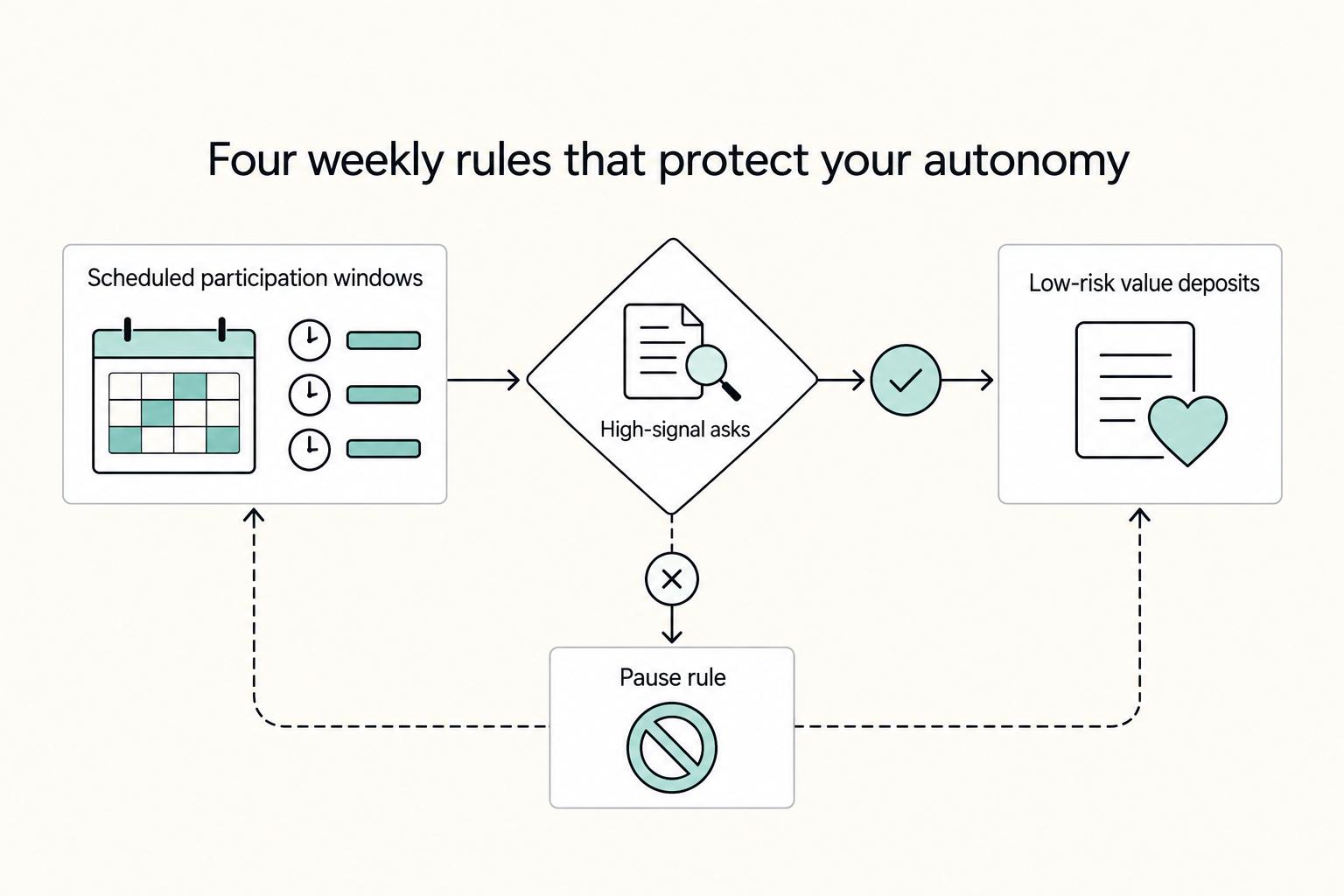
Four weekly rules that protect your autonomy#
| Rule | What to do | Guardrail |
|---|---|---|
| Scheduled participation windows | Block specific windows for reading, replying, and posting | Do not check in outside those windows unless it supports an already-approved active project |
| Pause rule | Pause for a week if community activity starts colliding with delivery, recovery time, or planned business development | Use the checkpoint questions: Are you happy? Are you proud of your work? |
| High-signal asks | Before posting, write the decision you need to make, the constraint you cannot change, and the kind of answer that would move you forward | If you cannot name the decision, draft offline first |
| Low-risk value deposits | Share summaries, redacted checklists, sanitized examples, or lightweight documentation | Make the contribution, then exit the thread |
- Work from scheduled participation windows, not ambient checking.
Block specific windows for reading, replying, and posting, and treat them like client work on your calendar. Outside those windows, do not check in unless it supports an already-approved active project.
- Use a pause rule when participation starts hurting core work.
Pause for a week if community activity starts colliding with delivery, recovery time, or planned business development. During the pause, ask yourself two checkpoint questions: Are you happy? Are you proud of your work? If either answer is drifting toward no, adjust your participation pattern before re-engaging.
- Post only high-signal asks.
Before posting, write three lines: the decision you need to make, the constraint you cannot change, and the kind of answer that would move you forward. If you cannot name the decision, draft offline first.
- Make low-risk value deposits, then exit the thread.
Share assets that help others without exposing sensitive work: summaries, redacted checklists, sanitized examples, or lightweight documentation (for example, a couple of pictures if that is enough). Avoid building big permanent systems when a small usable contribution will do.
What a good ask looks like#
| Context | Weak ask | High-signal ask |
|---|---|---|
| Client work | "Any thoughts on this client situation?" | "A client asked for another revision after sign-off. I need to decide whether to absorb it or treat it as a scope change. What reply would you send?" |
| Pricing | "What should I charge?" | "I am quoting a fixed-fee package. The buyer wants faster turnaround with the same scope. Should I raise price, reduce deliverables, or hold scope and timeline?" |
| Workflow | "My process feels messy. Advice?" | "Approvals arrive through three channels and handoff keeps slipping. I need one approval path. Which step would you standardize first?" |
Share value without giving away the store#
Before you post, run a quick IP boundary check: does this include confidential context, unreleased deliverables, personal data, or the exact method you sell as expertise? If yes, cut it back or keep it private.
| Content to screen for | If it appears in the post |
|---|---|
| Confidential context | Cut it back or keep it private |
| Unreleased deliverables | Cut it back or keep it private |
| Personal data | Cut it back or keep it private |
| The exact method you sell as expertise | Cut it back or keep it private |
Set one escalation rule in advance: if community requests conflict with client work, compliance duties, or core priorities, follow your operating plan.
That is the practical balance: participate deeply, but through repeatable systems rather than constant availability. With that protocol in place, the common questions are easier to answer.
For a step-by-step walkthrough, see How to Use a Community to Reduce Churn and Increase LTV.
Conclusion: Engineer Your Ecosystem, Own Your Future#
Stop looking for one room to solve everything. You need a portfolio of communities you chose on purpose, with clear limits, clear roles, and a review habit you actually keep.
That shift matters because scenius is not magic or luck. In the source material behind this article, it is framed as something rooted in infrastructure and culture, not accident. So treat your professional network the same way. Choose conditions that support your work, not just communities that feel exciting. A place or group can be popular and still be a poor fit for you. A city can stay attractive while carrying a real seasonal downside, such as Chiang Mai's smoky season from mid-March to mid-May.
Your non-negotiables stay simple. You keep decision authority. You protect sensitive details and clear authorship boundaries. You control time spent so community activity does not crowd out paid work or deep work. If a group pressures you to overshare, blurs authorship, or regularly steals focus without improving a live decision, it does not belong in your mix.
What you do next is straightforward:
- choose your mix of rooms based on function, not status
- set operating rules before you get socially attached
- review fit on a recurring schedule using a short checklist
That checklist can stay plain: Did this room improve a real decision, sharpen a real artifact, or create a relevant introduction? If not, do not keep paying the social cost. Watch for one more failure mode too. A similar dependency problem can show up when the value disappears if one host leaves or one key member goes quiet.
The useful part of creative community is not belonging for its own sake. It is disciplined participation that can give you clearer judgment, better collaboration fit, and enough protected focus to keep shipping.
Frequently Asked Questions
How do you build a scenius and creative community as a solopreneur?
Start small instead of trying to make one all-purpose room do everything. Build a mix of communities that serve different purposes, and keep solo practice at the center. Scenius is communal creativity, but solo deliberate work is still necessary.
Scenius vs. mastermind: which one should you use?
Use scenius-style communities when you need a wider creative network and an ecology of talent. Use a smaller peer-scrutiny format when you need direct feedback on live decisions or work. In practice, many people use both, with clear boundaries so social immersion does not crowd out creative solitude. | Option | Use it when | Participation style | Main risk if misused | | --- | --- | --- | --- | | Scenius | You need broader perspective from a creative network | Flexible participation across multiple scenes | Time diffusion without enough depth | | Small peer-scrutiny group ("mastermind") | You need focused feedback and higher trust on specific decisions | Deliberate, high-trust exchange | Overdependence or groupthink | | Portfolio of both | You want breadth plus focused scrutiny | Intentional mix with clear limits | Too many rooms and context switching |
What is the real ROI of this kind of participation?
Treat ROI as a test, not a guarantee. Define a few concrete before/after checks, then review whether participation is improving decisions, learning loops, or execution. If those signals are not improving, the social time may be outweighing the practical value.
What are the biggest risks of joining a professional community?
The core tradeoff is social immersion versus creative solitude. Another risk is low-trust collaboration that feels active but does not improve the work. Watch whether trust and authenticity are actually present, and whether participation still leaves room for focused solo practice.
How do you verify that a group is actually improving your work?
Bring one real decision or one concrete artifact and ask for specific scrutiny, not vague encouragement. Stronger evidence looks like better judgment on a live choice or useful feedback on reviewable work, including recorded work where appropriate and permitted. Prefer checkpoints you can revisit over general impressions.
When should you stay, downgrade, or exit a community?
Use explicit decision questions at each review point: Is your work done here, and can the value be replaced elsewhere? Stay if the group still improves your work. Downgrade if value exists but no longer justifies the time. Exit when fit or replacement value is clear.
Try a related tool
Researched and edited by the Gruv editorial team. Gruv builds cross-border billing, payouts, and finance-operations software for global businesses.
Sources
Includes 4 external sources outside the trusted-domain allowlist.
- academia.edu/1320506/Travels_in_Intertextuality_the_autop...trusted
- blogs.ncl.ac.uk/iaspmuki2024/files/2024/09/IASPM-UKI-2024-Co...trusted
- digitalcommons.memphis.edu/cgi/viewcontent.cgitrusted
- ec.europa.eu/research/participants/documents/downloadPublictrusted
- 4thgenerationcivilization.substack.com/p/towards-civilizational-ai-our-centralexternal
- astralcodexten.com/p/open-thread-336external
- creativecodex.coexternal
- creators.spotify.com/pod/show/beingsceniuspodcastexternal
Educational content only. Not legal, tax, or financial advice.
Related Posts

GDPR Compliance Checklist for Freelancers Working With EU Clients
Start by separating the decisions you are actually making. For a workable **GDPR setup**, run three distinct tracks and record each one in writing before the first invoice goes out: VAT treatment, GDPR scope and role, and daily privacy operations.
The Best Digital Nomad Communities to Join
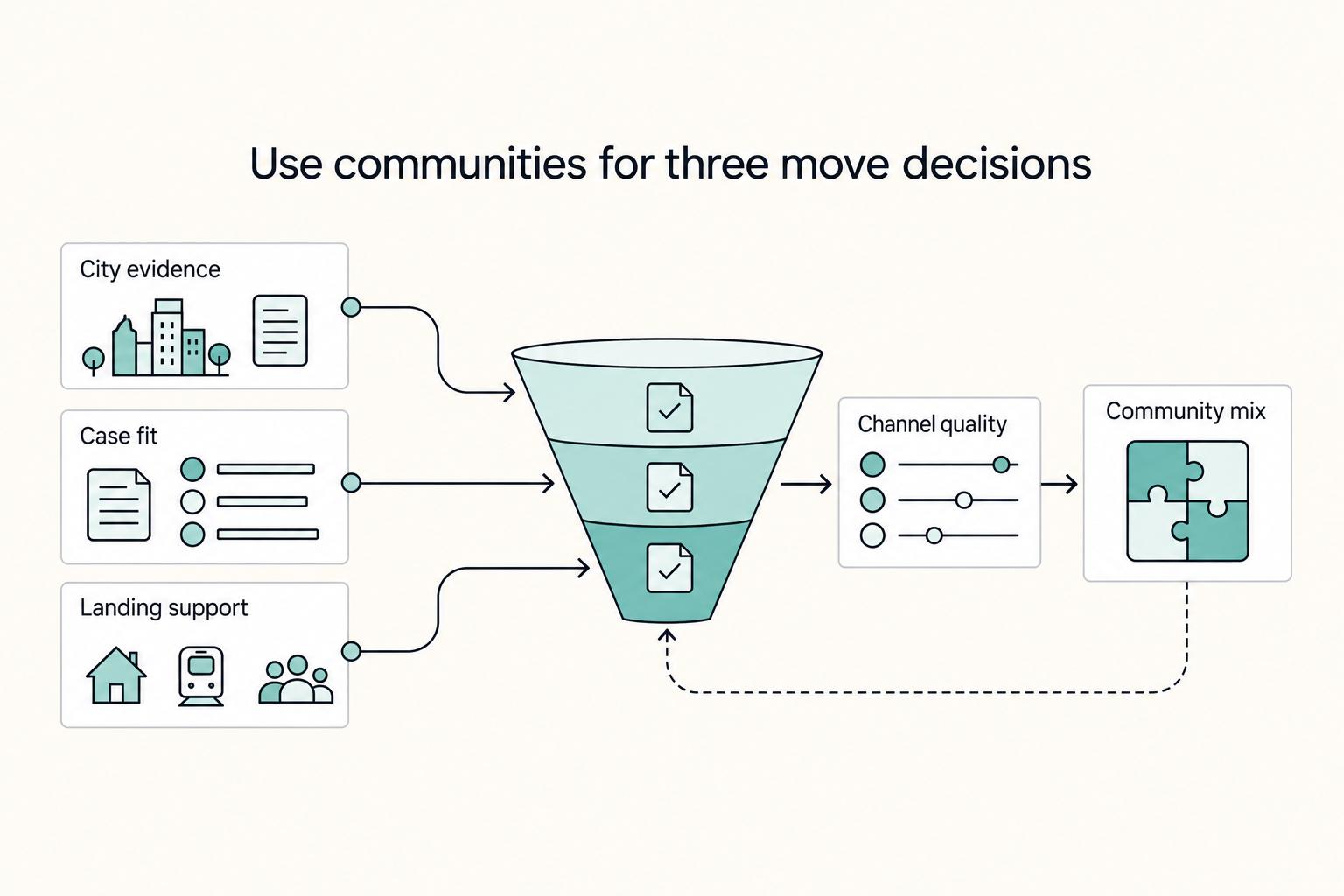
If your move date is real, use communities to answer three decisions in order: which city stays on your list, whether your case actually fits, and whether your landing week is covered. Judge every channel by outcomes, not activity. If it does not give you evidence you can use, stop giving it time.
How to Join a Mastermind Group for Your Freelance Business
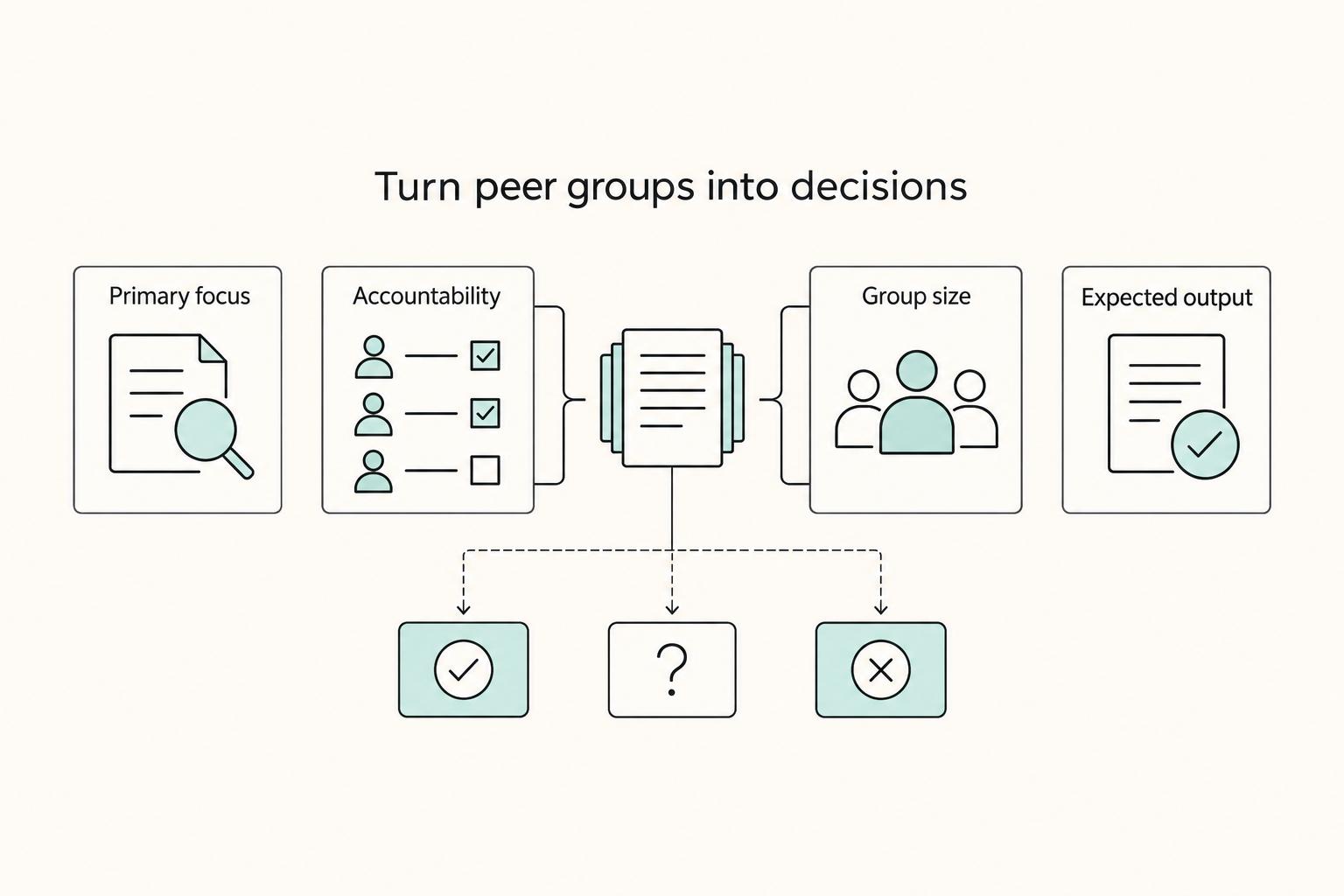
A **freelance peer group** can do more than make you feel less alone. At its best, it works like a personal board of directors: a small group that meets regularly to discuss issues, test decisions, and hold each other accountable, not just a general support circle.