
Quick Answer
Run a brand workshop as a structured sequence: align on value, set boundaries, and convert decisions into working terms before design choices dominate. Start with a Core Audit, then move into positioning, then lock an Engagement Protocol tied to approvals and scope changes. Capture decisions in plain language as they happen, and carry them into proposals and the Statement of Work so expectations stay consistent after kickoff.
Your Brand is Not a Logo. It's Your Primary Defense Mechanism.#
If you want to run a brand workshop well, treat brand as a decision model, not a debate about fonts. The real job is to help a client define how they explain value, where they draw boundaries, and how work gets approved before visuals lock anything in.
That matters because vague brand language does not always stay in a strategy deck. It can show up in live client behavior: teams may question price, scope can stretch at the edges, and approvals can become soft and reversible. Contracts can end up carrying arguments that should have been settled earlier. This is not a logo critique. It is workshop-led alignment on value, boundaries, and engagement rules.
Many creative professionals lead these conversations with little formal management training. That is why this work needs business acumen, not just taste: decision-making, cross-functional communication, and enough financial literacy to connect positioning to budget, scope, and timing.
| Dimension | Style-only branding | Operational brand system |
|---|---|---|
| Main question | "What should it look like?" | "What do we stand for, promise, and refuse?" |
| Client outcome | A visual direction | A shared basis for offers, approvals, and boundaries |
| Decision speed | Often faster on surface choices, slower when strategy questions return later | Slower upfront, clearer once rules are written down |
| Delivery risk | More rework risk when expectations were implied | Less ambiguity when key decisions are named early |
Think of this as your Brand Shield: a practical way to turn brand work into something the client can use when pressure shows up. First, the Core Audit defines the value that should not move. Next, the Positioning Blueprint makes the offer easier to understand and compare. Last, the Engagement Protocol turns that thinking into rules for scope, approvals, and working terms.
What this is and what it is not#
This process works best as the setup for everything that follows. It is not an argument that visual identity does not matter, and it is not a promise that one workshop fixes every delivery problem. It is a reminder that identity work lands better when the client has already agreed on the business meaning behind it.
Use a simple checkpoint before you open moodboards. Ask the key client voices to answer the same three questions in plain English: Who are we for? What problem are we trusted to solve? What is outside scope for this engagement? If those answers do not match, you are still doing alignment work.
A common failure mode is false agreement: people nod in session, then reopen basic questions in review because nothing was captured clearly. Your evidence pack should include written decisions, core claims, non-negotiables, approval roles, and a short list of red-line boundaries. That is the foundation for the next three steps.
Related: A guide to creating 'Brand Guidelines' for a client.
Step 1: The Core Audit - Codifying Your Unshakeable Value#
Treat this phase as complete only when the core decisions are written, read back, and approved live. Before moving on, capture and finalize:
- a short set of operating policies for how work is sold, approved, and delivered
- a one-line definition of the business problem this work is meant to solve
- a client-fit triage outcome for this engagement (
continue,clarify, ordecline) - a concise positioning statement the client approves in-session
Keep one shared document open during the workshop and write decisions in plain language as they are made. That is how you reduce false agreement and avoid reopening basics in proposal and scope reviews.
Turn non-negotiables into usable policy#
Write "non-negotiables" as operational rules, not values language. Use wording people can apply without interpretation, such as:
Feedback is consolidated through one client owner.Scope changes require written approval before work starts.Confirm the current deposit policy with finance or in the signed contract.
If a policy depends on legal or compliance material, mark it as verification-required until you check it against an official source.
For example, if a discussion references the FTC Non-Compete Clause Rule entry dated 05/07/2024, record it precisely (89 FR 38342) and verify against the official PDF on govinfo.gov. FederalRegister.gov states its daily Web 2.0 edition is an unofficial informational resource, and its XML does not provide legal or judicial notice, so do not treat an unofficial rendering as final policy evidence.
Reframe service labels into business value#
Use this live: convert each deliverable label into the business problem solved, then state the client-facing impact in plain language.
| Deliverable language | Outcome language | Client impact |
|---|---|---|
| Brand strategy deck | Clear agreement on what the company promises and what it will not promise | Fewer conflicting messages across teams |
| Website redesign | Clearer path for prospects to understand the offer and next step | Less confusion during evaluation |
| Messaging workshop | Shared language for proposals and client communication | Faster approvals with less rework |
If the impact column still sounds like studio shorthand, rewrite it until a non-specialist can explain it back.
Run fit triage before scope drafting#
Use red flags as risk triage, not opinion:
| Outcome | Use when |
|---|---|
| Continue | buyer can explain the problem, name decision owners, and accept core policies |
| Clarify | goals are broad, stakeholder alignment is unclear, or exceptions are requested without context |
| Decline | lead resists basic engagement terms, pushes price before scope is defined, or avoids contract structure |
Close Step 1 with a short positioning statement the client approves in the room: who you help, what business problem you solve, and how your working model is distinct. Use that line as the opening logic for the proposal and as a scope filter for the Statement of Work in the next steps.
Step 2: Build buying logic before you discuss fees#
Turn Step 1 into buying logic before you discuss fees. When you do this well, the client compares a defined business problem, a clear method, and expected evidence, instead of comparing you on rate alone.
Use this workshop sequence: problem clarity, value association, offer framing, then price. It aligns with the Customer-Based Brand Equity checkpoint for brand meaning: your positioning should be strong, favorable, and unique. If it is unclear, weak, or generic, revise it before you price.
Build the offer around the business problem#
Start with the business problem approved in Step 1, then map each activity to the business issue it addresses. If the room drifts back to labels like "strategy" or "messaging," ask what confusion, delay, or risk that work is meant to remove.
| Service activity | Business problem addressed | Evidence the client can track | Proposal language |
|---|---|---|---|
| Positioning synthesis | Leadership and sales describe the offer differently | One approved positioning statement used across proposal, site, and sales deck | "Create one market-facing promise the team can repeat consistently" |
| Messaging architecture | Prospects struggle to understand the value quickly | Fewer basic clarification questions in sales calls and review rounds | "Turn scattered service language into a buyer-ready message set" |
| Qualification criteria and engagement rules | Time is lost on poor-fit leads and exception requests | Count of declined misfit leads, fewer off-policy scope requests | "Define who the offer is for, and when not to sell it" |
This gives your internal buyer language they can defend: not "we need brand work," but "we need one offer story the team can use without contradiction." That framing can reduce comparison shopping and make internal approval conversations clearer.
Stress-test your onlyness before it goes in the proposal#
Your "Only-ness" claim should survive scrutiny, not just sound good. Use this test before it enters the proposal:
- If the claim is not backed by process, add the process.
- If the claim is not backed by proof or observable outcomes, narrow it.
- If too many competitors could say it, tighten the category focus or ideal client.
"We provide strategic clarity" is broad. "We help founder-led service firms replace conflicting sales language with one approved offer narrative before scope and pricing" is more defensible because it is specific about who, what, and when.
Present price after the value logic#
Discuss price only after the value logic is clear. Structure packages around real delivery differences, not cosmetic tier names.
In client conversations, keep the order consistent:
- Name the current business cost or friction.
- Show options and what each option changes.
- State a clear boundary: "Fees reflect the scope and level of involvement described here. Work outside this scope is quoted separately once defined." Confirm your current pricing policy against your own source records before sending.
That positioning output should flow directly into onboarding expectations and Statement of Work terms, where promises, limits, and change handling need to be explicit.
This pairs well with our guide on Create a Freelance Brand Style Guide You Can Use Every Day.
Step 3: Run a controlled workflow from proposal to signed SOW#
Once a client accepts your positioning, your next job is to run a controlled workflow from proposal to signed SOW. If you skip that structure, approvals stay vague, scope drifts, and hard conversations get harder.
Run a proposal-to-signature workflow you can repeat#
- Build the proposal as a decision document, not just a price sheet.
- Confirm approver ownership and review path in writing.
- Lock onboarding artifacts before work starts.
- Route pressure moments through one boundary script and escalation path.
- Move non-negotiables into the SOW with verified clause language.
Use the proposal to diagnose, not just quote#
Treat the proposal as your first control point: define the problem, outcomes, assumptions, dependencies, exclusions, and who approves. A useful operating model is negotiated process discipline: proposal intake and evaluation are handled explicitly rather than blended into price discussion.
| Proposal format | Scope clarity | Approval quality | Risk exposure |
|---|---|---|---|
| Proposal as quote | Usually lower because deliverables are listed without full assumptions, exclusions, or client duties | Often weaker because approval centers on price reaction | Higher because gaps surface during delivery |
| Proposal as diagnostic | Usually higher because problem, outcomes, dependencies, exclusions, and approval owner are stated upfront | Often stronger because the buyer can defend what is being approved | Lower because ambiguity is surfaced before signature |
Before you move forward, get three items confirmed in writing: the named approver, the review path, and the current business priority.
Onboard with required artifacts, in order#
Good onboarding starts with a documented sequence, then project-level customization.
| Artifact | What it covers |
|---|---|
| Kickoff agenda | objectives, attendees, decisions needed, and pre-read |
| Communication rules | channels, meeting rhythm, response handling, and the current communication policy, confirmed with the client or in the contract |
| Change-request path | where requests are submitted, who approves, and when work pauses pending approval |
| Approval ownership | who owns scope approval, content approval, and payment authorization |
Before signature, do one validation sweep: confirm linked docs, policies, and templates are current.
Use trigger-based playbooks for difficult moments#
Use one boundary line every time: "That changes the current agreement. I can update scope, timing, or cost once we confirm it in writing."
| Trigger | Playbook response |
|---|---|
| Scope change | restate request, label it out of scope, route to change control, pause extra work until written approval |
| Payment delay | confirm receipt status, point to payment terms, apply pause/escalation per policy; confirm the standard payment-delay clause against the signed contract |
| Timeline pressure | offer two paths only, reduce scope or accelerate client approvals; if neither changes, keep the committed date |
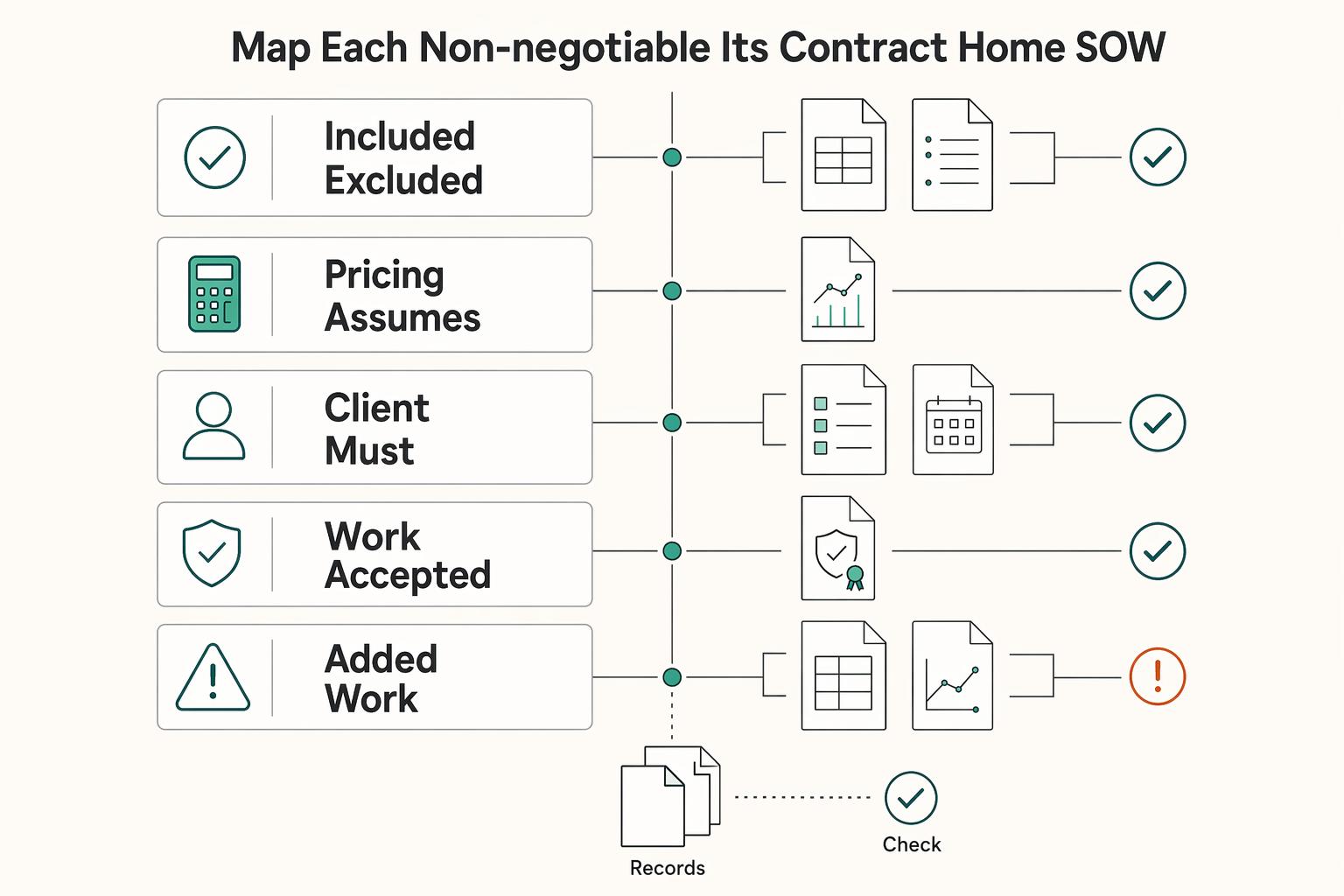
Map each non-negotiable to its contract home in the SOW#
| Non-negotiable | Contract home | What to lock before signature |
|---|---|---|
| What is included/excluded | Scope | Deliverables, exclusions, boundaries |
| What pricing assumes | Assumptions | Conditions your fee depends on |
| What client must provide | Dependencies | Inputs, access, decision availability |
| How work is accepted | Acceptance | Review steps, sign-off owner, acceptance trigger |
| How added work is handled | Change control | Request path, approval rule, repricing trigger |
| How and when you get paid | Payment terms | Invoice cadence, due handling, pause rights |
| How either side exits | Termination | Exit conditions, in-flight work handling |
Verify any legal wording against current contract or legal source records before use.
This closes Step 3 with a usable operating sequence and gives you the exact inputs for the next step: your repeatable Brand Shield operations manual.
You might also find this useful: A Brand Strategist's Guide to Trademarking a Client's New Brand Name.
Your Deliverable: The "Brand Shield" Operations Manual#
Your workshop deliverable should be a one-page working manual: finalize it, record who approved it, and use it in daily client decisions.
Use this practical structure on the page:
- positioning statement
- non-negotiables
- ideal-client filters
- proposal messaging
- scope boundaries
- escalation rules
Finalize the document with the people who will use it. On your side, assign one owner; on the client side, record who signed off on the current draft. If sign-off is unclear, treat the document as a draft until that is fixed.
| Decision point | Without Brand Shield | With Brand Shield |
|---|---|---|
| Qualification consistency | Fit decisions vary by memory and context | Fit checks follow named filters and non-negotiables |
| Proposal clarity | Message shifts from deal to deal | Core message stays consistent and easier to explain |
| Boundary enforcement | Scope pressure is handled ad hoc | Boundaries and escalation steps are already written |
Use it as a short playbook:
- When a lead is promising but unclear, use the ideal-client filters and non-negotiables before adding more calls.
- When writing a proposal, use the positioning statement and proposal messaging instead of rebuilding your value narrative each time.
- When scope starts moving, use the boundaries and escalation rules to state what changed and what needs written approval.
Keep implementation simple and explicit: assign an owner, define update triggers, label each revision, and keep one active version at a time. If review cadence or other policy details are not confirmed, label them as pending source-record verification.
Conclusion: Put your positioning decisions into consistent use#
Once you know the difference between strategy and expression, the real test is simple: do those positioning decisions show up in how you qualify clients, write proposals, and handle scope? If not, you probably do not need more ideas. You need your decisions written down and used consistently.
Strong brand strategy can do practical work. It can help you decide who is a fit, what you will and will not include, how you explain value, and when a request belongs in a change discussion instead of a casual yes.
A practical checkpoint is consistency. Your value statement, fit criteria, proposal language, and Statement of Work should point in the same direction. If they change every time you are on a call, you are still improvising. A common failure mode is staying always on for client communication and treating responsiveness as a substitute for clear boundaries.
| Area | Reactive freelancer behavior | System-led operator behavior |
|---|---|---|
| Decisions | Re-decides scope and positioning on each call | Uses documented fit, offer, and boundary rules |
| Client communication | Explains value from scratch and softens terms under pressure | Repeats consistent language across calls, proposals, and onboarding |
| Risk handling | Notices problems after expectations drift | Flags misfit, change requests, and approval issues earlier |
Your next move does not need to be big. To turn a workshop into something usable, do four things now: write your value statement in three sentences, define basic fit criteria, update your proposal and SOW language to match those decisions, then use that wording in your next client conversation. If it helps, draft the notes in a simple two-column format so one side captures decisions and the other captures where each decision must be applied. Done well, this can lead to clearer boundaries, may reduce avoidable disputes, and support more consistent delivery.
For a step-by-step walkthrough, see Best Icebreaker Activities for a Client Workshop. Want to confirm what's supported for your specific situation? Talk to Gruv.
Frequently Asked Questions
How can you do this if you work solo?
Treat it as four steps, not one long brainstorm. First, answer your prep questions in writing before the session. One common approach is to use a set of 10 pre-workshop questions, and the checkpoint is simple: if you cannot state your value proposition in three sentences, do not move on yet. Then run the session with structure, document the decisions in a working guide, and apply them in your post-workshop deliverables.
What does the return actually look like?
Do not look for a universal percentage. Look for outputs you can verify: a clearer value proposition, documented visual and verbal guidelines, and a cleaner approval path because the right stakeholders were included in discovery.
How do you introduce firmer boundaries to existing clients?
Do not assume one fixed transition script applies. A practical approach is to identify who has final approval, include key stakeholders early, and make approval and feedback steps explicit for the next phase of work.
What should a consultant’s messaging guide include first?
Start with the parts you will actually reuse every week: your value proposition in three sentences and clear verbal guidance you can repeat consistently. Then document practical usage rules so your messaging stays aligned across client-facing materials. For the visual and verbal implementation layer, see How to Create a Brand Style Guide for a Client.
How long does the process take?
Think in sequence, not in a fixed promise. Prepare your inputs, run the session, document the decisions, then apply them to client-facing materials. Reported workshop length can range from between four hours and two days depending on scope, and the process can take longer when pre-work includes multiple stakeholder interviews.
What is the difference between brand strategy and a style guide?
In this workflow, strategy covers discovery and decision-making; a style guide documents how to express those decisions consistently. | Question | Brand strategy | Style guide | |---|---|---| | Purpose | Clarifies value proposition, brand vision/voice, and stakeholder alignment | Documents consistent visual and verbal expression | | Decisions it drives | Workshop priorities, positioning clarity, approval context | Logo, typography, color, imagery, and verbal usage rules | | Where it lives | In pre-work and workshop outputs | In comprehensive brand guidelines | | When you use it | During discovery and workshop decisions | After strategy decisions, during design and content execution |
Try a related tool
Researched and edited by the Gruv editorial team. Gruv builds cross-border billing, payouts, and finance-operations software for global businesses.
Sources
- academia.edu/479089/Complicated_Conversations_and_Confirm...trusted
- acquisition.gov/far/part-15trusted
- armyuniversity.edu/cgsc/cgss/DCL/files/ST_22-2_US_Army_CGSC_Wri...trusted
- digitalcommons.buffalostate.edu/cgi/viewcontent.cgitrusted
- downloads.regulations.gov/USTR-2023-0009-0038/attachment_1.pdftrusted
- engl.uic.edu/coursestrusted
- federalregister.gov/documents/2024/05/07/2024-09171/non-compete-...trusted
- federalregister.gov/documents/2023/04/12/2023-07115/medicare-pro...trusted
Educational content only. Not legal, tax, or financial advice.
Related Posts

Thailand's Long-Term Resident (LTR) Visa for Professionals
For a long stay in Thailand, the biggest avoidable risk is doing the right steps in the wrong order. Pick the LTR track first, build the evidence pack that matches it second, and verify live official checkpoints right before every submission or payment. That extra day of discipline usually saves far more time than it costs.
How to Create a Brand Style Guide for a Client
If you work alone, your guide does not need to be a full brand book. It should work as a control document. Standardize the few choices that keep coming up so your proposals, reports, invoices, decks, and delegated work look and sound like they come from the same business.

The Freelance Payment Penalty: A Modeled Audit of Platform Fees, FX Spreads, and Payout Delays
The money rarely disappears through a single, easy-to-spot fee. The real loss is stacked. A marketplace takes its commission, a processor adds a charge for international cards, a bank or payment company converts the currency at a spread, a platform holds the funds before release, and a wire sheds a little to intermediaries on the way in. Each layer looks defensible on its own, but the worker feels the combined result as a smaller deposit and a later payday.