
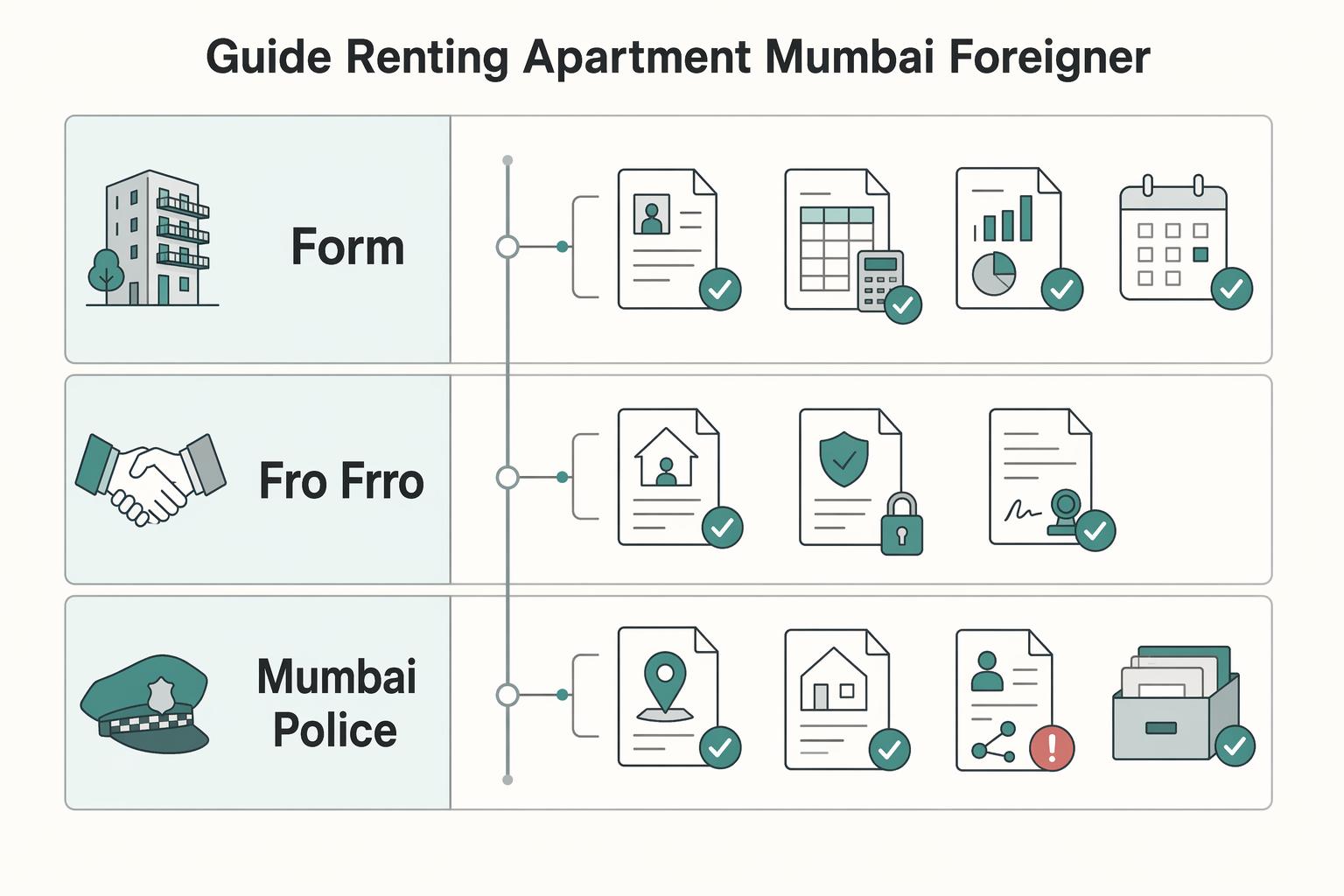
Quick Answer
Start by handling renting in mumbai as a foreigner as a paperwork-and-handoffs process, not just a property search. Lock in a written and registered Leave and License agreement, confirm who files each required post-move report, and keep one evidence folder with IDs, receipts, condition records, and acknowledgments. This cuts the most common failures: delayed filings, unclear responsibilities, and deposit disputes that surface after move-in.
A Guide to Renting an Apartment in Mumbai as a Foreigner#
If you are renting in Mumbai as a foreigner, the job is not just finding a decent flat. The real work is controlling four things early: how much cash goes out before move-in, who owns the broker and landlord handoffs, what protections make it into the agreement, and who completes the foreign-occupancy compliance steps once you get the keys. Most problems are not dramatic. They are delays, missing filings, vague promises, and money tied up before the paperwork is clean.
| Checkpoint | Timing or rule | Article note |
|---|---|---|
| Form C | Within 24 hours of a foreigner's arrival | The article notes this is time sensitive and some obligations can sit with the accommodation keeper or provider |
| FRO/FRRO registration | Within 14 days of first arrival if a qualifying visitor on a multiple-entry visa will stay continuously more than 180 days | The Ministry of External Affairs guidance is cited for this trigger |
| Mumbai Police tenant information | Police NOC not required; information can be submitted online or at the concerned police station | False information is punishable |
Use this guide as a three-phase timeline. First, prepare your documents and budget. Second, negotiate and register the agreement. Third, close out move-in compliance immediately after occupancy. That sequence matters because Form C is time sensitive, and some obligations sit with the accommodation keeper or provider rather than with you personally.
The Registration of Foreigners Rules text states that Form C must be transmitted within 24 hours of a foreigner's arrival. Separately, the Ministry of External Affairs says qualifying visitors on multiple-entry visas must register with the FRO or FRRO within 14 days of first arrival if they intend to stay continuously for more than 180 days. Mumbai Police says a police NOC is not required to rent a flat or house, but tenant information can be submitted online or at the concerned police station, and false information is punishable.
The other big issue is document control. Before you transfer meaningful money, confirm the agreement will be in writing and registered. Keep copies of your passport, visa, address proof, signed agreement, payment receipts, and move-in condition evidence. That small evidence pack saves time when a filing, refund, or compliance handoff is disputed.
Phase 1: Pre-Search Due Diligence & Team Assembly#
By the end of this phase, you should have a vetted broker team, a realistic pre-move budget, and a ready-to-send document pack. Treat this as setup work, not listing work.
Check your stay assumptions first#
Start with your visa timeline before you spend time on viewings or money on deposits. The e-Visa rules say you can apply online up to 120 days before arrival, entry is through designated international airports and 5 major Indian seaports, validity is up to 60 days, usage is a maximum of two times in a calendar year, and it is non-extendable except in the case of e-Medical Visa.
| e-Visa detail | Article statement |
|---|---|
| Application window | Can apply online up to 120 days before arrival |
| Entry points | Entry is through designated international airports and 5 major Indian seaports |
| Validity | Up to 60 days |
| Usage limit | Maximum of two times in a calendar year |
| Extension | Non-extendable except in the case of e-Medical Visa |
What this means for you: if your planned stay is longer or uncertain, sort that out first. Short-term renters may also face landlord resistance, so build that risk into your timeline rather than assuming flexibility later.
Vet brokers in three steps: shortlist, interview, verify#
A useful broker can map handoffs clearly and show proof after each step.
- Shortlist brokers who have recently handled rentals for non-Indian passport holders.
- Interview each broker with the same questions:
- Who coordinates foreign-tenant handoffs for police information submission, Form C coordination, and Leave and License handling? - What documents do you need before an offer is submitted? - What written acknowledgment do I receive after each handoff?
- Verify with evidence (redacted checklists, sample acknowledgments, or anonymized message trails).
If answers stay vague, move on.
Build your pre-search budget before serious viewings#
Use one sheet that separates cost behavior and negotiation leverage:
| Cost item | Fixed vs variable | Negotiable vs non-negotiable | Action now |
|---|---|---|---|
| Visa and arrival-routing costs | More fixed | Mostly non-negotiable | Current range pending visa, travel, and entry-route verification; confirm entry-point fit |
| Brokerage | Variable | Sometimes negotiable | Confirm the current brokerage range and payment trigger with a local broker before you commit |
| Security deposit and advance rent | Variable | Often partly negotiable | Current range pending local market and contract verification; pre-negotiate refund language |
| Agreement registration and admin costs | Variable | Sometimes split | Current range pending official fee, lease, and payer-split verification |
| Building move-in and setup charges | Variable | Usually less negotiable | Current range pending building schedule and contract verification; request written building schedule |
Leave and License: what to lock early#
Before money moves, get these four points clear in plain language:
- Renewal terms
- Early-exit flexibility
- Notice expectations
- Deposit-return wording (amount, timeline, conditions)
If these are unclear during early discussions, they usually stay unclear later.
Prepare a document pack you can send same day#
Create one shareable folder and label it by category. Before submitting your documents, verify each file's current validity requirement with the current rule source, lease counterparty, or local advisor.
| Category | Files listed | Article note |
|---|---|---|
| Identity | Passport bio page, visa page, recent photos | Validity requirement pending current rule and counterparty verification |
| Visa/work status | Visa grant details, employer letter, assignment letter, or other relevant status proof | Validity requirement pending current rule and counterparty verification |
| Tenancy support | Current address proof, references if available, and a one-page tenant profile with planned move-in date and expected stay length | Validity requirement pending current rule and counterparty verification |
- Identity: passport bio page, visa page, recent photos
- Visa/work status: visa grant details, employer letter, assignment letter, or other relevant status proof
- Tenancy support: current address proof, references if available, one-page tenant profile with planned move-in date and expected stay length
You might also find this useful: A Guide to Renting a Condo in Bangkok.
Phase 2: The Deal Room - Negotiation & Contracting#
Before you sign, decide what each contract decision is protecting: your exit options, your deposit, your privacy in the flat, and your proof trail if something is disputed later. In Mumbai, this is the phase where verbal assurances either become written protections or disappear.
The core document is typically a Leave and License agreement. Treat writing and registration as non-negotiable checkpoints: in Maharashtra, the agreement must be written and registered, and Section 55 places registration responsibility on the landlord/licensor side. Confirm who is handling registration, what acknowledgment you will receive, and when.
Review the agreement as a risk-control document#
Do not ask whether a clause is "standard." Ask what happens if plans change, maintenance issues come up, or the relationship becomes difficult.
- Rent escalation: Replace vague wording (for example, "as per market rate") with a clear formula or review method. If a number is needed, verify the current local standard before using it.
- Lock-in, exit, and notice: Push for equal notice treatment for both sides. If your role can change, ask for an early-exit trigger tied to transfer, visa change, or employer-directed relocation, with notice and deposit handling written clearly.
- Landlord access: Limit access to specific reasons (inspection, repairs, showing near move-out) and require prior notice; verify the current local notice standard before adding a number.
- Repairs and maintenance: Split structural repairs from routine upkeep so routine issues are not automatically treated as tenant-caused damage.
| Contract point | Negotiable? | Where to push | Evidence to keep | Walk away when |
|---|---|---|---|---|
| Rent escalation wording | Usually yes | Fixed percentage or clear review formula | Final draft with exact clause | Open-ended "market" increases remain |
| Lock-in, exit, notice | Usually yes | Equal notice treatment; assignment-change exit path | Marked-up draft/email confirming trigger and notice | Exit is one-sided or deposit can be withheld automatically |
| Landlord access | Yes | Prior notice and limited entry reasons | Final clause and written confirmations | Entry is allowed "any time" |
| Repair responsibility | Yes | Structural vs routine split; pending fixes listed | Defect list/annexure and promised repair notes | Major pre-existing issues stay undocumented |
| Registration and compliance handoff | Mostly no | Named owner and proof timing | Registration acknowledgment, tenant-information submission proof, Form C coordination trail where relevant | No clear owner for required filings |
Protect the deposit before money moves#
Deposit protection starts before signing and continues through move-in.
- Create a condition record: dated video, room photos, meter readings, appliance photos, and close-ups of existing damage.
- Put the record into the written trail: reference it in the agreement (or annexure), and include refund timing, permitted deductions, and normal wear-and-tear treatment.
- Keep a documented handover trail: email the file to landlord and broker, keep delivery receipts, and keep written key-handover confirmation. If repairs are pending, list each one with target dates before full handover is treated as complete.
Before closing, verify compliance language carefully. Mumbai Police states a police NOC is not required for renting a flat or house, and lists multiple tenant-information submission channels. For foreign occupants, confirm who handles accommodation-side reporting steps, including Form C coordination, since the referenced guidance includes a 24-hour filing instruction after arrival.
Match your negotiation tactic to your likely risk#
- Corporate assignment may change: Ask for an employer-transfer exit trigger. Fallback: shorter lock-in or reduced financial consequence after notice. Documentation: employer/assignment letter tied to the clause.
- Possible early exit for personal reasons: Ask for a clear notice-based termination path. Fallback: right to propose a replacement occupant acceptable to the landlord, with written approval steps.
- Likely maintenance disputes: Ask for a signed defect list at move-in and a written escalation path. Fallback: explicit wording that major structural issues remain landlord responsibility.
For a step-by-step walkthrough, see Renting in Kuala Lumpur for Remote Professionals.
Phase 3: The 7-Day Compliance Sprint & Base Activation#
In your first week, treat compliance and setup like a tracked handover: every task needs an owner, a status, and proof you can retrieve later.
Start with shared visibility. Open one message thread with you, your landlord, and your broker, then use it to confirm who is doing what and to collect evidence in one place.
Put names against every compliance task#
For police-related reporting, avoid assumptions. Ask for role clarity, document requests in writing, and completion proof.
| Party | What they own | What you provide | Evidence checkpoint |
|---|---|---|---|
| You | Share requested documents once in a clean bundle | Only the exact items requested in writing | Sent message/email, attachment list, delivery confirmation |
| Landlord | Confirm whether they are submitting directly or delegating | Any follow-up item requested in writing | Named handler, stated submission date, acknowledgment/receipt if generated |
| Broker | Keep all parties aligned and chase missing items | Clarifications only if something is incomplete | Status updates on-thread, promised date, copy of any proof shared |
Your checkpoint is completion evidence, not verbal reassurance.
Treat Form C like a tracked dependency#
Handle Form C the same way: assign an owner, set the target timing, and ask for proof. This article notes a 24-hour instruction after arrival, so treat that as your working deadline and verify the current operational rule.
Use a short communication checklist:
- Subject intent: request confirmation of move-in reporting for your full address.
- Required confirmation: who will submit, on what date, and when proof will be shared.
- Attachment request: acknowledgment, submission screenshot, or reference number (if generated).
- Follow-up cadence: same-day follow-up on the same thread, then next business day with landlord and broker copied.
If a portal flow is involved, store the final completion artifact. A draft screen is not completion.
Activate the flat in a practical order#
Set utility and access priorities based on what unblocks daily living first in your building, then capture proof as each item closes.
| Utility or service | Proof-of-address value | Typical setup friction | First contact |
|---|---|---|---|
| Electricity | Confirm locally before relying on it | Varies by account status and handoff | Landlord, then provider |
| Internet | Confirm locally before relying on it | Varies by install availability | Provider, then broker/building office |
| Gas or cooking access | Confirm locally before relying on it | Varies by building/process | Building office or landlord |
| Building access (parking, gate registration, amenity app) | Usually operational rather than formal | Varies by building admin | Building office, with broker if needed |
Before you close this phase, confirm five items:
- Compliance confirmations/receipts are stored.
- Form C ownership, timing, and proof are logged.
- Utility/account status is clear (transferred vs. left as-is).
- Move-in condition records sit with the signed agreement.
- One source-of-truth folder (online and offline) holds all tenancy records.
We covered this in detail in A Guide to Incorporating a Private Limited Company in India as a Foreigner.
Conclusion: You're Not Just Renting an Apartment; You're Establishing a Beachhead#
If you followed a structured checklist, you did more than secure a flat. You reduced the issues that often make an India move messy: missing paperwork, unclear handoffs, and lost acknowledgments.
That is the value of a structured approach. You now have documented records, named checkpoints, and a habit of verifying completion instead of assuming someone else filed everything correctly. In India, the hard part is often not one dramatic rule; it is paperwork and coordination across offices. Your advantage is treating each step as something to verify.
| Area | Unstructured approach | Your structured approach |
|---|---|---|
| Risk control | You rely on verbal updates and memory | You keep applications, receipts, IDs, and message history together |
| Compliance checkpoints | Steps are handled ad hoc and can be missed | You track consulate application, post-arrival registration, and any dependent-visa steps |
| Operational stability | A missing acknowledgment becomes urgent later | You save submission proofs and keep a clear escalation contact for each open item |
For the first weeks after move-in, do four simple things:
- Store your final agreement, ID bundle, move-in photos or video, and every submission acknowledgment in one folder with cloud backup.
- Keep proof of key immigration steps, including consulate submissions and post-arrival local police registration where required.
- If family is relocating with you, track dependent visa (type X) steps and confirmations in the same file trail.
- Track visa validity and extension timing early; keep online extension confirmations and references when applicable.
You now have a stable base and a process you can repeat. That makes renewals, relocation, or a dispute easier to handle without avoidable delays.
Related: A Guide to Renting an Apartment in Europe as a Foreigner.
Frequently Asked Questions
What if my deposit is delayed or disputed?
Go back to your agreement and evidence pack first. For ordinary rent and possession disputes in Brihan Mumbai, the forum is typically the Court of Small Causes, Mumbai, and RERA is usually not the rent forum because “allottee” does not include a person given premises on rent. Send a written demand with your move-out date, inspection notes, utility clearance, and the refund timeline stated in your agreement. Keep the registered agreement, handover photos or video, key-return message, and any deduction breakdown you receive.
Can you leave early if your plans change?
Only if your Leave and License agreement gives you a usable exit path. Vague promises from a broker or landlord are weak once the move is underway, and expiry rules get expensive if dates drift. Get the notice period, any penalty, and deposit-adjustment language written into the signed agreement or a later addendum before you announce your exit. Keep the exact clause, your notice email, and the landlord’s written acceptance of the final date.
Do you need police verification, and who handles it?
You do not need a police NOC for a Mumbai flat, and tenant information is handled through the Mumbai Police tenant-information process. The Mumbai Police online service is only for addresses within the Brihanmumbai Police Commissionerate, and false information is expressly punishable. Confirm whether your address falls in that jurisdiction and whether submission is being done online or at the concerned police station. Keep the final submission proof and the exact ID bundle you shared.
What if Form C or FRRO-linked reporting gets delayed?
Escalate the same day and verify the live rule. Cited BOI guidance says Form C should be submitted within 24 hrs of arrival, while FRRO or FRO registration timing depends on visa type and stay length, including 14-day and 180-day triggers in the cited regulations. Ask who is filing, when, and what confirmation you will receive, then recheck the current operational instruction with the competent FRRO or FRO if anything looks stale after recent legal changes. Keep every email, screenshot, acknowledgment, and reference number.
Try a related tool
Researched and edited by the Gruv editorial team. Gruv builds cross-border billing, payouts, and finance-operations software for global businesses.
Sources
- benedict.edu/wp-content/uploads/2021/08/2021-2022-Benedic...trusted
- boi.gov.in/boi/pdf/attachment-How_to_register_Form-C.pdftrusted
- congress.gov/109/crec/2006/07/17/152/93/CREC-2006-07-17-h...trusted
- ecommons.cornell.edu/server/api/core/bitstreams/8accbf72-e310-4f8...trusted
- govinfo.gov/content/pkg/FR-2017-03-06/pdf/FR-2017-03-06.pdftrusted
- grow.exim.gov/hubfs/ebook/basic-guide-to-exporting_Latest_...trusted
- mea.gov.in/foreigners-registration.htmtrusted
- mha.gov.in/PDF_Other/AnnexIII_01022018.pdftrusted
Educational content only. Not legal, tax, or financial advice.
Related Posts

London, UK: A Guide for Expats and Remote Workers
Get two calls right early and the rest of the move gets easier: how you'll be in the UK, and where you'll work when conditions are less than ideal. Make those decisions before you lock dates or prepay a long stay. If you book first and sort the basics later, admin and work reliability usually collide in your first week.
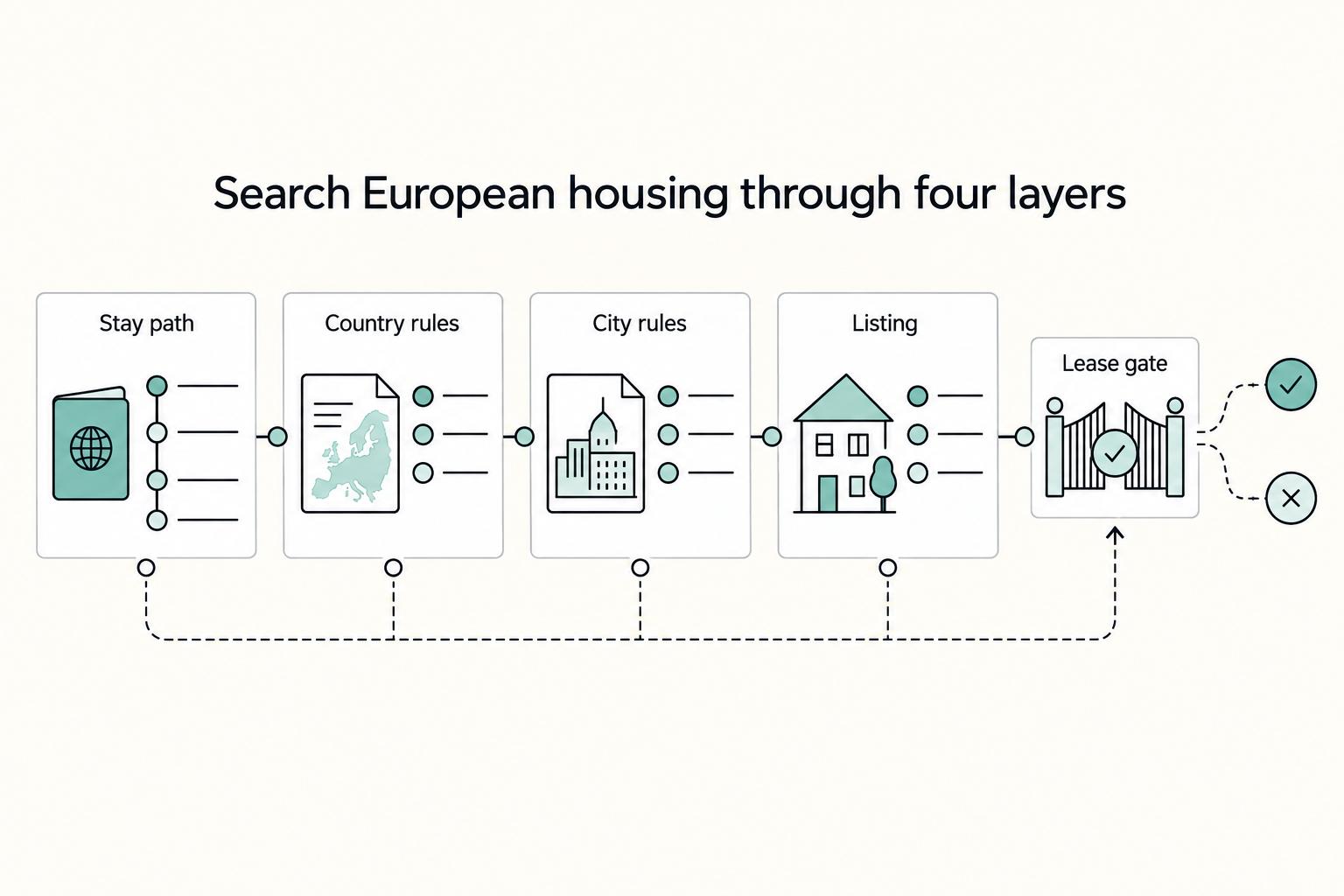
Renting in Europe as a Foreigner on a 90-Day Timeline
If you're **renting in Europe as a foreigner**, treat the move as a staged long-term housing plan, not a booking sprint. Your first decision is not which listing looks best. It is which city you're targeting, which legal stay track applies there, and when you'll be ready to sign without guessing.
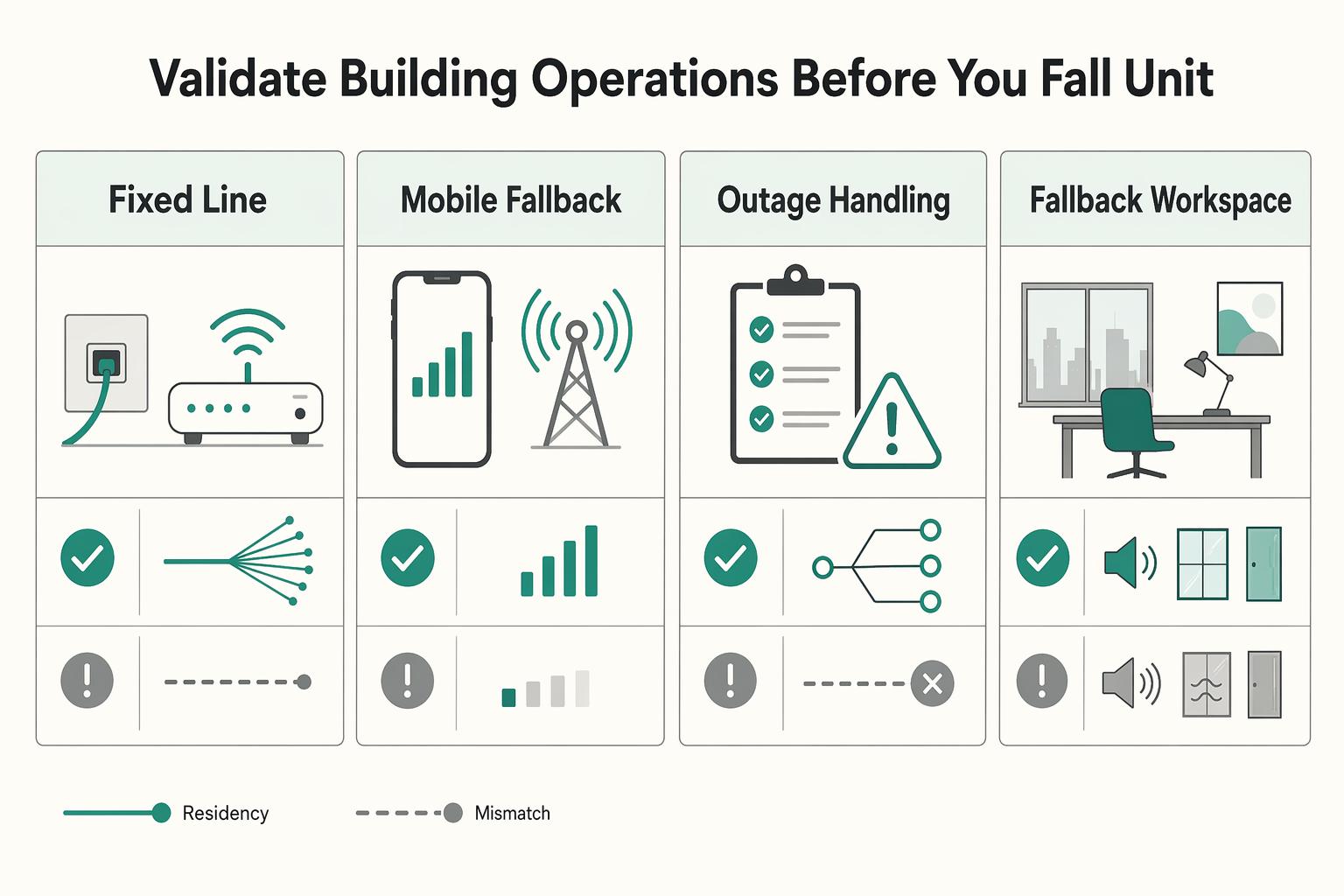
Renting a Condo in Bangkok for Remote Work
Start by narrowing the decision before you book viewings. If you're renting a condo in Bangkok, the useful order is simple: define what matters, screen districts, validate building operations, then shortlist listings.