
Quick Answer
Start by matching your housing path to how certain your plans are. For renting in kuala lumpur, a monthly furnished stay on Airbnb or Blueground is usually the lower-risk first step when dates, visa timing, or area choice can still change. Move to PropertyGuru or FazWaz long-term options once your timeline is stable and your document pack is ready. Before paying, confirm in writing who you are contracting with, what is included, and how deposit terms work.
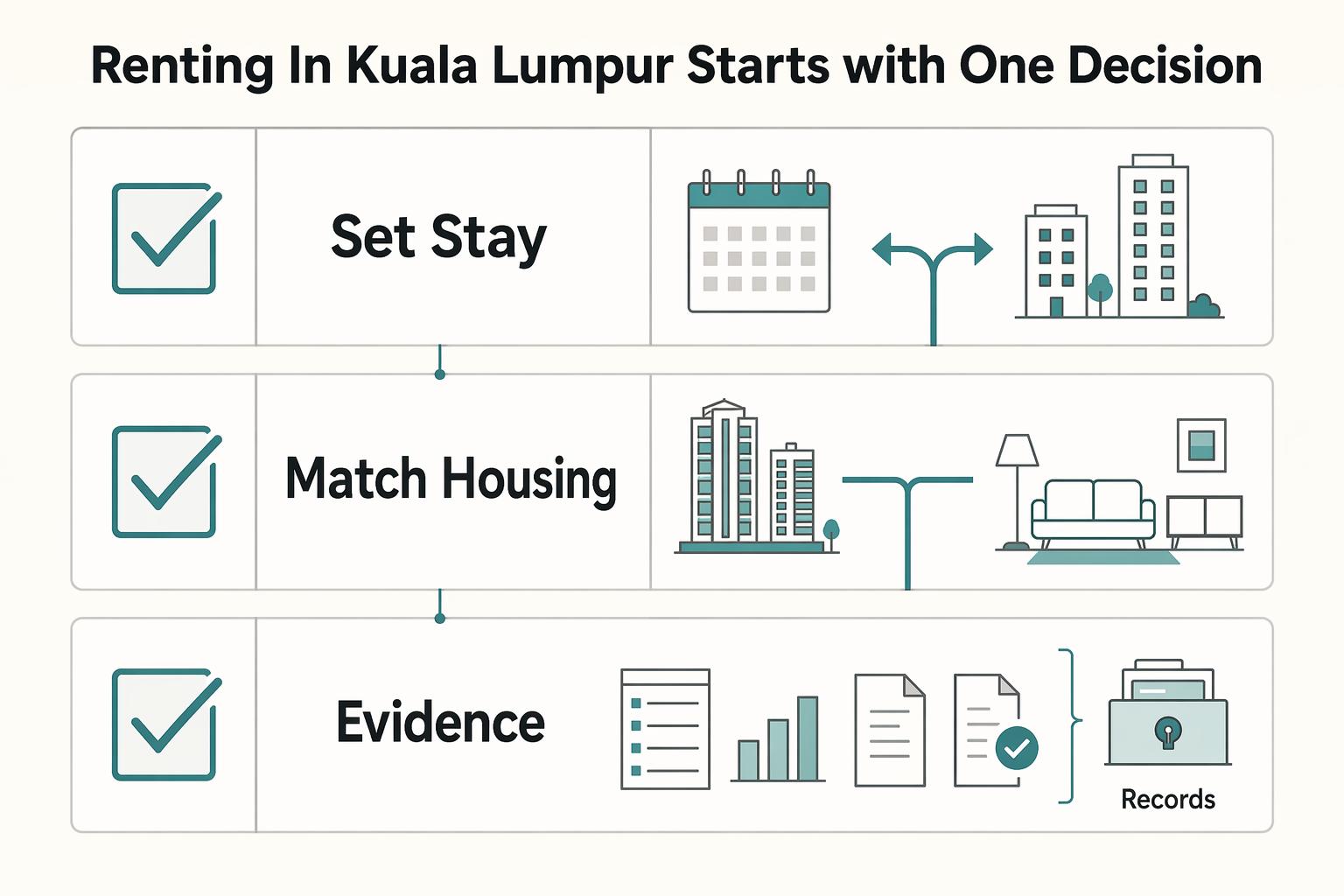
Renting in Kuala Lumpur starts with one decision#
Your first decision is not which tower, platform, or neighborhood to fixate on. It is whether you need a flexible landing option first, or whether you are ready to pursue a longer lease now. Make that call early and the rest of the search gets much simpler.
That matters because the big platforms are not solving the same problem. PropertyGuru's Kuala Lumpur rental page showed 41,865 results in the captured view. That tells you there is a large discovery pool, not that more scrolling will create clarity. Blueground's Kuala Lumpur City Centre page explicitly markets furnished apartments for both long and short-term stays. That is a different use case: speed and flexibility first, depending on provider terms, while broader listing sites are often more useful once you are ready for a longer stay.
If your arrival date, stay length, or paperwork is still moving, start with a monthly furnished stay and buy yourself time to inspect properly. If your dates are stable and you can handle applications and follow-up quickly, go straight into the long-term search and accept the extra admin. The mistake is trying to do both at once and expecting platform volume to answer questions that only your own timeline can answer.
Start with this sequence:
- Set your stay horizon as uncertain, likely medium-term, or clearly long-term.
- Match the housing path to that certainty, not to the prettiest listing photos.
- Prepare one reusable document folder so you are not rebuilding your case for every agent or landlord.
That folder should include basic identity and financial/employment documents plus your intended stay dates. Do not treat that as a universal legal checklist for every landlord in Malaysia, because requirements vary, but it is a practical baseline that cuts down back-and-forth. One current iProperty guide for Kuala Lumpur, updated 19 Feb 2026, still frames the process around rental rules, deposits, documents, and short stays like three month rentals. That is a useful reminder that paperwork is part of the housing decision, not a later chore.
One verification rule will save you trouble from day one. Before you pay anything, get the promised move-in date, furnishing status, and who you are actually contracting with in writing. Two common problems are arriving with changing travel dates and finding that the unit does not match the ad. A flexible first stay gives you somewhere to land without forcing a bad lease decision under pressure.
This guide follows that sequence: start by choosing the right rental path for your stay length, then build a reusable document pack, and only then compare actual units with a clearer set of checkpoints.
Related: A Guide to Renting an Apartment in Europe as a Foreigner.
Know the rental options before you compare listings#
Pick your rental path by commitment level first, then compare units. In Kuala Lumpur, short-term or monthly rentals usually give you more flexibility, while longer stays more often involve a tenancy agreement, upfront payments, and more document follow-up.
Short-term options are often easier to start with because they are usually furnished and work well when your plans are still moving. The iProperty guide (updated 19 Feb 2026) explicitly references three month rentals, a useful reminder that you do not always need to start with a full lease.
For longer-term options, treat contract and payment steps as part of the comparison from the start, not as an afterthought. One Kuala Lumpur renting guide describes the process as signing a tenancy agreement and paying a security deposit and the first month's rent. When you compare listings, confirm in writing what is included at move-in, who the contracting party is, and what you must arrange yourself.
Use platform filters as discovery tools, not approval guarantees. Listing quality can vary, and landlord or agent document expectations can differ, so verify listings and key terms before committing to viewings or payments.
You might also find this useful: A Guide to Renting an Apartment in Mumbai as a Foreigner.
Pick the right rental path for your stay length#
Choose based on certainty: if your dates, visa timing, or neighborhood choice might still change, start with a monthly stay (Airbnb or Blueground); if your plan is stable and your paperwork is ready, focus on long-term listings (PropertyGuru or FazWaz).
The iProperty Kuala Lumpur guide updated on 19 Feb 2026 includes short stays such as three month rentals, so a bridge stay is a practical first step when you still need in-person checks.
| Criteria | Airbnb / Blueground monthly rental | PropertyGuru / FazWaz long-term rental |
|---|---|---|
| Flexibility | Better when your stay length is still uncertain and you want a lower-commitment landing option. | Better when your stay horizon is clear and you are ready for a longer commitment. |
| Setup speed | Often faster to start, especially with furnished units that reduce setup work. | Often slower because document checks, contract details, and move-in terms usually need more coordination. |
| Minimum rental duration | Can align with short-stay or monthly booking logic; confirm exact terms on each listing. | Typically set for longer occupancy than a monthly bridge stay; confirm exact terms directly with the landlord or agent. |
| Negotiation room | May be more limited when convenience and furnishing are the core value. | Terms can vary by landlord and agent, so treat listing filters as search tools, not proof of what is negotiable. |
| Failure mode | If your move-in shifts or the first unit/area is not right, you can usually pivot with less disruption, but you pay for flexibility. | If your move slips or a unit fails verification late, recovery is harder and may force a restart under tighter timelines. |
When the monthly path is the smarter first move#
For many new arrivals, a monthly stay helps you avoid locking into a long commitment before basic checks are done. Short-term options are built around flexibility, and furnished units can reduce friction while you validate your area and day-to-day setup.
Before you switch to a longer lease, verify the listing in person and get the exact unit details, move-in timing, and contracting party in writing. That step helps reduce scam risk and cuts down the chance of paying for a unit that is not what you expected.
When to go straight to long-term listings#
If your plan in Kuala Lumpur is stable, long-term platforms are usually the more direct lane. You can focus on longer-occupancy inventory instead of paying for short-term flexibility you may not need.
Compare by area and unit attributes, not platform alone. Published examples show a wide spread: KLCC at RM 3,500-RM 10,000/month versus Cheras at RM 1,200-RM 2,500/month.
If the first long-term unit fails verification, keep your bridge option active long enough to avoid a rushed signature.
If you want a deeper dive, read London, UK: A Guide for Expats and Remote Workers.
Build a move timeline that prevents last-minute mistakes#
Use a phased timeline, not a rushed one: secure temporary housing first, verify fit in person second, and sign a longer lease only after key terms are documented in writing.
| Phase | Action | Checkpoint |
|---|---|---|
| Pre-arrival shortlist | Build a shortlist before arrival | Treat it as research until you can verify details on the ground |
| Landing stay | Start with a temporary stay | So you are not making lease decisions under arrival pressure |
| In-person viewings | Verify the exact unit, building, and area in person | Confirm the listing matches what was promised |
| Application and paperwork | Move to this step only after the unit passes your checks | Keep your documents organized and ready so the process does not stall |
| Move-in setup | Treat handover as a separate step | A checklist helps keep timing and logistics under control |
| Pre-handover check | Inspect the unit as close to handover as practical | A 24-48 hour pre-handover check is a useful window when access is possible |
Keep visa status inside this sequence. If your DE Rantau or other Malaysian digital nomad visa status is still not settled, keep housing flexible until your stay plan is clearer; if your status is firm, a longer commitment is easier to justify.
Before signing, set one non-negotiable checkpoint: confirm furnishing, move-in date, included items, and any agreed conditions in writing. Late oversights can push readiness and move-in timing, so do not rely on verbal confirmation alone.
As a final safeguard, inspect the unit as close to handover as practical. A 24-48 hour pre-handover check is a useful window when access is possible. Confirm condition and inclusions, and keep copies of the listing and written terms.
If your visa and housing timelines diverge, prioritize the visa timeline and keep your housing commitment adjustable.
Prepare one document pack and reuse it for every application#
Build one reusable document pack early, then send the same base packet for each serious PropertyGuru or FazWaz inquiry so you can move quickly without losing control of details.
Use a checklist as your baseline, not a fixed "Kuala Lumpur standard" list. A standardized application requirement is not established, so keep a core pack ready: identity document, employment or income proof, intended stay length, move-in window, and references only when requested.
Build the packet once#
Keep it short enough to send fast and clear enough to reduce back-and-forth:
| Packet item | What to include |
|---|---|
| Identity file | one identity file |
| Work or income proof file | one work or income proof file |
| Summary note | one short summary note with intended stay length, move-in timing, and occupants |
| References or extra documents | references or extra documents only when asked |
For document handling, stay strict. PDPA-related guidance emphasizes strict record-keeping, so keep one digital folder for shareable copies and one physical folder for originals. This also makes retrieval easier when an agent asks for another copy.
Verify where and what you send#
Share sensitive information only through official, secure websites, and check for HTTPS before uploading. If a link or form looks unfamiliar, verify it first or send only a minimal initial pack until legitimacy is clear.
Track unknowns per listing; confirm required documents, approval timing, and rental deposit terms directly with each landlord:
- documents requested
- expected approval timing, if stated
- rental deposit terms, if stated
- move-in date and included items confirmed in writing or not
If key terms are still verbal, pause and ask for written confirmation before paying anything, especially for deposits, move-in timing, furnishings, and included items.
We covered this in detail in Kuala Lumpur Digital Nomad Guide for a Low-Risk Move in 2026.
Choose neighborhoods by commute reality, not listing photos#
Start with area fit and connectivity, then compare units. In Kuala Lumpur, area fit is not one-size-fits-all: different locations support different routines, and connectivity matters alongside safety, surroundings, and affordability. KLCC is often positioned as a central-lifestyle option, while Mont Kiara is often linked to people seeking a nicer long-term home. Use those as starting signals only, then run the same check for Brickfields and Kampung Datuk Keramat.
| Check | What to test | Decision note |
|---|---|---|
| Weekday workday | start point, work location, regular meal stop, grocery run, gym, and trip home | If an area fails both scenarios, drop it even if the apartment looks better online |
| Weekend lifestyle | where you meet people, spend downtime, run errands, and begin longer trips | If it works well for one scenario but not the other, keep it only if that tradeoff is intentional |
| "Near transit" | map your repeat trips from the exact building pin | Watch for friction like awkward transfers or inconvenient first-mile/last-mile segments |
Run a two-scenario test#
Use your actual week for each shortlisted area before you rank viewings:
- Weekday workday: start point, work location, regular meal stop, grocery run, gym, and trip home.
- Weekend lifestyle: where you meet people, spend downtime, run errands, and begin longer trips.
If an area fails both scenarios, drop it even if the apartment looks better online. If it works well for one scenario but not the other, keep it only if that tradeoff is intentional.
Check transit friction, not just listing labels#
Treat "near transit" as unverified until you map your repeat trips from the exact building pin. Check whether the route is simple enough to repeat several times a week without extra effort, and watch for friction like awkward transfers or inconvenient first-mile/last-mile segments.
Platform filters are useful for narrowing by budget, area, layout, and lifestyle preferences, but they cannot confirm day-to-day fit. Use listing names, including options like Le Nouvel KLCC, as starting points for area validation, not as automatic quality signals.
This pairs well with our guide on A Guide to Renting an Apartment in Berlin.
Run viewings with a strict verification checklist#
At the viewing stage, consistency matters more than polish. Use the same checklist for every unit, and if two or more core checks fail, reject it immediately.
Your checklist protects the selection criteria you set at the start, so each viewing is compared on the same standard instead of on photos, staging, or sales pressure.
Use one sheet for every unit#
Keep one simple template and reuse it every time. Include: exact address, asking rent, furnishing status, condition, noise, internet practicality for remote work, listing mismatches, move-in readiness, lease terms, minimum rental duration, rental deposit conditions, and a final pass/reject decision.
| Check | What to verify on site | Red flag |
|---|---|---|
| Condition | Wear, damage, cleanliness, and whether fixtures match the listing | You already expect repairs or replacements before move-in |
| Noise | Bedroom/living-area noise, windows open and closed, hallway/street noise | You are relying on "I'll get used to it" |
| Internet practicality | Existing setup and whether your actual work spot is usable | You cannot see a reliable day-one work setup |
| Listing match | Layout, furnishings, light, and included items vs. listing claims | Obvious differences are dismissed as minor |
| Contract criticals | Lease terms, minimum rental duration, move-in condition, deposit conditions | Key points are still verbal or unclear |
Verify daily-life fit, not just appearance#
Test the unit the way you would actually live in it. Check work setup, background noise, and whether the space is genuinely ready for your routine, not just tidy for a viewing.
Treat listing mismatches as decision data, not small annoyances. If what is shown and what is offered do not align, record it and score it accordingly.
Clear contract points before committing#
Before you commit, get contract-critical items clearly stated in writing: lease terms, minimum rental duration, move-in condition, and rental deposit conditions. Do not rely on verbal summaries.
If these points stay unclear, pause. At that point, you are evaluating contract risk as much as apartment quality. If your stay horizon is still uncertain, a serviced apartment for the first month or two can reduce commitment risk before you lock into a longer lease.
Compare total monthly cost before you sign anything#
Choose the option with the best combined score on total monthly burden, certainty, and exit flexibility, not just the lowest headline rent on Airbnb or FazWaz.
Price the full month, not the ad#
Use one table for every finalist with the same columns: base rent, included services, setup burden, flexibility cost, exit constraints, and certainty score. This keeps short stays from looking overpriced when more is bundled, and long leases from looking cheap when key costs or terms are still unclear.
| Option type | What headline price can hide | What to verify before paying | Typical fit |
|---|---|---|---|
| Airbnb or Blueground monthly rental | Higher base rent, but lower setup burden and faster move-in | What is included monthly, minimum stay, extension terms, and refund/change rules in writing | First weeks or uncertain stay length |
| Three month rental or serviced stay | Middle ground between flexibility and a standard lease | Included services, deposit handling, exact move-in condition, extension path | Short bridge period before a longer lease |
| PropertyGuru or FazWaz long-term rental | Lower base rent can come with deposits, documentation demands, stricter lease terms, and more setup work | Minimum rental duration, deposit handling, tenant legal requirements, move-in condition, early-exit terms | Stable stay horizon with paperwork ready |
Compare total living friction, not monthly versus long-term labels. A higher monthly price can still win if it cuts setup and commitment risk. A lower long-term price can lose if key terms are not documented.
One source gives a reference band of $750 to $1,000 per month for a modern high-rise with amenities. Treat that as a reference point, not a Kuala Lumpur rule.
Add a certainty score before you compare#
Score each option by how many critical terms are documented versus still verbal or unclear. Count an item only when it is in writing:
- Lease terms or minimum stay
- Deposit handling
- Move-in date and unit condition
- Included items or services
- Tenant legal requirements or document requests
If rent is clear but deposit handling or required documents are still "to be confirmed," drop the certainty score.
Use a decision rule that matches your real stay horizon#
Make the final call using three side-by-side scores: certainty, commute fit, and flexibility for your real stay length. If your horizon is uncertain, weight certainty and flexibility above a small rent saving. If your horizon is stable and your documents are ready, a long-term rental can win only when terms are fully written and exit constraints are acceptable.
If an option has the lowest base rent but the lowest certainty score, do not sign yet. Request missing terms in writing first. If they stay unclear, choose the slightly more expensive option you can clearly verify.
The next step is to choose your path and start the checklist#
Choose your path now: use a monthly rental bridge or go straight to a long-term lease. If your stay timing, visa timing, or neighborhood fit is still uncertain, the bridge is the safer move. If those are stable and the rental terms are clear in writing, move to long-term.
Make the path decision before you browse more#
A monthly rental is usually lower risk when plans are still moving. Short-term rentals are useful because they keep you flexible, give you room to verify listings, and help reduce scam risk before you commit.
Move straight to long-term only when all of this is true:
- your stay plan is clear
- your document pack is ready
- your shortlisted areas fit your real routine
- lease terms, deposits, and recurring costs are confirmed in writing
If one of those is still unclear, keep flexibility and avoid locking in too early.
Build one packet and use one area filter#
Do the admin once, then reuse it. Send one consistent document pack each time and track only what each listing still needs.
For neighborhood choice, start with transit practicality, then pressure-test each area against your weekly life. Prioritize safety and surroundings, connectivity, affordability, and overall lifestyle fit.
Use rent examples only as a sense check. Some expat-oriented examples place a decent condo around RM 3,000/month, with specific cases ranging from RM 2,400 to RM 4,500 in certain buildings and areas. Treat that as directional, not a citywide average.
Match housing timing to visa timing#
If your move depends on the Malaysian Digital Nomad Visa (DE Rantau), do not let lease commitments run ahead of your immigration timeline. If visa timing is still unsettled, keep housing flexible until it is clearer.
Before paying, line up your visa timeline, rental path, and written terms in one checklist. If you need a visa refresher first, read A Guide to the Malaysian Digital Nomad Visa (DE Rantau).
For a step-by-step walkthrough, see A Guide to Renting a Condo in Bangkok.
Frequently Asked Questions
What is the fastest way to rent in Kuala Lumpur for a short stay versus a longer stay?
For speed, a short stay is often the faster path because it is not a long-term lease and is commonly found on Airbnb-style platforms. If you need a place immediately, use that as a bridge for days, weeks, or a couple of months. Then do in-person viewings for a longer lease once you are on the ground.
Should I start with a short-term platform before signing a long-term lease from listing sites?
If your stay length, visa timing, or neighborhood choice is still uncertain, starting with a monthly short stay is usually the lower-risk move. A temporary booking gives you time to verify the unit, the area, and the lease terms before you commit to a longer agreement.
What documents should I prepare before contacting agents or landlords in Kuala Lumpur?
Prepare one reusable document pack before you contact agents or landlords, then note any extra items a landlord asks for. The key is not a perfect universal checklist; it is being able to respond quickly and consistently.
Can I rely on listing counts to judge the real rental market size in Kuala Lumpur?
No. Use listing platforms as discovery tools, not as proof of true market size or current balance, especially when sources also note that demand and supply patterns have shifted. A better read is whether units that fit your budget and area keep appearing, stay available, and turn into real viewings.
How do I compare total monthly housing cost beyond advertised rent?
Use one table for every finalist and include base rent, what is included, setup burden, flexibility cost, and exit constraints. Also separate housing cost from general living cost estimates: one cited figure is RM2,577 for a single person and RM9,118 for a family of four, but those figures explicitly do not include rent. That distinction matters when a listing looks cheap but your actual monthly outflow is not.
How long should I budget for search, viewings, approval, and move in?
Budget by phases, not by one promised timeline. Shortlist before arrival, use a landing stay, do viewings in person, then move to application and setup. There is no single reliable duration here, so if your schedule is tight, protect yourself with temporary housing first instead of forcing a long lease too early.
What should I verify in lease terms before paying a rental deposit?
Verify lease duration, move-in date, move-in condition, included items or services, and exactly how the rental deposit is handled. The checkpoint that matters is simple: match the listing, message thread, and draft agreement line by line. If any of those points are still verbal only, do not pay yet.
Try a related tool
Researched and edited by the Gruv editorial team. Gruv builds cross-border billing, payouts, and finance-operations software for global businesses.
Sources
Includes 4 external sources outside the trusted-domain allowlist.
- congress.gov/committee-report/108th-congress/house-report...trusted
- pmc.ncbi.nlm.nih.gov/articles/PMC11445643trusted
- pmc.ncbi.nlm.nih.gov/articles/PMC11736104trusted
- sec.gov/Archives/edgar/data/811809/00011931252127210...trusted
- benhams.com.my/news/home-furnishing/uk-rental-checklist-202...external
- dl.acm.org/doi/10.1145/3689236.3689880external
- extraspaceasia.com/my/category/blog/storage-tipsexternal
- ikilinks.com/en/malaysia-rental-guide-enexternal
Educational content only. Not legal, tax, or financial advice.
Related Posts

London, UK: A Guide for Expats and Remote Workers
Get two calls right early and the rest of the move gets easier: how you'll be in the UK, and where you'll work when conditions are less than ideal. Make those decisions before you lock dates or prepay a long stay. If you book first and sort the basics later, admin and work reliability usually collide in your first week.
Renting in Europe as a Foreigner on a 90-Day Timeline
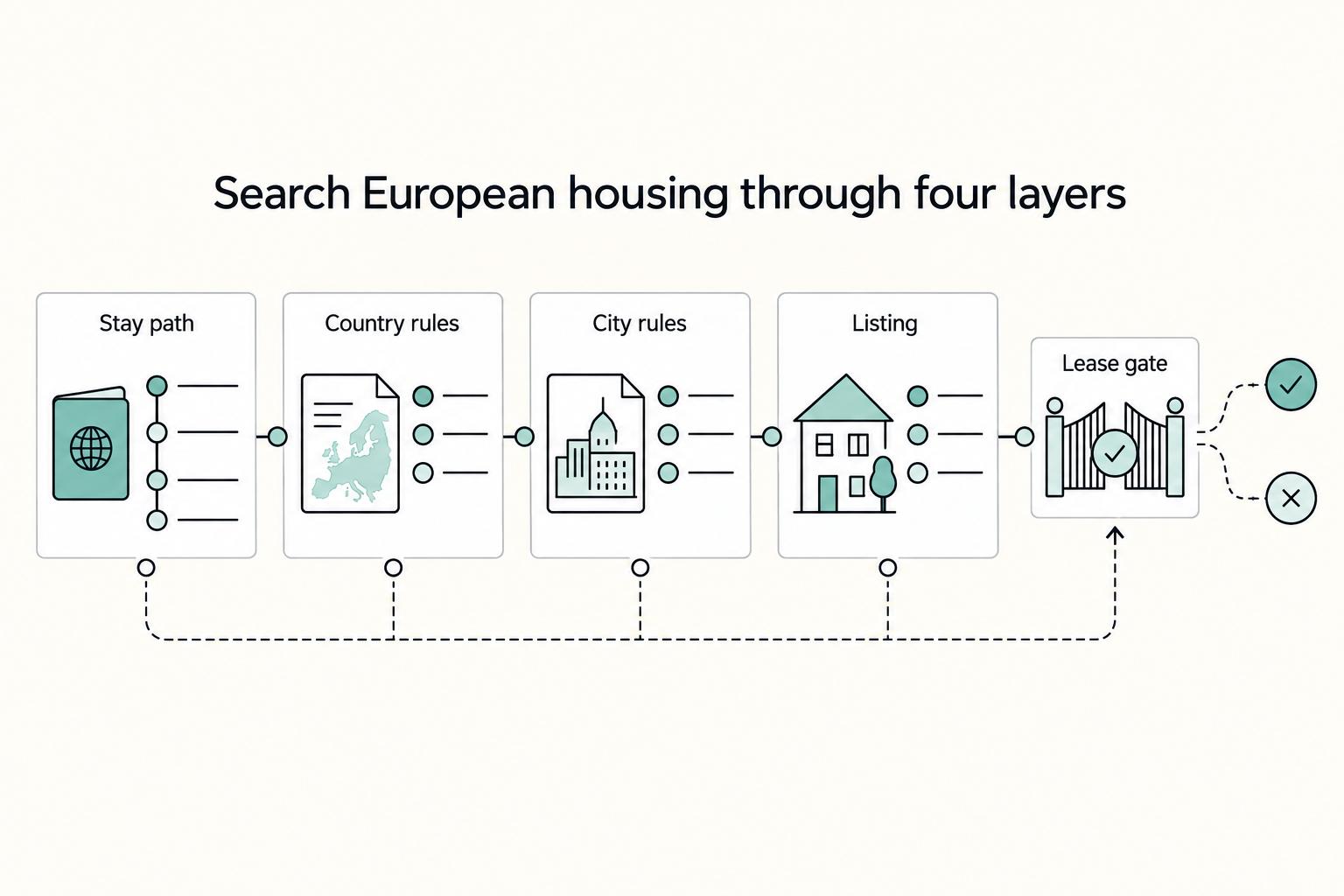
If you're **renting in Europe as a foreigner**, treat the move as a staged long-term housing plan, not a booking sprint. Your first decision is not which listing looks best. It is which city you're targeting, which legal stay track applies there, and when you'll be ready to sign without guessing.
Planning Your Move With the Malaysia Digital Nomad Visa (DE Rantau)
Treat this as a verification-first playbook, not a travel pitch. If you cannot confirm current rules from official Malaysian sources, the best move is to pause before planning anything else.