
Quick Answer
Yes: renting a condo in bangkok is manageable if you run it like an operations project. Start by preparing a Financial Dossier, then shortlist units using commute reality, connectivity reliability, and handover risk rather than listing photos. Before paying, finalize the written term sheet, early-exit language, and utility method. At move-in, lock in timestamped condition evidence and receipts, and confirm who files TM.30 and how you will retain proof.
Phase 1: Mission-Critical Scoping for Your Bangkok HQ#
Start by narrowing the decision before you book viewings. If you're renting a condo in Bangkok, the useful order is simple: define what matters, screen districts, validate building operations, then shortlist listings.
Your first filter should be operational, not aesthetic. If you work odd hours, the BTS schedule matters right away because the SkyTrain runs daily from 06.00 to 24.00 hrs. BTS currently reports 60 stations on 2 routes and 3 transfer points to the subway, but that still does not solve a 5:30 a.m. airport run or a midnight return from a coworking space. If your week includes early departures, late calls, or frequent meetings across town, score each area on commute friction, not just map distance.
| District | Supply signal | Commute-friction check | Flood and drainage check | What you should score yourself |
|---|---|---|---|---|
| Watthana | FazWaz snapshot shows 10,892 condo listings | Test unit to BTS/MRT, then ask how you get home after 24.00 | Check the BMA flood map for the street, station access, and last 500 meters | Noise at 8 a.m. and 8 p.m., building age, management responsiveness, grocery, gym, and cafe fit |
| Khlong Toei | FazWaz snapshot shows 7,790 condo listings | Compare rail access against your most common work trip, not tourist hotspots | Screen for nearby Flood Risk Points or Monitoring Points | Same scoring method, especially street noise and last-mile convenience |
| Your third option | Pull current listing count from DDProperty or FazWaz | Repeat the same route test | Repeat the same BMA map check | Use the same scoring so your shortlist stays comparable |
Do the flood check early because the Bangkok Metropolitan Administration publishes a public map built from the 2022 flood prevention plan and reports from all 50 district offices. You are not trying to prove an area is flood-proof. You are checking whether the condo, the soi, and the station route sit near BMA Flood Risk Points or Monitoring Points, because that can disrupt a normal workday long before the building itself has a problem.
Validate building operations before you fall for the unit#
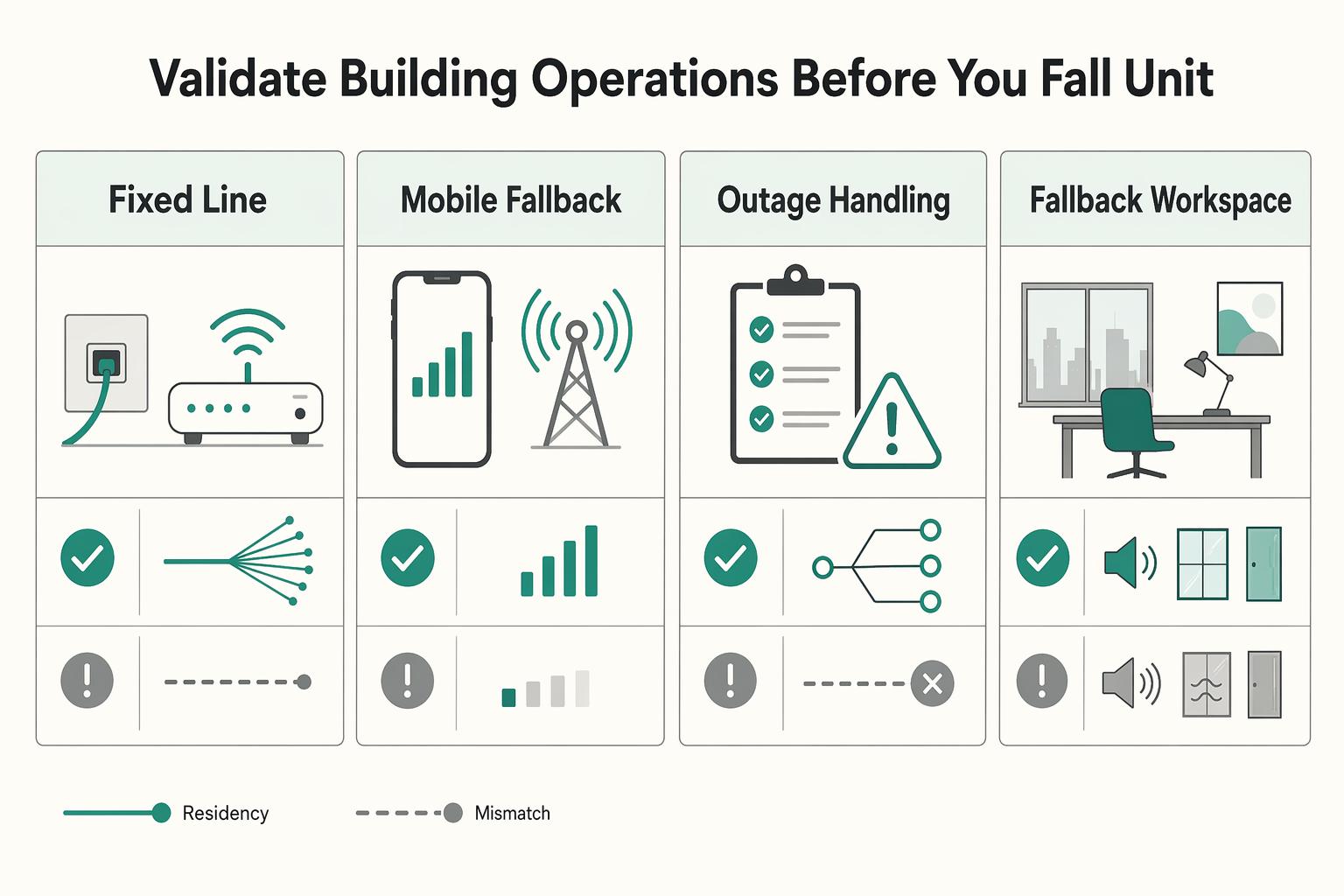
A good floor plan does not fix bad connectivity. Treat your digital infrastructure audit as a checklist you complete on site:
| Check area | What to verify |
|---|---|
| Fixed-line availability | Ask which fiber providers can install in that exact building and unit, then run the provider coverage check. Some ISPs, such as NT fiber2U, publish an explicit coverage-check step before signup. |
| Mobile fallback | Test your own carrier inside the unit, in the elevator lobby, and at the pool or coworking area. For a second check, compare with operator-submitted coverage data through GSMA maps. |
| Outage handling | Ask management what happens during internet or power failure, how residents are notified, and whether common areas keep power. |
| Fallback workspace | Identify one nearby place you can work from the same day. A Bangkok coworking day pass can start from THB 450 / seat / day and includes high-speed WiFi. |
A practical risk is a building marketed as fiber-ready that still has weak in-unit mobile signal and no clear answer from management on outages. Another risk is a unit with excellent internet but a noisy hallway, thin windows, or a building office that cannot answer basic operational questions. If management is vague before you sign, expect the same after move-in.
Build a real housing budget and use listings as market intel#
Once a building clears the operations check, price it like an ongoing commitment, not just a rent quote.
| Cost bucket | What it includes |
|---|---|
| Fixed costs | Monthly rent, internet if billed separately, parking if you need it, and any recurring services you choose to keep. |
| Variable costs | Electricity, water, transport, and occasional coworking days when your home setup fails. |
| Setup costs | Deposit and advance rent in the draft lease, moving, extra router or hotspot gear, basic housewares, and any temporary overlap with a hotel or serviced apartment. |
Before you start messaging agents, build the budget in those three buckets. Setup costs are where people usually under-budget: deposit and advance rent in the draft lease, moving, extra router or hotspot gear, basic housewares, and any temporary overlap with a hotel or serviced apartment.
Do not hard-code one universal deposit or advance-rent rule into your budget. Thailand's residential lease contract controls were updated in 2025, with one legal summary stating coverage for lessors with at least three residential units effective September 4, 2025, while older material cites five or more residences. Treat that as a live compliance question to verify during lease review, not a background assumption.
Use portals like DDProperty and FazWaz as market intelligence, not ground truth. DDProperty showed 42,199 Bangkok condo rentals in one snapshot, and listings often include the fields you need for like-for-like comparisons, such as distance to rail, built year, and posting freshness like "Listed on Apr 25, 2025."
Turn that data into a comparison sheet:
- Find the price band for the same building, same unit size, and similar furnishing level.
- Flag stale listings by posted or updated date.
- Compare only like-for-like stock using rail distance and built year.
- Prepare viewing questions from your sheet: why has this unit been available, what is included, and what is the outage plan?
That gives you a shortlist built on evidence, not listing photography.
You might also find this useful: A Guide to Renting an Apartment in Mumbai as a Foreigner.
Phase 2: Choose an Agent, Score Viewings, Then Negotiate Terms#
Once your shortlist is ready, run this in order: pick your agent, score viewings consistently, then negotiate the full term sheet before any transfer.
Pick the agent before the agent shapes your search#
Choose for reliability, not speed. A useful agent should show five things early:
- Clear fit with your target district and budget
- Predictable response time
- Transparent listing details (what is included, lease length, utilities, move-in timing)
- Straight handling of conflicts or mismatches
- Agreed communication norms (including LINE cadence and reply expectations)
Use one screening test for every agent: ask for three current listings in the same district and price band, then request inclusions, lease length, utility setup, and earliest move date. If answers are vague or inconsistent now, expect problems later around repairs, deposits, and handover.
Commission is a verify item, not something to assume. One Bangkok agency FAQ states the owner pays broker commission, but confirm this deal by deal.
Use this outreach template with agents or landlords:
- Profile: your role and how you earn income
- Move timing: your move window and target lease term (12 months is a common Bangkok residential term)
- Flexibility need: whether you require an early-exit/Diplomatic Clause for visa or international relocation changes
- Non-negotiables: quiet unit, stable internet, desk/work setup, rail access
- Readiness: confirm you can provide a financial dossier (ID, proof of funds, bank statements, client income evidence)
View units with one scorecard#
Keep one scorecard for every viewing so your shortlist stays comparable.
| What to score | What to verify on site | Red flag |
|---|---|---|
| Building operations | Fiber-provider availability, mobile signal in unit/common areas, outage handling, elevator/lobby condition | "Fiber-ready" with no provider confirmation |
| Workspace fit | Hallway/road/unit noise, desk layout, natural light, nearby backup workspace | Good photos but poor call quality or obvious noise |
| Cost realism | Electricity/water/internet billing method, internet price, parking, servicing responsibility | Vague billing answers |
| Handover risk | What "furnished" actually includes, appliance condition, mattress/curtains, inventory list | "Fully furnished" but essentials missing or worn |
Clarify utilities early because billing structure can materially change monthly cost. One Bangkok reference quotes condo electricity around 4 to 5 THB per unit, older apartment buildings up to 7 or 8 THB per unit, condo water around 18 to 20 THB per unit, and internet around 500 to 1,000 THB per month.
Negotiate the term sheet before you transfer anything#
Negotiate the full term sheet, not just the rent. Confirm whether a booking fee applies, how it is credited, and what happens if either party cancels. One agency describes the booking fee as a holding deposit (often around one month) credited toward advance rent, with tenant withdrawal potentially forfeiting that fee.
Also confirm the requested upfront package in writing. A common Bangkok structure is three months upfront: two months security deposit plus one month advance rent.
Before you transfer, lock these points in writing:
- Early-exit terms (including any Diplomatic Clause you need)
- Repair split (structural vs minor day-to-day upkeep)
- Utility billing method (electricity, water, internet)
- Furniture/appliance commitments
- Move-in handover standard and inventory check-in process
For deposit protection, require a signed inventory list plus timestamped photos or video at handover, not after.
For a step-by-step walkthrough, see Renting in Kuala Lumpur for Remote Professionals.
Phase 3: Fortifying Your Lease and Finances#
This is the point where you protect yourself: confirm you can prove payment ability, make sure the lease matches what was agreed, and only transfer funds once those terms are signed.
Thailand's 2025 residential lease notification can matter here, but only for covered lessors (at least 3 residential units), and it excludes hotels and dormitories. Available legal summaries conflict on whether the effective date is September 4 or 5, 2025. If your contract timing depends on that date, verify the Gazette text or get local advice. Even outside that scope, the same checkpoints below still reduce risk.
Build a clean financial dossier#
Keep this short and decision-ready so the landlord can quickly verify you.
| File item | What to include | Verify first |
|---|---|---|
| Identity file | Passport copy plus any visa/entry-status page requested. | Confirm required pages + whether signed copies are required. |
| Proof of funds | Recent bank statements or equivalent account evidence. | Confirm number of months + accepted statement window. |
| Income proof | Client contracts, employer letter, recent invoices, or similar records (with sensible redactions). | Confirm accepted format. |
| One-page renter summary | Your work, income source, planned move date, lease term, and occupants. | Keep this short and decision-ready so the landlord can quickly verify you. |
| Professional reference | Company website, portfolio, or LinkedIn (if relevant). | If relevant. |
Do not assume translation or notarization is required. Ask first, and if requested, get that requirement in writing.
Review the lease clause by clause#
Use the lease to convert verbal promises into clear, enforceable terms before signing.
| Clause | What you want in writing | Red flag |
|---|---|---|
| Maintenance scope | Clear split: landlord handles structural/plumbing/electrical/major-appliance issues; you handle minor day-to-day upkeep | "Tenant responsible for all repairs" or no scope detail |
| Deposit return conditions | Return timing, permitted deductions, and final utility true-up process | Vague deduction language with no process |
| Early termination language | Any break clause, notice period, and penalty spelled out | Verbal flexibility, but lease is silent |
| Subletting and guest rules | Explicit guest policy, replacement occupant rules, and subletting terms | No written rule when your plans may change |
| Inventory ownership | Attached inventory showing what stays with the unit and handover condition | Items shown during viewings missing from inventory |
| Dispute path | Notice method, escalation path, and named landlord-side signatory/contact | No formal notice address or named contact |
Key legal checks:
- Section 544: you cannot sublet or transfer rights unless the contract allows it.
- Section 538: a lease over 3 years is enforceable only for 3 years unless it is in writing and registered by the competent official.
- Section 540: immovable-property leases cannot exceed 30 years.
- For covered short-term residential leases (not more than 3 years), one 2025 legal update says deposit plus advance rent cannot exceed 3 months' rent.
Before you transfer funds and lock your deposit file#
Run this control list before any payment:
- Verify the payee: account name should match the lessor in the lease, or the lease should clearly authorize another recipient.
- Match payment milestones to signed terms: unit number, rent, deposit, advance rent, move-in date, and lease length must match the signed lease.
- Classify each payment in writing: receipt should show unit, amount, date, and purpose (deposit, advance rent, or other fee).
- Treat holding deposits as commitment money: market-practice examples describe this as often around one month's rent and potentially forfeitable if you cancel.
Then make the evidence trail operational. For covered leases, a jointly signed condition report (with optional photos) must be attached to and form part of the lease. Before move-in, record a full walk-through video, photograph existing damage, meter readings, keys, and appliance labels, then review inventory line by line with the landlord or agent. Have both sides sign and date each page, share the final file the same day (email or LINE), and store one handover folder with the lease, signed condition report, photos, videos, receipts, invoices, and repair messages. Reuse that same folder structure at move-out with matching photos/video angles to reduce deduction disputes.
If you want a deeper dive, read London, UK: A Guide for Expats and Remote Workers.
Beyond the Standard Condo: Is a Serviced Apartment Your Best Strategic Move?#
If your first weeks in Bangkok are still uncertain, start with a serviced apartment; if your routine is already stable, go straight to a condo. The decision is less about headline rent and more about how much flexibility, speed, and admin load you can handle right now.
Use this as a verification framework before you commit to either path:
| Decision area | Standard condo: verify | Serviced apartment: verify | Why it matters |
|---|---|---|---|
| Base rate | Quoted monthly rent and what is included in that quote | Quoted stay rate and any added charges in the booking terms | Prevents surprises between advertised and paid cost |
| Utilities | What is billed separately, billing cycle, and final settlement method | What is included vs separately billed, plus any limits in writing | Clarifies your real monthly outflow |
| Internet setup | Provider details, setup responsibility, and activation expectations | In-unit internet terms, upgrade options, and fallback plan | Protects work continuity |
| Deposits and prepayment | Amounts due at signing, refund conditions, and release process | Any security/incidentals hold and release conditions | Protects cash flow at move-in and move-out |
| Cleaning and maintenance | Who handles routine issues and how requests are logged | Housekeeping scope and maintenance contact process | Avoids service gaps after check-in |
| Contract flexibility | Minimum term, break terms, and notice requirements | Minimum stay, extension terms, and exit terms | Aligns housing with travel uncertainty |
| Handover and exit | Inventory, move-in condition record, and check-out process | Check-in/check-out condition standards and damage process | Reduces dispute risk |
What to confirm before you book#
Get these points in writing in the booking confirmation, house rules, or attached terms:
- what is included in your bill and what can be charged later
- how maintenance is handled, including after-hours reporting
- whether the unit supports your workday (desk setup, noise, and signal reliability)
- guest and overnight visitor rules, including any registration steps
- check-in/check-out condition standards and damage assessment method
Who this is best for vs who should go straight to a condo#
A serviced apartment first is usually the better fit if your dates may shift, you want to test neighborhoods, or you want a lower setup burden on arrival.
A condo first is usually the better fit if your work base is fixed, your target area is clear, and you are ready to manage lease paperwork, setup tasks, and full handover documentation immediately.
Use the initial stay as a soft-landing action plan: test your real commute time, check day/night building conditions, and validate the standards you care about before committing to a longer lease.
Related: A Guide to Renting an Apartment in Europe as a Foreigner.
Conclusion: Confirm the Lease, Handover, and Address Reporting in Writing#
If you have treated this rental as an operations decision, you should now know whether the deal is ready to sign. Proceed only when the lease, handover evidence, and address-reporting responsibility are clear in writing. Pause when anyone is vague about who files TM.30, because the legal duty sits with the host, usually the landlord or property manager, but the immigration problem lands on you.
What you should have in place is practical, not abstract: a clear lease file, documented handover evidence, and written admin checkpoints. The goal is to reduce avoidable approval friction up front and avoid preventable disputes later.
Before you move money or collect keys, run this final check:
- lease and supporting documents saved in one folder
- signed handover or condition evidence archived with timestamps
- payment method, receipts, and any building admin steps confirmed
- TM.30 ownership confirmed, with the host expected to file within 24 hours of your arrival
- plan to obtain and keep the TM.30 receipt slip
- first review point set for your next immigration or lease milestone
If any of those items is missing, slow down. If the contract is unclear, if repair responsibility is still fuzzy, or if no one will confirm TM.30 handling and proof, escalate before signing through the agent or an independent legal review. That matters even more on a DTV, because a missing TM.30 receipt can delay or block an extension, and some holders end up making border runs they did not plan.
If your next admin question is tax and residence planning, continue with Digital Nomad Tax Residency in Thailand for 2026.
For a second market example, see A Guide to Renting an Apartment in Berlin.
Try a related tool
Researched and edited by the Gruv editorial team. Gruv builds cross-border billing, payouts, and finance-operations software for global businesses.
Sources
Includes 4 external sources outside the trusted-domain allowlist.
- 2021-2025.state.gov/wp-content/uploads/2021/08/ACPD_2020Report_F...trusted
- oecd.org/content/dam/oecd/en/publications/reports/201...trusted
- ohrm.au.edu/images/service/VisaWorkPermit/TM30/TM30.pdftrusted
- pfeiffer.edu/wp-content/uploads/2024/08/2024-25-UG-Catalo...trusted
- bgloballaw.com/2026/01/18/ocpb-introduces-new-regulations-o...external
- bts.co.th/eng/faq/faq-howto.htmlexternal
- commonground.work/th-en/day-passexternal
- cpudgiportal.bangkok.go.th/portal/apps/experiencebuilder/experienceexternal
Educational content only. Not legal, tax, or financial advice.
Related Posts

London, UK: A Guide for Expats and Remote Workers
Get two calls right early and the rest of the move gets easier: how you'll be in the UK, and where you'll work when conditions are less than ideal. Make those decisions before you lock dates or prepay a long stay. If you book first and sort the basics later, admin and work reliability usually collide in your first week.
Renting in Europe as a Foreigner on a 90-Day Timeline
If you're **renting in Europe as a foreigner**, treat the move as a staged long-term housing plan, not a booking sprint. Your first decision is not which listing looks best. It is which city you're targeting, which legal stay track applies there, and when you'll be ready to sign without guessing.
Digital Nomad Tax Residency in Thailand for 2026
Low-stress compliance in Thailand comes from early decisions and clean records, not last-minute cleanup. Most costly problems start as small assumptions about visas, day counts, and money movement that stack up over time.