
Quick Answer
Start by choosing between a DBA path and a legal entity name change, because that decision controls every downstream update in rebranding an existing business. Then execute updates in dependency order, verify each system before moving on, and keep client communications explicit about what is changing versus what remains the same. A controlled rollout protects contract continuity, reduces payment friction, and keeps trust intact while your public brand evolves.
Treat a rebrand as an operating-risk decision first#
If you are rebranding an existing business, treat it as an operating-risk decision first and a creative project second. A name or identity change can affect three things at once: your legal identity, cash flow, and the trust signals clients use to decide whether you still look stable.
Use that lens for this guide. A rebrand is not just a visual update. It often reflects a shift in identity, mission, or strategy, which is exactly why it creates operational exposure. Your first decision is not logo, color, or tagline. It is whether you are changing only the market-facing name or changing the legal entity name itself. A DBA, or Doing Business As, can allow an LLC to operate under a different name without forming a separate entity. If you go beyond that, the work becomes dependency-sensitive because banks, licenses, and related records may need to line up.
| Mindset | Main decision | Likely failure point | What to verify before launch |
|---|---|---|---|
| Creative-only rebrand | Start with visuals and public announcement | Clients get mixed signals, search visibility slips, and payment or admin records do not match | Website, Google Business Profile, customer scripts, invoices, and account names all reflect the same intended brand |
| Risk-managed rebrand | Decide first between DBA and legal entity change | Rollout stalls because downstream updates need matching documents | Your DBA or entity-change paperwork, licenses, bank records, and marketing materials are ready and consistent across providers |
The main red flag is a split identity: one name on contracts or banking, another on your site, profiles, and client emails. That is where retention, SEO, and payment handling problems can start. Before you launch, assemble a basic evidence pack: filed name documents, updated license details where relevant, revised invoice templates, and client-facing scripts for anyone answering emails or calls.
The rest of this guide walks through the decision criteria, an update plan that accounts for dependencies, rollout controls, and client communication guardrails so your brand identity can change without creating avoidable business risk.
You might also find this useful: How to Create a Brand Style Guide for a Client.
Is a Rebrand a Smart Move or a Costly Mistake?#
A rebrand is a smart move only when you can show a verified business upside and a downside you can absorb. If you cannot show both, delay and fix the gaps first.
Before you decide, run a structured current-state audit of your visual identity, messaging, website, customer feedback, and competitive market. Then separate a full rebrand from a lighter reposition: if the issue is mostly messaging or visual consistency, a full reset may be unnecessary.
Run four pass/fail tests#
1) Business Case Scorecard Write one sentence that names the verified business reason for the change. Include only inputs checked against source records: target market shift, service mix change, rate-impact assumption, and capability proof already in place. Pass: The reason ties to a real business change, for example mission, offering, or operating model. Fail: The reason is mostly aesthetics, fatigue, or hope that visuals alone will fix demand.
| Test | What to assess | Pass | Fail |
|---|---|---|---|
| Business Case Scorecard | Verified business reason for the change | Reason ties to a real business change | Reason is mostly aesthetics, fatigue, or hope that visuals alone will fix demand |
| Revenue Risk Ledger | Clients, channels, and buying moments you cannot afford to disrupt | Every material risk has an owner and a response plan | Known risks exist, but ownership or mitigation is unclear |
| Non-Billable Hours Budget | Research, approvals, website updates, client communication, and visual updates across live channels | You can absorb the effort without harming delivery or cash flow | The rollout pulls too much capacity from paid work |
| Brand Equity Audit | Recognition, distinctive assets, search history, referral language, and trust cues tied to your current name | You have a clear plan to preserve or transfer those signals | You are likely to remove the cues buyers use to recognize and trust you |
2) Revenue Risk Ledger Map the clients, channels, and buying moments you cannot afford to disrupt. Assign each risk a trigger, downside, confidence level, and owner.
| Decision path | Trigger | Downside risk | Confidence level | Mitigation owner |
|---|---|---|---|---|
| Proceed now | Audit confirms a real business shift and dependencies are known | Limited confusion and manageable rollout load | High (assumptions checked) | Named owner for client communication, channel updates, and admin coordination |
| Delay | Business case is weak or key unknowns remain | Confusion, payment friction, momentum loss, search history and recognition risk | Low (assumptions still unverified) | Owner missing or approval gaps remain |
| Do a lighter reposition | Offer or messaging evolved, but current recognition still works | Lower disruption if you keep distinctive assets and continuity cues | Medium (needs validation) | You or delegated marketing owner |
Pass: Every material risk has an owner and a response plan. Fail: Known risks exist, but ownership or mitigation is unclear.
3) Non-Billable Hours Budget List the work across research, approvals, website updates, client communication, and visual updates across live channels: digital, print, apparel, signage, and other active touchpoints. Verify each budget input from current project, finance, legal, trademark, vendor, or source records before use: internal hours, current billable-rate impact, external design cost, relevant legal or trademark cost, and rollout mode. Pass: You can absorb the effort without harming delivery or cash flow. Fail: The rollout pulls too much capacity from paid work.
4) Brand Equity Audit Check what you could lose: recognition, mental availability in buying moments, distinctive assets, search history, referral language, and trust cues tied to your current name. Pass: You have a clear plan to preserve or transfer those signals. Fail: You are likely to remove the cues buyers use to recognize and trust you.
When these four tests produce a clear outcome, you can choose confidently: proceed now, delay, or do a lighter reposition. Then move to the next decision: are you changing only the market-facing brand, or the legal entity underneath it?
If you want a deeper dive, read Digital Nomad Health Insurance: A Comparison of Top Providers.
The Critical Decision: Rebrand Your Marketing or Your Legal Entity?#
Make this choice first: are you changing your public identity, or the legal name attached to your entity records? A marketing-layer rebrand keeps your legal entity name in place. A legal-name change moves the name tied to official records and can affect how records match across contracts, tax records, bank profiles, payment processors, licensing files, and invoices.
Classify your situation before you act#
If your goal is clearer positioning, messaging, or visual identity, you are typically deciding at the marketing layer. Rebranding is broader than a logo change, but that still does not automatically require changing your legal entity name.
If the legal name on formal records no longer reflects how you operate, treat this as a legal-name decision. The test is practical: does keeping the current legal name create avoidable friction in the records and verification checks you already use?
Check how your business appears in real documents before you choose. A public licensing example shows this format: "Diesel, Inc. dba Gia Ristorante Italiano." Use that as a format cue, not legal authority, to verify whether your own records support a separate operating name.
Compare the three paths#
| Path | When to choose it | What stays unchanged | Required update burden | Primary failure mode if you choose wrong |
|---|---|---|---|---|
| Marketing-layer rebrand only | Your offer or positioning has changed, but you have no verified reason to change the entity name on official records | Your legal entity name remains on records where required | Lower overall burden, but you still need name-use checks across invoices, contracts, disclosures, licenses, and payment profiles | Public name and record name drift apart and create confusion in invoicing, signoff, or verification |
| Legal-name change | You have a documented reason to change the entity's official name | Scope and services may stay the same, but name-linked records still need alignment | Higher burden because multiple record sets and counterparties may need updates | You change the legal name without coordinated record updates and create mismatches across tax, banking, processor, licensing, and client documents |
| Pause and verify | You cannot clearly map impacted records, or your setup spans multiple jurisdictions or channels | Everything for now | Short delay, lower risk than guessing | You rely on assumptions, old guidance, or nonbinding materials and create rework |
The core checkpoint is record consistency. Pull one current example of each live document type: a client contract, recent invoice, bank profile, payment processor profile, tax registration record, and any active license or permit. If the proposed name creates unresolved questions in several of these, treat it as an operations and compliance decision, not a simple brand refresh.
Do not treat nonfinal documents as binding authority. The Uxbridge packet is useful because it shows legal-name-plus-DBA formatting and references licenses tied to the operating name, but it explicitly says it is not legally binding. The Forbes piece is useful for strategy context, but it was published on Apr 12, 2022, so verify current legal and operational details before acting.
Use this checklist to force a real outcome#
- Proceed with marketing-layer rebrand if this is primarily a public identity shift and you can confirm where the legal name must still appear.
- Proceed with legal-name change if you have a documented reason to change the entity name and a complete map of affected records.
- Pause and verify with a qualified advisor if impact is unclear across contracts, tax records, banking, processors, licensing, or invoicing.
If you choose the legal-name path, execution depends on strict update sequencing in the Compliance Cascade. We covered related planning detail in How to Join a Mastermind Group for Your Freelance Business.
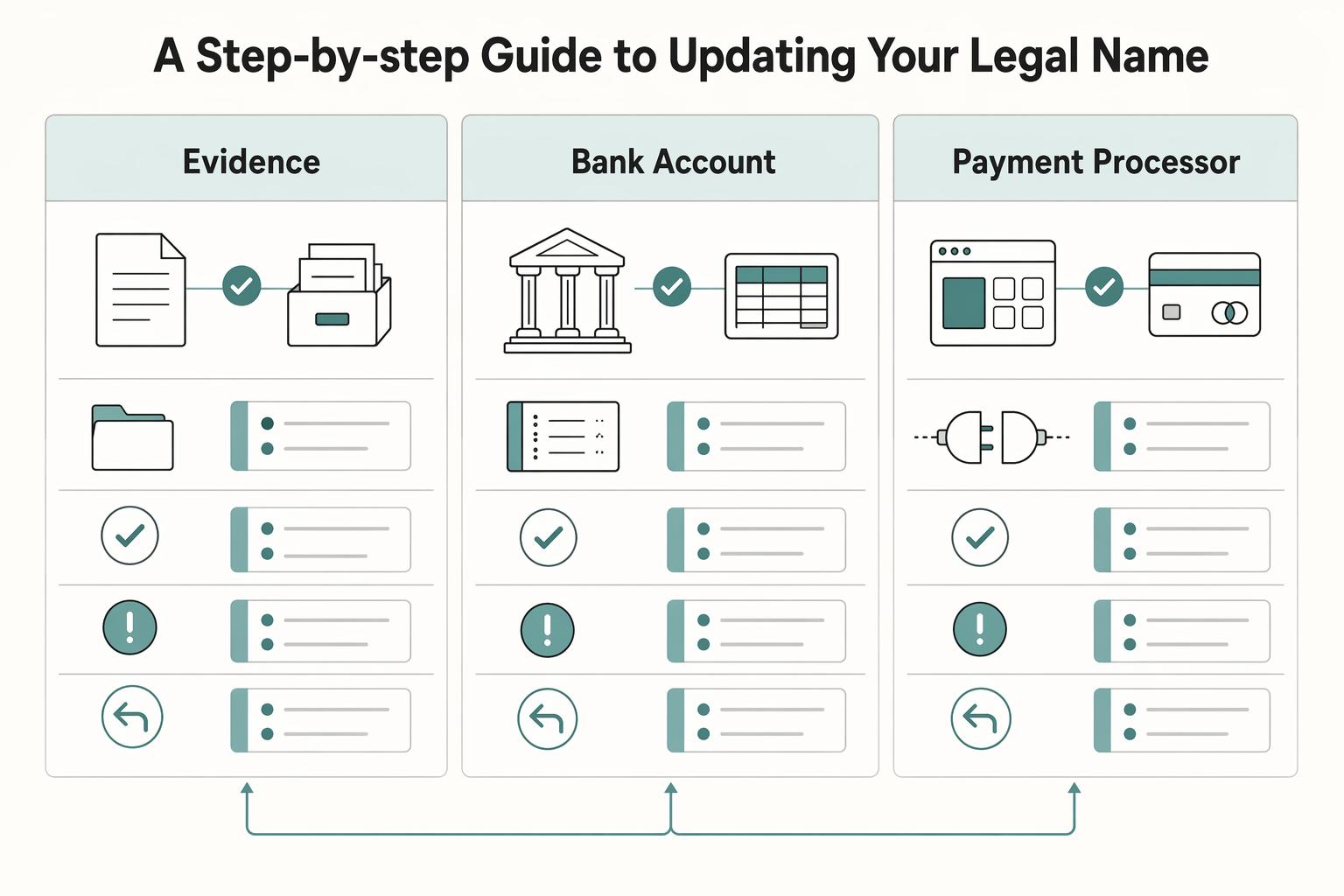
The Compliance Cascade: A Step-by-Step Guide to Updating Your Legal Name#
If you chose a legal-name change, treat this as a record-alignment runbook. Your goal is simple: make sure the same legal name appears across the systems other parties use to verify your business.
Use this sequence as an execution framework, then confirm local requirements for your setup: complete one step, capture confirmation, and do not start the next step until the prior record is verified.
- Update your state registration record first.
Input: your current state registration details and the required state update path. Output: formal confirmation that the state record shows the new legal name. Dependency gate: stop here until that confirmation is saved in your evidence folder.
- Update your federal tax record next.
Input: state confirmation plus your current federal tax record details. Output: confirmation that the federal record reflects the same legal name, or written confirmation of the accepted update path. Dependency gate: do not move to bank updates until this is verified.
- Update your bank account legal name after that.
Input: state and federal confirmations plus current business account details. Output: bank profile and account records aligned to the new legal name. Dependency gate: do not change downstream payment setup until bank records are confirmed.
- Update payment processor legal profiles, then review licenses and permits where applicable.
Input: verified bank legal name and current processor or license records. Output: processor legal profiles aligned to bank records, and license or permit records reviewed and updated or documented as required. Dependency gate: finish this alignment before public rollout.
| Step | Owner | What to verify | Common mismatch | Recovery action |
|---|---|---|---|---|
| State registration record | You or filing agent | Official state record shows the new legal name | Brand-facing name changed, state record still old | Pause downstream updates; wait for official confirmation |
| Federal tax record | You or tax advisor | Federal record matches the state-approved legal name | State updated, federal record still old | Re-submit or clarify the accepted path before bank outreach |
| Bank account legal name | You and bank representative | Account legal name and profile match confirmed records | Bank profile still old while state or federal are updated | Provide confirmations; request exact missing proof |
| Payment processor + licenses or permits | You, platform support, issuing authority | Processor legal profile matches bank record; license or permit records reviewed | Processor, payout, or permit records do not align | Revert to verified details where possible and escalate with your evidence pack |
If a step is rejected, pending, or put on hold, stop downstream changes. Confirm what name is currently on record, save your proof trail, and ask the next institution what interim evidence it will accept. Verify the current turnaround expectation from the relevant institution or official record before relying on it. If a bank or payout platform places a hold, escalate that issue first, then resume sequencing.
Once legal-name alignment is complete, move to operational rollout and client-facing continuity updates. This pairs well with our guide on How to Use AI for Market Research in Your Freelance Business.
Keep every brand touchpoint consistent through the rollout#
After your legal records are aligned, the next operational risk is inconsistency. If your website, profiles, documents, and client steps are updated at different times or in different ways, clients can see mixed signals and lose confidence.
Audit every live touchpoint#
Run this as a coordinated implementation project, not a design-only task. Build one tracker that covers every place your brand appears, then execute updates in sequence so dependent systems are not missed.
| System category | Dependency | Update action | Verification step |
|---|---|---|---|
| Website and domain | Domain control, CMS or hosting access, approved brand copy | Update visible brand elements and on-site messaging; apply redirects where needed | Check key pages and key links from a public browser view |
| Email and sender identity | Mail admin access, domain authentication access, approved signature block | Update sender display details, signatures, and branded footer language | Send external test emails and confirm sender display and reply path |
| Social and directory profiles | Handle availability, admin permissions, approved profile text or assets | Update display name, profile text, image assets, and destination links | Confirm public-facing profiles show the same identity and links resolve correctly |
| Sales and client documents | Final templates and approved messaging | Refresh proposal, deck, and client-facing document branding | Export a fresh file and confirm branding, contact details, and naming are consistent |
| Billing and client operations | Account-owner access and final display details | Update invoice or client-ops branding and client-facing labels | Create a test workflow and confirm brand consistency across the full path |
Keep before-and-after records while you roll out so you can quickly identify and correct any mismatch.
Secure assets before you say anything publicly#
Use a clear rollout sequence: reserve your domain and relevant handles, align naming conventions, then lock access and permissions before public mention. This reduces avoidable conflicts during launch.
Set naming rules early across usernames, sender names, file names, profile text, and invoice headers. Small inconsistencies across steps can create the same confusion risk as a larger fragmented rollout.
Prepare the kit, then run pre-launch QA and fallback planning#
Build a practical "Brand-in-a-Box" so updates are repeatable: logo variants, profile or avatar files, core visual references, approved short and long brand descriptions, and the templates you actively use across site updates, proposals, invoicing, social profiles, and client communications.
Before launch, run a full QA pass across your actual client paths, including redirects, sender identity, forms, and payment flows where applicable. Assign one rollback owner, keep prior assets accessible, and document the monitoring window after verifying it against source records.
Launch readiness is only complete when these operational updates are coordinated with your messaging and account-contact updates in client communications.
For a step-by-step walkthrough, see Color Psychology in Branding for Premium Positioning.
How to Announce Your Rebrand and Keep Every High-Value Client#
Announce your rebrand in a way that removes confusion: brief key clients privately, publish a clear public message, then complete finance and contact handoffs so work and payments keep moving.
A rebrand changes how clients interpret your business, not just how it looks. If your explanation is unclear, people can misread the change and lose confidence. Treat this as a planned transition, not a one-post launch.
Start with high-impact client outreach, then broaden#
Reach out directly to your most important clients before your public announcement. Internally, align anyone client-facing on the same story, timing, and language so clients do not hear mixed messages.
| Outreach format | When to use | Retention risk | Preparation needed |
|---|---|---|---|
| Personal call | Strategic or sensitive accounts, large retainers, procurement-heavy relationships | Risk rises if the client first hears through public channels | Brief script, launch timing, clear summary of what changes, clear summary of billing or contact impact |
| Tailored email | Mid-tier active clients, warm past clients, contacts who need a written record | Risk rises when the message feels generic or incomplete | Personalized opener, practical client benefit, updated contact details, short FAQ |
| Mass announcement | Newsletter audiences, social followers, low-touch contacts | Risk rises if used as first notice for priority accounts | One clear narrative, live links, consistent naming across channels |
If legal or billing details are involved, use only wording you have already verified.
Give one clear message clients can act on#
Keep each message short and practical. Cover these points every time:
| Message element | Details |
|---|---|
| Why you made the change | In client terms |
| What is changing | Name, website, email, visual identity, launch timing |
| What is staying the same | Service continuity, contacts, delivery standards, and only the legal continuity you can confirm |
| What action you need | Update records, route invoices correctly, whitelist a new sender, notify procurement |
Before sending, test clarity: ask someone outside the project to read it and say what changed and what the client needs to do.
Complete the finance and procurement handoff#
Prevent payment delays with explicit transition details. During the transition period, use clear dual-name labeling where appropriate, for example New Brand (formerly Old Brand), on invoices and payment-related communications.
Send finance and procurement contacts a short update with the exact fields to review: business display name, billing email, website, sender domain, and remittance details if changed. Then ask for a quick confirmation that vendor records and invoice-routing details are updated before the next invoice.
Consistency here is what protects trust during the rollout.
Related: How to Manage Your Personal Brand as a Freelancer.
Measure the rebrand by operational continuity#
Measure this rebrand by operational continuity, not by how exciting the new look feels. If clients can still pay you, records stay aligned, and delivery remains steady, the change is working.
You do not need to re-decide DBA versus legal entity change in this final step. You do need to verify that the route you already chose is fully reflected across live systems and documentation, and that your planned compliance updates are complete.
Confirm these four items before you close the project#
| Closeout area | What to verify |
|---|---|
| Legal and compliance updates | Registry, tax, contract, and vendor records reflect the name format tied to your chosen path |
| Client communication completion | Your notice log shows who was informed, when they were informed, and whether confirmation was required |
| Payment continuity | Send a real test invoice and verify the displayed business name, payment link, remittance details, and payout destination |
| Brand-asset consistency | Website, proposals, email signatures, invoice templates, social bios, and document headers match the approved brand identity |
If late uncertainty starts driving last-minute edits, pause and fix source files first. Constant changes are how brand expression becomes confusing, and rushed decisions usually reduce long-term value.
How you know it worked#
| Outcome area | What to verify |
|---|---|
| Client continuity | Active clients stayed informed and billing continued without unusual questions or delays |
| Admin accuracy | Legal, tax, bank, vendor, and template records match approved name usage |
| Delivery continuity | No missed deadlines, access issues, or service confusion during rollout |
Treat this as an operating standard, not a one-time launch. Keep one controlled documentation pack, assign clear ownership for updates, and review core assets on a schedule so your brand, records, and delivery stay aligned as the business evolves.
Need the full breakdown? Read A freelance IT consultant's guide to 'Business Interruption' insurance.
Frequently Asked Questions
How do you change your brand without changing your legal business name?
Start by scoping the brand problem first. If the issue is positioning or customer experience, a refresh or expansion can often address it without jumping to a complete rebuild. Legal naming mechanics are jurisdiction-specific, so confirm local requirements before launch. Operationally, keep naming consistent across customer touchpoints to reduce confusion during the transition.
When should you consider changing the legal entity name instead?
Use qualified local legal and tax guidance for that decision. For brand planning, decide scope first and avoid treating every naming issue as a complete rebrand. | Choice | Best fit | Effort | What changes | Client-facing changes | Risk if scoped poorly | |---|---|---|---|---|---| | Refresh rebrand | Parts of the brand feel dated | Lower | Selected brand elements | Targeted updates | Time and money spent without fixing root issues | | Expand rebrand | Core still works, but key pieces are missing | Medium | Existing core plus missing elements | Noticeable improvement without full reset | Inconsistent experience if additions are not integrated | | Complete rebrand | Current brand is no longer fit for purpose | Highest | Full brand rebuild | Major external change | High execution risk, cost, and time burden |
How do you know whether you need a refresh, an expand rebrand, or a complete rebrand?
Use a fit-for-purpose test with two parts: does the brand work across real customer interactions, and does it still align with your strategy. If parts feel dated, it is usually a refresh. If the core works but key pieces are missing, it is an expansion. If the current brand is no longer fit for purpose, it is a complete rebrand, and discovery should include customer and internal interviews rather than guesswork.
What is a realistic budget for rebranding an existing business?
Budget from scope and discovery, not one default number. Refresh, expansion, and complete rebrand paths carry different cost, time, and execution demands. Rebranding can be expensive, painful, and risky, and a poorly scoped effort can waste significant time and money, including several thousand dollars in failed work.
What should you do with active contracts and existing clients?
Use one clear communication pack across channels: old name, new name, effective date, what is changing, what is not, and any action needed. Keep a record of who was notified and when, then apply the same message consistently. If legal obligations may apply, verify locally rather than assuming one universal rule.
Should you rebrand or open a new business entity?
From a brand perspective, rebrand when the core business is still fit for purpose but positioning or customer experience needs work. If the business itself is changing beyond brand, evaluate broader structural options separately with qualified advisors.
Try a related tool
Researched and edited by the Gruv editorial team. Gruv builds cross-border billing, payouts, and finance-operations software for global businesses.
Sources
Includes 1 external source outside the trusted-domain allowlist.
- courts.delaware.gov/Opinions/Download.aspxtrusted
- jessup.edu/wp-content/uploads/2024/05/2024-2025-Catalog...trusted
- jolt.law.harvard.edu/assets/articlePDFs/v24/24HarvJLTech1.pdftrusted
- media.sos.nh.gov/govcouncil/2025/0604/025%20GC%20Agenda%20060...trusted
- omb.ri.gov/sites/g/files/xkgbur751/files/2026-01/FY%202...trusted
- scholarworks.waldenu.edu/cgi/viewcontent.cgitrusted
- uxbridge-ma.gov/sites/g/files/vyhlif3971/f/events/sb_packet_...trusted
- aashtoware.org/wp-content/uploads/2025/01/SG_Notebook_01012...external
Educational content only. Not legal, tax, or financial advice.
Related Posts

Digital Nomad Health Insurance Comparison for Long-Stay Moves
Use focused time now to avoid expensive mistakes later. Start with a practical `digital nomad health insurance comparison`, then map your route in [Gruv's visa planner](/tools/visa-for-digital-nomads) so we anchor policy checks to your real plan before pricing pages pull you off course.

How to Manage Your Personal Brand as a Freelancer
Your brand is not a mood board. Think of it as the experience people have of your work: the promise you make, the proof you can show, and the way you present yourself across client touchpoints. Get that clear first, and your fit is easier to read from profile to proposal.
How to Create a Brand Style Guide for a Client
If you work alone, your guide does not need to be a full brand book. It should work as a control document. Standardize the few choices that keep coming up so your proposals, reports, invoices, decks, and delegated work look and sound like they come from the same business.