
Quick Answer
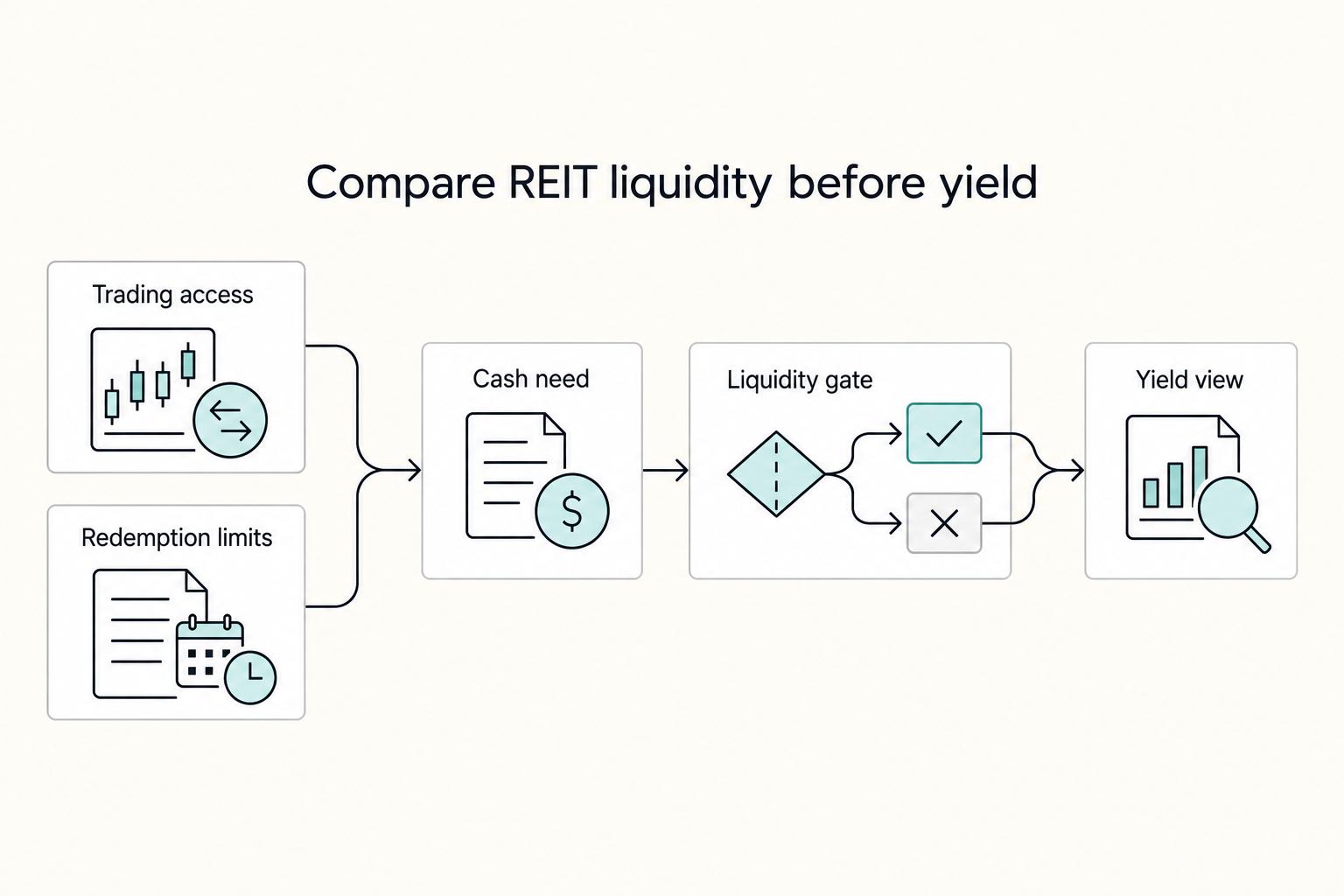
Yes - use REITs only after a cash-access test. Keep money for taxes, bills, and delayed invoices out of the allocation, then prefer options that trade daily on a stock exchange when you might need funds quickly. A trust distributing at least 90% of taxable income can still be a bad fit if you cannot explain how you exit or how dividends will be taxed in your account.
REITs Can Strengthen Income if Liquidity Comes First#
Use REITs only if they add income and diversification without putting near-term cash access at risk. This guide is for freelancers and small teams with uneven cashflow. It is not a list of top picks.
A Real Estate Investment Trust (REIT) is a company that owns, operates, or finances income-producing real estate. In practice, that gives you real estate exposure without buying or managing property directly. The cashflow path is simple: investors fund the REIT, the REIT owns or finances properties, those assets generate income, and part of that income is paid out as dividends.
Why REITs appeal, and where people get careless#
The appeal is straightforward. REITs can provide property-linked income and broaden your investment mix. That matters when direct ownership is capital-intensive, management-heavy, and hard to unwind.
The common mistake is assuming every REIT is just as easy to exit. Some have stock-like liquidity, but that is not true across all structures. If you may need cash on short notice, exitability matters more than headline yield.
The decision rule for uneven cashflow#
Treat a REIT allocation as acceptable only after you separate true surplus cash from operating cash. If funds may be needed for taxes, contractor invoices, core bills, or your emergency buffer, they are not investment cash yet. Before buying, do a short stress check in writing:
- your upcoming tax obligations
- fixed business expenses due soon
- whether a delayed client payment would force you to sell investments or borrow
This helps catch a common failure mode: trying to build passive income while increasing short-term cash pressure. A REIT can support income planning, but it should not create a new cash-access problem.
What this guide will focus on#
The rest of this guide stays on four decision factors: structure, risk, liquidity, and tax treatment. It does not chase recent winners or make return forecasts.
One structural point matters early. REIT qualification is commonly described as requiring distribution of at least 90% of taxable income as dividends. That helps explain why REITs are often framed as income vehicles, but it does not make them automatically predictable or suitable for your situation.
Use this rule as you read. If you cannot clearly explain how the REIT makes money, how you can get money back out, and how distributions may affect your tax picture, pause. REITs can strengthen income planning and diversification, but only when liquidity comes first.
Start With the REIT Terms You Cannot Mix Up#
Start with two checks: how the REIT is accessed, and whether your exposure is to property operations or financing. If you skip that, you can end up comparing the wrong risks.
Core REIT labels#
A Real Estate Investment Trust (REIT) generally owns and operates real estate assets or provides financing for real-estate-related assets. One structure checkpoint is legal formation: the entity must be a corporation, trust, or association.
A publicly traded REIT is the clearest category here. It is accessible through a stock exchange and is described as having high liquidity and transparency.
Public and private REIT categories are confirmed, but a supported definition for public non-listed REIT (PNLR) or mechanics for non-traded REITs is not provided here. Treat those labels as items to verify, not assumptions.
Equity REIT versus mortgage REIT#
An equity REIT owns and operates real-estate-related assets. A mortgage REIT (mREIT) generally provides financing to real estate owners and operators or holds mezzanine debt.
That is the practical split. Equity REITs are tied to property operations, while mREITs are tied to financing exposure. If you cannot explain which side you are buying, pause before allocating.
Direct shares versus pooled access#
The confirmed access path here is direct shares of a publicly traded REIT through a stock exchange. If a product is presented as pooled access, verify what it actually holds before you treat it as equivalent to owning one publicly traded REIT directly.
Related: How to Invest in Real Estate as a Digital Nomad.
Compare REIT Vehicles by Liquidity Before You Compare Yield#
Once you know the label, compare liquidity before yield. If you might need cash on short notice, exchange-traded exposure belongs in a different category from limited-liquidity structures.
| Vehicle | Liquidity | Price visibility | Access | Likely fit for short-notice cash needs |
|---|---|---|---|---|
| Publicly traded REIT | Highest liquidity in this set; shares can trade daily on a stock exchange. | Strong visibility: market prices are visible, and public REITs file regular disclosures with the SEC. | Bought and sold through the stock market. | Often a practical fit when cash needs can change quickly. |
| Public non-listed REIT (PNLR) | Verify before investing. This does not establish exchange trading, redemption timing, or liquidity mechanics for PNLRs. | Verify. Do not assume public-style daily pricing from the label alone. | Access depends on the specific product structure. | Consider only after you confirm exactly how exits work. |
| Non-traded REIT | Verify before investing. This does not provide supported exit timing or redemption mechanics for non-traded REITs. | Verify how value is set and disclosed. | Check the actual offering terms rather than assuming stock-like access. | Potentially a weak fit when you may need fast access to funds and the exit path is unclear. |
| Private REIT | Lower liquidity than exchange-traded options; shares are not publicly traded on stock exchanges, and exits may be restricted. | No exchange-based daily pricing; verify what reporting is provided. | Not bought and sold through exchange listing. | Usually a poor fit if you cannot tolerate restricted exits or possible redemption fees before a specified period. |
Decision rule before yield#
Use this question first: If you needed part of this money next week, how would you exit? If the answer is unclear, delayed, or approval-based, treat that vehicle as unsuitable for near-term cash needs.
The tradeoff to keep in view#
Less daily price movement is not the same as lower risk. Public REITs can move with broader stock market trends, but you still get visible pricing, regular SEC disclosure, and a daily trading path.
Practical check before you commit#
Confirm listing status first. If something is described as public, verify whether it is actually listed on a national stock exchange. Then read the exit terms as closely as you would a client contract. If payout language is clear but exit language is vague, treat that as a warning sign.
Pick Equity REIT or Mortgage REIT Based on Risk You Can Tolerate#
Do not treat equity REITs and mortgage REITs as interchangeable. They share the REIT label, but their income engines and risk drivers are different.
Know what drives returns#
An equity REIT owns and operates income-producing real estate, so outcomes are tied mainly to rental income and property value changes. A mortgage REIT (mREIT) invests in mortgage-backed securities and loans, so outcomes are tied to interest income and financing conditions.
REITs are required to distribute at least 90% of taxable income, which can make payouts look attractive. But payout size alone does not tell you whether the underlying risk is property-operations risk or rate-sensitive financing risk.
Use a risk-first choice rule#
If interest-rate sensitivity would strain your cashflow plan, be cautious with mREIT exposure. The real decision is not finding a perfect split. It is avoiding exposure you may not be able to hold through rate pressure.
Before buying, write one sentence answering: "How does this trust make money?" If you cannot clearly answer rent from properties or interest from mortgage assets, pause and dig deeper.
Diversify by driver, not ticker count#
Do not treat "REIT" as one bucket. Several REIT tickers can still leave you concentrated if they rely on the same property sector or the same financing backdrop.
Diversify across:
- Property type within equity REITs, since sectors have different characteristics and risks
- Structure (equity REIT vs mREIT), so you are not relying on one underlying risk driver
Where beginners overreach#
A common mistake is chasing a high distribution without understanding what has to go right for that payout to hold up. In practice, that often means underestimating sector concentration or rate sensitivity.
If materials make income easy to see but the underlying driver hard to identify, treat that as incomplete diligence. Before you buy, confirm the income source, the main risk driver, and how rising rates could affect the position.
Apply a Cashflow Gate Before Any REIT Buy#
Buy a REIT only with cash you can leave invested, not money you may need soon. If cash may be needed for a near-term obligation, waiting is usually the safer decision.
| Checkpoint | What to confirm | Article note |
|---|---|---|
| Near-term obligations | Keep soon-needed cash separate from the investment pool | If cash may be needed for a near-term obligation, waiting is usually the safer decision |
| Liquidity path | Confirm what you receive in the structure: cash vs. Operating Partnership Units (OPUs) or REIT shares | For REIT-related structures, verify the liquidity path before you commit |
| Cash-conversion trigger | Identify what event actually creates spendable cash | In a 721 UPREIT, the flow is not automatically "property in, cash out" |
| Tax timing | Identify what event triggers tax and when that liability may arrive | Tax can be deferred until shares are sold or the partnership sells the underlying property |
A REIT is an investment decision, not a cash-management substitute. Before each buy, run a short check to separate investable surplus from near-term liquidity needs:
- Near-term obligations: keep soon-needed cash separate from the investment pool.
- Liquidity path: confirm what you receive in the structure (cash vs. Operating Partnership Units (OPUs) or REIT shares).
- Cash-conversion trigger: identify what event actually creates spendable cash.
- Tax timing: identify what event triggers tax and when that liability may arrive.
If reserves still feel tight after this check, consider pausing new buys. The point is not a universal threshold. It is a repeatable discipline that keeps return-seeking from overruling liquidity reality.
That matters even more when the structure itself can delay cash access. For REIT-related structures, verify the liquidity path before you commit. In a 721 UPREIT (named for Section 721), the flow is not automatically "property in, cash out." You may receive OPUs or REIT shares instead of immediate cash, and tax can be deferred until shares are sold or the partnership sells the underlying property. One documented misconception is assuming immediate cash access in this structure. Confirm in writing what you receive, what creates cash, and what event triggers tax.
Run a 10-Minute REIT Screen With an Evidence Checklist#
After the cashflow gate, keep the screen simple. Proceed only when the filing lets you verify structure, valuation method, and liquidity path in writing. If any of those stay unclear, it is a no-go for now.
Start with the issuer filing, not the marketing page. An SEC filing such as Form S-11 or an offering circular is where you can confirm what the company says about REIT status, pricing, management structure, and stated risk language.
| Screen result | REIT structure | Listing status | Liquidity path | Valuation visibility | Concentration risk | Tax treatment notes |
|---|---|---|---|---|---|---|
| Documented | Filing clearly states REIT status or intent, and names are consistent across documents | Status is stated plainly and consistently across filing, broker view, and investor materials | Written path to cash is identifiable | Price source is explicit, for example a stated transaction price or NAV-based method with update dates | Property, sector, geography, or sponsor concentration is clear enough to explain exposure | Tax discussion is documented in the filing, including limits or qualifiers |
| Needs follow-up | "REIT" appears in marketing, but filing support is incomplete | Status is implied rather than stated | Exit language is vague or buried | Share value is shown, but method is unclear | Focus area is mentioned, but exposure is hard to assess | Tax language sounds favorable but is not clearly tied to filing text |
| No-go for now | Structure is unclear or inconsistent | You still cannot tell where or whether it trades | You cannot explain how cash access would work if needed | Price looks arbitrary or share-value disclosure is unreliable | Operational detail is too thin to judge what drives outcomes | Tax treatment is suggested, not documented |
What to verify first in the filing:
- Pricing method: in the SEC offering circular used here, the initial $10.00 per Share is described as "arbitrarily determined by our Manager." The per-share purchase price is then adjusted quarterly on January 1st, April 1st, July 1st and October 1st using a stated NAV per Share process.
- Manager or sponsor structure: the same filing states the REIT is externally managed by an entity that is also its sponsor. Record that clearly before you decide.
- Subscription terms: the cited minimum is 500 Shares, or $5,000. That directly affects how much capital is tied to one position.
Use educational sources only to decode terms and sanity-check language against the filing. If educational sources and issuer marketing feel clearer than the filing itself, defer to the filing and pause.
Red flags that should slow you down:
- unclear share-value disclosure, where you cannot tell what the displayed price actually represents
- unclear exit mechanics, where you cannot explain what event creates liquidity
- marketing-heavy material (including partner co-authored pieces) with weak operational detail
Put the filing risk section in your notes too. In the example used here, the issuer calls the investment "speculative and involves substantial risks" and says investors should buy only if they can "afford a complete loss of your investment."
Go/no-go check: Can you explain how this REIT makes money, how you exit, and what happens if you need cash quickly?
Understand Dividends and Tax Drag Before You Count Income#
Before you count REIT yield as usable income, treat it as pre-tax income until your actual tax treatment is clear. The cash distributed and the cash you keep are often not the same.
REITs are built to distribute income rather than freely reinvest profits, and those payouts can come from underlying property rents. But do not assume every REIT-related distribution gets the same treatment as qualified stock dividends. Some can be non-qualified dividends taxed at ordinary income rates.
The practical point is simple: headline yield is not take-home yield. A higher posted yield can still leave you with less spendable cash after tax reporting is finalized.
What to verify before you count the cash#
Start with brokerage tax reporting, not issuer marketing. Use your annual tax documents to confirm how distributions were actually classified.
| Check | What to review | Article note |
|---|---|---|
| Distribution classification | Use annual tax documents to confirm how distributions were actually classified | Some can be non-qualified dividends taxed at ordinary income rates |
| Reporting lag | Check whether tax reporting arrived on a lag, for example documents issued in 2023 for 2022 investments | Planning should follow tax-year timing and not only cash receipt timing |
| Withholding details | Check whether withholding or other tax-reporting details in your statements could change usable cashflow | Cross-border setups can add withholding complexity |
Check these first:
- how last year's REIT dividend income was classified in your taxable account
- whether tax reporting arrived on a lag, for example documents issued in 2023 for 2022 investments, so your planning follows tax-year timing and not only cash receipt timing
- whether withholding or other tax-reporting details in your statements could change usable cashflow
If you do not have a full year of holdings yet, mark projected tax impact as provisional so you do not overstate passive income.
Build tax drag into the same cadence as your cashflow plan#
If distributions are quarterly, review expected tax impact quarterly too, not only at year-end. Keep REIT distributions in the same rhythm as client receipts, estimated taxes, and known expense spikes. A practical tracker is enough:
- gross distributions received
- estimated after-tax amount available to spend or reinvest
Cross-border setups can add withholding complexity. Confirm local rules before acting, then update your estimate when brokerage tax documents or withholding details change.
You might also find this useful: Tax Implications for a UK Resident Owning a US LLC.
Avoid the Mistakes That Make REIT Income Unreliable#
REIT income becomes unreliable when avoidable decision errors creep in. Common problems are chasing promotional lists, picking the wrong structure for your risk profile, and treating yield as safety.
Treat "best-performing" or "high-yield" lists as idea sources, not buy signals. If a headline uses aggressive upside framing, for example "could explode higher," or includes sponsor or affiliate disclosures, separate promotion from analysis and verify method, timeframe, and suitability before acting.
Do not treat every REIT structure as interchangeable when income reliability matters. Equity REITs typically own and operate income-producing real estate, while mortgage REITs provide financing and tend to be more leveraged than equity REITs.
High dividend yield is not a low-risk signal by itself. Most REITs specialize in a single property type, so one holding can leave you concentrated in one commercial real estate segment.
Keep your first allocation rule simple. Start with one clear lane, learn its behavior, and use a basic qualification check before relying on income. Does the issuer still meet core REIT requirements, including real-estate-linked assets or income, the 75% asset test, and the 90% annual taxable-income distribution requirement?
Put REITs in the Right Account Type for Your Situation#
Where you hold a REIT can matter as much as what you buy, especially if distributions are affecting your current-year taxes. If tax drag is showing up in your annual plan, check tax-advantaged placement first, then confirm you are not giving up access you may need.
A qualifying REIT must distribute at least 90% of taxable income each year, and many distribute at least 100%, so account location is a practical cashflow decision, not just an administrative detail.
| Account type | Liquidity access | Tax impact | Operational simplicity |
|---|---|---|---|
| Taxable account | Typically the most direct access through a brokerage account. | Distributions may affect current-year taxes. | Straightforward to use, but you handle tax and reporting complexity directly. |
| IRA | REIT exposure is available through IRA accounts. | Traditional IRA: contributions are deducted now and taxed at withdrawal. Roth IRA: contributions are taxed now and qualified withdrawals are tax-free later. | Can be simple for long-term holding. |
| 401(k) | Access depends on plan rules and menu options. | Can provide tax-advantaged placement, depending on plan design. | Operationally convenient when offered, but not all 401(k) plans allow REIT investing. |
| Pension plan | REIT exposure may exist inside defined benefit, defined contribution, TSP, or other pension plans. | Tax treatment follows the plan framework. | Simple for participants when included. |
Decision rule#
If REIT distributions are materially affecting your current-year taxes, prioritize IRA or workplace-plan placement where available before adding more in taxable accounts. Then verify availability instead of assuming it. Not every 401(k) offers REIT options.
Tax and reporting complexity#
REITs can involve added tax and reporting complexity versus some other investments.
Use a simple pre-buy checklist. Confirm your account terms, plan documentation, and expected year-end tax documents. If any of that is unclear, get tax advice before you build your cashflow plan around the income.
Use a Monthly REIT Maintenance Checklist to Stay in Control#
A practical cadence is a light monthly check plus a deeper quarterly review to track REIT income, allocation, liquidity, and tax drag against your cash plan.
| Cadence | Review item | What to check |
|---|---|---|
| Monthly | Dividend receipt | Whether the expected dividend arrived and matches your statement or distribution notice |
| Monthly | Allocation | Whether your allocation is still close to your target |
| Monthly | Near-term cash needs | Whether near-term cash obligations have changed enough to affect new investing decisions |
| Quarterly | Structure mix | Confirm your split between property ownership REITs and mortgage REITs still matches your risk tolerance |
| Quarterly | Liquidity exposure | Reassess liquidity risk, especially for positions that could be harder to exit quickly |
| Quarterly | Tax planning | Review dividend income for tax planning, since REIT dividends are generally taxed as regular income |
Each month, check:
- whether the expected dividend arrived and matches your statement or distribution notice
- whether your allocation is still close to your target
- whether near-term cash obligations have changed enough to affect new investing decisions
If a dividend is missing, lower than expected, or posted on a different schedule, treat it as a verification task. Check account activity, issuer or fund notices, and your notes before treating that cash flow as reliable.
Each quarter, review your REIT mix and liquidity exposure:
- confirm your split between property ownership REITs and mortgage REITs still matches your risk tolerance
- reassess liquidity risk, especially for positions that could be harder to exit quickly
- review dividend income for tax planning, since REIT dividends are generally taxed as regular income
Set pause rules before stress hits. If your cash position weakens or obligations rise unexpectedly, pause new buys until your operating cash picture stabilizes.
Keep a simple investment log so decisions stay consistent:
- buy date and position size
- buy rationale
- target role or allocation
- exit rule, including what would make you stop adding
The Main Takeaway for Freelancers and Small Teams#
Use REITs only if they fit your risk and liquidity plan: screen cash access and tax impact before yield. They can support income and diversification, but outcomes vary and should be weighed against your broader portfolio goals.
Prioritize an operating process over headline payout. Confirm what you are buying from issuer or broker materials, write down the vehicle and listing status, and skip anything you cannot clearly explain. A simpler holding you understand can be easier to manage than a higher-yield option that adds timing stress.
Treat diversification as risk control, not ticker count. Broader exposure can help, but more holdings are not automatically better; diversification guidance also warns against holding too many options. The same goes for yield. Some REIT choices may offer less volatility instead of the highest dividend yield, and short-term REIT behavior can be sensitive to interest-rate moves.
Handle tax review with the same discipline. In the U.S. context, REITs are covered in Title 26, Part 1 (Income Taxes), and the eCFR page labels its text authoritative but unofficial, up to date as of 3/19/2026. Do not treat distributions as fully spendable until you confirm their treatment in your account and jurisdiction.
Before each buy, keep a short evidence note with:
- vehicle type and listing status
- how it makes money and what would hurt it most
- where you verified tax notes or reporting language
- how the purchase fits your risk and liquidity plan
Reuse that screen every time so your investing supports, rather than strains, your get-paid system.
Frequently Asked Questions
What is a REIT in one sentence?
A REIT is a way to invest in income-producing real estate without buying properties directly. In general, the structure is designed to hold income-generating real estate and distribute most of its income to shareholders.
How can I invest in REITs without buying property directly?
You can buy shares of a publicly traded REIT through a FINRA-registered broker, or use a mutual fund or ETF that holds REITs. If easy cash access matters, exchange-traded options generally offer more straightforward liquidity than non-listed structures.
What are the main REIT types I need to know before investing?
The two core operating types are equity REITs and mortgage REITs. Equity REITs earn mainly from property ownership and rent, while mREITs invest in mortgages or mortgage-backed securities tied to real estate. Structure also matters: publicly traded REITs trade on exchanges, while public non-listed and private REIT shares do not.
Are REITs liquid when I need cash quickly?
Liquidity depends on the structure. Publicly traded REITs are generally the most straightforward to sell because they trade on exchanges. Public non-listed REITs may have liquidity options like share repurchase programs or secondary transactions, but liquidity is generally limited.
How are REIT dividends taxed in practice?
REIT distributions can be allocated to ordinary income, capital gains, and return of capital, and each component may be taxed at a different rate. Check your brokerage tax reporting before treating the payout as fully spendable.
Which risks matter most for freelancers with uneven monthly income?
For uneven cash flow, liquidity risk is often the first check because access to cash can matter more than headline payout levels. After that, compare structure risk across REIT types. If your cash needs are uneven, prioritize structures with clearer liquidity.
Try a related tool
Researched and edited by the Gruv editorial team. Gruv builds cross-border billing, payouts, and finance-operations software for global businesses.
Sources
- assembly.ny.gov/Reports/WAM/2026_economic_revenue/2026_repor...trusted
- ecfr.gov/current/title-26/chapter-I/subchapter-A/part...trusted
- grants-neubauercollegium.uchicago.edu/book/browse/Documents/real_estate_investing_...trusted
- irlaw.umkc.edu/cgi/viewcontent.cgitrusted
- occ.gov/publications-and-resources/publications/comp...trusted
- patreasury.gov/pdf/procurement/RFI25-001-Investment-Adviser...trusted
- sec.gov/Archives/edgar/data/1759214/0001104659210140...trusted
- sec.gov/files/reits.pdftrusted
Educational content only. Not legal, tax, or financial advice.
Related Posts

Japan Digital Nomad Visa 2026: Six-Month Planning Runbook
Treat this as your operating model: identify the right mission first, commit to one route, and keep dated records before you make irreversible plans. That is what keeps the rest of your timeline, paperwork, and decisions coherent.
How to Invest in Real Estate as a Digital Nomad
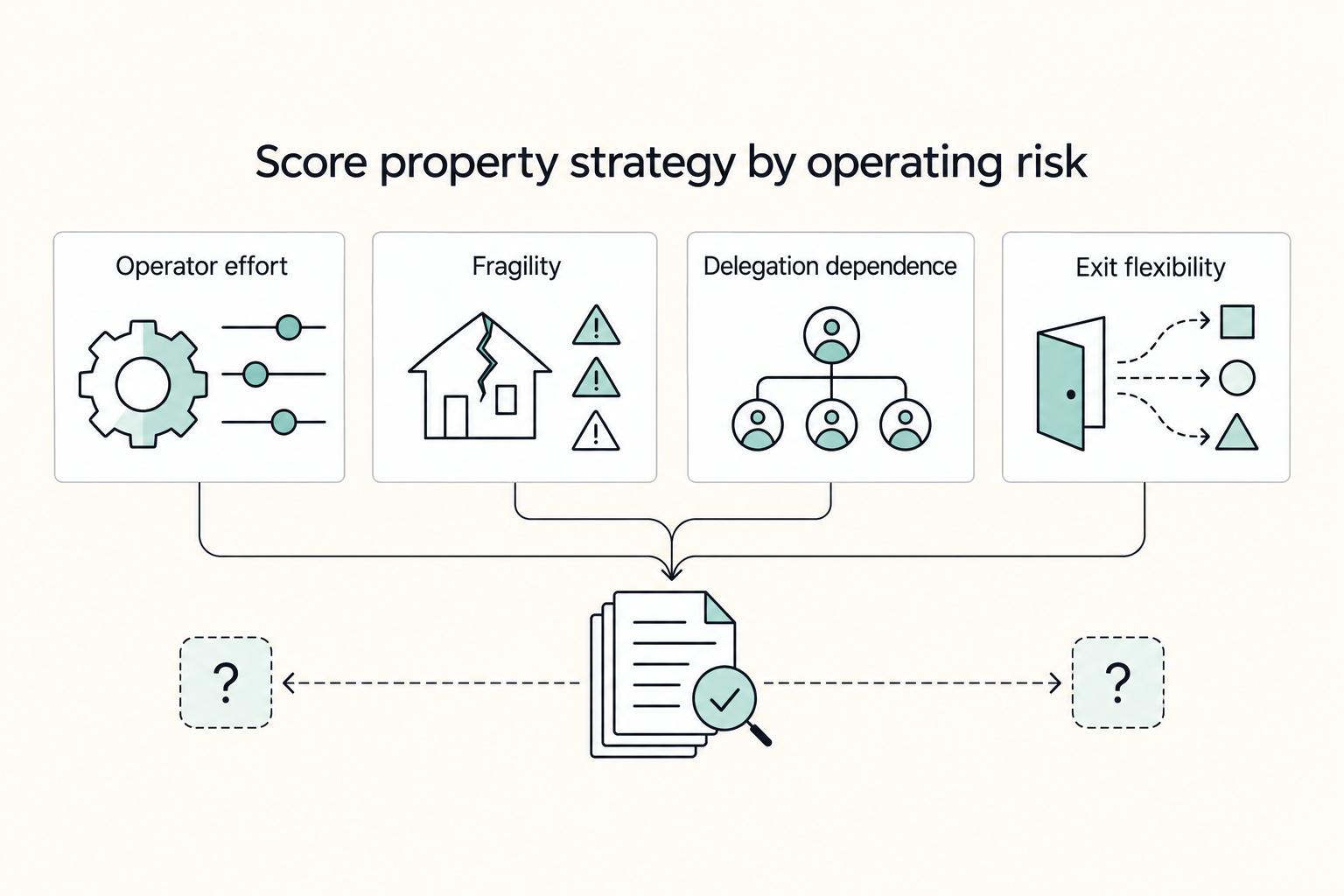
**Run anything with money and moving parts like an operations system (cash, docs, delegation, and controls), not a "passive income" vibe.** Real life stress-tests weak spots. You change time zones, a client pays late, and something breaks at the worst moment. As the CEO of a business-of-one, your job is to build a setup that keeps working when you are not available on demand.

Tax Implications for a UK Resident Owning a US LLC
When people search **uk resident owning us llc tax**, they often start with the wrong question. You do not win by chasing a clever position. You win by running a compliant system that can handle the way the US and UK classify LLC income differently, with records you can defend.